

Korea Car Accident Settlement for Foreigners:
Insurance, Hospital Bills and Compensation
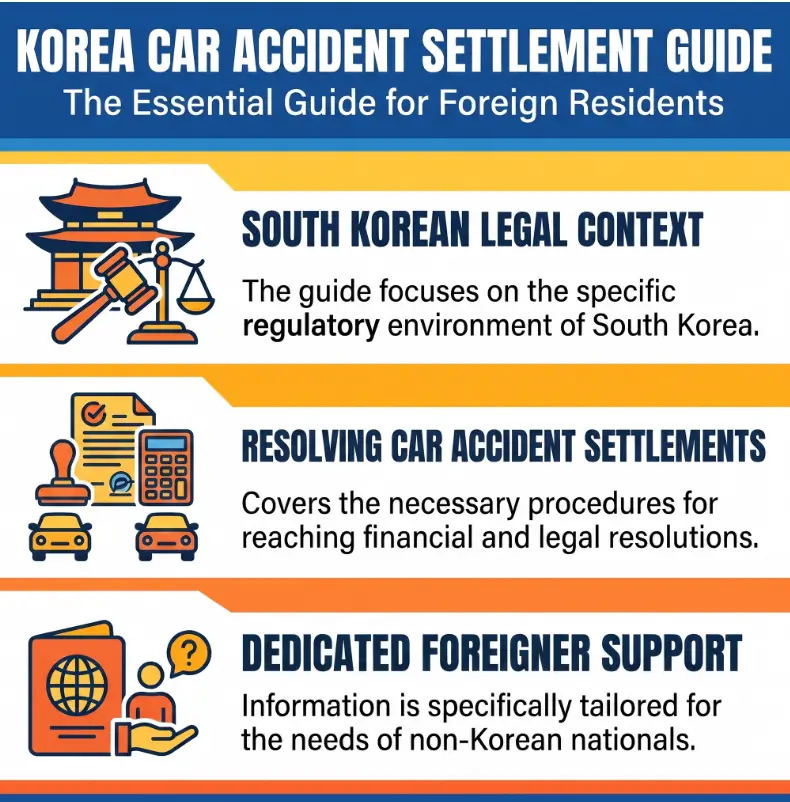
A car accident in South Korea can become confusing long before the injuries become serious. The hospital may ask for an insurance claim number, one insurer may be discussing fault while another person is asking about settlement, and a foreign visitor may already have a flight home booked.
The useful distinction is this: medical treatment, insurance payment, fault allocation and final settlement are connected, but they are not the same decision. A Korean motor insurer may pay qualifying hospital charges directly while the final compensation amount remains unresolved.
For foreigners, the difficult part is often not nationality itself. It is proving income earned in another country, dealing with a Korean insurer from abroad, understanding what a Korean settlement document actually releases, and preserving enough medical evidence before leaving Korea.
Check whether the auto insurer has issued a payment guarantee before paying significant treatment costs yourself.
Treatment costs, lost income, pain-related compensation and disability issues are assessed separately.
Do not confuse an early offer with a deadline to finish the entire injury claim.
The goal is not to hold out for the largest imaginable number. It is to avoid closing the claim before you understand what remains unpaid.
Snapshot
Who this is for: foreigners injured in a road accident in South Korea as a driver, passenger, cyclist or pedestrian.
What matters first: document the accident, obtain appropriate medical care, identify the liability insurer or transport mutual-aid association, and confirm how hospital charges are being handled.
Before settling: understand your diagnosis, treatment status, fault position, unpaid expenses, lost-income evidence and any future treatment or disability issue that has not yet been resolved.
Before You Act
This guide explains the general Korean motor-insurance and compensation framework. It cannot determine your personal fault percentage, medical prognosis, disability rating or settlement value. Serious injury, disputed causation, permanent symptoms, major income loss, a criminal investigation or pressure to sign a broad release are situations where individualized advice from the insurer, an appropriate professional or a Korean attorney may be sensible.
The First 24 Hours Matter More Than the Settlement Offer
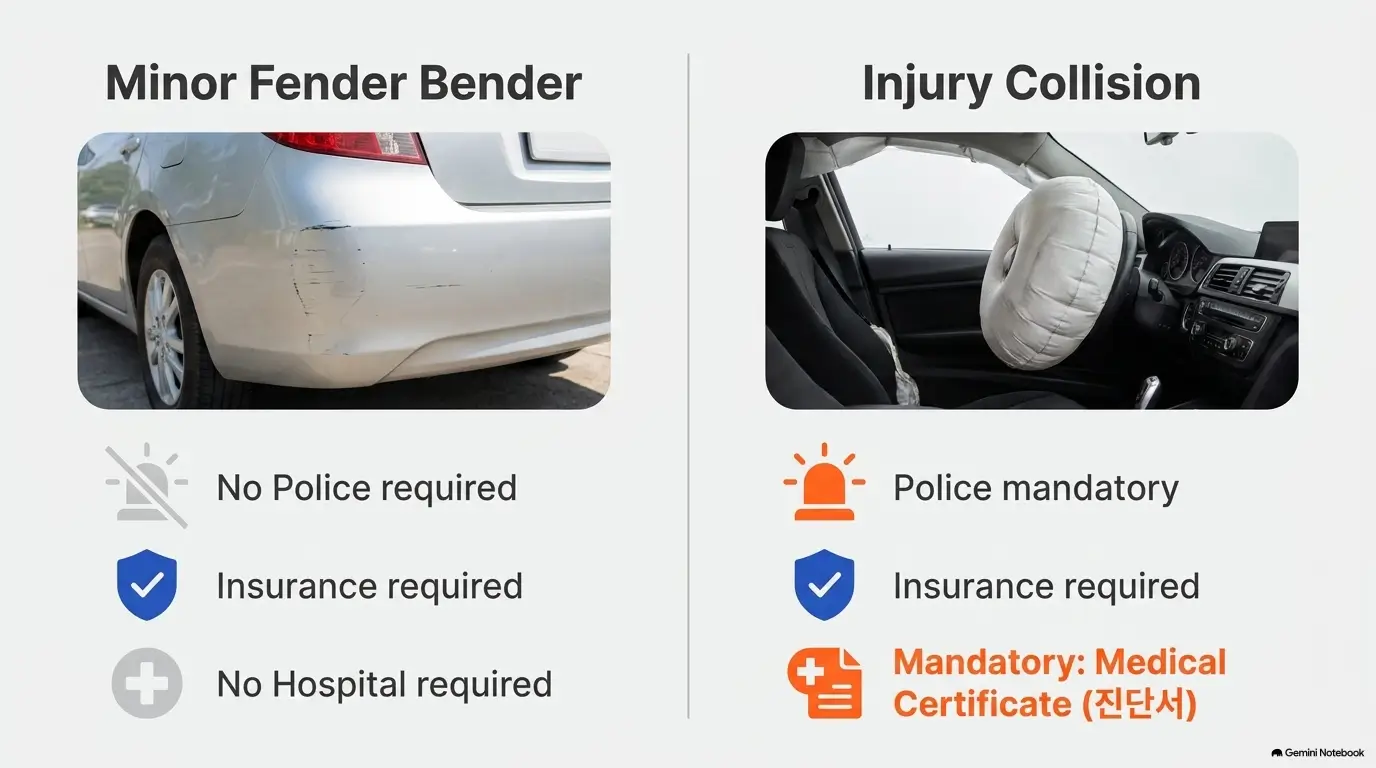
Immediately after an accident, your priority is safety, medical care and evidence. Settlement can wait. Evidence often cannot.
Under Korea’s Road Traffic Act, a driver involved in an accident must stop, take necessary measures for injured people and provide identifying information to the victim. Accidents involving injury should not be treated as a private exchange of phone numbers followed by everyone disappearing.
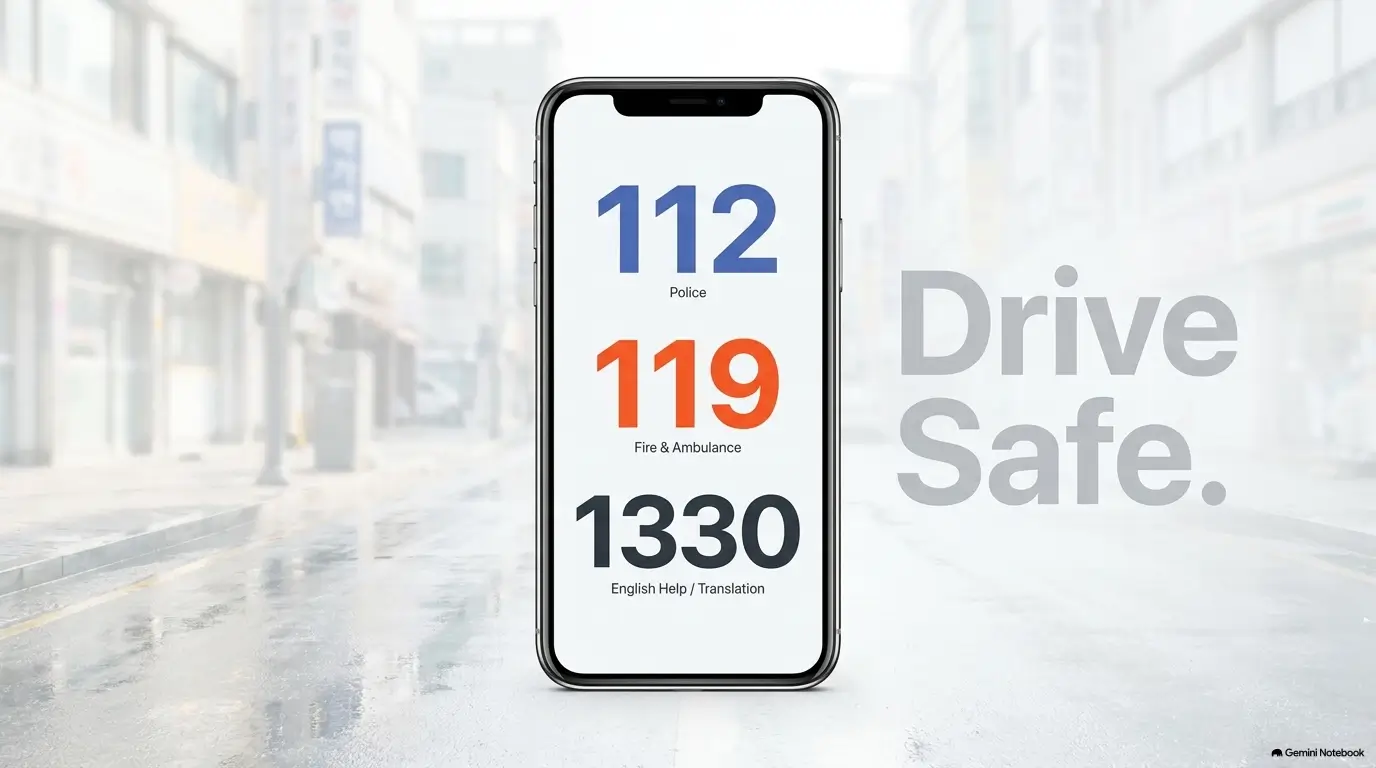
- Call 119 for an ambulance or emergency medical response when needed.
- Call 112 when police attendance is appropriate, particularly where someone is injured, fault is disputed, a driver may leave, alcohol is suspected or identification is uncertain.
- Photograph the vehicle positions, road markings, traffic signals, damage, surrounding cameras and visible injuries if safe to do so.
- Preserve dashcam or black-box footage before it is overwritten.
- Exchange the driver’s name, telephone number, registration information and insurer details.
- Record the insurance claim number once the accident has been reported.
- Seek medical attention when symptoms justify it, even when adrenaline initially makes the injury feel minor.
If you are the injured foreigner rather than the driver, do not assume somebody else has preserved the evidence. Ask for the police reference, insurer name and accident claim number yourself.
The claim sequence
Stop, assist, call 112/119 if needed
Photos, video, witnesses, dashcam
Insurer, claim number, adjuster
Diagnosis, treatment, records, receipts
Only after unresolved losses are mapped
That order matters. Settlement belongs at the end of the information chain, not at the beginning.
How Korean Auto Insurance Actually Pays an Injury Claim
Korea requires vehicle owners to carry compulsory motor liability coverage, and many vehicles also carry broader liability protection. An injured third party can generally make a direct claim against the relevant motor insurer rather than waiting for the driver to reimburse every expense personally.
This is one reason Korean accident handling can feel different from paying a medical bill first and seeking reimbursement months later. Once the insurer accepts the treatment for motor-insurance handling and notifies the medical institution, qualifying medical charges can normally be billed through the automobile-insurance system.
| Issue | Who usually handles it | What you should obtain |
|---|---|---|
| Police investigation | Police | Accident information and, when applicable, official accident documentation |
| Medical treatment | Hospital or clinic | Diagnosis, records, prescriptions and receipts |
| Bodily-injury insurance | Liability insurer or relevant mutual-aid association | Claim number, adjuster contact and payment-guarantee status |
| Vehicle/property damage | Property-damage adjuster | Repair estimate, photographs and payment decision |
| Final personal-injury settlement | You and the insurer, or representatives if used | Written calculation and release wording |
Do not assume that the person discussing your damaged car is also handling your bodily-injury claim. Korean insurers commonly separate property damage and personal injury into different files or handlers.
Another useful Korean mechanism is the statutory provisional payment system, or gabulgeum (가불금). When payment is delayed by a dispute over liability or the final amount, the Motor Vehicle Accident Compensation Security Act provides a route for an injured person to request advance payment in qualifying cases. The framework provides for automobile-insurance medical fees and, for certain other benefits, a portion of the loss within statutory compulsory-insurance limits. Ask the insurer specifically whether a provisional-payment claim is available rather than assuming nothing can be paid until final settlement.
Key decision
Separate three questions when speaking to the insurer: Who is at fault? Which treatment costs are currently guaranteed? What compensation remains for final settlement? One answer does not automatically resolve the other two.
Hospital Bills: Ask About the Payment Guarantee Before Paying Yourself
If the liability insurer has accepted automobile-insurance handling, it can notify the treating medical institution that it will pay automobile-insurance medical fees up to the notified scope. In everyday Korean practice this is often described as a payment guarantee (지급보증).
That small administrative detail can determine whether you leave the hospital with a receipt or with a surprisingly large bill.
Before paying, ask these four questions
- Has the auto insurer issued a payment guarantee for this visit?
- What insurer or mutual-aid association and claim number is attached to my treatment?
- Is every proposed treatment being billed under automobile insurance?
- Is there anything the insurer has declined, withdrawn or placed outside the payment limit?
Under the Motor Vehicle Accident Compensation Security Act, a medical institution that is entitled to claim qualifying automobile-insurance treatment charges from the insurer generally should not charge those same covered charges directly to the patient. Exceptions exist, including situations where the insurer states that it will not pay, withdraws payment intent, the expense falls outside compensable treatment, or the notified limit is exceeded.
If you must pay personally, keep the itemized medical statement, receipt, diagnosis, prescription, pharmacy receipt and proof of payment. Do not rely on a credit-card entry alone.
What if you have Korean National Health Insurance?
Foreign residents enrolled in Korea’s National Health Insurance should not assume NHIS and automobile insurance can simply be swapped without consequences. Korea has third-party-liability rules allowing NHIS to recover certain costs when another party caused the injury.
If automobile-insurance payment has been refused or interrupted, ask the hospital and the relevant payer how the treatment should be processed before paying a substantial bill. Keep written evidence of any refusal or withdrawal of the automobile-insurance guarantee.
Important change arriving in September 2026
An amendment to the Motor Vehicle Accident Compensation Security Act Enforcement Decree was promulgated on August 11, 2026. A new process scheduled to take effect on September 10, 2026 addresses minor-injury patients seeking treatment beyond eight weeks after the accident. The framework provides for review of the need and duration of continued treatment by the Korea Automobile Compensation Agency, with an objection procedure. If your treatment crosses that date, confirm the current documentation requirements rather than relying on older accident advice.
Check the official amendment history at the National Law Information Center.
What a Korea Car Accident Compensation Claim Can Include
A settlement is not simply a reimbursement of hospital receipts plus an arbitrary pain-and-suffering number. Korean automobile-insurance calculations divide bodily-injury loss into recognized categories, and the result can change substantially depending on the evidence.
| Loss category | What may matter | Evidence to preserve |
|---|---|---|
| Treatment-related expenses | Necessary and reasonable accident-related medical care | Medical records, diagnosis, receipts, prescriptions |
| Consolation / non-economic compensation | Injury classification and applicable insurance rules | Diagnosis and injury classification |
| Lost earnings during recovery | Actual reduction in income and inability to work | Payroll, contract, tax, employer and leave records |
| Future earning loss | Permanent impairment and effect on earning capacity | Medical assessment, occupation and income evidence |
| Future medical or care costs | Whether continuing treatment or assistance is medically supportable | Medical opinions and cost evidence |
| Property loss | Repair, total-loss value and related covered costs | Repair estimates, invoices, photographs |
The insurer’s voluntary settlement calculation and the damages a Korean court might assess in contested litigation are not necessarily identical. That distinction becomes important in high-value cases involving permanent disability, major future income loss, contested treatment or serious injury.
Pre-existing conditions also require care. An insurer may dispute whether all symptoms were caused by the collision. That does not mean a pre-existing condition automatically defeats a claim, but causation can become a medical and legal evidence issue.
The useful question is not “What is the average settlement?”
Ask instead: Which loss categories apply to me, what evidence supports each one, which items has the insurer accepted, and which items remain disputed? Average settlement figures from internet forums usually erase the facts that actually drive value.
Real-world example: Two foreigners suffer similar neck injuries in similar collisions. One misses no work and recovers quickly. The other is a contractor who cancels documented paid assignments and later develops medically supported persistent symptoms. Identical diagnosis labels do not automatically produce identical compensation because the provable financial consequences are different.
Foreign Income and Visa Status Can Change the Lost-Earnings Calculation
For foreigners, lost income is often where an otherwise ordinary accident becomes a cross-border evidence problem.
Korean courts generally look for objective and reasonable evidence of the income a person was actually earning or was reasonably expected to earn. For a foreign victim whose future residence in Korea was temporary, Korean case law has also recognized that expected earnings may need to be considered differently for the period the person could reasonably have continued working in Korea and the later period when the person would likely have worked elsewhere.
In other words, a Korean insurer or court does not necessarily treat your current Korean salary as an eternal lifetime salary merely because the accident happened in Seoul.
Prepare income evidence before the insurer asks
- employment contract and recent payslips
- tax returns or official income statements
- bank records showing regular salary deposits
- employer confirmation of unpaid leave or reduced pay
- freelance contracts and invoices
- evidence of cancelled assignments or commissions
- business accounting records if self-employed
- visa or residence status showing the likely period of lawful work in Korea
- evidence supporting a realistic extension or continued employment when relevant
Freelancers should be particularly disciplined. A calendar saying “client work” is weaker than a signed contract, invoice, prior payment history and written cancellation caused by the injury.
If your income records are in English, they may still be useful, but a Korean insurer, loss assessor or court may request translation or additional authentication depending on the dispute. Ask before commissioning expensive translations of every page.
Show me the nerdy details: why temporary residence can matter
In a 1998 Supreme Court decision involving a foreign worker, the Court explained that when a foreigner is expected eventually to leave Korea, lost earnings during the reasonably expected Korean employment or residence period can be based on Korean income, while later earnings may need to reflect income reasonably obtainable in the country where the person would have lived afterward.
The Court said the Korean period can depend on factors including the purpose of entry, residence status, duration of stay, extension history, employment situation and likelihood of continued stay. This does not create a simple visa-expiry formula. It shows why immigration status can become evidence in a major future-income claim.
When Should You Settle a Korean Car Accident Claim?
Settle when the important uncertainties are small enough that you understand what you are releasing. Do not settle merely because an adjuster has made the first offer.
An early settlement can be perfectly reasonable after a genuinely minor injury with stable symptoms, little or no income loss, no expected future treatment and no unresolved fault problem. Waiting is more sensible when the medical picture is still moving.
| Situation | Settlement posture |
|---|---|
| Symptoms resolved, treatment finished, no lost income | An informed early settlement may be practical |
| Treatment continuing but prognosis is clear | Map remaining treatment and unpaid losses before deciding |
| Persistent pain with uncertain recovery | Avoid treating the first offer as the natural finishing point |
| Possible permanent impairment | Consider medical and professional review before signing a broad release |
| Large overseas income loss | Organize proof and understand the valuation method first |
| Major fault dispute | Resolve or quantify the fault issue before evaluating the net result |
Ask for the calculation, not just the number
If an insurer offers a lump sum, ask for a written explanation showing the categories used to calculate it. A settlement number without a calculation is difficult to evaluate intelligently.
- What injury classification was used?
- What amount was allocated to non-economic compensation?
- Was any lost income included?
- What income figure and work-loss period were accepted?
- What fault percentage was applied?
- Were previous payments deducted?
- Does the agreement release future treatment or later-discovered damage?
Read the actual release language. Depending on its wording and the circumstances, a final settlement can make later claims far harder or impossible. A remaining hospital appointment is therefore not a clerical detail.
Key decision
A flight home is a travel deadline. It is not automatically a medical deadline or a settlement deadline. If you must leave Korea, organize the claim for remote handling rather than signing simply because departure is approaching.
Fault Percentage Is Negotiable Evidence, Not Just a Number
Fault can materially reduce compensation, which is why a seemingly small disagreement over lane position, signal timing or right of way can become expensive.
Korean insurers commonly use established automobile fault-allocation standards as a starting point, but the real accident facts still matter. Dashcam footage, road configuration, signal phase, impact points and unusual conduct can change the analysis.
The General Insurance Association of Korea operates an automobile accident fault-ratio information service that can help you understand commonly applied scenarios. Treat it as a reference framework, not an automatic judgment of your individual accident.
Do not accidentally turn uncertainty into an admission
Foreign drivers sometimes apologize extensively at the scene because it feels polite. Courtesy is fine. Speculating about legal fault is different.
Instead of declaring “It was completely my fault” before reviewing footage, stick to observable facts: where you were driving, what signal you saw, where the impact occurred and what happened immediately afterward.
- Preserve the original dashcam file, not only a compressed messaging-app copy.
- Photograph lane markings and traffic signs before leaving if safe.
- Identify nearby CCTV cameras quickly because retention periods can be limited.
- Write a short chronology while the sequence is still fresh.
- Keep insurer text messages and KakaoTalk conversations.
- Ask the insurer to explain the basis for its proposed fault percentage.
One subtle point: do not assume that a 20% or 30% negligence allocation means you will personally be billed that exact percentage of every hospital charge. Korean compulsory motor-insurance medical-payment rules contain special protections and calculations. Fault still matters greatly to the overall damages claim, but medical billing is not always a simple multiplication exercise.
Hit-and-Run, Uninsured Cars, Taxis and Leaving Korea
The normal insurer-to-hospital pathway becomes less tidy when the vehicle is unidentified, uninsured, commercially operated or the injured foreigner is about to leave the country.
Hit-and-run or uninsured vehicle
South Korea operates a government motor-accident compensation program for certain victims of unidentified hit-and-run vehicles and uninsured vehicles. The system is designed primarily for bodily injury and death, not as a replacement for ordinary property-damage insurance.
Current official guidance states that the government-guarantee framework follows compulsory-insurance limits, including up to KRW 150 million for death, up to KRW 30 million for bodily injury depending on injury classification, and up to KRW 150 million for qualifying permanent disability. Eligibility and actual payment depend on the facts and applicable rules.
Police documentation becomes especially important. The Ministry of Land, Infrastructure and Transport advises victims of hit-and-run and uninsured-vehicle accidents to report the accident and obtain documentation of the reported accident for the compensation process.
Taxi, bus or commercial vehicle
Commercial vehicles may be handled through a transport mutual-aid association rather than a familiar retail insurance company. Do not let the different organization name confuse the basic task: obtain the bodily-injury claim number, adjuster contact, payment-guarantee status and compensation procedure.
You are leaving Korea soon
This is one of the most important foreigner-specific situations. Before boarding your flight, collect enough information that your claim does not become a scavenger hunt conducted across time zones.
- medical certificate or diagnosis
- medical records and imaging access information where relevant
- itemized bills and receipts for anything you paid
- prescriptions and pharmacy receipts
- insurer name, claim number and adjuster email or telephone number
- police accident documentation when available
- fault position and outstanding disputes in writing
- instructions for submitting documents from overseas
- bank-payment requirements for settlement
Ask the insurer before departure how it will treat medically necessary follow-up care obtained outside Korea. Do not assume that every overseas medical bill will automatically fall within Korean automobile-insurance payment rules.
If you also purchased travel insurance, that policy may have separate notice, document, deductible and coordination requirements. Our South Korea travel insurance guide explains the broader coverage questions foreign visitors should check.
Build the Claim File Before Paying for Professional Help
Many minor accidents can be organized without hiring anyone. The smartest first move is often to make the file understandable.
DIY may be enough when
- the injury is minor and recovery is progressing normally;
- fault is largely agreed;
- the insurer is paying appropriate treatment costs;
- there is little or no documented income loss;
- there is no sign of permanent impairment;
- you can communicate adequately with the insurer.
A focused professional review may be worth paying for when
- treatment is prolonged or being challenged;
- a significant overseas salary or business-income claim is disputed;
- the insurer alleges substantial contributory fault;
- you may have permanent impairment;
- a settlement document contains language you do not understand;
- you must manage the entire matter after leaving Korea.
An independent Korean loss assessor may be useful for insurance-loss evaluation and documentation. A Korean attorney becomes more relevant where the issue is legal liability, litigation, serious injury, a large damages dispute, criminal consequences or the legal effect of a proposed settlement.
You do not necessarily need full representation. For some claims, paying for one careful consultation after organizing the evidence can be more economical than handing over the entire case before you know what is actually disputed.
Questions to ask before hiring anyone
- What exactly will you do that I cannot reasonably do myself?
- Have you handled foreign-income or overseas-resident motor claims?
- Is the fee fixed, hourly, stage-based, percentage-based or a combination?
- What expenses are separate from your professional fee?
- Who translates foreign documents, and who pays?
- Will you communicate directly with the insurer?
- Does your work include negotiation only, or litigation if negotiations fail?
- What happens to the fee if I accept an early settlement?
Official Sources to Verify
National Law Information Center: Motor Vehicle Accident Compensation Security Act
Easy Law: Traffic Accident Damages and Insurance Claims
General Insurance Association of Korea: Standard Automobile Insurance Terms
Ministry of Land, Infrastructure and Transport: Government Motor Accident Compensation Program
Mistakes That Quietly Reduce a Foreign Victim’s Claim
The expensive mistakes are often administrative rather than dramatic. A missing payslip, overwritten dashcam card or poorly understood release can matter more than a heated argument with the adjuster.
1. Settling because your flight is approaching
Departure from Korea does not by itself establish that your injury has stabilized. Ask how the claim can continue remotely.
2. Paying hospital bills without checking the insurance guarantee
A five-minute call to the insurer and hospital billing desk can prevent months of reimbursement paperwork.
3. Claiming lost income with screenshots instead of evidence
Build an evidentiary chain: contract, normal payment pattern, medical inability to work, cancellation and resulting reduction in income.
4. Letting dashcam evidence disappear
Export the original footage promptly and make more than one copy.
5. Treating the insurer’s first fault ratio as a final ruling
Ask what accident diagram or standard was used and identify evidence that changes the factual assumptions.
6. Signing Korean documents you only partly understand
Request an explanation or translation of the operative clauses, especially language concerning full settlement, waiver of additional claims and future treatment.
7. Waiting indefinitely because “insurance is handling it”
Legal claims have limitation periods. Under Korea’s Civil Act, a tort damages claim is generally subject to a three-year limitation period from when the victim knows of the damage and the person responsible, as well as a longer outside period under the statute. The start date can become legally complicated where later damage or disability develops, so a serious claim should not be left dormant merely because treatment is continuing.
One page beats fifty scattered screenshots
Create a simple claim summary containing the accident date, police reference, insurer, claim number, adjuster, diagnosis, treatment dates, fault position, income loss, expenses, unresolved issues and your next medical appointment. It makes every later conversation faster and more accurate.
FAQ
Can a foreign tourist receive a car accident settlement in Korea?
Yes. Foreign nationality by itself does not prevent an injured third party from pursuing compensation. The practical complications are usually identification, medical documentation, communication, proving overseas income and handling payment after departure.
Does the other driver’s insurance pay my Korean hospital bill?
Often, when liability insurance handling has been opened and the insurer has notified the medical institution that qualifying automobile-insurance treatment will be paid. Confirm the payment guarantee and its scope with both the insurer and hospital.
Do I have to accept the insurer’s first settlement offer?
No. Ask for the calculation and evaluate whether your treatment, income loss, fault and future issues are sufficiently clear. Rejecting an early offer does not mean you must litigate.
Can I leave Korea before settling?
Potentially, yes. Before leaving, obtain medical and accident records, confirm the adjuster’s remote-contact procedure and ask how overseas follow-up treatment and settlement payment would be handled.
What if the driver was uninsured or fled?
Korea has a government compensation mechanism for qualifying bodily-injury victims of uninsured and unidentified hit-and-run vehicles. Police reporting and official accident documentation are particularly important.
Will my foreign salary be recognized?
It can be relevant when objectively documented. Employment status, actual income, expected Korean residence or work period and future earning circumstances can all matter. High-value claims involving overseas earnings deserve careful documentation.
Do I need a Korean lawyer?
Not for every accident. A straightforward minor claim may be manageable directly with the insurer. Legal advice becomes more valuable when injury is serious, fault is heavily disputed, future disability is possible, substantial earnings are at stake or you are being asked to sign a release you do not understand.
What happens if treatment continues for more than eight weeks?
As of August 2026, an important rule change has been promulgated for implementation on September 10, 2026. It creates a review process for continued treatment beyond eight weeks for patients classified within the minor-injury framework. Anyone whose treatment extends beyond that point should verify the new procedure and required medical information with the insurer under the rules then in force.
Your Next 15 Minutes
Do one thing before making another settlement call: create a one-page accident file.
- Accident: date, time, place and short factual description
- Police: report or reference information
- Insurance: company, claim number and adjuster
- Medical: diagnosis, hospital, treatment dates and next appointment
- Money: bills you paid and income actually lost
- Fault: insurer’s current percentage and why
- Evidence: dashcam, photos, CCTV and witnesses
- Open issues: treatment, fault, income, future care or settlement wording
Then ask the insurer one precise question: “Please send me the current basis of your compensation calculation and list any items you still dispute.”
That question changes the conversation. You are no longer negotiating around a mysterious lump sum. You are comparing evidence, assumptions and unpaid losses, which is where a sound Korean car accident settlement actually begins.
Last reviewed: 2026-09