

Insurance due diligence for pet-care operators in South Korea
Korea Dog Daycare Liability Insurance: The Coverage Gaps That Matter Most
A polished reception desk, spotless playroom, and cheerful social feed can make a dog daycare look carefully protected. Insurance works differently. The real test begins after a dog is bitten, escapes through a shared entrance, swallows a toy, or needs emergency surgery while its owner is unreachable.
For foreign founders, franchise operators, and investors, the confusing part is rarely finding a policy with a large number printed on the schedule. It is discovering whether that number applies to dogs entrusted to the business, incidents outside the front door, veterinary expenses, employees, transportation, and the promises written into the customer agreement.
This guide turns policy language into practical questions. You will learn how to separate registration from insurance, identify the care-and-custody gap, compare coverage layers, test exclusions, and ask a Korean broker for written answers before a claim turns a small omission into a large invoice.
The policy name is only the label on the kennel. The definitions and exclusions decide what is actually inside. 🐾
Snapshot
This article is for: foreign owners, investors, franchise teams, and operators reviewing insurance for a Korean dog daycare, pet kindergarten, or mixed boarding business. It helps you identify where ordinary premises liability may stop, prepare better quote information, and run a five-scenario coverage test before choosing or renewing a policy.
Table of Contents
Registration and Insurance Solve Different Problems
Before You Act
This guide provides general educational information. It cannot determine whether a particular Korean policy, business model, facility, or incident is covered.
Insurance terms, registration procedures, municipal practices, employment obligations, and animal-care rules may change or apply differently according to the services offered. Confirm important decisions with a Korean-licensed insurance professional, the competent local government office, and a Korean attorney when the exposure is serious or disputed.
Ask for complete policy wording and written interpretations. A verbal assurance may be useful during a conversation, but it is a fragile foundation when a claim handler later reads a narrower definition.
Key takeaway
A registration certificate confirms that the business has addressed a regulatory step. It does not prove that customer dogs, bites, escapes, veterinary bills, vehicles, employees, or lost income are insured.
Confirm the Business Category Before Requesting Quotes
Dog daycares and pet kindergartens in South Korea may operate within the animal consignment management business framework. In practical terms, the business temporarily keeps, protects, supervises, or trains companion animals at its premises for their owners.
The insurance application should describe more than the sign above the door. A facility advertised as a daycare may also provide overnight boarding, obedience sessions, grooming, medication administration, pickup and delivery, retail sales, outdoor walks, or temporary isolation for sick dogs.
Each additional activity can alter the risk. It may require another registration inquiry, a separate insurance section, an endorsement, or a different underwriting classification.
- List every service shown on the website, booking page, customer agreement, and price board.
- Include services performed only occasionally or for selected customers.
- Disclose overnight stays, even when they are described as emergency care.
- Identify off-site walking, training, events, and transportation.
- Explain whether veterinary professionals operate independently or as part of the business.
Match the Premises, Capacity, and Operating Hours
A policy written for one indoor facility may not automatically extend to a rooftop run, leased yard, satellite classroom, pickup point, temporary event space, or second branch. Shared hallways, elevators, parking areas, and building entrances deserve special attention because many human injury and escape scenarios begin there.
Daily capacity matters too. If the application states that the daycare supervises 20 dogs with four handlers, but actual operations regularly involve 35 dogs and two handlers during peak hours, the difference can become important during a serious claim.
Foreign operators may find the registration process easier to understand after reading a plain-English guide to local district offices in Korea. The actual registration decision, however, should be confirmed directly with the office responsible for the business address.
The Custody Gap That Can Hollow Out a Policy
Find the Care, Custody, or Control Wording
General commercial liability insurance is usually designed around claims made by third parties for bodily injury or property damage. That sounds broad until the policy excludes property held in the insured business’s care, custody, or control.
For a dog daycare, the customer’s dog is not merely near the business. The animal has been handed over for supervision. That entrusted status can place the most emotionally and financially important claim outside ordinary property-damage coverage.
The solution is not to assume that every policy uses the same terminology. Ask whether the insurer offers entrusted-animal coverage, animal bailee-style protection, a custody endorsement, veterinary-expense coverage, or another locally used form that clearly addresses animals under supervision.
What Entrusted-Animal Coverage Should Address
A useful endorsement should be tested against events, not marketing labels. Ask whether it responds when a customer’s dog suffers injury, illness, loss, disappearance, theft, escape, poisoning, heat exposure, drowning, dog-to-dog trauma, or death while entrusted to the business.
| Exposure | Question to Ask | Limit Detail to Confirm |
|---|---|---|
| Dog-to-dog injury | Does coverage apply when one enrolled dog injures another? | Per animal, per incident, and annual aggregate |
| Escape or disappearance | Are search costs and resulting third-party claims included? | Search sublimit and geographic boundary |
| Accidental ingestion | Are diagnostics, surgery, medication, and follow-up care covered? | Veterinary-expense sublimit and deductible |
| Death | How does the policy value the animal? | Market value, purchase price, expenses, or stated amount |
| Emergency boarding | Are temporary care costs covered after a facility incident? | Daily and total reimbursement limits |
Ignore the Headline Limit for a Moment
A policy may display a generous general liability limit while giving entrusted animals a much smaller sublimit. The animal section may also contain a separate deductible, coinsurance requirement, per-animal cap, per-occurrence cap, or annual aggregate.
Suppose the schedule shows a large overall liability limit, but veterinary expenses are capped at a modest amount per dog. A single emergency surgery could consume that cap. Several smaller incidents could exhaust the annual aggregate before the busiest holiday boarding period begins.
Key takeaway
Compare four numbers for every animal-related section: the per-animal limit, per-incident limit, annual aggregate, and deductible. The biggest number on the first page may not govern the claim you fear most.
Show me the nerdy details
Policy analysis starts with definitions. Find how the contract defines animal, property damage, occurrence, insured location, professional service, entrusted property, employee, volunteer, vehicle, and bodily injury.
Next, trace the insuring agreement to the exclusions, exceptions, endorsements, schedule, and deductible pages. An endorsement can add coverage, restrict it, or replace language elsewhere in the policy.
Finally, confirm whether defense costs sit inside or outside the stated limit. If legal defense expenses reduce the available limit, a contested claim may erode the amount left for settlement or judgment.
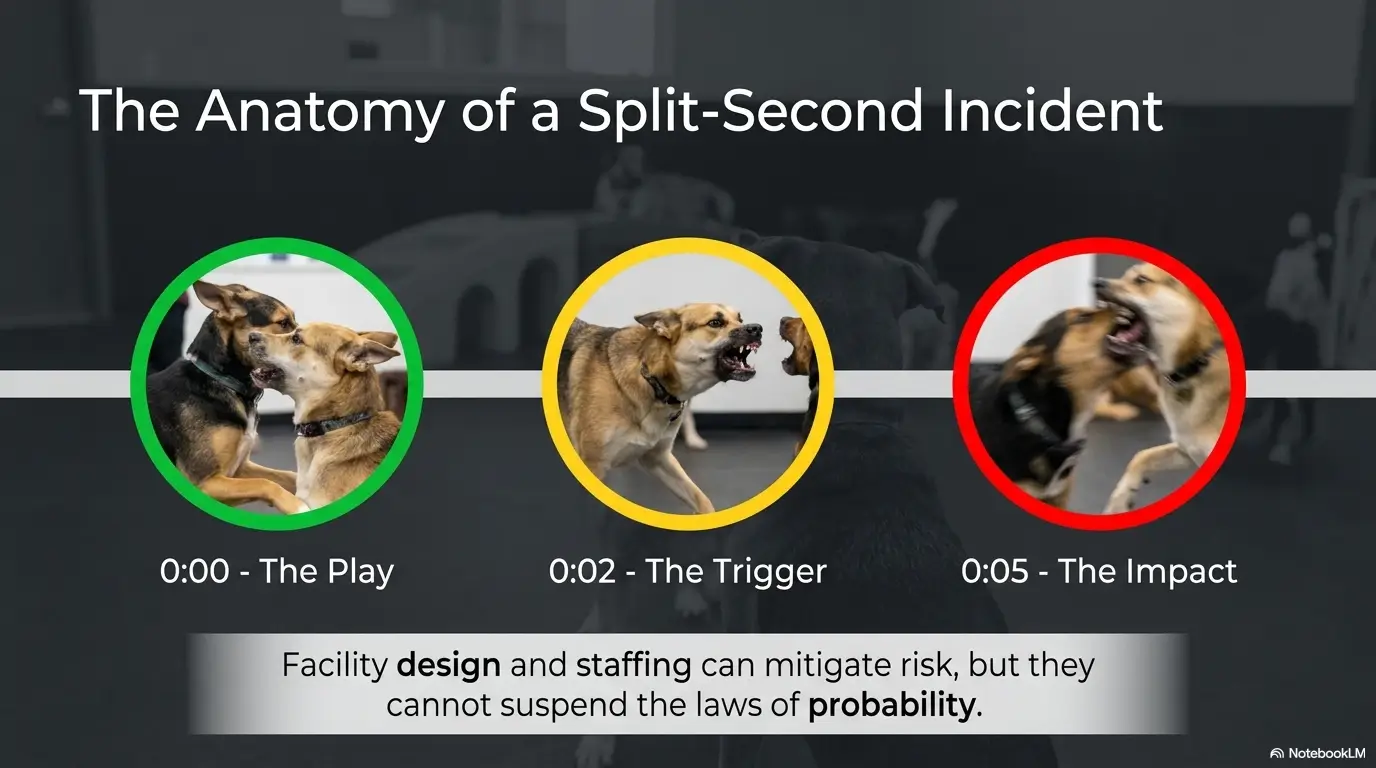
Bites, Escapes, and Death Need Separate Tests
Bite Claims Change With the Victim
“Dog bite coverage” is too vague to be useful. The relevant insurance section may change according to who or what was injured.
- A dog bites another enrolled dog: entrusted-animal coverage may be central.
- A dog bites a customer: commercial liability may respond to bodily injury, subject to animal and location exclusions.
- A dog bites an employee: workers’ compensation or employer-related coverage may become the primary route.
- A dog bites a passerby during a walk: off-premises coverage, authorized activities, and handler status become important.
- A dog bites inside a pickup vehicle: commercial auto, animal transit, and general liability wording may interact.
Ask the broker to identify which section responds to each victim category. Do not accept a single “bites are covered” answer without the applicable exclusion, deductible, and limit.
Follow an Escape Beyond the Door
An escape is not one loss. It is a chain of possible losses moving through space and time.
The dog may be injured, cause a cyclist to fall, damage a shop, trigger a vehicle collision, require emergency treatment, or remain missing for several days. Staff may distribute notices, hire search support, purchase advertising, pay temporary transportation costs, and communicate with local authorities.
Coverage should be checked from the moment custody begins until it clearly ends. For pickup services, that may begin when an employee receives the dog at the customer’s home. For ordinary daycare, it may begin at physical handoff or electronic check-in. The policy and customer agreement should tell the same story.
How a Policy Values a Dog After Death or Permanent Injury
Owners may speak about a dog as a child, companion, or irreplaceable family member. Insurance contracts may use a narrower economic measure.
Ask whether compensation is based on purchase price, market value, documented veterinary expense, replacement cost, a scheduled amount, or another formula. Also ask whether burial, cremation, necropsy, transport, or counselling-related expenses are included, excluded, or capped.
The customer agreement should not promise automatic reimbursement that the policy does not support. A generous sentence written during a quiet afternoon can become an uninsured contractual obligation during a crisis.
Real-World Example: One Open Gate, Four Coverage Questions
A daycare employee opens the entrance while receiving a food delivery. One dog slips into the shared hallway, exits the building, and runs into the street.
The dog is struck by a bicycle. The cyclist needs medical care, a parked vehicle is scratched, and the dog requires surgery. The owner also asks the daycare to pay for a specialist consultation and rehabilitation.
One event now touches entrusted-animal coverage, third-party bodily injury, third-party property damage, veterinary expenses, defense costs, and possibly premises-security conditions.
The lesson is simple: do not ask whether “escape” is covered. Ask which section pays each part of the escape, which exclusions apply, and whether all payments share one aggregate.
Veterinary Expense Coverage Is Often Smaller Than It Looks
Separate Immediate Care From Final Legal Liability
Some policies may reimburse limited emergency veterinary expenses without waiting for a final determination of negligence. Others may pay only when the business is legally liable under the policy terms.
This difference affects cash flow and customer communication. An owner facing an emergency surgery deposit may not be comforted by hearing that liability will be investigated over the coming weeks.
Ask whether the daycare can authorize treatment, pay the clinic, and seek reimbursement later. Confirm whether prior insurer approval is required except in life-threatening situations.
Map the Full Treatment Path
Veterinary treatment rarely ends with the first examination. A useful review follows the dog from intake through recovery.
- Emergency examination and stabilization
- Blood tests, imaging, and specialist diagnostics
- Surgery, anesthesia, and hospitalization
- Medication, wound care, and medical supplies
- Specialist referral and transfer
- Rehabilitation and follow-up visits
- Dietary or mobility support during recovery
- Necessary transport to and between clinics
Check whether follow-up care must occur within a specified number of days. Review exclusions for pre-existing conditions, congenital conditions, age-related illness, elective treatment, experimental care, or treatment considered unrelated to the incident.
Create an Emergency Treatment Protocol Before Opening Day
The admission agreement should identify emergency contacts, the owner’s preferred clinic, a backup hospital, treatment authorization, and an initial spending limit. It should also explain what happens when the owner cannot be reached.
Operationally, staff need a short decision tree. In a genuine emergency, nobody should be searching through a long contract while a frightened dog sits in a carrier.
Emergency response map
Protect the dog first. Preserve the claim at the same time.
Build the Right Policy Stack for the Actual Operation
One Contract Rarely Covers Every Exposure
A dog daycare’s insurance needs can resemble a stack of transparent sheets. Each sheet covers a different part of the operation, and missing sheets leave visible holes.
| Coverage Layer | Primary Purpose | Common Gap to Test |
|---|---|---|
| Commercial general liability | Third-party bodily injury and property damage | Animals in the business’s custody may be excluded |
| Entrusted-animal coverage | Injury, loss, or death of customer dogs | Low per-animal or annual sublimits |
| Property insurance | Equipment, tenant improvements, and contents | Animal-related damage or contamination restrictions |
| Business interruption | Lost income after qualifying physical damage | Closure without covered physical damage may not qualify |
| Workers’ compensation and employer coverage | Employee injury and related employer exposure | Owners, volunteers, and contractors may be treated differently |
| Commercial auto and animal transit | Pickup, delivery, and transport-related losses | Employee cars and hired vehicles may not be included |
| Cyber and privacy coverage | Customer data, payment records, and digital incidents | CCTV and biometric or access data may need careful disclosure |
| Umbrella or excess liability | Additional limits above scheduled underlying policies | It usually does not repair an exclusion below |
Good, Better, and Best Coverage Approach
The right tier depends on services, capacity, contract requirements, and loss tolerance. The following framework is a planning tool rather than a recommendation for a specific policy.
| Approach | Suitable Starting Point | What to Include | Main Limitation |
|---|---|---|---|
| Good | Small single-location daycare with no transport or overnight stays | General liability, explicit entrusted-animal coverage, property, and employee protection | May not address revenue interruption, privacy, or higher-severity claims |
| Better | Busy daycare with training, medication, longer hours, or occasional boarding | Good tier plus broader animal sublimits, business interruption, professional-service review, and cyber coverage | Off-site services and vehicles still require separate testing |
| Best | Multi-location, franchise, premium boarding, or transport operation | Better tier plus commercial auto, animal transit, umbrella or excess limits, franchise alignment, and branch-level schedules | Higher limits cannot cure inaccurate disclosures or excluded activities |
When a Free DIY Review Is Enough
A DIY checklist is useful for preparing an accurate service inventory, collecting documents, comparing quotations, and identifying questions. It can save paid professional time because the broker or attorney receives cleaner information.
Professional review becomes more valuable when the daycare transports dogs, operates overnight, combines grooming or training, serves high daily volumes, manages several branches, sells franchises, signs landlord or investor insurance clauses, or receives wording available only in Korean.
Foreign founders should also consider the communication gap. The practical meaning of a policy can be lost when the sales summary is translated but the definitions and endorsements are not. A careful approach to Korean business communication can help when requesting written explanations and confirming who has authority to interpret the contract.
Key takeaway
Umbrella coverage adds height to the policy stack, not width. It may increase an existing limit, but it usually does not restore a loss that the underlying policy excludes.
Exclusions and Underwriting Details That Deserve Red Ink
Breed, Health, and Behavioral Restrictions
Some policies restrict designated breeds, dogs above a certain size, animals with prior bite histories, dogs showing aggressive behavior, elderly animals, very young puppies, or dogs lacking required vaccination records.
Compare these restrictions with actual admission practices. If the daycare accepts a category the policy excludes, the business may be collecting a fee for an exposure it has chosen to retain.
Ask what evidence the insurer expects after an incident. Intake questionnaires, vaccination documents, temperament assessments, trial-day notes, and owner disclosures may become part of the coverage discussion.
Disease, Contamination, and Closure
Communicable illness can produce veterinary expenses, customer refunds, cleaning costs, isolation measures, reputational damage, and temporary closure. Yet disease and contamination exclusions are common areas of concern.
Ask separately about treatment for affected dogs, decontamination, testing, disposal of contaminated items, income loss, public-authority closure, and customer reimbursement. One covered cost does not imply that the entire outbreak is covered.
Unattended Dogs, Staffing Ratios, and Capacity
Coverage may depend on supervision conditions described during underwriting. Remote cameras do not necessarily satisfy a requirement for staff presence.
Review whether the policy or application states a maximum number of dogs per handler, separate-group rules, overnight staffing, isolation procedures, or conditions for outdoor play. If actual practices differ, correct the record before an incident rather than after one.
Services That Slip Outside the Classification
Training, grooming, medication administration, nail trimming, swimming, treadmill use, behavioral modification, and health observations may trigger professional-service or treatment exclusions.
Transportation deserves its own disclosure. A personal car used for customer pickups may not become commercially insured simply because the trip supports the daycare. Ask about owned vehicles, hired vehicles, employee vehicles, cages, heat control, loading, unloading, and animals left temporarily in transit.
Red-flag checklist
- The quote describes the business only as a “pet shop” or “pet service.”
- The broker will not provide full wording before purchase.
- Entrusted dogs are discussed verbally but not named in an endorsement.
- Transportation is treated as incidental without reviewing vehicle coverage.
- The customer agreement promises more than the policy appears to pay.
- The application understates capacity, operating hours, or additional services.
- No one can explain whether defense costs reduce the liability limit.
Incident Records Can Decide Whether a Claim Stays Defensible
Build One Reliable Timeline
After an incident, several people may remember the event differently. The front-desk log, handler notes, CCTV timestamps, owner messages, veterinary records, and staff schedule should be assembled into one factual timeline.
- Arrival, handoff, and check-in time
- Group assignment and supervising staff
- Feeding, medication, rest, and outdoor periods
- Observed behavior before the incident
- Exact incident time and location
- Separation, first aid, and transport actions
- Owner and emergency-contact calls
- Veterinary arrival, diagnosis, and treatment
- Insurer or broker notification
Preserve Original Evidence
Save original video rather than only an edited clip. Preserve photographs, messages, booking records, vaccination documents, signed agreements, staffing records, and relevant access logs.
Do not overwrite, trim, recreate, or quietly correct records after a serious event. A late change that seems harmless can create a larger argument about credibility and evidence preservation.
CCTV may be required or operationally valuable in some contexts, but it is not an insurance substitute. It records what happened. It does not finance veterinary care, defend a claim, or repair an exclusion.
Use Neutral Language and Notify Early
Incident records should describe observable facts. Avoid diagnosing injuries, assigning blame, speculating about intent, or promising payment before the policy has been reviewed.
Insurance contracts commonly impose notice, cooperation, and evidence-preservation duties. Report serious incidents promptly even when the owner initially appears calm. The emotional temperature of a conversation can change after a diagnosis, large bill, or second medical opinion.
Key takeaway
The best incident record is not dramatic or defensive. It is chronological, specific, preserved in its original form, and written before memories begin polishing themselves.
Use a Five-Scenario Test Before Paying the Premium
Prepare a Complete Quote File
Better insurance comparisons begin with better information. Give each broker the same operating profile so that quotations are based on comparable assumptions.
| Quote-Preparation Item | What to Include |
|---|---|
| Business identity | Legal entity name, registration details, ownership, and years operating |
| Services | Daycare, boarding, training, grooming, medication, walking, retail, and transport |
| Premises | Addresses, floor areas, shared spaces, outdoor areas, pools, and leased facilities |
| Capacity | Maximum daily dogs, average attendance, overnight count, and group sizes |
| Staffing | Employees, contractors, volunteers, shifts, training, and supervision ratios |
| Animal profile | Accepted sizes, breeds, ages, behavioral history, and vaccination rules |
| Transportation | Owned, rented, and employee vehicles plus pickup and delivery frequency |
| Claims history | Bites, escapes, injuries, complaints, closures, and prior insurance claims |
| Contracts | Lease insurance clauses, customer agreement, franchise terms, and lender requirements |
The Five Scenarios Every Broker Should Answer in Writing
- One dog bites another dog during supervised group play.
- A dog escapes from the building and causes a traffic accident.
- A customer slips while attempting to separate two dogs.
- An employee is bitten while feeding an enrolled dog.
- A dog needs emergency surgery after swallowing an object at the facility.
For each scenario, request the applicable policy section, relevant exclusion, deductible, per-animal limit, per-incident limit, annual aggregate, defense-cost treatment, geographic boundary, and notification procedure.
Also ask whether the answer changes if the incident occurs during an off-site walk, inside a vehicle, after normal closing time, at an unlisted branch, or while a contractor is supervising the dog.
Compare Answers Before Premiums
Price matters, but premiums are meaningful only after the scope of coverage is understood. A cheaper quotation may use lower animal sublimits, broader exclusions, a larger deductible, narrower definitions, or stricter supervision requirements.
Create a one-page comparison using identical scenarios. When one broker says a scenario is covered and another says it is excluded, ask both to point to the exact wording. The disagreement is useful. It reveals where the policy deserves closer attention.
Provider question card
Ask: “Please identify the exact policy section and endorsement that covers a customer’s dog while it is under our supervision.”
Then ask: “What exclusion could still prevent payment in that situation?”
Finish with: “Please confirm the per-animal limit, deductible, annual aggregate, and whether defense costs reduce the limit.”
Korea Dog Daycare Insurance FAQ
Is Liability Insurance Required for Every Korean Dog Daycare?
Do not assume that registration and insurance obligations are identical. Requirements may depend on the activity, animal category, municipality, lease, contract, facility, and other legal relationships. Confirm current obligations with the competent local office and a Korean-licensed insurance professional.
Does General Liability Cover a Dog Injured at Daycare?
Not automatically. Care, custody, control, entrusted-property, animal, and professional-service exclusions may restrict coverage. Look for wording or an endorsement that expressly addresses customer animals under the daycare’s supervision.
What Insurance Covers Dog-to-Dog Injuries?
The policy should expressly cover injury to an entrusted dog, including an injury caused by another customer’s dog. Confirm negligent-supervision allegations, veterinary expenses, deductibles, and limits rather than relying on a general statement that animal incidents are covered.
Are Veterinary Bills Paid Before Negligence Is Proven?
Coverage varies. Some policies may provide limited emergency veterinary-expense payments without a final liability decision. Others may reimburse costs only after the daycare’s legal liability has been established under the contract.
Does a Customer Waiver Stop Lawsuits?
A well-drafted agreement can document consent, owner disclosures, emergency authority, and risk allocation. It should not be treated as a guaranteed defense against every claim. The agreement should also avoid assuming obligations broader than the insurance policy accepts.
Is an Escaped Dog Covered After Leaving the Premises?
Only if the wording extends to the escape and the resulting losses. Ask about search costs, injuries to the dog, third-party bodily injury, property damage, vehicle accidents, geographic limits, and the point at which custody ends.
Does Daycare Insurance Cover Pickup and Delivery?
Transportation frequently requires separate review of commercial auto, hired and non-owned vehicles, animal transit, loading, unloading, and employee-car use. Do not assume a short or occasional trip is covered by the premises policy.
Will Insurance Cover an Infectious-Disease Outbreak?
Coverage can be narrow. Disease treatment, testing, cleaning, contamination, quarantine, closure, refunds, and lost income may be treated separately or excluded. Ask about each cost rather than discussing the outbreak as one event.
Can a Foreign Owner Buy Korean Business Insurance?
Possible eligibility may depend on the Korean entity, registration status, local business address, underwriting information, ownership structure, authorized representatives, and the insurer’s distribution rules. A local broker can explain what documentation is required.
Your 15-Minute Next Step
Open your current quote, renewal schedule, or broker proposal. Search for five terms: animal, custody, exclusion, veterinary, and aggregate.
Then write one sentence describing your highest-severity realistic incident. For many daycares, it will be a dog escaping and causing both human injury and emergency veterinary expense. Send that scenario to the broker and request the applicable wording, deductible, limits, and exclusions in writing.
That small exercise changes insurance from a vague promise into a testable contract. It also gives founders, investors, and franchise teams a clearer view of what the business is transferring to an insurer and what it is quietly keeping for itself.
The calm final check
A useful policy should survive a realistic story, not merely a premium comparison. Test the dog, the victim, the location, the service, the expense, and the limit. Where the answer becomes vague, keep asking.
Last reviewed: 2026-08