

Decoding the “Pali-Pali” Inbox:
Mastering Korean Business Communication
A Korean colleague replies at 9:12 p.m., and your inbox suddenly feels less like a tool and more like a tiny emergency siren.
In Korean workplace culture, speed isn’t always a deadline—it’s responsiveness, respect, and relationship maintenance. Guessing wrong can lead to overreaction or damaged trust. This guide helps you navigate the nuances of KakaoTalk, Slack, and after-hours threads with precision.
- • Separate response speed from decision speed.
- • Learn why “we’ll check” isn’t always an approval.
- • Ask about urgency without sounding defensive.
The message may be urgent. It may be courtesy. It may be alignment still finding its shoes.
And the difference matters.
Table of Contents
Start Here: “Fast” Is Not One Emotion in Korea
The Translation Trap: Fast Does Not Always Mean Frantic
Many foreign professionals read speed through a familiar American workplace lens: fast equals urgent, urgent equals risk, risk equals someone is about to ask why the deck is not already on their desk.
That reading is understandable. In many US workplaces, a sudden reply, a late-night message, or a rapid follow-up can carry emotional heat. It may suggest escalation, dissatisfaction, or an invisible clock starting to tick.
In Korean work settings, though, speed often carries more than one meaning. A quick reply may mean, “I received this.” It may mean, “I am showing attentiveness.” It may mean, “I do not want silence to create discomfort.” It may also mean, yes, “Please move quickly.” The problem is not speed itself. The problem is reading every fast signal as the same signal.
Why US Professionals Often Hear Alarm Bells First
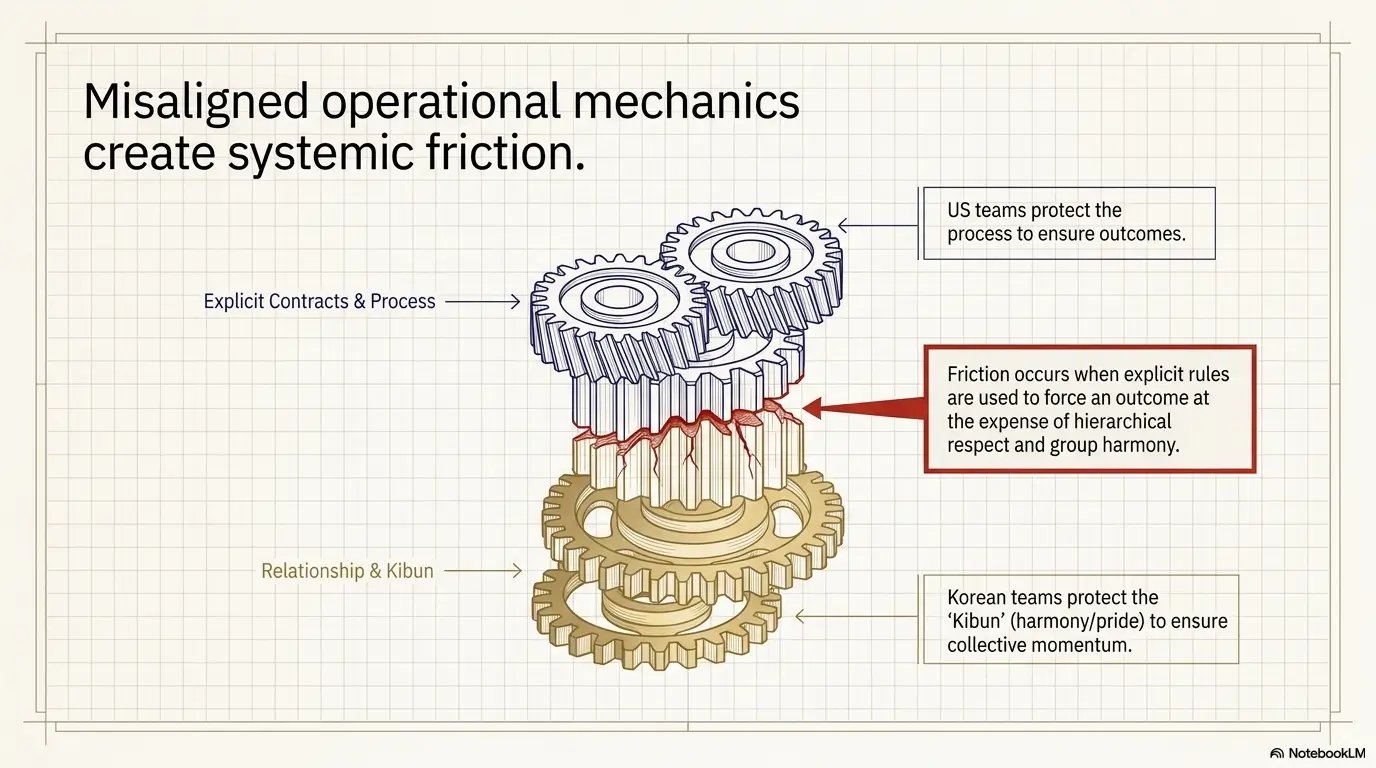
US business communication often prizes clarity, boundaries, and explicit priority labels. A good message says what is needed, when it is needed, who owns it, and what happens next. Beautiful, when it works. A little beige-cardboard, perhaps, but useful.
Korean business communication may place heavier weight on context, relationship, hierarchy, timing, and what is not said directly. That does not mean Korean teams are unclear by nature. It means the signal may live partly in the sentence and partly around it. If you want a deeper cultural backdrop for that pattern, Korean indirect communication is often where the quiet machinery begins.
Here is the first practical shift: instead of asking, “Why are they moving so fast?” ask, “What kind of fast is this?”
The Better Question: “Fast Toward What?”
Speed can point toward action, reassurance, alignment, hierarchy, courtesy, damage control, or simple habit. Once you know which one is operating, your reply gets calmer.
- Fast toward action: someone needs a deliverable, confirmation, or next step.
- Fast toward relationship: someone wants to acknowledge, maintain warmth, or avoid awkward silence.
- Fast toward hierarchy: someone may need to show responsiveness upward.
- Fast toward uncertainty: someone is replying quickly while waiting for approval.
- Read speed with wording, channel, and role.
- Do not escalate before you identify the signal.
- Reply in a way that confirms receipt without inventing urgency.
Apply in 60 seconds: Before answering, label the message as action, relationship, hierarchy, or uncertainty.
Who This Is For, and Who It Is Not For
For Foreign Professionals Working With Korean Teams, Vendors, Clients, or HQ
This guide is for the person who works across time zones and keeps wondering why a “quick note” from Korea feels heavier than it looks. Maybe you are a US-based manager coordinating with Seoul. Maybe you are a founder negotiating with a Korean manufacturer. Maybe you are a consultant who receives polite, rapid replies that somehow answer everything except the part you most needed answered.
I have seen this pattern in ordinary workrooms, not just cultural training slides. A foreign manager gets a fast “We will check and revert,” then assumes progress is guaranteed. A Korean counterpart thinks they have politely acknowledged the issue while gathering internal alignment. Both sides are trying to be professional. Both sides are also accidentally building a small fog machine.
For Managers Who Keep Thinking, “Why Is Everyone Replying So Quickly?”
This is especially useful if you manage cross-cultural workflows. Managers tend to infect a team with their interpretation speed. If you panic, everyone tightens. If you ignore everything, everyone floats.
A better middle path is to acknowledge quickly, clarify calmly, and timebox honestly. That habit lowers anxiety without slowing the work to a ceremonial crawl.
Not For Anyone Looking for a One-Size-Fits-All Korea Rulebook
Korea is not a single office with one thermostat and one personality. A startup in Pangyo, a chaebol division, a government-adjacent organization, a cosmetics exporter, and a gaming company may all handle speed differently.
Age, industry, English fluency, global exposure, seniority, company culture, and the relationship stage all matter. The point is not to stamp every Korean professional with one label. The point is to build a better reading habit.
- Notice patterns, but do not freeze people inside them.
- Compare teams, not national caricatures.
- Ask better priority questions before judging intent.
Apply in 60 seconds: Write down one Korean counterpart’s actual pattern, not your general impression of “Korean speed.”
The Hidden Meaning: Responsiveness as Workplace Courtesy
Fast Replies Can Signal “I Saw You”
In many Korean work settings, a quick acknowledgment can function like a small bow in digital form. It says, “Your message did not disappear into the basement with the broken printer.”
That matters because silence can feel relationally louder than many foreign professionals expect. In a US workplace, a delayed reply may simply mean someone is deep in focus mode, on calls, or defending their calendar from spreadsheet goblins. In Korea, depending on the relationship and context, a long silence may feel like neglect, avoidance, or a lack of respect. The same quietness that feels practical to one person can become socially loaded inside Korean silence in conversation.
Not always. But often enough that a quick “confirmed,” “checking,” or “I will review” becomes a social lubricant.
Silence Can Feel Heavier Than Delay
Here is a tiny but common scene. A US colleague receives a message and thinks, “I’ll answer after I have the full answer.” A Korean colleague waits and thinks, “Did they receive it? Are they ignoring it? Is this becoming sensitive?”
Nobody is wrong. They are simply optimizing for different risks. The US colleague is protecting accuracy. The Korean colleague may be protecting continuity.
The Small Ping That Keeps Trust Warm
A quick acknowledgment does not need to be a final answer. In fact, treating every acknowledgment as a final answer is one of the fastest ways to create trouble.
Better:
- “Received, thank you. I’ll review and come back by Thursday morning Korea time.”
- “Thanks for the context. I need to check one internal detail before confirming.”
- “I saw this. For planning purposes, should I treat it as urgent today or next-step discussion?”
The response is fast. The commitment is careful. That is the sweet spot.
Infographic: Four Possible Meanings of “Fast” in a Korean Workplace Message
⚡
UrgencyA real deadline or business risk needs movement now.
🤝
CourtesyA quick reply confirms the relationship is attended to.
🧭
AlignmentThe team is gathering views before final commitment.
🏛️
HierarchySomeone may need to show responsiveness upward while decisions mature.
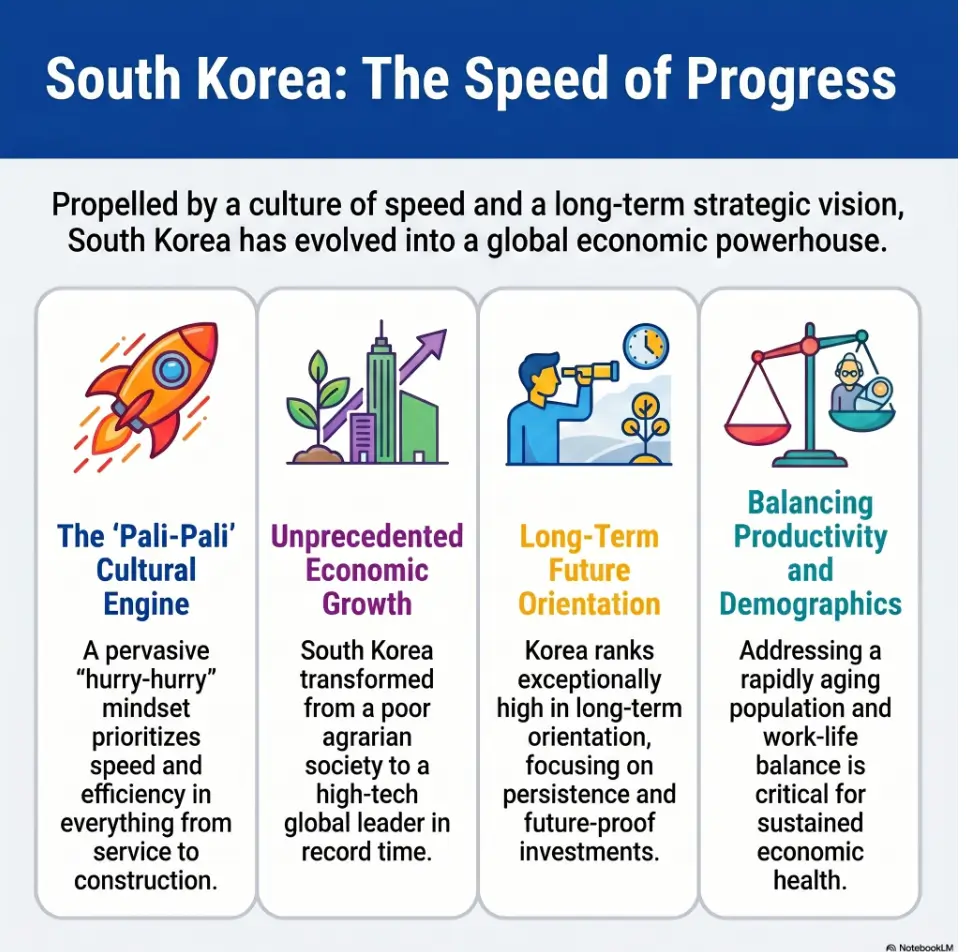
Ppalli-Ppalli, Reconsidered: More Than Hurry-Hurry
Speed as National Muscle Memory, Not Just Office Pressure
The Korean phrase ppalli-ppalli is often translated as “quickly, quickly” or “hurry, hurry.” The translation is useful, but thin. It is like translating a whole orchestra as “noise with uniforms.” Technically, sure. Emotionally, not enough.
In everyday Korea, speed appears in food delivery, public services, messaging, transport, beauty appointments, medical visits, repairs, and customer service. Foreign visitors often notice it immediately. Trains run cleanly. Cafes turn orders quickly. A document request may be handled with impressive speed. That same national rhythm also appears in everyday systems, from quick errands to why Korean clinics are so fast.
But workplace speed is not only impatience. It can be a performance of competence. It says, “We are attentive. We can move. We do not leave the other party hanging.”
How Rapid Development Shaped Expectations Around Execution
Korea’s modern economic development happened with extraordinary intensity across the late 20th century. The OECD and other major institutions often describe Korea as a high-income, highly educated, export-driven economy with strong technology and manufacturing capacity. That broader story matters because speed became attached to capability, survival, service, and national confidence.
Of course, that does not mean every fast habit is healthy. Fast can produce brilliance. It can also produce rework, fatigue, late-night messaging, and meetings where everyone says “yes” while their calendar quietly files a complaint.
The Part Foreigners Miss: Speed Can Be a Service Gesture
For foreign professionals, the most useful reframing is this: sometimes Korean speed is not trying to squeeze you. It is trying to serve the interaction.
A fast reply may be the digital equivalent of standing up when someone enters the room. It may not be the whole conversation. It may simply be the first courtesy.
Decision Card: When to Match Speed vs. When to Slow Down
Decision Card: Match the Tempo Without Losing the Plot
| Situation | Best Response | Why It Works |
|---|---|---|
| Simple receipt needed | Reply within a few hours | Keeps trust warm without overexplaining. |
| Complex decision requested | Acknowledge fast, decide later | Protects quality and relationship at once. |
| Senior stakeholder involved | Ask for priority and timing | Prevents false urgency from hierarchy fog. |
| After-hours message | Confirm receipt, timebox next action | Avoids both panic and silence. |
Neutral action line: Use this card before responding to any message that makes your pulse jump.
Mistake #1: Treating Every Quick Reply Like a Crisis
Don’t Escalate Just Because Someone Answered Fast
A fast reply can trick your body before your brain gets a vote. The message arrives, the notification flashes, and suddenly you are moving three meetings, drafting a defensive paragraph, and asking your innocent coffee to become a personality.
But fast does not automatically mean crisis. Sometimes it means your counterpart is efficient. Sometimes they are simply clearing messages. Sometimes they are showing attentiveness because the relationship matters.
Escalating too quickly can create the very pressure you were trying to avoid. You answer with unnecessary urgency. They sense tension. They reply even faster. Now both sides are jogging around a room with no exit.
Read the Channel Before You Read the Emotion
A quick KakaoTalk or Slack reply is not the same as a formal email from a senior executive. A short chat message may be a lightweight acknowledgment. A carefully worded email with multiple copied stakeholders may carry more weight. In everyday digital life, this is why KakaoTalk etiquette can feel less like app behavior and more like social choreography.
Look for:
- Deadline language: “by today,” “before the client call,” “urgent.”
- Stakeholder visibility: senior people copied, client thread, legal or finance involvement.
- Specific ask: a file, number, approval, revised sentence, or decision.
- Emotional wording: concern, issue, problem, delay, risk.
Let’s Be Honest: Your Inbox May Be Adding the Drama
One small lived truth: inboxes are terrible translators. They flatten tone, remove facial expression, and make a polite “checking” look like a tiny legal summons.
If your nervous system treats every notification as a falling piano, build a rule. Do not interpret urgency from response speed alone. Require at least one more signal.
Show me the nerdy details
A useful communication diagnostic is to separate latency from intent. Latency is how quickly someone replies. Intent is what they are trying to accomplish. Many cross-cultural misunderstandings happen when people infer intent from latency alone, especially in high-context work environments where acknowledgment, hierarchy, and relationship maintenance may travel inside short replies.
Mistake #2: Confusing Responsiveness With Final Decision-Making
A Quick “We’ll Check” May Not Mean Yes
In Korean business communication, a fast “We will check” can be beautifully polite and maddeningly incomplete. Foreign professionals sometimes hear it as, “This is moving forward.” The Korean counterpart may mean, “We have received this, but internal alignment is not finished.”
That gap matters. Acknowledgment speed and decision speed are different clocks.
In US-style communication, people may push earlier for a yes, no, owner, and deadline. In Korean settings, especially where hierarchy or client sensitivity is involved, people may move quickly on communication while moving carefully on commitment. This is also where phrases that sound mild to foreign ears can carry more caution, much like the layered meaning behind Korean “maybe” meaning.
Fast Communication, Slow Consensus
Consensus can take time because the visible meeting may not be the only place where the decision forms. Side conversations, senior review, relationship implications, and risk distribution may all matter.
This is not inefficiency by default. Sometimes it is a way of preventing embarrassment, protecting group harmony, and making sure the final answer can survive contact with reality. Reality, as usual, has elbows.
Why the Real Decision May Happen Around the Meeting
A meeting may confirm what was already softened, tested, or negotiated elsewhere. That is why foreign professionals sometimes feel confused: the meeting sounded open, but the decision seemed pre-shaped. Or the meeting sounded positive, but nothing finalized.
The answer is not to become suspicious. The answer is to ask cleaner process questions.
- “Who else should review this before we treat it as final?”
- “Is this a working direction or a confirmed decision?”
- “For planning purposes, when should we expect internal alignment?”
- Separate acknowledgment from approval.
- Ask whether the answer is tentative or confirmed.
- Give people a graceful way to say, “Not final yet.”
Apply in 60 seconds: Add the phrase “working direction or final decision?” to your next ambiguous thread.
Hierarchy Changes the Speed Signal
Junior Staff May Reply Fast but Decide Carefully
Hierarchy can make speed look more decisive than it is. A junior team member may reply quickly because responsiveness is expected, but they may not have authority to confirm the substance.
Foreign managers sometimes miss this and treat the quick reply as ownership. Then, when the answer changes after senior review, they feel misled. In many cases, nobody was trying to mislead anyone. The reply was fast. The authority was elsewhere.
Senior Approval Can Slow the Final Answer Without Killing Momentum
Senior approval may slow final commitment, especially for price, public statements, timelines, legal terms, hiring, partnerships, or anything involving client reputation.
A Korean counterpart might keep the thread moving with prompt replies while waiting for a director, VP, founder, or client-side stakeholder. The rhythm becomes fast-fast-slow: fast acknowledgment, fast coordination, slow final authorization.
The Polite Delay Hidden Inside a Prompt Response
Some phrases deserve careful reading:
- “We will review internally.”
- “Let us check with the relevant team.”
- “It may be difficult, but we will discuss.”
- “We understand your request.”
These can be honest process statements. They can also be soft buffers. If you need clarity, ask without cornering the person.
Eligibility Checklist: Is This Message Actually Decision-Ready?
Eligibility Checklist: Can You Treat the Reply as Final?
- Yes/No: Did the person have authority to decide?
- Yes/No: Did the message include a clear commitment?
- Yes/No: Were senior stakeholders aligned or copied?
- Yes/No: Was a deadline or owner named?
- Yes/No: Did the wording say “confirmed,” not only “we will check”?
One-line next step: If two or more answers are “No,” treat the reply as acknowledgment, not final approval.
Further Reading from Authoritative Sources
- OECD Korea Economic Snapshot
Useful for understanding Korea’s high-speed economic context, productivity pressures, and broader workplace environment. - Ministry of Employment and Labor: Labor Standards Policy
Official Korean government resource on working hours, labor standards, and work-life policy changes. - Korea.net: Korean Lifestyles and Society
Official cultural background from Korea’s government portal, helpful for readers who want broader context beyond office communication.
The Responsiveness Matrix: Decode the Moment Before Reacting
Fast + Specific = Likely Action-Oriented
When a Korean colleague replies quickly with a specific ask, deadline, or owner, you should take it seriously as action-oriented.
Example: “Could you send the revised pricing table by 3 p.m. KST before the client meeting?” That is not just relationship warmth. That is a clock wearing shoes.
Fast + Vague = Likely Relationship Maintenance
When the reply is fast but vague, it may be maintaining connection while the real answer forms.
Example: “Thank you. We will review and get back to you.” This may mean they are being attentive, but it does not tell you priority, decision status, or timeline.
Slow + Formal = Likely Approval or Sensitivity
A delayed but formal reply may indicate internal review, senior approval, legal sensitivity, pricing pressure, or reputational risk. Do not assume disinterest. Formality often means the matter has weight.
Slow + Silent = Check Context Before Assuming Disinterest
Silence can mean many things: holiday timing, senior travel, internal disagreement, discomfort, overload, unclear ownership, or the quiet swamp of “we need one more person to bless this.”
Here is the matrix in plain form:
| Pattern | Likely Meaning | Your Best Move |
|---|---|---|
| Fast + specific | Action needed | Confirm owner and time. |
| Fast + vague | Acknowledgment or relationship care | Ask for planning timeline. |
| Slow + formal | Review, approval, or sensitivity | Stay respectful and precise. |
| Slow + silent | Unknown | Follow up with context, not accusation. |
Here’s What No One Tells You: “Fast” Can Protect Harmony
Quick Acknowledgment Prevents Social Friction
Responsiveness can protect harmony because it prevents the awkwardness of a message hanging in the air. In a relationship-sensitive workplace, silence may become a little room where anxiety starts arranging furniture.
A short reply keeps the room lit.
This is one reason foreign professionals can misread Korean speed. They think the fast response is about task pressure. Sometimes it is about preventing relational pressure.
A Soft Reply Can Buy Time Without Saying No
Direct refusal can be uncomfortable in many Korean business contexts, especially when the relationship is new, seniority is involved, or the request comes from a valued client. A fast but soft reply may create time while avoiding blunt disagreement.
That does not mean you should accept vagueness forever. It means you should design questions that allow clarity without forcing someone into public discomfort.
Responsiveness Lets the Relationship Keep Breathing
I once watched a foreign team interpret a Korean vendor’s quick “We will try our best” as a commitment. The Korean side meant, more or less, “We hear the request and will examine what is possible.” Two days later, the foreign team was irritated. The vendor was surprised by the irritation. The sentence had done two different jobs in two different minds.
The fix was not dramatic. They changed future messages to include: “For planning purposes, should we treat this as feasible, risky, or not yet confirmed?” Suddenly the fog thinned.
Useful reframe: In cross-cultural work, clarity is not the opposite of politeness. Good clarity is politeness with handles.
Short Story: The 11:43 p.m. Message That Wasn’t a Crisis
Short Story: A US-based product lead once received a late-night Korean message: “Thank you. We checked. Please review once more.” He read it at breakfast and felt the familiar dread. Was the client unhappy? Had the launch slipped? Was “once more” actually a velvet-wrapped accusation? He almost wrote a long defensive reply.
Instead, he answered, “Received, thank you. For planning purposes, is this urgent for today, or should I include it in the next revision cycle?” The response came back: “Next revision is okay. Just sharing before I forget.” The entire drama had lived inside the notification badge. His takeaway was wonderfully unglamorous: ask one calm timing question before feeding the anxiety raccoon.
Email, KakaoTalk, Slack: The Channel Changes the Message
Chat Speed Is Not Email Speed
Channel matters. Chat tools invite quick acknowledgment. Email tends to carry more formality. KakaoTalk may feel more immediate and socially close. Slack may sit somewhere between office hallway and project tracker, depending on the team.
A fast chat reply does not always deserve a fast strategic decision. Match the channel’s lightness, but do not let it decide your commitment level.
After-Hours Replies Need Careful Interpretation
Korea’s work culture has been changing, and many teams care more about boundaries than old stereotypes suggest. Still, after-hours communication can happen, especially across global projects, senior stakeholders, client work, or launch periods. For a wider look at how time off and workplace boundaries can feel different in practice, annual leave culture in Korea gives helpful context.
Do not assume every after-hours message demands an after-hours answer. Also, do not ignore patterns if your role requires coverage. The adult answer, boring and heroic, is to define norms.
When “Seen” Feels Like a Social Contract
Read receipts and “seen” indicators can create pressure because they expose awareness. If someone knows you saw the message, silence may feel different.
For sensitive matters, a short acknowledgment can be safer than waiting for the perfect complete answer.
Fee/Rate Table: The Hidden Cost of Misreading Speed
Cost Table: What a Speed Misread Can Cost a Cross-Border Team
| Misread | Typical Cost | Prevention Note |
|---|---|---|
| Fast reply treated as final approval | Rework, timeline confusion | Ask “confirmed or working direction?” |
| Late-night message treated as emergency | Burnout, unnecessary escalation | Ask for deadline and priority. |
| Soft reply treated as yes | Client disappointment | Clarify feasibility level. |
| Silence treated as disinterest | Relationship damage | Follow up with context. |
Neutral action line: Choose the prevention note that matches your next message before you reply.
How US Professionals Can Respond Without Overcorrecting
Acknowledge Quickly, Commit Carefully
The best cross-cultural response habit is not “reply instantly to everything.” That way lies caffeine theology and calendar collapse.
The better rule is: acknowledge quickly when the relationship or channel calls for it, but commit only after you understand the priority, authority, and deadline.
Use a two-speed response:
- Speed 1: “Received, thank you.”
- Speed 2: “I’ll confirm after checking X by Y time.”
Use Time-Bound Clarity: “I’ll Review and Reply by Thursday”
Time-bound clarity is magic because it gives the other side reassurance without pretending you have the full answer.
Good examples:
- “Received. I’ll review this with our finance lead and reply by Thursday 10 a.m. KST.”
- “Thanks. I can confirm the timeline after our internal check tomorrow.”
- “I saw your note. I need one business day to give you a reliable answer.”
Ask Priority Questions Without Sounding Defensive
The trick is to ask from planning, not resistance. “Is this urgent?” can sound like “Why are you bothering me?” in the wrong tone. “For planning purposes” softens the question and gives it a practical reason.
Try:
- “For planning purposes, should we prioritize this before the proposal revision?”
- “To sequence our team’s work, is this needed today or this week?”
- “Would a preliminary answer be useful now, or would you prefer a confirmed answer tomorrow?”
Use “Is This Urgent or Just for Awareness?” With Tact
That phrase can work, but refine it for Korean-facing communication. “Just for awareness” may sound dismissive if the relationship is sensitive. Better:
“For planning purposes, should I treat this as action-needed today or awareness for the next discussion?”
It is clear. It is respectful. It does not shove anyone into a corner wearing fluorescent lights.
- Acknowledge receipt first.
- Name what you need to check.
- Give a specific return time.
Apply in 60 seconds: Save one template: “Received, I’ll check X and come back by Y.”
Common Mistakes Foreign Professionals Make
Mistake: Matching Speed With Half-Baked Answers
Speed pressure can make smart people send undercooked answers. The result is a message that arrives fast, then breeds three follow-ups, two corrections, and one haunted spreadsheet.
If you do not know yet, say so professionally. A careful timebox beats a shaky instant answer.
Mistake: Assuming a Fast Request Is Automatically Top Priority
Some fast requests are simply fast because the sender is responsive. Do not reorder your whole day without checking actual priority.
Use: “I can work on this today, but it would move the pricing review to tomorrow. Which should come first?”
Mistake: Treating Indirect Language as Evasion
Indirect language may feel evasive to US professionals who value plain speech. But it can also be an attempt to preserve respect, avoid embarrassment, or keep options open while people align.
Translate gently. “It may be difficult” may deserve attention. It could be a polite warning, not a vague shrug.
Mistake: Publicly Forcing Clarity Too Early
Public clarity can be useful. Public cornering is not. If a decision involves seniority, reputation, or disagreement, forcing a direct answer in a group thread may make the other side less direct, not more.
Move sensitive clarity into a smaller channel when appropriate. In many teams, Korean group chat culture can make public threads feel more socially consequential than a foreign colleague expects.
Mistake: Ignoring the Relationship Work Inside Small Replies
Small replies can carry relational work. “Thank you,” “checking,” “noted,” and “we will review” may look thin on task content but thick on relationship maintenance.
Responding with cold efficiency every time can make you seem inattentive, even if your actual work is strong.
Mini Calculator: Your Speed Misread Risk
Mini Calculator: Is This a High-Risk Speed Misread?
Give yourself 1 point for each “yes.”
- Was the message fast but vague?
- Is the sender not the final decision-maker?
- Are senior stakeholders or clients involved?
Output: 0–1 points means low ambiguity. 2–3 points means clarify before acting.
Neutral action line: If you score 2 or more, reply with acknowledgment plus one priority or decision-status question.
Build a Better Cross-Cultural Response Habit
The 3-Part Reply: Receive, Clarify, Timebox
The simplest habit is also the most powerful:
- Receive: “Received, thank you.”
- Clarify: “Should I treat this as final direction or still under review?”
- Timebox: “I’ll come back by 3 p.m. KST.”
This structure works because it gives the relationship warmth, the task clarity, and the calendar a chair to sit on.
Example: “Received, I’ll Check Internally, and I’ll Come Back by 3 p.m.”
That sentence is plain, but it solves three problems. It reduces silence. It avoids false commitment. It sets a return point.
You can adapt it:
- “Received. I’ll check with our legal team and reply by Friday morning.”
- “Thank you. I’ll review the file and send comments before tomorrow’s call.”
- “I saw this. I need to confirm one internal number before answering.”
The Tiny Phrase That Reduces Panic: “For Planning Purposes”
“For planning purposes” is useful because it explains why you are asking. You are not challenging the sender. You are sequencing work.
In cross-cultural communication, that distinction matters. A question without context can sound defensive. A question with context sounds responsible.
Quote-Prep List: What to Gather Before Comparing Vendors or Partners
Quote-Prep List: Before You Ask a Korean Partner for Speed, Gather This
- Decision deadline and whether it is flexible.
- Final approver on your side.
- Budget range or price sensitivity.
- Must-have requirements versus nice-to-have requests.
- Preferred response format: email summary, call, spreadsheet, or signed document.
Neutral action line: Send these details upfront so the partner can respond quickly without guessing.
Next Step: Run a One-Week “Speed Signal” Audit
Track Three Things: Channel, Wording, and Actual Deadline
For one week, stop guessing and start observing. Track messages that feel urgent. Write down the channel, exact wording, sender role, and actual deadline.
You may discover that only 30% of the messages that felt urgent were truly urgent. You may also find the opposite: certain stakeholders really do use speed to signal priority. Either way, you will be working with evidence instead of notification weather.
Separate “Response Speed” From “Decision Speed”
Create two columns:
- Response speed: how quickly they acknowledged or replied.
- Decision speed: how quickly the actual commitment happened.
This one distinction can save hours of emotional static. A team may be highly responsive but careful with final approval. That is not contradiction. That is two clocks.
End the Week With One Better Team Norm
At the end of the week, propose one communication norm. Keep it small.
- “For urgent items, let’s include the deadline in the first message.”
- “For after-hours messages, let’s label whether action is needed before morning.”
- “For decisions, let’s mark replies as working direction or final approval.”
Small norms beat grand cultural lectures. Nobody wants a 47-slide sermon titled “Our New Philosophy of Reply Speed.” People want a sentence they can use on Tuesday.
FAQ
Why do Korean coworkers reply so fast?
Korean coworkers may reply quickly because responsiveness can signal attentiveness, respect, and engagement. It may also reflect company norms, hierarchy, client pressure, or simple efficiency. Do not assume every fast reply means panic. Read the wording, channel, sender role, and actual deadline together.
Does fast communication in Korea always mean something is urgent?
No. Fast communication can mean urgency, but it can also mean acknowledgment, relationship maintenance, or internal coordination. A quick “We will check” is often not the same as “This is approved” or “Drop everything now.”
How should Americans interpret quick Korean business messages?
Americans should avoid reading speed alone as emotional pressure. A better method is to ask: Is the request specific? Is there a deadline? Does the sender have decision authority? Is this chat, email, or a formal stakeholder thread? Then reply with acknowledgment, clarification, and a timebox.
Is “ppalli-ppalli” always negative in Korean work culture?
No. Ppalli-ppalli can create pressure and rework when overused, but it can also support strong service, quick coordination, and impressive execution. The balanced view is to treat speed as a cultural resource that needs good boundaries.
Why do Korean teams sometimes reply quickly but decide slowly?
Because acknowledgment and approval are different. A team member may respond quickly to show attentiveness while still needing senior approval, internal alignment, pricing confirmation, or client review. Fast communication does not always equal final decision-making authority.
What should I do when a Korean client sends a late-night message?
First, check whether the message includes a true deadline or explicit urgency. If not, a calm acknowledgment can work: “Received, thank you. I’ll review this tomorrow morning and reply by noon KST.” If after-hours coverage is expected, define that norm clearly before it becomes a recurring stress ritual.
How can I ask whether something is urgent without sounding rude?
Use planning language. Try: “For planning purposes, should I treat this as action-needed today or for the next discussion?” This frames the question as workflow coordination, not resistance.
Why do Korean business partners avoid saying no directly?
Some Korean business partners may use softer language to preserve harmony, respect hierarchy, or avoid embarrassing the other party. Phrases such as “It may be difficult” or “We will review” may carry important caution.
The best response is to ask for feasibility, timing, and next steps without forcing a public blunt answer. For related wording choices beyond the office, Korean texting formality can help explain why small phrases often carry more social weight than they first appear to foreign readers.
Conclusion
The 9:12 p.m. message at the beginning of this article was not automatically a crisis. It may have been urgency. It may have been courtesy. It may have been a small signal of attentiveness crossing the ocean in a blue notification bubble.
That is the point. Foreign professionals often misread “fast” in Korea because they treat speed as a single emotion. But Korean workplace speed can contain responsiveness, hierarchy, service, harmony, uncertainty, and execution all at once. A little crowded, yes. But readable.
Your next step is not to become slower or faster. It is to become more precise. For the next 15 minutes, review your last five Korean-facing messages. Label each one: urgent, acknowledgment, decision, relationship, or unclear. Then rewrite one reply using the 3-part habit: receive, clarify, timebox.
Last reviewed: 2026-04.