
The Invisible Rules of Korean Annual Leave
A vacation request in Korea can go sideways without anyone ever saying “no.” The contract looks clear, the leave balance looks real, and still the room cools the moment you mention dates.
That is the friction many foreign employees miss. Annual leave culture in Korea is not just about paid leave, labor law, or what sits in the employee handbook. It is also about team timing, manager signals, hierarchy, coverage, and the small office rituals that decide whether a request feels easy, awkward, or quietly expensive.
Keep guessing, and a normal time-off request can turn into approval fog, team resentment, or a reputation problem you did not see coming. This guide helps you read both layers at once: the legal floor under Korean annual leave and the lived workplace culture above it.
“The value here is not drama. It is fewer avoidable mistakes. It comes from watching how leave actually works in Korean offices, schools, and small teams, where the formal rule and the emotional rule do not always shake hands.”
Here is the part most people learn late:
- What the handbook says is only half the story.
- What managers react to is the other half.
And that second half is where most of the trouble begins.
Fast Answer: Annual leave culture in Korea is not only about policy written in a contract. It is also shaped by team timing, hierarchy, manager expectations, busy seasons, and how leave requests are communicated. Foreign employees often run into trouble not because they asked for leave, but because they misread the workplace rhythm. The safest approach is to understand both the formal rule and the unspoken office culture before requesting time off.
Table of Contents

Annual Leave in Korea Is a Policy Story and a Culture Story
Why the written vacation policy is only half the picture
Foreign employees often begin with the contract. That makes sense. Contracts feel solid. They sit there like a clean white plate under restaurant light, promising order. But annual leave in Korea rarely lives only inside that document. It also lives in calendars, delivery deadlines, team staffing, school schedules, month-end reports, and the manager who says “that should be okay” in a tone that somehow creates more questions than answers.
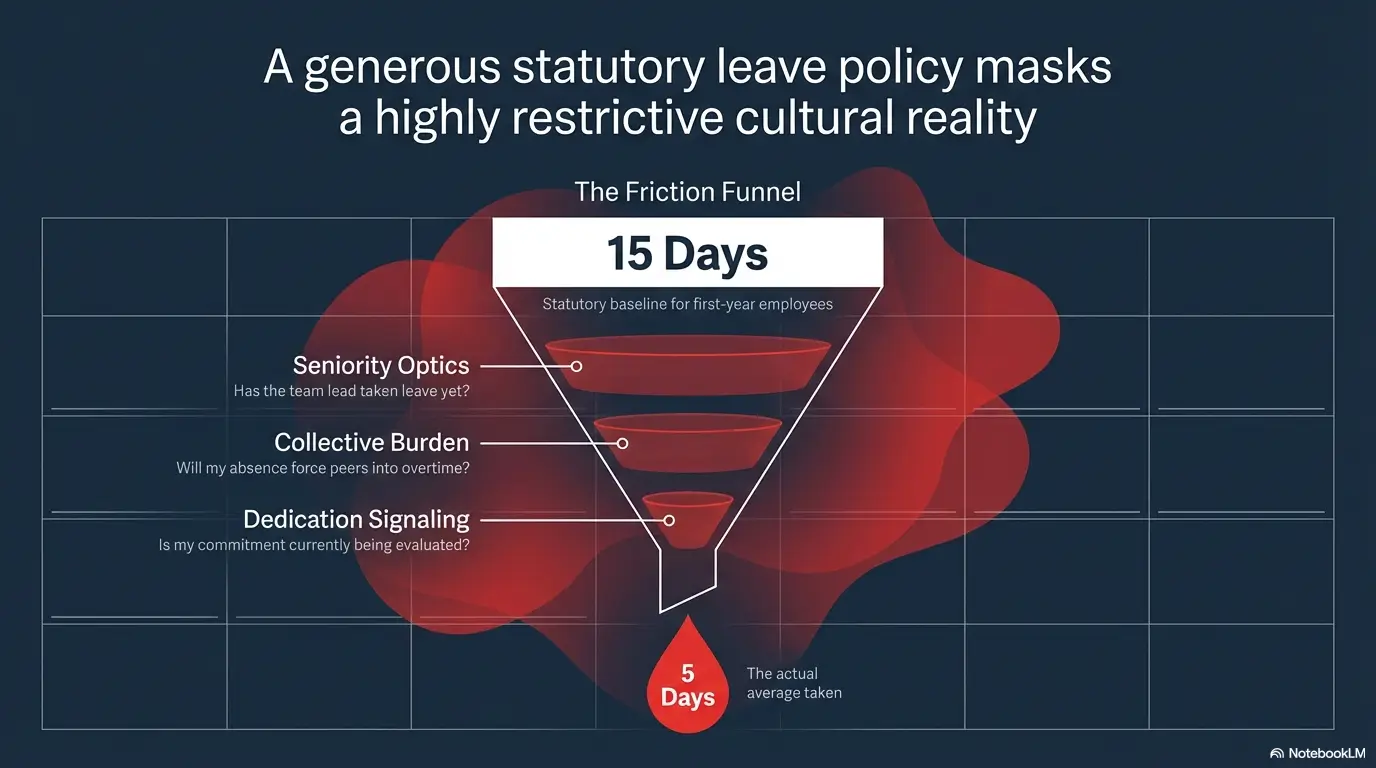
The legal side is distinct from office habits. For workers covered by Article 60 of the Labor Standards Act, at least 80% attendance over a year gives the 15-day baseline; workers with less than one year of continuous service, or below 80% attendance over a year, accrue one day for each month of perfect attendance. Additional service-based days and other statutory conditions apply. Coverage depends on the workplace and working arrangement; this is not an individual calculation.
A recorded leave balance and a team’s scheduling habits answer different questions. Coordination can reduce confusion, but social discomfort does not remove statutory rights. If a request is blocked, ask for the concrete reason and keep a written record rather than treating an awkward atmosphere as the final answer.
How team rhythm, hierarchy, and timing shape real leave decisions
Korean workplaces often read leave as a coordination event, not a purely personal choice. That does not mean people never rest. It means rest is frequently negotiated through group rhythm. A request made before an audit week, before enrollment season, before quarterly closings, or before a department head visit can land very differently from the same request made two weeks later.
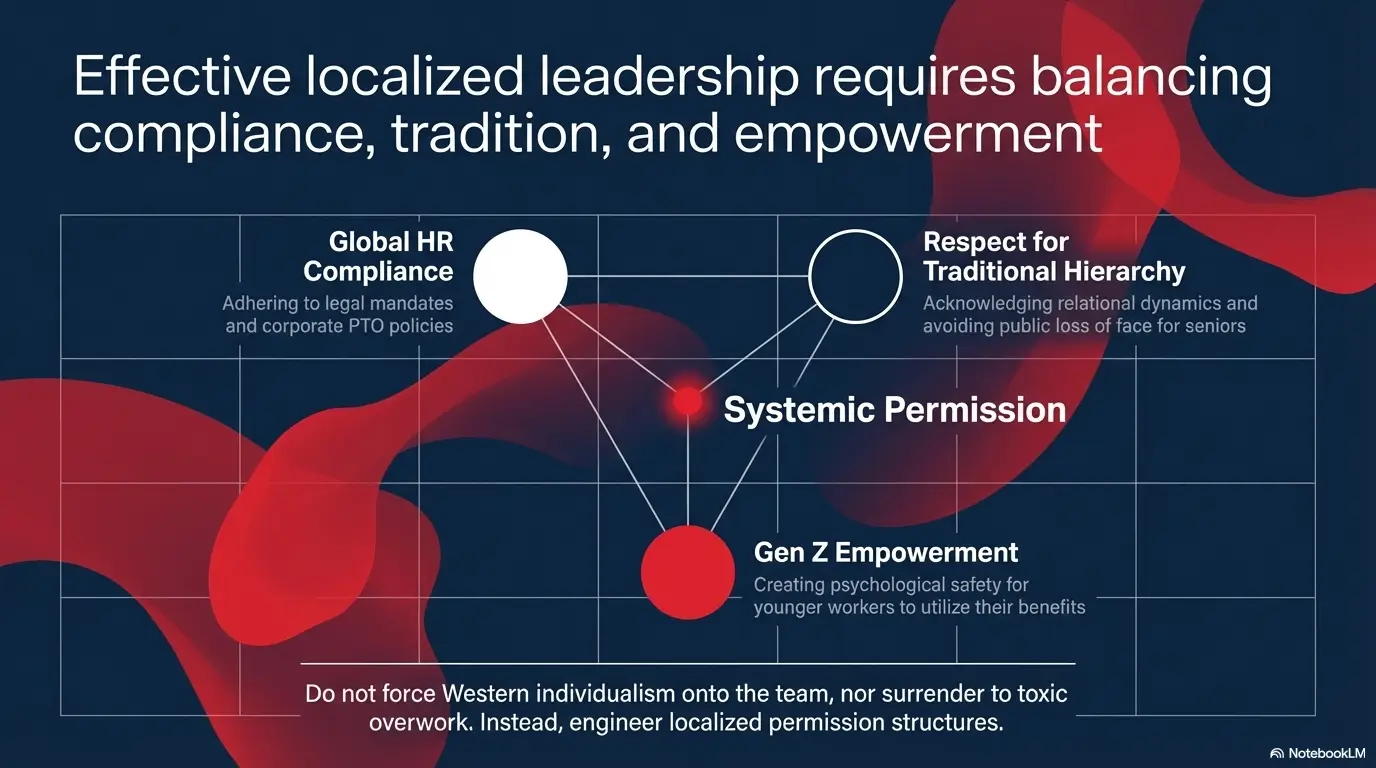
Hierarchy matters too. In flatter workplaces, a leave request may look like a simple scheduling step. In more traditional ones, it can feel closer to a status-sensitive conversation. Junior employees sometimes watch senior staff first. If directors never take visible leave, the message can be louder than the handbook. Culture whispers. Handbooks announce. Guess which one many employees actually obey.
Why foreign employees can feel confused even when the handbook looks clear
The confusion usually comes from mixed signals. A company says, “Please use your annual leave.” Then the busiest person in the office apologizes for taking one Friday off in eight months. Or HR says the policy is generous, but your manager asks three follow-up questions that sound less like logistics and more like a courtroom cross-examination with better stationery.
This mismatch is not always malicious. Sometimes HR speaks in policy, while managers live in staffing reality. Sometimes a team is short-handed. Sometimes a workplace is trying, awkwardly, to move from old norms to healthier ones. Foreign staff get caught in the middle, hearing two truths at once.
- The contract tells you the floor, not always the temperature of the room.
- Manager signals and team timing shape how smoothly leave is received.
- Confusion often comes from policy and practice drifting apart.
Apply in 60 seconds: Before your next request, check both the written policy and your team’s recent leave patterns.
Before You Request Leave, Know What Korean Workplaces Often Mean by “Good Timing”
Busy seasons, reporting cycles, and team coverage matter more than many newcomers expect
“Good timing” in Korea is often less about your personal calendar than the team’s load-bearing beams. In an office, that may mean month-end, quarter-end, product launches, audit windows, client visits, or evaluation season. In a school, it may mean exam periods, open class days, festival prep, or parent communication weeks. In a small business, one absent person can feel like a chair missing from a tiny kitchen. Suddenly everyone is balancing plates.
A foreign employee may think, “I’m only asking for two days.” The team may see, “Two days during the worst week possible.” Both views are sincere. They are just using different maps.
Why the same request can feel reasonable one week and awkward the next
This is where many misunderstandings begin. Leave requests are not judged in a vacuum. The exact same request, for the exact same number of days, can feel normal one week and uncomfortable the next because the context changed. Another coworker is already out. A report deadline moved. Someone quit. Someone’s child is sick. Workplaces are ecosystems, not vending machines.
One manager may say yes immediately in a light week. The next month, the same manager pauses and asks whether you can shift the dates. That does not always mean you did something wrong. It may simply mean the workplace weather changed. Korea can be like that: the forecast looks sunny in the policy, then the office sky decides to improvise.
Here’s what no one tells you… a “yes” may depend on how easy you make the absence for others
The most practical truth is also the least glamorous. Many leave requests become easier when the employee reduces the cost of saying yes. That can mean finishing a key draft early, arranging coverage, documenting urgent tasks, flagging deadlines, or promising a clear handoff. Managers are often more relaxed when the absence looks planned rather than dropped from the ceiling.
Constructed example: An employee requests specific dates and includes a brief handover; another mentions a possible trip without making a formal request. The first message is easier to process. This illustrates communication design, not evidence that better wording guarantees leave approval.
Eligibility checklist: Is this request likely to feel well-timed?
- Yes / No: Is your team entering a deadline-heavy week?
- Yes / No: Is another coworker already scheduled out?
- Yes / No: Can you explain coverage in 3 to 5 lines?
- Yes / No: Are you asking early enough for others to adjust?
Next step: If you answered “No” to two or more, tighten the timing or prepare a stronger handoff before you ask.
Show me the nerdy details
Under the Labor Standards Act, the legal entitlement exists independently from whether a manager personally likes the timing. But in practice, many workplaces layer internal approval workflows, coverage expectations, and leave-use planning over that legal baseline. Some employers also use the statutory framework that allows them to urge workers to use annual paid leave before it expires. That is one reason leave conversations in Korea can feel part law, part logistics, part office anthropology.
Not Every Workplace in Korea Handles Vacation the Same Way
Large corporations, startups, schools, and small businesses often operate very differently
One of the fastest ways to get confused is to hear one story about vacation in Korea and treat it as the story. Large corporations may have formal HR workflows, digital approval systems, and visible leave balances. Startups can look more flexible but may become surprisingly sensitive during crunch periods. Schools may appear orderly, yet the academic calendar creates its own steel bars. Small businesses can be warm and human, but they may also feel every absence more sharply because staffing is thin.
That means “In Korea, people don’t take leave” is too blunt. So is “My friend at a tech company travels freely, so I can too.” Korea contains both the old-script office where people hesitate to disappear and the healthier team where using leave is treated as normal adult maintenance. Same country. Very different room.
Why foreign employees should not generalize from one coworker’s experience
A coworker’s experience is useful, but it is not a universal law tablet descended from the corporate mountain. Seniority, nationality, job function, contract type, and manager relationship all matter. The Korean employee who takes Chuseok-adjacent leave every year without trouble may have ten years of trust built up. A new foreign employee on probation, or close to it, may not have the same margin.
I have heard people say, “But my teammate does it.” Sometimes that is true and still irrelevant. That teammate may be handling a different workload, reporting to a different sub-manager, or simply have the kind of calm competence that makes absence feel less risky. Unfair? Sometimes. Real? Very.
The difference between national work culture and one manager’s personal style
Some leave friction comes from Korean work culture broadly. Some comes from one manager who has a martyr complex and wears it like a necktie. Those are not the same thing. It matters to distinguish them because your strategy changes. National patterns call for cultural reading. One difficult manager calls for documentation, precise wording, and maybe escalation through the proper channel if things become serious.
The Ministry of Employment and Labor, often shortened to MOEL, matters here because it represents the official legal side. Your manager, however, represents your lived daily side. Most foreign employees need to learn how to navigate both without confusing one for the other.
Decision card: When A vs B
A. Formal company with HR system: use the policy, request early, and keep records. Time cost is low, but clarity matters.
B. Small team with informal approvals: align with the manager first, then confirm dates in writing. Time cost is higher, but it prevents “I never approved that” fog later.
Neutral action: Match your leave strategy to the actual workplace structure, not your guess about Korean culture.
Who This Is For, and Who May Need a More Legal Answer Instead
Best for foreign employees, expats, teachers, office workers, and first-time hires in Korea
This guide is for readers who want to understand the practical layer of annual leave culture in Korea. It is especially useful for foreign employees, expats, teachers, office workers, and newly hired international staff who keep wondering why leave feels more delicate than the contract suggests. If your main question is cultural rather than adversarial, you are in the right place.
Not enough on its own for disputed leave, retaliation concerns, or contract conflicts
If your situation includes denied legal entitlements, retaliation, wage issues, fake approvals, threats, contract disputes, or pressure not to use accrued leave at all, you may need something more formal than cultural advice. That is where the Labor Standards Act, MOEL counseling, a Regional Employment and Labor Office, or a qualified labor professional becomes more important than a blog post, however lovingly assembled.
This matters because readers sometimes stay too long in interpretation mode. They keep asking, “Maybe this is just Korean culture?” when the issue may actually be a compliance problem. Culture explains many gray areas. It should not be used to excuse everything.
When culture advice helps, and when policy documentation matters more
Culture advice helps when you want smoother relationships, better timing, and fewer avoidable misunderstandings. Documentation matters more when dates, approvals, balances, or denial reasons are becoming disputed. If you are hearing inconsistent answers, save the written messages. If you are told one thing verbally and another thing in the HR system, that contrast matters.
A practical rule: use cultural reading to ask better; use written documentation to protect yourself if asking better does not solve the problem.
The First Mistake: Treating Vacation as a Purely Personal Decision
Why “I earned the days, so I can use them anytime” may create friction
On an emotional level, the statement feels fair. If you earned the days, why should anyone act dramatic about it? But many Korean workplaces still see leave through the lens of collective burden. That means the sentence “I earned it” can sound legally tidy and socially tone-deaf at the same time.
This is one of the biggest misfires foreign employees make. They present leave as a private entitlement issue, while the team hears a group-impact issue. Neither side is speaking nonsense. They are just speaking different dialects of workplace reality.
How Korean teams often view leave through shared workload, not individual entitlement alone
In many teams, someone’s absence changes everyone else’s day. Meetings move. Customer replies slow down. A colleague covers urgent tasks. A manager absorbs approvals. This does not erase your entitlement, but it explains the emotional logic behind the questions you may hear. “Can it be next week?” “Who will handle this?” “Is there anything urgent pending?” Those are often not coded moral judgments. They are operational anxieties wearing business-casual clothes.
Coverage planning is a practical question: which tasks can wait, which require a named backup, and who may make time-sensitive decisions? Resolve those points without implying that leave is earned only by eliminating every inconvenience.
What thoughtful coordination signals to managers and coworkers
Thoughtful coordination signals maturity, respect, and low drama. In workplaces that prize reliability, those signals matter. An employee who requests leave with a clear plan often looks more professional than one who invokes policy loudly and leaves a paper tornado behind.
This is not about becoming apologetic for existing. It is about understanding how trust is built. The foreign employees who navigate Korea best are often not the most assertive or the most deferential. They are the ones who make their requests easy to approve without making themselves small.
- Entitlement language can be legally right and socially clumsy.
- Teams often focus on workload impact first.
- Coordination earns trust without surrendering your rights.
Apply in 60 seconds: Rewrite your next request to include dates, impact, and coverage in one short paragraph.
The Second Mistake: Asking Too Vaguely, Too Late, or Too Casually
Why vague wording can make managers uneasy
Vague leave requests create administrative fog. “I might take some days off next month” sounds relaxed, but it gives a manager very little to hold onto. Korea often rewards clarity in internal coordination, especially when schedules depend on chain approvals. A manager may not object to the leave itself. They may object to the messiness of the request.
Specific wording helps. Include dates, whether it is full-day or partial, what is urgent before then, and whether any handoff is needed. This is not corporate poetry, but it keeps your request from floating around like a balloon nobody wants to claim.
Late requests, peak periods, and informal chats that never become clear requests
Another common problem is mistaking an informal mention for a formal request. You say something in the hallway, in KakaoTalk, or after a meeting. The manager nods politely. You assume it is approved. Two weeks later, the HR system shows nothing, and now everyone is annoyed in stereo.
Late requests magnify this problem. Even when leave is technically possible, the perceived burden rises when people feel cornered by timing. In many Korean workplaces, earlier is kinder. Earlier also protects you. A request made two or three weeks ahead reads very differently from one made two working days before departure.
Let’s be honest… many leave problems begin before anyone actually says “no”
The trouble often starts in the request itself: unclear dates, no written follow-up, no handoff plan, bad timing, or too much casualness for a workplace that still prefers formality. By the time a manager hesitates, the employee thinks the problem is the answer. Often the problem began in the setup.
Illustrative scenario, not a reported event: A new hire mentions a trip at lunch and assumes approval. HR has no recorded request. The employee then submits the actual dates through the designated process and asks for written confirmation. The lesson is to verify the workflow, not to infer hostility or promise a particular turnaround.
Quote-prep list: What to gather before you request leave
- Your exact dates and whether any half-days are involved
- The deadlines falling within 7 to 10 days of your absence
- The name of the person covering urgent issues, if applicable
- A one-line update on anything that could surprise your manager later
Neutral action: Put those four items in your request so the manager does not have to excavate them from you later.
Don’t Read Silence Too Fast: Korean Responses Can Be Less Direct Than You Expect
Why hesitation may signal timing concerns, not rejection
Foreign employees from more direct cultures often expect a crisp yes or no. Korea can offer something gentler and harder to decode: a pause, a soft “we should see,” or a sentence that looks positive until you read it twice and realize it has the structural integrity of fog. That hesitation does not always mean rejection. Sometimes it means the manager wants to check coverage, consult someone senior, or delay an uncomfortable answer.
Silence can also be a relationship-preserving move. Direct refusal may feel too blunt. So the workplace buys time. To someone new, that can feel maddening. To the office, it can feel polite.
How indirect communication can confuse foreign staff used to blunt answers
This is one of those moments where cross-cultural friction is almost mechanical. A foreign employee hears ambiguity and thinks, “They are hiding the real answer.” A Korean manager may think, “I am avoiding a harsh answer until I know more.” Both sides then become less comfortable, and the conversation grows little wings and starts flying into walls.
“Let’s discuss after checking the schedule” leaves a request unresolved. Ask who will check, when you should expect a response and where confirmation will be recorded. Do not treat a vague reply as either approval or a definite refusal.
What to listen for when the answer sounds polite but uncertain
Listen for operational signals, not just tone. Did the manager ask for dates, task coverage, or alternate timing? That often means the request is still alive. Did they say nothing concrete and never follow up? Then you may need to send a polite written confirmation request. Ambiguity should not be allowed to stretch forever like office taffy.
A useful move is this: respond with a brief written summary and a specific next step. Something like, “To confirm, I am requesting leave on these dates. I can finish X before then and hand off Y to Z. Please let me know if another timing would work better.” Calm, clear, harder to misunderstand. Readers who have already stumbled over Korean silence in conversation will recognize the pattern.
Approval Is Not the Whole Story: What Happens After Leave Is Granted
Why handoff, coverage, and visibility still matter after approval
Approval is not the finish line. In many Korean workplaces, the real trust test comes next. Did you leave clean notes? Did you flag urgent items? Did you vanish gracefully, or did your absence create a scavenger hunt? Managers and coworkers remember the texture of your leave more than the formal approval itself.
This is one reason some employees feel “punished” for taking time off when nobody actually opposed it. What really happened is that the team had a rough experience during the absence, and the memory sticks. Offices have long memories for preventable chaos.
How employees protect trust before they step away
Strong performers protect trust through predictability. They write a short handoff note. They set an out-of-office message if appropriate. They tell the right people, not everyone with a pulse. They close loops before leaving. None of this is glamorous. It is the workplace equivalent of washing the dishes before a trip. Future-you will be grateful. So will everyone else.
A handover should cover decision ownership as well as task status. List what can wait until your return and which agreed contact may handle a genuinely time-sensitive issue. Avoid promising routine availability during the leave itself.
The quiet career value of leaving clean notes and realistic timelines
There is also a reputational benefit here. In Korean workplaces, reliability often compounds. Employees who handle leave cleanly are easier to trust the next time. Over months and years, that can matter more than one brilliantly argued request. Trust grows like interest. So does irritation.
- Approval does not erase the need for a clean handoff.
- Teams remember preventable confusion.
- Good leave hygiene makes future leave easier.
Apply in 60 seconds: Draft a five-line handoff template and save it for future requests.
Short Trips, Long Holidays, and Chuseok Reality Checks
Why holiday-adjacent leave can feel more sensitive than ordinary days off
Holiday-adjacent leave often carries extra emotional weight. The reason is simple: many people want it. Attach leave to a major holiday and you are no longer just asking for time off. You are entering a competitive zone where fairness, team coverage, seniority, and timing become more visible. Chuseok and Seollal can turn even relaxed teams into intricate puzzle boxes.
To a foreign employee, adding two leave days to a public holiday may feel efficient and sensible. To a manager, it may trigger questions about who else wants the same window and whether the office can function.
How major Korean holidays affect team expectations and travel demand
Major holidays bring travel demand, family obligations, and workplace sensitivity. Transport fills up. People return to hometowns. Some teams quietly assume Korean staff with family obligations get priority, while other teams try to rotate fairly. There is no single national rule for this social choreography. That is why observing your own workplace matters so much.
In some offices, holiday leave is normalized if requested early. In others, it is treated like a high-friction request unless the team is already well-staffed. The same nation can contain both “Of course, just plan early” and “Please do not even breathe near that calendar slot.”
What foreign employees should think about before attaching leave to long holiday periods
Think about lead time, fairness, and optics. Request earlier than you think is necessary. Be ready to show flexibility on exact dates. Consider whether half the department is aiming for the same bridge days. If your role is coverage-sensitive, holiday-adjacent leave needs even better preparation.
None of this means you should never ask. It means you should ask with clearer situational awareness. Korea often rewards readers of the room, not just readers of the rulebook. If your leave overlaps with autumn travel or family gatherings, a quick read on Chuseok etiquette for foreigners can also help you understand why those dates carry more emotional and logistical weight than a normal week.
Practical check: Use the specific questions and next steps below. A point score cannot establish someone’s intentions, your rights, or whether a social setting fits your needs.
Some Teams Encourage Leave, Others Quietly Punish It
How to spot a healthy leave culture without waiting for a bad experience
A healthy leave culture usually leaves footprints. People actually use leave. Managers do not act surprised every time someone takes it. Approvals happen through a clear process. Handoffs are normal, not moral theater. Nobody treats rest like a betrayal in nicer clothes.
If senior employees take leave visibly and return without apology rituals, that is a good sign. If HR explains policy and managers behave in line with it, even better. If coworkers share coverage naturally rather than resentfully, you are probably in a healthier ecosystem.
Warning signs that vacation is technically allowed but culturally discouraged
Warning signs include vague discouragement, endless delay, invisible penalties, approving leave but criticizing absence later, or a culture where everyone has balances but nobody uses them. Another red flag is when employees use sick leave language to make ordinary vacation feel acceptable. That usually means the formal system and the emotional system are not aligned.
Some teams never say, “Do not take leave.” They simply make the aftermath unpleasant enough that employees learn the lesson without hearing the sentence. It is efficient, quiet, and not especially healthy.
Why observing senior staff behavior can reveal more than orientation materials
Orientation materials show the official script. Senior staff show the living script. Watch what experienced employees actually do. How early do they ask? What tone do they use? Do they take full annual leave or only fragments? Do managers praise planning or subtly glorify never being absent?
In Korea, observation is often a form of survival. It is not cynical. It is practical. The same skill helps in other workplace rituals too, from Korean seating hierarchy to the everyday mechanics of Korean politeness.
Coverage tier map: What changes from Tier 1 to Tier 5
Tier 1: Leave is normal, visible, and easy to request.
Tier 2: Leave is fine with early notice and clean handoff.
Tier 3: Leave is allowed, but timing sensitivity is high.
Tier 4: Leave exists on paper, but employees hesitate to use it.
Tier 5: Leave requests trigger delay, guilt, or retaliation signals.
Neutral action: Figure out your team’s tier before assuming the handbook tells the whole story.
Infographic: A low-drama leave request flow in Korea
Confirm days, accrual, and request channel
Avoid peak weeks if possible
Tasks, deadlines, coverage
Dates, impact, backup plan
Leave no approval fog behind
Common Mistakes Foreign Employees Make With Annual Leave in Korea
Assuming policy and practice always match
This is the grandparent of many other mistakes. Policy and practice sometimes align beautifully. Sometimes they barely exchange holiday cards. If you assume the written rule fully predicts the lived experience, you may misread the room and then misdiagnose the fallout.
Comparing Korea too quickly with US, Europe, or home-country norms
Comparisons are natural, but they can become traps. “Back home, nobody cared.” That may be true. It may also be useless. Workplace norms are local, and Korea has its own mix of hierarchy, group coordination, and timing sensitivity. The smart move is not to judge the difference first. It is to decode it accurately.
Waiting until frustration builds before clarifying expectations
Many employees stay silent because they do not want to seem difficult. Then the silence ferments. By the time they ask a real question, it comes out carrying a small suitcase full of resentment. Early clarification usually works better than late frustration.
Treating one awkward response as proof that leave is impossible
Sometimes a bad response really does signal a bad culture. Sometimes it just signals bad timing, a stressed manager, or an unclear request. One awkward exchange is data, not destiny. Gather more before drawing the map.
Failing to document approvals, dates, and handoff plans clearly
Documentation is not distrust. It is memory support for a busy workplace. Confirm dates in writing. Save approvals. Keep your leave balance clear if your company system shows it. If there is confusion later, written clarity is your best quiet ally.
- Do not assume one policy document predicts team behavior.
- Do not import home-country norms without adjustment.
- Do document what was approved and when.
Apply in 60 seconds: Start a simple note on your phone with leave dates, approvals, and handoff details.
FAQ
Can I take annual leave freely if it appears in my contract?
For covered workers, Article 60(5) generally requires leave at the time the worker requests; the employer may change the timing where taking it then would seriously impede business operations. Office discomfort alone is not that legal test. Follow the recording process, but do not assume a manager has unlimited discretion to deny annual leave.
Why do some managers seem uncomfortable when employees use vacation days?
Sometimes it is culture, sometimes staffing pressure, sometimes habit. In older work cultures, visible absence can still feel sensitive. In lean teams, the issue may be pure workload. The discomfort is not always personal, though it can certainly feel personal when you are the one asking.
Is it rude to take leave during a busy season?
Not automatically. But it is more sensitive. During peak periods, your request may need earlier notice, stronger coverage planning, or more flexibility on dates. The rudeness question is usually less important than the burden question.
How early should I request time off in Korea?
There is no universal number for every workplace, but earlier is usually better. For ordinary leave, many employees aim for at least one to three weeks when possible. For holiday-adjacent leave or coverage-sensitive roles, more lead time is wise.
What if my team says leave is allowed, but people rarely use it?
That is a classic sign that policy and culture may be misaligned. Watch how senior staff behave, how managers react to requests, and whether people who take leave face subtle penalties afterward. The answer is in behavior, not slogans.
Do foreign employees need to be more careful about how they ask?
Often yes, especially early in the job. Not because they should accept unfair treatment, but because they may be reading a new communication culture. Clear wording, good timing, and written follow-up reduce avoidable misunderstanding.
Is taking all my annual leave seen negatively?
That depends heavily on the workplace. In healthier teams, using annual leave is normal. In more conservative teams, using all of it may draw attention, especially if no one else does. The key is to understand your environment without surrendering your legal baseline.
What should I do if my manager gives unclear answers?
Follow up politely in writing. Summarize the dates, your coverage plan, and any alternate timing you can offer. If the issue becomes formal, inconsistent, or disputed, keep records and consider using company HR channels or official labor counseling.
Next Step: Audit Your Workplace Before Your Next Leave Request
Review the official policy, then compare it with actual team behavior
Start with the formal layer. Check your contract, employee handbook, HR system, and leave balance. If you are in a workplace covered by the Labor Standards Act framework, understand the legal minimums. Then compare that paper reality with the human reality in your team. Does the policy say one thing while the office behaves another way? That gap is your most important data.
For formal help, the Ministry of Employment and Labor offers labor-law counseling, including 1350 domestically and an overseas number on its English site, and it also provides an e-Application channel. Those official routes matter if your situation moves beyond ordinary workplace awkwardness.
Watch how coworkers request time off and how managers respond
Observation gives you practical intelligence. Notice who asks early. Notice what level of detail gets approved smoothly. Notice whether managers care more about dates, workload, or fairness between teammates. In Korea, you can often learn the hidden policy by watching two or three normal requests play out in real time.
Make your next request early, specific, and easy for others to work around
If you want one simple formula, use this: early, specific, coordinated, written. That four-part structure solves more leave problems than grand speeches about work-life balance. Lovely phrase, by the way. Not always the most operative one at 4:47 p.m. on a deadline Friday.
Here is the practical pilot step: draft your next leave request in six lines. State the dates. Note one or two key tasks. Say how urgent items will be covered. Confirm when you plan to finish pending work. Ask politely for confirmation. That alone can change the tone of the conversation.
In that sense, leave requests are not separate from the rest of Korean workplace communication. They sit inside the same wider habits that shape Korean texting formality, Korean group chat culture, and even the choices people make around Korean titles versus first names in professional settings.
Conclusion
The central mystery we opened with was this: why can annual leave in Korea look clear on paper and still feel delicate in real life? By now the answer should be less mysterious. Leave sits at the intersection of law, hierarchy, timing, and team burden. Foreign employees often run into trouble not because they want rest, but because they approach the request through only one lens. They read policy and miss rhythm. Or they read rhythm and forget the policy floor exists.
The strongest approach is steadier than either extreme. Know the formal rule. Read the actual team. Ask early. Be precise. Reduce the burden of saying yes. Keep the approval trail clear. If something still feels off, do not hide forever inside cultural interpretation. Some problems are cultural. Others need formal guidance.
Within the next 15 minutes, do one useful thing: open a note and build your personal leave template with dates, handoff, urgent items, and written follow-up language. That small tool can spare you a surprising amount of friction later. In Korea, clarity is often not cold. It is kindness with better formatting.
Last reviewed: 2026-04.