

The Chuseok Guest Playbook: From Doorstep to Dinner
Chuseok visits can turn a confident adult into a polite, overdressed question mark in under 30 seconds. The door opens, shoes become a puzzle, someone offers tea, and suddenly your hands don’t know what country they belong to.
If you’re searching Chuseok etiquette for foreigners, you’re probably not trying to “be Korean.” You’re trying to be easy to host, respectful to elders, and quietly competent without accidentally stepping on a family tradition.
“Guess wrong and you don’t just feel awkward. You risk leaving a strange little aftertaste that outlives the visit.”
Chuseok is Korea’s major harvest holiday, when families gather, share traditional foods (like songpyeon), and in some homes observe ancestral rites (charye). That meaning is why small signals, greetings, gifts, and what you wear matter more than usual.
I’ve built this as a door-to-table playbook: simple Korean lines, the two-hands rule, safe Chuseok gifts, and “photo-ready” outfits that won’t betray you under indoor lighting.
- ✨ Keep it warm.
- ✨ Keep it low-drama.
- ✨ Keep it moving.
You’re not performing. You’re reducing friction. Let’s make the first 60 seconds feel easy.
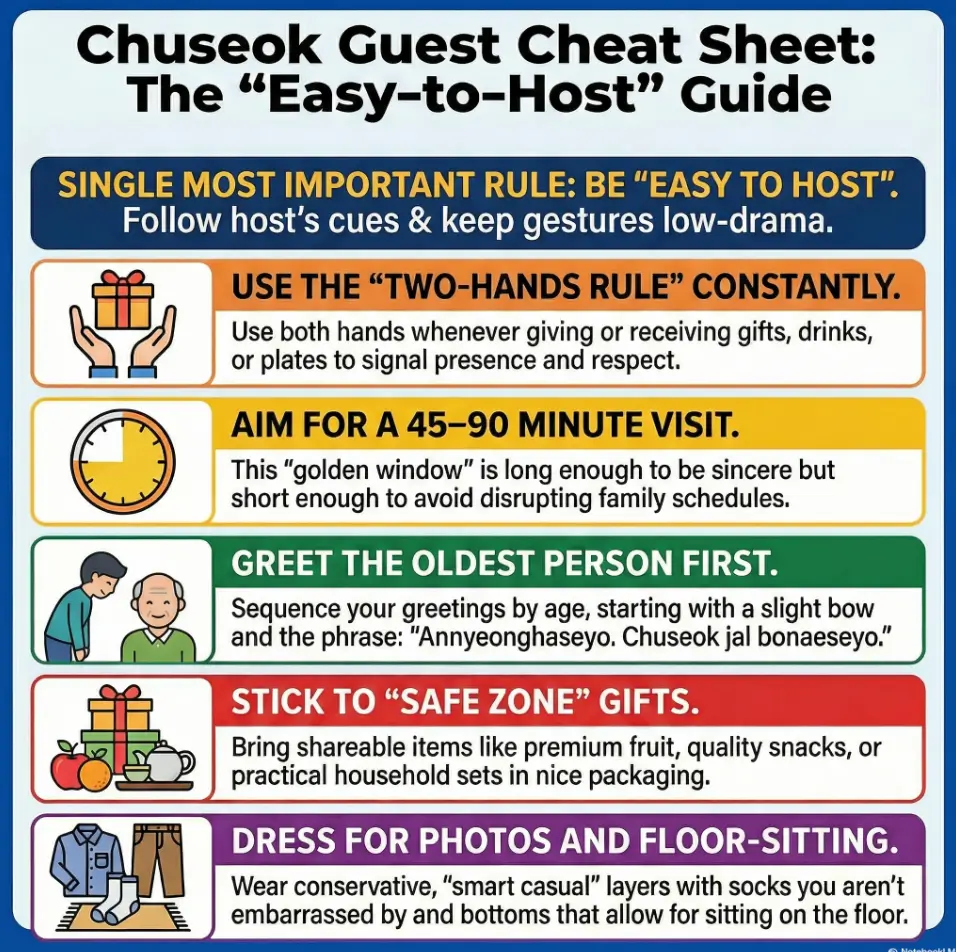
For Chuseok, aim for “warm, respectful, low-drama.” Bring a modest, presentable gift (fruit, premium snacks, or practical sets), greet elders first with a slight bow + polite Korean greeting, and dress neat, conservative, and photo-ready (covered shoulders, closed-toe shoes if you’re unsure). Offer help once (don’t insist), follow seating cues, and avoid loud opinions about politics, money, or family plans.
Table of Contents
Who this is for / not for
For: first-time Chuseok visitors (expats, exchange students, digital nomads)
If you’re invited to “just stop by,” this guide is your seatbelt. It won’t turn you into a Korean auntie overnight, but it will help you avoid the classic bumps: arriving too early, gifting too loud, or accidentally turning a family living room into a debate stage.
For: partners meeting a Korean family (or joining a spouse’s visit)
If you’re meeting parents or grandparents, your goal is not “impress.” Your goal is “easy to like.” That’s often as simple as neat clothes, soft manners, and letting the host steer. (I once tried to be helpful by overexplaining my gift choice. It landed like a TED Talk at a picnic. Lesson learned.)
For: short-stay travelers invited to “just stop by” during the holiday
Short stays have a hidden advantage: expectations are usually lower. You can win with a clean greeting, a sensible gift, and a graceful exit.
Not for: formal ancestral rites (차례 / charye) as a primary participant
If you’re being asked to participate in charye in a formal way, follow the family’s instructions. Charye is a memorial service performed during major holidays, including Chuseok, and every household has its own rhythm and rules. You can still be respectful without trying to “freestyle” ceremony behavior.
Not for: advice that replaces family-specific instructions
If the host says “come at 2, bring nothing,” believe them. This guide is a safety net, not a substitute for your host’s preferences.
- Follow the host’s cues more than your own assumptions.
- Keep gestures warm and “low-drama.”
- When uncertain, do the simpler, quieter version.
Apply in 60 seconds: Send one message asking about timing and whether fruit/snacks are helpful.
Chuseok visit timing rules: arriving, staying, leaving cleanly
The “golden window” for drop-ins (and how to ask without sounding stiff)
Chuseok days can run like a relay race: family A, family B, short rest, repeat. Your best timing is usually a planned window, not a surprise pop-in. Ask like you’re trying to reduce their workload, not like you’re negotiating a treaty.
Try: “What time is easiest for you?” That phrase reads as considerate in any culture.
How long to stay (the 45–90 minute sweet spot)
If you’re not immediate family, 45–90 minutes is often the safest range. Long enough to be sincere, short enough to avoid becoming a scheduling problem. If the vibe is flowing and they keep refilling your cup, you can stretch. If the host keeps glancing at the kitchen or phone, you have your exit cue.
Personal note: I once stayed “just a bit longer” because the conversation felt friendly. Fifteen minutes later, a cousin arrived with three kids and a mountain of food. Suddenly I wasn’t a guest; I was furniture. Don’t be furniture.
Leaving lines that sound natural (without the dramatic “Irish goodbye”)
Leaving is an art. You want a clean ending that doesn’t make people chase you with guilt. The trick is to signal appreciation and reduce their burden.
- “I had a really nice time. Thank you for having me.”
- “I’ll let you get back to your family schedule.”
- “Happy Chuseok. I’m grateful I could stop by.”
Then do the polite round: thank the host, acknowledge elders, and go. No lingering in the doorway while everyone stands, frozen in a social loading screen.
- Yes/No check: Are you invited for a quick visit (casual), or for a formal family ritual?
- If casual, aim for 45–90 minutes unless asked to stay.
- If formal, ask what role you should take (observer vs participant).
Apply in 60 seconds: Text the host: “What time is easiest, and should I plan a short visit or stay for a meal?”
Greetings that land: bow angle, names, and what to say first
The safe opener: one Korean line that almost always works
You want a line that’s polite, easy to pronounce, and hard to misunderstand. This one is reliable:
“안녕하세요. 추석 잘 보내세요.”
(Annyeonghaseyo. Chuseok jal bonaeseyo.) “Hello. Have a good Chuseok.”
If you can add your name once, great. If not, don’t spiral. A warm smile and steady tone do a lot of heavy lifting.
Who to greet first (elder-first sequencing that saves you)
In many Korean households, you greet elders first. It’s not a test; it’s a comfort signal. Look for the oldest person, or the person everyone else is subtly orienting toward. Greet them, then work outward.
Handshake vs bow vs both (and when physical contact feels odd)
A small bow is almost always safe. A handshake is fine if the other person initiates or you’re in a more international context. When in doubt, do bow first, then follow their lead. If a handshake happens, keep it gentle, not “firm American job interview mode.”
Let’s be honest… the hardest part is your hands
Hands create most of the micro-awkwardness: how to hold the gift, when to shake, how to receive something. The simplest fix is what I call the two-hands rule.
A simple “two-hands rule” for greetings and passing items that prevents 80% of micro-awkwardness
When you give or receive something (gift, drink, plate), use two hands. If you’re holding something already, at least touch your wrist or forearm with the second hand. This reads as respectful and attentive without you needing perfect language.
Show me the nerdy details
In many Korean settings, two hands signals “I’m present and respectful.” It’s less about hierarchy theater and more about reducing ambiguity. One-handed passing can read as casual or distracted, especially with elders. Think of it as a social safety feature: fewer misreads, fewer awkward corrections.
Tiny personal confession: the first time I did a two-hand receive for a drink, I felt like I was acting. Then I noticed the room relax. That’s the point. It’s not performance; it’s friction reduction.
If you want a quick confidence boost for titles and polite address, skim this Korean honorifics for foreigners guide before you go. It’s the difference between “I’m trying” and “I’m landing it.”
And if you’re anxious about bowing, this Korean bowing (jeol) primer will calm your angle anxiety fast.
Gift strategy that won’t backfire: what to bring, how much, how to hand it over
Chuseok gift rules are less about “What is correct?” and more about “What creates comfort?” Many Koreans give family holiday gift sets, and you’ll see everything from fruit to practical household sets. The safest gift is something the whole household can share.
The “host type” gift picker: parents, grandparents, coworkers-turned-friends
- Parents (hosting a meal): premium fruit, quality snacks, or a tidy household set.
- Grandparents: fruit is often the least risky; avoid anything too “personal care” unless you know preferences.
- Coworkers-turned-friends: premium snacks, cafe gift sets, or something nicely packaged and easy to share.
Budget ranges that feel normal (without looking flashy)
If you’re worried about looking too cheap or too intense, here’s a practical approach: match your gift to closeness and occasion weight, not your anxiety level.
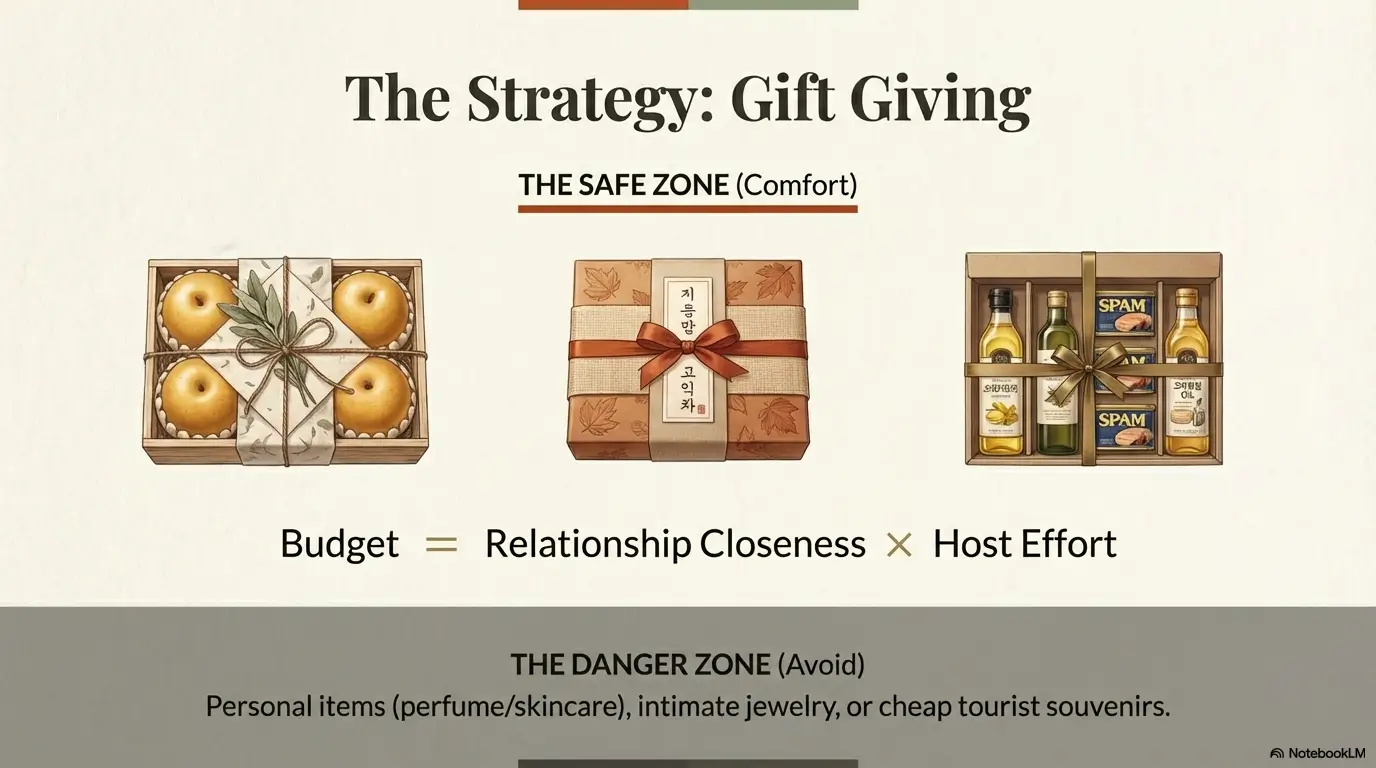
- Mini calculator: Gift budget = (Relationship closeness 1–3) × (Host effort 1–3) × “Your comfort” factor.
- Closeness: 1 = new invite, 2 = dating/close friend, 3 = spouse-level family.
- Host effort: 1 = quick drop-in, 2 = snacks/tea, 3 = full meal hosting.
Apply in 60 seconds: Pick a number combo, then choose from the “safe zone” list below.
What’s inside the safe zone: fruit, premium snacks, household sets
These are common, low-risk categories because they’re shareable and easy to accept without awkwardness:
- Fruit: a well-presented fruit box or premium seasonal fruit.
- Premium snacks: quality cookies, nuts, tea sets, or a tasteful mixed snack box.
- Household/practical sets: cooking oil sets, household care sets, or neatly packaged everyday essentials.
If you’ve browsed Korean stores before Chuseok, you’ve probably noticed how gift sets are packaged like they’re going to a small awards ceremony. That’s helpful. Packaging does half the etiquette work for you.
What to avoid: overly personal items, ultra-cheap “souvenir” vibes, anything too intimate
- Overly personal: perfume, skincare “anti-aging” products, anything that implies judgment.
- Too intimate: jewelry, clothing, or anything that feels like a romantic gesture unless you’re explicitly at that level.
- Too random: “tourist souvenir energy” unless the family loves that kind of thing.
One more quiet hazard: over-gifting. A very expensive gift can create a burden of reciprocity. If you’re tempted to go big, ask the host first.
How to present the gift (two hands, brief line, no long speech)
Hand it over with two hands, say one short line, and stop there. You’re not pitching a product.
Simple line: “A small thing for Chuseok. I hope you enjoy it.”
If you can do Korean: “작은 선물이에요.” (Jageun seonmurieyo.) “It’s a small gift.”
- Fruit if you’re new, unsure, or meeting grandparents.
- Premium snacks if it’s a casual visit and the household is busy.
- Household set if the host is doing a full meal and practicality is valued.
Apply in 60 seconds: Pick one category and commit. Overthinking is how you end up buying “five of everything.”
A small lived-experience note: I once brought a gift that was “cool” but unfamiliar. It became a conversation object… in the wrong way. With Chuseok, boring is beautiful. Let the warmth be the interesting part.
The quiet rules at the door: shoes, bags, and first 60 seconds
Shoes off? Look down first (entryway clues)
Your eyes should go to the entryway like a radar sweep. If you see shoes lined up, slippers nearby, or a small step up into the home, assume shoes off. If you’re not sure, pause and ask:
“Shoes off?” (with a small gesture to your shoes) is universally understood.
I have done the “one step inside with shoes” mistake. The room didn’t explode, but the vibe did a small wince. Save yourself. Look down first.
Where to put your coat/bag (and what not to plop on the table)
Don’t put your bag on the dining table or food surface. Wait for instruction or place it near the entryway neatly. If someone reaches to take your coat, let them. The goal is to reduce their mental load, not wrestle over politeness.
Compliments that don’t sound fake (home, food, travel effort)
Compliments should be specific and low-volume. Pick one:
- Home: “Your home feels so calm and comfortable.”
- Food: “Everything smells amazing.”
- Effort: “Thank you for hosting during a busy holiday.”
Avoid exaggeration. “This is the greatest table in human history” sounds like you’re trying to sell something. Calm sincerity wins.
What to wear: conservative, comfortable, and camera-proof
Chuseok outfits have one hidden job: survive indoor lighting and family photos. You don’t have to wear hanbok. You do have to look like you respect the occasion and the people in it.
Safe outfits for women (neckline, hemlines, fabrics, shoes)
- Top: covered shoulders, modest neckline, nothing too sheer.
- Bottom: midi skirt, tailored trousers, or neat dark jeans if the family is casual.
- Shoes: closed-toe if unsure, socks that match your outfit (you may be barefoot indoors).
- Fabrics: avoid wrinkly linen unless you’re traveling with an iron in your soul.
Safe outfits for men (collar rules, clean sneakers, “smart casual” anchors)
- Top: collared shirt or neat knit; avoid graphic tees.
- Bottom: chinos or dark jeans without rips.
- Shoes: clean sneakers can work if the rest is tidy; otherwise simple loafers.
Weather and travel reality: layers, socks, and sitting-on-the-floor planning
Chuseok weather varies year to year, and travel days can be long. Bring a light layer you can remove indoors. Also: plan for floor seating. Anything too tight or short becomes a “why did I do this” moment when you sit down.
Color and vibe: how to look respectful without dressing like a funeral
Neutral colors, soft tones, and clean lines are safe. You don’t need all black. Think “neat and calm,” not “club” and not “corporate deposition.”
Here’s what no one tells you… photos are the real dress code
If you look neat in indoor lighting and family photos, you’re basically winning. People remember the feeling you brought, and photos are how feelings get replayed.
- Covered shoulders
- Simple neckline
- No loud graphics
- Comfortable when sitting
- Clean, un-torn fabric
- Neutral color
- Closed-toe if unsure
- Clean soles
- Socks you’re not embarrassed by
Operator tip: if you can go from “door greeting” to “family photo” without adjusting anything, you chose correctly.
Table manners that matter: seating, pouring, chopsticks, and the “one-bite test”
Seating logic: don’t choose first unless invited
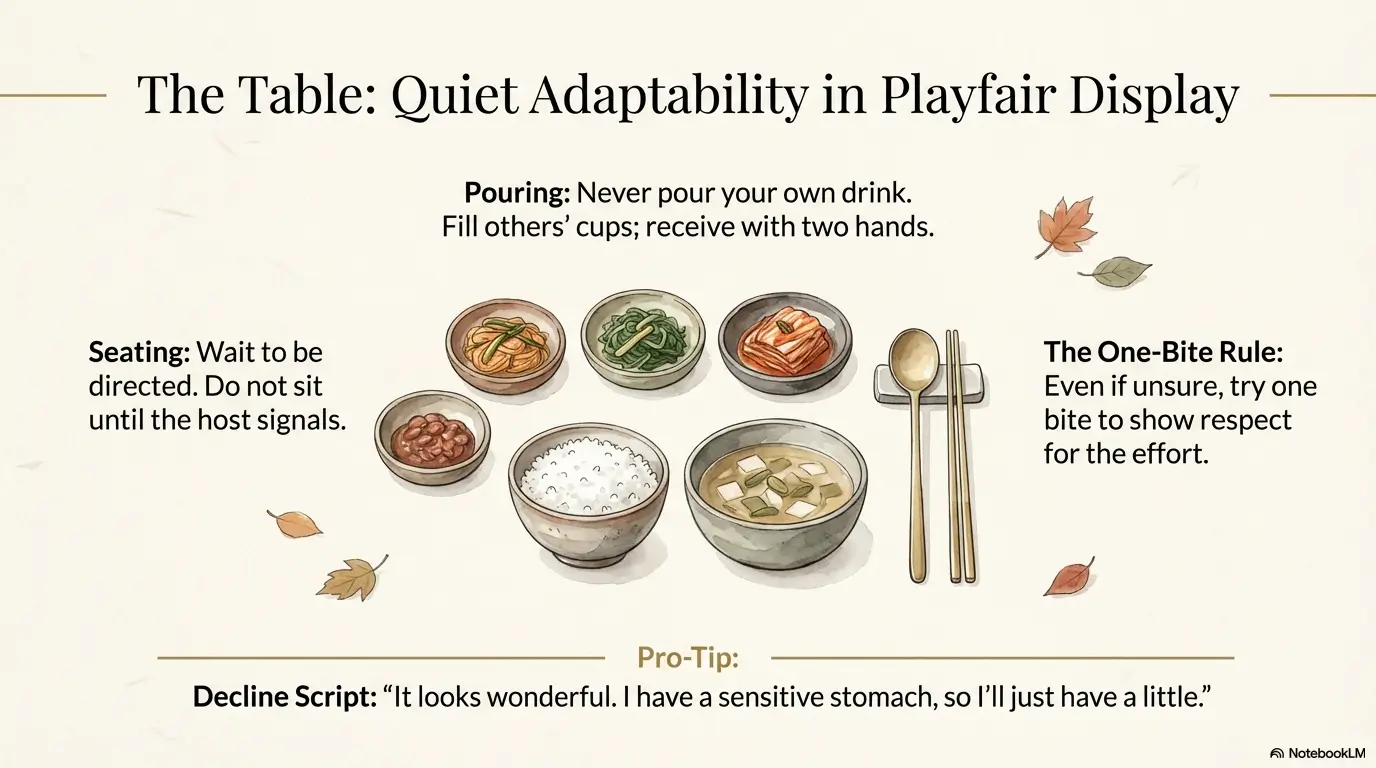
Stand for a second. Let the host direct you. If the seating is on the floor, watch where elders sit first. If someone gestures, take that seat with a small “thank you.” Confidence is good. Taking the “best seat” by accident is not.
Pouring drinks: when to pour, how to receive, when to decline politely
If alcohol is served, pouring etiquette can show respect. Generally, you don’t pour your own drink first. If someone offers, receive with two hands. If you want to decline, do it gently and early. If you want a ready-to-use script menu, this guide on how to refuse alcohol in Korea politely is basically a social seatbelt.
- Soft decline: “I’m taking it easy today, but thank you.”
- Health/energy angle: “I’m a little tired from travel, I’ll pass for now.”
Personal note: the best declines are calm and consistent. If you decline with drama, people will try to solve your drama. Keep it small.
Chopstick landmines: what not to do (and how to recover)
If you’ve heard “don’t stick chopsticks upright in rice,” that’s a useful one to remember because it can resemble ritual offerings in some contexts. If you mess up, don’t panic. Just correct it quietly. Most families care more about your attitude than your chopstick geometry.
The one-bite rule: how to show appreciation even if you’re unsure about a dish
If you’re not allergic and it’s safe for you, take one bite. You don’t have to love it. You just have to show respect for effort. If you truly can’t, use a gentle explanation and pivot to appreciation:
“It looks wonderful. I have a sensitive stomach, so I’ll just have a little.”
Bonus table-confidence builder: knowing small “refill/extra” norms helps you read the room. This quick explainer on Korean banchan refill rules is handy if you’re eating with people you want to impress softly.
- Let others sit first; accept guidance.
- Use two hands for receiving/pouring when relevant.
- Try a small bite if you can, and praise the effort.
Apply in 60 seconds: Decide your alcohol plan before you arrive (yes, no, or “one and done”).
Conversation safe lanes: topics that build warmth (and ones that crack the floor)
Safe topics: food, hometowns, travel, work in broad strokes, compliments on effort
If you want the room to feel warmer because you entered it, choose topics that create connection without creating debate:
- Food you’ve enjoyed in Korea (keep it positive)
- Your hometown and what you miss (one detail, not a monologue)
- Travel effort: “It must be a busy holiday for everyone”
- Work in broad strokes: “I work in ___, it keeps me busy”
Topics to sidestep: politics, money, marriage timeline, family conflicts
During family holidays, some topics are gasoline. Even if you’re right, you’ll still smell like smoke. If someone brings up politics or money, steer back to neutral ground with a soft pivot:
Pivot line: “That’s a big topic. I’m still learning Korea. By the way, this food is amazing, what’s in it?”
If you want to understand why that gentle pivot works so well in real Korean rooms, this guide to Korean indirect communication puts language to the vibe without turning you into a robot.
How to answer personal questions without oversharing (soft boundaries script)
Sometimes you’ll get personal questions (job, salary range, marriage plans). You can answer warmly without handing over your private diary. Use the “small answer + gratitude + redirect” structure:
- Small answer: “We’re taking things step by step.”
- Gratitude: “Thank you for caring.”
- Redirect: “How do you usually spend Chuseok?”
If you want extra “what do I say when they ask X?” scripts, this breakdown of Korean personal questions etiquette is the cleanest way to stay warm without over-sharing.
Short Story: The day I learned “warm + vague” is a superpower
On my first holiday visit, a well-meaning aunt asked a question that felt like a spotlight: “So, when are you two getting married?” My brain offered two terrible options: a detailed explanation of modern relationship timelines, or a panicked joke. I chose a third option that I didn’t know existed yet. I smiled, bowed my head slightly, and said, “We’re really happy, and we’re taking things step by step.
Thank you for caring about us.” Then I turned the spotlight away from myself and toward her: “How was Chuseok when you were younger?” Her face changed. She softened. She told a story about making songpyeon and sneaking extra sesame filling as a kid. The room warmed up like a kettle finally catching. Later, my partner whispered, “That was perfect.” I didn’t feel perfect. I felt relieved. But relief counts.
Common mistakes foreigners make at Chuseok (and how to fix them fast)
Mistake: bringing nothing (or bringing something too “random”)
Fix: bring something shareable and presentable. If you already arrived empty-handed, don’t apologize for ten minutes. Say thank you, be helpful once, and follow up later with a small gesture (a message or a modest gift) if appropriate.
Mistake: wearing “too casual for the photo”
Fix: keep a backup layer in your bag if you’re traveling. A neat cardigan, a clean overshirt, or a simple scarf can upgrade you quickly.
Mistake: over-helping in the kitchen (insisting creates friction)
Fix: offer once, then accept the answer. In some homes, the host will say “no” because they want you to rest. In others, they’ll happily hand you a task. Your insistence can create a new task: managing you.
Mistake: refusing food too strongly (a gentle decline beats a hard “no”)
Fix: use “a little” language. “Just a little, thank you.” Or “It looks great, I’ll try a small amount.” Hard refusals can sound like rejection of effort.
Mistake: leaving without a closing thank-you (and skipping elders)
Fix: do a quick gratitude loop. Thank the host, acknowledge elders, and wish them well for the holiday. Then exit cleanly.
- Ask the host: time, duration, shoes, and whether a gift is helpful.
- Pack: neat socks, a backup layer, and a small phrase or two.
- Plan: one safe topic + one graceful exit line.
Apply in 60 seconds: Write your exit line now. Future-you will thank you.
Don’t do this at the door: 9 quick “avoid” moves
Don’t: step into the home with shoes on “just for a second”
Even a single step can feel jarring. Pause. Look down. Ask if unsure.
Don’t: put your gift on the floor or toss it on the table
Hold it neatly, offer it with two hands, and let the host decide where it goes.
Don’t: sit first, eat first, or pour your own drink first (unless told)
Wait for cues. It’s not about rank; it’s about flow.
Don’t: joke about Korean stereotypes or compare cultures competitively
This is not the time for “In my country we do it better.” Keep humor gentle and self-directed.
Don’t: get loud, overly tipsy, or overly affectionate in front of elders
Public affection norms vary by family. Keep it modest unless the room signals otherwise.
- Don’t overshare your opinions on politics or social issues.
- Don’t interrogate family members about private matters.
- Don’t correct someone’s English or pronunciation.
- Don’t turn the visit into content creation without asking (photos/videos).
Next step: one action that makes everything easier
Text your host this 2-line message (copy/paste) to confirm timing + gift expectations
This is the cheat code. It turns guesswork into certainty, and certainty into calm behavior.
“Happy Chuseok! What time should I come by, and is there anything you’d like me to bring (fruit/snacks)? I want to make it easy for you.”
If you want an extra-safe version for a newer relationship, add one sentence: “Please tell me what’s best for your family.” That line reads as humble, not clueless.
If you’re sending this through chat, it helps to know the unspoken “read receipts, timing, and tone” norms. This quick KakaoTalk etiquette guide can prevent accidental double-text chaos.
FAQ
Do Koreans open gifts immediately during Chuseok visits?
Often, gifts are received politely and may be opened later, especially with elders or in more formal households. Don’t pressure the moment. If they open it immediately, smile and keep your reaction calm and appreciative.
What’s an appropriate Chuseok gift for a boyfriend/girlfriend’s parents?
Choose something shareable and presentable: premium fruit, quality snacks, or a practical set. Keep it tasteful, not intimate. If you’re unsure, ask your partner what their parents actually like.
How much should I spend on a Chuseok gift in Korea?
Aim for a budget that communicates respect without creating a burden. Relationship closeness and host effort matter more than a specific number. When in doubt, pick a “safe zone” gift category and keep the presentation neat.
What should I say when I meet Korean grandparents for the first time?
Keep it simple and warm: “Hello, nice to meet you. Have a good Chuseok.” A slight bow helps. Speak slowly, smile, and let your partner handle any longer explanations.
Is it rude to refuse food during Chuseok?
A hard “no” can feel like rejecting effort. A gentle approach works better: “I’ll try a little,” or “It looks wonderful, I’ll have a small amount.” If you have dietary limits, say so calmly and early.
Do I need to bow, and how deep should I bow?
A small, respectful bow is generally safe. You don’t need a dramatic angle. Think of it as a brief nod with intention. If others bow deeper, follow their lead without turning it into a performance.
Can I wear jeans to a Chuseok family visit?
Sometimes yes, if they’re dark, clean, and paired with a neat top. The safer default is smart casual. If you’ll be in family photos, slightly more polished usually ages better.
Should I bring cash (like a red envelope), or is that awkward?
Cash can feel awkward in many family visit contexts unless there’s an established tradition (for example, giving money to younger relatives within the family). For most foreign guests, a shareable gift set is simpler and safer. If you’re trying to understand “cash gifting” in Korea more broadly, this guide to Korean wedding cash gift etiquette explains the logic and the social edges clearly.
What time should I arrive for a Chuseok visit?
Ask the host. Holiday schedules vary widely. If it’s a casual stop-by, arriving within the agreed window and staying 45–90 minutes is a reliable default.
How do I politely leave a Chuseok gathering?
Thank the host, acknowledge elders, and use a line that reduces burden: “I’ll let you get back to your family schedule.” Then leave cleanly, without lingering in the doorway.
Wrap-up: leave a good echo
If you remember nothing else, remember this: Chuseok etiquette is mostly about reducing stress for the host. You do that with timing, neat presentation, elder-first greetings, and calm social energy. You don’t need to be flawless. You need to be considerate in ways the room can recognize quickly.
One last truth from the official side of things: Chuseok is widely understood as a harvest holiday and a major time for family gathering, and many families also connect it with ancestral remembrance and traditional foods like songpyeon. Knowing that helps you read the emotional temperature. When a holiday carries meaning, your “small respect signals” land bigger.
Your next step, within 15 minutes: copy the host text template, confirm timing, and pick one gift from the safe zone. Then stop. The rest is simply being present, smiling, and letting the family lead.
Last reviewed: 2026-02-26