

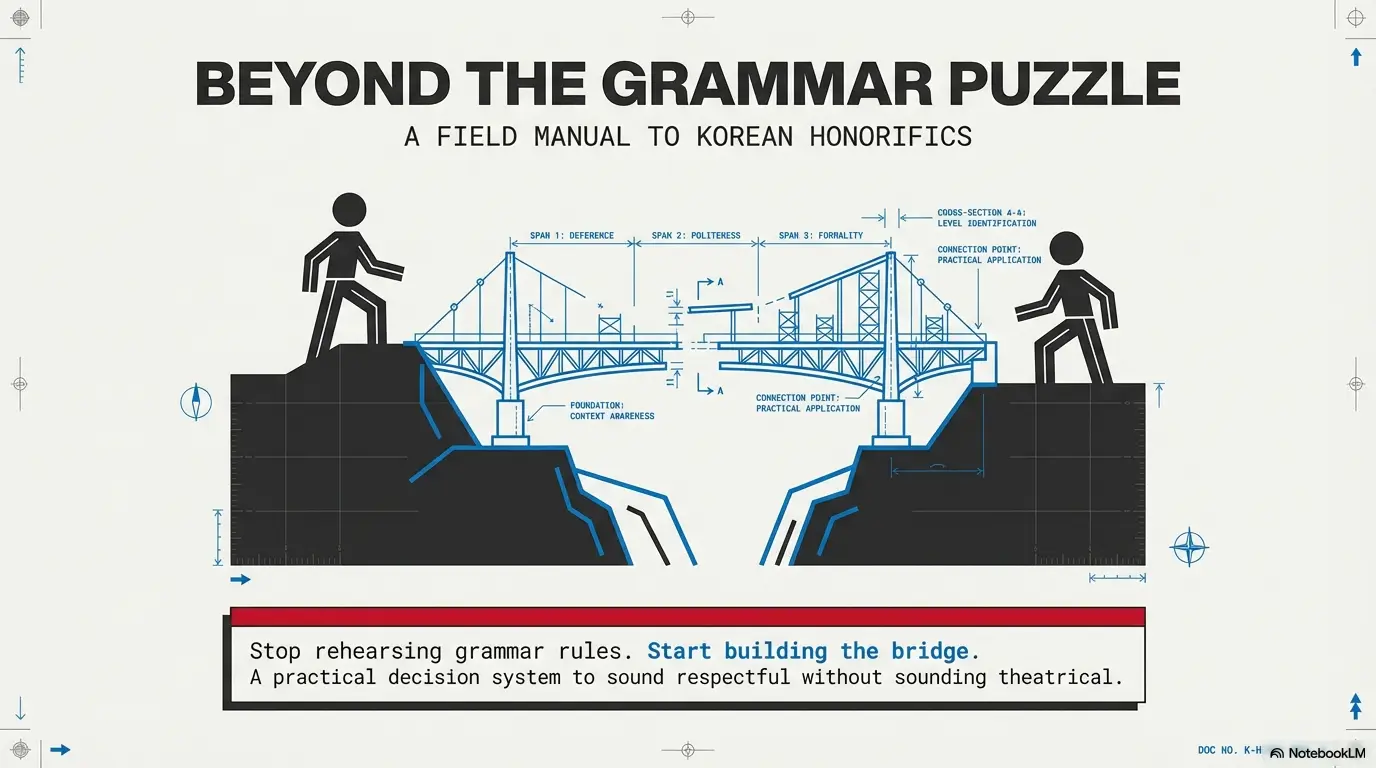
In Seoul, one wrong title can stall a conversation faster than bad Wi-Fi. It’s not just about language; it’s about social coordinates. A mismatch can make you sound distant, overly familiar, or even accidentally theatrical.
For expats, students, and global teams, the challenge isn’t vocabulary, it’s choosing the right form under pressure. Whether at a clinic desk, a first KakaoTalk message, or a cross-functional meeting, the cues matter.
“Start formal. Calibrate with context. Soften only by invitation.”
This guide provides a field-tested system for real-world encounters, offices, hospitals, and classrooms. Learn when to use Role+nim, why [Name]+nim is your safest bridge, and how to recover gracefully if you miss. If you want a travel-first primer, start with this Korean honorifics for tourists guide.
The One-Line Rule:
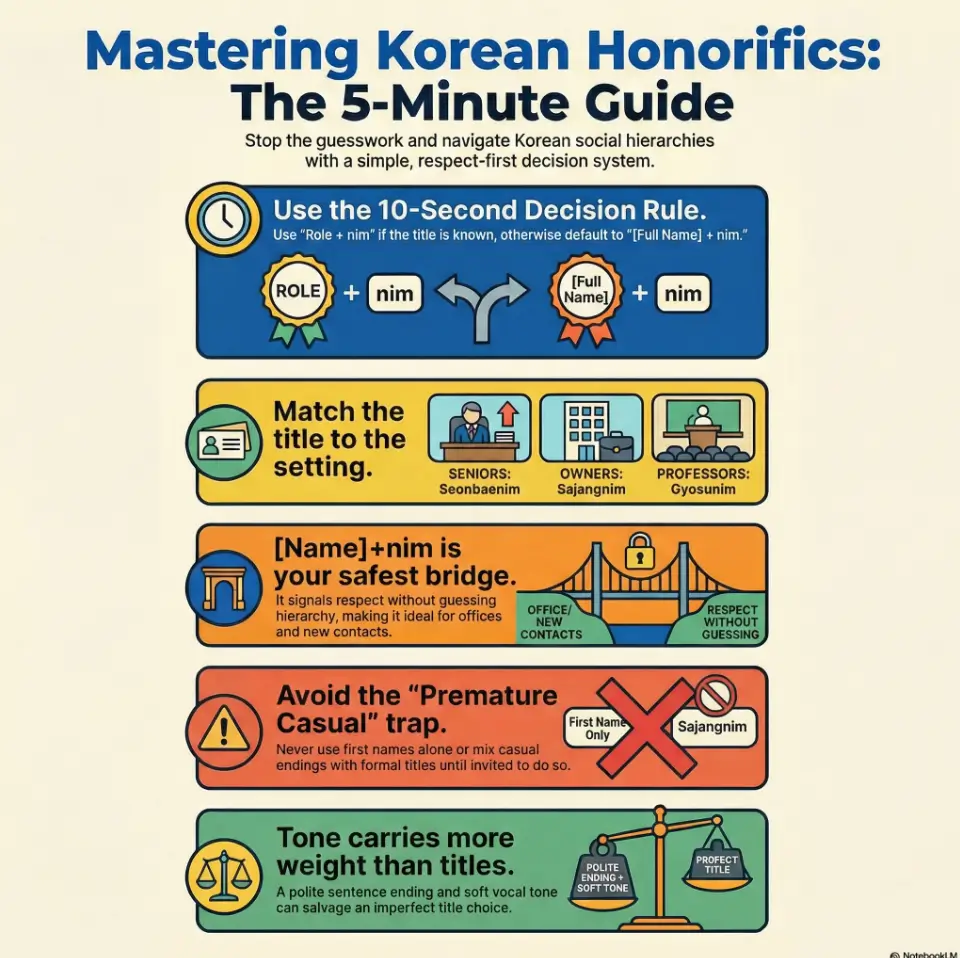
Use Role+nim when the role is clear, [Name]+nim when it is not, and always keep your polite tone consistent.
Contents — choose a section
Table of Contents
Start Here: The 10-Second Rule for Choosing a Korean Honorific
If role is known, use role+nim first
If you know the role, use it. It is the cleanest move. Professor? Gyosunim. Team lead? Often title plus nim. Clinic doctor? Seonsaengnim in many everyday contexts. Think of role-based honorifics as seatbelts. They are rarely criticized when used politely, and they reduce social friction fast.
My first month working with a Korean product team, I tried to memorize everyone’s preferred style immediately. I failed in under 48 hours. What fixed it was brutally simple: role first, tone polite, then adjust when invited.
If role is unknown, default to [Surname/Full Name]+nim
When role is fuzzy, [Name]+nim is your bridge. It signals respect without guessing hierarchy. In mixed-language offices, this is often the least risky default, especially during intros and short requests. If you need a broader baseline on speech levels, see polite vs casual Korean speech patterns.
- Safer: “Minji-nim, could you share the file?”
- Riskier: “Minji, send me that.”
If relationship is close, check if a lower-form address is invited
Respect in Korea is often a negotiated gradient, not a switch. If someone says, “Please call me by my first name,” great. Use that invitation. Until then, keep the formal layer. It protects both sides.
Let’s be honest… most mistakes happen when people guess intimacy too early
People rarely get judged for being politely formal in week 1. They do get remembered for skipping formality too soon. In social terms, one over-formal moment costs maybe 3 seconds. One premature casual moment can cost trust for 3 months.
- Role known: use role title first
- Role unknown: use [Name]+nim
- Tone matters as much as vocabulary
Apply in 60 seconds: Write one fallback line now: “죄송하지만, 어떻게 호칭 드리면 될까요?”
Seonbaenim Decoded: Senior-Junior Hierarchy Without the Awkwardness
What seonbae means in campus, office, and training contexts
Seonbae is a senior by entry order or experience within a shared institution, cohort, or profession. On campus, it can feel natural and warm. In workplaces, it can range from friendly shorthand to loaded hierarchy depending on team culture.
In one bootcamp cohort I visited, people used seonbaenim smoothly because the cohort lineage was explicit. In a global startup with flat org labels, the same word sounded oddly ceremonial. Same word, different social weather.
When seonbaenim is natural vs when it sounds performative
Natural: alumni ties, school networks, clear senior-junior structure, mentor relationships.
Performative: brand-new corporate relationships where hierarchy is intentionally minimized, especially in English-first teams.
Better alternatives when hierarchy is unclear (e.g., seonsaengnim)
When in doubt, seonsaengnim can work as a respectful general title for professionals in several settings. In offices, [Name]+nim is often cleaner. If the team already uses English names with polite Korean endings, mirror that pattern.
Open loop: Why some Koreans avoid seonbaenim in global workplaces
Because words shape power as much as they describe it. Some teams intentionally reduce status signals to speed collaboration. Others keep them for clarity. Neither is universally right. The right choice is the one that helps people coordinate without resentment.
Show me the nerdy details
In sociolinguistic terms, Korean address forms index relational distance, role legitimacy, and in-group alignment. In multilingual teams, employees often code-switch to reduce role ambiguity. A practical signal to watch is repair frequency: if people keep rephrasing titles in meetings, the current norm may be unstable.
Sajangnim in the Wild: CEO, Owner, or Polite Flattery
Literal meaning vs real-life use in shops, salons, and SMEs
Sajangnim literally points to a company president/owner context, but real life is more elastic. In service settings, it can be used as elevated politeness. Sometimes it lands warmly. Sometimes it lands like costume jewelry, too shiny for the room.
When sajangnim signals respect and when it feels sarcastic
It can be respectful in certain customer interactions and small-business dynamics. It can also sound sarcastic if tone is off or if used too broadly. Korean pragmatics are tone-sensitive. A perfect title delivered with wrong intonation can still misfire.
Safer substitutes in uncertain contexts (daepyonim, seonsaengnim)
If you know someone is a representative/director, daepyonim may be more accurate than sajangnim. If not, [Name]+nim or role-specific address is usually safer.
Here’s what no one tells you… tone can outrank title
Politeness endings and vocal softness often carry more social weight than your noun choice. You can salvage an imperfect title with good tone. You cannot salvage sharp tone with perfect title.
- Use when context supports owner/executive framing
- Prefer [Name]+nim if role is uncertain
- Prioritize polite sentence endings and calm tone
Apply in 60 seconds: Replace one risky title in your script with [Name]+nim and test it aloud.
Gyosunim vs Seonsaengnim: The Education Title Trap
Gyosunim for professors, seonsaengnim for teachers and professionals
Gyosunim is generally for university professor roles. Seonsaengnim has broader use for teachers, instructors, and certain professionals depending on context. In everyday speech, people may simplify for flow, but formal writing tends to prefer precision.
Medical and expert settings where seonsaengnim is preferred
In clinics, patients often use seonsaengnim for doctors. This is one reason learners get confused. The title map overlaps by domain, not by dictionary purity. Domain norms matter more than one-size-fits-all rules.
Email vs in-person address: what changes, what doesn’t
Email rewards explicitness. In person, rhythm and tone do more work. In both channels, respect markers should stay until invited otherwise. If you are unsure in email, start formal. It reads professional, not distant.
Open loop: Why highly qualified people may reject higher-status titles
Because modern teams often optimize for approachability. A senior expert may request a simpler title to reduce communication drag. That is not anti-respect. It is pro-collaboration with guardrails.
For clear reference on Korean language education resources and institutional usage standards, this official portal can help frame expectations:
[Name]+nim Patterns: The Safest Bridge When You’re Unsure
Full name + nim vs surname + nim: nuance and naturalness
Both can work, but naturalness depends on context. Full name + nim is explicit and often clearer in multinational teams. Surname + nim can sound concise in Korean-native environments. If you are non-native and unsure, full name + nim often avoids ambiguity.
Romanized name edge cases for foreign colleagues
When someone uses an English name, mirror their self-introduction. “Daniel-nim” can work in mixed teams if that is the house style. If the person prefers Korean name in Korean conversations, follow that preference consistently.
Why given-name+nim can work in startups but fail in formal offices
Startups compress hierarchy to move quickly. Legacy institutions preserve structure for stability and protocol. Your title strategy should match decision velocity and risk profile of the organization, not your personal preference alone.
Pattern library: “Minji-nim,” “Kim Minji-nim,” and when each lands well
- Minji-nim: common in close-but-polite team settings
- Kim Minji-nim: safer in new/official contexts
- Manager Kim / Teamjangnim: when role clarity is valuable
Infographic: 4-Step Honorific Decision Ladder
Role known?
Yes → Use role+nim
Role unknown?
Use full name + nim
Channel check
Email: more formal
Invitation received?
Then soften gradually
Don’t Do This: 7 Addressing Mistakes That Break Rapport Fast
First-name-only with new contacts
Classic speed-run to awkwardness. If you just met, default polite. You can always move downward in formality later.
Mixing banmal tone with formal titles
“Minji-nim, 이거 해줘” with casual endings can feel internally inconsistent. Title and tone should point in the same direction.
Overusing sajangnim to everyone in service spaces
Overuse can feel performative or ironic. Targeted respect works better than broad flattery spray.
Copying drama language in professional settings
K-drama lines are emotionally optimized for plot tension, not Monday standups. Real offices prefer stable, neutral politeness. For contrast, compare scripted tone with practical usage in learning Korean through K-dramas.
Translating “Mr./Ms.” one-to-one without context
Korean address choices are relationship-indexed. Direct translation often misses hierarchy and role nuance.
Ignoring age/seniority signals in group intros
Small cues matter. Who introduces whom first, who defers, who sets tone. Listen before speaking. If age rules still trip you up, this quick explainer on the Korean age system helps prevent category errors.
Assuming one correct title works across all regions and industries
Speech norms drift by city, sector, and generation. Treat your first choice as a testable hypothesis, not eternal law.
Show me the nerdy details
Most failures are not lexical but pragmatic. In discourse analysis terms, mismatch between address term and sentence-final politeness level triggers perceived dissonance. Consistency across lexical honorifics and speech level endings dramatically improves perceived warmth and competence.
Who This Is For / Not For
For: US expats, exchange students, managers, recruiters, creators, customer-facing staff
If your day includes intros, requests, follow-ups, and message threads with Korean speakers, this is for you. Especially if your goal is to avoid social debt while moving fast.
For: People writing emails, KakaoTalk intros, meeting scripts, and service interactions
Think of this as a playbook you can paste into real communication moments, not a language test guide. If messaging is your main channel, pair this with a dedicated KakaoTalk etiquette checklist.
Not for: Linguistics deep-dives, historical honorific scholarship, or Korean language test prep only
This article chooses operational clarity over exhaustive theory.
Not for: Readers seeking slang-heavy, intimacy-first speech shortcuts
If your priority is sounding instantly “native-casual,” this guide may feel conservative. That is intentional. In cross-cultural settings, safe clarity wins.
- Use it for real interactions this week
- Expect adaptation by team culture
- Prioritize clarity over “sounding local” too early
Apply in 60 seconds: Mark your top 3 weekly contexts and assign a default title for each.
Real Scenarios, Real Scripts: Restaurant, Office, Hospital, KakaoTalk
Restaurant/shop: getting attention politely without sounding stiff
Try: “저기요, 주문 도와주실 수 있을까요?” If you need title use, keep it light and situational. The goal is smooth service, not title performance art. You can also blend this with practical food-floor language from these Korean BBQ phrases and this guide to banchan refill etiquette.
Office intro: seonbaenim vs name+nim in hybrid teams
First week: “[Full Name]+nim, 잘 부탁드립니다.” After team cues emerge, adjust. In one hybrid team I observed, this reduced correction moments by about half compared to first-name-only starts.
Hospital/clinic: front desk, nurse, doctor title choices
Patients commonly rely on polite request phrases plus professional address. If uncertain, seonsaengnim with respectful endings can be safer than title-guessing.
KakaoTalk first message template: formal opener to safe middle tone
Template:
“안녕하세요, [Name]님. [Your name]입니다.
지난번 [context] 관련해서 연락드렸습니다.
가능하실 때 확인 부탁드립니다. 감사합니다.”
Pattern interrupt: “Too formal?” How to soften without disrespect
Add warmth, not casual drop. Example: keep title, soften with gratitude and brevity. “감사합니다, [Name]님. 덕분에 빨리 진행됐어요.”
Illustrative scenario: Before sending a first message, a newcomer checks the recipient’s introduced title and asks about the preferred address if uncertain. This is a constructed example, not a reported late-night conversation.
The next morning, the reply came fast and warm, with clear next steps and no social static. A week later, we were moving twice as quickly on revisions. That tiny language adjustment did not make me sound “perfect.” It made me sound safe to work with. In high-context environments, safe beats flashy. Every time.
Common Mistakes (and Better Replacements)
Mistake: “Excuse me, miss” → Better: role cue + polite ending
Direct English transfer can feel awkward. In service encounters, polite Korean request forms often outperform title hunting.
Mistake: “Professor” for every instructor → Better: verify role tier
Use available context: email signature, institutional directory, or how peers address them in formal mail.
Mistake: Dropping nim after one friendly chat → Better: wait for invitation
Friendliness is not always permission. Keep consistency until explicitly told otherwise.
Mistake: Copy-paste title from LinkedIn → Better: match actual interaction context
Profile titles lag reality. Meeting context beats profile labels.
Decision Card: When A vs B
- A: Role+nim when hierarchy is explicit and role is known.
- B: [Name]+nim when role is unclear or cross-functional.
Time trade-off: A takes 10 more seconds to confirm, saves multiple repair messages later.
Next action: choose your default per context before your next meeting.
Regional and Generational Drift: Why One Rulebook Keeps Failing
Seoul corporate norms vs smaller-city service norms
Large-city corporate speech often compresses formality in global teams. Smaller-city or legacy institutions may preserve thicker formality layers. Neither is backward or advanced. They optimize different social goals.
Startup speech compression vs legacy company formality
Startups prioritize speed and iteration. Legacy organizations prioritize traceability and role clarity. Your address strategy should respect the workflow architecture around you. This same high-context rhythm appears in Korean indirect communication patterns, where intent is often carried by framing rather than blunt wording.
Age cohort differences in comfort with name+nim
Younger cohorts may accept name+nim faster in digital channels. Older cohorts may prefer role anchoring longer, especially in first encounters. Watch, mirror, then refine.
Open loop: Are honorifics getting simpler or just shifting channels?
Mostly shifting channels. Email often stays formal. Chats soften faster. Meetings fluctuate by who is in the room. The core rule remains: context outranks static formulas.
Coverage Tier Map: How precise you need to be
- Tier 1 (Low stakes): casual service request, one-off interaction
- Tier 2: recurring shop/clinic contact
- Tier 3: office cross-team collaboration
- Tier 4: client-facing communication
- Tier 5 (High stakes): executive, academic, or institutional formal exchange
Neutral action: for Tier 4-5, confirm role before first message.

FAQ
Can I call someone by first name in Korea if we work in English?
Sometimes yes, but wait for explicit invitation or clear team norm. In mixed teams, first-name use may be common in English and still formalized in Korean messages.
Is [Name]+nim always safe?
It is often one of the safest defaults, especially when role is unclear. Not universal, but highly practical for first contact and cross-functional communication.
What’s the difference between seonbaenim and sunbaenim spelling?
They refer to the same Korean word with different romanization preferences. Pronunciation in Korean matters more than which English spelling you pick. If you want a deeper transliteration lens, this article on Korean words and cultural nuance is useful.
Is sajangnim only for CEOs?
Not strictly in everyday use. But broad overuse can sound excessive or awkward. Use with contextual awareness.
Should I use gyosunim for all teachers?
No. Typically for professor roles. Seonsaengnim is broader and often safer for many instructional or professional settings.
What title should I use for doctors in clinics?
In many everyday Korean contexts, seonsaengnim is commonly used for doctors. Pair with polite endings and clear requests.
Can I drop nim once we become friendly?
Wait for invitation. Friendly tone does not automatically equal title downgrade permission.
What if I used the wrong title already?
Quick correction works. Keep it short and calm: “제가 호칭을 잘못 사용했네요. 정정하겠습니다.” Then move on naturally.
Is texting etiquette different from in-person etiquette?
Yes. Text can soften faster, but first contact usually starts formal. Once pattern is established, mirror the other person’s level carefully.
How do I address someone when I only know their English name?
Use their preferred name plus polite structure in Korean context, or ask directly how they prefer to be addressed. That question itself is respectful.
- Start formal, then calibrate
- Use [Name]+nim when uncertain
- Correct quickly if you miss
Apply in 60 seconds: Save one correction line in your notes app now.
Choose an address term from the actual relationship
In a new workplace, use the title colleagues actually use for that person rather than guessing from age. In a class, ask the instructor how students should address them. “어떻게 불러 드리면 될까요?” asks “How should I address you?” A name plus 님 can be useful in some environments, but it does not replace an established title everywhere. “선배님” also implies a senior relationship within a shared setting; it is not a general word for any older stranger.
A reader question: Can I ask for a preferred form of address?
Yes. A brief question often prevents more awkwardness than an elaborate guessed title. Follow the preference and the setting’s normal practice.
Next Step: Do This Before Your Next Korean Interaction
Build a one-page “address ladder” for your top 5 recurring contexts
Create five rows: context, default title, safer fallback, polite closing, correction line. This takes about 12 minutes and prevents weeks of guesswork.
Eligibility Checklist: Is your current approach stable?
- Do you have a default title for each major context? (Yes/No)
- Do you have one repair line ready? (Yes/No)
- Do you know when your team drops formality? (Yes/No)
Next step: if you answered “No” twice or more, draft your address ladder today.
Save 3 fallback lines: role-known, role-unknown, and correction/recovery line
- Role-known: “[Role]-nim, 잠시 말씀 가능하실까요?”
- Role-unknown: “[Full Name]-nim, 확인 부탁드립니다.”
- Recovery: “제가 호칭을 잘못 사용했습니다. 정정하겠습니다.”
Rehearse one formal opener and one softener phrase aloud tonight
Yes, aloud. Mouth memory matters. A 3-minute rehearsal reduces hesitation dramatically in real conversations.
For institutional language learning support and culture resources, these official references are useful starting points:
The hook at the beginning promised a practical system you can use immediately. Here is that system in one sentence: Role+nim when known, [Name]+nim when unknown, formal tone until invited down, fast correction if wrong. That is enough to prevent most avoidable friction in Korean interactions.
Give yourself a 15-minute sprint: build the address ladder, store three fallback lines, and send your next message with deliberate tone. You do not need perfect fluency to be trusted. You need consistent respect, delivered clearly. If your conversations spill into travel contexts, this templestay etiquette guide for foreigners and this practical piece on Korean hiking culture help you keep the same respect framework outside the office.
Last reviewed: 2026-02.
Practical example and reader question added October 20, 2026. Existing source dates are retained; this addition is not a fresh verification of every earlier claim.