
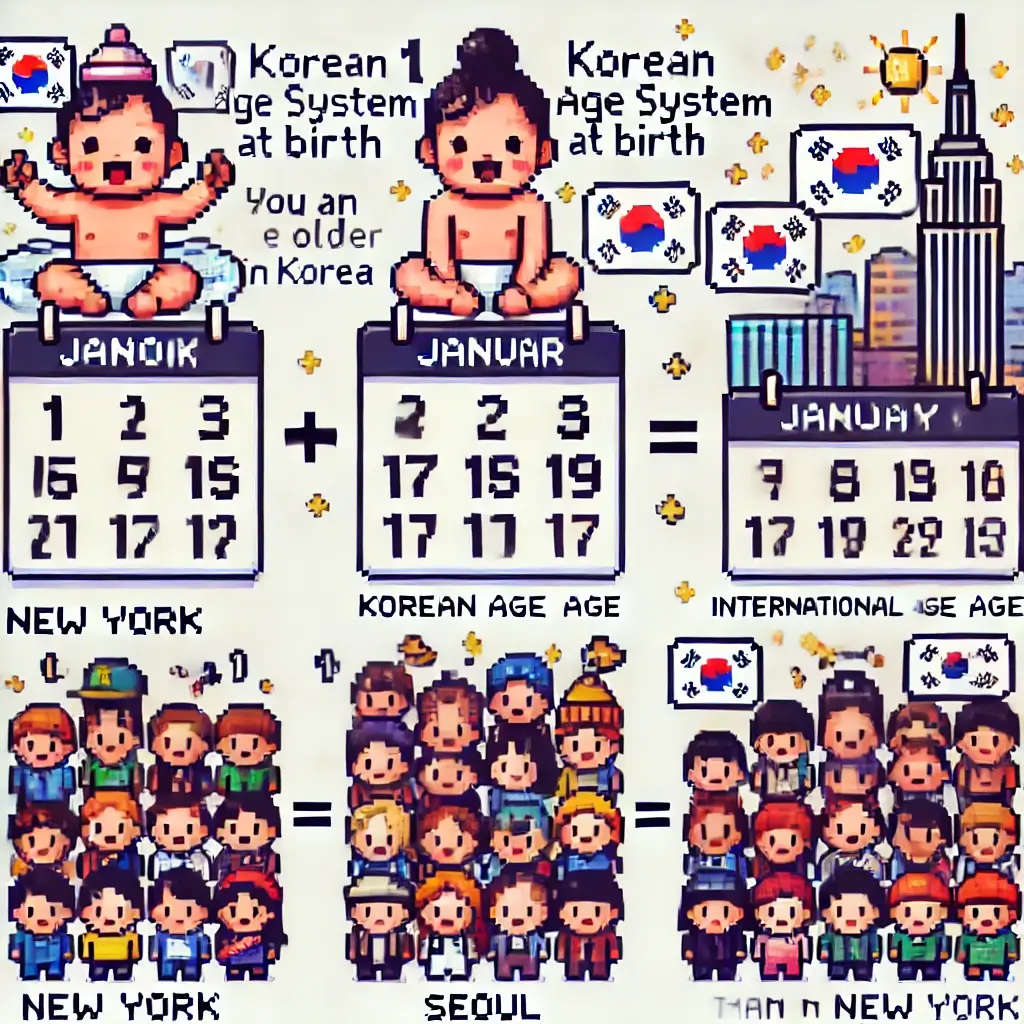
Korean Age System Explained: 21 Reasons You’re “Older” in Seoul Than in New York
Table of Contents
Midnight Confession — Korean Age System Explained While My Coffee Gets Cold
I am writing this with a half mug of coffee that tastes like regret and ambition mixed together.
I once tried to explain the Korean age system to a friend at 1 a.m., and by 1:07 a.m. we were Googling our birth years like two detectives who’d lost the plot.
Then we did what all tired adults do when numbers get emotional.
We blamed the calendar.
The truth is that the Korean way of talking about age wasn’t made to confuse you, but it will, especially if you measure life in birthday cakes and not New Year gongs.
So tonight you’ll get the Korean Age System explained like we’re sitting in a tiny Seoul café where the spoons clink and the auntie refills your water without asking because she can see you’re struggling with math and feelings.
Beginner Map — Korean Age System Explained in One Bowl of Soup
Here is the simple story if you only have time to sip soup and nod bravely.
In the traditional Korean system, you are considered one year old the moment you are born.
When the calendar flips to January 1, everybody adds one more year together like a nationwide group text that says “Level up.”
If you were born on December 31, you can be two years old by January 1, even though you’ve only experienced twenty four hours of Netflix and naps.
That is the heart of the confusion and the charm, depending on your personality and your relationship with birthdays.
The global “international age” system counts your age from zero at birth and adds one year each birthday, which is what New York and most of the world follow when they ask for your ID and judge your skincare routine.
Two different clocks are telling your story at once, and that is how your age can change at the airport even if your face doesn’t.
Why You’re “Older” in Seoul Than in New York — Korean Age System Explained
Imagine age as a sweater you put on as soon as you enter the world.
In Korea, the sweater arrives with a tag that already says “1.”
Then everyone gets a new sweater label on January 1, so the neighborhood toddlers level up together, and the grandparents smile because time is a community event, not just a solo party with candles.
In New York, your sweater starts at “0,” and it changes only on your birthday, which means the world spins around you like a spotlight while you bite a cupcake and pretend the frosting is a personality trait.
Because of those two logics, stepping into Seoul can add one or even two to your label, especially if it is January and your birthday hides somewhere later in the year.
You do not instantly grow extra wisdom or knee pain, but numbers have a way of convincing your knees to play along anyway.
The 2023 Legal Shift — Korean Age System Explained Without Tears
Here is the plot twist that calms some people and annoys others in a very specific way.
As of June 2023, South Korea standardized most official paperwork and legal contexts to “international age.”
That means for legal and administrative matters, the country generally uses the same method as New York, London, or your favorite online shopping cart.
However, culture is not a switch you flip once and forget.
In everyday conversation, in family chat threads, and in those moments when hierarchy or respect matters, many people still casually use the traditional way or at least refer to it with a wink.
You will still hear someone call themselves “thirty Korean age” at a dinner table, then hand a passport to a customs officer that says a younger number, and both facts will be true in their own ecosystems.
That is not hypocrisy.
That is how cultures informally keep rituals alive while aligning official life with global standards and airline counters.
Practical Life Moments — Korean Age System Explained for Daily Chaos
Let’s walk through real situations so your brain can relax and your calendar can stop yelling.
You sit down at a Korean barbecue and someone older by one traditional year reaches for the grill tongs first, because seniority is a vibe and a duty here.
At the hospital counter, the form uses your international age and the nurse smiles because your numbers got shy but your symptoms showed up on time.
At a company meeting, you might hear titles that reflect seniority, and that seniority might correlate with a mix of birthday order, entry year, and that traditional sense of who was technically “older.”
Meanwhile, the HR system calculates vacation eligibility with the international method and your tired soul accepts both truths because the paycheck says so.
On social media, a friend caption says “Thirty one in Korean age today,” and the comments include both heart emojis and detailed math from cousins who treat birthdays like competitive sports.
Conversion Cheat Sheet — Korean Age System Explained With Math You Can Forgive
Here is the friendliest way to convert without turning your kitchen whiteboard into a crime drama.
If it is not your birthday yet this year, your traditional Korean age is usually your international age plus two.
If your birthday has already happened this year, your traditional Korean age is usually your international age plus one.
If you were born on December 31 and it is January 1, your traditional Korean age can be two days old and also two, which is mathematically adorable and emotionally unhelpful.
After the 2023 shift, official documents will ask for your international age anyway, so use the conversion mostly for conversations, jokes, and decoding how your aunt ranks the cousins at holiday dinners.
When someone asks your age at a casual event in Seoul, a respectful way to answer is to say your birth year and let the room do its quiet math.
Birth year creates a cohort, and cohorts create warmth and order, like class years at school without the hoodies.
Korean Age System vs International Age — Infographic
International Age
Start: 0 at birth
+1 each birthday
Used in most countries
Legal system in Korea since 2023
Traditional Korean Age
Start: 1 at birth
+1 every January 1
Social & cultural use
Still common in daily life
Conversion Cheat Sheet
| Birthday Status | Traditional Korean Age |
|---|---|
| Birthday has passed this year | International Age + 1 |
| Birthday not yet this year | International Age + 2 |
Example Cases
Case A
Born Oct 10
International: 29
Korean: 31
Case B
Born Jan 5
International: 26
Korean: 27
Case C
Born Dec 31
International: 0 (1 day old)
Korean: 2
Edge Cases and Lunar Confusion — Korean Age System Explained for the Brave
There are moments when the moon gets involved and suddenly everyone is talking about calendars like poets who own calculators.
Some families still celebrate a lunar birthday, which can drift relative to your solar one, and that can add an extra layer of sweet chaos when the group chat tries to plan a cake.
Historically, New Year increments could feel like a collective rhythm anchored to the lunar cycle, even if your office today is powered by Wi-Fi and iced Americanos.
If you move between countries, your digital life will default to international age while your dinner conversations in Korea may hop to the traditional number because it greases the wheels of politeness and storytelling.
Neither of these facts will ruin your taxes, but they might improve your ability to laugh at time as a human invention with a stubborn personality.
Culture and Etiquette — Korean Age System Explained at the Dinner Table
Age in Korea is not just a number for birthday cakes, but a compass for respect, tone, and tiny decisions like who pours whose drink first.
Older people often get honorific speech, and the gradient can be sensitive and beautiful when it works well, and a bit heavy when it doesn’t.
Knowing your relative age can lower the friction of social life because it tells you who should nudge the conversation forward and who gets first pick of the crispy bits.
When you’re the younger one, calling someone “older sibling” style terms can build warmth faster than small talk about the weather.
When you’re the older one, the expectation to look after others can make you a better human on Tuesdays and a bit exhausted on Fridays, which is a fair trade if the soup is good.
International age rules the paperwork, but traditional age still whispers to the etiquette that makes a table feel like a tiny civilization.
Schools, Work, and Forms — Korean Age System Explained Where It Actually Hurts
School cohorts in Korea often organize by birth year and the year you enter rather than the day you hit the cupcake jackpot.
This creates crisp edges around who is a classmate and who is a senior, and those edges can follow you into alumni groups, mentorship networks, and job interviews.
Hiring isn’t supposed to be about age, and modern HR practices try very hard to be fair and legal, but the social memory of who is older can shade expectations in subtle ways, like a filter you didn’t choose but that still flatters your cheekbones.
For visas, contracts, and medical records, the international age now dominates, which makes airport counters kinder and online portals less likely to crash into existentialism.
If a form asks for your date of birth, give it exactly and let the system compute your age, because arguing with a database is how you lose an afternoon you will never get back.
New York vs Seoul Birthday Scenarios — Korean Age System Explained With Shoes On
Picture a traveler who was born on July 2 and lands in Seoul on January 3.
In New York on January 2 they were twenty five, and in Seoul on January 3 they might be twenty seven in the traditional sense, because the country handed out a new label the moment the calendar said “새해 복 많이 받으세요.”
On July 2 they celebrate twenty six internationally and keep twenty seven as the traditional conversational number until the next New Year, which means both numbers can appear in the same week like siblings who insist they’re not related.
If you are born in December, the traditional label can leap quickly and give you bragging rights or fake wrinkles depending on your mood.
If you are born in January, the gap between the systems may be gentler, and you can look smug for twelve months without apology.
Expert Layer and Trends — Korean Age System Explained for Data Nerds
From a systems perspective, the traditional method reduces the granularity of age differences within the same birth year, which simplifies social ranking but can confuse cross border analytics.
The 2023 policy shift harmonized official data with international standards, which improves interoperability with global health, education, and labor statistics.
Culturally, however, the traditional number still functions like an analog metadata tag that helps route respect, humor, and responsibility inside families and teams.
If you model social networks in Korea, you’ll see clusters formed not only by age gaps in years but by birth year cohorts that behave like natural communities with shared rites of passage.
This is why knowing someone’s exact birth date matters less at a barbecue than knowing that you are both “ninety three line,” which makes conversation bloom faster than a spring festival.
For brands and UX designers, displaying birth year alongside international age can reduce friction while gracefully acknowledging how people actually talk.
For policy makers, the takeaway is to separate legal compliance from cultural literacy, and to design communications that honor both without collapsing either into confusion.
Metrics wise, after 2023, longitudinal studies need careful footnotes because participants may self report in traditional terms even as forms log international age, and misalignment can bias interpretations if analysts are sleepy or hungry or both.
Infographic — Korean Age System Explained in a Visual That Won’t Yell at You
International Age
Start at 0 on your birth day.
Add +1 each birthday.
Used by most countries and airlines.
Smooth for forms and software.
Traditional Korean Age
Start at 1 at birth.
Add +1 on January 1 for everyone.
Warm for social ranking and etiquette.
Still heard in daily conversations.
Quick Conversion
If your birthday has not happened yet this year → Traditional ≈ International + 2.
If your birthday already happened → Traditional ≈ International + 1.
Example A
Born Oct 10.
In March 2025: International 29.
Traditional 31.
Example B
Born Jan 5.
In July 2025: International 26.
Traditional 27.
Example C
Born Dec 31.
On Jan 1 next day: International 0 plus 1 day.
Traditional 2.
Big Helpful Buttons — Korean Age System Explained With Sources You Can Actually Read
When you need more than my midnight metaphors, these trusted explainers help you nail the details without calling your math teacher.
🔗 Read the Overview on Wikipedia
🔗 BBC Explainer on the 2023 Change
Beginner, Intermediate, Expert — Korean Age System Explained in Three Layers
Layer 1 — Beginner Feelings First
Begin with the emotional truth that age is not just math but meaning.
The Korean approach front loads dignity for newborns and synchronizes life’s chapters across a whole community, which is strangely comforting in a world where everyone stares at separate screens.
If you only remember one sentence, remember that “Korean age” is a conversational tradition and “international age” is your paperwork personality.
Both can live in peace if you don’t make them compete for your attention like two karaoke tracks playing at once.
Layer 2 — Intermediate Life Hacks
When someone in Korea asks your age, try answering with your birth year first, then add your international age if they look like they enjoy decimals.
If you book a clinic visit or buy tickets, assume the international method unless someone says otherwise in a voice that sounds like a printer.
When you use social apps, set your profile to the international method for clarity, and then shout your traditional number in captions when you feel poetic or when your older cousin needs to feel useful.
In work contexts, read the room and default to respect, which costs nothing and often pays compound interest.
Layer 3 — Expert Deep Dive
Consider how cohort based culture reduces social entropy by narrowing ambiguity around relative seniority, which lubricates coordination at scale in education and early careers.
Note that after 2023, the coexistence of conversational tradition with legal standardization creates a dual track system that is resilient against global friction while preserving local identity.
For data pipelines, explicitly annotate whether self reported ages come from the traditional or international frame, because silent assumptions are where dashboards go to cry.
For intercultural design, use birth year plus international age as a pair, which maximizes clarity with minimal extra cognitive load for the user.
Micro Stories — Korean Age System Explained by People You Might Know
There is a barista who turned “twenty eight” internationally last week and still calls herself “twenty nine” in Korean age because she promised her grandmother she would not break the family arithmetic.
There is a project manager who loves the 2023 change because he can finally align his spreadsheets and his sense of reality without adding footnotes on slides at 2 a.m.
There is a teacher who quietly tracks students by birth year so that class dynamics stay balanced, while report cards use international age because rules are rules and printers are unforgiving.
Mini Playbook — Korean Age System Explained for Travelers and Expats
Save your date of birth accurately in every official account and resist the urge to be clever with digits.
Learn how to say your birth year confidently, because “ninety seven line” is faster than a TED Talk and friendlier than a business card.
Assume the international age for services and legal stuff, and enjoy the traditional number for stories, selfies, and family dinners where the soup is hotter than the takes.
Math Corner — Korean Age System Explained With Gentle Equations
Traditional Age ≈ International Age + 1 if your birthday already happened this year.
Traditional Age ≈ International Age + 2 if your birthday is still coming up this year.
International Age = Current Year − Birth Year − One if you haven’t had your birthday yet, or just ask your phone because your phone knows everything including your snack delivery preferences.
Common Misunderstandings — Korean Age System Explained So Your Group Chat Stops Fighting
“Korea changed the age system, so no one uses the old way.”
That is not quite true because culture keeps singing even when the law changes the key.
“Traditional age is illogical.”
It is perfectly logical within a frame that prioritizes community rhythm over individual candles.
“Only grandparents use it.”
Also not true, because slang evolves and young people love inside jokes that travel across generations like hand me down hoodies.
FAQ
Q1. Does the 2023 change mean I am officially younger now.
A1. In most legal and administrative contexts, yes, your official age is calculated the international way, but your friends might still tease you with the traditional number because friendship is a sport.
Q2. Which age should I say in a job interview.
A2. In a modern professional setting, people use international age or simply your birth year if age even comes up, which it often does not because skills are hotter than birthdays.
Q3. How do schools count.
A3. Entry years and birth year cohorts matter most, and daily conversation can include traditional language even while official records use international age.
Q4. What about lunar birthdays.
A4. Some families celebrate by the lunar calendar for cultural or sentimental reasons, but legal systems and most software use the solar date, so you can enjoy two cakes if your aunt approves.
Q5. Why do people ask my birth year first.
A5. Birth year quickly sorts social context and removes awkward arithmetic without putting your exact birthday on blast, which is polite and efficient at the same time.
Tiny Toolkit — Korean Age System Explained for Your Next Conversation
Have your birth year ready like a favorite quote.
Assume international age for any document someone can stamp.
Smile when the traditional number shows up because it is an invitation to join a rhythm older than your phone plan.
Correct gently, never loudly, because calendars are weird and humans are tender.
Reality Check — Korean Age System Explained With Empathy for Missteps
You will say the wrong number once, and someone will laugh, and you will live to tell the tale with extra flavor.
You will hear two numbers for the same person and think the universe is trolling you, and then you will become the person who explains it to others at 1 a.m. with a spoon as your pointer.
You might prefer the international method because it is clean, or you might enjoy the traditional one because it is communal, and either way you are not wrong, you are just human in a world that insists on being interesting.
Test Your Age Knowledge — Interactive Fun!
Quick Checklist
Conclusion — Korean Age System Explained and a Call to Count Better Stories
If age is a story we tell together, then the Korean tradition reminds us that you are born into a community that counts you from day one, literally.
The international method reminds us that your life blooms on your own timeline, one candle at a time, and both truths make for better birthday speeches.
If you made it this far, please do one brave thing this week.
Ask someone their birth year with respect, share your own, and watch how fast a conversation turns into a small warm planet of connection.
Maybe I am wrong, but I think the math of belonging beats the math of precision on most Tuesdays.
And if anyone tries to argue, hand them this guide and tell them their coffee is getting cold.
Keywords
Korean age system explained, international age vs Korean age, South Korea 2023 age change, birth year cohorts Korea, why older in Seoul than New York
🔗 Korean Independence Activists Posted 2025-08-22 05:29 UTC 🔗 Korean Honorifics Guide 2025 Posted 2025-08-23 11:08 UTC 🔗 Konglish Words to Avoid 2025 Posted 2025-08-24 09:56 UTC 🔗 Hangeul: The King Who Made the Alphabet Posted 2025-08-26 00:01 UTC 🔗 Common Mistakes with Korean Numbers Posted 2025-08-26 UTC