Hangeul: 17 Delightfully Human Reasons This King-Made Alphabet Still Wins in 2025
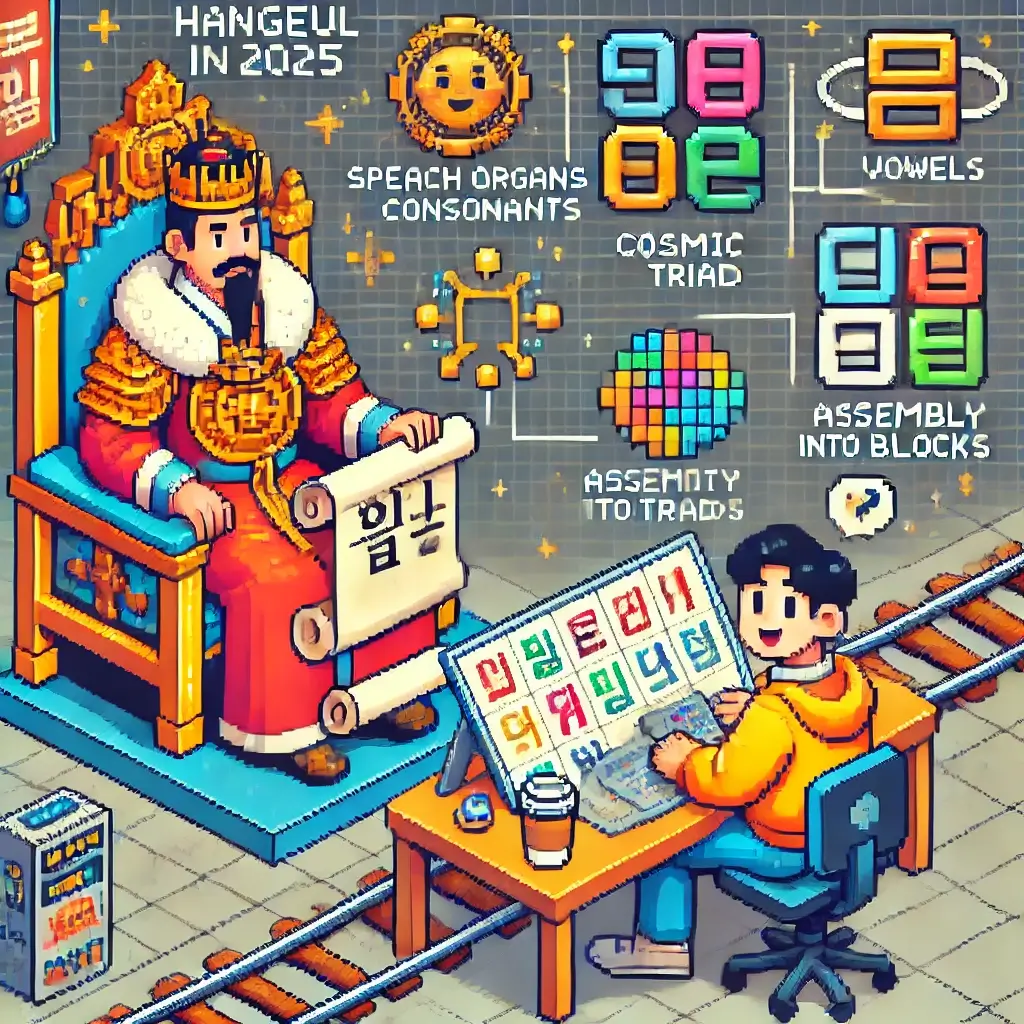
Table of Contents
Hangeul in 2025: Coffee, Courage, and a King
Let me start with an admission that will probably make my linguist friends do a tiny scream into a pillow.
I fell in love with Hangeul not because it is perfect but because it feels like it was designed by someone who cared about ordinary people having a voice.
You can sense that intention every time a consonant clicks into a vowel and locks into a neat little square like LEGO bricks for thoughts.
It is the only alphabet on Earth that we can point to and say, yes, a king did that, on purpose, with a plan, in public, for the people.
Maybe I’m wrong, but when a writing system begins life as an act of social empathy, it ages differently.
In 2025, that empathy still matters because attention is fractured, misinformation is loud, and tools are powerful yet indifferent.
Hangeul reminds us that design can be ethical, that usability can be liberation, and that literacy can be engineered with love and logic in the same room.
If that sounds romantic, well, it is, and I’m unashamed about it.
Hangeul Origins: A Monarch, a Mission, and Mouth-Shapes
King Sejong the Great, fifteenth-century Korea, a court of scholars, and a country where Chinese characters dominated the page like a skyscraper skyline.
The story many of us hear is simple but electric.
Sejong wanted a writing system that common people could learn quickly, without needing years of classical study and the purse of a small dragon.
So he commissioned the creation of Hangeul, publishing it with explanations that connect letter shapes to how our mouths actually move.
Consonants mirror the tongue and teeth and throat in action like tiny anatomical selfies.
Vowels come from a triad of symbols for sky, earth, and human—cosmic minimalism with everyday consequences.
Syllables then stack into blocks, each block a one-syllable apartment where sound lives with meaning.
It is a featural alphabet, which is just a fancy way of saying the features of speech are baked into the features of the letters.
I know that sounds like UX talk for phonetics, but honestly, that’s what it is.
Hangeul for Beginners: The Friendly Alphabet That Welcomes You In
What You See When You Stop Being Scared
If you’re new, Hangeul looks like beautiful geometry that refuses to be intimidating no matter how hard it tries.
Each block is one syllable, so the word for Korea, 한국, is Han-guk, two tidy sound apartments and zero stress.
You don’t need to memorize five hundred squiggles or unlock level fifty of calligraphy before you can read a sign.
You learn a small set of consonants and vowels, and suddenly menus start whispering secrets at you.
Okay, whispering loudly, if it’s a fried chicken shop.
Hangeul at a Glance
Basic Letters
24
14 consonants + 10 vowels
Precomposed Syllables (Unicode)
11,172
Range AC00–D7A3
Promulgation
1446
King Sejong’s new script announced
Memory of the World
1997
Hunminjeongeum Manuscript registered
Hangeul Day
Oct 9 (KR) · Jan 15 (KP)
Annual celebration of the alphabet
The LEGO Metaphor You Won’t Forget
Think of consonants as pegs and vowels as beams.
You snap a consonant to a vowel to make a basic block, and if a syllable needs another consonant at the end, it clicks underneath like a little basement garage.
This simplicity is eccentric in the nicest possible way.
Most scripts either string letters in a line or go full syllabary with unique symbols for every possible sound chunk.
Hangeul nods politely and says, what if we did both, with better storage.
Five-Minute Confidence Boost
Learn ㄱ g, ㄴ n, ㄷ d, ㄹ r/l, ㅁ m, ㅂ b, ㅅ s, ㅇ silent/ng, ㅈ j, ㅋ k, ㅌ t, ㅍ p, ㅎ h.
Pair them with vowels like ㅏ a, ㅑ ya, ㅓ eo, ㅕ yeo, ㅗ o, ㅛ yo, ㅜ u, ㅠ yu, ㅡ eu, ㅣ i.
Make “가” by pairing ㄱ with ㅏ and say “ga.”
Make “김” by stacking ㄱ ㅣ ㅁ and you’ve got gim, the word behind “kimchi” and “Kim.”
Even if my romanization is oversimplified and your accent is doing parkour, you will feel the lock-in of sound to shape.
That lock-in is the serotonin of literacy.
Hangeul: From Court to Code — A Micro-Timeline
1446 — Promulgation
Publication of the new Korean alphabet with explanatory notes.
1926 → 1931 → 1940
Early commemorations evolve; discovery of Hunminjeongeum Haerye clarifies dates.
1997 — UNESCO Memory of the World
The Hunminjeongeum Manuscript is registered internationally.
2013 — National Holiday Status Restored
Hangeul Day becomes a public holiday again in South Korea.
Today — Digital Ubiquity
11,172 precomposed syllables standardized in Unicode for universal use.
Beginner Pitfalls I’ve Made So You Don’t Have To
Don’t fear ㅇ, the circle letter.
At the start of a syllable it’s silent, but at the bottom it’s ng, which is charming and slightly mischievous.
Don’t get precious about romanization either.
Road signs and apps vary, and that’s okay because Hangeul itself is the standard, not the alphabet soup we use to approximate it.
Also, do not overthink double consonants like ㄲ or ㅆ on day one.
They’re just tense cousins who drink espresso.
Hangeul for the Intermediate: Real-World Moves, Typing Tricks, and Everyday Wins
Typing Like You Mean It
The standard keyboard layout puts consonants on the left and vowels on the right like a dance where each partner knows their cue.
Your fingers will start to crave the rhythm of left-right-left as syllables assemble under your hands.
If you’re bilingual on your phone, switching keyboards becomes muscle memory, and you’ll accidentally send your friend “ㅋㅋㅋ” instead of “lol.”
Honestly, they’ll get it.
How a Hangeul Block Works
Step 1 — Choose Jamo
Consonants: ㄱ ㄴ ㄷ ㄹ ㅁ ㅂ ㅅ ㅇ ㅈ ㅋ ㅌ ㅍ ㅎ
Vowels: ㅏ ㅑ ㅓ ㅕ ㅗ ㅛ ㅜ ㅠ ㅡ ㅣ
Optional final consonant (받침): ㄱ ㄴ ㄷ …
Step 2 — Assemble CV or CVC
ㄱ + ㅏ → 가
ㄱ + ㅣ + ㅁ → 김
ㅂ + ㅗ + ㅁ → 봄
Step 3 — Read the Block
가 = “ga” · 김 = “gim/kim” · 봄 = “bom”
Each square is one syllable.
Menus, Subtitles, and Not Getting Lost
Reading “라면” ramyeon and “비빔밥” bibimbap without pictures makes you the friend who orders bravely.
It also helps you read subway lines and bus stops, which is great for the part of you that refuses to ask for directions until it’s dramatic.
Hangeul on packaging can save you from mistaking sugar for salt and rinsing your strawberries in existential dread.
Pronunciation: The Honest Middle Ground
People love to say Hangeul is easy to learn and hard to pronounce, which is partly true and partly a vibe.
Final consonants can soften, and sounds can change at syllable boundaries, but your mouth will figure it out faster than your brain thinks.
If you can say “spring rolls” without looking like you’re debugging your tongue, you can handle 받침, the final consonant slot.
Notes for Teachers and Parents
Build letter knowledge with minimal pairs and block assembly games.
Use magnetic tiles or printable squares to make syllables snap together—physicalizing the logic reduces fear and increases giggles.
Praise progress loudly and mistakes louder because a confident reader is a future writer, and writers save worlds, at least their own.
Counts That Matter
Consonants
Vowels
Unicode Syllables
Notes: 14 consonants, 10 vowels, and 11,172 precomposed syllables standardized in Unicode.
Hangeul for Experts: Featural Design, Unicode Realities, and NLP in 2025
Featural System with a Spine
Consonant shapes encode place and manner of articulation in a way that still feels audacious five centuries later.
Basic consonants map to tongue and palate positions, and derived consonants add strokes to mark aspiration or tension like tiny diacritics embedded in the letterform itself.
The system invites systematic extension while retaining legibility, which is why the script adapts elegantly to dialects and loans.
Syllable Blocks: Human-Readable, Machine-Parsable
Each Hangeul block is a stack of jamo units arranged in a grid that your eyes read as one glyph but your brain disassembles instantly.
Computationally, you can store precomposed syllables or decompose into jamo for algorithmic manipulation.
In 2025, modern NLP pipelines often normalize text to NFC for consistency, then tokenize at the sub-syllabic level when modeling fine-grained phonotactics.
Yes, that sentence just put coffee in your veins if you’re a developer.
Why It Works — A One-Screen Concept Map
Speech Organs → Consonants
Letter shapes mirror tongue/teeth/throat articulation.
Cosmic Triad → Vowels
Sky · Earth — Human; simple forms combine into diphthongs.
Grid → Syllable Blocks
CV / CVC blocks pack sound into readable squares.
Standard → Unicode
11,172 syllables encoded (AC00–D7A3) for universal computing.
Unicode and the Real World
Unicode assigns code points to 11,172 modern Hangeul syllables as well as compatibility jamo for specialized contexts.
Normalization matters because a visually identical block can be represented in multiple ways under the hood, and string equality can lie to you like a handsome spreadsheet.
Developers, always normalize before deduping, indexing, or hashing.
Designers, test your fonts for hinting and for the clarity of complex stacks at small sizes because mobile is everyone’s first classroom now.
Search, SEO, and Tokenization
If you build search for Korean content, tune your tokenizers to respect syllable boundaries and optionally decompose to jamo for fuzzy matching of typos.
Hangeul’s structured nature makes it unusually forgiving for approximate string matching, which is a gift if you appreciate fewer 404s and more “did you mean” victories.
For bloggers and marketers, write clear Hangeul titles and meta descriptions because your users are human and your crawlers are picky robots who adore clarity.
Speech Tech and ASR
Because Hangeul represents phonological features so cleanly, it pairs beautifully with modern speech recognition and TTS systems.
When your acoustic model hiccups, Hangeul’s structure can help the language model recover gracefully, especially in noisy environments where vowels carry the melody of intelligibility.
If that sounded like jazz, good, because language is jazz with deadlines.
Hangeul in Context: Why This King-Made Alphabet Feels Different
Many writing systems evolved slowly or were devised by individuals outside royal power structures, which is wonderful and wild.
Hangeul’s origin as a state project for social good is rare, and that intent permeates the design like a watermark.
It is not superior in a moral sense—scripts are not olympians—but it is unusually teachable, extensible, and equitable by design.
When people say it’s the only alphabet created by a king, what they’re capturing is the singularity of a head-of-state design sprint with humanity as the stakeholder.
That is not just a trivia nugget for pub night; it’s a blueprint for public-interest design.
Hangeul and 2025: AI, Creativity, and the New Literacy Contract
AI can autocomplete an essay while you blink, but it cannot give a community dignity.
Literacy does that, and Hangeul has been doing it for centuries with an interface that refuses to be gated by wealth.
In 2025, teenagers remix Hangeul in typographic posters, indie games ship with Hangeul fonts that slap, and researchers push tokenization boundaries to model morphology with surgical precision.
Creators play with interlinear glosses, devs measure grapheme clusters, and grandparents text in group chats with stickers that deserve museum curation.
When a system invites both play and precision, it stays alive.
Hangeul Micro-Course: Thirty Minutes from “Huh?” to “Hey, I Can Read That”
Minute 0-5: Meet the Cast
Consonants: ㄱ g, ㄴ n, ㄷ d, ㄹ r/l, ㅁ m, ㅂ b, ㅅ s, ㅇ silent/ng, ㅈ j, ㅋ k, ㅌ t, ㅍ p, ㅎ h.
Vowels: ㅏ a, ㅑ ya, ㅓ eo, ㅕ yeo, ㅗ o, ㅛ yo, ㅜ u, ㅠ yu, ㅡ eu, ㅣ i.
Say the sounds once out loud and forgive yourself immediately because bravery beats accuracy at this stage.
Minute 5-10: Build Your First Blocks
가 ga, 나 na, 다 da, 라 ra, 마 ma.
Switch vowels and make 고 go, 누 nu, 디 di, 르 reu, 미 mi.
Write your name phonetically just for fun, even if it looks like a secret code from a kindergartener spy agency.
Minute 10-15: Final Consonants
Learn 받침 with words like 밥 bap, 밤 bam, 방 bang.
Notice how the final consonant tucks under the block like a cat under a blanket.
Whisper the words until they stop feeling like strangers.
Minute 15-20: Real-World Words
커피 coffee, 버스 bus, 택시 taxi, 초콜릿 chocolate.
Borrowed words are great training wheels because your brain already knows the bicycle.
Bonus: order a coffee in Korean and feel your spine grow two inches from joy.
Minute 20-25: Signs and Menus
Look for 편의점 convenience store, 약국 pharmacy, 출구 exit.
Read slowly, proudly, and with the swagger of someone who has unlocked a polite superpower.
Mistakes are merely plot twists for your memory.
Minute 25-30: Celebrate and Screenshot
Text a friend a Hangeul block you built and announce your new talent with unnecessary exclamation marks.
Learning thrives on ceremony, and you deserve a tiny parade even if it’s just in your kitchen with mismatched socks.
Hangeul Coffee Break: A Quick Ad While You Breathe
You’re doing great and I refuse to pretend otherwise.
Here’s a short pause so your brain can file things and your eyes can rest for five sentences worth of peace.
If an ad shows up below, it helps keep the lights on and the caffeine ethically sourced.
Or at least keeps my cup from being fully imaginary, which is half the battle.
Back to our regularly scheduled wonder in a moment.
Hangeul Infographic: How Sound Snaps into Shape
This simple diagram shows the path from mouth to meaning the Hangeul way.
It’s not a museum piece, but it’s honest, and it fits on a screen without a forklift.
1) Speech → Consonants
Tongue, teeth, throat.
ㄱ ㄴ ㄷ ㄹ ㅁ ㅂ ㅅ ㅇ ㅈ ㅋ ㅌ ㅍ ㅎ
2) Cosmos → Vowels
Sky • Earth — Human |
ㅏ ㅑ ㅓ ㅕ ㅗ ㅛ ㅜ ㅠ ㅡ ㅣ
3) Assembly → Blocks
CV or CV(C).
가, 김, 봄, 한, 글.
4) Use → Life
Reading, typing, signage.
Search, NLP, ASR, design.
Hangeul Resources: Trustworthy Reads and Tools (Big Buttons)
I want you to have sources that won’t evaporate when you click them and won’t make you feel like you just read a conspiracy about vowels.
These are solid, human-friendly places to deepen your journey.
Britannica — Hangul Overview King Sejong Institute — Learn Korean Unicode Chart — Hangul Syllables
FAQ
Q1. Is Hangeul really easy to learn?
It is easy to start and rewarding to continue.
The alphabet itself is learnable in a day, but smooth reading and natural pronunciation take practice like every good instrument.
Q2. Why do some people write “Hangul” and others “Hangeul”?
It’s transliteration style.
Both point to the same script, and neither bites.
Use what your audience expects, or pick one and be consistent like a responsible plant parent.
Q3. What’s special about the syllable block system?
Blocks make sound units visually chunked, boosting reading flow and giving typography a grid that is weirdly satisfying.
It also helps new readers parse pronunciations without drowning in letter soup.
Q4. Can Hangeul represent all Korean sounds?
Yes, with accuracy and grace, including phonological variations that surface in real speech.
Loanwords get along fine with a few clever conventions that keep everything tidy.
Q5. How does Hangeul matter for AI and software?
Its featural logic pairs beautifully with tokenization, search, and speech tech.
Normalize strings, test fonts, and treat grapheme clusters with respect, and your app will feel like it speaks human.
Q6. Is it really the only alphabet created by a king?
It’s the famous example of a ruling monarch initiating and publishing a full writing system with explicit design rationale for public literacy.
That uniqueness is part of its cultural magic in and beyond Korea.
Q7. How long before I can read signs on a trip?
If you follow the micro-course above and stick with it for a week, you’ll be reading basic words and recognizing names with a grin that can be seen from space.
Okay, not space, but definitely across the street.
Hangeul in Your Hands: A Slightly Messy, Very Real Call to Action
I want you to try something deliciously small and absolutely brave.
Write your name in Hangeul tonight on a scrap of paper or the notes app you never organize.
Take ten minutes and build the blocks, even if you guess the vowels like you’re choosing a door on a game show.
Because the first time you read a sign out loud and your mouth recognizes the shape your eyes just saw, you will feel your brain applaud from the balcony.
Design did that for you, and a king started it, and a million teachers carried it, and now it’s yours too.
Maybe I’m overselling this, but if literacy isn’t a tiny miracle, what is.
Hangeul is not just letters.
It is an invitation to belong in a story that keeps making room.
Say yes.
Say it in blocks.
Watch: Hangeul & King Sejong — Curated Videos
Tip: If your theme strips aspect-ratio, keep the wrapper and it will still scale properly on mobile.
No-script fallbacks:
Video 1 •
Video 2 •
Video 3.
Keywords
Hangeul, King Sejong, Korean alphabet, 2025 language trends, learn Korean
🔗 Principles of Hwagae Posted 2025-08-21 07:27 UTC 🔗 Master Japanese with J-Pop & J-Rock Posted 2025-08-21 08:31 UTC 🔗 Korean Independence Activists Posted 2025-08-22 05:29 UTC 🔗 Korean Honorifics Guide 2025 Posted 2025-08-23 11:08 UTC 🔗 Konglish Words to Avoid 2025 Posted 2025-08-23 11:08 UTC