

If you are a foreign victim of fraud connected to South Korea, a Korean lawyer can help with much more than filing a police complaint. The real work may involve deciding whether the facts support criminal fraud rather than an ordinary civil dispute, organizing Korean-language evidence, communicating with investigators, protecting a potential money-recovery claim, and deciding whether a compensation order or separate civil action makes sense.
You do not automatically need a lawyer for every scam. A relatively simple online-purchase fraud with a clear bank transfer, known seller, and straightforward evidence may begin with a police report. For a practical introduction to that process, see this Korea police report guide for foreigners. A lawyer becomes much more useful when the amount is substantial, the suspect disputes what happened, the transaction crosses borders, cryptocurrency or corporate accounts are involved, or recovering the money matters as much as obtaining a criminal investigation.
The most important distinction is simple: reporting fraud and recovering your money are related, but they are not the same legal task. A criminal case focuses on whether an offense occurred and whether the suspect should be punished. Financial recovery may require settlement, a criminal-court compensation order, a civil claim, enforcement against assets, or a combination of strategies.
Table of Contents
What Counts as Fraud Under Korean Law?
Article 347 of Korea’s Criminal Act addresses fraud. Under the Korean text currently in force, a person who deceives another and thereby receives property or obtains a pecuniary benefit may face criminal punishment. The statute was amended recently, so anyone checking an older English translation should be cautious: the current Korean statutory text should control the legal analysis. You can review Article 347 through Korea’s official National Law Information Center.
For a victim, however, the word “fraud” should not be treated as a synonym for every unpaid debt, disappointing investment, broken promise, or failed business deal. Korean courts examine whether there was deceptive conduct connected to the victim’s decision to transfer property or provide an economic benefit.
This distinction becomes particularly important in loan and contract disputes. If someone genuinely intended and was able to repay a loan when borrowing the money but later became unable to pay, the later default does not automatically transform the transaction into criminal fraud. The facts existing when the money or property was obtained can therefore become the center of the case.
That is one reason a fraud lawyer may ask questions that initially seem oddly historical: What did the suspect say before payment? What financial condition did the suspect conceal? Was a fake document shown? Did the suspect already owe other victims? Was the promised business, property, investment, product, or job real? What happened to the money immediately afterward?
What a Korea Fraud Lawyer Can Do for a Foreign Victim
A victim-side fraud lawyer is not simply a person who translates your complaint into Korean. The useful work begins by converting a messy sequence of messages, transfers, promises, and excuses into a legally coherent theory supported by evidence.
1. Decide whether the case is criminal fraud, a civil dispute, or both
This first classification matters enormously. Suppose you paid a contractor who disappeared after inventing a nonexistent office, forged licenses, and diverted the money immediately. That may present a different criminal picture from a contractor who performed part of the work but later became insolvent.
A lawyer can review what was represented before payment, what the other party apparently knew at the time, how the money moved, and whether the evidence supports an allegation of deception rather than merely nonperformance.
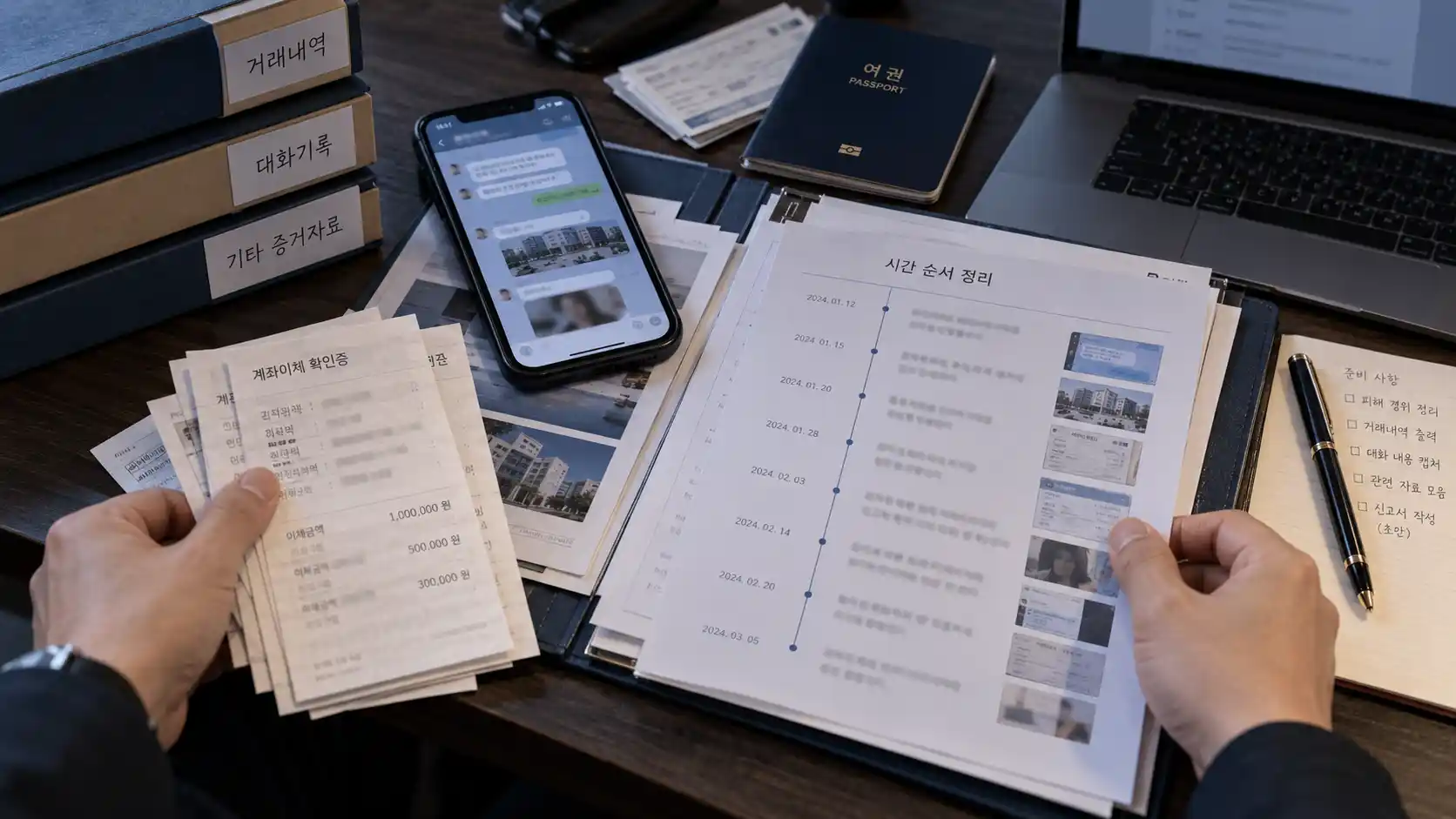
2. Turn your evidence into an investigation file
Foreign victims often have plenty of evidence but very little organization. Screenshots may sit across WhatsApp, KakaoTalk, Telegram, email, bank apps, crypto exchanges, cloud storage, and several phones. A lawyer can help identify which items establish identity, deception, payment, reliance, loss, and what happened afterward.
A useful evidence file commonly includes:
- A chronological timeline with dates and amounts.
- Bank-transfer receipts and recipient account information.
- Cryptocurrency transaction IDs and wallet addresses where relevant.
- Contracts, invoices, advertisements, listings, proposals, and investment materials.
- KakaoTalk, text-message, email, and social-media communications.
- The suspect’s names, phone numbers, usernames, company names, addresses, and account details.
- Copies of identification or corporate documents supplied by the other party.
- Evidence showing which representation caused you to send the money.
- Requests for refunds and the responses received.
- Evidence of other known victims, where lawfully obtained and relevant.
Do not edit screenshots in a way that destroys context. Preserve originals where possible. A beautiful twelve-page collage may look tidy, but investigators may prefer original conversations, transaction records, and a separate index explaining what each item proves.
3. Prepare the criminal complaint and communicate with investigators
A lawyer can help frame the alleged deception, identify the relevant evidence, prepare Korean-language submissions, and respond when investigators request additional records. This can be particularly useful where the victim is abroad or where the case involves technical financial records that are difficult to explain through a short translated statement.
A lawyer cannot guarantee that police will accept the victim’s legal characterization, identify an unknown suspect, arrest anyone, refer the case for prosecution, or recover the money. Investigators and prosecutors make their own decisions based on the evidence and applicable procedure.
4. Build a money-recovery strategy alongside the criminal case
This is where victim-side representation can diverge sharply from merely filing a report. The lawyer may need to assess whether the suspect has identifiable assets, whether settlement is realistic, whether provisional civil measures should be considered, whether a criminal-court compensation order may eventually be available, and whether a separate civil lawsuit is economically rational.
If a separate lawsuit becomes necessary, filing fees are only one part of the budget. Translation, service, legal fees, overseas evidence, potential asset enforcement, and other costs can matter more. The site’s guide to Korea civil lawsuit costs for foreigners explains those layers in more detail.
Foreign Victims Can Use Interpretation During the Korean Police Process
Language should not be treated as a minor inconvenience when the wording of a complaint or statement may shape a criminal investigation. Korean police investigation rules specifically address foreign persons who are not proficient in Korean and provide for interpretation when statements are taken. The rules also address an oral complaint or accusation made by a foreigner who is not sufficiently proficient in Korean.
You can review the applicable provisions in the National Law Information Center’s current crime-investigation rules.
Still, interpretation and legal representation solve different problems. An interpreter helps participants understand each other. A lawyer evaluates legal significance, evidence, procedure, recovery strategy, and how a statement may affect the case. In a substantial fraud matter, you may need both.
What to Do Immediately After Discovering the Fraud
Fraud evidence has a habit of evaporating. Websites disappear. Accounts are renamed. Messages are deleted. Money moves. The first hours should therefore focus on preservation and damage control rather than composing the perfect accusation.
- Stop additional payments. Do not send another “tax,” “release fee,” “verification deposit,” “lawyer fee,” or “withdrawal charge” simply because the other party promises that it will unlock your original money.
- Contact the bank or payment provider promptly. Ask what fraud-response or transfer-recall options, if any, remain available. Different payment methods have different procedures.
- Preserve the complete conversation. Export chats where possible and save screenshots showing dates, usernames, phone numbers, profile details, and context.
- Preserve transaction evidence. Keep bank statements, transfer confirmations, crypto transaction hashes, wallet addresses, payment receipts, and exchange records.
- Write a chronology while your memory is fresh. Record what was promised, when you believed it, why you paid, and what happened afterward.
- Identify the Korean connection. Note Korean accounts, companies, addresses, telephone numbers, websites, individuals, property, or meetings connected with the transaction.
- Consider police reporting promptly. The Korean National Police Agency’s English site lists official crime-report and support contacts.
- Get legal advice before taking high-impact steps. This is particularly important before signing a settlement, withdrawing a complaint, making public accusations, or launching costly civil proceedings.
If the incident involves voice phishing, smishing, spoofed calls, or another form of telecommunications financial fraud, special reporting and financial-response procedures may apply. Do not assume that every investment, contract, crypto, or marketplace fraud falls into the same recovery system.
Criminal Complaint vs. Getting the Money Back
This is the hinge of the entire article: a criminal investigation does not automatically refund the victim.
The criminal process asks whether an offense can be proved and what should happen to the defendant. Recovery is a separate financial objective. Sometimes those paths overlap. Sometimes they travel beside each other for months and barely touch.
| Route | Main purpose | What a foreign victim should understand |
|---|---|---|
| Police/prosecutor criminal case | Investigate and prosecute an alleged offense | May create leverage and establish facts, but does not guarantee repayment |
| Voluntary settlement | Negotiate repayment or compensation | Terms, timing, withdrawal language, releases, and actual payment security matter |
| Compensation order | Seek qualifying damages within the criminal trial | Available for fraud in appropriate cases, but statutory limitations apply |
| Civil lawsuit | Obtain a civil judgment for money or damages | Requires separate cost, evidence, jurisdiction, and collectability analysis |
| Enforcement | Collect against assets after obtaining an enforceable title | A judgment is valuable only to the extent it can realistically be enforced |
Can a Fraud Victim Seek a Compensation Order in the Criminal Trial?
Potentially, yes. Korea’s compensation-order system allows a criminal court, in specified categories of cases including fraud, to order compensation for qualifying losses when statutory conditions are met.
The Korean Judiciary explains that a compensation order can allow a victim to pursue certain direct financial losses through the first- or second-instance criminal trial rather than beginning an entirely separate damages lawsuit. You can review the Judiciary’s official explanation of the criminal compensation-order procedure.
It is not automatic. The court can decline to issue a compensation order where, for example, the amount of damage cannot be identified clearly, the existence or scope of the defendant’s liability is not sufficiently clear, or deciding compensation would substantially delay the criminal proceeding.
The application timing also matters. Under the governing statute, a victim generally applies to the court handling the case before the close of argument in the first- or second-instance criminal trial. If you receive notice that the defendant has been indicted, ask promptly whether a compensation application fits your case rather than assuming it can be filed at any time.
When a Separate Civil Fraud Claim May Still Matter
A separate civil action may become relevant when the criminal route does not resolve the full recovery problem, when damages require more extensive proof, or when the victim needs a civil remedy that cannot be handled efficiently inside the criminal case.
Before filing, however, ask the question that litigation advertising often leaves out: if you win, what can you realistically collect?
A defendant with no identifiable assets can turn a successful judgment into an expensive certificate. Conversely, identifiable Korean property, bank accounts, receivables, business interests, or other assets may make civil strategy more important. Asset preservation and enforcement questions can therefore deserve attention early, not after years of litigation.
Foreign plaintiffs should also budget for translation and procedural work. For a more detailed breakdown, use the site’s civil litigation cost guide for foreign plaintiffs in Korea before assuming that the court filing fee represents the total cost of recovery.
When Hiring a Korea Fraud Lawyer Is Usually Worth Considering
The amount lost is important, but it is not the only variable. A relatively modest fraud can justify professional help if the evidence or jurisdiction is unusually complicated, while an obvious low-value marketplace scam may not justify full representation.
| Situation | Why a lawyer may add value |
|---|---|
| Large financial loss | The cost of a procedural or evidence mistake becomes economically significant |
| Cross-border fraud | Victim, suspect, evidence, companies, and money may sit in different countries |
| Investment or business fraud | The case may require separating criminal deception from ordinary commercial risk |
| Cryptocurrency transfers | Wallet records, exchange information, transaction tracing, and asset location can be technically complex |
| Real estate or deposit-related fraud | Property records, contracts, multiple claimants, and asset-preservation issues may overlap |
| Suspect’s identity is disputed | Account holder, company representative, intermediary, and actual decision-maker may not be the same person |
| Multiple victims | Evidence may reveal a broader pattern, but coordination and privacy require care |
| You live outside Korea | Language, document handling, time zones, police communication, and court procedures become harder to manage directly |
| Settlement is proposed | You need to understand payment security, releases, deadlines, and how the agreement interacts with the criminal case |

How Much Does an English-Speaking Fraud Lawyer in Korea Cost?
There is no nationwide official price for an English-speaking fraud lawyer. The quote may depend on whether you want one consultation, preparation of a criminal complaint, continuing representation during an investigation, settlement work, a compensation-order application, a civil lawsuit, asset-preservation work, or enforcement after judgment.
The useful question is not merely “What is your retainer?” It is “What legal work does this amount cover, and what triggers another fee?”
Before comparing firms, see the site’s detailed guide to English-speaking lawyer consultation fees and costs in Korea. Then request quotes using the same scope so that you are comparing legal services rather than four unrelated numbers wearing identical price tags.
Ask each lawyer whether the quote includes:
- Initial evidence review.
- Preparation or revision of a Korean criminal complaint.
- Police or prosecutor communication.
- Attendance at victim interviews, if appropriate and permitted.
- Written legal opinions or supplementary submissions.
- English-language client updates.
- Translation or interpretation coordination.
- Settlement negotiations.
- Compensation-order work.
- Civil litigation.
- Provisional asset-preservation work.
- Judgment enforcement.
- VAT and third-party expenses.
Questions to Ask Before Hiring a Fraud Lawyer
- Have you handled fraud complaints for foreign victims before?
- Which Korean-licensed attorney will personally be responsible for my case?
- Do you view this primarily as criminal fraud, a civil dispute, or both?
- What evidence is currently missing?
- What should I preserve before contacting the other party again?
- Will you prepare the criminal complaint in Korean?
- How will the complaint explain the deception that existed before I transferred the money?
- Can you communicate with investigators after filing?
- Is English communication with me included throughout the engagement?
- Are translations included in the fee?
- What part of the quote covers settlement negotiations?
- Should I be thinking about a compensation order if the case reaches trial?
- Would a separate civil lawsuit add meaningful recovery options?
- Are there identifiable assets worth pursuing?
- Would asset-preservation measures be legally and economically realistic?
- What work is excluded from your current quote?
A lawyer who cannot promise a result is not necessarily being evasive. Criminal charging decisions, trial outcomes, asset location, defendant solvency, and enforcement all sit partly outside the lawyer’s control. Clear scope is more useful than theatrical certainty.
What If the Alleged Fraudster Files a Complaint Against You?
Commercial and personal disputes can become procedurally messy. A person you accuse of fraud may respond by alleging defamation, threats, coercion, false accusation, business interference, or a different version of the underlying transaction.
That does not mean the counter-allegation is valid. It does mean your legal role may have changed. If Korean police begin questioning you as a suspect rather than merely a victim or witness, obtain advice appropriate to that status. The site’s separate guide to a Korea criminal defense lawyer for foreigners explains why suspect interviews, Korean-language statements, and defense representation require a different strategy.
Public accusations deserve particular caution. Posting names, photographs, passport images, private messages, or allegations across social media in an attempt to force repayment can create a second legal problem without recovering the first won.
Free or Lower-Cost Legal Help for Foreign Residents
Full private representation is not the only starting point. Foreign residents in Korea may be able to obtain initial legal guidance through public programs.
The Ministry of Justice operates the Village Lawyers for Foreigners program, which provides free legal counseling to foreign residents in Korea and uses the 1345 Immigration Contact Center to connect callers with legal counseling and interpretation support. The Ministry states that counseling can cover issues including damages caused by crime.
The Korea Legal Aid Corporation also provides legal consultation and litigation-support services, although eligibility and the extent of representation depend on the service and the applicant’s circumstances.
These services can be useful for orientation, particularly when the financial loss is too small to justify immediate full private representation. A large, urgent, cross-border, or asset-sensitive fraud case may still justify contacting a specialist directly.
A One-Page Fraud File to Prepare Before the Lawyer Consultation
You can make a paid consultation dramatically more efficient by preparing one page before the meeting. Keep it factual. Lawyers can add adjectives later if the evidence earns them.
- Victim: your name, nationality, current country, and Korean residence status if relevant.
- Suspect: every known name, company, account, phone number, address, website, and username.
- Total loss: exact amount and currency.
- Payments: date, amount, method, sending institution, recipient, and transaction reference.
- Representation: what the other party told you before each important payment.
- Why you believed it: documents, identity claims, contracts, photographs, website information, referrals, or other supporting facts.
- What proved false: identify each alleged deception separately.
- Refund history: amounts returned, promises made, deadlines missed.
- Korean connection: Korean account, company, address, property, telephone number, meeting, contract, or other link.
- Police status: whether anything has already been reported and any case or reference number.
- Goal: criminal investigation, repayment, settlement, asset preservation, civil judgment, or a combination.
Then create a folder containing the ten or twenty documents that best prove the story. Do not begin the consultation by dropping 4,800 screenshots into a cloud link and whispering, “It’s all in there.” Even excellent lawyers are not licensed archaeologists.
Frequently Asked Questions
Can a foreigner report fraud to Korean police?
Foreign status does not by itself prevent a person from reporting a crime in Korea. Language assistance is particularly important where the complainant is not proficient in Korean. The correct reporting method can depend on where the conduct occurred, where the suspect and evidence are located, and whether the victim is currently inside or outside Korea.
Do I need a Korean lawyer to report fraud?
Not necessarily. A victim can report an incident without retaining private counsel. A lawyer becomes more useful when the legal classification is disputed, the loss is substantial, the evidence is complicated, the suspect is difficult to identify, you live abroad, or financial recovery requires a strategy beyond the police report.
Will Korean police recover my money?
Do not assume so. A criminal investigation may identify assets or encourage repayment, but punishment and financial recovery are different objectives. Settlement, a compensation order, civil litigation, and enforcement may need separate consideration.
Is an unpaid debt automatically fraud in Korea?
No. Failure to repay does not by itself establish criminal fraud. The legal analysis examines circumstances including what the debtor represented and intended when obtaining the money. A genuine later inability to perform can present a civil dispute rather than criminal fraud.
Can I recover my fraud loss through the criminal court?
In qualifying fraud prosecutions, a compensation-order application may be available. It is subject to statutory requirements and may be rejected where the amount or scope of liability cannot be determined clearly within the criminal proceeding. Ask about it promptly if the suspect is indicted.
Should I accept a settlement offer from the suspect?
A settlement can sometimes produce faster recovery than litigation, but the wording and payment mechanics matter. Confirm whether payment occurs before or after signing, whether installments are secured, what happens after default, whether claims are being released, and what statements you are being asked to make to investigators or the court. Obtain case-specific advice before signing a substantial settlement.
Can I hire a Korean fraud lawyer while living overseas?
Initial consultation, document review, evidence organization, and substantial case preparation can often begin remotely. The exact procedure for representation, powers of attorney, identity verification, police interaction, court filings, and original documents depends on the matter. Confirm those requirements before assuming that either travel or complete remote handling is necessary.
The Practical Decision
If your loss is small, the suspect is identifiable, and the evidence is straightforward, begin by preserving the evidence and understanding the Korean police-report process. You may not need full legal representation.
If the amount is meaningful, the story crosses borders, the transaction looks partly civil and partly criminal, assets may disappear, or the suspect has already begun rewriting the history of the transaction, a lawyer can add value much earlier.
The most useful first consultation should answer four questions: Is this legally fraud? What evidence is missing? What is the fastest sensible reporting step? And which recovery route is economically worth pursuing?
That last question matters. Winning the argument that you were deceived and actually getting the money back are two different finish lines. A strong Korea fraud strategy for a foreign victim keeps both in view from the beginning.