

Korea Legal Cost Guide for Foreigners
English-Speaking Lawyer in Korea: Consultation Fees and Costs
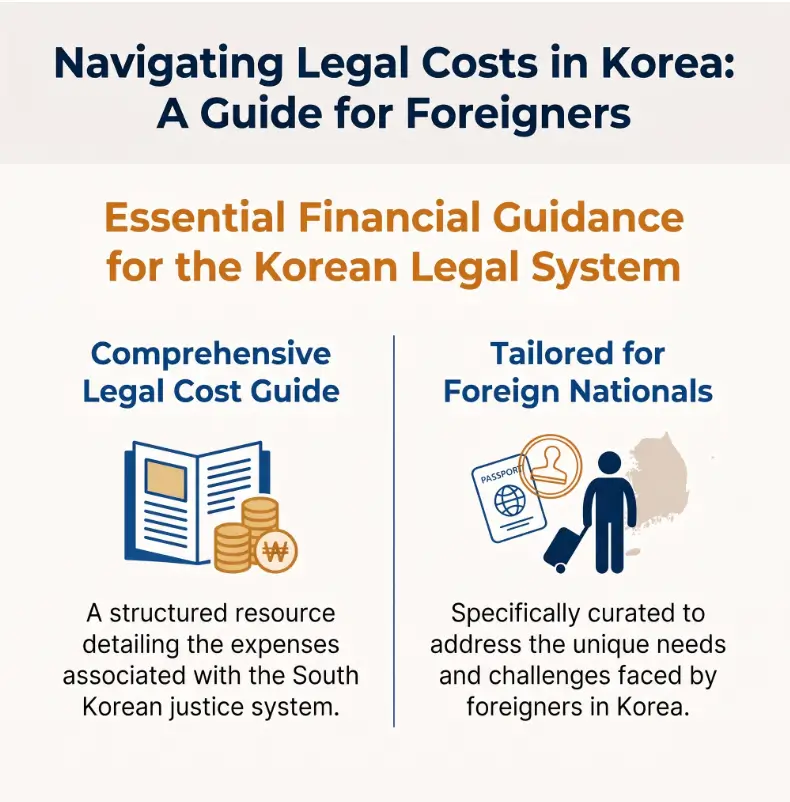
Hiring an English-speaking lawyer in Korea does not come with a single official price list. Some firms charge a fixed consultation fee, others bill by time, and full representation may be quoted as a separate retainer or fixed fee. The number that matters is therefore not simply “How much per hour?” but “What legal work is included for that price?”
For a foreign client, language can add another layer. A consultation may involve English communication, review of Korean documents, translation, immigration consequences, overseas evidence, or coordination with someone outside Korea. A cheap quote can become expensive quickly if those pieces sit outside the agreed scope.
The useful comparison is not lawyer A versus lawyer B. It is scope A versus scope B.
This guide is for foreigners who need Korean legal advice and want to understand the likely cost before booking. There is no single nationwide consultation tariff. Current publicly posted examples show substantial variation even before full representation begins. Your first job is to identify the right type of lawyer, get the fee scope in writing, and separate attorney fees from translation, court, filing, expert, and other third-party costs.
Table of Contents
This article explains general cost structures and ways to compare Korean legal services. It cannot determine the correct strategy for your individual dispute. If you have a police interview, court deadline, detention issue, deportation risk, expiring appeal period, injunction, or another time-sensitive matter, obtain case-specific advice rather than delaying while comparing prices.
How Much Does an English-Speaking Lawyer in Korea Cost?
There is no official national price for an English-language lawyer consultation in Korea. Lawyers and firms set their own charges, and fees can differ by practice area, seniority, urgency, document volume, language requirements, and how much legal analysis is expected before or during the meeting.
For a concrete planning reference, publicly posted fee pages checked in August 2026 show examples including KRW 100,000 including VAT for a 30-minute consultation, KRW 330,000 including VAT for an hour, and another foreign-client practice posting KRW 220,000 for 30 minutes or KRW 440,000 for 60 minutes. These are examples from individual providers, not an official Korean market average.
| Cost level | Published example | How to use the number |
|---|---|---|
| Lower published example | KRW 100,000 / 30 minutes, VAT included | Useful as proof that short fixed-fee consultations exist, not as a universal minimum |
| Mid published example | KRW 330,000 / 60 minutes, VAT included | Shows how specialist or business-oriented consultation pricing can rise |
| Higher published example | KRW 220,000 / 30 minutes or KRW 440,000 / 60 minutes | Useful when budgeting for specialist foreign-client legal review |
| Full legal matter | Separate quote | Do not extrapolate a case retainer from the consultation price |
A consultation fee and a case fee are different animals. Thirty minutes of advice may cost a few hundred thousand won, while taking responsibility for an investigation, lawsuit, negotiation, divorce, inheritance dispute, or business matter can require far more work.
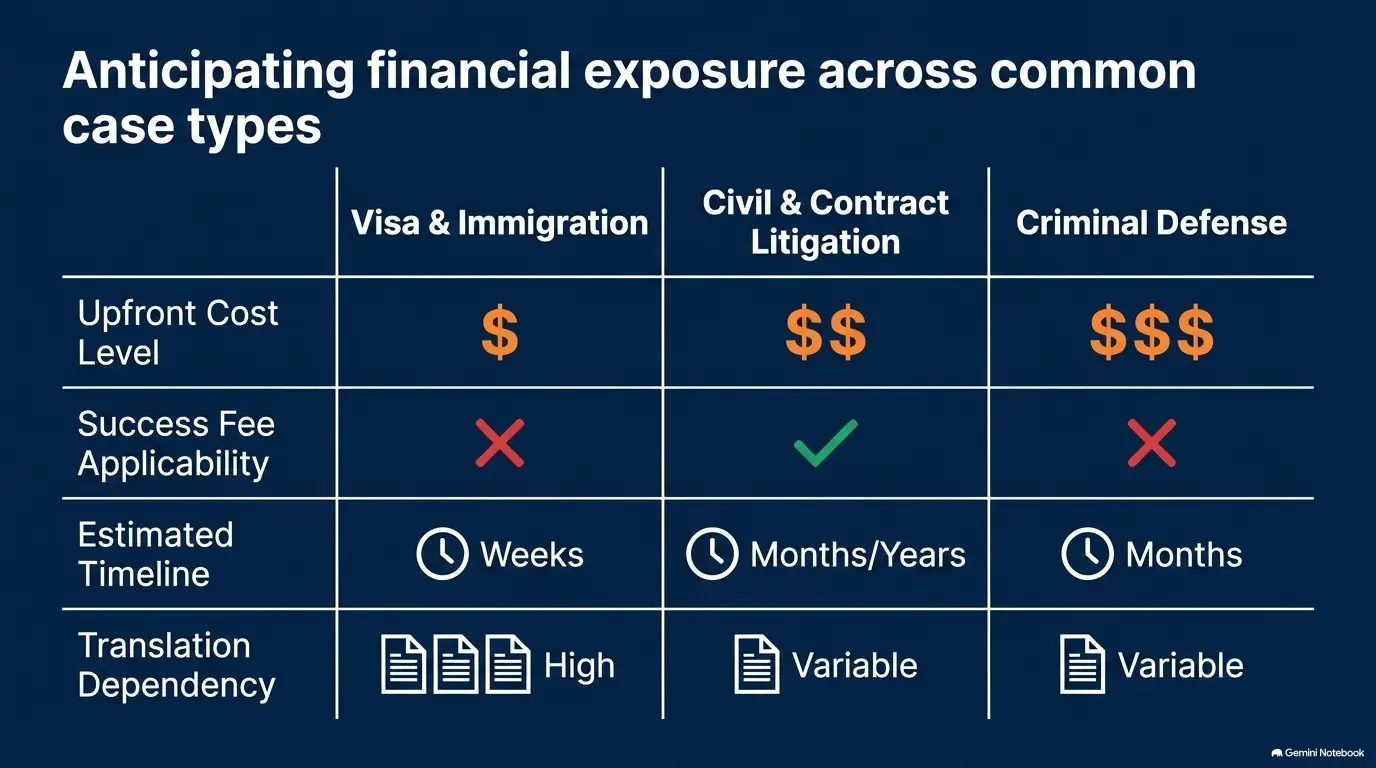
One currently published specialist criminal-defense schedule, for example, lists investigation-stage representation at KRW 7.7 million to KRW 11 million and trial-stage representation at KRW 8.8 million to KRW 13.2 million. That is a provider-specific criminal-law schedule, not a general Korean lawyer price range, but it illustrates why the initial consultation cost tells you very little about the eventual case budget.
Budget the consultation separately from representation. Before paying either one, ask what work the quoted amount buys and what event triggers the next fee.
What the First Consultation Should Actually Buy You
A good first consultation should reduce uncertainty. You are paying for judgment, not simply for the pleasure of occupying a chair opposite someone with a law degree.
By the end of the meeting, you should ideally understand four things: what the legal problem actually is, what must happen next, what can wait, and what professional work would cost if you proceed.
For a straightforward matter, try to leave with these answers
- Which area of Korean law controls the problem?
- Is there a deadline or irreversible step?
- What documents or evidence matter most?
- What should you avoid doing before the next step?
- Can you handle part of the process yourself?
- What would the lawyer handle if retained?
- What is the next-stage fee structure?
- Which expenses are outside the lawyer’s fee?
If the lawyer needs to review a 90-page contract, a folder of KakaoTalk messages, police records, medical evidence, corporate documents, or overseas probate papers before answering responsibly, the consultation may require advance document-review time. Ask whether that work is included.
Write the problem in three sentences.
Create a one-page timeline.
Send only the essential documents first.
Confirm scope and fees.
DIY, limited help, or representation.
What Changes Your Legal Bill in Korea
The headline fee is only the beginning of the equation. Two foreigners with apparently similar problems can receive very different quotes because the amount of legal work underneath the label is different.
| Cost driver | Why it matters | What to ask |
|---|---|---|
| Practice area | Criminal defense, litigation, tax, corporate, family, immigration, and routine document work require different levels of specialization | “Who in the firm will actually handle my matter?” |
| Urgency | Police interviews, hearings, injunctions, and expiring deadlines compress preparation time | “Is there an emergency or expedited charge?” |
| Document volume | Hundreds of pages can turn a one-hour call into several hours of preparation | “How much document review is included?” |
| English service | Bilingual explanation, email communication, and translated summaries may require additional work | “Is English communication included throughout the matter?” |
| Cross-border facts | Foreign law, overseas assets, witnesses, notarization, apostilles, or international service can add work | “Which overseas steps are outside your scope?” |
| Number of proceedings | A police case, immigration response, civil action, and appeal may be treated as separate matters | “Exactly which stage does this retainer cover?” |
| Senior lawyer involvement | Partner or specialist time may be billed differently from associate work | “Who bills my file and at what rate?” |
Foreign clients should pay particular attention to scope fragmentation. A criminal allegation, for example, can create a separate immigration problem. A divorce may involve custody and visa questions. An inheritance matter can include Korean assets but foreign heirs and documents. A business dispute may involve both Korean-law litigation and a contract governed by another jurisdiction.
Show me the nerdy details: why “one case” can become several fee scopes
Lawyers usually price work around legal tasks and procedural stages rather than around your personal description of the problem. “My landlord is keeping my money” could require contract analysis, a demand letter, provisional relief, a civil claim, enforcement, and possibly a separate fraud complaint. “I was arrested” could involve police questioning, prosecutorial investigation, trial, appeal, and immigration consequences. Ask the lawyer to map the matter into stages before agreeing to the price.
Korean Lawyer vs Foreign Legal Consultant: Check the Qualification
Speaking English does not tell you what law a professional is licensed to practice. For a dispute governed by Korean law, confirm that a Korean-licensed attorney-at-law is responsible for the Korean-law advice and representation you need.
Korea also has a regulated category called a Foreign Legal Consultant. Under the Foreign Legal Consultant Act, an approved and registered foreign legal consultant may advise on the law of the jurisdiction in which that person originally qualified, certain treaty and customary international-law matters, and international arbitration within the statutory scope. That is different from general authority to practise Korean law.
| Professional | Useful for | Check before hiring |
|---|---|---|
| Korean attorney-at-law | Korean legal advice, Korean disputes and representation within the lawyer’s practice | Korean qualification, relevant experience, English capability |
| Foreign Legal Consultant | Permitted foreign-law advice and certain international matters | Country of original licence and statutory scope |
| Interpreter or bilingual case coordinator | Communication and administrative support | Who is actually giving the legal advice? |
The practical question is wonderfully simple: “Which lawyer is legally responsible for advising me on Korean law?” If the answer becomes foggy, keep asking.
DIY, One Consultation, or Full Representation?
Paying for a lawyer does not have to mean handing over the entire problem. In many matters, the most economical approach is to buy the smallest amount of professional help that meaningfully reduces your risk.
| Approach | Usually sensible when | Main limitation |
|---|---|---|
| DIY organization | You are gathering records, building a timeline, requesting documents, or identifying the correct agency | You may misidentify the legal issue or deadline |
| One paid consultation | You need legal triage, a second opinion, document prioritization, or a strategy before acting | The lawyer may not review every document or act for you afterward |
| Limited-scope legal work | You need a contract reviewed, letter drafted, document checked, or specific submission prepared | You remain responsible for other stages |
| Full representation | The case is adversarial, procedurally difficult, high value, urgent, criminal, or capable of affecting residence, family rights, substantial assets, or business operations | Highest cost and requires careful scope management |
A single consultation is often economically rational when the mistake you are trying to avoid is much more expensive than the consultation. Signing away a claim, missing a procedural deadline, giving an unnecessary police statement, accepting a settlement without understanding its effect, or filing in the wrong way can create costs that are difficult to unwind.
Real-world example
Imagine a foreign employee who believes an employer owes money and is preparing a long accusatory message. The employee could pay for complete representation immediately, but that may be premature. A focused consultation might first establish the legal category of the claim, the evidence needed, whether an administrative route is available, what language should be avoided, and whether negotiation is worth attempting. If the employer refuses to cooperate, the client can then decide whether further paid work is justified.
The cheapest legal strategy is not automatically DIY. Sometimes it is one well-prepared hour that prevents ten expensive hours later.
- Criminal Defense Lawyer in Korea for Foreigners
- Defamation Law in Korea for Foreigners
- How to File a Police Report in Korea
- Korean Entertainment Lawyer Cost and Legal Fees
- K-Pop Trainee Contract Review in Korea
Costs Beyond the Lawyer Fee
When comparing quotes, separate professional fees from third-party and procedural costs. Otherwise two proposals can look thousands of won apart when they are actually pricing different baskets of work.
- VAT: ask whether the quoted lawyer fee includes or excludes it.
- Translation: contracts, evidence, judgments, police records, or foreign documents may require translation.
- Interpretation: meetings, interviews, hearings, or other proceedings may require language assistance.
- Court filing and service costs: these depend on the proceeding and, in civil matters, can depend on the value and nature of the claim.
- Notarization or apostille: cross-border documents may need formal authentication.
- Expert opinions: medical, accounting, valuation, technical, or other expert work may sit outside the legal fee.
- Travel: work outside the firm’s usual location can create additional charges.
- Appeals or enforcement: a first-instance retainer may end before either begins.
Korean judicial proceedings are conducted in Korean. The Supreme Court states that interpretation services are available for parties and witnesses who speak other languages, including English through its interpretation infrastructure, but that does not mean every piece of private lawyer-client translation work is free. Clarify who is responsible for translations and interpretation at each stage.
Winning a civil case does not necessarily refund your entire lawyer bill
This catches foreign clients by surprise. Korean civil procedure permits attorney fees to be treated as litigation costs within limits prescribed by Supreme Court regulations. In practical terms, the amount recoverable as litigation costs can be different from the private fee you actually agreed to pay your lawyer. Do not build a litigation budget on the assumption that victory automatically shifts your entire legal bill to the other side.
Ask every firm for the same breakdown: attorney fee, VAT, translation, filing/service costs, expert costs, travel, appeal, enforcement, and what happens if the matter expands.
Questions to Ask an English-Speaking Lawyer Before Paying
A ten-minute fee conversation can save weeks of friction. Send these questions before the engagement agreement is signed, preferably by email so the answers are easy to compare.
- What exactly does the consultation fee include?
- Will you review documents before the meeting, and how many pages?
- Is VAT included in the quoted amount?
- If I retain the firm afterward, is the consultation fee credited toward the retainer?
- Which lawyer will actually handle my case?
- Is English communication included throughout the engagement?
- Does the fee include calls, emails, negotiations, police attendance, hearings, or only document preparation?
- Are translation and interpretation included?
- Are filing fees, service fees, experts, notarization, apostilles, or travel charged separately?
- Does the retainer cover only the current stage, or also trial, appeal, enforcement, or immigration follow-up?
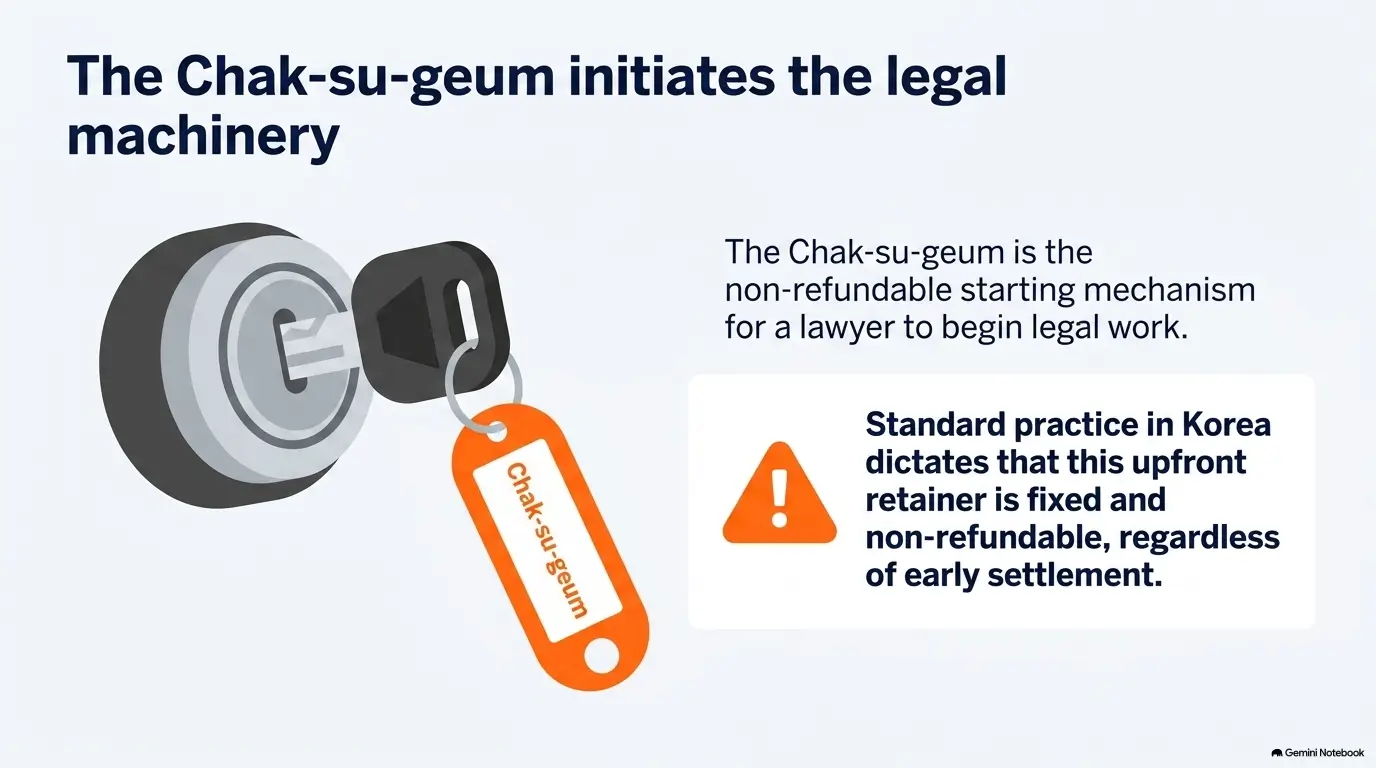
- If the matter settles early, what happens to prepaid fees?
- If the case becomes more complicated, when can the fee change?
For fixed-fee work, also ask what counts as a change in scope. For hourly work, ask the billing increment, which team members bill, and whether you receive periodic statements. For a retainer, ask whether the money is simply the agreed fee for a defined stage or whether additional hourly work can be added later.
Free and Lower-Cost Legal Help for Foreigners in Korea
Before spending several hundred thousand won simply to identify the right direction, check whether an official or publicly supported service fits your situation. Availability, eligibility, languages, and subject areas vary, so confirm the current conditions before relying on one.
Seoul Global Center
For 2026, the Seoul Global Center advertises free expert consultations in fields including law, taxation, and management for eligible foreign prospective job seekers and entrepreneurs. Seoul City’s separate general free legal-consultation service is Korean-language only and specifically directs foreigners toward the Seoul Global Center.
Check the Seoul Global Center’s 2026 expert consultation notice.
Korea Legal Aid Corporation
The Korea Legal Aid Corporation provides legal counseling and lists 132 as its legal-counseling number. Eligibility for further assistance is separate from simply receiving general counseling, and language availability should be confirmed for your situation.
Check the Korea Legal Aid Corporation.
Court litigation aid
Korean courts also have a litigation-aid system for qualifying parties who cannot afford litigation costs and whose case is not obviously without merit. The Supreme Court’s foreigner information service states that covered costs can include stamp fees, service fees, attorney fees, witness travel, appraisal fees, and certain other litigation expenses. Eligibility must be established through the court process.
Review the Supreme Court’s English-language litigation aid guidance.
Immigration Contact Center 1345
If the legal problem may affect your visa, stay status, immigration reporting, or another immigration procedure, the Ministry of Justice’s Immigration Contact Center provides multilingual counseling through 1345. It is not a substitute for a defense lawyer in a criminal or contested legal matter, but it can help you verify immigration procedures and identify the correct administrative route.
Check the Ministry of Justice Immigration Contact Center.
- Korean Bar Association for the Korean bar and professional framework.
- Supreme Court of Korea: Litigation Aid for court-based assistance information.
- Seoul Foreign Portal for current foreign-resident support programs.
- Ministry of Justice Immigration Contact Center for multilingual immigration information.
Mistakes That Make Legal Help More Expensive
Most legal bills do not explode because a client forgot to bargain over KRW 50,000. They grow because the matter becomes broader, later, messier, or harder to prove.
1. Sending a document avalanche without a timeline
Fifty screenshots named IMG_4821 through IMG_4870 are not yet evidence architecture. Create a one-page chronology and label the handful of documents that prove each important event. Organized clients make it easier for lawyers to spend paid time on legal judgment rather than archaeology.
2. Comparing only the retainer number
KRW 4 million covering negotiations and a first-instance case may be cheaper than KRW 3 million covering only the initial filing. The scope is the price tag’s missing denominator.
3. Assuming “English-speaking” means everything will be translated
Confirm whether English service covers consultations only, routine email communication, Korean document explanations, translated drafts, hearings, and final written advice. Those are not the same service.
4. Waiting until the night before an official deadline
Urgency removes options. It can also make document review harder, reduce the number of available lawyers, and turn an orderly consultation into emergency preparation.
5. Assuming the other side will pay everything if you win
Private legal fees and court-recognized litigation costs are not necessarily the same. Budget the case using your own agreed fee obligations first.
6. Hiring before checking the legal specialty
A fluent English conversation is valuable, but the harder question is whether the lawyer routinely handles your type of Korean legal problem. A criminal investigation, international divorce, startup investment, lease dispute, tax issue, and inheritance case are not interchangeable.
A polished English website is a communication signal, not a substitute for checking qualification, experience, fee scope, and who will personally handle your file.
Frequently Asked Questions
Is the first lawyer consultation in Korea usually free?
No universal rule requires it to be free. Some firms offer free introductory calls, while others charge for the first substantive legal consultation. Ask whether a free call is merely an intake or conflict-check conversation or whether a lawyer will actually analyse your legal position.
How much should I expect to pay for an English-speaking lawyer consultation?
Current publicly posted examples checked for this article range from KRW 100,000 for 30 minutes to KRW 440,000 for 60 minutes. These examples should be treated as planning references rather than a nationwide market range. Specialist, urgent, document-heavy, and cross-border consultations can be priced differently.
Does speaking English make the lawyer more expensive?
Not necessarily as a separate surcharge. The more important issue is whether foreign-client work creates additional tasks such as bilingual communication, document translation, overseas evidence review, or coordination between Korean and foreign legal issues. Ask whether those tasks are included.
Can I hire a lawyer for just one document or letter?
Sometimes. Limited-scope work can be economical when you need a contract reviewed, a demand letter drafted, a legal opinion, or preparation for a specific meeting. Availability depends on the firm and the matter, so request a fixed scope and fixed quote where appropriate.
Will I get my lawyer fees back if I win a lawsuit in Korea?
Do not assume you will recover the full private amount you paid. In civil litigation, attorney fees can be included in recoverable litigation costs only according to the applicable legal and Supreme Court regulatory framework. Your private engagement fee may exceed the amount treated as recoverable litigation costs.
Can a foreign lawyer represent me on Korean law?
A foreign legal qualification and Korean legal qualification are different. Korea’s Foreign Legal Consultant system has a defined statutory scope centered on foreign-law and specified international work. If you need advice or representation under Korean law, confirm which Korean-licensed attorney is responsible for it.
Can I hire a Korean lawyer while I am outside Korea?
Often, initial consultations and substantial preparation can be handled remotely, but the practical answer depends on the matter. Court appearances, notarized powers of attorney, original documents, identity verification, overseas service, or particular administrative procedures can create additional requirements. Ask what can be completed remotely before booking travel.
What should I send a lawyer before the first consultation?
Start with a short timeline, the names of the parties for a conflict check, the key deadline, your desired outcome, and a small set of decisive documents. Do not send hundreds of unlabelled pages unless the firm asks for them and confirms how document-review time will be charged.
Before You Book: Your Next 15 Minutes
Before contacting three different lawyers and receiving three quotes that cannot be compared, make a one-page case sheet.
- Write the problem in three sentences.
- Add the next known deadline or appointment.
- List the five most important documents.
- Write the outcome you actually want: payment, defense, settlement, contract review, divorce, visa protection, property recovery, or something else.
- Add this sentence to every inquiry: “Please tell me the consultation fee, what it includes, whether VAT and document review are included, and the likely fee structure if I retain you afterward.”
That small preparation step turns “How much do you charge?” into a much better question: “How much will it cost to solve this particular part of my problem?”
In Korea, where a language barrier can blur the edges of an already unfamiliar legal process, clarity is worth buying. The trick is to buy the right amount of it.
Last reviewed: 2026-09