

Contract Review Guide for Families and Foreign Trainees
K-pop Trainee Contract Review: Legal Risks Before the Dream Gets Expensive
A trainee contract can feel like a golden ticket pressed into your hand under bright studio lights. For a foreign trainee, though, that paper can also carry debt, visa limits, school disruption, image rights, housing rules, and exit penalties that do not glow until someone wants to leave.
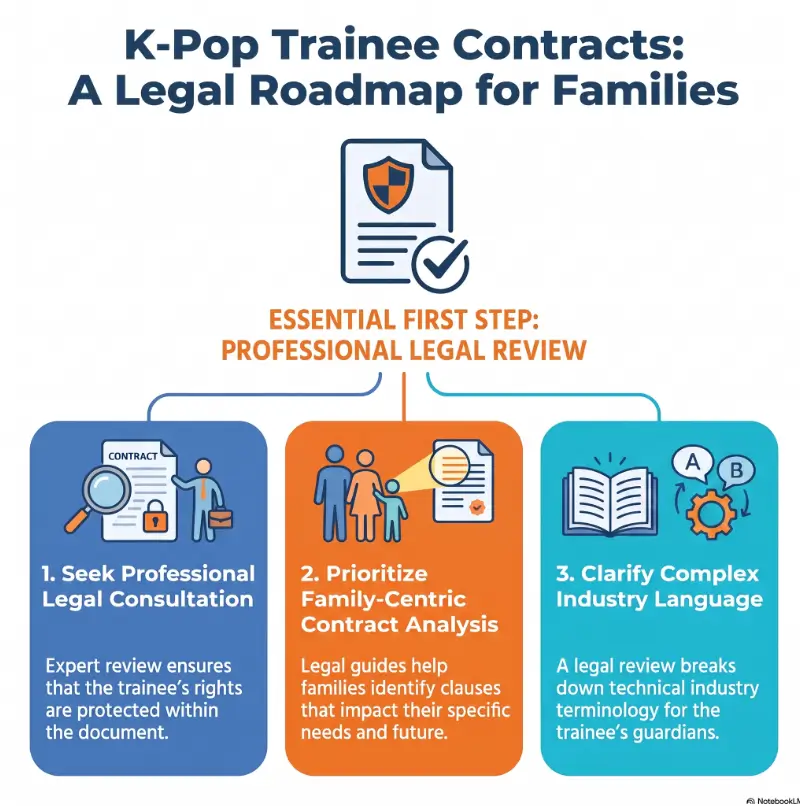
This guide is built for parents, guardians, aspiring idols, and talent-side advisors who need a calm first pass before calling a lawyer. It turns the contract into a map: what costs money, what controls movement, what affects a minor’s health and schooling, and what should never be accepted with a nervous smile.
The goal is not to scare anyone away from training. It is to help families treat the opportunity with the seriousness it deserves. A fair contract should make the path clearer, not turn ambition into a locked room with choreography mirrors.
Money Clauses
Spot training-cost repayment, penalties, profit splits, and audit rights before the numbers bite.
Minor Protections
Check school, rest, sleep, health, diet, travel, and guardian consent with sharper eyes.
Cross-Border Risk
Compare Korean contract terms with visa rules, US state duties, and translation control.
One careful review can save years of confusion, conflict, and family panic. 🧭
Snapshot: This article is for US and UK families, foreign trainees, and guardians reviewing a K-pop trainee contract before signing. It explains the clauses most likely to create legal, financial, immigration, schooling, health, and image-rights problems. By the end, you will have a practical risk memo structure and a smarter question list for a qualified entertainment lawyer.
Table of Contents
Before You Sign: What This Review Can and Cannot Do
A K-pop trainee contract review is not a vibe check. It is a controlled reading of who owns what, who pays what, who can end the deal, and what happens if the trainee gets sick, homesick, delayed, injured, rejected, or simply changes direction.
This guide can help you identify pressure points before a signature. It cannot tell you whether your specific contract is enforceable, fair, voidable, compliant, or safe. That depends on the full contract, the trainee’s age, nationality, location, visa path, agency structure, applicable law, and the facts around signing.
For a minor, the review should be even stricter. A parent’s signature should protect the child, not donate the family’s caution to the agency.
Before You Act
This article is educational, not legal advice. Before signing, compare the full Korean and translated versions, confirm immigration steps in writing, and ask a qualified lawyer familiar with Korean entertainment contracts and the trainee’s home-country rules to review the paperwork. Do not rely on a summary, a recruiter’s explanation, or “everyone signs this” as legal comfort.
Why this topic is high risk
A foreign trainee contract can touch several areas at once: entertainment law, immigration, child protection, education, medical care, accounting, housing, travel, privacy, and intellectual property. That makes it different from a normal dance-class agreement or a casual online audition release.
Korea’s Popular Culture and Arts Industry Development Act requires fair contract terms and written treatment of issues such as contract period, duties, profit distribution, portrait rights, content rights, dispute settlement, and child or juvenile protection. Families should treat those topics as minimum review categories, not decorative legal furniture.
The first question is not “Is this famous?”
A famous agency may have stronger systems, better training, and more experienced staff. It may also have more polished contracts. Polish is not the same as balance.
The first question is simpler: if the trainee leaves, who owes money, who controls content, who keeps records, who handles the visa, and who decides whether the young person is healthy enough to continue?
Key takeaway
A “standard contract” is not automatically safe. Standard can mean common, not fair. Ask what happens in the worst normal scenario: no debut, early exit, injury, visa delay, or family emergency.
The “Trainee” Label Can Hide Serious Contract Power
The word “trainee” sounds soft. It suggests practice rooms, vocal lessons, language drills, dorm chores, and the tiny thunder of sneakers on studio flooring. But a trainee agreement can still create enforceable obligations with real money attached.
Families should separate three ideas that often get blended together: a training contract, an artist contract, and a management agreement. The names may differ by agency, but the practical questions are the same.
Training contract vs artist contract vs management agreement
A training contract may focus on lessons, dorm rules, evaluation, conduct, expenses, and pre-debut activity. An artist contract usually governs commercial work, revenue, exclusivity, public appearances, brand deals, recorded music, performances, and post-debut obligations.
A management agreement may give the company authority to negotiate, schedule, promote, and control commercial opportunities. Some documents combine these functions. Others use a short trainee document now and reserve a more powerful artist agreement for later.
The risk is the bridge. A family may think they are signing for training only, while the document quietly creates a path into long-term exclusivity, content ownership, or repayment duties.
Why unpaid training can still create obligations
Some trainees are not paid. Some receive housing, lessons, food, transportation, styling, language classes, or living support. The legal issue is not just whether cash is paid today. It is whether the agency records those benefits as recoverable costs tomorrow.
Ask whether every lesson, meal, flight, dorm bed, and evaluation camp is a company investment, a trainee debt, a shared cost, or a cost recovered only from future earnings. Those are four very different worlds.
Real-world example: The translated summary that missed the debt clause
A sixteen-year-old vocalist from California receives an English summary saying the agency will provide “training support.” The family reads it as free instruction. The Korean contract, however, says certain training, housing, travel, and management expenses may be recorded and settled later under company accounting rules.
No one in the room is shouting. No one looks dishonest. The family signs because the opportunity feels rare and the deadline feels urgent.
A year later, the trainee wants to leave after recurring anxiety, missed schoolwork, and a visa delay. The family asks for the final amount. The agency sends a spreadsheet with categories the parents never understood. The lesson is plain: a summary is not the contract. The controlling version, expense definitions, and audit rights matter before the welcome dinner.
The 7 Clauses That Deserve a Red Pen
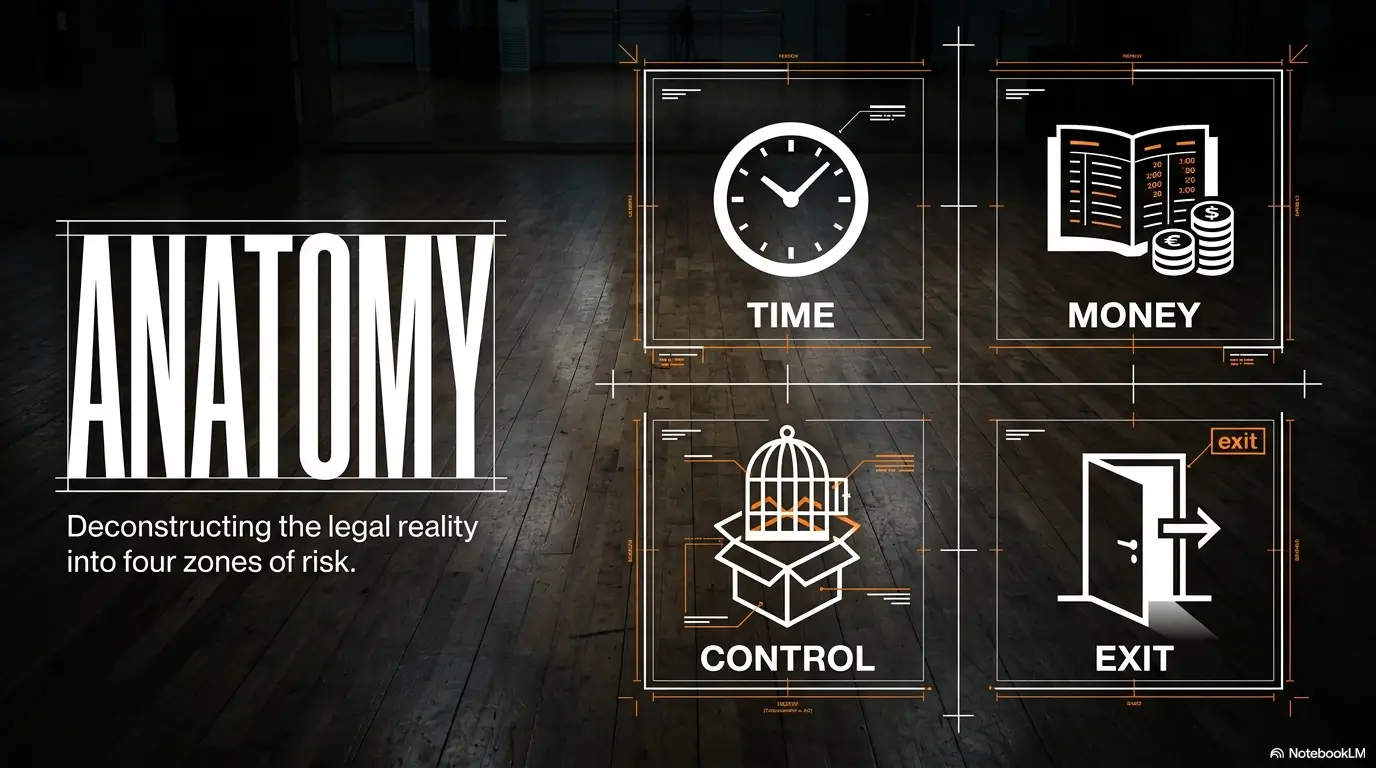
Every trainee contract has its own architecture, but seven clauses deserve first-page attention. Read them as a set. One strict clause may be manageable. Five strict clauses combined can make the contract feel less like a launchpad and more like a paper cage.
| Clause | What to check | Why it matters |
|---|---|---|
| Term and renewal | Start date, end date, extension triggers, evaluation periods, debut transition | A short training period can become long if renewal language is automatic or vague. |
| Exclusivity | Music, acting, modeling, social media, livestreaming, dance teaching, brand content | The trainee may be blocked from earning or building a public profile elsewhere. |
| Training costs | Expense categories, repayment triggers, caps, audit rights, receipts | Open-ended costs can become the most painful exit issue. |
| Housing and conduct | Dorm rules, curfew, visitors, phone use, diet, travel documents, discipline | Daily-life control can raise safety, privacy, and parent-access concerns. |
| Profit split | Pre-debut income, post-debut income, deductions, payment timing | Revenue language is meaningless unless deductions and accounting are clear. |
| Image and content rights | Name, likeness, voice, dance clips, vlogs, audition footage, AI reuse | A trainee’s face and voice can become commercial assets before debut. |
| Dispute rules | Governing law, venue, arbitration, language version, emergency relief | Where and how a dispute is handled can determine whether rights are usable. |
Term length and automatic extension language
Term language should tell you when the contract starts, when it ends, and what has to happen for it to extend. Watch for wording that allows the company to extend the contract because of training pauses, visa delays, injury, illness, lack of debut, disciplinary issues, or “company need.”
Ask whether debut creates a new contract, automatically converts the trainee deal, or extends the existing term. This is one of those small hinges that can swing a very heavy door.
Exclusivity across platforms
Modern trainees are not just singers and dancers. They may post dance covers, livestream, teach online, model, appear in short-form content, or build fan communities before debut. A broad exclusivity clause can limit all of that.
For culture and fan-context background, a guide to Korean fandom culture can help foreign families understand why pre-debut content and fan accounts are not small side issues.
Translation control
If the Korean version controls and the English version is “for convenience only,” the family must have the Korean text reviewed. A bilingual friend is helpful for reading tone, but a contract review needs legal meaning, not casual fluency.
Key takeaway
If the family cannot explain the exit clause, debt clause, image-rights clause, and dispute clause in plain English, the contract is not ready for signature.
Training Debt: The Clause That Can Follow You Home
Training-cost repayment is often the clause parents worry about only after the trainee wants to leave. That is backwards. It should be one of the first items reviewed, because it can shape every later decision.
A good review does not simply ask, “Are there training costs?” It asks who records them, who verifies them, whether they are capped, when they become repayable, and whether the trainee can audit the numbers.
What counts as “training cost”?
Training costs may include vocal lessons, dance lessons, language classes, fitness coaching, evaluation camps, recording sessions, styling, dormitory expenses, meals, flights, local transportation, medical expenses, wardrobe, content production, and administrative costs.
The danger is the phrase “including but not limited to.” It can be reasonable in some contracts, but for a trainee family it should trigger a follow-up: What categories are included, what categories are excluded, and where is the cap?
Repayment triggers are the real trapdoor
Some contracts recover costs only from future earnings. Others may require repayment if the trainee quits, breaches conduct rules, refuses debut terms, fails evaluations, cannot obtain a visa, or is removed for health or performance reasons.
Families should ask for written examples. What happens if a trainee leaves after three months? After one year? After an injury? After the agency delays debut? After a visa denial? A contract that cannot survive examples may not be clear enough.
The audit-right sentence every trainee should look for
Accounting language matters. Korea’s entertainment law includes accounting-record duties for popular culture planners and disclosure obligations in certain circumstances, but families should still look for clear contract wording that gives the trainee access to records, receipts, ledgers, and calculation methods.
The safest practical question is simple: “If we disagree with the expense total, what documents can we inspect, how quickly, and at whose cost?”
Show me the nerdy details
How to pressure-test a training-cost clause
Build four exit scenarios: voluntary exit, agency termination, medical exit, and visa-related exit. For each one, ask whether the trainee owes money, whether the amount is capped, whether costs are reduced for agency delay, whether disputed charges pause collection, and whether parents or guardians are personally liable.
Then ask for a sample expense ledger. If the agency cannot show how costs are recorded, allocated, and verified, the family cannot realistically evaluate the price of leaving.
Visa Status: The Quiet Risk Behind the Studio Door
Immigration risk is quiet because it often sits outside the contract. A recruiter may say, “We will handle the visa,” and the family may exhale. That sentence is not enough.
Foreign trainees should ask for the immigration plan in writing, including the visa type, expected activities, paid or unpaid status, travel timing, documents required, who pays fees, what happens if approval is delayed, and whether the right to stay depends on remaining with the company.
Training, tourism, and paid work are not the same thing
A tourist stay, a training program, a paid performance, a promotional appearance, and a content shoot can have different immigration implications. The family should not guess. The agency should put its plan in writing, and the trainee should confirm it with qualified immigration support when the stakes are high.
For families managing Korean apps, accounts, and identity paperwork, this guide to Korean identity verification for foreigners may help explain why seemingly small administrative steps can become surprisingly important in Korea.
Who pays when the visa plan fails?
Visa denial or delay can create flights, housing, training interruption, missed school, and contract-extension issues. The contract should say who bears those costs and whether the agency can extend the term because of immigration delays.
A parent-friendly question: “If the visa is delayed for 90 days, what happens to the contract term, training schedule, expenses, housing, and school plan?”
Passport and travel-document control
A trainee should be able to access personal identification and travel documents. If a company requires temporary document handling for a specific administrative purpose, the reason, duration, storage process, and return rule should be clear.
If a trainee or parent is told that documents, phone access, account passwords, or departure rights are being restricted for “discipline” or “protection,” seek qualified help immediately.
Key takeaway
The visa plan should be written, specific, and consistent with the contract. “We always handle it” is not a plan. It is a lullaby with paperwork missing.
Minors, School, Sleep, and Health: Where the Contract Must Slow Down
When a minor signs a trainee contract, the question is not only whether the child has talent. It is whether the contract respects childhood while testing talent. Training can be intense without becoming careless.
Korean law contains protections for juvenile popular culture artists, including contract measures tied to physical and mental health, education, sleep, rest, publicity rights, and free choice. It also includes limits and conditions around service hours for juvenile artists, with age-based rules and night-hour restrictions.
Education rights should be specific, not sentimental
A contract that says the agency “respects education” sounds pleasant. A better contract says how schooling continues, who coordinates with the school, what happens during exams, who pays for tutoring, how online classes are handled, and when training must yield to compulsory education.
If the trainee is a foreign minor, families should compare Korean obligations with home-country schooling duties. US parents, for example, may still have state-based responsibilities even while the child trains abroad or participates in a US-based bootcamp.
Diet, weigh-ins, injury, and mental health
Training contracts should not leave health to vague company discretion. Families should look for who approves medical care, who pays for treatment, whether a trainee can request a doctor, how injuries affect evaluations, and whether mental health support is available without retaliation.
For foreign families preparing for care access in Korea, this guide to mental health visits in Korea for foreigners may be a useful companion topic.
Check the newest youth-protection paperwork
South Korea’s Ministry of Culture, Sports and Tourism published a youth popular culture artist or trainee standard supplementary agreement on December 23, 2025, with a January 1, 2026 revision date. If the trainee is a minor, ask whether the agency’s paperwork reflects the newest youth-protection materials and whether the family has received the full applicable Korean text.
Trainee Contract Risk Flow
1. Money
Training costs, repayment, deductions, audit rights
2. Control
Exclusivity, housing, schedules, conduct rules
3. Health
Sleep, school, medical care, mental health
4. Status
Visa plan, travel documents, work limits
5. Exit
Termination, penalties, records, disputes
US Families: The Cross-Border Trap Most Articles Miss
A Korean agency contract does not erase US parent obligations. If a minor trains, performs, records, appears in content, or attends a bootcamp in the United States, state child entertainment rules may matter.
The US Department of Labor tracks state child entertainment law differences, and those differences can be meaningful. California, New York, Texas, Georgia, and other states may treat permits, hours, trust accounts, education, and parental duties differently.
California bootcamps and content shoots need extra care
California has specific entertainment work permit rules for minors. It also requires certain minor entertainment work permit applicants ages 14 to 17 to complete sexual-harassment prevention training before obtaining a permit.
If a Korea-linked agency runs auditions, bootcamps, content shoots, recording sessions, or trainee showcases in Los Angeles, parents should not assume “Korean company” means “Korean rules only.” Location matters.
Blocked trust and earnings questions
Some US states have rules around protecting a minor performer’s earnings, sometimes discussed in the same family of issues as Coogan-style trust protections. A trainee contract should make pre-debut earnings visible: social content, commercials, showcases, brand appearances, modeling, livestream revenue, fan platform income, and recording income.
Ask whether the agency will pay the trainee, the parent, a trust account, or another entity. Then ask how taxes, deductions, and currency conversion are handled. This is where a contract review can shift from “legal wording” to actual family budgeting.
State law mismatch is not a small detail
A family in California may face different rules than a family in New York or Texas. A trainee who attends an online program from home, travels to LA for a bootcamp, then moves to Seoul may pass through several legal systems before debut is even discussed.
For broader Korean child-safety context, families can also read about child protection in Korea. It will not replace legal advice, but it helps build the right caution muscles.
Image Rights, Social Media, and AI: Your Face Is a Business Asset
Before debut, a trainee may already appear in audition clips, dance videos, training vlogs, livestreams, promotional teasers, short-form clips, group photos, or fan platform posts. The contract should say who owns that content, who can edit it, who can monetize it, and when it must come down.
This matters because image rights no longer stop at posters and album jackets. Voice, likeness, dance style, facial scans, AI voice models, digital avatars, and post-contract reuse should all be reviewed.
Can the agency post trainee content before debut?
The contract should distinguish internal evaluation footage from public promotional content. A trainee may be comfortable with practice videos used inside the company but not with public posts that can follow them for years.
Parents should ask whether the trainee can approve public posts, request removal, limit captions, restrict old content, or prevent embarrassing footage from becoming a marketing asset.
Who controls accounts, revenue, and deletion?
Fan platform accounts, YouTube channels, TikTok profiles, Instagram handles, livestream pages, and login credentials need clear ownership. If the agency creates the account, does the trainee ever receive access? If the trainee brings an existing account, can the agency control it?
For families new to Korean app habits and platform friction, a guide to the Korean mobile app ecosystem can help explain why platform access and account identity can become practical contract issues.
AI voice and digital likeness clauses
A modern contract should not give permanent, worldwide, transferable rights to clone, alter, synthesize, or reuse a trainee’s voice and likeness without tight limits. If AI language appears, slow down.
Ask whether AI rights are opt-in, project-specific, revocable, paid, time-limited, and banned for sensitive uses. A teenager’s face should not become a forever-file because the contract was signed during an audition rush.
Key takeaway
Treat content rights like money rights. A trainee’s name, face, voice, dance footage, and social accounts can have value before the first official stage.
Don’t Sign This Blindly: Language That Should Slow the Room Down
Some contract phrases are not automatically illegal or fatal. But they should make the family pause, ask questions, and get legal review before moving forward. Think of them as smoke from the toaster: maybe breakfast is fine, maybe the kitchen needs attention.
| Contract language | Why it is risky | Safer question to ask |
|---|---|---|
| “All expenses as determined by the company” | The agency may control both the spending and the accounting. | Which expenses are recoverable, capped, documented, and auditable? |
| “Worldwide exclusive rights in perpetuity” | The rights may last too long and cover too much. | Can rights be limited by project, territory, term, media, and payment? |
| “Trainee waives all claims” | Broad waivers may reduce practical remedies. | Which claims are excluded from any waiver, especially safety and payment issues? |
| “Company may change schedules at its sole discretion” | School, sleep, medical care, and travel can become unstable. | What limits apply for minors, illness, school obligations, and rest? |
| “Penalty” or “liquidated damages” | The amount may exceed realistic agency loss. | How is the amount calculated, and is it tied to actual harm? |
| “English version for convenience only” | The family may rely on text that does not control. | Who reviewed the Korean version, and can conflicts be resolved fairly? |
Refusal to provide a full copy
If the agency refuses to give a full copy before signing, that is a serious warning sign. A family cannot review what it cannot keep.
Ask for every document: main agreement, supplementary agreement, house rules, code of conduct, privacy policy, content release, medical consent, visa plan, expense schedule, parent consent, and any later artist-contract template mentioned in the trainee agreement.
Pressure deadlines and “everyone signs” language
A real opportunity can still allow time for review. If the family is told that asking a lawyer will offend the agency, the room is already giving you information.
Professional contracts are meant to be read. An agency that handles young foreign talent should expect families to ask careful questions.
Threats involving deportation, blacklisting, or family liability
If the trainee is threatened with deportation, blacklisting, public exposure, family debt, passport control, or retaliation for asking questions, stop treating the issue as normal negotiation friction. Save records and seek qualified legal or emergency support.
If there are concerns involving harassment, coercion, grooming, assault, unsafe housing, or physical danger, prioritize safety and local emergency resources before contract strategy.
The 30-Minute K-pop Trainee Contract Review Checklist
This first-pass checklist does not replace a lawyer. It gives the family a structured way to find the questions a lawyer should answer. Print the contract, use colored marks, and make the paper confess.
- Mark every money clause in yellow. Include training costs, housing, food, medical bills, flights, wardrobe, deductions, profit share, penalties, and repayment triggers.
- Circle every “sole discretion” phrase. Then write what the company can decide alone: schedule, diet, discipline, content, evaluation, termination, or costs.
- List every right the trainee gives away. Name, likeness, voice, content, social accounts, public appearances, exclusivity, confidentiality, and future artist rights.
- Compare exit rights. Can the agency end easily while the trainee pays to leave? That imbalance deserves attention.
- Demand operational plans in writing. Visa, school, housing, medical care, mental health support, travel, and parent communication should not live in chat messages only.
- Create a lawyer question list. Send the contract, translations, emails, schedules, visa notes, expense estimates, and family concerns before the review call.
Risk scorecard for parents and guardians
| Review area | Low concern | Medium concern | High concern |
|---|---|---|---|
| Training costs | Clear, capped, documented, audited | Some categories unclear | Open-ended costs with repayment after exit |
| Minor protections | Specific school, rest, health, parent access rules | General promises only | School absence, sleep loss, injury training, vague diet control |
| Visa plan | Written visa process and cost allocation | Agency says it will explain later | No written plan or stay tied to agency control |
| Content rights | Limited use, approval, removal process | Broad promotional use | Permanent worldwide rights, AI reuse, no removal path |
| Disputes | Clear venue, language, remedies, records | Foreign venue with unclear translation | Family cannot practically enforce rights |
What documents to save before a dispute exists
- Every contract version, including Korean and translated copies
- Agency emails, recruiter messages, chat screenshots, and deadline messages
- Expense estimates, invoices, receipts, and ledger screenshots
- Schedules, attendance records, training evaluations, and medical notes
- Visa documents, travel records, school communications, and housing rules
- Any content release, social media login instruction, or image-rights request
Key takeaway
The best time to organize records is before anyone is upset. A clean file folder can turn panic into a timeline.
DIY Review vs Paid Legal Help: What Is Worth the Cost?
A DIY review is useful for spotting obvious issues. It is not enough for signing a high-risk foreign trainee contract, especially when the trainee is a minor. The right question is not “Can we avoid legal fees?” It is “Which questions are too expensive to guess?”
Families searching for an entertainment lawyer near me, Korean contract lawyer, child performer lawyer, or immigration attorney should compare experience carefully. The best fit may involve more than one professional, especially if the trainee will move between Korea and the United States.
| Option | Best for | What it can do | What it cannot do |
|---|---|---|---|
| Free family checklist | Early triage before a call | Find obvious cost, exit, visa, school, and content questions | Confirm enforceability or negotiate legal language |
| Paid contract review | Before signing or renewing | Explain risk, suggest edits, compare terms, prepare negotiation points | Guarantee agency acceptance or future outcome |
| Bilingual legal review | Korean controlling text | Compare Korean and English terms and spot translation gaps | Replace home-country child, tax, or immigration advice |
| Immigration review | Foreign trainee travel or work activity | Clarify visa category, status limits, travel risk, and sponsor dependence | Fix an unfair contract by itself |
| Child performer compliance review | US-based bootcamps, shoots, recordings, or performances | Check permit, training, trust, schooling, and hours questions by state | Resolve Korean law questions alone |
Questions to ask before paying a professional
- Have you reviewed Korean entertainment, trainee, artist, or management contracts before?
- Can you review the Korean controlling version, or do we need a separate Korean-law specialist?
- Do you understand minor entertainment rules in our state or country?
- Can you identify immigration questions that require a separate immigration lawyer?
- Will you provide a written risk memo, markup, or call summary?
- Can you prioritize must-change clauses versus negotiable comfort edits?
Good / Better / Best review setup
| Setup | What the family does | When it fits |
|---|---|---|
| Good | Use a checklist, organize files, ask for the full contract, refuse pressure signing | Very early talks before any serious offer |
| Better | Pay for a focused entertainment contract review and written questions | Before signing a trainee agreement with costs, exclusivity, or content rights |
| Best | Combine Korean contract review, immigration review, and child-performer compliance review where needed | Minor foreign trainee, relocation, US bootcamp, public content, or significant expenses |

FAQ
Can a foreigner legally sign a K-pop trainee contract?
In many cases, foreigners can sign trainee-related agreements, but the contract, age, visa status, location, activity type, and home-country rules all matter. A legal review should confirm whether the agreement fits the trainee’s actual situation.
Is a K-pop trainee contract the same as an idol contract?
Not always. A trainee contract may focus on training, evaluation, expenses, dorm rules, and pre-debut content. An idol or artist agreement usually governs commercial activity, revenue, promotion, recordings, performances, and brand work. Some contracts connect the two, so the transition language is important.
Can an agency make a foreign trainee pay back training costs?
That depends on the contract and applicable law. Families should check whether costs are recoverable, capped, documented, audited, and triggered by voluntary exit, breach, failed debut, injury, visa issues, or agency delay.
Do parents have to sign if the trainee is under 18?
Minor contracts often require parent or guardian involvement, but the exact legal effect depends on the contract, country, and local law. Parent consent should not be treated as a blank check for unsafe schedules, vague debt, or broad rights transfers.
What happens if a trainee quits before debut?
The contract should answer that clearly. Review repayment, penalties, content rights, confidentiality, social accounts, visa consequences, housing departure, travel costs, and dispute process. If the answer is vague, ask for written examples before signing.
Can a Korean agency control a trainee’s TikTok, Instagram, or YouTube?
The agency may request certain controls, especially for brand consistency or confidentiality. But the contract should clearly define account ownership, login access, revenue, posting approval, deletion rights, and what happens after termination.
Should the contract be reviewed in Korean or English?
If the Korean version controls, review the Korean version. An English summary can help the family understand the deal, but it should not replace review of the binding text.
Can a US minor train in Korea without US child performer protections?
It depends on where the activity occurs and which rules apply. US state laws may still matter for US-based auditions, bootcamps, recordings, performances, or content shoots. Families should check state-specific child entertainment rules when any activity happens in the United States.
What documents should parents save before a dispute happens?
Save the full contract, all translations, agency messages, expense records, schedules, visa documents, school communications, medical notes, housing rules, content releases, and social-account instructions. Organize them by date.
Your Next 15 Minutes: Build the One-Page Risk Memo
Before any signature, build a one-page risk memo. It does not need legal poetry. It needs five columns and enough honesty to make the contract visible.
| Clause | What it says | What it costs | If the trainee leaves | Lawyer question |
|---|---|---|---|---|
| Training expenses | List exact wording | Known and unknown amounts | Repayment, cap, audit | Can this be narrowed or capped? |
| Exclusivity | Platforms and activities covered | Lost outside income or opportunities | Survival after exit | Can exclusions be added? |
| Visa plan | Who handles status | Fees, travel, delay costs | Right to stay or return | Is the immigration plan realistic? |
| Minor protections | School, sleep, health rules | Tutoring, care, travel | Medical or school exit | Does this satisfy youth-protection duties? |
| Content rights | Name, image, voice, AI, accounts | Revenue and reuse | Removal and post-exit control | Can rights be limited and paid? |
Then send the memo, full contract, translation, agency emails, schedule, visa plan, expense list, and family concerns to qualified legal counsel. The most useful review call is not the one where everyone arrives with fog in their pockets. It is the one where the questions are already lined up like shoes by the door.
For deeper background on the trainee system itself, you can also read this related guide to K-pop trainee contracts. Use it as context, then let the actual contract decide what needs legal review.
Final practical move
Open the contract now and highlight only five things: money, exit, visa, health or school, and image rights. If any one of those feels unclear, do not sign until the uncertainty has a written answer.
Last reviewed: 2026-08