
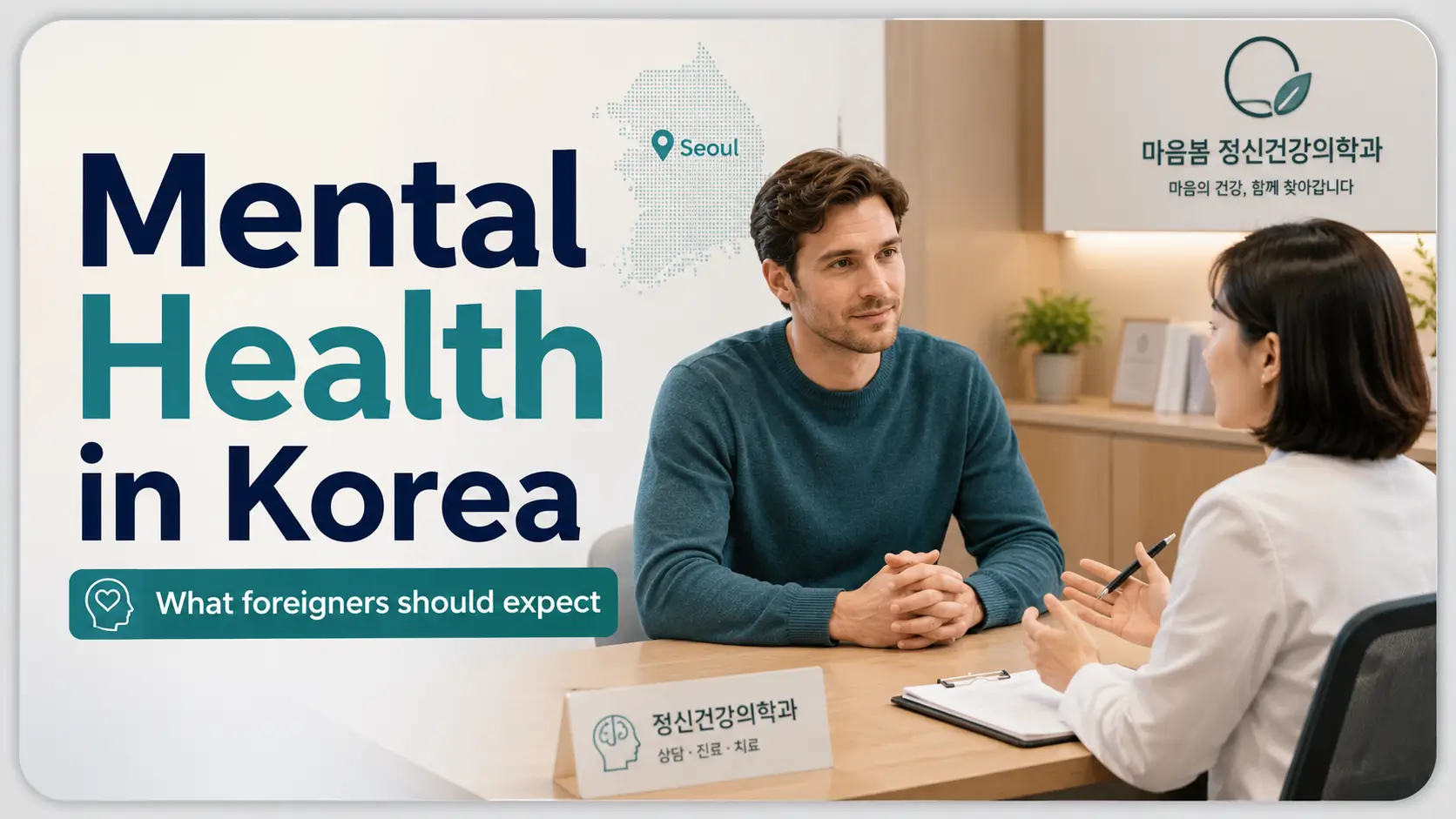
Foreigners in Korea Mental Health Guide
How Mental Health Visits in Korea Feel Different
From What Foreigners Expect
A first mental health appointment in Korea can feel unexpectedly formal, fast, and clinical. You may walk in expecting a quiet hour of talk therapy, then find yourself answering direct questions about sleep, panic, appetite, work, medication history, and whether daily life still feels manageable. That difference can be jarring, especially when you are already carrying stress in a second language.
This guide is written for English-speaking readers who want practical clarity before they book: expats, exchange students, English teachers, digital nomads, military families, long-term residents, and travelers who realize that “I can push through” has quietly expired. The goal is not to make Korean mental health care sound frightening or perfect. The goal is to make it legible.
You will learn why Korean psychiatry may feel more medical than conversational, how therapy and medication often sit in different rooms, what to ask before leaving the clinic, and how to prepare a one-page note that turns a short appointment into something useful. Think of it as a small lantern for a hallway that can otherwise feel too bright and too quiet at the same time.
Know the visit style
Understand why appointments may feel brief, direct, and symptom-focused.
Ask better questions
Leave with clearer answers about diagnosis, medication, therapy, and follow-up.
Prepare safely
Use scripts, checklists, and crisis red flags without guessing in the moment.
Small promise: by the end, you should know what to bring, what to ask, and when “wait and see” is no longer safe. 🕯️
Snapshot: This article is for English-speaking foreigners preparing for a first non-emergency mental health visit in South Korea. It explains what may feel different from US or UK expectations, how to prepare symptom notes, how to ask about medication and therapy, and when to seek urgent help instead of waiting for a routine appointment.
Safety First: What This Guide Can and Cannot Do
This article is for general educational purposes only. It is not medical advice, diagnosis, treatment instruction, or a replacement for a licensed mental health professional who can assess your specific situation.
Mental health symptoms can change quickly. Medication questions, withdrawal concerns, suicidal thoughts, self-harm risk, psychosis, severe panic, and unsafe alcohol or drug use should be handled with professional help. If you feel at risk of harming yourself or someone else, do not wait for a blog article, a friend’s reply, or a routine clinic opening time.
In South Korea, emergency help may involve local emergency services, a hospital emergency room, a nearby psychiatric emergency service, or a crisis support line. If language is a barrier, ask a trusted Korean speaker, school office, employer support staff, base support office, embassy guidance desk, or local international center to help you communicate quickly.
Key Takeaway
If safety is uncertain, treat it as urgent. A routine appointment is for support and planning. Immediate danger needs immediate help.
Use this guide as preparation, not permission to delay care
Preparation is useful when you are booking a first appointment, comparing clinic styles, or wondering why Korean psychiatry feels different from therapy back home. It is not useful as a reason to postpone care when you cannot sleep for days, feel detached from reality, have frightening medication reactions, or feel unsafe being alone.
A good rule is simple: if the problem is making daily life unsafe, move from “research mode” to “help mode.” That may mean contacting emergency services, going to an emergency room, calling a crisis line, or asking someone to stay with you while you get help.
Know the limits of cultural comparison
This article compares common appointment experiences, not every doctor, clinic, hospital, or therapist in Korea. Some Korean psychiatrists spend more time in conversation. Some English-speaking counseling centers offer deeply reflective talk therapy. Some foreign patients have warm, careful experiences. Others feel rushed and confused.
The safest way to read this guide is as a pattern map. It helps you recognize what might happen, what to ask, and how to protect your own clarity when the visit moves faster than expected.
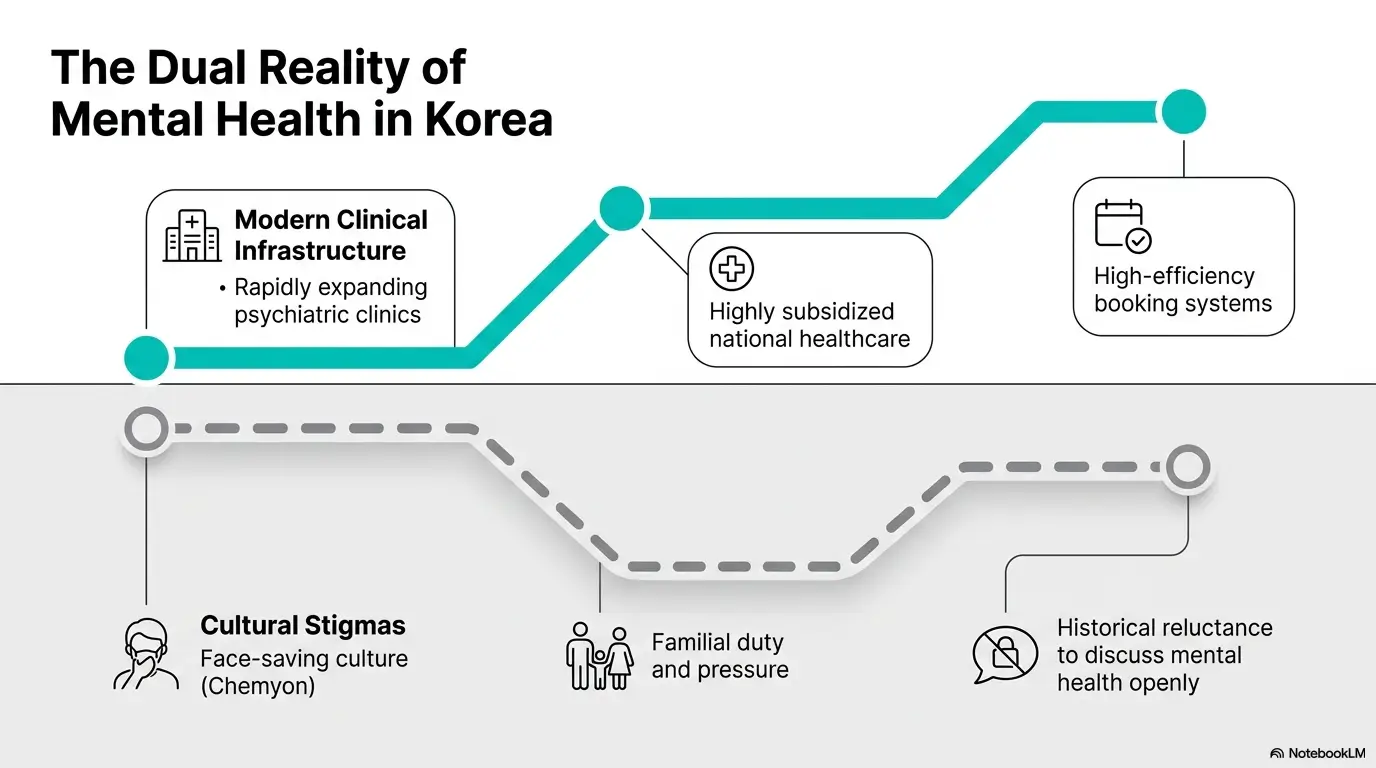
The First Surprise: It May Feel More Like a Clinic Than a Couch
Many foreigners arrive with a mental picture formed by US or UK therapy culture: a calm room, a soft chair, a long session, and enough time to tell the whole story from the beginning. In Korea, a first psychiatry visit may feel closer to a medical consultation. The doctor may ask targeted questions, type while listening, and move quickly toward diagnosis, medication, or follow-up planning.
That can feel emotionally cold if you expected a long unfolding. But “brief” and “dismissive” are not the same thing. Korean outpatient care often runs on speed, high patient volume, and a strong medical model. You may need to be more direct than feels natural, especially if you were raised to soften distress with phrases like “I’m okay, just tired.”
Korean psychiatry visits often start with symptoms, not life stories
A psychiatrist is a medical doctor. In many Korean clinics, the first job is to understand symptoms: sleep, appetite, anxiety, depression, panic, concentration, irritability, suicidal thoughts, hallucinations, trauma symptoms, substance use, and how long the problem has lasted.
You may want to explain the full story of a breakup, a toxic workplace, military relocation, loneliness, family pressure, visa stress, or burnout from teaching. Those details matter. But the doctor may first try to classify the symptoms in a way that supports treatment decisions.
That means you should not wait for the perfect emotional opening. Bring the key facts forward early. For example: “I have slept three hours a night for two weeks,” “I had two panic attacks at work this month,” or “I have thoughts of not wanting to be alive.” These sentences are not dramatic. They are clinically useful.
What “brief but serious” can look like in a real appointment
A brief appointment may include an intake form, a short wait, a focused conversation, a prescription discussion, and a follow-up date. The room may not invite long emotional pauses. There may be a computer on the desk and other patients outside. It can feel like your private storm has been given a numbered ticket.
Still, the doctor may be paying close attention to the data that changes treatment: how long symptoms have lasted, whether you are functioning at work or school, whether you have taken medication before, whether there is a family history, and whether there is immediate risk.
The mismatch is emotional. The patient may want witness. The system may offer assessment. Both can matter, but they are not the same experience.
Here’s what no one tells you: short does not always mean careless
A short visit can still be clinically useful if the right information reaches the doctor. It becomes much less useful when the patient minimizes, forgets key details, or leaves with unanswered questions because the atmosphere felt too formal.
Think of the appointment as a narrow bridge. You may not have room to carry every suitcase across. Carry the vital ones first: symptoms, duration, severity, safety concerns, medication history, and the one problem you most need help with this week.
Key Takeaway
Do not measure the visit only by warmth or length. Measure it by whether your most important symptoms were heard, explained, and turned into a clear next step.
Short Story: The Note That Changed the Visit
Maya, an exchange student in Seoul, booked a psychiatry appointment after six weeks of waking at 4 a.m. with her heart racing. She expected to explain everything: the new campus, the language wall, the cafeteria meals she barely touched, the way her mother’s texts arrived during lectures like tiny alarms.
At the clinic, the doctor asked short questions. Maya froze and answered politely. “I’m okay. Just stressed.” The visit ended with advice that felt too light.
Before her follow-up, she wrote one page: sleep, appetite, panic episodes, missed classes, family history, and the sentence she had avoided saying: “I am scared to be alone at night.”
The second visit was still brief. But it was different. The doctor understood the severity, adjusted the plan, and helped her find counseling support. The lesson was not that notes replace courage. Notes help courage speak on time.
Medication May Come Up Faster Than You Expect
Foreigners used to therapy-first care may be surprised when medication enters the conversation early. In many Korean psychiatry settings, medication is not treated as a last resort after months of talk therapy. It may be presented as a practical tool for depression, anxiety, panic, insomnia, ADHD symptoms, mood instability, or severe stress responses.
This does not mean you must accept a prescription without questions. It also does not mean medication is automatically wrong. The key is to slow the conversation enough to understand what is being prescribed, why it is being prescribed, how to take it, and what to watch for.
Why prescriptions may appear early in Korean mental health care
Psychiatrists are trained to diagnose and treat mental health conditions medically. In a busy clinic model, medication can be one of the most direct tools available. If someone has not slept properly for weeks, cannot function at work, or has repeated panic attacks, the doctor may focus on symptom relief first.
For a foreign patient, this can feel abrupt. You may wonder, “How can they prescribe after only talking to me for ten minutes?” The answer is that some psychiatric decisions are based on symptom patterns, risk level, history, and clinical judgment rather than a long life narrative.
That said, you deserve to understand the plan. A prescription should not feel like a sealed envelope handed to you in a language you cannot read.
What to ask before starting antidepressants, anxiety medication, or sleep aids
Medication conversations are where short appointments can become risky if you stay too polite. You do not need to challenge the doctor aggressively. You do need to ask clear questions.
- “What is this medication meant to help first?”
- “How soon might I notice an effect?”
- “What side effects should I watch for?”
- “Can I drink alcohol while taking it?”
- “Will it make me sleepy during work, school, or driving?”
- “What should I do if I miss a dose?”
- “Should I stop suddenly if I feel better or worse?”
- “When should I contact you urgently?”
Write these questions down. A calm list is a small rebellion against confusion.
How refill visits can feel different from the first consultation
Follow-up visits may be shorter than the first appointment. The doctor may ask whether symptoms improved, whether side effects appeared, whether sleep changed, and whether the dose should stay the same. If you expected every follow-up to feel like therapy, this can be disappointing.
Prepare a quick update before each refill visit. Use simple categories: mood, anxiety, sleep, appetite, concentration, side effects, daily functioning, and safety. Instead of saying “better,” say “I sleep six hours instead of three, but I still wake up with panic twice a week.” That gives the doctor something useful to work with.
Medication Question Card
- Name of medication in English and Korean, if possible
- Main symptom it targets
- When to take it and whether food matters
- Common side effects and serious warning signs
- Alcohol, driving, work, school, and pregnancy considerations
- Follow-up date and what to do if symptoms worsen
Therapy Is Not Always Built Into the Same Visit
One of the biggest expectation gaps is the word “mental health.” For many English-speaking foreigners, mental health care means talk therapy, counseling, emotional processing, and coping tools. In Korea, a psychiatry appointment may mean diagnosis and medication management, while counseling or psychotherapy may be separate.
This distinction matters because a patient may leave a psychiatrist thinking, “They did not let me talk,” when the clinic was never structured as a talk therapy session in the first place. That does not erase the need for emotional support. It simply means you may need to ask for it directly or book it separately.
Why psychiatry and counseling may sit in different rooms
Psychiatrists can prescribe medication. Counselors and therapists usually focus on conversation-based support, coping skills, trauma work, relationship patterns, stress management, and emotional processing. Some clinics combine these services. Many do not.
If you want therapy, say so plainly. Try: “I am also looking for talk therapy or counseling. Is that available here, or can you recommend a place?” This one sentence can prevent weeks of quiet disappointment.
Where foreigners often find talk therapy in Korea
Foreigners may look for therapy through international counseling centers, university counseling offices, employer assistance programs, military or embassy-connected resources, private English-speaking therapists, online therapy platforms, or referrals from psychiatrists. Availability depends heavily on location, language, budget, and whether you need licensed care in a specific jurisdiction.
Students should check their university counseling center early, even if they think their problem is “not serious enough.” English teachers may ask whether their employer offers any wellness support, though privacy concerns should be weighed carefully. Military families may have access to base-specific support systems. Digital nomads may need private pay options or remote counseling from a provider licensed where they are legally able to practice.
The quiet gap: wanting emotional space but receiving medical efficiency
The emotional gap can ache. You may be living far from family, navigating Korean work culture, missing old routines, and trying to explain loneliness in a language that makes you sound flatter than you feel. Then the appointment ends before the deeper story has found its shoes.
Name the gap without shame. You can use psychiatry for medical assessment and medication support while also seeking therapy for the longer conversation. A good care plan may include both, plus sleep habits, social support, exercise, reduced alcohol use, workplace changes, or academic accommodations.
| Need | Who may help | What to ask |
|---|---|---|
| Medication assessment | Psychiatrist or hospital psychiatric department | “What diagnosis or symptom pattern are we treating?” |
| Talk therapy | Counselor, therapist, psychologist, counseling center | “Do you offer sessions in English, and what is your approach?” |
| School stress | University counseling center or international office | “Can I speak with someone confidentially in English?” |
| Work burnout | Psychiatrist, counselor, employee support resource | “Can you help me document functional impact if needed?” |
| Urgent safety risk | Emergency services, ER, crisis line | “I do not feel safe. I need urgent help now.” |
Language Support Can Change the Whole Appointment
Language support is not a decorative extra in mental health care. It is the floor. If you cannot explain panic, intrusive thoughts, trauma symptoms, medication reactions, or suicidal thoughts clearly, the appointment can become a fog machine with a prescription pad somewhere inside it.
An English intake form helps, but it is not the same as an English-speaking clinician. A receptionist who can book you in English is helpful, but it does not guarantee the doctor can discuss diagnosis, medication risks, and follow-up instructions in English.
How to check whether the clinic truly offers English care
Before booking, ask specific questions. “Do you speak English?” is sometimes too broad. A clinic may answer yes because someone can handle basic scheduling. For mental health, you need clinical conversation.
- “Can the psychiatrist provide the consultation in English?”
- “Can the doctor explain medication instructions and side effects in English?”
- “Are English documents or receipts available if I need them?”
- “Can I bring a Korean-speaking friend or interpreter?”
- “Is there an extra fee for interpretation or longer consultation?”
If the answers are vague, be cautious. Mental health appointments rely on nuance. “A little English” may be fine for a cold. It may not be enough for complex anxiety, bipolar symptoms, trauma, medication changes, or safety concerns.
What to prepare if the doctor speaks some English but not fluently
Use plain words. Avoid idioms like “I’m spiraling,” “I’m burnt out,” or “I feel wired.” Instead, describe what happens in your body and behavior. Say “I cannot sleep until 4 a.m.,” “I cry before work,” “my chest gets tight and I think I will die,” or “I have stopped answering messages.”
Bring a written note with short sentences. Translation apps can help with basic terms, but do not rely on them for sensitive nuance. If possible, prepare Korean keywords for major symptoms, medication names, allergies, and urgent safety statements.
You can also ask, “Can you explain that in simpler terms?” This is not rude. It is responsible. Medical care should not become a guessing game because everyone is being polite.
When translation help is worth arranging
If your symptoms are severe, your medication history is complicated, or you need documents for school, work, insurance, or travel, consider arranging language support before the visit. A trusted interpreter, university support office, or professional medical translation resource can reduce errors.
For a broader look at the communication side of Korean healthcare, you may find this guide to medical translation in Korea useful, especially if you are deciding whether a bilingual friend is enough or whether you need more formal help.
Key Takeaway
For mental health, “English available” should mean the clinician can explain diagnosis, medication, side effects, follow-up, and safety instructions in English.
First Visit Flow: From Confused to Prepared
1. Safety check
Unsafe today? Use emergency help, ER, or crisis support instead of waiting.
2. Language check
Confirm the doctor can discuss care in English, not only book the visit.
3. Symptom note
Bring dates, severity, sleep, appetite, panic, mood, medication, and risk.
4. Ask directly
Clarify diagnosis, medication purpose, side effects, therapy, and follow-up.
Appointment Style: Direct, Fast, and Sometimes Formal
Korean medical visits can feel efficient in a way that surprises foreigners. The doctor may not spend much time on small talk. The clinic may be busy. The receptionist may move quickly. You may be called in, asked focused questions, given a plan, and sent to the payment desk before your nervous system has fully arrived.
This style is not limited to mental health. If you have used general Korean clinics, you may already know the rhythm: quick assessment, practical action, short follow-up. For more context, this related article on why Korean clinics are so fast can help you understand the broader medical culture.
Why efficiency can feel cold when the topic is emotional
Efficiency feels different when you have a sore throat than when you are describing depression. With a sore throat, speed can feel wonderful. With mental health, speed can feel like your pain has been folded too quickly and put in a drawer.
That feeling is real. It does not mean care is impossible. It means you may need to bring structure into the room so the important parts are not lost. Your note, your questions, and your willingness to say “this is affecting my daily life” can give the appointment a stronger spine.
How hierarchy and politeness can make patients hesitate
In Korea, medical and social settings can carry a sense of hierarchy. Patients may feel they should not interrupt, challenge, or ask too many questions. Foreigners may also worry about being seen as demanding, especially if they are already anxious about language or cultural mistakes.
But questions are not disrespect. In mental health care, questions are safety equipment. You can be polite and firm at the same time: “Thank you. I want to make sure I understood correctly. Could you explain the follow-up plan again?”
Let’s be honest: awkward silence feels louder in a second language
When you are speaking about private pain in a second language, silence can feel enormous. You may start editing yourself. You may laugh at the wrong time. You may say “not serious” because the room feels too formal for the truth.
Prepare one or two sentences that do not require improvisation. For example: “I am embarrassed to say this, but it is serious,” or “I tend to minimize things, so I wrote down the real symptoms.” These sentences give you a handrail.
Privacy, Records, and Insurance Questions to Ask Clearly
Foreigners often worry about mental health records in Korea. Will it affect a visa? Will an employer know? Will insurance cover it? Should you pay privately? What appears on receipts? What if you need documentation later? These are not silly questions. They are practical questions, and they deserve direct answers from the clinic or insurer.
The hard part is that privacy, billing, employment, school, visa, and insurance concerns can vary by situation. A short blog article cannot promise what applies to your exact case. The safe move is to ask the clinic how billing and records are handled before you proceed, especially if documentation could affect work, school, military status, immigration paperwork, or private insurance claims.
What foreigners often worry about before booking
Common concerns include whether National Health Insurance applies, whether private insurance will reimburse the visit, whether an employer can see the claim, whether a diagnosis appears on documents, whether medication history matters for future applications, and whether paying out of pocket creates more privacy.
Do not rely on rumors from group chats. A friend’s experience may be useful, but it may not match your visa type, insurance plan, employer arrangement, clinic category, or documentation needs.
Questions to ask before you pay or use insurance
- “Can I use National Health Insurance for this visit?”
- “What will appear on the receipt?”
- “Can I receive an English receipt or medical certificate if needed?”
- “If I pay privately, what changes and what does not change?”
- “Who can access my records?”
- “Do you provide documents for school, work, travel, or insurance claims?”
If you are new to the Korean insurance system, this related guide to Korean National Health Insurance for foreigners may help you understand the general setup before you ask clinic-specific questions.
When private pay may feel simpler but cost more
Some foreigners choose private pay because it feels simpler, faster, or more discreet. That may be reasonable in certain situations, but it can cost more. It also does not automatically mean there are no records. Clinics still maintain medical documentation.
Before deciding, ask what the total cost includes: consultation, medication, documents, therapy, follow-up, and any tests. If medication is prescribed, ask how prescriptions are filled and whether the pharmacy can explain instructions clearly. For more practical context, see this guide on prescription filling in Korea.
Official resource for insurance questions
For general foreign resident insurance information, use the official National Health Insurance Service English page as a starting point, then confirm details with your clinic.
Visit NHIS English GuidanceCommon Mistakes Foreigners Make Before the First Visit
The first visit is not a performance. You do not need perfect Korean, perfect emotional insight, or a perfectly organized life. But a few common mistakes can make the appointment less helpful than it could be.
Most mistakes come from the same root: trying to be easy. Easy for the receptionist. Easy for the doctor. Easy for the friend who came with you. Easy for your own pride. Mental health care is the wrong place to become invisible.
Mistake 1: expecting a 50-minute therapy session from a psychiatrist
If you expect a long talk therapy session, a brief psychiatry visit may feel like failure. It may not be failure. It may be a different service. The psychiatrist may assess symptoms and medication needs, while therapy must be booked separately.
Before the appointment, decide what you are seeking: medication review, diagnosis, sleep support, panic treatment, therapy referral, documentation, or urgent risk assessment. You can need more than one, but name the top priority first.
Mistake 2: arriving without symptom notes or medication history
Anxiety scrambles memory. Depression flattens detail. Shame edits the truth. A written note protects you from all three.
Bring current and past medication names, doses, allergies, major diagnoses, hospitalizations, therapy history, and family history if relevant. If you do not know the exact medication name, bring a photo of the bottle or prescription record.
Mistake 3: saying “I’m fine” out of politeness when things are not fine
Many people soften distress automatically. They smile. They say “just stress.” They hide the frightening part until the appointment is nearly over. In a short visit, that can lead to undertreatment.
Use functional language if emotional language feels too exposed. “I missed work twice,” “I stopped eating breakfast,” “I cannot ride the subway without panic,” “I have not showered regularly,” or “I am scared by my thoughts” gives the doctor a clearer picture.
Mistake 4: leaving without understanding the plan
Before leaving, you should know what the doctor thinks is happening, what treatment is being tried, what medication instructions mean, when to return, and what warning signs require faster help.
If you do not understand, say: “I want to follow the plan correctly. Could you summarize it once more?” That sentence is simple, polite, and quietly powerful.
Mistake Checklist
- I expected therapy but booked psychiatry.
- I did not bring medication names or doses.
- I minimized symptoms to sound polite.
- I forgot to mention safety concerns.
- I accepted medication without asking about side effects.
- I left without a follow-up date or warning-sign plan.
Show me the nerdy details
A psychiatry visit often compresses several clinical tasks into a short time: symptom screening, risk assessment, differential diagnosis, medication review, treatment planning, documentation, and follow-up scheduling. That is why your answers need to be concrete.
Doctors listen for duration, severity, impairment, triggers, protective factors, past episodes, family history, substance use, medical conditions, and medication response. “I feel bad” is emotionally true, but “I sleep three hours, missed two classes, lost five pounds, and had daily panic for ten days” is easier to act on.
The more you can translate feelings into observable changes, the more useful a short medical appointment becomes.
Cost, Timing, and Follow-Ups May Feel Different Too
Costs and timing can vary widely depending on location, insurance status, clinic type, hospital level, language support, testing, documentation, therapy, and medication. A small neighborhood clinic will not feel the same as a large hospital department. An English-speaking private counseling center may not bill like a psychiatrist who accepts Korean National Health Insurance.
Because mental health care sits at the intersection of medicine, language, privacy, and money, ask practical questions early. There is no prize for being surprised at the payment desk.
Why first visits and follow-up visits may not feel equally detailed
The first visit may include more intake questions. Follow-ups may focus on whether the treatment is working. If medication is involved, the doctor may adjust dose, continue the same plan, or ask you to return after a set period.
Do not assume a shorter follow-up means nothing can be discussed. Bring a tight update. If symptoms worsened, say so at the beginning. If side effects are affecting work, school, driving, or sleep, do not save that for the hallway.
The practical bit: bring ID, payment, medications, and written questions
For a first visit, bring your ARC or passport if relevant, insurance information, payment method, current medication list, supplement list, allergies, previous diagnoses, and written questions. If you are a student, bring any school forms only if you need documentation. If you are using private insurance, check reimbursement rules before the visit.
If you are taking sleep aids, ADHD medication, antidepressants, anti-anxiety medication, mood stabilizers, pain medication, or herbal supplements, disclose them. Mixing medications without clear guidance can create real risk.
Cost questions that save awkwardness later
| Question | Why it matters | When to ask |
|---|---|---|
| “What is the estimated first-visit fee?” | First visits may cost more than follow-ups. | Before booking |
| “Is medication paid here or at a pharmacy?” | In Korea, prescriptions are often filled separately. | Before leaving |
| “Can I use National Health Insurance?” | Coverage can change the out-of-pocket cost. | Before consultation |
| “Are English documents extra?” | Certificates or letters may have separate fees. | Before requesting forms |
| “How long are follow-up visits?” | Helps set expectations for medication review. | At the first visit |
Key Takeaway
Ask about fees, insurance, medication pickup, documents, and follow-up timing before the visit ends. Mental health care feels less intimidating when the logistics are not floating around like loose receipts.
When to Seek Help Immediately Instead of Waiting
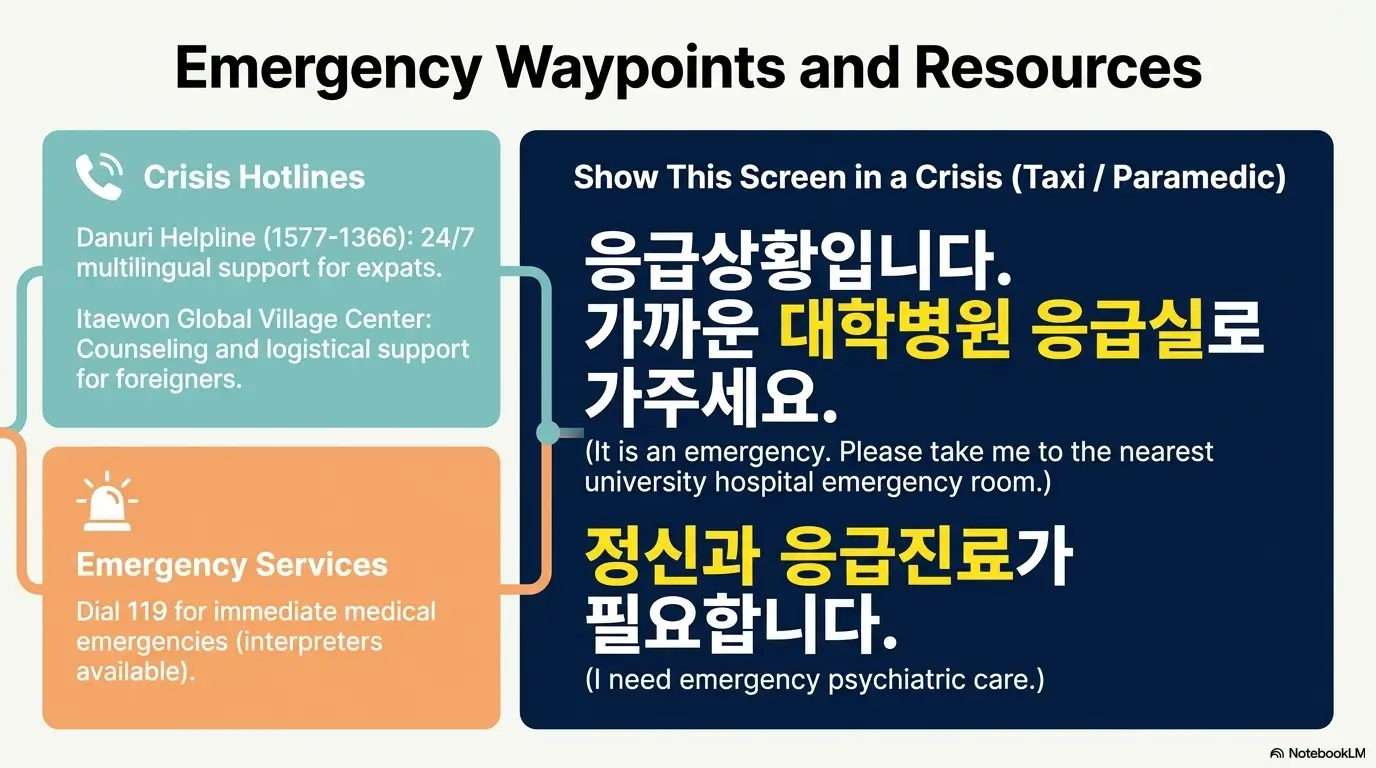
Some situations should not wait for a convenient appointment. If you are in immediate danger, feel unable to stay safe, or are worried you may harm yourself or someone else, seek urgent help now. This may mean emergency services, a hospital emergency room, a crisis hotline, or asking someone nearby to stay with you while help is arranged.
If you are unsure whether it is “bad enough,” treat uncertainty with care. People often underestimate risk when they are exhausted, ashamed, intoxicated, isolated, or frightened by their own thoughts.
Red flags that need urgent support
- You feel at risk of harming yourself or someone else.
- You have a plan, intent, or access to means for self-harm.
- You are hearing or seeing things others do not.
- You feel severely confused, paranoid, or detached from reality.
- You have not slept for several nights and feel out of control.
- Panic, depression, or agitation makes daily functioning unsafe.
- Medication side effects feel sudden, severe, or frightening.
- Alcohol, drugs, or withdrawal symptoms are involved.
What to say if you need urgent help in Korea
In a crisis, simple language is best. You can say: “I am not safe alone,” “I might hurt myself,” “I need emergency mental health help,” or “Please take me to an emergency room.” If you need Korean help, prepare a translated sentence in advance and keep it in your phone.
If you are with someone who is struggling, do not debate whether their pain is logical. Stay close, remove immediate dangers if safe to do so, contact emergency support, and use calm sentences. “I am staying with you. We are getting help now.”
Use trusted support lines and emergency services
Crisis resources can change, and language availability may vary. Use current, trusted directories or official services rather than old screenshots from social media. If you are in immediate danger, emergency services or an emergency room should come before routine clinic research.
Crisis support directory
For a current list of helplines in South Korea, use a trusted helpline directory and choose urgent support if you feel unsafe.
Find Crisis Help in South KoreaHospital mental health contact reference
For official hospital-level mental health contact information in Korea, the National Center for Mental Health English page can be a useful starting point.
Visit National Center for Mental HealthHow to Make the Visit More Useful in 15 Minutes of Prep
You do not need a perfect autobiography. You need a one-page clinical snapshot. Fifteen minutes of preparation can make a short Korean mental health appointment much more useful, especially if you are nervous, sleep-deprived, or speaking in a second language.
The best note is plain, brief, and honest. It should help the doctor see what has changed, how serious it is, and what you need today.
Write a one-page symptom timeline before you go
Start with when symptoms began. Then describe what changed. Did sleep collapse? Did panic begin on the subway? Did you stop eating? Did you miss work? Did you start drinking more? Did you have thoughts that scared you?
Use dates where you can. If you cannot remember exact dates, use rough anchors: “after Chuseok,” “during finals,” “two weeks after moving apartments,” “since my new job started,” or “after stopping medication.”
Bring medication names, doses, and past reactions
Medication history is not clutter. It can change what the doctor prescribes. Include psychiatric medications, sleep medication, ADHD medication, pain medication, supplements, birth control, allergy medication, and any substance use that could affect mood or sleep.
If you previously had a bad reaction to a medication, write what happened. “It was bad” is less useful than “I had severe nausea,” “I felt emotionally numb,” “I became agitated,” or “I had suicidal thoughts after starting it.”
Ask three direct questions: diagnosis, treatment plan, and follow-up
If you remember nothing else, ask these three questions before you leave.
- “What do you think is happening?”
- “What is the treatment plan?”
- “When should I come back, and what should make me seek help sooner?”
These questions work for medication, therapy referrals, sleep problems, anxiety, depression, burnout, and diagnostic uncertainty. They are short enough to fit in a fast appointment and important enough to change the quality of care.
One-Page Visit Note Template
- Main reason for visit: one sentence
- When it started: date or rough timeline
- Top symptoms: sleep, mood, panic, appetite, concentration, energy
- Daily impact: work, school, relationships, hygiene, eating, errands
- Safety: self-harm thoughts, risky behavior, feeling unsafe alone
- Medication history: names, doses, side effects, allergies
- Questions: diagnosis, medication, therapy, follow-up
Key Takeaway
Your note does not need literary elegance. It needs dates, symptoms, impact, safety concerns, medication history, and three questions you want answered.
FAQ
Is mental health care in Korea more medication-focused than in the US?
It can feel that way, especially in psychiatry clinics. Korean psychiatrists may focus on symptoms, diagnosis, medication, and follow-up rather than long talk therapy. This does not mean therapy is unavailable, but it may be a separate service you need to request or book elsewhere.
Can foreigners see an English-speaking psychiatrist in Korea?
Yes, some clinics and hospitals offer English-speaking psychiatric care, especially in larger cities. Confirm that the psychiatrist, not only the front desk, can conduct the consultation in English and explain medication instructions clearly.
Is therapy included in a Korean psychiatry appointment?
Not always. A psychiatry visit may focus on medical assessment and prescriptions. Talk therapy, counseling, or psychotherapy may require a separate appointment with a counselor, therapist, psychologist, university center, or private clinic.
How long is a typical mental health visit in Korea?
It varies by clinic, hospital, language needs, and whether it is a first visit or follow-up. Many foreigners experience psychiatry appointments as shorter and more focused than therapy sessions in the US or UK. Ask about appointment length when booking if this matters to you.
Will a Korean doctor prescribe medication on the first visit?
It is possible. If symptoms suggest medication may help, the psychiatrist may discuss a prescription during the first appointment. Ask what the medication is for, how to take it, common side effects, serious warning signs, and when to return.
Can I use Korean health insurance for mental health care?
Some foreign residents may be able to use Korean National Health Insurance for eligible medical care, but details depend on your status, clinic, and service type. Confirm directly with the clinic and the insurer before relying on coverage.
What should I bring to my first mental health appointment in Korea?
Bring ID, insurance information if applicable, payment method, medication names and doses, allergy information, previous diagnoses, a short symptom timeline, and three questions you want answered before leaving.
What should I do if I need urgent mental health help in Korea?
If you feel unsafe, at risk of self-harm, severely confused, or unable to function safely, seek immediate help through emergency services, a hospital emergency room, or a trusted crisis line. Do not wait for a routine appointment if safety is uncertain.
Next Step: Prepare a One-Page Visit Note Tonight
If you are thinking about booking a mental health visit in Korea, your next step does not need to be dramatic. Take 15 minutes tonight and write one page. Not a confession. Not a perfect essay. Just a clear note your future self can carry into the clinic when nerves try to erase the important parts.
Write your main symptoms, when they started, what makes them worse, how they affect daily life, what medication or supplements you take, and whether safety is a concern. Add three questions: What do you think is happening? What is the treatment plan? When should I come back, and what should make me seek help sooner?
That single page can turn a fast, formal appointment into a more useful one. It gives your distress a shape. It gives the doctor better information. It gives you something steady to hold when the room feels too bright, the Korean is too quick, and the truth is waiting at the edge of your tongue.
15-Minute Action Plan
- Open a note on your phone or use one sheet of paper.
- Write your top three symptoms in plain English.
- Add when they started and how they affect work, school, sleep, eating, or relationships.
- List medications, supplements, allergies, and past mental health care.
- Add one honest safety sentence, even if the answer is “I feel safe today.”
- Write three questions to ask before leaving the clinic.
Last reviewed: 2026-06