

Foreign Artist Legal Cost Guide
Korean Entertainment Lawyer Cost Before the Contract Gets Expensive
A Korean entertainment contract can arrive looking polished, bilingual, and ready for signature. The dangerous parts are often quieter: an open-ended expense clause, an overseas rights transfer, a translation that does not control, or a termination penalty that grows teeth only after the relationship sours.
For foreign musicians, actors, dancers, models, creators, producers, and managers, the legal bill is rarely determined by page count alone. Cost follows the rights at stake, the number of decision-makers involved, the languages and laws in play, and whether counsel is reviewing a deal or trying to rescue one already signed.
This guide gives you realistic planning ranges, shows where quotes quietly expand, and explains how to request a scope that can be compared without needing a law degree or a backstage pass to the billing department.
See the likely budget
Compare consultation, review, negotiation, retainer, and dispute cost bands.
Find hidden extras
Spot translation, VAT, immigration, tax, rush, certification, and foreign-counsel charges.
Request a cleaner quote
Build a document pack that helps lawyers price the actual assignment.
The goal is not the lowest legal fee. It is the smallest avoidable surprise. 🎭
Snapshot
This article is for foreign artists and representatives comparing Korean entertainment-law fees before a contract review, negotiation, rights dispute, or urgent filing. By the end, you will be able to estimate the likely cost tier, compare engagement letters, identify exclusions, and send a quote-ready document pack.
Table of Contents
Before You Act
This article provides general educational information and budgeting guidance. It is not legal, tax, immigration, or financial advice, and it cannot determine whether a particular clause is enforceable. Confirm Korean-law questions with a properly licensed Korean attorney, and ask whether separate US, UK, tax, immigration, or accounting advice is required.
Price Snapshot: What Foreign Artists May Actually Pay
Published Korean marketplace examples and law-service descriptions can provide an early budgeting frame, but they do not create an official fee schedule. Korean lawyers and firms may charge a fixed project fee, an hourly rate, a staged retainer, or a negotiated combination.
For preliminary planning, a foreign artist might encounter ranges such as KRW 100,000 to 500,000 for an initial consultation, KRW 300,000 to 1.5 million for a relatively straightforward contract review, and KRW 1 million to 7 million for bilingual drafting or negotiation. A dispute, injunction request, or court matter may begin around KRW 5 million to 15 million and move well beyond that range as hearings, evidence, appeals, and enforcement accumulate.
These figures are reference bands, not promises. A five-page agreement transferring global master rights may demand more legal judgment than a thirty-page appearance agreement with familiar terms.
Planning ranges by legal task
| Legal task | Illustrative planning range | What may be included | Common exclusions |
|---|---|---|---|
| Initial consultation | KRW 100,000 to 500,000 | Short meeting, issue screening, basic next-step discussion | Written opinion, detailed contract markup, follow-up negotiation |
| Straightforward contract review | KRW 300,000 to 1.5 million | Review of one agreement, issue list, limited comments or redline | Translation, calls with the agency, multiple revision rounds |
| Bilingual drafting or negotiation | KRW 1 million to 7 million | Drafting, redlines, advice, selected counterparty communication | Tax opinion, visa filing, overseas counsel, extensive due diligence |
| Ongoing monthly advice | Quoted by scope and expected hours | Routine contract questions, calls, document review, release support | Litigation, major transactions, urgent filings, unused-hour policies |
| Dispute or court proceeding | Often KRW 5 million to 15 million to begin | Case assessment, demand strategy, initial filing or defense phase | Appeals, experts, translation, court fees, enforcement, travel |
Consultation, review, and negotiation are different products
A consultation is usually a conversation. A review may include comments or a redline. Negotiation means the lawyer may communicate with the agency, label, production company, advertiser, or its counsel until specific issues are resolved.
That distinction matters because an inexpensive “contract review” may end the moment the first markup is delivered. When the counterparty rejects the edits, further emails, calls, and drafting may be billed separately.
A dispute budget should be separated into phases
Ask for separate estimates for assessment, demand letter, negotiation, provisional measures, first-instance litigation, appeal, and enforcement. A single headline estimate for “the lawsuit” can hide a corridor of later invoices.
Convert won-denominated quotes into your home currency on the day you compare them. Exchange-rate movement can distort older dollar or pound examples.
Key takeaway
Budget by phase, not by page count. Ask what happens after the first redline, the first counterproposal, and the first court decision.
Why the Cheapest Quote May Become the Most Expensive
Compare the deliverable, not the headline fee
Two lawyers can quote radically different prices while offering entirely different assignments. One may provide a thirty-minute call and a lightly marked document. Another may trace every payment clause through schedules, prepare a bilingual risk memo, negotiate directly, and check the final signing copy.
The second quote is not automatically better. It is simply broader. Your job is to compare like with like.
- Does the fee include a redline, a written explanation, or both?
- Will the lawyer review schedules, amendments, policies, and side letters?
- How many calls and revision rounds are included?
- Will counsel communicate with the counterparty?
- Will the final execution copy be checked against the agreed changes?
- Is urgent turnaround included or separately charged?
A redline is not the same as a legal opinion
A redline shows proposed changes. It may not explain which issues are non-negotiable, commercially acceptable, difficult to enforce, or dependent on facts outside the document.
Foreign managers often need both: a marked agreement for the counterparty and a plain-English explanation for the artist. If you need both, request both before comparing prices.
What a low quote may quietly exclude
Common exclusions include legal translation, agency calls, document certification, tax analysis, visa coordination, research into a foreign governing law, rush work, weekend communication, and review of revised versions.
A lower-cost review can be perfectly sensible when the deal is modest, the document is familiar, and you only need issue spotting. It becomes false economy when the assignment is too narrow to reach the decision you actually need to make.
The five-step cost-control path
1. Gather
Collect every agreement, schedule, promise, and deadline.
2. Define
State whether you need review, drafting, negotiation, or dispute help.
3. Separate
Split legal, translation, tax, immigration, and foreign-law work.
4. Cap
Request fixed phases, hour caps, and approval points.
5. Confirm
Check the final signing copy and every negotiated attachment.
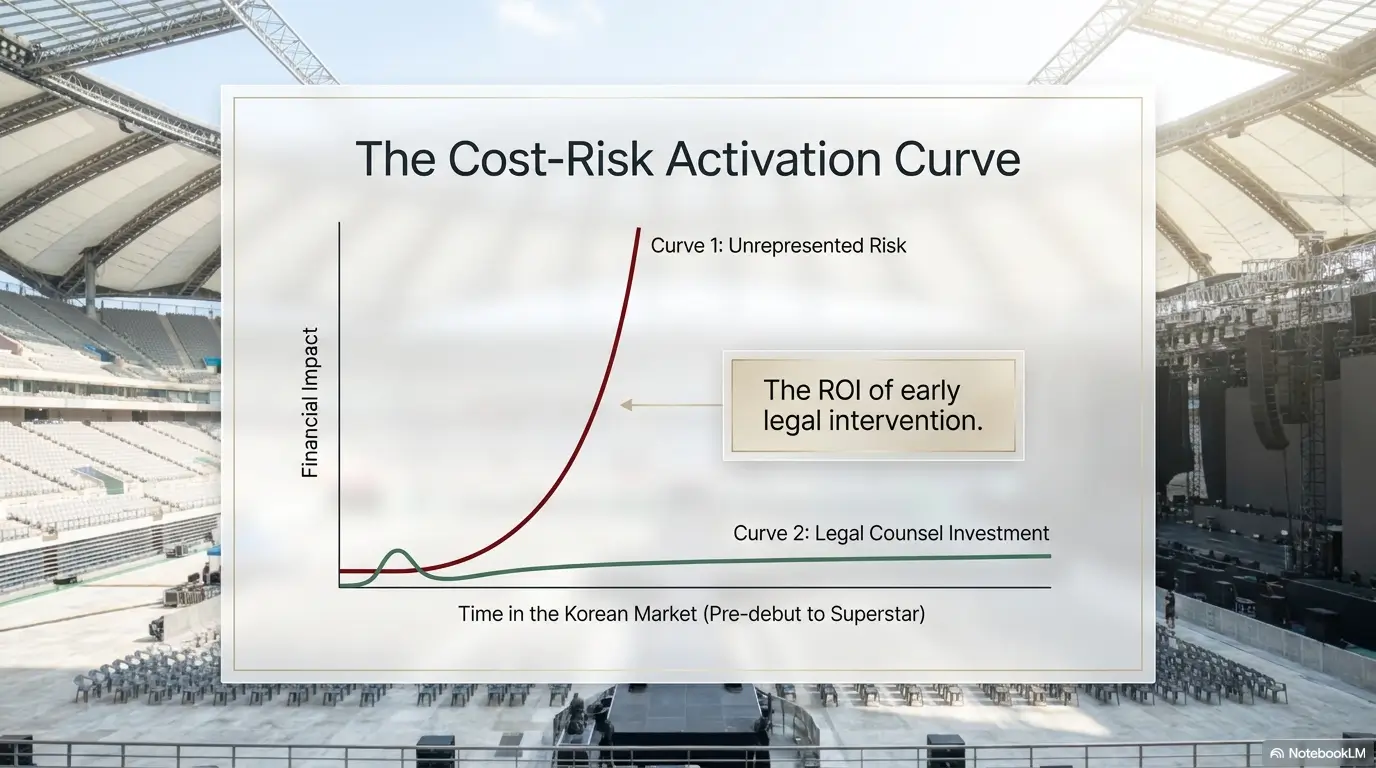
Scope Drives Cost More Than the Lawyer’s Hourly Rate
One-document review is the narrowest assignment
A review becomes easier to price when the lawyer receives one complete agreement, a clear deadline, and a short list of concerns. The fee becomes less predictable when the “one contract” refers to six schedules, an older agreement, chat promises, payment statements, and an unsigned amendment.
Send the full package at the beginning. Drip-feeding documents can require repeated reading and may trigger additional fees.
Drafting and negotiation require different kinds of work
Drafting from scratch means building definitions, rights, approvals, accounting rules, termination routes, dispute provisions, and practical procedures that may not exist in the counterparty’s template.
Negotiation adds another layer. Counsel must decide which points deserve pressure, which can be traded, how each revision affects other clauses, and when a commercial compromise creates an unacceptable legal risk.
Deal closing is a small task with an expensive failure mode
After several rounds of edits, ask whether the lawyer will verify the execution version. A clean PDF can quietly omit a negotiated sentence, restore an old definition, or attach the wrong royalty schedule.
Closing review is particularly useful when the agreement has parallel Korean and English versions. It is cheaper to catch a mismatch before signatures than to debate which version reflects the bargain months later.
| Service level | Best suited to | Likely deliverable | Main limitation |
|---|---|---|---|
| Review only | Artists with a complete, relatively familiar agreement | Issue list or redline | You handle counterparty communication |
| Review plus advice | Artists who need help deciding what matters | Redline plus written or verbal explanation | Negotiation may still be excluded |
| Review plus negotiation | Higher-value or complex deals | Redlines, strategy, counterparty exchanges | May be limited by rounds or hours |
| Full closing support | Cross-border deals with multiple documents | Drafting, negotiation, final-copy verification | Higher fee and broader coordination needs |
Show me the nerdy details
A practical legal-cost estimate can be viewed as four layers: the base assignment, complexity factors, outside costs, and later phases.
Base assignment: consultation, review, drafting, negotiation, or representation.
Complexity factors: multiple parties, unusual rights, incomplete records, urgent deadlines, bilingual documents, or conflicting governing laws.
Outside costs: translators, tax advisers, foreign counsel, filing fees, experts, notarization, apostilles, couriers, and travel.
Later phases: revised drafts, settlement talks, provisional measures, trial, appeal, and enforcement. A quote that describes all four layers is easier to manage than a single number floating without a shore.
Contract Type Changes the Bill Faster Than Page Count
Management and recording agreements carry long shadows
An exclusive management agreement may regulate income streams, schedules, personal conduct, creative approvals, publicity, outside work, accounting, renewal, suspension, and termination. A recording agreement may add master ownership, recoupment, delivery obligations, release commitments, royalty calculations, remixes, samples, and neighboring rights.
These agreements often cost more to review because one clause can affect years of work. Foreign artists unfamiliar with the trainee and agency structure may also benefit from reading a broader guide to K-pop trainee contracts and long-term agency obligations before deciding which terms deserve immediate attention.
Appearance, brand, and touring deals hide different risks
Acting and television agreements may focus on cancellation, exclusivity, billing, promotional duties, reshoots, likeness use, and morality provisions. Brand deals can add territory, campaign duration, social posting duties, category conflicts, approval rights, synthetic media, and AI-generated replicas.
Touring agreements introduce venue obligations, insurance, cancellations, technical riders, travel, withholding, accommodation, merchandise, force majeure, and promoter responsibility. The lawyer may need supporting documents that never appear in the main performance agreement.
Licensing and royalty agreements require accounting logic
A royalty clause is not useful merely because it contains an attractive percentage. The agreement must also explain the revenue base, deductions, currency conversion, statements, audit rights, payment timing, reserves, sublicensing, and what happens when income passes through several companies.
Composers, performers, and producers may also need to separate contractual royalties from collective-management or platform income. The mechanics become clearer when considered alongside how K-drama OST royalties and music rights can move through different channels.
Key takeaway
The rights being transferred matter more than the number of pages. Global masters, likeness, AI replica rights, exclusivity, and termination restrictions deserve their own budget line.
Foreign-Artist Extras That Quietly Expand the Quote
Legal translation is not word replacement
A translator can render language accurately, but a bilingual lawyer may need to decide whether two legal concepts truly match. Terms involving termination, moral rights, publicity rights, indemnity, injunctions, fiduciary duties, or consequential damages may not travel neatly between systems.
Ask whether the quote includes translation of the full contract, translation of proposed edits, bilingual negotiation emails, or only an English summary. These are separate workloads.
Immigration and tax coordination may require other professionals
Paid performances, filming, promotional appearances, recordings, and long-term management arrangements can raise immigration questions. Royalty payments, appearance fees, reimbursements, and cross-border company structures can also raise withholding and treaty questions.
Do not assume an entertainment-law quote includes visa filing or a tax opinion. Ask whether the lawyer will coordinate with an immigration specialist, tax attorney, accountant, or overseas adviser, and whether those charges will be billed directly or passed through.
Certification, time zones, and foreign counsel create small invoices that multiply
Overseas corporate documents may require notarization, certification, apostilles, translation, or courier delivery. A foreign manager may also request calls during Korean evenings, while US or UK counsel may need separate conferences and written analysis.
None of these costs is inherently unreasonable. Trouble begins when they appear for the first time after the work has started.
Real-world example: A bilingual brand deal that grew three budgets
A foreign performer receives a short English-language endorsement agreement and asks for a basic review. The fee appears modest because the document is only nine pages.
During review, counsel discovers that the Korean campaign brief contains broader image-use rights than the English contract. The agency also expects promotional appearances that may require immigration confirmation, while payment will be split between an overseas company and the artist.
The original “contract review” has now become three assignments: entertainment-law negotiation, bilingual document reconciliation, and tax or immigration coordination.
The lesson is not that the first quote was deceptive. The lesson is that the first request described only the visible document, not the full transaction. Sending every brief, schedule, email promise, and payment route at the start produces a more honest price.
One Clause Can Turn a Review Into a Cross-Border Dispute
Governing law and forum decide where the fight lives
A contract may choose Korean law, a US state’s law, English law, Korean courts, an overseas court, or private arbitration. Some transactions split these choices across related agreements.
A Korean attorney may need foreign counsel when a clause depends on foreign law. Foreign counsel may likewise need Korean counsel to assess Korean enforcement, assets, provisional measures, or mandatory local rules.
Language priority is a money clause wearing grammatical clothing
When Korean and English versions differ, the agreement should state which version controls. Without a clear priority rule, the parties may spend heavily debating whether the difference was a translation error, an agreed commercial change, or evidence of competing intentions.
Ask counsel to compare operative numbers, defined terms, termination rights, schedules, and exceptions across both versions. Formatting can make two documents look identical while one sentence quietly changes the result.
Injunction and enforcement questions can change the urgency
An agency’s threatened ability to stop a release, performance, sponsorship, or competing engagement may require faster and more specialized advice than a routine damages dispute. Urgent work often costs more because the lawyer must review facts, preserve evidence, prepare filings, and coordinate under compressed deadlines.
Winning is also different from collecting. Before spending heavily, ask how the counterparty holds assets, where revenue flows, and what enforcement may require after a judgment or award.
Key takeaway
A favorable royalty rate can be hollow when the artist cannot audit statements, challenge deductions, terminate for nonpayment, or enforce the agreement where the agency holds its assets.
How to Choose Korean Entertainment Counsel
Confirm licensing and the lawyer’s actual role
For Korean-law advice, confirm that the responsible professional is properly licensed to practise Korean law. A foreign-qualified lawyer or registered foreign legal consultant may assist with foreign-law issues and cross-border communication, but that title does not automatically authorize unrestricted Korean-law advice.
Ask who will personally review the document, who will attend calls, and who will sign off on advice. A senior lawyer may supervise while much of the work is completed by a junior attorney, foreign attorney, translator, or paralegal. That can be efficient when the engagement letter explains the staffing and rates.
Ask about similar matters, not generic prestige
An excellent corporate lawyer may not regularly handle music royalties, talent management, appearance cancellations, choreography ownership, synthetic likeness rights, or emergency release disputes.
Request examples at the category level without asking the lawyer to reveal confidential client details. Useful questions include whether the firm has handled foreign artists, bilingual negotiations, agency disputes, licensing, royalty audits, injunctions, or deals involving both Korean and overseas counsel.
Good, better, and best support depends on the deal
| Support level | When it may be enough | What to request | Primary risk |
|---|---|---|---|
| Good: targeted consultation | Low-value, familiar deal with one or two specific questions | Paid meeting plus written confirmation of key answers | Issues outside your question may remain unseen |
| Better: complete contract review | Meaningful deal with negotiable terms | Full redline, issue memo, one follow-up round | You may still manage the negotiation alone |
| Best: review through signing | Exclusive, long-term, cross-border, or high-value agreement | Strategy, redlines, negotiation, bilingual checks, execution review | Higher cost and more coordination |
Before sharing unreleased music, scripts, allegations, financial records, or private messages, request a conflict check and confirm that the firm is prepared to accept the matter. Do not assume an inquiry alone creates a full attorney-client relationship.
Common Cost Mistakes Before and After Hiring
Mistake 1: Requesting a quote with half the documents
A lawyer cannot price the real assignment when the main agreement refers to missing schedules, policies, side letters, royalty statements, or earlier amendments. Send a complete package and explain what has already been promised orally or through messages.
Mistake 2: Accepting hourly billing without reporting points
Hourly billing is not a red flag by itself. It can be fair when the work is unpredictable. The danger is an engagement with no initial estimate, cap, phase boundary, or requirement to seek approval before exceeding a threshold.
- Ask for an estimated hour range.
- Request notice before the estimate is exceeded.
- Set a spending threshold requiring written approval.
- Ask for itemized invoices showing task, professional, time, and rate.
- Separate routine work from urgent or senior-partner work.
Mistake 3: Assuming victory repays every legal fee
Korean civil procedure may allow certain litigation costs and a rule-based portion of attorney fees to be allocated, but the recoverable amount may be lower than the client’s actual spending. Do not build a litigation budget on the assumption that the opposing party will reimburse the entire invoice.
Ask counsel to distinguish legal fees paid to the firm from costs that might later be recoverable under court rules.
Mistake 4: Turning a contract dispute into a public statement problem
Artists sometimes post accusations while negotiations are active. Public statements can affect evidence, settlement, reputation, confidentiality obligations, and possible defamation claims.
Before publishing names, screenshots, or allegations, consider obtaining advice and reviewing how defamation law in Korea may differ from assumptions formed under US or UK law.
| Common mistake | Safer alternative |
|---|---|
| Asking for “the price” without defining the task | Request separate quotes for review only and review plus negotiation |
| Assuming translation is included | List every Korean and English deliverable required |
| Ignoring VAT and outside costs | Request a VAT-inclusive total and a written exclusions list |
| Paying for full litigation immediately | Ask whether assessment, demand, or settlement can be phased first |
| Sending documents gradually | Provide one indexed document package at intake |
| Hiring after signature | Review while commercial terms are still negotiable |
Key takeaway
The safest fee structure is often a defined first phase with a cap, a clear deliverable, and a decision point before further work begins.
When to Seek Help Before the Problem Hardens
Get advice before signing when pressure replaces explanation
A short deadline is not always improper, but it should not prevent independent review of a long-term or exclusive agreement. Be cautious when the counterparty refuses to provide attachments, says legal review is disloyal, or insists that unfavorable clauses are harmless because they are “never used.”
- The agency demands immediate signature.
- Rights to masters, copyright, likeness, voice, or AI replicas are perpetual or broadly transferable.
- The contract allows unilateral expense deductions without records.
- Termination penalties are unclear or disconnected from actual losses.
- Renewal or extension can occur without meaningful artist consent.
- One language version contains broader rights than the other.
Missing statements and blocked work deserve early attention
Seek timely help when payment statements are late, inconsistent, or impossible to audit, or when releases, performances, sponsorships, and outside engagements are being blocked without a clear contractual basis.
Preserve contracts, invoices, statements, emails, messages, draft versions, calendars, and files showing approvals or promises. Avoid editing original records. A clean timeline can reduce legal review time and make a consultation far more productive.
A termination notice, injunction threat, or court document changes the clock
Do not leave a formal notice, filing, hearing date, or demand unanswered while waiting for the “perfect” lawyer. Contact qualified counsel promptly, provide the exact date and method of receipt, and avoid guessing about the response deadline.
Foreign residents in Seoul may also find preliminary guidance through public support services. Such consultations may help identify the type of professional needed, but they usually do not replace retained representation for negotiations, urgent filings, or litigation.

FAQ: Korean Entertainment Lawyer Fees
How much does one Korean entertainment contract review cost?
A relatively straightforward review may fall within a planning band of roughly KRW 300,000 to 1.5 million, while complex, bilingual, high-value, or multi-document reviews can cost more. Confirm whether the quote includes a redline, written explanation, follow-up questions, and review of revisions.
Can I request a fixed fee instead of hourly billing?
Yes. Fixed fees can work well for clearly defined reviews and drafting assignments. Negotiations and disputes may be harder to predict, so a capped phase, limited number of rounds, or fixed fee plus hourly overage may be offered instead.
Does the fee normally include Korean-English translation?
Do not assume it does. Ask whether the fee includes full translation, bilingual redlines, summary translation, counterparty emails, and final-version comparison. Legal translation may be billed by the lawyer, a translator, or both.
Do I need both a Korean lawyer and a US or UK lawyer?
You may need both when different agreements choose different laws, when overseas tax or company issues are involved, or when enforcement may occur in more than one country. Ask one lawyer to coordinate the work so that duplicated research is limited.
Can Korean counsel negotiate directly with my agency or label?
Often, yes, when direct communication is included in the engagement. Confirm who may contact the counterparty, whether you must approve each proposal, and how many negotiation rounds the fee covers.
Will I automatically pay more because I am foreign?
Nationality alone should not be treated as a fee formula. Costs may rise because the matter requires another language, overseas calls, foreign-law coordination, immigration review, certification, or additional explanation of Korean procedures.
Are visa, tax, and copyright questions included in one engagement?
Only when the written scope says so. Entertainment transactions may touch several practice areas, and a firm may involve separate specialists or outside advisers. Ask for each workstream and fee to be identified.
Can I hire a Korean lawyer while living outside South Korea?
Many matters can begin remotely through secure document exchange, video calls, and electronic communication. Identity checks, engagement procedures, document originals, notarization, payment methods, or court representation may create additional steps.
How much more does an urgent review or injunction cost?
There is no universal rush rate. Urgent work may require rescheduling, senior review, evening work, rapid translation, evidence organization, or immediate filing preparation. Ask for the urgent fee and exact deliverable in writing before work begins.
Can I recover legal fees if I win a Korean contract dispute?
Some litigation costs and a rule-based portion of attorney fees may be recoverable depending on the case and court decision. The recoverable amount may not equal what you actually paid, so treat possible recovery as a legal question rather than a budget guarantee.
Build Your Quote Pack in 15 Minutes
The fastest way to improve a legal quote is not to negotiate the lawyer’s rate first. It is to remove uncertainty from the assignment.
Create one folder containing the main contract, every schedule and amendment, the latest redline, relevant emails or messages, payment records, and any earlier agreement that remains in force. Name the files in date order.
Add a one-page brief that answers eight questions
- Who are the parties, and where are they based?
- What type of agreement is involved?
- Has anything already been signed?
- What is the deadline?
- Which language should be used for advice and negotiation?
- What are your five biggest concerns?
- What outcome do you want?
- Do you need review only, negotiation, or dispute representation?
Request two prices, not one vague estimate
Ask for one quote covering review and advice only, and another covering review through negotiation or final signature. Request a written list of included documents, revision rounds, communication, staffing, VAT treatment, outside costs, exclusions, expected turnaround, and the trigger for a new phase.
That single comparison reveals whether the lower quote is genuinely efficient or simply stops before the difficult work begins.
Your 15-minute next step
Put every contract document into one folder and write five sentences describing the deadline, the rights at stake, the money involved, the current disagreement, and the result you want.
Send the same pack to each lawyer you are comparing. A clean request produces cleaner quotes, and clean quotes are where costly fog begins to lift.
Last reviewed: 2026-08