

Korean rules, translated into decisions.
Korea Health Insurance Claim Denied: Appeal Process for Foreigners
A Korean health insurance denial can mean several very different things. You may have an adverse decision from the National Health Insurance Service (NHIS), a decision involving the Health Insurance Review & Assessment Service (HIRA), or simply a hospital bill marked as non-covered. Those situations do not share the same remedy.
For a formal NHIS or HIRA disposition, the first statutory challenge is generally an objection within 90 days from when you became aware of the disposition, subject to a 180-day outer limit from the date of the disposition unless a legally sufficient reason excuses the delay. For foreigners, the expensive mistake is often not weak evidence. It is starting the wrong process while the correct deadline keeps moving.
Practical rule: identify the decision-maker before writing the appeal. “My insurance claim was denied” is a description of the problem, not yet the name of the legal remedy.
Snapshot
This guide is for foreign residents or other English-speaking patients dealing with Korean National Health Insurance. If you have a written NHIS or HIRA disposition, protect the objection deadline first. If the hospital merely charged something as non-covered, obtain the itemized bill and determine whether HIRA’s medical expense confirmation process is the better first route. By the end, you should know which agency to approach, what evidence to preserve, how the two administrative review stages work, and when legal help becomes economically sensible.
Table of Contents
Before You File
This article can help you identify the statutory review route and organize a stronger file. It cannot determine whether a particular treatment was medically necessary, whether a specific billing code was correct, or whether your individual denial is lawful. If a large amount is at stake, a court deadline may be approaching, or the dispute involves medical coding, workplace injury, motor-vehicle insurance, or another insurance system, confirm your position with the relevant agency or a qualified Korean professional.
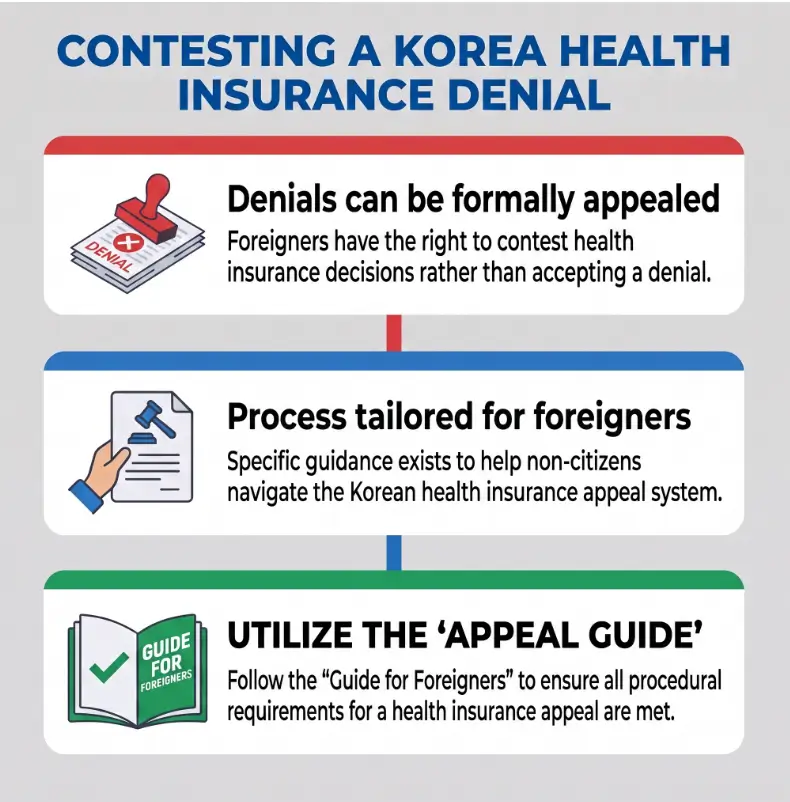
First Identify Who Actually Denied the Claim
The Korean National Health Insurance system does not always resemble the claim process familiar to an American or British patient. For ordinary covered care, the medical provider usually interacts directly with the public insurance system. As a result, a patient who says “my claim was denied” may actually be describing one of several different administrative or billing events.
Your first task is to find a document that answers two questions: who made the decision, and what exactly did that decision decide?
| What you have | Who is involved | Usually investigate this route first |
|---|---|---|
| A written decision about eligibility, contributions, insurance benefits, or benefit costs | NHIS | Statutory objection to NHIS under the National Health Insurance Act |
| A formal HIRA disposition within its statutory functions | HIRA | Objection to HIRA |
| A hospital receipt showing a service as non-covered or fully out-of-pocket, but no agency decision | Hospital or clinic | Obtain the detailed bill and consider HIRA’s medical expense confirmation process |
| A denial letter from a travel, employer, international, or Korean private insurer | Private insurer | The insurer’s contractual complaint or dispute route, not the NHIS Article 87 process |
This distinction matters because a hospital employee saying “insurance does not cover this” is not automatically the same thing as receiving an appealable NHIS disposition. Ask for the Korean itemized statement, the reason for the classification, and any written agency decision that exists.
Foreign status itself does not create a weaker National Health Insurance benefit package for an enrolled person. NHIS’s current English guidance for foreign residents states that National Health Insurance for foreigners has the same coverage as for Korean citizens. The harder question in a dispute is usually whether you were eligible on the relevant date and whether the particular service satisfied the rules for coverage.
Do not write a five-page medical argument until you know whether you are challenging NHIS, HIRA, a hospital’s billing classification, or a private insurer. The same receipt can sit inside four very different dispute systems.
Protect the 90-Day Deadline Before Arguing the Medicine
For a formal objection under Article 87 of Korea’s National Health Insurance Act, the headline deadline is 90 days from the date you became aware of the disposition. There is also an outer limit of 180 days from the date the disposition was made. The statute provides an exception where the person can show a legitimate reason for being unable to file within the period, but that exception should be treated as a rescue argument, not a scheduling strategy.
As of August 2026, the relevant current version of the National Health Insurance Act is effective from January 2, 2026. You can verify the live text through the National Law Information Center.
The objection must be made in writing, and the Act recognizes electronic documents. This makes one practical point especially important for foreigners: do not assume that waiting for an English translation, another hospital appointment, or a promised callback stops the statutory clock.
Record the agency, decision date, and date you received or learned of it.
File the written objection before spending weeks perfecting supporting material.
NHIS or HIRA generally has 60 days, with a possible extension of up to 30 days.
If still dissatisfied, consider a request to the Health Insurance Dispute Mediation Committee.
Under the current Enforcement Decree, NHIS or HIRA generally must decide an objection within 60 days after receiving it. If unavoidable circumstances require more time, that period can be extended by up to 30 days, with notice of the extension required before the original period expires.
A useful defensive habit is to preserve the evidence of when you learned about the decision: the envelope, text-message notification, email, online notice, screenshot, or call record. If timing later becomes disputed, “I think it arrived sometime in May” is far less helpful than a dated document.
A promising appeal filed too late can become a dispute about lateness instead of a dispute about coverage. Calendar both the 90-day date and the 180-day outer limit as soon as you receive the decision.
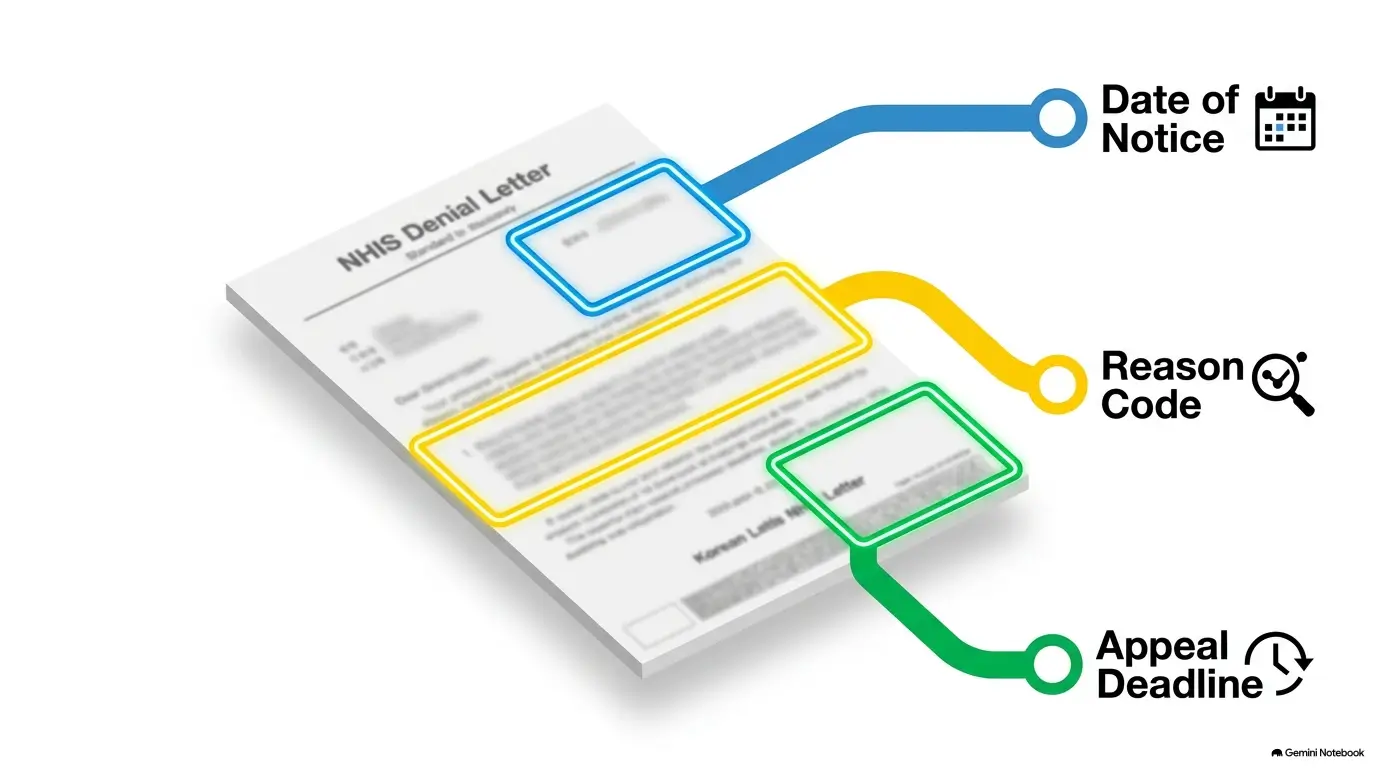
Build the Evidence File Before Writing the Appeal
An effective objection does not need to sound like a courtroom speech. It needs to make the disputed decision easy to identify, the factual error easy to see, and the requested correction easy to understand.
Start with the Korean source documents. English translations are useful for you and for an English-speaking adviser, but the original Korean decision, bill, diagnosis, prescription, and medical records remain the anchor of the Korean administrative process.
Your practical evidence pack
- The NHIS or HIRA disposition or denial notice, including every page
- The envelope, electronic notification, or other evidence showing when you received it
- Your passport and Korean residence identification details where required for identification
- Evidence of National Health Insurance eligibility on the treatment date if eligibility is disputed
- The medical bill, official receipt, and detailed itemized statement
- Diagnosis records, medical certificates, referral documents, prescriptions, and relevant test results
- Proof of payment when reimbursement or an alleged overcharge is involved
- Any prior written explanation from the hospital, NHIS, or HIRA
- A one-page chronology of treatment, billing, inquiries, and decisions
- A short statement identifying the exact result you want changed
Not every item above is a statutory requirement for every objection. Think of it as an evidence architecture. Your actual filing requirements depend on the decision being challenged.
Write around the disputed sentence
If the decision says your eligibility did not exist on the treatment date, organize the file around eligibility. If the problem concerns whether an expense falls within an insured benefit, organize it around the coverage rule and medical documents. If the dispute is really about a hospital charging something as non-covered, move to the HIRA route discussed later rather than trying to force an NHIS objection onto a billing problem.
A clean appeal file usually answers four questions in order:
- What decision am I challenging?
- What part of it do I believe is wrong?
- What document or rule supports my position?
- What specific correction do I want?
That structure is more useful than a long narrative about how frustrating the experience has been. The frustration may be entirely justified, but administrative review runs on identifiable decisions and evidence.
How to File an NHIS Objection
If the disputed document is an NHIS disposition concerning matters such as insured status, contributions, insurance benefits, or benefit costs, Article 87 provides the objection procedure known in Korean as 이의신청.
The current Enforcement Rule prescribes the NHIS objection form, and Korean government guidance states that filing can be made through NHIS by methods including in-person submission, mail, fax, and the agency’s online system. Because website authentication can be less friendly to foreign residents than the legal rule itself, confirm the available channel before the deadline rather than assuming an online login problem prevents filing.
A sensible filing sequence
- Read the disposition, not just the hospital explanation. Record its date and the issuing unit.
- Call NHIS if the legal route is unclear. Ask whether the document is a disposition subject to Article 87 objection and which submission channel applies.
- Complete the current prescribed form. Make the requested correction explicit.
- Attach the most relevant supporting documents. Put the strongest document first rather than attaching an unsorted medical archive.
- Keep proof of submission. Save the receipt, fax confirmation, postal tracking, or electronic filing confirmation.
- Record the case or reference number. Keep it on the front page of your appeal file.
NHIS currently provides foreign-language consultation in English, Chinese, Uzbek, and Vietnamese through 1577-1000, extension 6, or 033-811-2000. Its English contact page lists +82-33-811-2001 for callers overseas and operating hours of 9 a.m. to 6 p.m. You can verify the current numbers on the NHIS English contact page.
When calling, avoid beginning with “Why didn’t you pay my claim?” Begin with the document: “I received an NHIS decision dated [date]. I need to confirm whether the proper remedy is an Article 87 objection and where I should submit it.” That small change often turns a general customer-service conversation into a procedural one.
A protective, timely objection with a clear disputed issue can be more valuable than a beautifully translated package that arrives after the deadline. If additional evidence is still being collected, ask the agency how supplemental material should be submitted for your case.
If the First Objection Is Denied
A rejection of the first objection is not necessarily the end of the administrative process. Under Article 88 of the National Health Insurance Act, a person dissatisfied with the objection decision may request a second-stage review by the Health Insurance Dispute Mediation Committee (건강보험분쟁조정위원회) under the Ministry of Health and Welfare.
The second-stage filing is commonly described as a 심판청구, or request for adjudication. The same basic deadline framework applies: generally 90 days from becoming aware of the objection decision and no later than 180 days from the date of that decision, subject to the statutory legitimate-reason exception.
The request may be submitted through the agency that made the original disposition or to the Committee. The Committee also operates an official online administrative adjudication portal.
Under the current Enforcement Decree, the Committee generally must decide within 60 days after the request is submitted. It may extend the decision period by up to 30 days where unavoidable circumstances exist, and the claimant must be notified before the original decision period expires.
Do not simply resubmit the same argument
Before moving to the second stage, read the first decision as if it were a map of the weaknesses in your file. Did NHIS reject a factual assertion because it lacked proof? Did the agency rely on a coverage rule you did not address? Was your argument medically persuasive but legally beside the point? The second review should answer the reasoning actually used against you.
Show me the nerdy details: what about court?
Article 90 of the National Health Insurance Act permits administrative litigation by a person dissatisfied with an NHIS or HIRA disposition, as well as a person dissatisfied with a decision on an objection or second-stage adjudication.
Court deadlines are a separate system. Under Article 20 of Korea’s Administrative Litigation Act, a revocation action generally has a 90-day filing period from awareness of the disposition and a one-year outer period, with special timing rules where an administrative appeal has been pursued and exceptions defined by law.
If litigation is realistically on the table, do not calculate a court deadline from this article alone. Have a Korean administrative-law professional review the actual decision dates and procedural history.
A Hospital Bill Dispute May Need HIRA Instead
One of the easiest mistakes for a foreign patient is treating every unexpectedly large medical bill as an NHIS denial. Sometimes the real problem is that a hospital or clinic charged a service as non-covered (비급여) or as a full out-of-pocket expense.
HIRA operates a separate medical expense confirmation service (진료비 확인) to determine whether amounts paid as non-covered or fully self-paid expenses should actually have been treated as health-insurance benefits. This is a patient-rights route, not merely a complaint about customer service.
HIRA’s current service page says the process can examine amounts shown as non-covered or full patient payment on the medical receipt. It accepts requests through PC-based filing, its mobile service, mail or fax, and in-person submission. HIRA lists 1644-2000 as its main inquiry number.
You can review the current procedure, required documents, and exclusions on HIRA’s official medical expense confirmation page.
For a request made by the patient through mail, fax, or an in-person visit, HIRA identifies the medical bill, receipt, or payment certificate as core documentation. For an outside-pharmacy prescription expense, HIRA also calls for the prescription and pharmacy receipt. Representatives and family members can face additional consent, relationship, identity, or authorization requirements.
Real-world example
Suppose a foreign employee receives hospital imaging and is told at checkout that the scan is “not covered.” The patient pays the full amount and leaves with only a credit-card slip. There is no NHIS denial notice.
The useful first move is not to draft an NHIS objection. It is to obtain the official medical receipt and detailed billing statement, ask the hospital which item was treated as non-covered, and determine whether the HIRA medical expense confirmation service can review that charge. If HIRA later issues a formal determination that the patient believes is incorrect, the dispute may then enter a formal objection route.
NHIS’s own English benefits guidance states that when HIRA confirms an overcharged co-payment, the excess amount is paid back to the beneficiary. That is why a billing-classification dispute should not be confused with an eligibility or benefit disposition from NHIS.
There are also exclusions from HIRA’s expense-confirmation service, including certain expenses governed by other systems such as automobile accident or industrial accident compensation. If your treatment followed a workplace injury or traffic collision, identify the responsible insurance regime before choosing a health-insurance remedy.
What an Appeal Can Cost and When Help Is Worth Paying For
Do not measure appeal cost only by asking what a lawyer charges. For a foreigner, much of the friction may sit around the appeal: record copies, translation, obtaining old documents, medical interpretation, international communication, and eventually professional representation.
| Approach | Usually sensible when | Costs or friction to compare |
|---|---|---|
| DIY organization and filing | The agency and issue are clear, the deadline is safe, and the evidence is straightforward | Document copies, translation if needed, postage or travel, time spent obtaining records |
| One professional consultation | You can manage the filing but need help interpreting a Korean decision, coverage rule, or procedural choice | Consultation scope, document review, translation, whether written advice is included |
| Full representation | A large amount is at stake, facts are medically or legally complex, multiple insurance systems interact, or litigation is being considered | Retainer, professional time, court-related work, third-party expenses, specialist opinions, certified translations |
For an ordinary first-stage objection, paying someone to organize documents you can organize yourself may add little value. A targeted consultation becomes more rational when the central problem is not paperwork but interpretation: for example, which statutory benefit rule applies, whether a medical classification is defensible, or whether another compensation system takes priority.
Full representation starts to make economic sense when an error could leave you with a substantial unreimbursed bill, when a court deadline is approaching, or when the cost of getting the procedural route wrong is larger than the professional fee.
Questions to ask before hiring help
- Have you handled NHIS, HIRA, or Korean administrative health-insurance disputes before?
- Are you reviewing only the documents, drafting the objection, or formally representing me?
- Does your fee include the second-stage adjudication if the objection fails?
- Does it include administrative litigation, or would that require a new engagement?
- Will I need a medical specialist’s opinion or a billing-code review?
- Who pays translation, certified document, courier, expert, or court-related expenses?
- Can communication and written advice be provided in English?
- What specific document do you need before you can tell me whether professional representation is worthwhile?
Ask for the scope in writing. “Handle my insurance case” is too vague when the Korean system can involve an NHIS objection, HIRA billing review, second-stage administrative adjudication, private insurance, and litigation.
Official Sources to Verify
Mistakes That Weaken Otherwise Good Appeals
The most damaging errors are often procedural rather than medical. They make the agency spend time discovering what you are asking instead of deciding whether you are right.
1. Appealing the hospital’s words instead of an agency decision
“The receptionist told me this was not covered” identifies a conversation, not necessarily an NHIS disposition. Get the itemized statement and identify whether an official decision exists.
2. Waiting for perfect English documentation
The Korean original is often more important to the Korean proceeding than your English translation. Protect the filing deadline first and ask how additional evidence may be supplied.
3. Sending a mountain of records without a map
Twenty attachments can weaken rather than strengthen a case if nobody can see which one proves the disputed point. Number the attachments and refer to the key evidence in your written explanation.
4. Mixing Korean public insurance with overseas or private insurance
A denial under an international travel policy does not establish that NHIS should deny coverage, and an NHIS decision does not automatically settle what a foreign insurer owes under its contract. Keep separate decision letters, separate deadlines, and separate evidence folders.
5. Treating a general complaint as a statutory objection
A service complaint, customer-center inquiry, or public petition may help with communication, but it should not be assumed to preserve the deadline for an Article 87 objection. If you need the formal remedy, file the formal remedy.
6. Losing proof of the filing date
Keep the confirmation. A fax transmission page, registered-mail record, electronic receipt, or stamped copy can become surprisingly valuable months later.
What to Check Next
Your next useful guide depends on which branch of the problem you discovered while reading this one.
Start with Korean National Health Insurance for foreigners and verify eligibility before arguing about the benefit.
Use the separate guide to a denied Korea travel insurance claim. The NHIS objection process is not a substitute for a policy dispute.
See how the Korea public complaint system works, but remember that a complaint does not replace a statutory health-insurance objection deadline.
FAQ
Can a foreigner appeal an NHIS decision in Korea?
Yes, where you are an affected insured person or otherwise fall within the statutory right to challenge the disposition. The National Health Insurance Act’s objection procedure is not written as a nationality-specific remedy, and NHIS states that enrolled foreigners receive the same National Health Insurance coverage as Korean citizens. Your actual entitlement still depends on eligibility and the benefit rules applicable to the case.
Do I need a Korean lawyer for the first objection?
Not automatically. A clear first-stage objection can often be organized by the affected person. Professional help becomes more useful when the amount is substantial, the governing rule is unclear, medical or billing expertise is needed, several insurance systems overlap, or court proceedings are being considered.
What if the hospital only told me that my treatment was not covered?
Do not assume you already have an NHIS denial. Request the official receipt and detailed billing statement and identify how the item was classified. If you paid a non-covered or full out-of-pocket charge that you believe should have been covered, HIRA’s medical expense confirmation service may be the appropriate first route.
How long does an NHIS health insurance appeal take?
For the formal first-stage objection, the current Enforcement Decree generally gives NHIS or HIRA 60 days to decide after receipt, with a possible extension of up to 30 days in unavoidable circumstances. The Health Insurance Dispute Mediation Committee has a similar 60-day decision period with a possible extension of up to 30 days.
What if I already missed the 90-day objection deadline?
Contact the relevant agency immediately. Article 87 contains an exception where a person can show a legitimate reason for being unable to file within the statutory period, but whether your circumstances qualify is case-specific. Do not assume language difficulty, travel, or misunderstanding automatically satisfies the exception.
Can I start the appeal while I am outside Korea?
The statute permits written and electronic objections, and NHIS publishes an overseas contact number. That does not mean every foreign applicant will be able to complete every identity-verification step online. Contact NHIS or HIRA promptly to confirm the submission and identification method available for your specific case rather than planning an unnecessary trip before checking.
Is a travel insurance denial appealed through NHIS?
No. Travel insurance, employer insurance, international health insurance, and other private policies are contractual insurance arrangements with their own claim and dispute procedures. You may have an NHIS issue and a private-insurance issue arising from the same treatment, but they should be tracked separately.
What happens if HIRA finds that I was overcharged?
NHIS’s English benefits guidance states that when HIRA confirms an overcharged co-payment in connection with care provided by a medical institution, the excess amount is repaid to the beneficiary. The precise refund route depends on the type of HIRA review and the parties involved.
Your Next 15 Minutes
Do one thing before making another phone call: create a one-page cover sheet for the dispute.
- Decision-maker: NHIS, HIRA, hospital, or private insurer
- Document title: the exact name printed on the decision or bill
- Disposition date: when the decision was made
- Date you learned of it: when you received or accessed it
- Deadline: your working 90-day date and 180-day outer date if Article 87 applies
- Amount at stake: the disputed medical or reimbursement amount
- Disputed point: one sentence describing what you believe is wrong
- Requested result: one sentence saying what you want changed
- Best evidence: the three strongest documents supporting your position
That page turns a foggy insurance problem into a decision file. Take it with you when you call NHIS, HIRA, a hospital billing office, translator, or lawyer. Korea’s health-insurance system is paperwork-heavy, but paperwork has one quiet virtue: once the right decision, deadline, and evidence are lined up, the path becomes much easier to see.
Last reviewed: 2026-09