
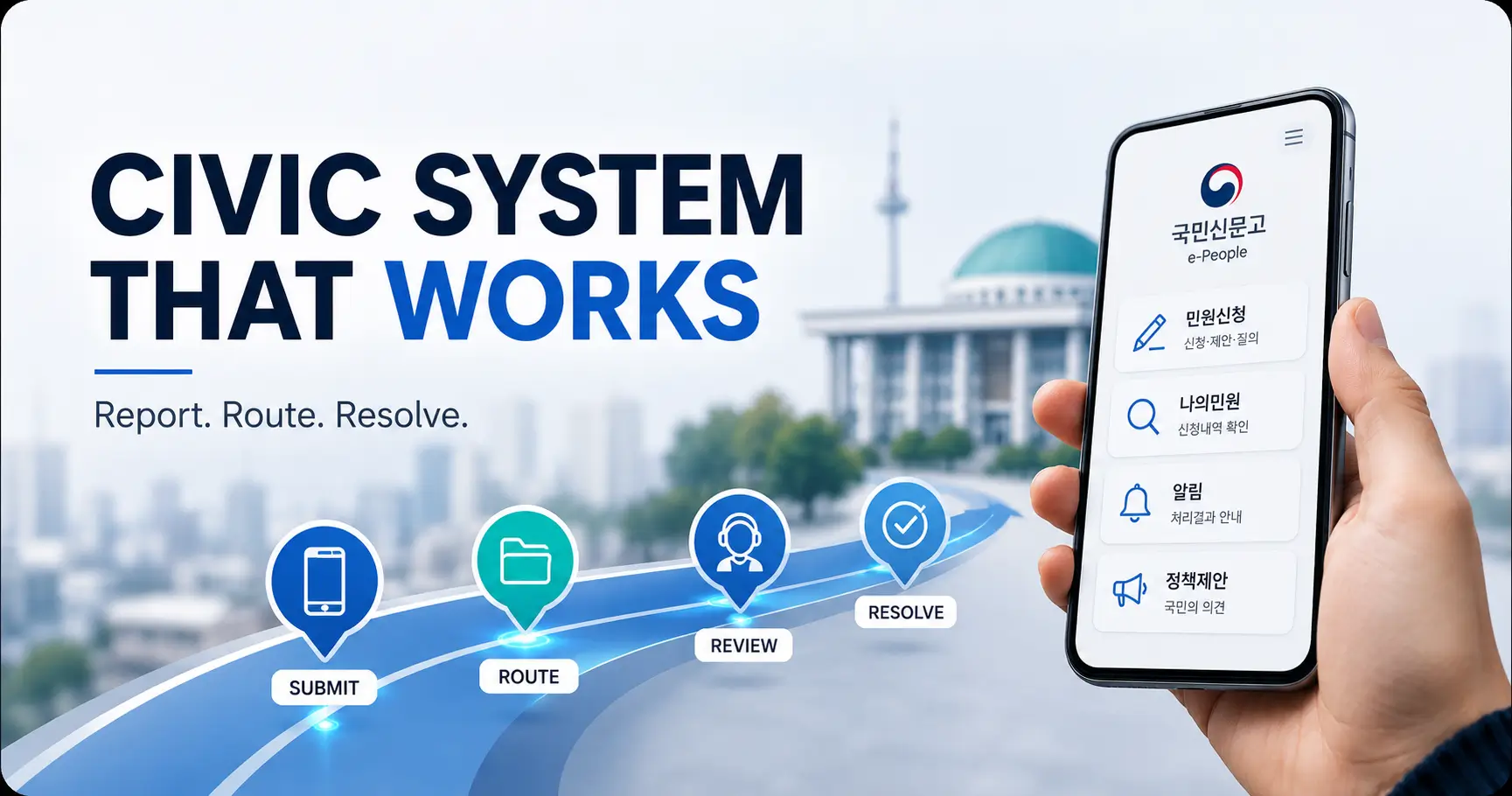
The Civic Pipeline: Understanding Korea’s Minwon System
A cracked sidewalk tile in Seoul can travel farther than a tourist with a rail pass. Someone photographs it, sends it through an app, and suddenly a tiny piece of street frustration becomes a routed public record. That is the quiet surprise behind how Korea’s public complaint culture works through apps, hotlines, and local offices: the system is not only about anger. It is about moving everyday friction into a civic pipeline.
For US readers, the confusion is understandable. Korea’s 민원 (Minwon) system can look like 311, a city hall request, a DMV inquiry, an ombudsman complaint, and a formal agency petition all wearing the same neat government lanyard. Guessing wrong can waste time, especially when the issue involves housing paperwork, public safety, noise, immigration-adjacent questions, or neighborhood services.
- • Use apps when the problem is visible and location-based.
- • Use 110 when you do not know where to ask.
- • Use 국민신문고 (e-People) for broader government complaints or suggestions.
- • Use local offices when documents, identity, or neighborhood context matter.
The Civic Conveyor Belt Hiding in Plain Sight
In Korea, a public complaint is often less like shouting into a void and more like putting a labeled envelope onto a moving belt. The system may not grant every request. It may not be warm and poetic. It may occasionally smell faintly of printer toner and Monday morning coffee. But it often gives residents a route: submit, classify, transfer, answer, record.
The practical lesson: the clearer your issue, the easier it is for the system to carry it to the right desk.
Table of Contents
Safety and Context Note
This guide is for cultural and practical education. It is not legal advice, immigration advice, emergency guidance, or a substitute for professional help. Korea’s public complaint channels can be useful for everyday public-service issues, local safety concerns, agency delays, unclear procedures, and administrative questions.
They are not the right tool for every serious problem. A crime, medical emergency, fire, immediate personal danger, domestic violence situation, labor dispute, eviction threat, immigration crisis, or lawsuit may require police, fire services, medical care, an attorney, a labor office, an embassy, or another urgent authority.
Think of complaint systems as public-service routing tools. They are useful doors. They are not ambulances with keyboards.
- Use urgent emergency channels for immediate danger.
- Use complaint portals for recordable public-service issues.
- Save reference numbers when you submit anything formal.
Apply in 60 seconds: Before submitting, ask, “Is this urgent danger, legal strategy, or public-service routing?”
The First Surprise: Complaining Is Not Always “Complaining”
Why Korean 민원 Means More Than a Grievance
The English word “complaint” carries a heavy little suitcase. It can sound emotional, accusatory, even theatrical. In Korean public administration, 민원 is broader and more ordinary. It may mean a request, question, report, application, petition, service issue, or formal grievance.
A US reader might picture several systems at once: a 311 service request, a city hall help desk, a state-agency complaint form, a public works ticket, a DMV inquiry, and an ombudsman-style escalation. Korea bundles many of these instincts into a more normalized public-service habit.
That matters because foreigners sometimes misread the tone. A Korean resident who “files a 민원” may not be furious. They may simply believe the issue belongs in the system rather than being carried around privately like a pebble in the shoe.
The Cultural Switch: From Private Frustration to Public Routing
Dense urban life creates small collisions: parking, construction noise, sidewalk damage, delivery congestion, school zones, smoking areas, trash rules, building management, and office paperwork. Korea’s complaint culture gives these small frictions a pathway.
That does not mean every pathway leads to a perfect fix. A local office may inspect and reject a request. An agency may say it lacks jurisdiction. A reply may feel stiff enough to stand upright by itself. Still, the issue has been named, routed, and recorded.
This is one reason Korea can feel administratively fast to visitors. The country’s digital habits, high smartphone use, and expectation of public response all feed the same machine. Even people who grumble about bureaucracy often expect a channel to exist.
Here’s What No One Tells You…
A Korean complaint does not always mean, “I am angry.” Sometimes it means, “This needs a file number.”
That is a very different civic instinct. The emotion may be small. The record is the point. In a culture where Korean business communication often depends on context, hierarchy, and careful wording, the same principle appears in public service: make the issue visible enough for the right person to act.
The Core Map: Apps, Hotlines, and Offices Each Do Different Jobs
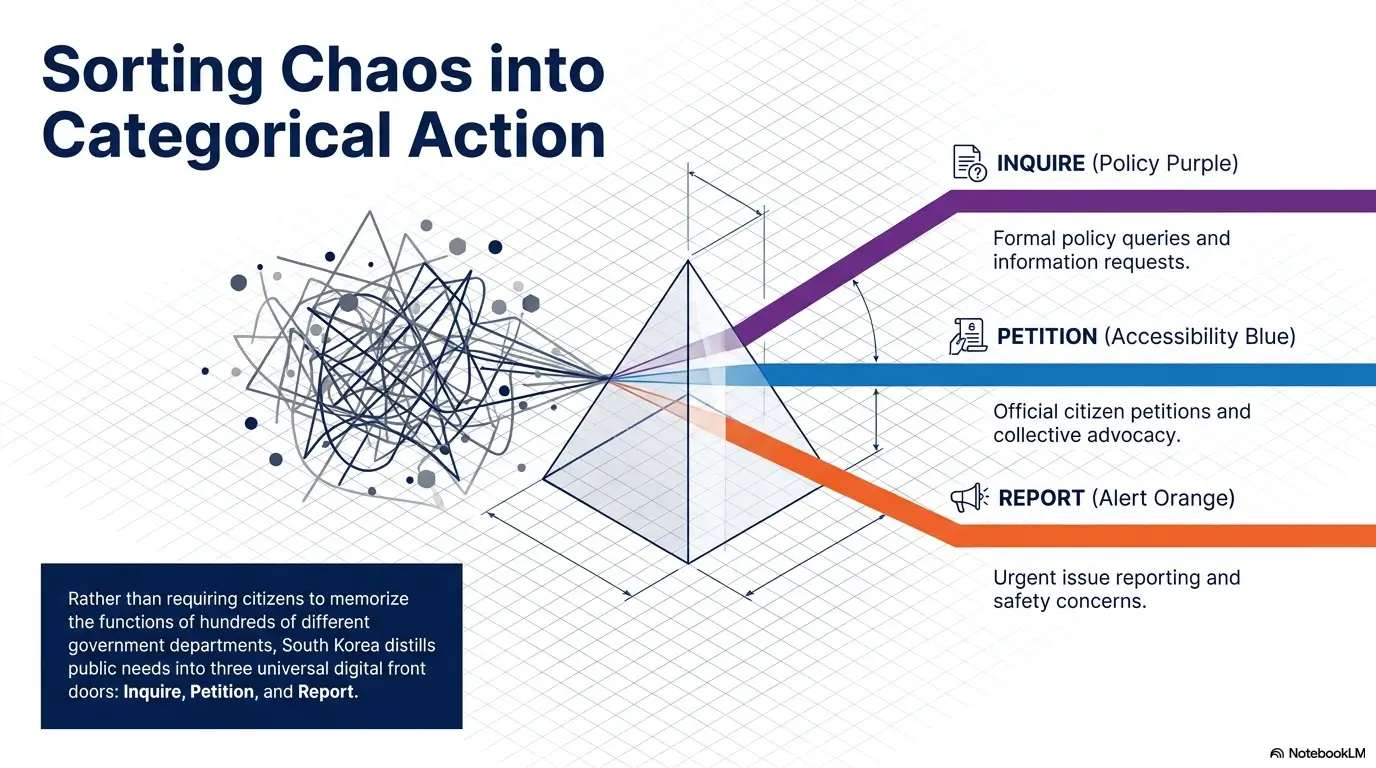
Korea’s public complaint system is not one magic app. It is a stack of doors. The trick is not memorizing every agency. The trick is choosing the door that matches the problem.
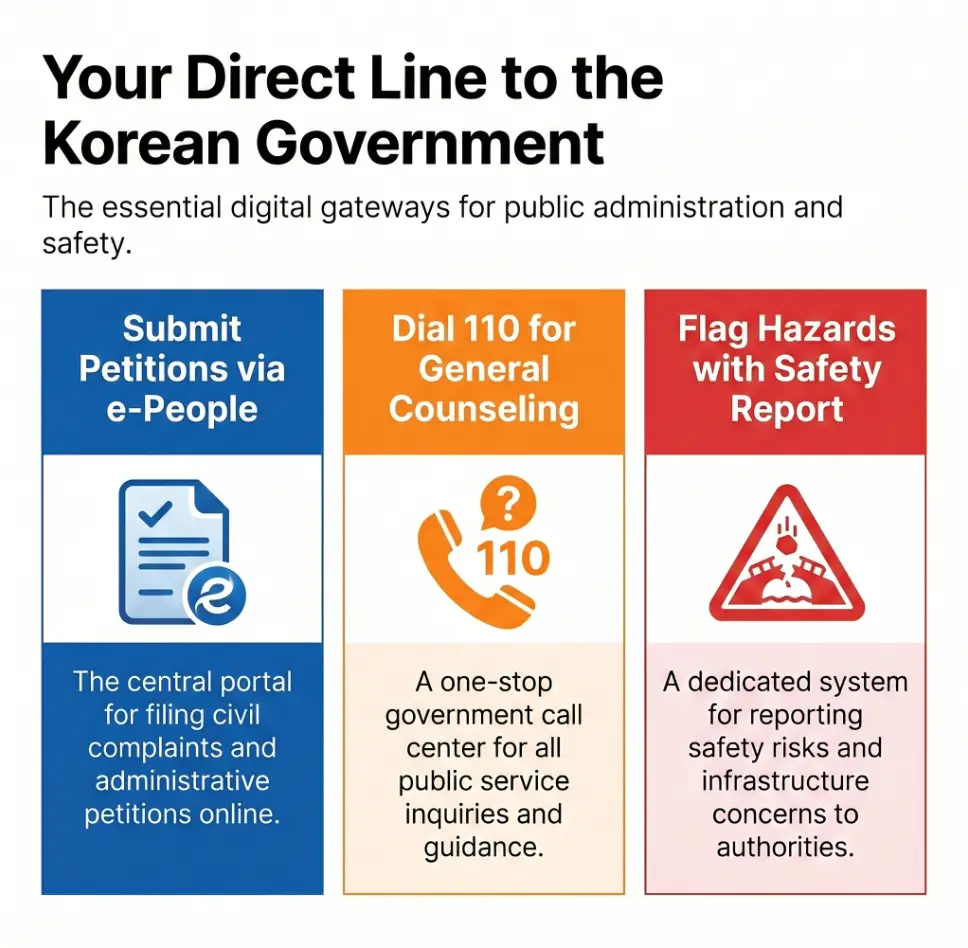
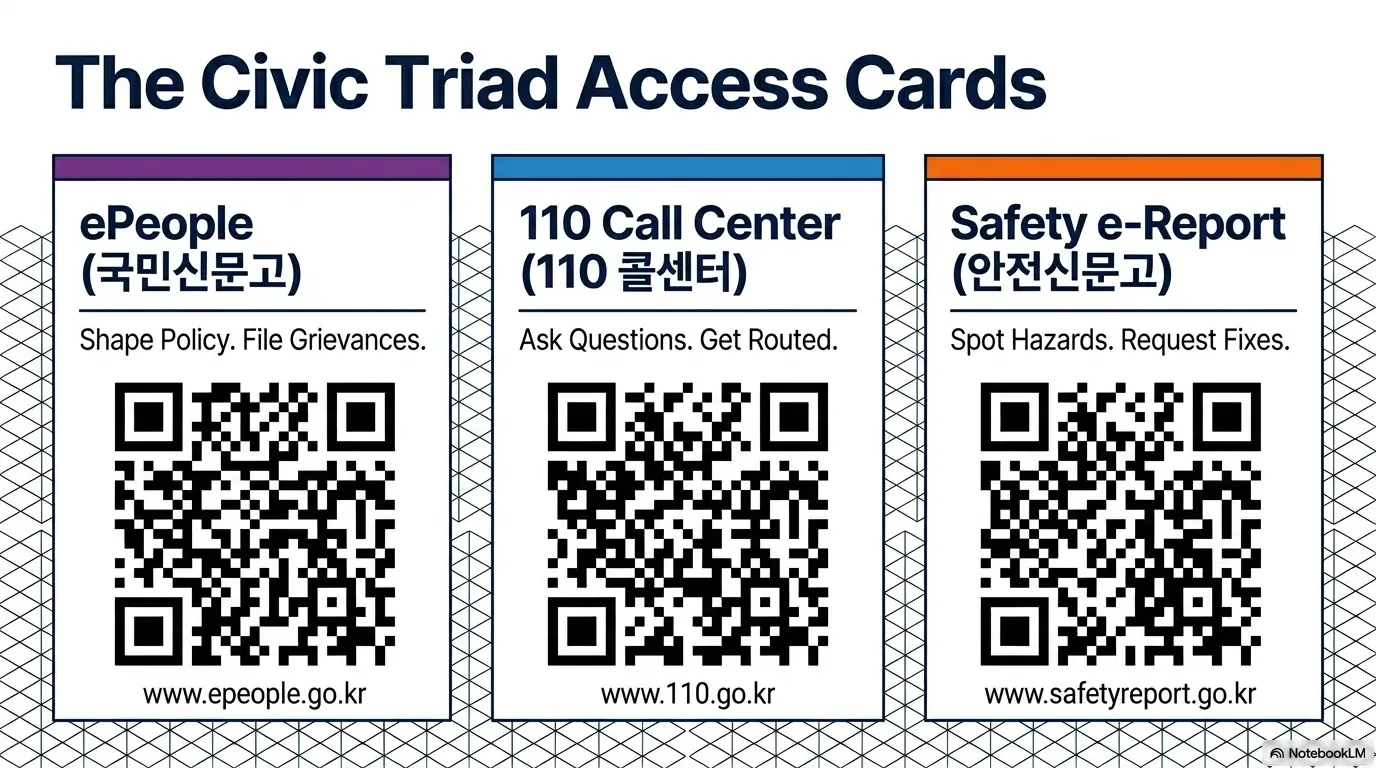
국민신문고: The Big Door for Government Complaints
국민신문고, often known in English as e-People, is the broad online channel for petitions, complaints, suggestions, and reports involving many public bodies. It is useful when the issue concerns government administration, agency response, unfair treatment, delay, policy suggestions, or a matter that needs formal routing.
For a US comparison, imagine a federal-state-local complaint portal that tries to send the message to the correct public institution. It is not casual texting. It is closer to submitting a formal request that becomes part of an administrative trail.
국민콜110: The “Where Do I Even Ask?” Hotline
110 is Korea’s government civil complaint information call center. Its role is especially useful when you do not know which ministry, city office, district office, education office, or public body handles the issue.
The beauty of 110 is not glamour. It is triage. When the menu of government options feels like a noodle shop with 400 broths, 110 helps you find the counter where your question belongs.
안전신문고: When the Problem Is Visible, Local, and Risky
안전신문고, often translated as Safety Report, is built for reporting public safety hazards and daily-life risks. Think illegal parking that blocks visibility, damaged facilities, traffic risks, unsafe sidewalks, broken road infrastructure, or other visible hazards.
One practical note: older app names can still appear in search results or in conversation. 생활불편신고 and 스마트국민제보 have been folded into the broader safety-reporting ecosystem over time. If a Korean friend mentions an old name, they may be pointing toward the current Safety Report channel.
Local Offices: The Human Counter Still Matters
Digital Korea still has counters, chairs, number tickets, laminated notices, and fluorescent lights humming above public-service desks. 주민센터, 구청, 시청, 군청, and ward-level offices remain essential.
They matter most when the issue involves identity verification, resident registration, certificates, local welfare, housing paperwork, neighborhood services, or a situation that needs human explanation. If you are new to Korea, local offices may feel intimidating at first. But they are often the practical face of the system.
Use 안전신문고 for hazards, traffic risks, unsafe facilities, or blocked public spaces.
Use 국민콜110 for routing guidance and government 상담.
Use 국민신문고 for petitions, complaints, delays, suggestions, and responses.
Visit 주민센터, 구청, 시청, or 군청 when paperwork and identity matter.
Who This Is For / Not For
For Expats Trying to Decode the “Civic Dashboard”
If you live in Korea, you eventually meet the civic dashboard. It appears when your building has a recurring noise issue, your neighborhood sidewalk is dangerous, your residence paperwork is confusing, or your local office gives an answer you cannot quite interpret.
For foreign residents, the practical question is rarely “Can I complain?” It is usually “Which channel will understand this problem?” That is a different question, and a better one.
This guide can help you choose between an app, the 110 hotline, a formal portal, and a local office. It also helps you phrase the issue so it looks like an administrative request, not a midnight diary entry written during a construction-drill symphony.
For Travelers Who Notice a Public Safety Issue
Travelers may also encounter public hazards: a broken stair, a blocked walkway, a damaged bus stop, a dangerous crossing, or confusing signage near a public facility. Some channels may require Korean language ability or identity verification, so visitors may need help from local staff, a hotel desk, a Korean-speaking friend, or a tourist support service.
The main idea still helps: urgent danger requires urgent channels. Non-urgent public-service issues require clear reporting.
For US Readers Studying Korean Governance
Policy observers, researchers, and Korean American readers may find this system fascinating because it shows how culture and administration braid together. Korea’s complaint culture is not merely personal fussiness. It is a governance habit shaped by density, digital infrastructure, formal records, and expectations of responsiveness.
It also sits beside other Korean communication patterns. The same society that prizes nuance in nunchi at work in Korea can also be startlingly direct when a sidewalk, office, agency, or public service needs a ticket number.
Not For Emergencies, Lawsuits, or Personal Legal Strategy
This guide should not be used to decide legal strategy. Public complaint systems can document a problem, but documentation is not the same as legal protection. If the issue touches immigration status, workplace retaliation, eviction, assault, stalking, discrimination, fraud, family law, or criminal accusations, get qualified help.
Money Block: Channel-Fit Checklist
Answer yes or no before choosing a channel:
- Can I point to a physical location? If yes, an app or local office may help.
- Is there immediate danger? If yes, do not use a complaint portal first.
- Do I need documents or identity verification? If yes, a local office may be better.
- Do I not know the responsible agency? If yes, start with 110.
- Is this about agency delay or unfair administrative treatment? If yes, 국민신문고 may fit.
Neutral action line: Choose the channel based on the problem’s shape, not your frustration level.
The App Habit: Why Korea Turns Small Friction Into Digital Reports
The Smartphone Became a Civic Clipboard
Korea’s public complaint culture works because the phone is already the remote control for daily life. Banking, food delivery, hospital appointments, maps, taxis, messaging, apartment notices, and school communication all pass through digital tools. Public reporting naturally joins the orchestra.
Photo uploads matter. Location tags matter. Time stamps matter. A pothole report with a blurry sentence is weak. A pothole report with a clear photo, exact location, date, and risk description becomes administratively edible. The system can chew it.
This also explains why complaint apps can feel surprisingly normal. The same person who orders lunch, pays a bill, checks a bus, and messages a coworker on a phone may also report a dangerous curb. One more tap in the day’s civic choreography.
Tiny Problems, Big Signal
A loose sidewalk tile is not a national crisis. Neither is a broken streetlight or an illegally parked car blocking a corner view. But in a dense city, tiny problems gather weight quickly. A small hazard can become a fall, a traffic risk, or a daily inconvenience repeated by hundreds of people.
This is especially important in aging neighborhoods. Korea’s demographic shifts, older housing stock, and changing local needs make small maintenance signals more meaningful. If you are interested in that social backdrop, Korea’s aging neighborhoods show why local friction can become a public-service issue.
A Little Civic Origami
A complaint folds reality into a shape the government can process. That is the civic origami. “The sidewalk is bad” is a crumpled napkin. “At Exit 3 of X Station, the tile is loose near the crosswalk; photo attached; elderly pedestrians are tripping; please inspect” is a paper crane with a destination.
No, the crane may not fly instantly. It may land on a desk, get transferred, or receive a reply about jurisdiction. But it has a form. Form is what bureaucracy understands.
- Photos reduce ambiguity.
- Exact locations reduce routing errors.
- Clear requested action reduces delay.
Apply in 60 seconds: Take one wide photo, one close-up photo, and note the nearest landmark.
The Hotline Layer: 110 Is the Bridge for People Who Hate Menus
Why 110 Matters in a Country Full of Specialized Offices
Korea has many public bodies, and ordinary residents are not expected to know every jurisdiction chart. Is the issue local government, police-adjacent, transport-related, education-related, immigration-related, health-related, or handled by a public corporation? Sometimes even confident adults become civic raccoons staring into a very official trash can.
That is where 110 helps. It is not a magic solution desk. It is a guidepost. The hotline can help users understand where a question belongs, what kind of channel may fit, and whether a specialized office is involved.
Call, Chat, KakaoTalk, or Text: Choose the Lowest-Friction Door
Phone 상담 works best when the issue is layered and you need back-and-forth clarification. Chat can be better for a quick routing question. Text-based options may help people who prefer written records or have accessibility needs. KakaoTalk matters because it matches a daily communication habit in Korea.
If you are a foreign resident with limited Korean, prepare your key facts before contacting 110. Write the address, district, date, and problem in short lines. Translation tools can help, but short factual phrases usually work better than long machine-translated emotional paragraphs.
Don’t Do This: Calling 110 Like It Is 911
110 is not an emergency dispatch number. If there is immediate danger, fire, urgent medical need, violence, or an active crime, use the appropriate emergency service. A civil complaint hotline is the wrong tool for a burning kitchen, a collapsed pedestrian, or a threat happening now.
It is useful to compare this with the US distinction between 311-style service information and 911 emergency response. The exact systems differ, but the operating logic is similar: guidance and non-emergency service questions belong in one lane; immediate danger belongs in another.
Local Offices: Where Digital Korea Still Has Fluorescent Lights and Paper Forms
The 주민센터 Role: Neighborhood-Level Problem Solving
The 주민센터, often translated as a community service center or resident center, is where local public administration becomes tangible. People visit for certificates, resident-related paperwork, local welfare guidance, neighborhood notices, and questions that do not fit neatly into an app.
For foreigners, this office can be both useful and slightly bewildering. Bring identification, relevant documents, addresses, screenshots, and a calm written summary. The goal is not to perform perfect Korean bureaucracy ballet. The goal is to give the staff enough information to route or explain the matter.
Local offices are also part of the larger rhythm of Korean neighborhood life. Rules about trash, recycling, housing, and local notices often sit close to these offices. If your issue involves household disposal or neighborhood sorting rules, recycling in Korea for foreigners is a useful companion topic.
City Hall and District Offices: Bigger Problems, Bigger Desks
구청, 시청, and 군청 handle broader district, city, or county-level issues. These may involve roads, construction noise, sanitation, public facility repair, local permits, enforcement questions, and public policy implementation.
If a complaint involves a road hazard, the relevant office may depend on whether the road is local, provincial, national, or privately managed. If it involves construction, the responsible team may differ by permit, location, and type of disruption. This is why routing matters.
Let’s Be Honest… Sometimes Showing Up Works Faster
Digital tools are convenient. But when the issue is messy, in-person help can save time. A person behind a counter can look at your documents, notice what is missing, tell you which department handles the issue, and sometimes call another desk while you stand there trying not to look like a lost umbrella.
Showing up is especially useful when identity verification, residence details, local maps, or language nuance matter. It can also help when an online answer is technically correct but practically foggy.
Short Story: The Sidewalk Tile Near Exit Three
A foreign resident in Busan once noticed the same loose sidewalk tile near a subway exit every morning. It clicked under shoes like a tiny trapdoor. At first, he ignored it. Then an older woman stumbled, recovered, and kept walking with the elegant fury of someone who refused to give the pavement the satisfaction.
That evening, he took two photos: one wide shot showing the subway exit, one close-up showing the raised edge. He wrote the location, date, and risk in four simple lines. The first reply was plain and bureaucratic, almost dry enough to toast bread. But the tile was inspected, then repaired. The lesson was not that every report becomes a triumph. It was smaller and more useful: public systems can only fix what becomes visible, legible, and routed.
The Routing Game: How One Complaint Finds the Right Desk
Submit First, Then the System Sorts
Many Korean complaint portals are designed around routing. The user may choose a category, but the system or staff may transfer the matter to the responsible agency. That is helpful because residents often do not know the exact department.
Still, “the system sorts it” does not mean “write anything and hope.” The first submission is your chance to help the router. A vague complaint can bounce between offices like a ping-pong ball with a civil-service badge.
Why Your Wording Changes the Destination
Wording matters because agencies act on categories, facts, locations, and legal authority. A complaint about “noise” could involve construction permits, police response, apartment management, environmental standards, school events, road work, or private disputes. The category changes the destination.
Write like a person who wants a practical response. Include what happened, where, when, why it matters, and what action you are requesting. Do not bury the usable details under three paragraphs about your moral disappointment in asphalt.
The Hidden Skill: Make the Problem Administratively Legible
Administrative legibility means the issue can be understood, classified, assigned, and answered. It is the difference between “This place is dangerous” and “The crosswalk signal at the north side of X intersection turns green while right-turning cars continue entering the pedestrian path; please inspect signal timing and signage.”
Show me the nerdy details
A clear complaint usually contains five data points: location, time, observable condition, impact or risk, and requested action. These details reduce classification errors because public offices often work through jurisdiction, category, and evidence. Photos establish condition. Dates establish recurrence. Landmarks help field staff locate the site. Requested action narrows the response from general sympathy to inspection, repair, referral, explanation, or enforcement review.
Money Block: The Four-Line Complaint Formula
| Line | What to write | Example |
|---|---|---|
| 1 | Exact location | Near Exit 3 of the station, north sidewalk |
| 2 | Problem observed | One sidewalk tile is raised and loose |
| 3 | Impact or risk | Pedestrians may trip, especially at night |
| 4 | Requested action | Please inspect and repair the tile |
Neutral action line: Draft the four lines before opening the app or portal.
Common Mistakes That Make Korean Complaints Stall
Mistake 1: Writing a Drama Instead of a Service Request
Emotion is human. A complaint usually begins because something annoyed, worried, delayed, or harmed someone. But a public official cannot process emotional weather. They need facts.
“This is outrageous and nobody cares” may be understandable. It is not very actionable. “Construction noise at 7:10 a.m. on three weekdays at this address; please check permitted hours” gives the office something to inspect.
Mistake 2: Using the Wrong Channel for the Risk Level
A dangerous road hazard belongs in a safety-reporting channel or with the relevant local office. A broad question about which agency handles a problem may belong with 110. A formal grievance about an agency delay may belong with 국민신문고. A residence document issue may require a local office or immigration-related channel.
Wrong-channel complaints may still get transferred, but transfers take time. The more urgent or document-heavy the issue, the more channel choice matters.
Mistake 3: Forgetting Photos, Dates, and Exact Location
Missing evidence turns an actionable issue into bureaucratic fog soup. A photo does not need to be beautiful. This is not a café dessert shoot. It needs to show the problem and the surroundings clearly enough for a staff member or field worker to identify it.
For recurring issues, include dates and times. Noise at “night” is less useful than “April 3, 4, and 5, from about 10:40 p.m. to 11:20 p.m.” Precision can be the little key that opens the right cabinet.
Mistake 4: Expecting Every Answer to Feel Satisfying
A reply may explain jurisdiction, legal limits, inspection results, budget constraints, or referral. That may not feel emotionally satisfying. But it can still be useful because it tells you what the system can or cannot do.
Save the response. If the harm repeats, a previous answer becomes context for escalation. Korea’s record trail is part of the culture. Keep your receipts, even when they arrive wearing gray bureaucratic socks.
- Lead with facts before feelings.
- Match the channel to the problem.
- Attach evidence whenever possible.
Apply in 60 seconds: Rewrite your complaint title as a neutral service request, not a headline of outrage.
The Cultural Logic: Korea Expects Responsiveness, Not Just Politeness
Speed as Public Trust
Responsiveness matters in Korea because public services sit close to daily life. People expect fast delivery, fast hospital visits, fast mobile replies, fast transport updates, and fast administrative answers. That expectation does not vanish at the government office door.
This does not mean every agency is quick. Anyone who has waited for a document, permit, or reply knows the tiny spiritual winter of bureaucracy. But the expectation of a channel and response is strong.
Foreigners may notice the same rhythm in other areas too. For example, Korean clinics are often experienced as fast because systems are built around high-throughput routines. Public complaint culture shares a cousinly logic: move the case, record the step, answer the user.
Record-Keeping as Social Pressure
A submitted complaint creates a trace. That trace can nudge departments to respond. It can also protect the resident from being told later that nothing was ever reported.
In a society where hierarchy and indirect communication still matter, written administrative records can be strangely direct. The file number says, “This exists.” Sometimes that is half the battle.
The Quiet Contract
The quiet contract looks like this: citizens and residents report; agencies respond; the response enters the record. Nobody has to be thrilled. Nobody has to throw confetti over the municipal drainage office. The point is visible responsibility.
This helps explain why complaint culture is not always negative. It can be a form of civic maintenance. The app is not just a complaint box. It is a broom, a signal flare, a receipt printer, and occasionally a very patient pigeon carrying paperwork.
Practical Script: How to Write a Clear Complaint in Korea
The Four-Line Formula
Use this simple structure when writing in English or Korean-friendly translated text:
- Location: Where exactly is the issue?
- Problem: What did you observe?
- Impact: Who is affected or what risk exists?
- Request: What action do you want?
Keep it plain. Good complaint writing is not about sounding official. It is about being easy to route.
Example for a Sidewalk Hazard
Subject: Raised sidewalk tile near subway Exit 3
Near Exit 3 of [Station Name], on the north-side sidewalk, one tile is raised and loose. I saw pedestrians step around it on May 16, 2026, around 8:30 a.m. It may cause a trip or fall, especially at night or in rain. Please inspect and repair the sidewalk tile.
Example for Noise or Construction Disruption
Subject: Early morning construction noise at [address or landmark]
Construction noise occurred near [address] on May 14, 15, and 16, 2026, starting around 7:05 a.m. The sound included drilling and heavy equipment. Residents nearby may be affected before normal daytime hours. Please confirm whether the work is permitted at this time and advise the responsible office.
Example for Foreign Residents With Limited Korean
If your Korean is limited, short sentences are your friend. Translation tools usually perform better with simple factual lines than with long emotional paragraphs. Write the facts first in English, translate them, then check names, addresses, and dates carefully.
You can also ask 110 or a local office for routing guidance. If you visit an office, bring screenshots and a printed or phone-ready summary. Korea’s administrative culture often rewards preparation. A tidy folder can do more than nervous charm, though nervous charm has its own tiny socks.
Money Block: Complaint Prep List
Gather these before you submit:
- Exact address, landmark, or map pin
- One wide photo and one close-up photo
- Date and time observed
- Short description of risk or impact
- Requested action: inspect, repair, explain, transfer, or guide
- Your contact method, if the channel requires it
Neutral action line: Save the same details in a note app so you can reuse them if the issue is transferred.
Mini Decision Guide: Which Door Should You Use?
Use 안전신문고 When You Can Point to a Safety Risk
Choose Safety Report-style channels when the problem is visible, local, and potentially risky. Examples include illegal parking that blocks drivers’ view, damaged roads, unsafe public facilities, broken street infrastructure, and hazards in daily public spaces.
Photos matter here because the issue is physical. A clear image can do what five paragraphs cannot.
Use 국민콜110 When You Do Not Know the Responsible Office
Choose 110 when your main problem is uncertainty. “Which agency handles this?” is a valid starting point. So is “Can this be reported?” or “Where should I ask about this public-service issue?”
For newcomers, this can reduce the feeling that Korean bureaucracy is a hallway full of identical doors. Sometimes you just need someone to point to Door 7.
Use 국민신문고 for Formal Government Complaints or Suggestions
Choose 국민신문고 when the issue is broader or more formal: agency delay, unfair treatment, policy suggestions, unresolved administrative problems, or matters requiring a written response trail.
Formal does not mean dramatic. It means the request should be clear, documented, and directed toward an administrative answer.
Use a Local Office When Documents or Local Context Matter
Choose a 주민센터, 구청, 시청, or 군청 when the matter involves documents, resident services, local welfare, neighborhood-specific rules, or identity confirmation. This is especially true for foreign residents navigating housing, certificates, or public services tied to residence.
For housing-related issues, distinguish public complaint routing from private contract protection. If your concern involves a deposit, lease, or housing risk, jeonse deposit protection requires a different level of caution and documentation.
Money Block: Decision Card
| Situation | Best first door | Why |
|---|---|---|
| Broken sidewalk or blocked public path | 안전신문고 or local office | Visible location-based hazard |
| Unclear which agency handles issue | 국민콜110 | Routing guidance |
| Agency delay or unfair administrative response | 국민신문고 | Formal written complaint trail |
| Residence paperwork or certificates | Local office | Identity and document verification |
Neutral action line: When in doubt, start with the channel that can identify jurisdiction fastest.
- Physical risk: safety reporting.
- Unclear office: 110.
- Formal grievance: 국민신문고.
Apply in 60 seconds: Label your problem with one word: safety, routing, formal, or documents.
FAQ
Can foreigners use Korea’s public complaint systems?
Yes, foreigners can often use Korea’s public complaint systems, but the exact experience depends on the channel, language, identity verification, and issue type. Some portals may require login or verification. Some local offices may require identification or documents. If language is a barrier, prepare short translated facts and ask for routing help through 110 or a local office.
Is 국민신문고 the same as calling 110?
No. 국민신문고 is mainly an online portal for submitting formal complaints, petitions, suggestions, and administrative issues. 국민콜110 is a government civil complaint guidance hotline and 상담 channel. A simple way to remember it: 110 helps you figure out where to ask; 국민신문고 helps you formally submit many types of public complaints.
What is the difference between 국민신문고 and 안전신문고?
국민신문고 is broader and more formal. It can handle many government-related complaints and suggestions. 안전신문고 is more focused on safety hazards, traffic-related issues, illegal parking, damaged public facilities, and daily-life risks. If you can point to a visible danger in a public place, 안전신문고 may be the better first fit.
Should I visit a local office instead of using an app?
Visit a local office when the issue involves documents, identity checks, residence matters, local welfare, neighborhood-specific details, or confusion that needs human explanation. Apps are useful for visible, reportable problems. Offices are better when the situation has paperwork, nuance, or a person-sized knot in the middle.
Do Korean complaint apps guarantee a fix?
No. Complaint apps create a formal report and response trail. They do not guarantee that the requested action will happen. Outcomes depend on jurisdiction, evidence, budget, law, field inspection, and agency authority. Even an unsatisfying reply may still be useful because it records the response and clarifies the responsible office.
What should I include in a Korean public complaint?
Include exact location, date, time, photos, a concise description, the risk or impact, and the action requested. A strong complaint is short, factual, and easy to route. Think of it as a service ticket, not a courtroom speech.
Can 110 handle emergency situations?
No. 110 is for government civil complaint guidance and counseling, not urgent police, fire, or medical response. If there is immediate danger, use the appropriate emergency service. Complaint systems are for routing and records, not instant rescue.
Why are public complaints so normalized in Korea?
Public complaints are normalized because Korea combines dense urban life, strong digital habits, formal administrative routing, and high expectations of public responsiveness. Reporting a problem can feel like routine civic maintenance rather than confrontation. The culture treats many small issues as something to record, route, and answer.
Conclusion: Build a One-Minute Complaint Checklist
The cracked sidewalk tile from the introduction is the whole story in miniature. Korea’s public complaint culture is not merely about dissatisfaction. It is about turning daily friction into a public signal the system can see.
That signal works best when it is specific. Apps help with visible hazards. 110 helps when the right office is unclear. 국민신문고 helps with formal government complaints or suggestions. Local offices help when documents, identity, and neighborhood context matter. Behind every channel sits the same practical truth: bureaucracy may be stiff, but it likes clear labels.
Your next step is small enough to finish within 15 minutes. Create a note on your phone with this template: “Where is it? What happened? When did I see it? Why does it matter? What action do I want?” Add one photo, one screenshot, and one reference number whenever you submit a report.
That is the small civic door. Not glamorous. Not dramatic. Just useful.
For readers trying to understand the broader social rhythm, Korea’s complaint culture also connects to everyday etiquette, workplace nuance, and local expectations. The same public that navigates Korean politeness, Korean phone call culture, and Korean texting formality may also file a crisp public report when the streetlight fails. Courtesy and accountability can occupy the same small room.
Last reviewed: 2026-05.