

Beyond the Checklist: Cracking the Code of Korean Politeness
What foreigners get wrong about Korean politeness is not usually the bow, the honorific, or the dinner rule they forgot from a travel reel. It is the assumption that politeness in Korea works like a fixed checklist, when in practice it often works more like context: who is present, how close you are, who carries status, and what kind of emotional weather the room is trying to protect.
That is why so many well-meaning people leave ordinary interactions feeling strangely off. They were not rude, exactly. They were just solving the wrong problem. They focused on etiquette tips while missing relationship stage, hierarchy, indirect communication, and setting.
Keep guessing, and you risk the two classic errors: sounding too casual too early, or performing respect so intensely that everyone feels the strain.
This piece helps you read Korean politeness more accurately, with less anxiety and far fewer awkward overcorrections. Instead of handing you brittle rules, it gives you a better operating system for meals, work culture, friendships, dating, and first meetings.
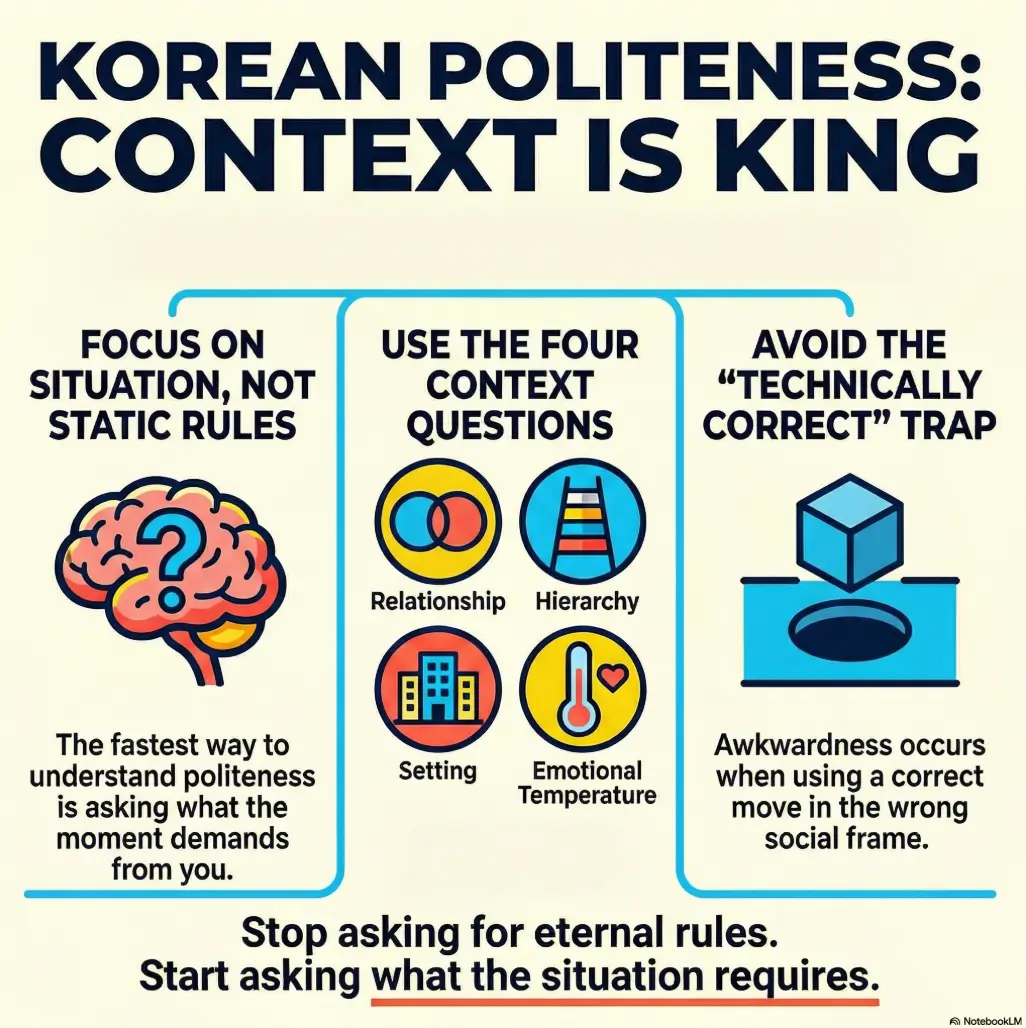
The real shift isn’t asking “What is the rule?”
but rather “What is this situation asking of me?”
Table of Contents
Who This Is For / Not For
This is for readers who…
Live in Korea, visit often, study here, date here, work here, or simply keep having the same strange thought after an interaction: I thought I was being polite, so why did that feel off? It is for travelers trying to survive dinners without turning every meal into a choreography exam. It is for expats who have learned enough Korean to notice that grammar does not explain everything. It is for professionals who sense that office politeness and everyday warmth are not the same instrument.
This is not for readers who…
Want a rigid checklist that guarantees social perfection. Culture does not behave like a microwave manual. This is also not a grammar-only guide to honorifics, nor a “Koreans always do X” explainer stuffed with stereotypes wearing little academic hats. The goal here is interpretation, not folklore.
- People often adjust tone by relationship, not abstract principle
- The same behavior can feel respectful in one moment and awkward in another
- Context usually beats memorized etiquette fragments
Apply in 60 seconds: Before your next interaction, silently name the setting: work, family, friends, formal meeting, casual errand, or first-time introduction.
The Real Frame: Korean Politeness Is Usually About Reading Context, Not Performing Niceness
Why “polite” can be the wrong English lens
In English, “polite” often suggests general niceness, pleasant manners, and basic civility. That translation can lead foreigners astray. In Korea, what gets interpreted as respectful behavior is often tied to social positioning and situational judgment. It is not merely about being sweet. Sometimes the respectful move looks warm. Sometimes it looks restrained. Sometimes it looks like waiting half a beat longer before speaking. Sometimes it looks like not making yourself the main character when the group needs a quieter center.
How role, age, setting, and relationship change the social script
This is the part many foreigners resist because it feels slippery. But social life is slippery. A university class, a company dinner, a cousin’s wedding, and a late-night meal with close friends do not run on the same current. Age matters. Role matters. Who invited whom matters. Whether the group is tense, tired, celebrating, grieving, or simply trying not to create discomfort also matters. What feels perfectly relaxed among friends can sound abrupt in a workplace. What feels respectfully formal at first can become strangely icy after familiarity has grown.
Why the same phrase can feel respectful, distant, warm, or awkward depending on the moment
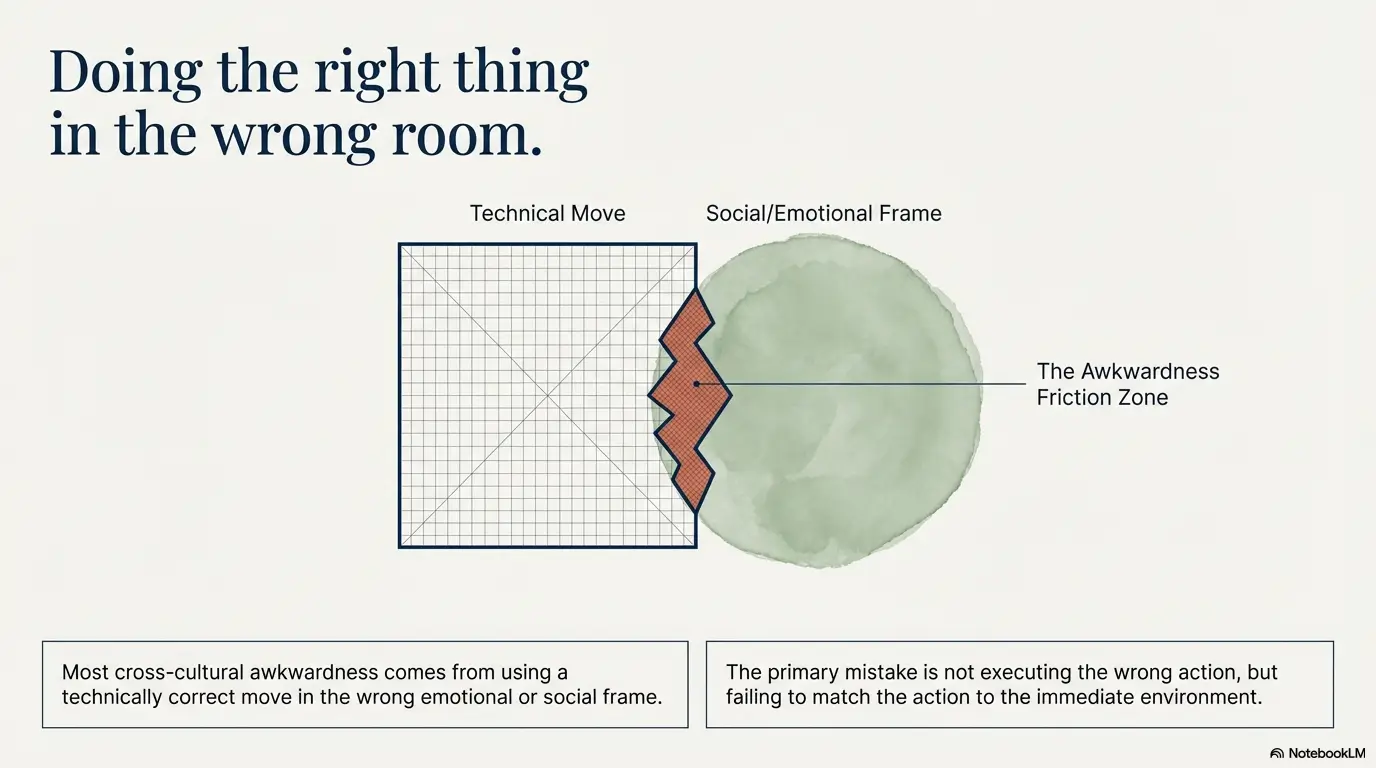
I once watched a foreign resident say all the technically correct things at dinner, every phrase polished, every thank-you pristine. And yet the whole performance landed with the emotional texture of laminated paper. Why? Because it was too much. The group had already relaxed. Everyone else had shifted into a softer mode, but he was still acting like he had wandered into a royal audience. Politeness without calibration can feel as odd as rudeness.
Bold truth: In Korea, social skill is often less “Do I know the rule?” and more “Can I tell where the room is now?”
| Situation | Lead With | Best Next Move |
|---|---|---|
| First meeting | More formality | Observe before loosening up |
| Established friendship | Shared rhythm | Match the group’s actual tone |
| Work setting with seniors | Role awareness | Be clear, deferential, and brief |
Neutral action: Choose the safer setting-first approach until the group clearly signals more ease.
The First Mistake: Treating Politeness Like a Universal Personality Trait
Why someone can seem cold at first and deeply considerate later
Foreigners often decide too quickly: warm means friendly, reserved means cold, casual means authentic. But in Korea, first impressions can be filtered through caution, role, and social distance. A person who seems stiff at first may later prove generous, attentive, and genuinely caring. Meanwhile, someone who feels breezy and easy in minute one may not actually be offering closeness. You are sometimes reading stage management, not essence.
Why reserve is not always dislike
Reserve can be protective rather than dismissive. It can say: I do not want to presume closeness too quickly. I do not want to embarrass you. I do not want to overstep a role boundary that still matters here. In American settings, spontaneous friendliness often signals goodwill. In Korean settings, immediate informality can sometimes feel like jumping two chapters ahead in the book.
How group harmony often outranks individual expressiveness
That does not mean individuality disappears. It means timing matters. Many social settings in Korea reward smoothness over dramatic self-expression, especially early on. The point is not to erase yourself. The point is to avoid creating needless friction before trust has settled into place.
Let’s be honest…
Some foreigners secretly believe that the most “real” version of themselves is the most unfiltered one. But cross-cultural skill is not fake. It is adaptive. Nobody calls it dishonest to use an indoor voice in a library. Social tone works much the same way.
Sometimes what feels “friendly” in the U.S. feels premature in Korea
I have seen this in tiny moments. A newcomer uses first-name energy too fast. Jokes land before the room has granted joke-permission. Someone leans into instant intimacy and then feels wounded when the response is cautious. The problem is not kindness. The problem is tempo.
Show me the nerdy details
When people say Korean politeness is “formal,” they often collapse several things into one word: speech level, age awareness, role sensitivity, turn-taking, hosting norms, and emotional pacing. Treating all of that as one trait hides the real mechanism. It is a system of calibration more than a single personality style. If you want the language side of that system explained more directly, a separate guide to Korean honorifics for foreigners can help fill in the grammar layer without replacing the context layer.
The Hidden Variable: Relationship Stage Changes Everything
Why first meetings, second meetings, and long-term familiarity follow different rules
Many foreigners assume a relationship should feel internally consistent from day one. But Korean interactions often unfold in stages. First meetings can be careful, second meetings less guarded, and long-term bonds much more relaxed. If you judge everything by the opening scene, you miss the plot.
How speech level, humor, and directness shift once trust is established
Trust changes the air pressure. Once a relationship becomes real, conversations may get looser, jokes sharper, teasing more affectionate, and directness more acceptable. This surprises foreigners who assumed the initial formality was the person’s whole personality. It was sometimes just the wrapper.
Why early restraint is often a form of respect, not emotional distance
Think of early restraint as leaving space rather than withholding warmth. It says, I will not assume closeness you have not given me yet. In a culture where people often pay attention to social alignment, that restraint can be a courtesy. It may feel anticlimactic if you come from a chatty culture. But it is frequently meant to reduce pressure, not create it.
Small field note: The most useful question after a Korean interaction is rarely “Did they like me?” It is often “What stage is this relationship actually in?”
- First encounters often run on caution and role awareness
- Familiarity changes speech, humor, and social looseness
- Judging too early creates most foreigner misunderstandings
Apply in 60 seconds: After a meeting, label the relationship honestly: stranger, new acquaintance, repeated contact, or actual friend.
Status Signals Matter More Than Many Foreigners Expect
How age, seniority, job title, and host-guest roles shape interaction
Here is the part that catches many Americans off guard. Korea often pays more explicit attention to age and role than the modern U.S. does in daily life. Not because every Korean is obsessed with hierarchy every second, but because role signals still help organize interaction. Who is older. Who invited the group. Who is responsible. Who is the boss. Who is being welcomed. These things influence speech, seating, turn-taking, and even who is expected to make certain small decisions. In practical terms, this is also why guides on the Korean age system explained or Korean seating hierarchy feel oddly relevant to ordinary social life.
Why “equal treatment” can accidentally feel tone-deaf in a Korean setting
Many foreigners are proud of treating everyone exactly the same. The intention is admirable. The effect is not always. In Korea, sameness can sometimes ignore context that others are actively tracking. Equal dignity does not always mean identical behavior. You can respect everyone while still recognizing that not every situation asks for the same tone.
When casual behavior reads as confidence, and when it reads as social clumsiness
This is where people lose the plot in stereo. Casual behavior among peers may read as relaxed and confident. The same behavior toward someone older or in a formal setting can read as socially blunt, naive, or oddly self-centered. The line is not impossible to read, but it rarely reveals itself to people who insist it should not exist.
I once watched a junior employee interrupt a senior colleague in a mixed-language meeting because he thought “being direct saves time.” It did save time. In the same way a dropped plate saves dishwashing. Everyone remembered it.
- Have you met more than once? Yes/No
- Has the other person clearly relaxed their tone first? Yes/No
- Are you outside a formal work or family setting? Yes/No
- Are you sure age or rank is not the active frame right now? Yes/No
If you answered “No” to two or more, stay slightly more formal for now.
Neutral action: Let the senior person or host set the room’s looseness before you do.
Don’t Do This: Mistaking Informality for Authenticity
Why dropping formality too early can create discomfort instead of closeness
There is a modern international myth that authenticity always looks casual. It does not. Sometimes authenticity looks like good judgment. Dropping formality too early can make the other person work harder to restore social balance. That is rarely the gift foreigners imagine they are giving.
How “just be yourself” can fail across cultures
“Just be yourself” is charming advice until it travels badly. Which self? Your bar-self? Your job interview self? Your dinner-with-future-in-laws self? Every culture already expects version control. Korea just makes some of those switches more visible. Adaptation is not betrayal. It is literacy.
What respectful warmth looks like before intimacy is earned
Respectful warmth is not robotic. It is calm. It is attentive. It speaks without flooding the space. It asks questions without overreaching. It accepts a little initial distance without treating that distance as a personal insult. It avoids the two melodramas foreigners often stage: forced coolness and forced charm.
Here’s what no one tells you…
Over-correcting into fake formality can be just as awkward as being too casual. You do not need to behave like a period drama footman. Foreigners sometimes learn one etiquette tip and then wear it everywhere like a sequined cape. That is how you end up speaking like an office memo at a friend’s fried-chicken dinner.
Over-correcting into fake formality can be just as awkward as being too casual
The goal is not theatrical respect. The goal is well-tuned respect. There is a difference. One feels grounded. The other feels like someone swallowed a guidebook and is now speaking in subtitles.
Pull-quote: The opposite of rude is not “formal.” The opposite of rude is often “well-calibrated.”
Context at the Table: Meals Reveal More Than Manners Guides Admit
Why seating, pouring drinks, and starting to eat are about situation, not theater
Meals are where foreigners often become amateur anthropologists with very bad timing. They have memorized three rules from social media, and suddenly dinner feels like a hidden-camera exam. But table behavior in Korea is rarely just about ritual. It is about who is present, what kind of meal this is, who is hosting, how formal the gathering is, and how closely the group wants to observe convention in that specific moment.
How family dinners, work dinners, and friend gatherings use different standards
A family dinner may be warm but still role-conscious. A company dinner can be more structured, especially at the beginning. A friend gathering may look almost startlingly casual once the group’s internal hierarchy has already settled. Foreigners get confused because they expect one table code to rule them all. But meals, like weather, change by location.
Why copying one viral etiquette tip can mislead you in a different setting
“Never pour your own drink.” “Always wait for the eldest person to start.” “Always sit only where you are told.” These are the kinds of tips that travel beautifully online and then collide with real life. Some are useful in certain settings. Some are outdated in others. Some are less strict among younger friends. The danger is not that the tip is false. The danger is that it is incomplete. The same goes for meal-specific advice around Korean banchan refill rules, how to refuse alcohol in Korea, or even learning a few Korean BBQ phrases without understanding the room they are entering.
I remember watching a foreign student freeze with his spoon midair because he had read that he must not begin until the oldest person started. The eldest aunt, meanwhile, was telling everyone to eat before the soup got cold. He sat there preserving etiquette while the noodles expanded into despair.
- Is this family, work, dating, or close friends?
- Who is the host or most senior person?
- Are younger people following the same rule strictly, loosely, or not at all?
- Is the mood formal, celebratory, hurried, or intimate?
Neutral action: When unsure, follow the host’s pace and the table’s rhythm rather than a single internet rule.
The Soft No Problem: Indirectness Is Often About Social Temperature
Why Koreans may avoid blunt refusal in tense or hierarchical moments
Many foreigners, especially from cultures that praise “clear honesty,” misread Korean indirectness as evasive. But indirectness is often less about hiding truth than managing social temperature. A direct no can carry more force than the moment can comfortably absorb, especially when hierarchy, obligation, or embarrassment is in play.
How “maybe,” silence, deflection, or soft agreement can signal caution
You may hear a maybe that means unlikely, a soft agreement that means not now, or a silence that means discomfort rather than consent. None of this is uniquely Korean, of course. Every culture has ways of buffering social friction. Korea simply trains the eye to notice them more carefully.
What foreigners get wrong when they assume indirectness equals dishonesty
The mistake is moralizing the style instead of interpreting the function. Indirectness can be a way of preserving dignity, protecting the relationship, or reducing public tension. That does not mean it is always ideal. It means you should decode it before condemning it. In some Korean situations, bluntness is not admired as courage. It is experienced as social carelessness. Readers who want to zoom in on this one pattern can compare it with a more focused guide to Korean indirect communication.
Small practice tip: When you hear a soft answer, check timing and tone before content alone. Was the person under pressure? In front of seniors? Avoiding embarrassment? Context often supplies the missing subtitles.
Show me the nerdy details
Indirect communication tends to become more active when a situation carries higher stakes for face, role, or group smoothness. In lower-stakes settings among close peers, directness can rise sharply. This is why the same person may sound careful at work and completely unfiltered after midnight with friends.
Common Mistakes
Mistake 1: Assuming politeness always means kindness
Sometimes a formal interaction is simply well-managed, not warm. Respectful language does not guarantee emotional intimacy. A person can be impeccably mannered and still distant. Foreigners often confuse polished tone with personal closeness.
Mistake 2: Assuming directness is always more respectful
Directness can be efficient. It can also be reckless. Respect is not only about clarity. It is also about delivery, timing, and the cost you create for the other person in the moment.
Mistake 3: Using one Korean etiquette rule in every setting
This is the tourist-brochure problem. You learn one rule and then apply it like sunscreen to every surface. Context rebels. The result is usually either stiffness or confusion.
Mistake 4: Reading emotional restraint as rejection
Sometimes reserve is just reserve. Not dislike. Not passive aggression. Not a secret referendum on your worth. It may simply mean the relationship has not ripened yet.
Mistake 5: Ignoring who holds responsibility in the group
Groups often operate through invisible responsibility lines. Who is organizing. Who is hosting. Who is representing the team. Foreigners miss this and then wonder why a casual move felt off.
Mistake 6: Focusing on words while missing timing, tone, and setting
Language learners often obsess over phrases. But social meaning also lives in pause length, volume, facial tension, when you speak, and whether you are making the other person manage your uncertainty in public. That is also why even a strong primer on polite vs casual Korean only solves part of the puzzle.
- Do not confuse formal tone with real closeness
- Do not confuse reserve with dislike
- Do not let one etiquette rule colonize every situation
Apply in 60 seconds: The next time a Korean interaction feels strange, review tone, timing, and relationship stage before blaming vocabulary.
The Work Culture Trap: Office Politeness Is Not the Same as Social Politeness
Why Korean workplaces can feel more structured than casual friend groups
Foreigners often meet Korean friends first and then assume offices run on the same current. They do not. Workplaces can be more layered, more title-aware, and more careful about reporting lines. That does not mean every Korean office is rigid in the same way. It means professional settings often preserve formality longer because role clarity matters more there.
How meeting etiquette, reporting lines, and deference differ from everyday conversation
At work, deference can be a functional tool, not a personality confession. It helps meetings move. It clarifies who carries responsibility. It protects people from public embarrassment. A coworker who jokes freely at dinner may sound extremely measured in a meeting because the meeting is not an authenticity contest. It is a role performance with real consequences.
Why a coworker who is relaxed after hours may sound formal at work on purpose
This is a point many foreigners take too personally. They think, “Yesterday you joked with me over barbecue. Why are you speaking so formally now?” Because now there are witnesses, stakes, and structure. Professional tone is sometimes the clothing a situation requires. Nobody is betraying the friendship. They are changing shoes for different ground.
I once heard an expat complain that his Korean teammate had become “cold” in front of senior staff. The truth was less dramatic. She was protecting the workflow. Later, over coffee, she was exactly the same person he knew. The office had simply asked for a different register. Even phone behavior can shift this way, which is why Korean phone call culture often feels more formal than casual chatting among friends, and message-based norms in KakaoTalk etiquette can carry their own quiet hierarchy.
| Tier | Setting | What Changes |
|---|---|---|
| Tier 1 | Private chat with peer | More ease, more humor, less role signaling |
| Tier 2 | Team meeting | More turn awareness, clearer deferential cues |
| Tier 3 | Meeting with senior staff or clients | Highest role sensitivity and careful phrasing |
| Tier 4 | Company dinner with hierarchy present | Formal cues and social observation both increase |
Neutral action: Treat work and after-hours interactions as related but not identical social systems.
What Changes by Setting: Family, Friends, Dating, and Public Spaces
How family politeness can be warmer but more role-conscious
Family settings can confuse foreigners because they may look emotionally warm while still carrying clear expectations about age, order, and role. You may feel welcomed and constrained at the same time. That is not a contradiction. It is the social architecture doing two jobs at once. Around holidays, that architecture often becomes even more visible, which is why Seollal etiquette for foreigners and Chuseok etiquette for foreigners can feel like magnified versions of everyday context-reading.
Why friend-group behavior may look surprisingly casual once hierarchy is settled
Once a friend group knows who is older, who leads, who teases whom, and who can say what, the surface can relax dramatically. Foreigners sometimes see this and conclude that hierarchy has vanished. More often, it has simply been settled in the background. The room can now afford to look casual.
How dating culture can blur sincerity, caution, and social scripts
Dating is where everyone’s cultural confidence goes to spill soup on itself. Signals can be hard to read because sincerity, shyness, gender expectations, and general modern human confusion all overlap. A careful tone may signal respect. It may also signal uncertainty. Public behavior and private messaging may not match neatly, and that mismatch is not always strategic. Sometimes people are simply navigating multiple scripts at once.
Why public courtesy and private communication do not always match
Someone can be quite reserved in public and much more open in private channels. That does not automatically mean they are two-faced. It may mean they separate public role management from personal expression. Foreigners often expect one style to dominate across all settings. Korea frequently distributes style by context instead.
Micro-reminder: Do not borrow your interpretation of a Korean office and apply it to dating. Do not borrow your dating interpretation and apply it to someone’s parents. Social life is not a one-size coat. It is more like weather layers.
Short Story: The dinner where everyone was polite and I was the only one who was wrong
Years ago, a foreign friend was invited to a Korean family meal by his classmate. He arrived armed with internet confidence. He had read about bowing, pouring drinks, waiting for elders, and speaking formally. For the first ten minutes, he was a model exchange-student statue. He stood too quickly, sat too carefully, laughed too little, and answered every simple question as if submitting a visa essay.
The family, who had already decided he was sweet, kept trying to relax him. The grandmother told him twice to eat. The younger cousin joked with him. His friend switched into a softer tone. But he was still trapped inside “perform respectful foreign guest.” Finally the host smiled and said, “You can breathe now.” That was the moment he understood it. He had not been rude. He had been context-blind. He was obeying the opening scene long after the room had moved on.
Stop Chasing Rules: Learn the Three Better Questions Instead
Who is senior, hosting, or responsible here?
This question alone will save you from a shocking number of awkward moments. When you can identify the person carrying seniority or responsibility, you suddenly understand who sets tone, pace, and often the first move. It is like finding the conductor after listening to an orchestra as if it were a traffic jam.
How close is this relationship right now?
Not how close you hope it is. Not how close it would be in your home culture. How close is it right now. New acquaintance, repeated contact, friend, colleague, friend-of-a-friend, partner’s parent, professor, manager. Different distances invite different tones.
What emotional tone is the group trying to protect?
Sometimes the group is protecting celebration. Sometimes calm. Sometimes deference. Sometimes efficiency. Sometimes the avoidance of embarrassment. If you can sense the emotional temperature the group is trying to preserve, your own choices become much simpler.
- Who has seniority or responsibility?
- How close is the relationship right now?
- What emotional climate is the group protecting?
Apply in 60 seconds: Write these three questions in your notes app before your next Korean dinner, meeting, or first introduction.
Infographic: Read the Room Before You Perform
Stranger, acquaintance, friend, coworker, family. The closer the bond, the more relaxed the acceptable range often becomes.
Age, title, host-guest role, responsibility. These cues often shape tone, pace, and deference.
Office, family meal, first meeting, date, public space. Same person, different setting, different script.
Is the group protecting harmony, speed, celebration, privacy, or dignity? Match that before you try to shine.
FAQ
Is Korean politeness really stricter than American politeness?
Sometimes it can feel that way, especially in first meetings, workplace settings, and interactions shaped by age or rank. But “stricter” is not always the most useful word. A better word is more context-sensitive. The U.S. often rewards quick friendliness and verbal openness. Korea often rewards better calibration to relationship and setting.
Why do Koreans sometimes seem distant at first?
Because first-contact caution can be a form of respect. It may signal that the person does not want to presume closeness or create discomfort too soon. What feels distant through one cultural lens may feel considerate through another.
Is using formal language enough to be respectful in Korea?
No. Formal language helps, but tone, timing, volume, role awareness, and situational judgment matter too. Someone can use the “right” words and still feel awkward if the behavior is poorly calibrated to the room.
Why do Korean friends act differently in private versus in public?
Because public and private settings can invite different levels of role management. A person may be more careful in public and more relaxed in private without being inconsistent. They are responding to different social demands.
Do younger Koreans still care about hierarchy?
Often yes, but not always in the same way or with the same intensity as older generations. Many younger Koreans are more casual in some settings, especially with peers. Even so, age, seniority, and role do not simply disappear. They often become more selective, situational, or quietly backgrounded.
Is bowing more important than tone and timing?
No. Bowing can matter, especially in greetings, but foreigners often overestimate it because it is visible and easy to notice. Tone, pacing, who speaks first, and how you read the room often matter more over the course of an actual interaction. For the visible side of this ritual, some readers may also want a separate explainer on Korean bowing and jeol.
Why is indirect communication so common in some Korean situations?
Because indirectness can help manage embarrassment, preserve dignity, and reduce friction in hierarchical or tense settings. It is often less about deception than about keeping the relationship intact while communicating carefully.
Can being too polite make things awkward in Korea?
Absolutely. When your formality no longer matches the room, it can create distance, stiffness, or gentle discomfort. Respect works best when it is responsive, not theatrical.
Next Step
For one week, stop asking “Was that polite?” and start asking “What was the context?”
This is the real door out of etiquette panic. The room is not demanding perfection. It is asking for sensitivity. Foreigners often imagine Korean politeness as a locked cabinet of rules. In daily life, it behaves more like weather. There are patterns, yes. But the useful skill is not memorizing every cloud. It is learning what kind of sky you are under.
After each Korean social interaction, note three things: relationship, setting, and hierarchy
That tiny habit will teach you more than twenty viral etiquette tips. In less than 15 minutes, you can start a simple note on your phone with three headings:
- Relationship: stranger, acquaintance, friend, coworker, family
- Setting: office, classroom, meal, date, casual gathering, public space
- Hierarchy: age, host, title, responsibility, or none that seemed active
Do this for one week. You will begin to see the hidden grammar behind interactions that once felt random. That is the curiosity loop from the opening of this article, closed at last: the problem was never that Korean politeness was impossibly complicated. The problem was that you were taught to look for rules where the real answer was context.
Add 1 point for each “yes.”
- Is this a first meeting?
- Is someone clearly senior or responsible here?
- Is the setting work, family, or otherwise formal?
0–1 points: You can usually relax a little, while still observing.
2–3 points: Start more carefully and let the room loosen you, not the other way around.
Neutral action: Use the score only as a starting frame, then watch the group.
Last reviewed: 2026-03.