
Navigating Korea’s Precision Healthcare:
The Ultimate Health Checkup Guide
Korea can turn a health checkup into a surprisingly efficient morning: one elevator ride, one locker key, a few numbered stations, and suddenly you have blood work, imaging notes, measurements, and a report dense enough to make your smartwatch look shy.
But health checkup culture in Korea is not just “fast healthcare.” For foreigners, the real challenge is knowing whether you are booking an NHIS health screening, a private full-body checkup, a work or visa exam, or a glossy package that may create more questions than answers.
“Guess wrong, and you can waste money, miss covered benefits, misunderstand fasting rules, or let an abnormal result sit quietly inside a PDF you never fully decode.”
This guide helps you choose the right screening lane, prepare without morning chaos, avoid unnecessary add-ons, and make sure your results become a clear next step instead of medical confetti. It covers coverage, language support, private packages, cancer screening, and follow-up care.
Korea may move quickly. Your decision does not have to.
Start with the difference that matters most: screening is not diagnosis.
Table of Contents
Safety: screening is not diagnosis
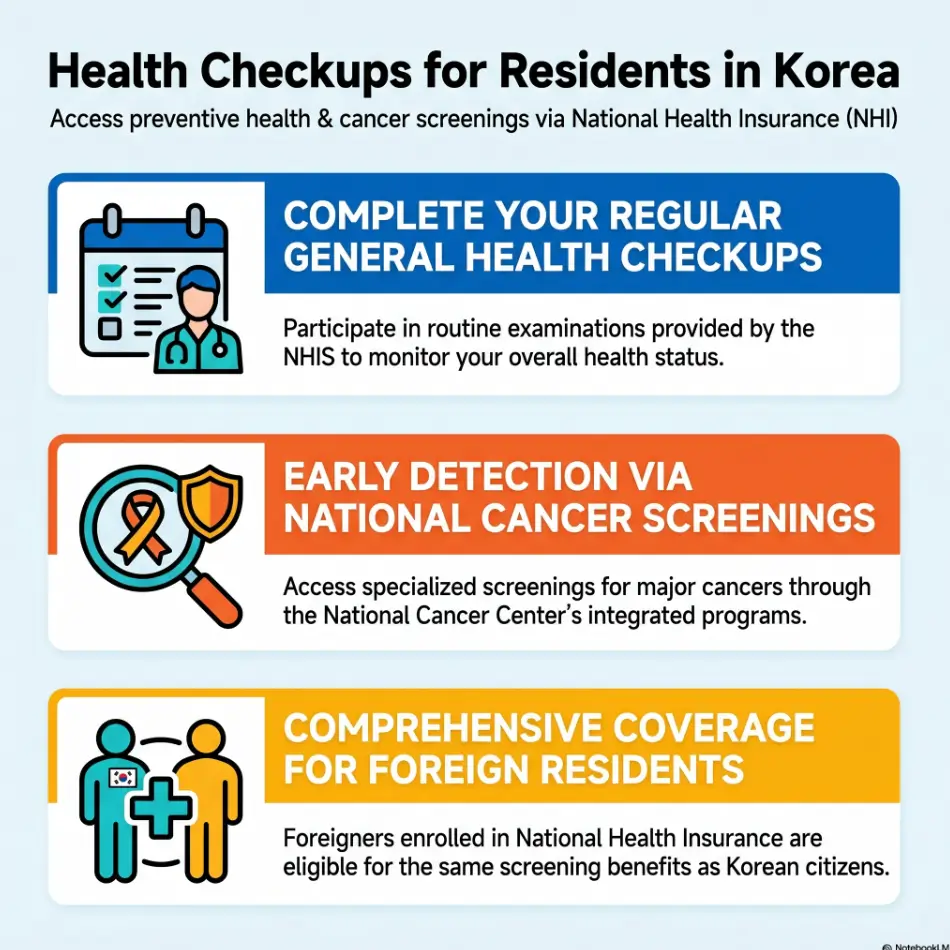
Korean health checkups are best understood as screening and prevention tools, not a replacement for a clinician who knows your symptoms, medications, history, and family risks.
A normal result can be reassuring, but it does not rule out every condition. An abnormal result can feel frightening, but it does not automatically mean serious disease. Screening is a doorway. Diagnosis is the room beyond it, with a clinician holding the map.
Bring prior medical records if you have them, especially past imaging, lab results, surgery notes, medication lists, allergy history, and family history. Ask how results will be delivered and whether anyone will explain them in English or in a language you can truly understand.
- Use screening for prevention and risk signals.
- Use clinical care for symptoms, treatment, and follow-up.
- Ask who explains abnormal or unclear results.
Apply in 60 seconds: Write down one sentence: “After the results arrive, who reviews them with me?”
Korea’s Checkup Culture Feels Fast Because It Was Built for Routine
Prevention is not a luxury appointment here
In the United States, many people meet preventive care through annual physicals, employer wellness programs, insurance networks, and a little calendar wrestling. In Korea, routine screening has a more public rhythm. The National Health Insurance Service, commonly called NHIS, operates structured health screening programs, and many hospitals and private centers build additional paid packages around that culture.
For foreigners, this can feel almost cinematic. You arrive early, change into checkup clothing, move through stations, and watch the system hum. Blood draw here. Chest X-ray there. Hearing, vision, blood pressure, urine, counseling, perhaps endoscopy if you booked it. The choreography is real.
I still remember seeing a waiting area where everyone seemed to know the dance except me. I was holding a locker key like it contained state secrets. The staff member simply pointed, smiled, and moved the line forward. Korea often treats routine screening like train timetables: not sentimental, but impressively organized. If you want the broader cultural backdrop, this guide to why Korean clinics are so fast explains the everyday rhythm behind that quick-moving healthcare experience.
Why one building can handle blood work, imaging, dental, and counseling
Many Korean hospitals and screening centers are designed around throughput. That does not mean careless. It means the building, staffing, forms, and testing sequence are often built for a high number of routine visits.
The result is a one-stop feeling that surprises foreign residents and visitors. Instead of booking separate appointments across several weeks, you may complete multiple screening steps in one morning. That convenience is one reason Korea has become known for medical tourism and executive-style checkup packages.
The cultural surprise: efficiency can feel impersonal if you expect long conversation
The flip side is emotional. If you expect a long, warm, deeply narrative conversation at every station, the speed may feel chilly. A nurse may be kind but brief. A technician may be precise but not chatty. A doctor may explain key findings quickly, especially in a busy screening setting.
That is why foreigners should prepare questions before the visit. The system may be fast, but your concerns still deserve a seat at the table.
Show me the nerdy details
Screening systems work best when the test, population, follow-up pathway, and clinical explanation all fit together. A fast screening center can collect data efficiently, but the value depends on what happens after abnormal, borderline, or confusing results appear.
Who This Is For, and Who Should Slow Down First
Good fit: foreign residents trying to understand NHIS health screening
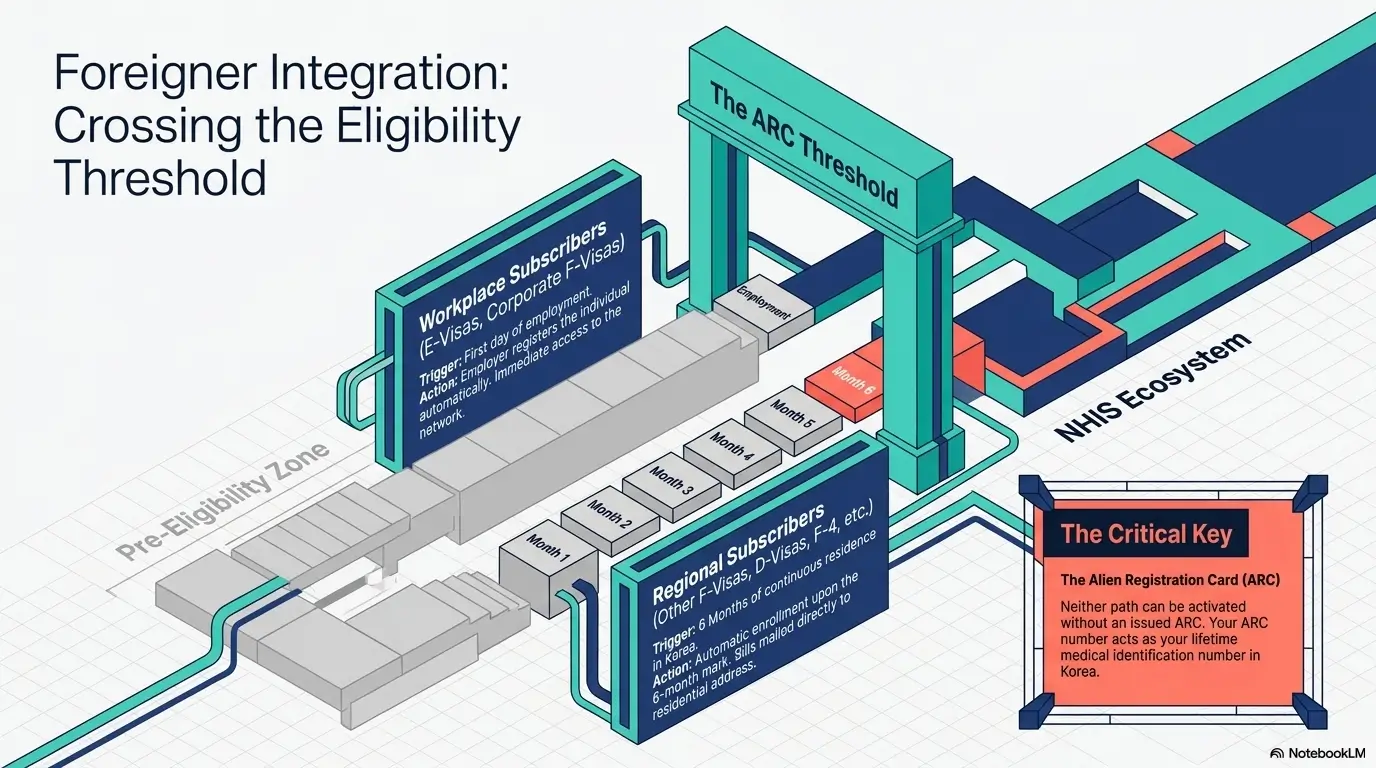
This guide is especially useful if you live in Korea, have an Alien Registration Card, pay into Korean National Health Insurance, and keep hearing that you may be eligible for a health checkup. You may not know whether the notice in your mailbox is important, optional, or secretly expensive. Usually, it is less dramatic than it looks, but it is worth understanding.
Foreign residents enrolled in NHIS generally receive coverage in a way that mirrors Korean citizens for many insurance benefits. NHIS also provides English-language information and multilingual health checkup forms, which can soften the language fog before it becomes a thundercloud.
Good fit: visitors comparing private checkup packages before a Korea trip
This guide also fits visitors who are curious about private screening packages in Seoul, Busan, Daegu, Daejeon, Incheon, or other medical centers. Some travelers book checkups alongside dental care, dermatology, eye exams, or general wellness travel.
That can be practical. It can also become a shopping cart with a stethoscope. If you are choosing private tests, the question is not “What is the biggest package?” The better question is “What decision will this test help me make?” Visitors who are pairing medical appointments with a longer stay should also think through travel insurance for South Korea, because screening, follow-up care, cancellations, and emergencies are very different financial animals.
Not for: anyone with urgent symptoms looking for a “quick reassurance scan”
If you have chest pain, sudden weakness, severe shortness of breath, new vision loss, fainting, severe abdominal pain, or stroke-like symptoms, do not wait for a screening appointment. A screening center is not an emergency department wearing nicer slippers.
Not for: people who need diagnosis, treatment planning, or medication changes today
If you already have symptoms, a known condition, or medication concerns, book clinical care. Screening may produce useful data, but it is not designed to replace a targeted visit with a doctor who can examine you, order the right diagnostic tests, and adjust treatment.
- Do you live in Korea and have NHIS? Check your NHIS eligibility before paying privately.
- Are you a short-term visitor? Compare private packages, but ask about follow-up before booking.
- Do you have symptoms today? Choose a clinic or emergency care, not routine screening.
- Do you need documents for work, school, or visa use? Confirm the exact certificate format first.
Neutral action: Match the appointment type to the job you need it to do.
NHIS Checkups Are Different From Private “Full Body” Packages
The national screening lane: basic, structured, and eligibility-based
NHIS health checkups are built around eligibility rules, age, risk categories, and national screening goals. The general health checkup is not meant to be a luxury buffet. It is a structured baseline that looks for common risk signals such as blood pressure issues, diabetes risk, kidney-related clues, anemia markers, lifestyle factors, and other items depending on age and program rules.
NHIS English guidance states that general health checkup expenses are free of charge for eligible people, and cancer checkups may involve cost-sharing depending on the cancer type and eligibility. Details can change, so check the current NHIS page before making plans.
The private package lane: broader menus, more add-ons, more decisions
Private checkup packages are different. They may include more imaging, endoscopy, ultrasound, thyroid testing, tumor markers, cardiovascular add-ons, women’s health options, men’s health options, brain packages, premium rooms, English coordinators, and same-day counseling.
Some packages are thoughtfully designed. Others are mostly menus with better lighting. The brochure may be glossy enough to make your wallet sit up straight, but clinical value depends on your age, sex, history, symptoms, family history, risk factors, and what you will do with the findings.
Do not assume “more tests” means “better care”
More testing can find useful problems early. It can also create incidental findings, false positives, repeat imaging, biopsies, extra bills, and anxiety. The strange part is that both can be true in the same building before lunch.
I once watched someone choose a package by pointing at the middle price tier and saying, “This feels responsible.” I understood the impulse. Price tiers whisper moral language. But your body is not a hotel booking.
The quiet question: who explains the results when the machinery is done?
The most important difference is often not the machine. It is the explanation. A private package with a clear doctor consultation, English report, and follow-up pathway may be more useful than a larger package that leaves you holding a translated report full of numbers and tiny arrows.
| Choose this lane | When it fits | Watch for |
|---|---|---|
| NHIS checkup | You are eligible and need routine screening. | Language support and follow-up explanation. |
| Private package | You want broader screening or visitor-friendly scheduling. | Unnecessary add-ons and unclear result counseling. |
Neutral action: Pick the lane that answers your real question with the least confusion.
Foreign Residents May Have More Access Than They Realize
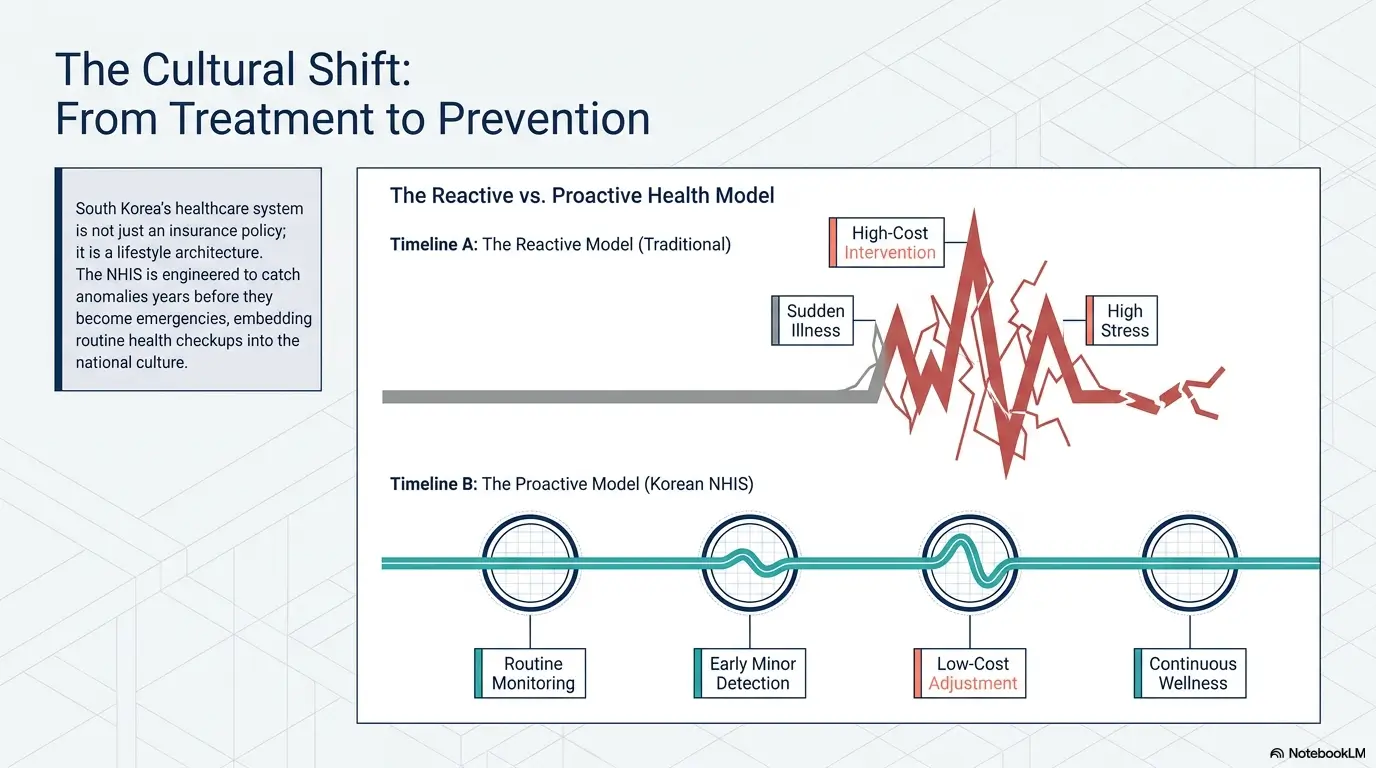
NHIS coverage for foreigners generally mirrors citizen coverage
Many foreign residents are surprised to learn that Korean National Health Insurance is not only for Korean citizens. NHIS explains that national insurance for foreigners generally has the same coverage structure as it does for Korean citizens, once the person is properly enrolled.
That matters because routine screening can be much less expensive than a foreigner expects, especially if they are mentally comparing everything to US healthcare prices. The difference can feel almost suspicious at first. You may find yourself asking, “Wait, this is allowed?” Yes, sometimes the answer is less dramatic than your American billing trauma expects.
Health checkup forms and foreigner support can reduce the language fog
NHIS provides multilingual health checkup forms, including English. Some hospitals also have international healthcare centers or coordinators. Private screening centers may offer English reports, English-speaking staff, or interpretation services.
But “English support” can mean different things. Sometimes it means full medical explanation. Sometimes it means appointment help, directions, and payment support. Those are not the same. Administrative English gets you through the hallway. Medical English helps you understand the result.
Bring the right ID, not just your passport confidence
If you are a resident, bring your Alien Registration Card or Residence Card, insurance information, appointment confirmation, and passport if the center requests it. If you are a visitor, bring passport details, payment method, and any medical records you want the clinician to consider. For longer stays, everyday logistics like Korean phone plans for Americans can also matter more than expected, because hospitals may send appointment confirmations, result notices, and portal codes by text.
Do not rely on “I have my passport somewhere in my bag” energy. That energy is charming at a cafe and less charming at a registration desk at 7:40 a.m.
Here’s what no one tells you: eligibility is boring until it saves you money
Eligibility rules rarely make exciting reading. They are beige. They are administrative oatmeal. But checking them can prevent you from paying out of pocket for something covered or partly covered.
Before booking privately, ask: Am I eligible for an NHIS checkup this year? Which items are covered? Which cancer screenings apply to my age or risk group? Which items would be private add-ons?
The Basic Korean Health Checkup Is Often About Risk Signals, Not Certainty
Blood pressure, blood tests, urine tests, and lifestyle questions create the first map
A basic Korean health checkup often feels simple, but simple does not mean useless. Blood pressure, height, weight, waist measurement, vision, hearing, blood tests, urine tests, and lifestyle questionnaires can identify risk signals that deserve attention.
Think of the basic checkup as a weather report, not a satellite command center. It may show storm clouds, stable conditions, or something that needs a closer look. It does not explain every ache, every fatigue pattern, or every family-history worry by itself.
Cancer screenings follow age, sex, and risk-based rules, not tourist curiosity
Korea’s national cancer screening system focuses on major cancers such as stomach, colorectal, breast, cervical, liver, and lung cancer, with eligibility based on age, sex, and risk factors. The National Cancer Center in Korea also describes screening as part of early detection and prevention.
For foreigners, the key point is restraint. A cancer screening is not automatically better because it is earlier, broader, or more expensive. Good screening asks whether the right person is getting the right test at the right interval, with the right follow-up.
Results are a doorway, not a verdict
Some results are straightforward: normal, abnormal, repeat, follow-up recommended. Others are maddeningly gray. Borderline cholesterol. Slightly elevated liver enzymes. A small nodule. A phrase that looks harmless in Korean but becomes frightening after machine translation turns it into medieval poetry.
That is where clinical context matters. Your age, medications, alcohol use, exercise, infection history, menstrual status, prior scans, and family history can change how a result should be interpreted.
The mistake: treating a “normal” report as a lifetime warranty
A normal report is not a lifetime warranty. It is a snapshot. If you develop new symptoms after a checkup, do not wave the old report at your body and say, “But we already discussed this.” Bodies are poor bureaucrats. They do not respect paperwork.
- Use normal results as reassurance for what was actually checked.
- Use abnormal results as prompts for follow-up, not panic.
- Use symptoms as a reason to seek care even if screening was recent.
Apply in 60 seconds: Circle any result labeled abnormal, borderline, repeat, or follow-up and put it on one list.
Private Screening Centers Can Feel Like Medical Airports
Robes, wristbands, numbered stations, and timed movement
Private screening centers in Korea can feel like airports designed by someone who loves lab values. You may receive a locker key, change into center clothing, follow station numbers, and move through tests in a carefully timed sequence.
This can be soothing if you like structure. It can be disorienting if you are jet-lagged, fasting, under-caffeinated, and unsure whether the next door is for ultrasound or existential reflection.
Why Korea’s one-stop checkup model impresses foreigners
The one-stop model is genuinely impressive. Blood tests, imaging, endoscopy, dental checks, body composition, consultation, and payment may all happen under one roof. For US readers used to separate referrals and surprise bills, this can feel almost unreal.
Medical travel companies and international clinics often highlight this convenience. Hospitals such as Samsung Medical Center, Asan Medical Center, Severance Hospital, Seoul National University Hospital, and CHA medical centers are names many foreigners encounter when researching Korea healthcare, although services and package details vary by institution. The same efficiency shows up in daily neighborhood life too, where clinics, pharmacies, transit stops, and apartment blocks often sit close together; that is part of how Korean city identity is shaped by practical routines, not only tourist landmarks.
Why speed can hide decision fatigue
Speed has a trick: it makes choices feel smaller than they are. Add thyroid ultrasound? Add low-dose CT? Add sleep testing? Add tumor markers? Add a premium endoscopy option? Each checkbox may seem harmless alone. Together, they can create a costly pile of results that needs careful interpretation.
When I see a long add-on menu, I think of a restaurant where every side dish has a lab coat. Tempting, yes. But you still need to know what meal you came for.
Pattern interrupt: the fancy lobby is not the medical plan
A beautiful lobby can reduce anxiety. It cannot decide which screening tests match your risk profile. Marble floors do not read family history. A premium robe does not interpret nodules.
The medical plan begins when you connect your goal to the test list. Everything else is atmosphere.
Infographic: The Korean Checkup Decision Flow
Routine screening, work form, family history, or travel check?
NHIS covered, partly covered, or private pay?
Choose the smallest set that answers the real question.
Fasting, medications, ID, records, interpreter needs.
Translate results, review meaning, book next care if needed.
Common Mistakes Foreigners Make Before Booking
Mistake 1: buying the biggest package because it sounds safest
The biggest package often feels like the responsible adult choice. But “comprehensive” can mean clinically thoughtful, commercially broad, or simply very good at making you fear the package below it.
Ask what each added test changes. If a result is abnormal, what happens next? If the test finds something small and unclear, who explains it? If the answer is vague, pause.
Mistake 2: forgetting fasting rules and losing the cleanest morning slot
Many blood tests, abdominal ultrasounds, glucose tests, and endoscopy appointments may require fasting. Rules vary by test and center. Some medications may need special instructions. Do not guess.
There is a particular sadness in arriving early, proud, hydrated, and cheerful, only to learn that your 6 a.m. latte has betrayed the mission.
Mistake 3: not asking whether English interpretation is medical or administrative
Ask specifically: “Will a clinician explain my results in English?” “Will the written report be in English?” “Can I ask follow-up questions?” “Is interpretation included, or only registration support?”
Those questions sound fussy until you are staring at a result that says “follow-up recommended” and nobody has explained whether that means next week, next month, or please stop Googling immediately.
Mistake 4: skipping follow-up because the report “looked mostly green”
Color-coded reports are comforting. Green feels like permission to forget. But one yellow or red item may matter more than ten green ones, especially if it connects to your symptoms or family history.
Mistake 5: comparing Korea prices to US prices without comparing clinical context
Korean private checkups may look inexpensive compared with US cash prices. That does not automatically make every test necessary. A good deal on an unnecessary test is still a detour with fluorescent lighting.
- Your age, sex, and current symptoms or “no symptoms.”
- Family history of cancer, heart disease, diabetes, stroke, or kidney disease.
- Current medications, allergies, pregnancy status if relevant, and prior surgeries.
- Whether you need English report, English counseling, or insurance documentation.
- Your exact goal: prevention, work form, travel curiosity, or follow-up of a known issue.
Neutral action: Send this information before asking which package is “best.”
Add-On Tests Need a Reason, Not Just a Glossy Brochure
CT, MRI, endoscopy, ultrasound, and tumor markers are not interchangeable
Add-ons can be useful, but they are not magic synonyms for “thorough.” CT scans involve radiation and may find small incidental findings. MRI avoids radiation but is not automatically the right tool for every concern. Ultrasound is useful for certain organs and questions, but it is operator-dependent. Endoscopy directly examines the digestive tract but requires preparation and carries procedure considerations. Tumor markers may be helpful in specific contexts but are often poor general screening tools when used without a reason.
The right test depends on the question. “I want to be safe” is a human feeling. “I have a strong family history of colorectal cancer” is a clinical clue.
Incidental findings can create cost, anxiety, and more testing
An incidental finding is something discovered while looking for something else. Some incidental findings matter. Many are harmless. The problem is that you may not know which category yours belongs to until more appointments, repeat imaging, or specialist reviews happen.
Medical researchers and major health institutions often warn that screening can produce false positives, false reassurance, and follow-up burdens. That does not mean screening is bad. It means screening works best when attached to good judgment.
Family history should guide choices more than package names
Your family history can make certain tests more relevant. Heart disease at young ages, colorectal cancer, breast or ovarian cancer, liver disease, diabetes, stroke, or sudden cardiac death may change what you should discuss with a clinician.
Write down which relative had what condition and at what age. “My uncle had something stomach-ish” is a start, but “father diagnosed with stomach cancer at 52” is more useful. In Korea, family history often sits inside a wider social world of aging parents, adult children, and practical care decisions; you can see that everyday context in how Korea’s aging neighborhoods reveal health and family pressures.
Do not let the menu choose your medicine for you
Private checkup menus are designed to be browsed. Healthcare decisions should be designed to be reasoned through. Those are different muscles.
Show me the nerdy details
Good screening considers test sensitivity, specificity, pretest probability, downstream follow-up, and whether early detection actually improves outcomes for the person being tested. A broad package can increase the chance of finding something, but not every finding improves health decisions.
- Ask what each test can and cannot detect.
- Ask what happens after an abnormal or unclear result.
- Use family history and symptoms to guide choices.
Apply in 60 seconds: Cross out any add-on you cannot explain in one sentence.
Results Day Is Where the Real Value Lives
Ask how results arrive: app, mail, portal, email, or in-person counseling
Before the test day, ask how results will arrive. Some centers provide printed reports. Some use apps or portals. Some email summaries. Some schedule counseling. Some offer same-day preliminary explanations with final results later.
This is not a tiny administrative detail. It is the hinge of the whole experience. A screening result you cannot access, read, or interpret is basically a sealed envelope wearing a lab coat.
Translate the report, then translate the meaning
Machine translation can help you understand headings, but it may turn medical nuance into soup. Use translation as the first pass, not the final answer. If something is abnormal, unclear, or scary, ask a clinician to explain what it means for your actual body.
I once saw a translated report make a mild phrase sound like a prophecy carved into stone. Ten minutes with a calm doctor turned it back into what it was: a follow-up item, not a thunderbolt.
Keep copies for your doctor at home or your next clinic in Korea
Save your report, lab values, imaging summaries, endoscopy findings, pathology results if any, and medication notes. If you have imaging, ask whether you can receive files on CD, USB, portal, or another format. Your future doctor will thank you silently, which is the highest form of medical romance.
The hidden win: one clean folder beats ten forgotten screenshots
Create one folder named by date and city, such as “2026-05 Seoul Health Checkup.” Inside, keep the appointment receipt, package list, test results, imaging files, follow-up instructions, and questions.
The goal is not to become a medical archivist. The goal is to avoid the old screenshot swamp, where one blurry image becomes your only evidence of a cholesterol result from three apartments ago.
Count your result items that say abnormal, borderline, recheck, suspected, follow-up, referral, or further evaluation.
- 0 items: Save the report and keep routine screening reminders.
- 1–2 items: Ask for explanation and timeline.
- 3+ items: Book a clinician review so the report becomes a plan.
Neutral action: Turn result volume into a follow-up priority list.
When to Seek Help Instead of Waiting for a Screening Appointment
Chest pain, severe shortness of breath, sudden weakness, or stroke-like symptoms need urgent care
Do not use a screening appointment as a delay tactic for serious symptoms. Chest pain, severe shortness of breath, sudden weakness, facial drooping, trouble speaking, new confusion, or stroke-like symptoms need urgent medical care.
In Korea, emergency departments are called 응급실, and the emergency number is 119. If you are unsure whether symptoms are dangerous, err toward urgent evaluation.
New severe headache, vision loss, fainting, or severe abdominal pain should not wait
A routine checkup is not the right container for sudden severe headache, new vision loss, fainting, severe abdominal pain, severe allergic reaction, or major injury. Those need timely clinical attention.
The appointment calendar may look tidy. Your nervous system does not care.
Blood in stool, unexplained weight loss, persistent fever, or worsening pain needs clinical review
Some symptoms are not instant emergencies but still deserve medical review. Blood in stool, unexplained weight loss, persistent fever, worsening pain, new lumps, unusual bleeding, or symptoms that keep returning should be discussed with a clinician rather than parked until a routine screening slot opens.
A screening center is not the right place for an emergency
Screening centers are built for planned evaluation. Emergency care is built for immediate risk. Use the right door. It can save time, money, and fear.
How to Prepare Without Turning the Morning Into Chaos
Confirm fasting, medication instructions, and arrival time the day before
The best checkup starts the night before. Confirm fasting rules, water instructions, medication guidance, bowel prep if you are having colonoscopy, endoscopy sedation rules, and arrival time.
If you take blood pressure medicine, diabetes medication, blood thinners, psychiatric medication, hormone therapy, or supplements, ask for specific instructions. Do not freestyle your medication routine because a blog post sounded confident. That road has potholes.
Bring ARC, passport if needed, insurance details, and prior records
Pack your Residence Card or ARC, passport if requested, insurance information, appointment confirmation, prior reports, medication list, allergies, glasses or contacts, hearing aids, and any forms the center sent you.
For private packages, bring the exact package name and proof of what is included. For work, school, or visa-related tests, bring the required form. A beautiful checkup is less useful if it produces the wrong document.
Wear clothes that make changing and testing less awkward
Choose simple clothing, minimal jewelry, and shoes you can remove easily. Avoid metal-heavy outfits if imaging is involved. If you are having procedures, ask about sedation, escort requirements, and whether you can drive afterward.
This is not the morning for complicated fashion architecture. Your belt should not require a graduate degree.
Let’s be honest: the best checkup starts the night before
Put everything in one bag. Set your alarm. Stop eating when instructed. Avoid alcohol if told to. Charge your phone. Write your top 3 questions. Sleep if your brain allows it.
| Tier | Typical situation | Best next step |
|---|---|---|
| Tier 1 | Eligible NHIS general checkup | Use covered screening first. |
| Tier 2 | NHIS plus age-based cancer screening | Confirm which cancer tests apply. |
| Tier 3 | Private basic package | Check English support and follow-up. |
| Tier 4 | Private package with targeted add-ons | Match add-ons to risk history. |
| Tier 5 | Executive or medical-travel package | Require clear counseling and records. |
Neutral action: Choose the lowest tier that gives you useful answers and a clear follow-up path.
Short Story: The green report that still needed a doctor
A foreign teacher I knew in Seoul once treated his annual checkup like a stamp card. He went, fasted, changed, followed the arrows, received the report, saw mostly green boxes, and filed it away with old apartment contracts. Three months later, he mentioned fatigue and stomach discomfort to a clinic doctor.
The doctor asked for the checkup report. Buried in the middle was a small follow-up recommendation he had ignored because it was not bright red or dramatic. Nothing catastrophic happened, thankfully. But he learned the lesson many foreigners learn late: the report is not the finish line. It is a conversation starter. The Korean system had done its part by collecting the signal. His job was to carry that signal into care. A folder, a translation, and one follow-up appointment would have saved him months of low-grade worry.
FAQ
Can foreigners get health checkups in Korea through national insurance?
Yes, many foreign residents enrolled in Korea’s National Health Insurance may be eligible for NHIS health checkups. Eligibility depends on enrollment status, screening cycle, age, and program rules. Check NHIS directly or ask your local clinic or hospital to verify before paying for a private package.
Are Korean health checkups free for foreign residents?
Some NHIS general health checkups are free of charge for eligible insured people. Certain cancer screenings may be fully covered or partly covered depending on the type of screening and eligibility. Private packages, extra imaging, premium services, sedation, and add-ons usually cost extra.
What is usually included in a basic Korean health checkup?
A basic checkup commonly includes measurements such as blood pressure, height, weight, waist size, vision, hearing, blood tests, urine tests, and lifestyle questions. Some items vary by age, sex, and screening program. Cancer screenings follow separate eligibility rules.
How are private health screening packages different from NHIS checkups?
NHIS checkups are structured public screening programs based on eligibility. Private packages are paid screening menus that may include broader testing, faster scheduling, English support, imaging options, endoscopy, ultrasound, and premium counseling. Private does not automatically mean medically better for every person.
Do Korean hospitals offer English support for health checkups?
Many large hospitals and international clinics offer some English support, especially in Seoul and major cities. However, support levels vary. Ask whether English help includes medical result explanation, written English reports, appointment coordination, or only basic administrative assistance.
Do I need to fast before a health checkup in Korea?
Often, yes. Blood glucose, lipid tests, abdominal ultrasound, endoscopy, and other tests may require fasting. The exact fasting period and medication rules depend on the package and center. Confirm instructions directly before the appointment.
Are full-body checkups in Korea worth it for foreigners?
They can be useful for some people, especially if the package is matched to age, risks, family history, and follow-up access. But full-body packages can also include low-value add-ons, incidental findings, and extra anxiety. Choose by medical purpose, not package size.
What should I do if my Korean checkup result is abnormal?
Do not panic and do not ignore it. Ask what the abnormal result means, whether it needs repeat testing, specialist referral, lifestyle changes, medication review, or urgent evaluation. Keep a copy of the result and bring it to a qualified clinician.
Next Step: Make a One-Page Checkup Decision Card
Write your goal: routine screening, family-history concern, visa/work need, or second opinion
Before you book, write one sentence that names the job of the checkup. “I want routine NHIS screening.” “I need a work certificate.” “I have family history of stomach cancer and want to discuss appropriate screening.” “I am visiting Korea and want a private prevention package with English counseling.”
That one sentence prevents the brochure from driving the bus.
List your must-have supports: English report, interpretation, female/male doctor preference, follow-up counseling
Your support needs are not luxuries. They shape whether the checkup becomes useful. If you need an English report, ask. If you prefer a female or male clinician for certain exams, ask early. If you need follow-up counseling, confirm whether it is included.
Choose the simplest package that answers your real question
The simplest useful package is often better than the largest confusing one. Good healthcare does not always arrive wearing the most expensive name tag.
Book only after you know what happens after the results arrive
This closes the loop from the beginning: Korea can collect health data quickly, but the real value is not the speed. The real value is knowing what the data means and what to do next.
Conclusion: Let the System Be Fast, but Make Your Decision Slow
Korea’s health checkup culture can be wonderfully efficient. It can also move faster than your questions if you arrive without a plan. The trick is not to resist the system. The trick is to bring a small compass.
Know whether you are using NHIS screening or a private package. Know what fasting means. Know which add-ons have a reason. Know who explains the results. Know where your records will live afterward. If your checkup is part of a longer relocation or semi-resident life, pair the medical folder with practical basics like a Korean apartment move-in checklist, because health records are easiest to manage when your everyday admin life is not scattered across tote bags and screenshots.
In the next 15 minutes, make your one-page checkup decision card: goal, eligibility, must-have language support, key family history, current symptoms, package choice, and follow-up plan. Then book with calm hands. The best checkup is not the biggest one. It is the one that turns a fast morning in Korea into a clear next step for your actual life.
Last reviewed: 2026-05.