

In Korea, a phone plan can fail for one boring reason that has nothing to do with signal bars: the line can’t be registered in your name. That one detail, 명의 (name-registration), is the door lock most Americans don’t see until they’re already standing in front of it.
The modern pain is simple: you have an unlocked phone, you pick a “cheap” plan, you hit checkout… and activation stalls because your ID stage and your phone stage don’t match. Or you sign a discounted deal, then your timeline changes and 약정 (contract terms) quietly turns into 위약금 (cancellation penalties).
Keep guessing and you lose time, verification access, and sometimes money—right when you’re already juggling flights, housing, and paperwork.
This guide helps you compare Korean phone plans for Americans using true monthly cost, not marketing confetti, and choose the path that activates today and doesn’t punish you later. It’s built around a practical “Plan Proof” checklist: written terms, screenshots, and one must-ask cancellation question.
- ✔ Avoid MVNO (알뜰폰) signup friction before it happens.
- ✔ Decode discounts vs device payments so the bill can’t surprise you.
- ✔ Estimate early-exit risk before you accept any “deal.”
- ✔ Leave with proof you can use in a dispute, in any language.
*명의 (name-registration) means the legal owner name tied to the phone line, used for identity checks across apps and account recovery.
If you’re from the US getting a phone plan in Korea, the big forks in the road are carrier vs MVNO (알뜰폰), contract length (약정), and ID/name-registration (명의) rules. MVNOs can be cheaper, but may have stricter signup requirements and fewer perks.
Contracts can trigger cancellation penalties (위약금) if you leave early. Before you pick a plan, confirm your eligible ID, who can register the line, and the total cost including device and discounts.
Contents — choose a section
Table of Contents
Safety / Disclaimer (Read this once)
This guide is general consumer info, not legal advice. Carrier rules and eligibility can change, and your visa/ID situation matters a lot. When in doubt, ask the provider for the terms in writing (Korean or English) and keep screenshots of plan pages and confirmation texts. Your future self, stressed and jet-lagged, will thank your past self for doing the boring part.
- Get the contract length and penalty rule in writing.
- Screenshot promo end dates and the exact plan name.
- Save the first confirmation message (SMS/email/app screen).
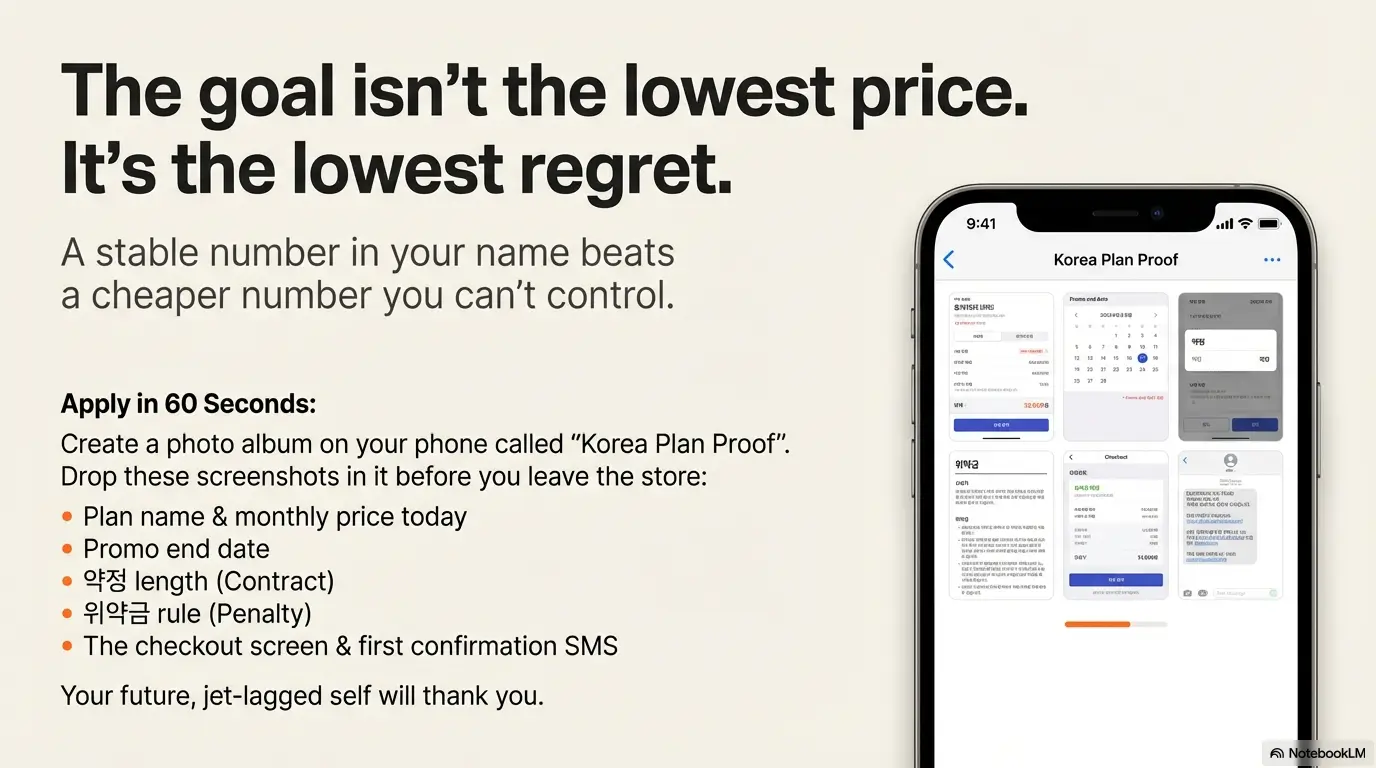
Apply in 60 seconds: Make one album called “Korea Plan Proof” and drop every screenshot there.
Who this is for / not for
Who this is for
- US travelers staying 30+ days who need a Korean number for deliveries, banking, or verification texts
- US students/exchange visitors who want budget data without getting locked in
- New expats setting up life admin (apps, housing, work) who need 명의 clarity first
Who this is not for
- People needing enterprise/corporate lines (different paperwork and policy lanes)
- Anyone who can’t yet meet ID/name-registration requirements and needs a temporary workaround first
- Short trips where a tourist SIM/eSIM is enough and contract penalties aren’t worth the risk
Quick personal note: the first time I tried to “optimize” a plan in a new country, I focused on price like it was a sport. I won the sport. I lost the ability to receive a verification text at the exact moment an app demanded it. Price is important. But identity is the gatekeeper.
Start here: “Do you need a Korean number or just data?”
The two-job test (why this matters)
- Data = maps + messaging + rides
- Korean phone number = identity in Korea (apps, delivery, verification)
If you only need maps and KakaoTalk, “data-only” feels tempting. But the moment you try to do real-life admin, a lot of systems treat a Korean phone number as your quick identity handshake.
That’s why you’ll see people who are happily online… and still locked out of the “adulting apps.” If KakaoTalk is part of your daily oxygen, it’s worth skimming KakaoTalk etiquette for foreigners so your messages (and group chats) don’t become an accidental friction tax.
Micro-check: what your phone must support
- Unlocked phone (carrier-unlocked, not “I think it’s unlocked”)
- eSIM vs physical SIM compatibility
- Optional but helpful: dual SIM (so your US number can still receive critical texts)
Pattern interrupt: Let’s be honest…
Your “cheap plan” is useless if you can’t pass 명의 checks and can’t receive verification texts when the apps start asking.
- Data-only works for short stays and light admin.
- Voice/SMS number is the ticket for verification-heavy life tasks.
- If you’re staying 30+ days, assume you’ll need SMS at least once.
Apply in 60 seconds: Write down the top 3 apps you must use (banking, delivery, campus, work). If any requires SMS verification, you need a Korean number.
Neutral action: Choose your “number vs data” path before visiting a store or checkout page.
알뜰폰 (MVNO) vs Big 3 carriers: the real tradeoff, not the marketing
Think of Korea’s mobile market as a subway system: the Big 3 carriers are the main lines, and 알뜰폰 (MVNOs) are the express shuttles running on the same tracks, often cheaper, sometimes fussier at the gate. For time-poor people, the hidden cost isn’t always money. It’s friction.
What MVNOs usually win on
- Lower monthly rates for similar data buckets
- Flexible plans that don’t assume you want a device installment
- Good fit for “I want service, not a relationship” energy
Where MVNOs can pinch you
- Signup friction (ID/name rules, confirmation steps)
- Customer support may be more limited
- Fewer bundled perks (streaming, points, family bundles)
Curiosity gap: The hidden “activation bottleneck”
Here’s the classic scene: you picked the perfect MVNO plan, you’re ready to pay, and then the signup flow quietly asks for identity linkage that you don’t have yet. This is why people say, “I bought the plan but can’t activate.” The plan isn’t the product. The product is activation plus verification readiness.
Show me the nerdy details
MVNOs typically lease network capacity from major carriers. Your coverage can be comparable, but onboarding processes, customer support channels, and “extras” (bundles, point programs, device promos) can differ. The real operator move is picking the plan whose identity/verification path fits your current documents.
A timely, practical fact for tourists: both KT and SK Telecom publish tourist-focused SIM/eSIM products in English. KT’s tourist eSIM notes it’s designed for foreign tourists and can be used for a limited duration (often framed around short stays), and SK Telecom’s roaming eSIM pages also describe foreign-national eligibility details. Those pages are useful as “ground truth” when you want to see what a provider claims in writing, not what a reseller paraphrases.
약정 (contract terms): the “discount leash” you don’t feel until you move
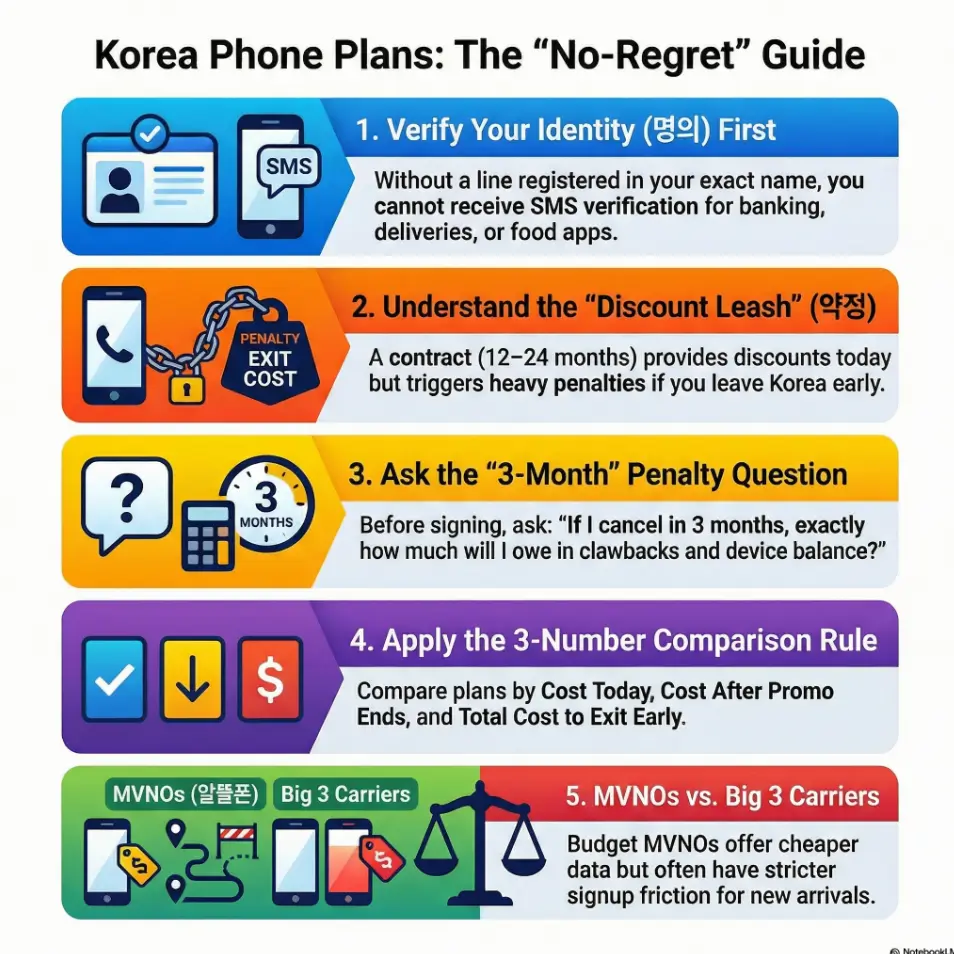
In plain English, 약정 is a time commitment. You promise to stay (often 12 or 24 months). In exchange, you get discounts. In the beginning it feels like winning. Later, if your plans change, it can feel like your phone bill is holding your passport hostage. It’s not personal. It’s math with a calendar.
What “약정” typically means in plain English
- You accept a time commitment (often 12/24 months)
- In exchange, you get discounts (plan discount, device discount, bundle discount)
The discount stack: where people misread the bill
- Plan discount vs device installment discount (two different animals)
- “Promotional” discounts that end quietly (the bill gains weight in month 2 or 3)
- Add-ons that look tiny monthly but compound fast (insurance, content bundles, extra services)
Curiosity gap: Why a cheaper monthly can cost more
Because a “cheap” monthly can be a discounted monthly. If you leave early, that discount can get partially reclaimed through 위약금, plus you may owe remaining device payments. It’s like a plane ticket: the cheap fare is cheap because it has rules.
Money Block: “Discount stack” decoding table
| Item | Where it shows up | Why it matters | What to ask |
|---|---|---|---|
| Plan discount | Monthly plan line item | Early exit can trigger discount clawback | “Is this discount tied to a 약정?” |
| Device installment | Separate device payment line | You may owe remaining balance if leaving | “What’s the remaining device balance if I cancel?” |
| Promo discount | Often a temporary discount line | Bill can jump after promo ends | “When exactly does this promo end?” |
| Add-ons | Small monthly extras | Compounds; often forgotten | “List every add-on currently active.” |
Neutral action: Before paying, repeat back the discount stack in one sentence, out loud, like a flight attendant doing the safety speech.
위약금 (cancellation penalties): how the fee is born
The word 위약금 can sound like “fine” or “punishment.” In practice, it’s often a reversal of discounts plus any remaining device obligations. If you’ve ever returned something on sale and the refund felt smaller than your soul expected, you already understand the emotional arc here.
The three common penalty sources
- Discount clawback (you leave early, they reclaim part of the discount)
- Device installment remaining balance
- Admin/termination fees (varies by provider)
The timeline trap (most common)
- You cancel after a few months and assume you “only owe the rest of the month”
- But the system treats early exit as breaking the discount deal
Pattern interrupt: Here’s what no one tells you…
The penalty is often less about “punishing you” and more about undoing the discount math you already benefited from.
Practical check: Confirm the actual terms and preferences using the questions below. A generic score or budget formula cannot establish a required payment, contract charge or social obligation.
Early cancellation can include different categories of charges. Ask for the actual provider’s dated breakdown instead of treating a sales slogan or rough estimate as the contract.
If you’re leaving because of a housing move, pairing this with a Korean apartment move-in checklist mindset (paperwork first, optimization second) can save your sanity.
명의 (name-registration): the rule that decides whether you can even play
What “명의” is (in one sentence)
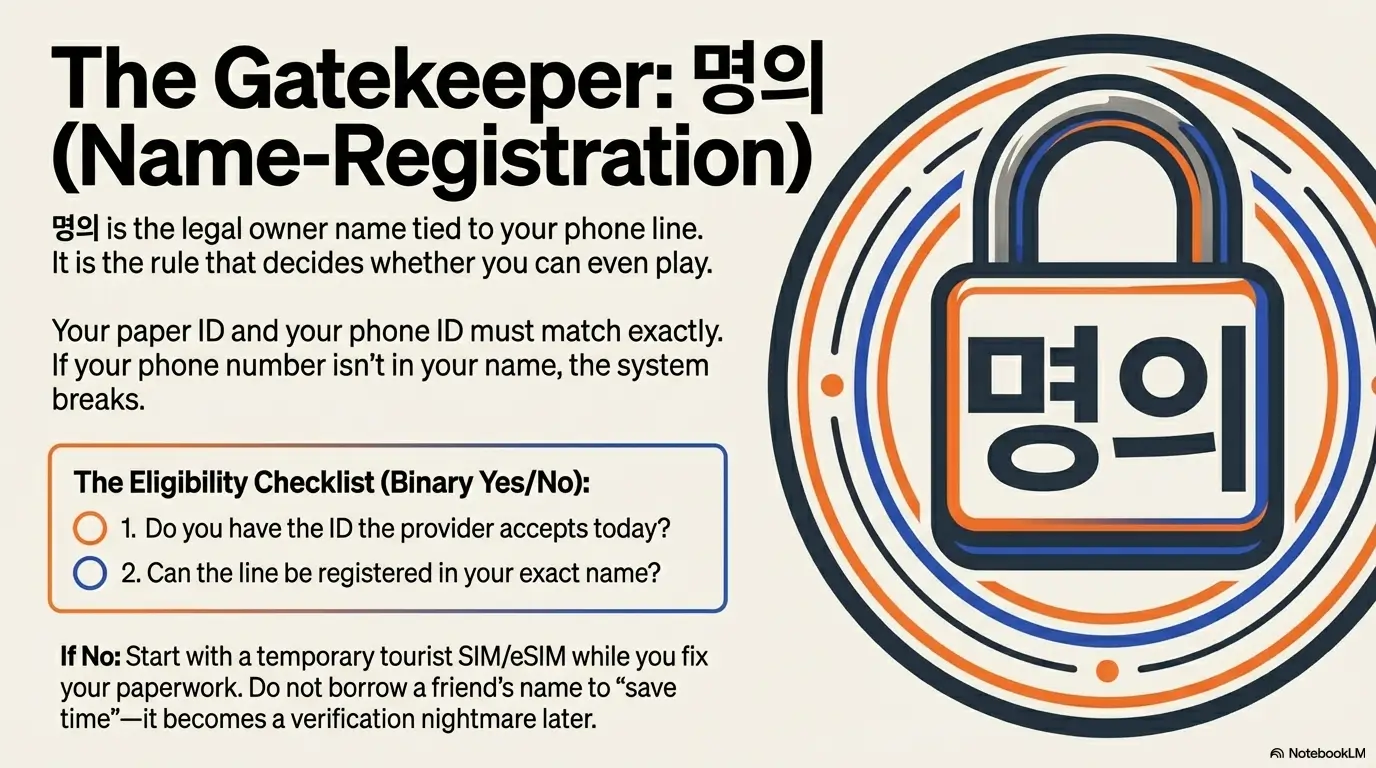
명의 is the legal “owner name” tied to the line, used for identity checks across services.
Why foreigners hit friction
- Eligibility depends on your ID status and what the provider accepts
- Some services expect phone-number identity to match your registered identity data
- Timing matters: your “paperwork stage” and your “phone stage” must align
This is where the story gets quietly serious. Korea’s digital life is wonderfully efficient once you’re inside the system. But getting inside can require the right identity hooks at the right moment.
For example, the Korean government’s Working Holiday info emphasizes that foreign resident registration (residence card/ARC terminology varies by era and translation) is compulsory and is handled through immigration, with timing requirements that matter. If you don’t have that registration yet, many “full service” mobile options can be harder.
(If you’re navigating phone-shop conversations with limited Korean, a small safety rail is having a Korean digital nomads phrasebook open on your phone.)
Curiosity gap: The “my friend can sign up for me” problem
Borrowing someone’s name can feel like a shortcut today and become a verification nightmare later. If your phone number isn’t in your name, you may hit issues with:
- Account recovery (“We sent a code to your number.”)
- App verification flows that compare identity fields
- Changing carriers, upgrading plans, or porting numbers
Show me the nerdy details
Many identity systems treat a phone number as a “possession factor” and use it as a trusted channel for verification codes. If the number ownership and your identity record diverge, you can still be functional day-to-day but fragile during high-stakes moments: password resets, banking verification, or account disputes.
Money Block: Eligibility checklist (binary yes/no)
- Do you have the ID the provider accepts today? Yes / No
- Can the line be registered in your name (명의)? Yes / No
- Do you need voice/SMS (not just data) for verification? Yes / No
- Are you likely to leave Korea before 12 months? Yes / No
- Do you need English support in a billing dispute? Yes / No
Neutral action: If you answered “No” to the first two, start with a tourist SIM/eSIM while you fix identity linkage, then upgrade later.
Choose your setup: 5 common US-to-Korea scenarios
Let’s sort you fast. Not by personality type (though I suspect many of us are “I can survive on instant noodles but not on unclear billing”). By scenario.
Scenario A: Tourist (short stay, minimal admin)
- Prioritize: quick activation, predictable cost, no penalties
- Typical move: tourist SIM/eSIM, avoid long commitments
Scenario B: Student (semester+)
- Prioritize: name-registration readiness, stable number, budget data
- Typical move: start with a simple plan, then optimize after documents settle
Scenario C: New hire expat (needs banking + verification)
- Prioritize: a number that works reliably for identity flows, plan that won’t break during transitions
- Typical move: choose stability first, then chase savings once life admin is working
Scenario D: Digital nomad (uncertain length)
- Prioritize: month-to-month options, exit-friendly terms, transparent penalties
- Typical move: avoid device bundles unless you’re truly staying
Scenario E: Family/partner plan confusion
- Prioritize: whose name should hold each line, how transfers work (if allowed)
- Typical move: keep each adult’s verification-critical number in their own name if possible
I’ve watched more than one couple have a “tiny phone plan discussion” that quietly turned into a “why can’t I log into my account” saga. Phones are small objects with big consequences. Treat them like keys, not like snacks. And when you’re navigating those in-person conversations, knowing the basics of Korean honorifics for tourists can be the difference between “helpful” and “helpful plus patient.”
Illustrative scenario: A resident expects to leave sooner than planned and requests a written cancellation quote, including device balance and discount repayment. The quote informs the decision; a generic months-times-discount formula does not.
Common mistakes (the expensive ones)
Mistake #1: Picking the plan before confirming your ID eligibility
If you can’t clear registration, the “best deal” becomes dead weight. This is the #1 trap because it feels like being proactive. It’s not. It’s being prematurely optimized.
Mistake #2: Confusing “no contract” with “no penalties”
Some plans look flexible but still include discount recovery conditions. The plan can be “no contract” in one sense and still have “you benefited from a discount” math in another. Ask for the penalty rule, not the slogan.
Mistake #3: Registering under someone else’s name to “save time”
This can blow up later when you need number-based verification, account recovery, or provider changes. Shortcuts with identity are rarely shortcuts. They’re loans with interest.
Mistake #4: Not screenshotting the plan terms and promo end date
When the bill changes, memory doesn’t count. Screenshots do. (Also: your memory will be jet-lagged. That’s not a moral failing. It’s biology.)
Mistake #5: Forgetting add-ons and roaming toggles
Small switches can quietly turn your monthly cost into a leaky faucet. If you wouldn’t leave your sink running, don’t leave mystery add-ons running either.
Don’t do this: the “cheap plan” traps that cost the most
Don’t stack discounts you can’t explain back to yourself
If you can’t summarize the discount structure in one breath, it will surprise you. You don’t need to become a telecom accountant. You just need a single sentence you can repeat under stress.
Don’t buy a device bundle unless you’ve priced the exit
Leaving Korea early is common. Device installments don’t care. If you might leave in 6 months, treat “24-month device deal” like adopting a pet while moving apartments. Possible, but consider the future paperwork.
Don’t assume “English support exists” at the moment you need it
Prepare screenshots and a short message template (Korean + English) before you have a billing issue. When you’re already frustrated, you don’t want your brain also translating. If you want a clean “reset tone” for messy situations, having a few Korean apology phrases ready can lower the temperature fast, even if you’re clearly disputing a charge.
- A stable number in your name beats a cheaper number you can’t control.
- Know your exit cost before you accept a discount.
- Save proof as you go, not after the bill jumps.
Apply in 60 seconds: Write one line in Notes: “I will not sign a plan I can’t cancel calmly.”
Price decoding: how to compare plans without getting hypnotized
Build a “true monthly cost” line item
- Base plan
- Device installment (if any)
- Add-ons
- Promo discount end date
- Estimated exit cost if leaving early
Use the 3-number rule
- Cost today
- Cost after promo ends
- Cost to leave early
Quick checklist: what to ask before you pay
- What is the 약정 length (if any)?
- Exactly how is 위약금 calculated?
- What ID is required for 명의 registration?
Accessibility note: This infographic is a text-based decision flow with four steps and “If No” guidance for each decision point.
A small lived-experience tip: when you’re comparing plans on your phone in a store, your brain becomes a sponge for sales pressure and a sieve for fine print. That’s why the “3-number rule” is so calming. It’s a lighthouse. It doesn’t negotiate. It just shines.
When to seek help (so you don’t spiral into billing limbo)
Get provider support immediately if
- Your bill jumps and you can’t identify why
- You can’t receive verification texts for critical services
- You’re told your name/ID “doesn’t match” and you’re being bounced between systems
Consider third-party help if language is a barrier
- In-person assistance via a bilingual friend or relocation support
- University international office (for students)
- Workplace HR onboarding (for employees)
If you’re dealing with identity-related friction, your “support team” matters more than your plan. The best plan in the world is still a brick if you can’t activate it or prove you own it. If a staff member asks personal questions that feel abrupt (address, age, “why Korea?”), it helps to recognize the cultural default of “practical curiosity.” A quick primer on Korean personal questions etiquette can keep you calm while you steer back to what you actually need: written terms.
FAQ
Can US tourists get a Korean phone number without residency?
Often, yes, through tourist-focused SIM/eSIM products, especially for short stays. The details vary by provider and product type (data-only vs voice/SMS). Always read the provider’s official product page and confirm what ID is required at activation.
What does 알뜰폰 (MVNO) mean in Korea, and is it reliable?
알뜰폰 is Korea’s MVNO category: budget providers that typically use major carrier networks. Reliability is usually fine for everyday use, but signup requirements, customer support, and bundled perks can differ. Choose based on your identity/verification needs, not just price.
What is 약정 and how do I know if I’m signing one?
약정 is a time commitment (often 12/24 months) tied to discounts. You’ll know you’re signing one when the plan offers a discount contingent on staying for a set period. Ask for the contract length and penalty rule in writing before checkout.
How is 위약금 calculated if I cancel early?
Commonly it’s a mix of discount clawback and remaining device payments, plus any administrative fees. The exact formula varies. The operator move is to ask: “If I cancel in 3 months, what exactly will I owe?” and save the answer.
Can I switch from a carrier plan to an MVNO later without changing my number?
Number portability can be possible in many telecom markets, but the steps and eligibility vary by provider and your line ownership situation. If keeping your number is essential, confirm portability and any constraints before committing, especially if the line isn’t in your name.
What is 명의 and why do Korean apps care about it?
명의 is the legal ownership name attached to the phone line. Many services use phone numbers for verification and account recovery, so mismatches can create friction. For verification-heavy life admin, keep the line in your own name whenever possible.
Can I register a phone plan under a friend’s or partner’s name?
Sometimes it’s technically possible, but it’s risky. It can complicate verification, account recovery, and provider changes later. If you must do it temporarily, treat it like a temporary bridge, not a forever home, and plan the transition to your own name.
Do I need a Korean bank account to sign up for a phone plan?
Not always. Requirements differ by provider, plan type, and payment method. If you don’t have a Korean bank account yet, ask about payment options and whether the plan can be activated with your current documents.
Is eSIM easier than a physical SIM for foreigners in Korea?
eSIM can be faster because you don’t need to physically swap cards, but “easier” depends on identity verification requirements and device compatibility. Always confirm your phone supports eSIM and whether the product includes voice/SMS if you need verification texts.
What should I screenshot or save as proof when I sign up?
Plan name, monthly price today, promo end date, 약정 length, 위약금 rule, and whose 명의 is on the line. Save the checkout screen and the first confirmation message. Screenshots are your bilingual best friend.
Ask whether the SIM supports the service you need
A data connection and eligibility for a particular identity-verification service are separate questions. Before buying, name the service you need and ask the operator whether that exact plan, registration method and customer status support it. Also ask what changes if you later update your identification or move to another operator. Avoid a broad question such as “Does this work in Korea?” when your real need is receiving a specific verification message or keeping a number.
A reader question: Can I judge a plan from the first month’s price?
Include the price after any promotion, permitted usage, cancellation terms and the services you need. Save the written offer and ask for a dated cancellation estimate when relevant.
Conclusion
Let’s close the loop from the hook: the “key” that opens the door is not always money or even a good plan. It’s identity alignment (명의) plus exit-aware pricing (약정/위약금). If you remember only one thing, make it this: a plan is only “cheap” if it stays cheap when life changes. And life changes a lot when you move countries. (So does communication style. If support feels indirect, that’s often cultural, not hostile; a quick read on Korean indirect communication helps you decode what’s being implied.)
Next step (one concrete action)
Make a one-page “Plan Proof” note on your phone: (1) plan name, (2) monthly price today, (3) promo end date, (4) 약정 length, (5) 위약금 rule, (6) whose 명의 is on the line, plus screenshots of the checkout page and confirmation message. This takes 5 minutes and can save you hours later.
- Prioritize 명의 readiness over the “lowest monthly.”
- Ask for the 위약금 formula before you accept discounts.
- Compare using the 3-number rule: today, after promo, early-exit.
Apply in 60 seconds: Text yourself: “What will I owe if I cancel in 3 months?” and use that as your must-ask question.
Last reviewed: 2026-02.
Practical example and reader question added October 20, 2026. Existing source dates are retained; this addition is not a fresh verification of every earlier claim.