

A Korean parent noting a child’s height in centimeters, saving old test scores, or remembering milestones with forensic precision can look extreme from the outside. But why so many Korean parents track height, grades, and milestones so closely has less to do with cartoonish “Tiger Parenting” than with something colder and more ordinary: risk management inside a system that makes small differences feel expensive.
That is where many Anglo-American readers misread the scene. They see control where parents often feel vigilance. They see vanity where families may be reacting to academic pressure, social comparison, private education markets built around hagwons, and the fear of a child slipping behind quietly rather than dramatically.
Get that reading wrong, and every notebook starts to look like personality instead of context.
This post helps you read Korean parenting culture more accurately, so you can separate love from surveillance, structure from stereotype, and family duty from simple status anxiety. It also gives you a cleaner way to explain why grades, child development milestones, and even height can carry so much symbolic weight in South Korea.
The analysis is grounded in the real machinery behind the behavior: education pressure, comparison culture, OECD and UNICEF context, and the emotional logic families often live inside.
Because the notebook is not really the story.
The pressure around it is.
And once you see that, the whole picture changes.
Fast Answer: Why so many Korean parents track height, grades, and milestones so closely is not just about perfectionism or control. In many cases, it reflects a culture shaped by competition, comparison, family duty, and fear of falling behind. What looks excessive from the outside often feels, to parents inside the system, like vigilance, care, and preparation for a future that seems narrow and unforgiving.
Contents — choose a section
Table of Contents
This is not only parenting, it is risk management
Height, grades, and milestones become signals, not just facts
In many Korean families, these numbers do not live as neutral facts. They behave more like weather alerts. A height percentile may suggest health, but also social treatment. A test score may describe one exam, but also whisper about future schools, future peers, future options. A language milestone may be one developmental marker, yet in a high-comparison environment it can start to feel like an early forecast of who will move smoothly through the system and who may need rescue later.
What looks like “tracking” often feels like protection to parents
I have known parents who did not think of themselves as strict at all. They sounded tired, practical, and almost apologetic. One mother kept a note on her phone with height, sleep, after-school schedules, and mock exam dates. She laughed at herself once and called it “my tiny control tower.” But the laugh had a tremor in it. The point was not obsession for its own sake. The point was to prevent drift. In cultures where the costs of drifting can feel steep, record-keeping starts to feel like care wearing office clothes.
The deeper fear is not failure alone, but being left behind quietly
That last word matters: quietly. Many parents are not terrified of one dramatic collapse. They are afraid of the slow, polite kind of falling behind that arrives with no alarm bell. A child does not bomb school. He simply slips a little lower in rank. A daughter is not unhealthy. She is just a little smaller and begins hearing comments. Nothing looks like an emergency, yet everyone feels the slope. That is why Korean parenting can sometimes look less like coaching and more like continual calibration.
- Parents may read tiny changes as early warning signs
- Monitoring can feel preventive, not punitive
- The emotional engine is often anxiety about drift
Apply in 60 seconds: When you see a parent tracking closely, ask what future risk they think the habit is reducing.
Behind the spreadsheet is a social world
In Korea, comparison often arrives through schools, relatives, and other parents
No child grows in a vacuum, and Korean parenting rarely pretends otherwise. Information moves through apartment elevators, family group chats and parent messaging circles, school networks, 학원 conversations, pediatric waiting rooms, and the casual question that is not casual at all. “How tall is he now?” can sound like concern. It can also sound like ranking in a cardigan. “Which academy does she go to?” may be genuine curiosity. It may also be social reconnaissance with a smile.
Progress is rarely viewed in isolation from the peer group
For many American readers, this is one of the hardest emotional translations. In the United States, parents can certainly compare, but the cultural ideal still praises individuality and private pacing. Korea often operates with a stronger sense of cohort movement. Children are felt in relation to the class, the grade, the neighborhood, the exam pool. That does not mean every parent likes it. It means many parents cannot fully escape it, even when they roll their eyes at it over coffee.
Why ordinary updates can turn into status markers
The social layer changes the emotional chemistry of ordinary data. Once information circulates socially, it stops being just information. It becomes signal. And signal attracts interpretation. This is part of why parents may monitor more than they planned. The act is not always born dramatic. Sometimes it begins with one or two comparisons, a slightly uneasy pediatric comment, a relative who notices everything, and then the family is suddenly living inside a scoreboard they never consciously installed.
- Family: comments often sound caring, but can carry evaluation
- School: class performance creates a shared reference frame
- Parent networks: practical advice and quiet competition often travel together
- Private education: choices become visible, and visibility breeds comparison
Grades first, because school still carries symbolic weight
Academic performance is often read as future stability
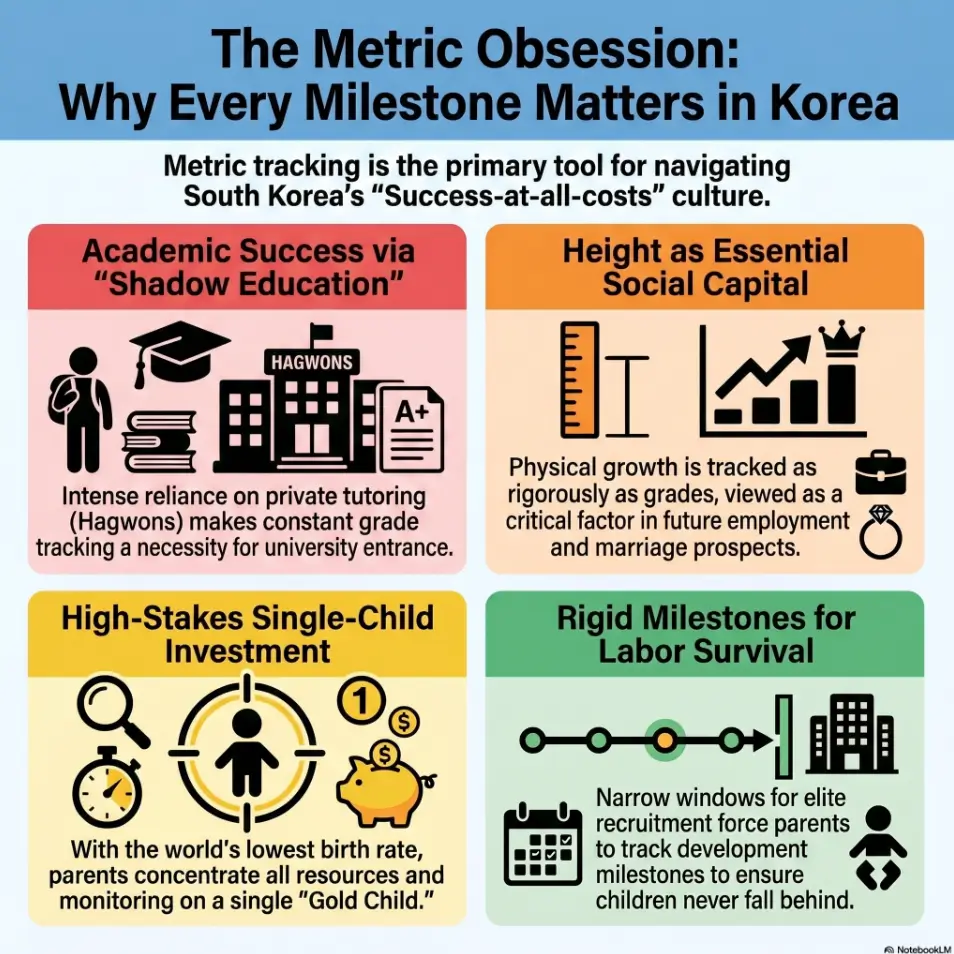
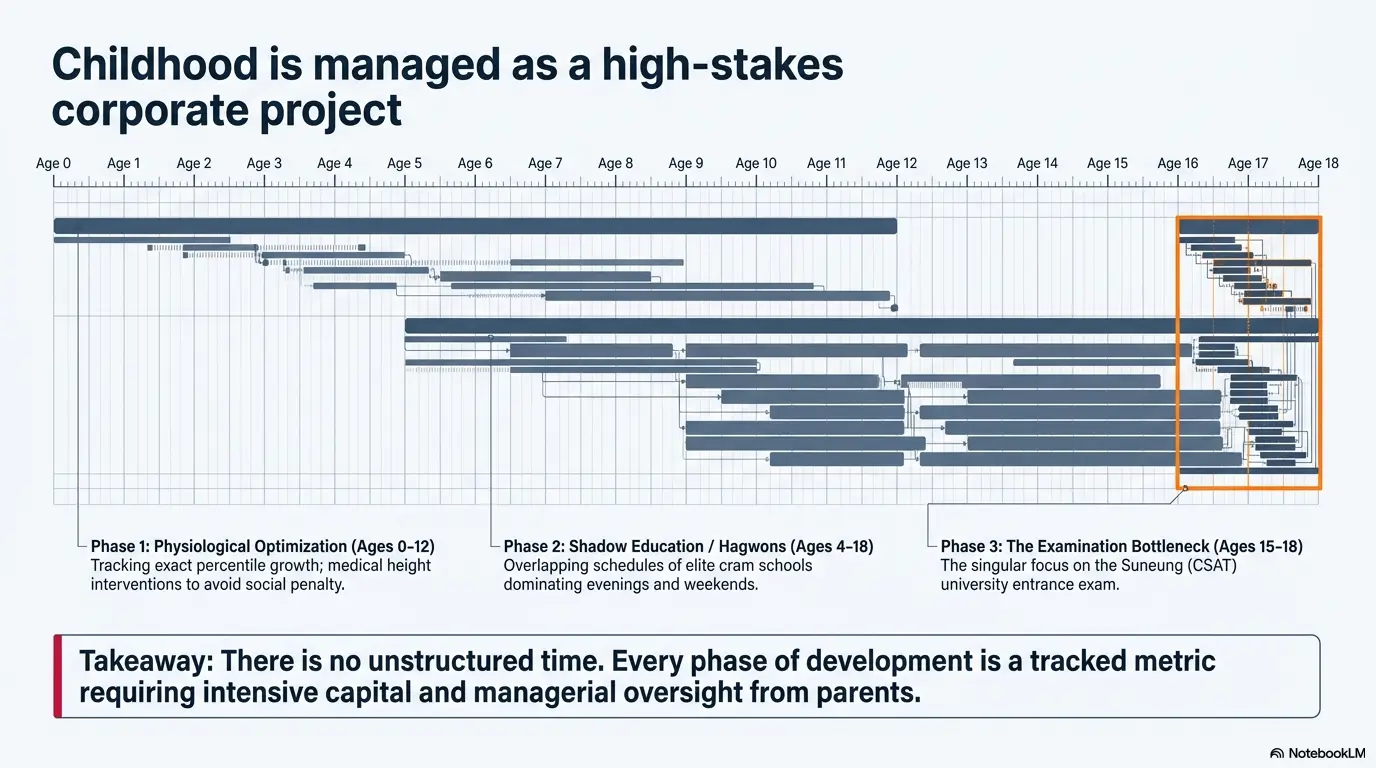
To say that Korean parents care about grades is true, but not yet useful. The better question is why grades feel so charged. In Korea, school performance has long carried symbolic weight far beyond classroom learning. It is often read as a proxy for seriousness, discipline, effort, and future security. The logic may be imperfect. It may also be emotionally rational inside a society where educational credentials have historically mattered a great deal in sorting opportunity.
Test scores can stand in for discipline, effort, and family investment
This is where outsiders sometimes misread the scene. A parent may say, “Her score dropped,” while meaning five other things: Is she tired? Is the academy not working? Are we missing something? Did our routines loosen? Are we, as a family, failing to steer properly? Numbers become crowded with moral meaning. That makes them powerful and dangerous at the same time.
The pressure grows because education is tied to mobility, not just pride
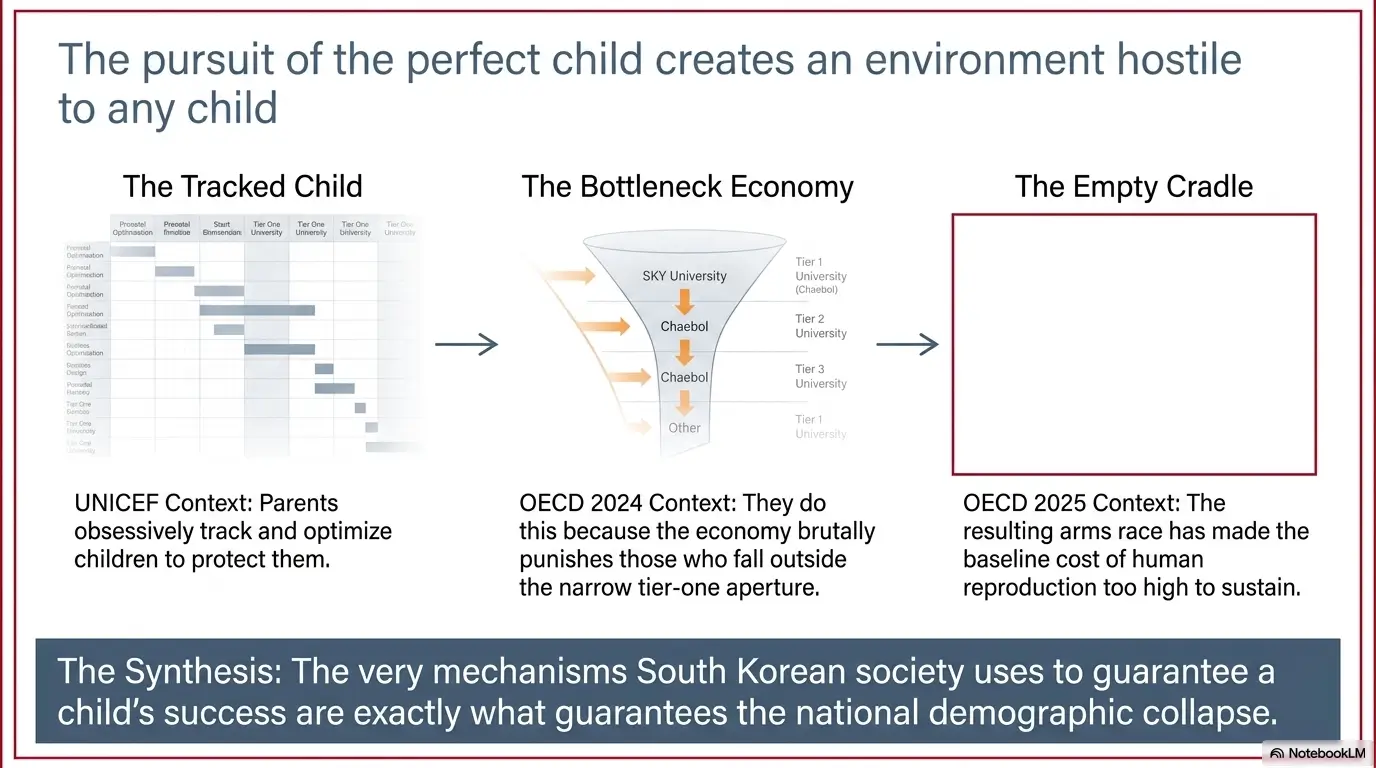
The OECD’s 2024 Economic Survey of Korea notes that private education spending has increased in recent years, is positively correlated with parents’ income, and is positively correlated with academic achievement. The same report explains that policy efforts to limit tutoring did not solve the core issue because competition for elite universities remained intense. In plain English, parents are not imagining the system pressure. They are reacting to it.
That does not make every response healthy. But it does explain why “just relax” lands like advice from another planet. When mobility feels narrow, families start guarding every rung. It is less a simple worship of grades than a belief, sometimes grim and sometimes justified, that grades still buy margin.
Decision card: When grades feel like information versus identity
| When parents read grades as information | When parents read grades as identity |
|---|---|
| They ask what changed in sleep, routine, or teaching fit. | They treat one score as proof of character or future worth. |
| The conversation stays practical and time-bound. | The conversation gets moral, global, and heavy. |
| Next step: adjust the system. | Next step: restore emotional safety before more measurement. |
Neutral action: Notice whether a family is managing data or turning data into destiny.
Height matters for reasons people do not always say out loud
Physical growth can become a proxy for health, care, and competitiveness
Height talk can puzzle foreigners because it seems so oddly specific. Yet height is visible, countable, and socially legible. It can therefore carry far more symbolic cargo than it deserves. Parents may worry about health, nutrition, sleep, and hormones. But they may also worry about teasing, first impressions, sports selection, dating markets later on, and the cruel little social myths that still attach status to size. The body becomes a public report card no one asked for.
Parents may worry about social treatment as much as medical concerns
Constructed illustration, not a reported event: In practice, many parents are not only asking, “Is my child healthy?” They are also asking, “How will the world treat my child if he looks late, small, weak, or behind?” That shift matters. Once social treatment enters the room, measurement becomes harder to dismiss. a fictional narrator once heard a parent say, in essence, that she was less worried about centimeters than comments. That sentence explains a lot. The ruler is often trying to defend against the mouth of society.
Here’s what no one tells you: body anxiety can be social before it is biological
This does not mean height concern is uniquely Korean. Plenty of countries attach emotional nonsense to bodies. Korea is simply one place where that concern can be amplified by dense comparison culture and fast information exchange. Height gets discussed because it is easy to compare, impossible to hide, and loaded with meanings that exceed medicine.
Show me the nerdy details
Developmental tracking becomes more emotionally intense when a trait has three qualities at once: it is visible, easy to measure repeatedly, and socially interpretable. Height checks fit all three. That is why they can spiral into a stronger family ritual than more meaningful but less visible indicators of health.
Milestones become emotional clocks
First words, reading speed, and activity levels can feel like countdown markers
Milestones are supposed to be useful guides. The trouble begins when guides become clocks. In anxious parenting environments, a milestone can stop functioning as a broad developmental range and start functioning as a countdown timer. The child has not simply not done the thing yet. The child is now using up time. That small psychological twist changes everything.
Early achievement is often treated as evidence of later advantage
Part of this comes from a very human bias: people love early clues. Parents everywhere are tempted by the fantasy that the future can be read in small beginnings. Korea did not invent this. But where educational competition is fierce, early signs can feel extra magnetic. A fast reader at seven becomes a promising student at twelve, then perhaps a stronger candidate later. None of that is guaranteed, of course. Still, the emotional logic is easy to understand. Early edges feel precious in systems people experience as crowded.
When “just checking” turns into constant measurement
The danger is repetition without reflection. What starts as reasonable checking can become chronic surveillance. And once a child feels watched all the time, the family atmosphere changes. A home can slowly begin to resemble an airport security line with snacks. Efficient, maybe. Relaxing, absolutely not.
- Ranges are healthier than rigid clocks
- Repeated checking can raise family anxiety
- Children notice tone as much as content
Apply in 60 seconds: Replace “Are we late?” with “What support would help right now?”
Let’s be honest, other parents are part of the story
Parenting culture is shaped by conversation, gossip, and subtle ranking
Modern parenting is rarely private. It is networked. In Korea, that network can be especially dense. Parents swap academy information, developmental worries, school gossip, lunch quality, teacher impressions, and pediatric recommendations. This can be helpful. It can also become a low-grade pressure machine. Nobody may say, “You should monitor more.” Yet after enough conversations, a parent can feel negligent for not knowing exactly where the child stands.
Advice from friends and family can raise the pressure fast
The escalation is often social, not ideological. One aunt asks a question. Another parent mentions a specialist. Someone says their son jumped three centimeters after changing sleep routines. A classmate started advanced math. A cousin reads chapter books already. Suddenly the room fills with tiny alarms. None is decisive. Together they are exhausting.
Why even confident parents can start monitoring more than they planned
Confident parents are not immune. In fact, confidence sometimes cracks the moment a child enters a more comparative phase of schooling. It is easy to be philosophical in the abstract. It is much harder when the peer group becomes visible and the market for parental worry opens at 8 a.m. on Monday.
Eligibility checklist: Is this mainly family care, or has it become comparison-driven monitoring?
- Yes/No: The tracking helps solve a real practical question
- Yes/No: The child knows the notes are for support, not ranking
- Yes/No: The routine would still exist even without other parents’ updates
- Yes/No: Adults can skip a week without panic
Neutral action: If most answers are “No,” the social layer may be driving the habit more than the child’s actual needs.
Confucian echoes still matter, even in modern apartments and apps
Family responsibility remains a strong moral frame
It is tempting to treat everything as economics and stop there. But culture still breathes through habits. Confucian traditions do not mechanically determine modern parenting, yet they leave a durable moral atmosphere: family duty matters, educational seriousness matters, and adults are expected to steward children with intention. Parents may therefore feel that “not paying close attention” is not merely relaxed. It can feel irresponsible.
Children’s progress is often felt as shared family work
This is one of the key differences in emotional framing. In a more individualist setting, a child’s progress may be narrated as the child’s journey, supported by adults. In Korea, progress is often experienced more collectively, as family labor and family reputation intertwined. That can create beautiful devotion. It can also create suffocating over-identification.
Achievement can be interpreted as both personal success and filial reflection
The interesting thing is that modern apartments, educational apps, and polished dashboards did not erase older values. They digitized them. The moral instinct to care, guide, and prepare now arrives with notifications. Ancient family duty meets smartphone analytics. A very twenty-first-century headache.
The OECD’s 2025 report on Korea’s demographic future argues that the country’s extremely low fertility rate, which was 0.72 in 2023, sits alongside rigid labor practices and work-family pressures that make parenting feel difficult and high-stakes. That broader atmosphere helps explain why child-rearing can feel less casual and more intensely managed. Readers who want a broader lens on that climate can also look at how Korea’s low birth rate reshapes everyday social pressure and family expectations.
Do not reduce it to “Tiger Parenting”
The stereotype misses affection, anxiety, and structural pressure
“Tiger Parenting” is one of those labels that arrives quickly and explains very little. It compresses many motives into one dramatic image: stern parent, pressured child, ambition everywhere. The phrase survives because it is vivid. It fails because it is sloppy. Many Korean parents who track closely are affectionate, worried, sacrificial, funny, and deeply tired. Some are indeed harsh. Many are not. A stereotype cannot hold that range.
Many parents are responding to systems they did not design
This matters morally. A parent can reproduce pressure while also being trapped by it. Those two facts can coexist. Families often operate inside systems they did not create: competitive schooling, visible private education markets, expensive housing, status-conscious networks, and labor cultures that leave little room for leisurely experimentation. When the system is narrow, parenting tends to become defensive.
The real story is often burden, not cruelty
That does not absolve adults when children are hurt. It simply asks for accuracy. If your explanation begins and ends with “Korean parents are strict,” you may have described the surface and missed the machinery.
Pull-quote: Close tracking can be loving and stressful at the same time. That contradiction is not a bug in the analysis. It is the analysis.
Common mistakes Americans make when reading this culture
Mistake one: assuming all tracking comes from vanity or ego
This is the laziest reading, and it misses the fear underneath the behavior. Vanity exists everywhere, yes. But many families are not tracking to boast. They are tracking because they feel responsible for preventing disadvantage before it hardens.
Mistake two: missing the role of schools, markets, and social comparison
American readers often over-psychologize what is partly structural. The habits make more sense once you see the mesh of schools, exams, private tutoring markets, and peer comparison. UNICEF’s case study on the Republic of Korea notes that the country’s education system performs highly overall while still showing gaps tied to socio-economic status and reporting widened achievement gaps for vulnerable students. In a setting like that, parents can become more watchful precisely because the system looks strong from afar yet feels uneven up close.
Mistake three: treating Korean families as culturally identical
There is no one Korean parent. Region, class, generation, religion, child temperament, school type, and family history all matter. A Seoul professional couple, a provincial grandparent-led household, and a younger pair deliberately resisting intense tracking may share a passport and almost nothing else in daily parenting style. The same is true of school experience itself, which can carry different symbolic meanings depending on whether a family is navigating school uniform culture and its social signals, after-school expectations, or neighborhood status.
Mini calculator: How fast can comparison creep in?
If a parent hears just 3 comparison-triggering comments a week, that becomes about 12 a month and more than 140 a year.
No single remark needs to be dramatic. Repetition does the work.
Neutral action: Track the number of comparison inputs before judging the parent’s response.
Do not romanticize it either
Close tracking can create stress for children and parents alike
Nuance should not become softness toward harm. A child can feel deeply loved and still feel over-watched. A parent can be sacrificial and still create an atmosphere of chronic evaluation. One does not cancel the other. Households shaped by continuous measurement often produce a low hum of tension. The child learns that being observed is normal. The parent learns that relaxing feels risky. Everybody gets tired.
Measurement can crowd out play, rest, and emotional safety
This is where the hidden cost appears. When every area becomes trackable, everything starts competing for proof. Sleep is no longer just rest. It is a performance input. Reading is no longer pleasure. It is advancement. Play must now justify itself as developmental. Even affection can become instrumental, parceled out around achievement rather than offered as climate.
Here’s where the line starts to blur between care and chronic pressure
Often the line is not drawn by the existence of tracking but by the emotional temperature around it. Is the data used to support the child, or to tighten the air in the room? Is the child allowed to be unfinished? Those questions matter more than the spreadsheet itself.
- Measurement can help when it reduces confusion
- Measurement harms when it raises shame
- Atmosphere often matters more than method
Apply in 60 seconds: Ask whether the child feels guided, watched, or graded at home.
Who this is for, and who it is not for
This is for readers trying to understand Korean family culture with more nuance
If you are a teacher, relative, expat, journalist, researcher, or curious parent, this lens will help you read behavior more accurately. It is especially useful if you have looked at Korean parenting and felt torn between admiration and discomfort. That tension is not confusion. It is a clue that more than one truth is present.
This is for parents, teachers, and expats who want context before judgment
Context does not erase accountability. It improves interpretation. And improved interpretation usually leads to better questions, better reporting, and less cartoonish cross-cultural commentary. In practice, that same habit of reading context before intent also helps when decoding Korean politeness norms, indirect communication in Korean settings, or the way personal questions can feel intrusive yet socially ordinary.
This is not for readers looking for a one-word explanation or a caricature
If you want a neat label, you will be disappointed. Culture is rarely a single motive with good lighting. It is usually a braid: love, fear, economics, status, memory, aspiration, duty, and habit all pulling at once.
Infographic: Why the tracking gets so intense
1. Competition
Grades and early signals are read as future margin.
2. Comparison
Peers, relatives, and schools make progress visible.
3. Family duty
Attention can feel like moral responsibility.
4. Fear of drift
Parents fear quiet slippage more than dramatic failure.
What children may feel when everything is tracked
Some children experience tracking as support and structure
Not all children hate structure. Some genuinely find it containing. They like knowing what matters, where they stand, and what the next step is. In calm families, careful tracking can create reassurance. It says, “The adults are awake. Someone is steering.”
Others experience it as surveillance, fragility, or conditional approval
But children are exquisite readers of tone. If every note seems worried, disappointed, or hungry for comparison, the same practice lands differently. Then the message is not “We are supporting you.” It becomes “You are always being evaluated.” That can produce fragility, fear of mistakes, and a sense that love is warmest when performance is tidy.
The same practice can land differently depending on tone, family climate, and child temperament
The OECD’s 2024 paper on parental emotional support found that greater parental emotional support is associated with higher PISA test scores and better subjective well-being outcomes. That is a useful reminder that children do not respond to structure in the abstract. They respond to structure as it is emotionally delivered.
Illustrative Scenario:
A father kept a wall calendar for his daughter’s study plan, sleep hours, and piano practice. To visiting friends, it looked severe. Colored pens. Tiny boxes. A military air. But one evening the daughter told him she liked the calendar on weekdays and hated it on Sundays.
Weekdays, she said, it helped her know the day had shape. Sundays, it made the house feel like school in disguise. That distinction was small and brilliant. The problem was not the chart itself. It was the absence of a place where nothing had to be measured. The father changed one thing. Sundays became blank on purpose. The calendar stayed. The pressure softened. Same father, same child, same apartment wall. Different emotional climate. Sometimes culture explains the habit, but family wisdom appears in the edits.
FAQ
Why do Korean parents care so much about height?
Because height can be read as more than health. It may signal care, social treatment, confidence, and future competitiveness, even when those assumptions are unfair or exaggerated.
Are Korean parents more competitive than American parents?
Some are, some are not. The more accurate point is that Korean parents often parent inside a denser comparison environment, especially around education, peer status, and private tutoring.
Is this mainly about college admissions?
No. College admissions are part of the story, but the habit usually begins earlier and includes health worries, milestone anxiety, and social comparison in everyday family life.
Do all Korean families track children this closely?
Not at all. Families differ by class, region, generation, school expectations, and personal values. Some track heavily. Some resist it. Many live somewhere in the middle.
How much of this is cultural versus economic?
It is both. Cultural ideas about family responsibility matter, and so do structural pressures such as educational competition, inequality, and fear about future mobility.
Is this changing among younger Korean parents?
Yes, in some households. Younger parents often question older pressure patterns more openly, but they still live inside the same schools, markets, and social comparisons, so the old habits do not vanish overnight.
How do Korean children usually react to this pressure?
There is no single reaction. Some children feel supported. Others feel watched or burdened. Much depends on tone, flexibility, and whether the family leaves room for rest and imperfection.
Why do relatives and other parents seem to matter so much?
Because parenting is socially observed. Advice, comparison, and judgment travel through family and school networks, which can intensify the urge to monitor children closely.
Keep health, schoolwork and personal worth on separate pages
If you keep records, label a health concern, a learning task and a family observation separately. A constructed note might say “Reading: needs help with this passage” rather than “behind everyone.” For a physical-development concern, record the question and discuss it with the child’s clinician instead of comparing classmates or starting a treatment based on a social ranking. Let the child help identify what support would be useful and which information should remain private.
| Focus | What to check |
|---|---|
| Purpose | What decision will this record help you make? |
| Context | Separate health, learning and family observations. |
| Privacy | Limit sharing and include the child’s perspective. |
A reader question: How can tracking stay useful rather than becoming constant comparison?
Choose a purpose for each record and a sensible review point. Keep achievements and difficulties in context, and avoid turning a measurement into a judgment about future potential.
Next step: read behavior as context, not character
Before judging a parent’s tracking habits, ask what fear or system sits underneath them
The notebook, the height chart, the academy spreadsheet, the saved exam scores, the worried questions about milestones: all of these can look sharp from the outside. Sometimes they are sharp. Sometimes they are the household’s attempt to survive a competitive social order without admitting how frightened it feels.
Look for the mix of love, anxiety, comparison, and social structure
The curiosity loop from the beginning closes here. The reason so many Korean parents track children so closely is not one thing. It is a cluster: love trying to protect, anxiety trying to predict, comparison trying to rank, and structure quietly narrowing what feels safe. Remove any one strand and the picture gets blurrier. Hold them together and the behavior becomes legible.
Use that lens to write or think more accurately about Korean parenting culture
If you need a practical next step within the next 15 minutes, try this: rewrite your first explanation of Korean parenting without the words “strict,” “obsessed,” or “Tiger Parenting.” Force yourself to name the system, the fear, and the social context instead. Your writing will get truer. Your judgment will get humbler. And the parents you are trying to understand will start to look less like caricatures and more like human beings carrying too much. That same discipline also improves how we write about adjacent topics such as Korean first-birthday traditions like doljanchi, teacher gift culture in Korea, or the broader symbolic weight families place on children’s public milestones.
Last reviewed: 2026-04
Practical example and reader question added October 20, 2026. Existing source dates are retained; this addition is not a fresh verification of every earlier claim.