
Beyond the Headline: Reading Korea’s Demographic Shift
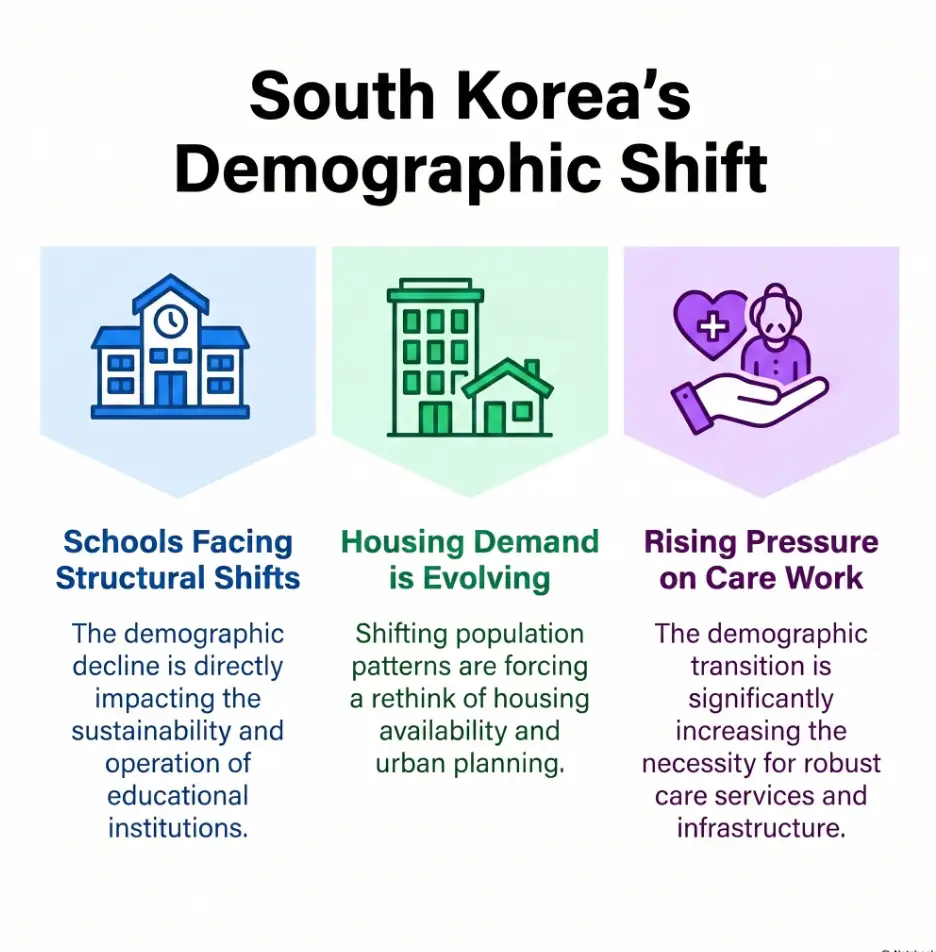
Korea’s ultra-low birth rate is easy to misread when you meet it only as a headline number. The real story shows up somewhere quieter: in a school with one less class, in a city where housing still feels punishingly tight, and in the lives of those whose calendars have quietly turned into a second shift of care.
Once you notice the school clock, the housing clock, and the care clock ticking at different speeds, the whole country starts to look different and much more legible.
Table of Contents
- Schools show the change early
- Housing reveals contradictions, not simple relief
- Care work exposes who absorbs the strain
Apply in 60 seconds: As you read, ask one question in each section: who gains flexibility here, and who loses it?
Start Here: Why This Is Not Just a “Birth Rate Story”
The real shift is institutional, not only personal
It is tempting to narrate low fertility as a private choice story. People marry later. People delay children. People hesitate. All of that matters. But the larger transformation is institutional. A society built around bigger cohorts starts operating differently when those cohorts shrink. Classrooms, teacher assignments, apartment demand, pension pressure, neighborhood retail, hospital staffing, transit design, and elder services all feel the tremor. Statistics Korea reported 238,300 live births in 2024, with the total fertility rate edging up to 0.75 after 0.72 in 2023. That small rebound matters, but it does not erase the depth of the shift already underway. (kostat.go.kr)
Why fewer children changes daily routines before it changes headlines
Daily life usually changes quietly first. One classroom is merged. One daycare decides not to expand. One parent notices there are fewer strollers but still no cheaper housing near work. One office worker starts spending more weekends helping aging parents because siblings are fewer, farther away, or equally exhausted. That is how demographic change behaves in real life. It does not always arrive like thunder. Often it arrives like a room getting slightly colder each month.
What US readers often miss when they imagine demographic decline from far away
From a distance, readers sometimes assume a neat equation: fewer births equals fewer people later, which should mean less demand, less crowding, less pressure. Korea refuses that neatness. Urban concentration, delayed marriage, small household formation, and the concentration of jobs in the Seoul capital region all scramble the simple story. The OECD has emphasized that Korea’s low fertility is tied not only to family preference, but to housing costs, work culture, gendered career penalties, and private education burdens. That is why the everyday consequences appear uneven, braided, and often frustratingly contradictory. (oecd.org)
Short Story: A few years ago, I visited a neighborhood that still had the architecture of family abundance. Playgrounds. Hagwon signs. Apartment blocks with names that sounded like promises. Yet the emotional weather had changed. An older shopkeeper told me the mornings felt different, quieter, less packed with school-hour urgency. Not empty, exactly. Just thinned out.
Two streets over, however, a real estate office was still talking as if demand had never learned the word “decline.” That contrast stayed with me. Demography, in lived experience, rarely behaves like one clean arrow. It feels more like three clocks ticking at different speeds: the school clock, the housing clock, and the care clock. Korea’s ultra-low birth rate becomes legible when you stop asking for one national mood and start noticing those clocks disagreeing in public.
In Schools First: Empty Seats Change More Than Enrollment Charts
Smaller cohorts can mean fewer classmates, merged classes, and vanishing programs
Schools are often the first institution where demographic decline becomes visible to non-specialists. An empty seat is not merely an empty seat. It can affect staffing, subject offerings, club viability, transportation routes, and the social life of children. A school can still be open and yet operate with a sense of contraction. In many places, this shows up as mixed-grade arrangements, fewer elective options, or a thinning extracurricular menu. A choir can disappear before a building does.
When “better student-teacher ratios” is only half the truth
On paper, smaller cohorts can sound beneficial. Fewer students per teacher might suggest more attention, calmer classrooms, and better learning conditions. Sometimes that is true. But this optimistic reading leaves out scale. A school with too few students may lose budget flexibility, struggle to maintain specialized programs, or become vulnerable to consolidation. Better ratios are not automatically better institutions. A school needs critical mass, not only compassion.
Here’s what no one tells you about school decline: a school can stay open and still feel diminished
There is a subtle sorrow in institutional thinning. Parents notice it quickly. A building may be open, the bell may still ring, the staff may do heroic work, yet the school can feel less complete than it once did. Fewer peers can mean fewer friendship options, weaker age-cohort energy, and less resilience when one teacher leaves or one program is cut. In that sense, a school can survive administratively while shrinking socially. For readers trying to understand the social codes wrapped around Korean classrooms, Korean school uniform culture offers a useful companion lens because institutions often keep their visible rituals even while the student body underneath them quietly thins.
- Programs can weaken before schools shut
- Ratios can improve while choice narrows
- Parents read subtle decline as a future risk signal
Apply in 60 seconds: When evaluating a school, ask not only “Is it open?” but also “What has quietly disappeared in the last five years?”
Show me the nerdy details
Enrollment decline changes the economics of staffing and programming. Fixed costs do not shrink as neatly as student counts do. That is why “fewer students” does not map cleanly onto “better-resourced student experience.”
Rural Warning Lights: What Happens When a Town Starts Losing Its Children
Why school closures often signal deeper neighborhood thinning
In rural areas, school vulnerability can act like a warning light on a dashboard. Once a local school is threatened, the issue is rarely educational alone. It suggests a broader thinning of households, reduced local services, aging residents, and a shrinking future customer base for small businesses. The OECD has noted that Korea’s shrinking and aging pattern is especially uneven, with the Seoul capital region still attracting younger residents while many other regions age faster and lose population momentum. (oecd.org)
How parents read closure risk as a signal about whether to stay or leave
Parents do not interpret school decline in isolation. They treat it as a forecast. If the local school looks fragile, a family may wonder what comes next: fewer services, longer commutes, reduced peer networks, weaker housing demand, and less confidence in the town’s future. That fear can accelerate the very decline everyone worries about. In other words, closure risk is not just an outcome. It can become a cause.
The quiet feedback loop between education access, mobility, and local decline
One of the harshest demographic feedback loops is simple enough to fit on a napkin. Fewer children weaken schools. Weaker schools push some families to move. Those moves reduce the child population further. Once that loop tightens, rural communities can start feeling like they are negotiating with gravity. And gravity, unlike politicians, does not attend public hearings.
- Yes/No: Are grade cohorts visibly smaller than five years ago?
- Yes/No: Are merger or closure rumors now normal conversation?
- Yes/No: Are parents traveling farther for school or services?
- Yes/No: Are local businesses quietly adjusting to older customers?
Neutral next step: If you checked three or more, analyze the school, housing, and care systems together instead of separately.
For readers in the United States, there is a familiar echo here. When a school weakens, a community often feels it in property confidence, parent mobility, and civic morale. Korea’s case is distinctive in degree and speed, but the underlying mechanism is not exotic. It is painfully legible.
In Cities Too: Low Birth Rates Do Not Mean Housing Pressure Simply Disappears
Why fewer births can coexist with expensive urban housing
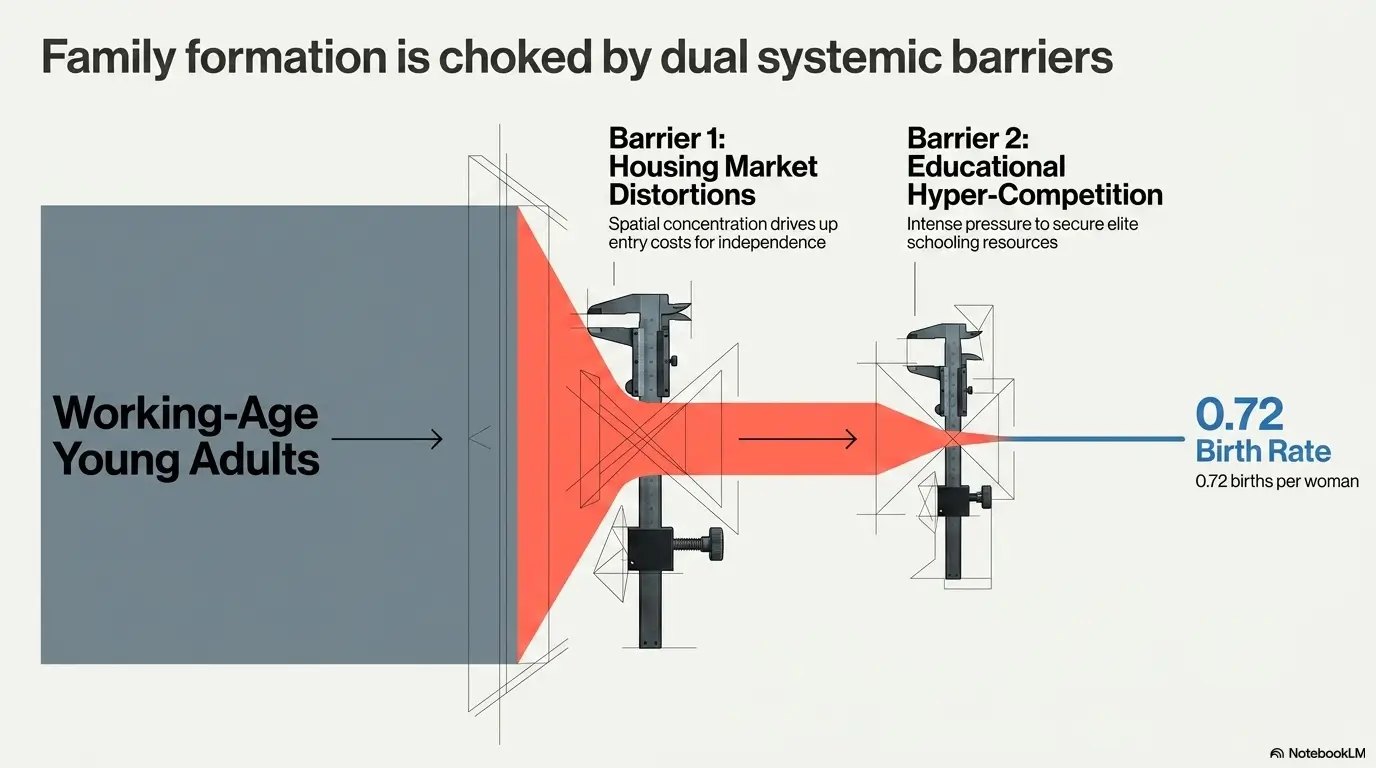
This is one of the most important contradictions in the whole story. Falling births do not automatically melt urban housing pressure. Cities can remain expensive because housing demand is shaped by more than childbirth. Job concentration, education prestige, transport convenience, speculative behavior, delayed marriage, and the rise of one-person households all matter. In Korea, one-person households reached 7.829 million in 2023, accounting for 35.5% of all households, according to Statistics Korea. That means household formation can remain strong even when family size falls. (kostat.go.kr)
Smaller households, delayed marriage, and one-person living patterns that keep demand alive
Housing markets respond to households, not babies alone. Two adults living separately create more housing demand than the same two adults living together, and a society with more solo living can keep pressure high even as births fall. This is why the phrase “fewer people should mean cheaper homes” sounds sensible in conversation but often stumbles in practice. Population structure matters as much as population size. For foreign residents trying to read these housing pressures at street level, a Korean apartment move-in checklist can make the lived logic of the market feel less abstract.
Let’s be honest: “fewer people” and “cheaper homes” are not automatic twins
I have seen this assumption stroll into conversations with the confidence of a person who has never met a metro area. In large cities, scarcity does not retire just because the nursery count falls. When jobs, universities, social mobility, and medical access cluster in one place, housing can stay costly even during demographic slowdown. Korea’s low birth rate therefore does not erase urban competition. It changes who is competing, what unit sizes matter, and how long the queue stays emotionally exhausting.
When A: If you think births alone drive housing, you will expect quick price relief.
When B: If you track household size, job concentration, and solo living, you will expect uneven pressure.
Time/cost trade-off: A simple population reading is faster. A household-structure reading is slower, but closer to reality.
Neutral next step: Compare birth trends with one-person household growth before drawing housing conclusions.
Apartment Choices Shift: Family Housing, School District Logic, and Aging Buildings
How demand changes when fewer households are built around multiple children
When family size changes, the ideal apartment map changes with it. Not every household wants the classic larger family unit near a prized elementary school. Some still do, of course, especially in education-competitive settings. But a lower-fertility society also produces demand for smaller units, flexible layouts, better transit access, convenience for elderly parents, and housing that works for solo or dual-income adults without children. The market does not disappear. It mutates.
Why school-zone prestige may evolve rather than vanish
School-district logic can weaken in some areas and remain potent in others. Elite education ecosystems do not simply evaporate because the national fertility rate is low. In fact, when fewer children are born into a highly competitive system, some families double down on quality, location, and educational signaling. Prestige can become more selective rather than less powerful. The effect is a narrowing, not a collapse. That same competitive logic is part of why Korean hagwons for foreign families still matter so much in urban family decision-making.
What happens to older neighborhoods built for a different family map
Older neighborhoods designed around a more standard family script can feel slightly out of tune with present needs. Buildings age. Elevators matter more. Walkability for older residents matters more. Access to clinics, pharmacies, and daily services matters more. The neighborhood of the future is not necessarily the neighborhood with the most playgrounds. Sometimes it is the one with the shortest distance between a bus stop, a supermarket, and a geriatric clinic. That is not dramatic. It is only the architecture of reality.
One reason this matters for readers outside Korea is that the change is not purely economic. It is emotional. Neighborhoods store old assumptions in concrete. They remember the family shape they were built for. When households change, the mismatch becomes visible in very ordinary ways: parking ratios, bench placement, elevator retrofits, clinic density, and the kinds of shops that survive street level rent.
Care Work Expands: Fewer Children Does Not Mean Less Family Labor
Why elder care pressure rises as the age structure tilts upward
Low fertility is often discussed as if the main issue were “not enough children.” But on the ground, one of the most immediate consequences is a heavier elder-care load. Korea’s population is aging rapidly, and the OECD has warned that its old-age dependency ratio is set to rise faster than in any other OECD country. That means more support pressure on workers, families, and care systems. The calendar fills up with appointments, errands, medication management, and the low-grade fatigue of always being on call. (oecd.org)
The daughter, daughter-in-law, and middle-aged worker squeeze that policy charts can hide
Demographic discussions often become bloodless at exactly the point where life becomes hardest. The spreadsheet says “aging.” A person says, “I have not had a Saturday to myself in six months.” That is the translation problem. Much of the care burden lands on women in midlife who are balancing employment, older parents or in-laws, and sometimes children at the same time. This squeeze is not a metaphor. It is a scheduling crisis with a human face.
How care shortages reshape time, employment, and emotional bandwidth
Care pressure does not only cost money. It eats flexibility. Workers turn down travel. Adult children reduce hours. Emotional bandwidth frays. What looks like a labor market issue from one angle is a care infrastructure issue from another. The birth-rate debate often misses this because babies are visually louder than eldercare. Strollers photograph better than medication charts. Public attention is not always morally fair.
- Elder care becomes a labor issue
- Family size changes the number of available caregivers
- Time scarcity becomes the hidden demographic tax
Apply in 60 seconds: When you hear “aging society,” mentally translate it into appointments, transport, paperwork, and fewer free weekends.
Show me the nerdy details
Dependency ratios are crude tools for lived experience, but useful. They do not tell you who performs the care. They do tell you the direction of structural pressure. That pressure then passes through households, labor markets, and local services in uneven ways.
Women Pay Twice: The Birth Rate Story Often Sits on Top of a Labor Story
Why unpaid care, career interruption, and long-work-hours culture belong in the same frame
When Korea’s fertility rate is discussed as a “family values” problem alone, the analysis goes crooked. The OECD has repeatedly pointed to the large employment and wage gaps between men and women, along with the difficulty of combining careers and motherhood, as major factors behind very low fertility. In plain English, many women are asked to absorb a punishing bargain: do more unpaid care, accept larger career penalties, and somehow remain cheerful about the national demographic project. That is not policy. That is outsourced sacrifice. (oecd.org)
The hidden tax of expecting families to solve structural problems privately
One family can improvise around a broken system for a while. Millions cannot. If housing is costly, work hours are long, private education pressure is intense, childcare still feels precarious, and eldercare hangs over the horizon, then exhorting people to have more children starts sounding like a speech delivered from dry land to people already waist-deep in water.
When “have more children” messaging collides with everyday work reality
This collision between public messaging and daily life is one reason the issue carries such emotional charge. A country may want more births, but people live inside timetables, rents, promotion ladders, school expectations, and care obligations. Fertility is not just about desire. It is about whether ordinary life feels survivable enough to add one more dependent human to it. Readers who want to understand how workplace pressure is felt socially, not just economically, may also find annual leave culture in Korea helpful, because time scarcity is one of the quiet engines beneath family hesitation.
- Average housing burden in the area being discussed
- Typical work-hour expectations for parents
- Childcare reliability, not just nominal availability
- Private education expectations by class and region
- Career interruption penalties, especially for women
Neutral next step: Compare structural conditions before reaching for cultural blame.
Do Not Flatten It: Korea Is Not One Neighborhood, One Family Model, or One Outcome
Why Seoul, smaller cities, and rural counties can feel like different demographic planets
Korea is compact on a map, but demographically it can feel like several countries stitched together. Seoul and the capital region concentrate jobs, educational ambition, and housing pressure. Smaller cities have different balances of affordability and opportunity. Rural counties can face sharper aging and school vulnerability. An argument that fits one geography can misfire badly in another. The OECD’s regional work on Korea underscores that national population decline coexists with continued concentration in the Seoul capital region. (oecd.org)
How class, housing security, and job stability change the lived experience
Demographic strain is not democratically distributed. Secure households can buffer it better. They can buy flexibility, purchase care, move neighborhoods, or maintain two generations more smoothly. Households with weak job security or thin savings face the same structural pressures with fewer cushions. This matters because national averages can make a society sound uniformly strained or uniformly resilient when, in fact, it is doing both depending on who is being counted.
The mistake of treating all young adults as making the same choices for the same reasons
Some young adults delay marriage because housing costs are brutal. Some because work culture is punishing. Some because care expectations look unfair. Some because their ideals changed. Some because all of those reasons live in the same cramped apartment together. A serious article has to preserve that plurality. Once the analysis turns everyone into a single motive, it stops being analysis and becomes a lecture with nicer formatting.
| Tier | What changes | What to watch |
|---|---|---|
| Tier 1 | Large metro concentration | Housing pressure, solo-living demand |
| Tier 2 | Mixed city adjustment | School resilience, aging stock |
| Tier 3 | Faster thinning regions | Closures, care access, out-migration |
Neutral next step: Place any news item into a regional tier before generalizing about all of Korea.
Common Mistakes: The Fastest Ways to Misread Korea’s Ultra-Low Birth Rate
Mistake one: reducing everything to “young people just do not want kids”
This explanation feels tidy and often travels well online. It is also too shallow. Preferences matter, yes, but preferences are shaped by cost, work, fairness, expectation, and the felt viability of ordinary life. When the environment is exhausting, hesitation is not a mystery. It is a method of self-defense.
Mistake two: assuming population decline solves housing stress by itself
We have already touched this nerve, but it deserves repeating because it is the most stubborn misconception. Household structure, regional concentration, and the distribution of opportunity mean that a lower birth rate can coexist with painfully expensive urban life. There is no demographic magic wand hidden under the lease agreement. In practice, issues like jeonse deposit protection and housing insecurity can matter more to lived decision-making than a distant population chart ever will.
Mistake three: discussing schools and care work as separate worlds when they are braided together
Families do not live in policy silos. The same household may be managing a child’s education, a parent’s medical appointments, and the impossible geometry of work schedules at once. School policy, housing conditions, and care infrastructure interact in the same week and often in the same exhausted person. Any article that slices them apart too cleanly may be readable, but it will not be honest.
Who This Is For, and Who It Is Not For
This is for readers who want lived-experience analysis, not just fertility statistics
If you are looking for a single dramatic number and a simple moral, this will feel slower than you hoped. Good. This topic deserves slowness. It rewards readers who want to understand how social systems bend before they break.
This is for educators, housing observers, caregivers, and culture readers who need practical context
Educators can use this frame to interpret school change beyond enrollment tables. Housing watchers can avoid the trap of assuming demographic decline automatically means price relief. Caregivers and labor observers can see why family strain belongs in the same frame as fertility headlines. Policy-curious expats can read Korea not as a curiosity cabinet, but as a working society under pressure. Readers tracking how group norms are taught and maintained in institutions may also appreciate South Korean school lunch culture, where everyday routines reveal more than official slogans do.
This is not for readers looking for partisan point-scoring or a one-cause explanation
This issue is too large, too intimate, and too entangled for cheap certainty. The moment someone claims one cause explains everything, hold onto your wallet and your patience.
Watch the Everyday Signals: Where the Demographic Shift Shows Up in Ordinary Life
Enrollment notices, daycare waiting patterns, and school-merger rumors
If you want to track demographic change without staring at national charts all day, watch the institutions closest to family routine. School-merger rumors, class-size shifts, preschool recruitment pressure, and transportation changes often tell a clearer story than grand speeches do.
Apartment size demand, solo-living growth, and neighborhood age imbalance
In housing, notice which unit types move fastest, where one-person households cluster, and which neighborhoods begin to tilt older without becoming cheaper in the ways outsiders expect. Statistics Korea’s one-person household data is especially useful here because it shows why “smaller population” can still mean “stubborn demand.” (kostat.go.kr)
Caregiver fatigue, elder-service strain, and the quiet redistribution of family labor
In care work, listen for phrases like “I am the one who handles everything now” or “we cannot find coverage.” Those are not anecdotal footnotes. They are demographic indicators wearing ordinary clothes. Even adjacent pieces of daily infrastructure, including why Korean clinics are so fast, become part of the story once you realize how much family care depends on speed, access, and repeat visits.
- Watch routines, not just rates
- Track who absorbs the new labor
- Notice where contradiction persists
Apply in 60 seconds: Pick one lens, school, housing, or care, and list three local signals you could observe without needing a national dataset.
FAQ
Whether ultra-low birth rates automatically mean schools become better funded per child
No. A smaller student population can improve ratios in some cases, but schools also need enough scale to sustain programs, staffing flexibility, and community confidence. Lower enrollment can produce both intimacy and fragility at the same time.
Why housing can stay expensive even when births fall
Because housing demand responds to household formation, job concentration, location prestige, and one-person living patterns, not just births. Korea’s large and growing share of one-person households helps explain why lower fertility does not simply dissolve city housing pressure. (kostat.go.kr)
Whether Korea’s aging population increases pressure on care workers and families
Yes. As the age structure shifts upward, elder care needs rise and the burden often lands on families, especially women in midlife, alongside formal care systems. The OECD has warned that Korea’s old-age dependency ratio is projected to rise especially fast. (oecd.org)
Why school closures matter beyond education alone
Because they often signal broader community thinning. Families may read school weakness as a forecast of declining services, weaker neighborhood vitality, and lower confidence in staying put.
Whether this trend affects Seoul and rural areas in the same way
No. Seoul and the capital region can still experience concentration, housing stress, and competitive schooling, while many smaller cities and rural areas face sharper aging, thinning cohorts, and school vulnerability. (oecd.org)
How women’s labor conditions connect to birth-rate outcomes
When work culture is long-hours, career penalties after childbirth remain high, and unpaid care expectations stay unequal, having children becomes harder to combine with employment. That is one reason labor structure belongs inside any serious fertility discussion. (oecd.org)
Whether government incentives alone can reverse everyday demographic strain
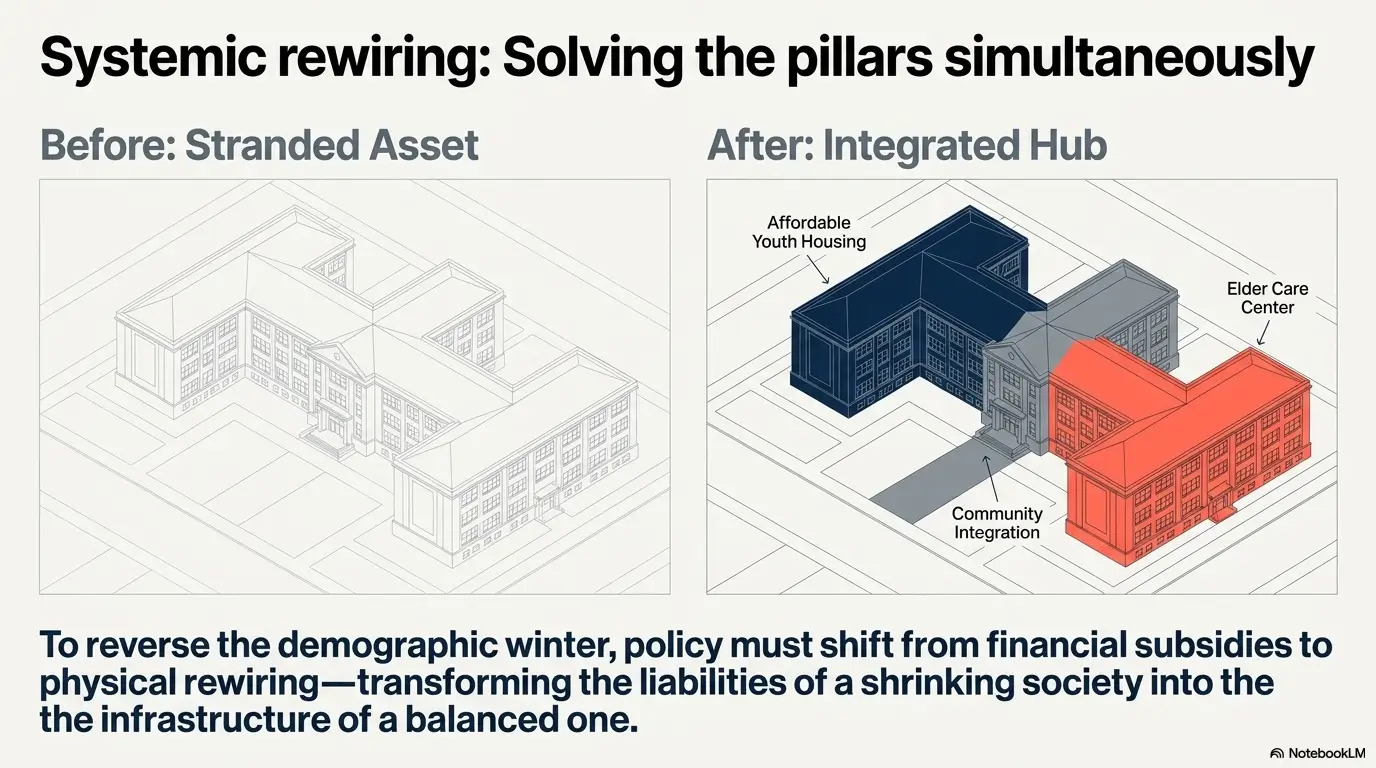
Probably not by themselves. Cash and benefits can help, but if housing, work hours, gender inequality, and care infrastructure remain misaligned, the deeper strain persists. Mechanisms matter more than slogans.
What US readers can learn from Korea without copying the story too neatly
They can learn to watch institutions, not just headline statistics. Korea shows how quickly education, housing, and care systems begin to reflect demographic pressure. But every country has different labor rules, family norms, housing markets, and regional patterns, so comparison should be careful, not theatrical. For a broader frame on how these small social codes accumulate, Korean culture is a useful parallel read.
Next Step: Read Korea’s Birth Rate Through One Institution at a Time
Pick one lens, such as schools, housing, or care work, and trace the chain reaction outward
If you try to hold the whole demographic story in your head at once, it can turn into fog. Start smaller. Choose one institution and follow the chain reaction. Schools lead you to migration and family confidence. Housing leads you to household structure and regional concentration. Care work leads you to aging, labor, and gendered burden. One door opens into the next.
Use everyday consequences, not just fertility numbers, as your organizing principle
The hook at the top of this article was simple: demographic change becomes real when institutions begin behaving differently. We can close that loop honestly now. Korea’s ultra-low birth rate matters not because the number is shocking, though it is. It matters because the number has already started rearranging classrooms, apartment choices, and family labor in the present tense. That is why this topic feels so charged. People are not debating a distant future. They are negotiating a changed week.
Build the article around lived systems so readers feel the structure, not just the statistic
Within the next 15 minutes, do one practical thing: pick one Korean institution you follow, a school district, a housing market segment, or an elder-care service, and list the everyday signals that would reveal demographic strain before any politician names it. That tiny exercise will make future headlines far more intelligible. If your lens is communication rather than policy, even articles on Korean group chat culture can help you notice how institutional stress eventually shows up in ordinary coordination, obligation, and response time.
Last reviewed: 2026-04.