
How Bus Arrival Apps Changed Daily Commuting in Korea
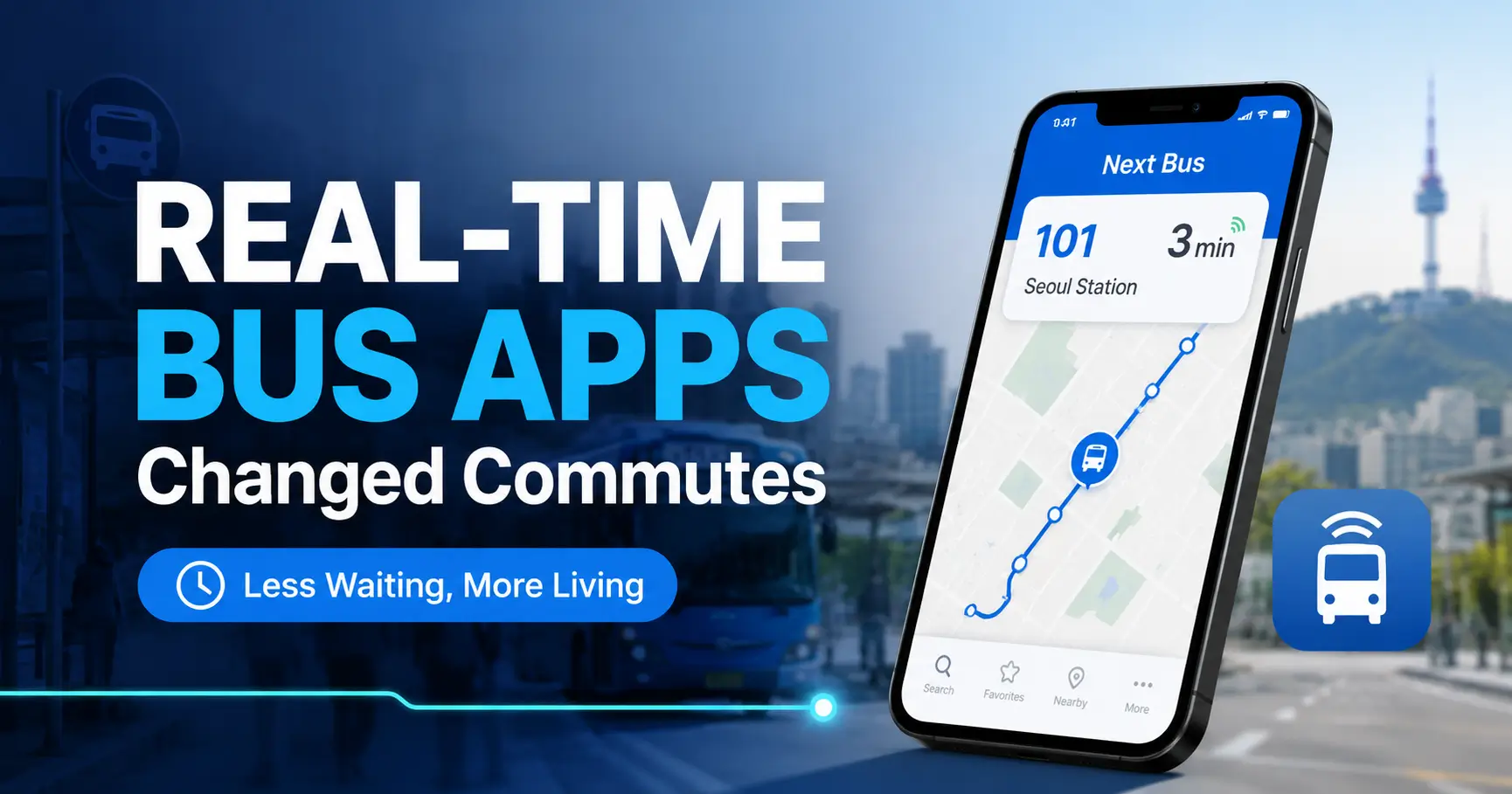
One small commute panic used to live at every Korean bus stop: the empty road, the cold wind, the silent question of whether the bus had already slipped past like a guilty cat. This is not just a story about better screens. It is a story about time becoming visible.
For Korea-curious travelers, expats, urban planning readers, and transit-tech observers, the real shift is easy to miss. Real-time bus information did not simply help people save a few minutes. It changed how riders leave apartments, choose cafés, handle transfers, trust public space, and recover tiny pieces of the morning.
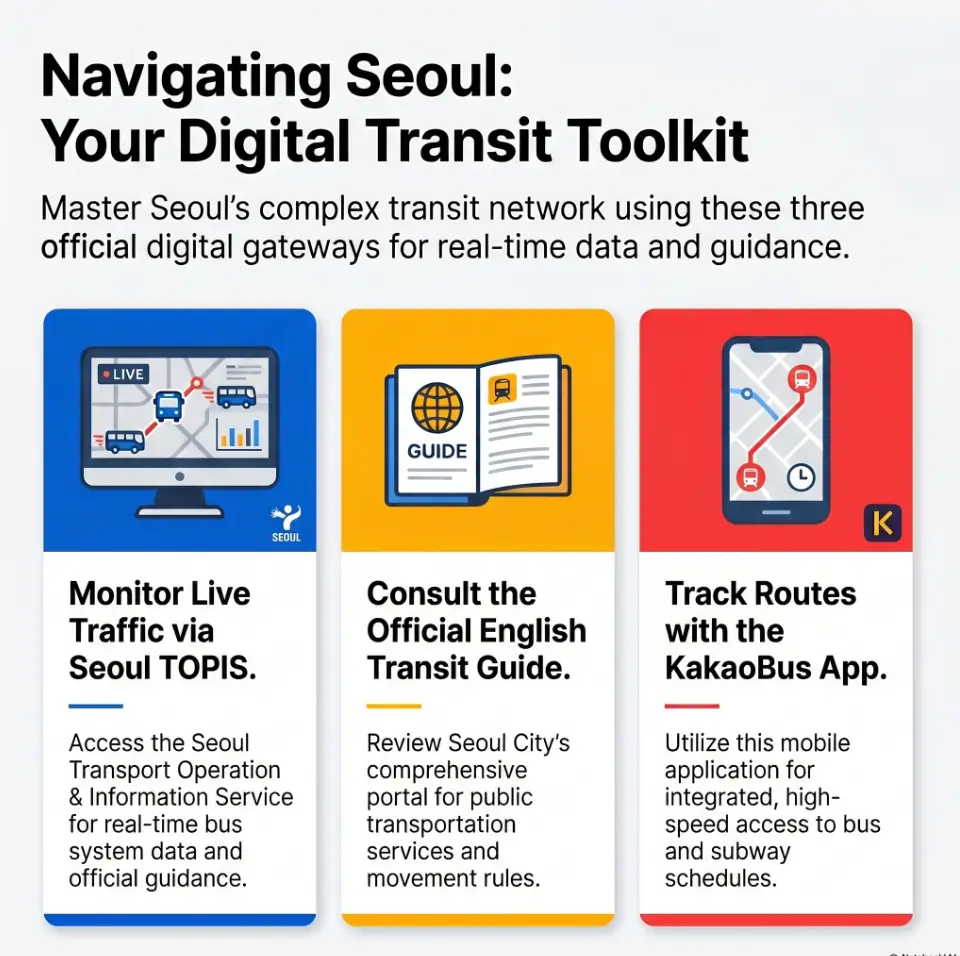
Bus arrival apps in Korea use real-time transit data, GPS-based bus location information, route planning, and stop-level arrival estimates to help riders decide whether to wait, walk, transfer, or change plans. Services such as Naver Map, Kakao Map, KakaoBus, Seoul TOPIS, and bus stop displays turned waiting from a guessing game into a practical decision.
That matters.
- • The bus stop became less of a gamble.
- • The commute became less brittle.
- • And a four-minute wait finally felt like four minutes, not a small fog bank in the middle of the day.
Quick Answer: The Screen Changed the Stop
Bus arrival apps changed daily commuting in Korea by turning uncertain waiting into real-time planning. Riders can check live bus locations, estimated arrivals, route alternatives, transfer options, and sometimes extra crowd or seat clues. The result is not only convenience. It is a calmer, more flexible way to move through dense Korean cities.
- For commuters: fewer blind waits and better departure timing.
- For visitors: less fear around transfers and unfamiliar stops.
- For cities: stronger trust in buses as everyday infrastructure.
Table of Contents
The Old Bus Stop Problem: Waiting Without Knowing
The commute used to begin with a question mark
Before real-time bus apps became a daily reflex, taking the bus often began with an act of faith. You walked to the stop. You looked down the road. You checked the printed route sign. Then you performed the ancient commuter ritual: pretending to be calm while your neck became a rotating traffic camera.
Printed timetables helped, but they were never the whole story. A bus timetable is a promise made under ideal conditions. Korean city traffic, like city traffic anywhere, has its own mood swings. A school zone, a delivery truck, a rainstorm, a crowded stop, or one long red light could bend the schedule.
So riders relied on memory. The bus usually came around 8:12. The red bus was often late near the bridge. The green bus came in pairs, naturally, because buses enjoy theatrical entrances. Local knowledge mattered. Newcomers had to earn it stop by stop.
Why uncertainty made short trips feel longer
Unknown waiting stretches time. Five minutes with information feels manageable. Five minutes without information grows whiskers and starts pacing.
That uncertainty changed behavior. People left home too early. They avoided useful transfers because the second bus felt risky. Some grabbed taxis for trips that public transit could have handled. Others arrived at school, work, clinics, and appointments with a nervous buffer large enough to host a small picnic.
That is why bus arrival apps mattered. They did not remove traffic. They removed the fog around traffic.
- Uncertain wait time makes short trips feel longer.
- People build larger buffers when they cannot see the system.
- Real-time information reduces the mental tax of commuting.
Apply in 60 seconds: When analyzing any transit system, separate actual wait time from unknown wait time.
The tiny stress no one measured
No one usually calls this a crisis. It is not dramatic. It is not the stuff of grand speeches or marble monuments. It is the small daily scratch of not knowing.
That scratch repeats. Monday morning. Wednesday rain. Friday evening with grocery bags. The bus stop becomes a place where time leaks out of the pocket.
This is why Korean bus arrival apps feel socially important. They gave ordinary riders a tiny but durable form of control. In a country where daily routines can be dense, fast, and carefully timed, that control matters more than a tourist first realizes.
It also fits a broader Korean urban rhythm. Many visitors notice how tightly daily life is coordinated: convenience stores beside stations, cafés built around short pauses, office lunches that move with surprising speed, and group chats that keep plans alive in real time. If you want more cultural background on that fast, coordinated rhythm, the guide to Korean convenience stores as everyday infrastructure offers a useful companion lens.
Real-Time Arrival Data Turned Waiting Into Planning
From “when is it coming?” to “what should I do now?”
The most important change was a question swap. Riders stopped asking only, “When is the bus coming?” They started asking, “What should I do with this information?”
That shift sounds small. It is not.
If the bus is arriving in one minute, you walk faster. If it is arriving in nine, you wait indoors. If the next bus is crowded or delayed, you try another stop. If two routes can work, you choose the one with less friction. The commuter becomes a tiny dispatcher, conductor, and weather prophet, all from one glowing rectangle.
The bus stop no longer owns the rider’s body. The rider can remain in an apartment lobby, office elevator bank, convenience store, school hallway, or café until the timing makes sense.
Korea’s bus systems made the app feel reliable
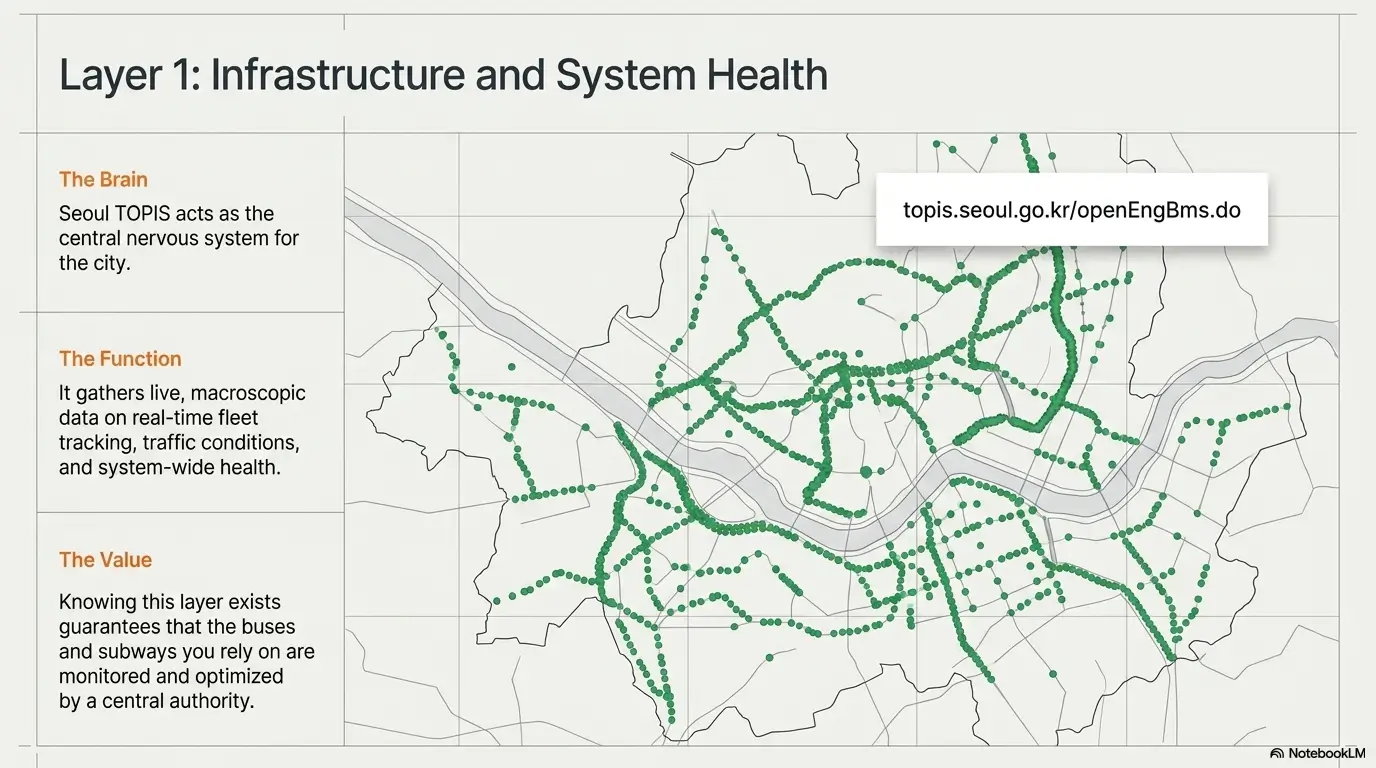
Real-time arrival apps only work when the city data behind them is useful. Seoul’s transport information system, TOPIS, describes its bus systems as collecting, processing, and analyzing bus location information in real time. That kind of backend matters because the rider’s trust is built one accurate arrival estimate at a time.
Seoul also explains that buses can be tracked through bus stop terminals, TOPIS, mobile apps, and map apps such as Naver Map and Kakao Map. In practice, that means the information is not hidden inside one specialist tool. It appears where people already make route decisions.
That is the quiet genius. The data meets the rider in the moment of need.
Here’s what no one tells you…
The killer feature was never only the number on the screen. The magic was emotional permission.
Permission to stop staring down the road.
Permission to buy coffee without turning the purchase into a strategic military operation.
Permission to wait under a roof instead of pretending drizzle builds character.
Permission to trust that the city is not ignoring you.
Show me the nerdy details
Real-time bus arrival estimates usually depend on a chain of signals: vehicle location, route ID, stop sequence, recent speed, traffic conditions, dispatch intervals, and prediction logic. The rider sees “3 minutes,” but the system is making a rolling estimate from moving data. That estimate can improve when buses report location frequently and stops, routes, and traffic conditions are mapped cleanly. It can also wobble when GPS signals lag, buses bunch together, detours occur, or boarding takes longer than expected.
Money Block: Real-Time Decision Card
| App says… | Best move | Why it works |
|---|---|---|
| 1–2 minutes | Go directly to the stop | Boarding delay risk is low, but missing it hurts. |
| 5–8 minutes | Wait indoors nearby | You save comfort without losing control. |
| 10+ minutes | Compare route alternatives | A subway, transfer, or nearby stop may beat waiting. |
Neutral action: Check one alternate route before committing to a long wait.
The App Did Not Save Minutes. It Saved Mornings.
The 4-minute bus became a different kind of 4 minutes
There are two kinds of four minutes.
The first is blind. You stand at the stop, wondering whether the bus has already passed. You look at the road. You look at your phone. You look at the road again, as if eye contact might summon public transportation.
The second is informed. The app says the bus is four minutes away. You know it. You can relax your shoulders. You can zip your coat. You can answer one message. The time is still four minutes, but the emotional weight is different.
That is why bus arrival apps changed mornings. They made small waits legible.
Micro-decisions became normal
Korean commuters often check the bus before leaving home. Not at the stop. Before shoes. Before elevator. Before the final sip of instant coffee.
That habit creates a chain of micro-decisions:
- Leave now or wait three minutes upstairs.
- Walk to the main road or use the closer stop.
- Take the bus to the subway or walk straight to the station.
- Delay departure until the crowd thins.
- Use the convenience store as a waiting room with snacks, which is one of civilization’s better inventions.
Visitors who understand this rhythm also understand why Korea’s transit experience can feel unusually smooth. It is not only the infrastructure. It is the information behavior layered on top of the infrastructure.
The coffee test
The simplest symbol is coffee.
A commuter opens KakaoBus or Naver Map and sees that the bus is eight minutes away. Eight minutes is just enough time to step into a café, order an iced Americano, and return with dignity still mostly attached. Three minutes means no coffee. Twelve minutes means coffee and maybe a bun. Twenty minutes means something is wrong, or the city is inviting you into a second breakfast.
This sounds cute until you multiply it by millions of trips. Real-time arrival data helps riders spend the margins of the day more intelligently.
Short Story: The Coffee That Waited
Mina used to leave her apartment at 7:42 every morning because her mother had once said the 146 bus “usually” came around 7:50. Usually became a law. Rain or not, she stood at the same stop with her tote bag slipping from one shoulder, watching the road with a face that said she trusted no vehicle.
Then she started checking the bus before leaving the elevator. One Thursday, the app showed nine minutes. She stopped at the café below her building, ordered coffee, and arrived at the stop just as the bus turned the corner. Nothing miraculous happened. She was not suddenly more productive, richer, or spiritually upgraded. But her morning had a hinge now. She could open it and close it. The lesson is plain: good transit information does not need to transform a life. It only needs to return one ordinary moment to its owner.
- Informed waiting feels lighter than blind waiting.
- Small routines become easier to coordinate.
- Commuters gain control over the edges of the day.
Apply in 60 seconds: Notice whether your next transit wait is stressful because it is long or because it is uncertain.
Naver, Kakao, and Local Transit Data Changed the Map Habit
Korea’s commute apps became everyday infrastructure
In many US cities, a transit app can feel like a special-purpose tool. You open it when you are confused, traveling, or forced to take a route you do not know. In Korea, map and bus apps are more woven into ordinary routine.
Naver Map, Kakao Map, and KakaoBus are not just tourist aids. They help residents plan routes, compare bus and subway combinations, save favorite stops, check arrival times, and search nearby places. They sit beside KakaoTalk, mobile payment tools, delivery apps, and weather apps in the daily phone ecosystem.
That matters for cultural readers. Korea’s commuting habits are not only built from rails, roads, and buses. They are built from repeated screen checks that have become socially normal.
This overlaps with other parts of digital life. If you are trying to understand why Korea feels so coordinated to outsiders, start with transportation, then look at KakaoTalk etiquette and everyday messaging norms. The same habit appears in different clothing: check, coordinate, adjust, arrive.
Why Google Maps is not the main character here
For many Anglo-American visitors, Google Maps is the default mental map. In Korea, that default can mislead. Local services such as Naver Map and Kakao Map have historically mattered more for detailed navigation, public transit routing, and location search.
South Korea’s mapping rules and national security concerns have long affected how global map services operate there. Even when Google Maps improves, visitors should still expect local Korean apps to be central to daily navigation. The practical rule is simple: do not arrive in Seoul with only one map habit and a heroic amount of optimism. Optimism is lovely. It is not a bus route.
One screen, many choices
A single commuting screen can answer several questions at once:
- Which bus route gets me there fastest?
- How many minutes until the next bus?
- Which stop should I use?
- Which direction is correct?
- Should I transfer to the subway?
- Can I walk part of the route instead?
- Is there a better stop around the corner?
For visitors, this reduces the feeling of being stranded between two alphabets, four lanes of traffic, and one very judgmental countdown clock.
Money Block: Visitor App Setup Checklist
- Yes/No: Do you have at least one local Korean map app installed?
- Yes/No: Have you searched your hotel or apartment in that app before leaving Wi-Fi?
- Yes/No: Did you save your closest bus stop and subway station?
- Yes/No: Can you recognize the stop direction, not just the route number?
- Yes/No: Do you have mobile data or a backup offline address note?
Neutral action: Save your lodging, nearest subway station, and nearest bus stop before your first full day in Korea.
If you are preparing for a longer trip, pair app setup with practical arrival planning. A broader 14-day South Korea itinerary can help you see when buses, subways, taxis, and walking each make the most sense.
Seat and Crowd Clues Changed the Emotional Math
Not all buses feel equal
A bus is not just a bus. Anyone who has carried groceries, a laptop, a sleepy child, a suitcase, or the emotional remains of a long workday knows this.
The same route can feel different depending on crowding, time of day, weather, and whether the ride is short or long. A standing ride for three stops is fine. A standing ride across town with a backpack pressed into your ribs is a small sociology experiment.
That is why extra information matters. Some apps or route displays may show nearby buses, route details, or additional arrival context. In some cases, riders may see clues related to crowding or available seats, depending on route, vehicle type, region, or service.
The “should I wait for the next one?” decision
Real-time data helps riders make a choice that once depended mostly on instinct: board this bus or wait for the next one.
Older riders may prefer a less crowded bus. Parents with strollers may need a calmer boarding moment. Students with heavy bags may choose a different route. Office workers may avoid a packed bus if the next one is only four minutes behind.
These are not luxury decisions. They are dignity decisions.
Money Block: Wait or Board Calculator
Neutral action: Use this only for low-stakes trips; for appointments, build in a real buffer.
Don’t treat the number like a promise
Arrival information is useful. It is not a prophecy wrapped in pixels.
Traffic can change. GPS can lag. Buses can bunch. Boarding can take longer when a stop is busy. Roadwork, protests, snow, rain, and late-night dispatch patterns can bend the estimate.
The wise commuter trusts the app enough to plan, but not so much that they leave zero margin. In Korea, that margin can be small. It should not be imaginary.
- Use crowd and seat clues when available.
- Keep extra time for medical visits, airports, exams, and work meetings.
- Check whether the next bus is close before skipping a crowded one.
Apply in 60 seconds: For your next important trip, add one backup route before leaving.
Transfers Became Less Scary, Especially for Visitors
The app became a quiet translator
Transfers are where transit anxiety grows teeth. A single bus ride is easy enough. Bus plus subway plus walking across an unfamiliar intersection is where visitors begin bargaining with fate.
For tourists, exchange students, military families, remote workers, and business travelers, Korean bus arrival apps act like quiet translators. They do not translate only language. They translate uncertainty into steps.
Go to this stop. Board this route. Get off after this many stops. Walk this direction. Transfer here. The instructions turn a strange city into a sequence.
That is especially useful in neighborhoods where subway stations are not directly beside the destination. Korea’s subway network is powerful, but buses often do the delicate last-mile stitching.
Bus plus subway became a single commute system
For everyday riders, the distinction between “bus trip” and “subway trip” is often less important than the full door-to-door route. A useful app combines walking, bus arrivals, subway transfers, stop names, station exits, and travel time.
KakaoBus describes real-time bus and subway information. Seoul’s public transportation guidance also points riders toward bus stop terminals, TOPIS, mobile apps, and map apps. The experience becomes layered: official infrastructure, city data, private apps, and rider habits all working together.
Let’s be honest…
For many US visitors, the hardest part is not the bus itself. It is trusting the tiny moving icon more than your own nervous instinct.
The app says walk east. Your body says, “Are we sure east is not a trap?” The app says the bus arrives in three minutes. Your eyes see no bus and begin writing a farewell letter to confidence.
This is normal. The cure is repetition. After two or three successful trips, the screen becomes less mysterious. The city begins to unfold.
If you lose something during that unfolding, Korea’s transport systems can still surprise you with their organization. The guide to Korea subway lost and found is worth reading before you need it, especially if your phone, wallet, or bag has a flair for drama.
Infographic: From Guessing to Choreography
Check the next bus while still indoors.
Choose the stop, direction, and route with live arrival context.
Compare bus, subway, and walking options if timing changes.
Save the stop for the return trip and reduce the next search.
Who This Is For and Not For
This is for readers studying modern Korean daily life
This topic is useful for several kinds of readers.
- Travelers who want to move through Seoul, Busan, Incheon, Daegu, Gwangju, or smaller cities with less stress.
- Expats and exchange students who need to build repeatable routines.
- Urbanists and transit planners studying how information changes public transport behavior.
- Korean culture readers trying to understand the texture of daily life beyond food, fashion, and dramas.
- Productivity-minded commuters who love tiny systems that save attention.
The story sits at the intersection of technology, city design, and habit. It is not glamorous in the usual tourist-brochure way. No palace roof. No neon street food steam. Just a person looking at a phone and leaving home at the right minute. But that is where modern life often reveals itself.
This is for US readers comparing transit cultures
US readers may find the Korean experience especially interesting because many American communities still organize daily life around cars, parking, and schedule buffers. In that context, a bus arrival app can seem like a convenience feature.
In dense Korean cities, it feels closer to a daily operating system.
The contrast is not “Korea perfect, US terrible.” That is too easy, and too boring. The better comparison is this: what happens when buses are frequent enough, data is available enough, and riders check information often enough that public transit becomes a flexible default?
The answer is not utopia. It is something more practical: more confidence in everyday movement.
This is not a technical API tutorial
This article is not about building a bus tracking system, scraping transit feeds, or engineering prediction models. It is about the rider-side change: behavior, trust, time anxiety, and cultural rhythm.
If you are a developer, the human lesson still matters. Data is only valuable when it lands at the moment someone needs to decide. If the user interface makes people squint, guess, or decode symbols under rain, the backend may be brilliant while the rider still feels abandoned.
Money Block: Reader Fit Checklist
- Yes/No: Are you planning a Korea trip and deciding which apps to install?
- Yes/No: Are you comparing Korea’s transit culture with US commuting habits?
- Yes/No: Are you studying smart city systems from the rider’s point of view?
- Yes/No: Are you writing about Korean daily life beyond tourist landmarks?
Neutral action: If you answered yes to two or more, study one real bus trip instead of only listing app features.
Common Mistakes: Don’t Read Bus Apps Like Crystal Balls
Mistake 1: Leaving with zero buffer
Real-time does not mean friction-free. A bus can be close and still get delayed by a traffic light, wheelchair boarding, heavy rain, or a knot of passengers at a busy stop.
For casual trips, tight timing is usually fine. For airport buses, job interviews, hospital visits, school exams, visa appointments, and train connections, keep a buffer. A heroic sprint across a station concourse builds character, yes, but mostly the sweaty kind.
For airport planning, it also helps to understand the bigger travel system. The South Korea airports overview can help readers match bus, subway, rail, and taxi choices to their flight day.
Mistake 2: Ignoring the stop direction
This is the classic visitor error: correct bus number, wrong side of the road.
Korean bus routes can be dense, and many stops have similar names. The app may show the right route, but you still need to confirm direction. Look at the destination, map arrow, stop sequence, and nearby landmarks. The bus number alone is not enough.
A route number is a label. Direction is the plot.
Mistake 3: Trusting only one app in unfamiliar areas
In familiar neighborhoods, one app may be enough. In unfamiliar areas, especially late at night or outside major metro cores, cross-checking can help.
Try comparing Naver Map, Kakao Map, KakaoBus, or official city transit information when the trip matters. If two tools disagree sharply, pause before walking to a lonely stop under a suspiciously cinematic streetlight.
Mistake 4: Forgetting rural and late-night limits
Korea’s major cities can make buses feel impressively trackable. Smaller towns, rural routes, and late-night service can feel different. Frequency may drop. Route choices may narrow. Estimates may be less forgiving because missing one bus costs more time.
This is where real-time information helps most, but also where you should avoid overconfidence.
- Confirm stop direction before boarding.
- Keep larger buffers for high-stakes trips.
- Cross-check routes when traveling late or outside major centers.
Apply in 60 seconds: Before boarding, confirm the next three stops match your intended direction.
The Bigger Cultural Shift: Commuting Became More Elastic
People stopped building the whole morning around uncertainty
When riders can see arrival times, the morning becomes less rigid. People do not need to leave absurdly early “just in case” for every ordinary trip. They can adjust departure by a few minutes, choose a different stop, or change route combinations on the fly.
This elasticity fits Korean urban life, where dense neighborhoods support quick errands, short waits, and many small transitions. A person can leave an apartment, pass a convenience store, check a bus, buy breakfast, and still make a transfer with surprising precision.
It is not magic. It is infrastructure plus habit.
Public space became more usable
Real-time arrival information also changes how people use the spaces around bus stops. Instead of standing frozen at a pole, riders can wait in cafés, lobbies, stores, campuses, clinics, or office entrances.
That matters in winter wind and summer humidity. It matters for older riders and parents. It matters for anyone who has ever held an umbrella, phone, coffee, and tote bag while realizing humans should have been issued more hands.
Korea’s café culture makes this especially visible. A short wait can happen beside a window, not under a cloud. For visitors who want to avoid awkward café behavior while doing this, Seoul cafe etiquette offers a helpful cultural side note.
The bus stop became a data point
The old bus stop was a pole, a sign, a bench if you were lucky, and perhaps a timetable that looked brave but tired. The new bus stop is part of a real-time information network.
That changes its identity. It becomes a node in the city’s nervous system. Buses move, data moves, riders move, and decisions ripple through the morning.
This is one reason Korean city life can feel both intense and strangely smooth. Many daily systems are designed around quick adjustment. From office lunch routines to subway transfers, from group chats to convenience stores, the city rewards people who can read signals and move accordingly.
For a wider cultural frame, the essay on Korean city identity helps connect transportation habits to how urban places develop personality, pride, and rhythm.
What US Cities Can Learn Without Copying Korea Blindly
Real-time info must be boringly reliable
The best transit technology is not spectacular. It is boring in the noble sense. It works often enough that people stop admiring it and start depending on it.
For US cities, the lesson is not simply “make an app.” Many cities already have apps. The better lesson is: make the information reliable, visible, accessible, and easy to act on.
Real-time arrival signs at stops can matter as much as mobile apps. Not every rider has a charged phone, strong data connection, or comfort using several apps. Transit information should meet people across multiple channels.
Apps are not enough if the bus is bad
A polished app cannot rescue a bus that runs once an hour, skips neighborhoods, feels unsafe, lacks shelter, or misses key destinations. Information improves trust only when the underlying service deserves trust.
Frequency matters. Coverage matters. Payment simplicity matters. Sidewalks matter. Lighting matters. Accessibility matters. Bus lanes and signal priority may matter more than another button in an app.
Technology can reduce uncertainty. It cannot replace service quality.
The lesson is dignity, not gadgetry
The deeper lesson from Korea is not that every city needs shinier transit screens. It is that riders deserve control over time, weather, fatigue, and uncertainty.
A good bus arrival system says: your time counts. Your body in the rain counts. Your transfer anxiety counts. Your morning is not disposable.
That is a civic message, not just a product feature.
- Information should be easy to access at stops and on phones.
- Frequency and coverage still do the heavy lifting.
- The goal is rider dignity, not app worship.
Apply in 60 seconds: When comparing cities, ask whether real-time data changes actual choices or only displays delays.
Next Step: Try the One Commute Replay Exercise
Pick one ordinary bus trip in Korea
To understand how bus arrival apps changed daily commuting in Korea, do not begin with a feature list. Begin with one trip.
Choose something ordinary:
- Apartment to subway station.
- Hotel to café.
- Office to dinner.
- School to hagwon.
- Clinic to home.
- Market to bus terminal.
Ordinary trips reveal more than dramatic ones. The everyday commute is where technology becomes culture.
Track three moments
Replay the trip and watch for three decision points:
- Before leaving: When did the rider check the app?
- At the stop: Did the rider wait, walk, switch routes, or stay indoors?
- During transfer: Did real-time information reduce fear or change the route?
This exercise works for writers, students, urban planning readers, and travelers. It turns a technical topic into a human scene.
Turn that into your article’s strongest example
The strongest example is often not a flashy one. It is one bus, one screen, one morning made calmer by information.
If you write about Korean daily life, this approach prevents the article from becoming a dry app list. The reader sees behavior. They feel the wait. They understand why the tool matters.
That same method works beyond transportation. It can help explain Korean office lunch culture, school routines, café habits, and even apartment life. Start with one scene. Then widen the lens.
FAQ
What bus arrival apps do people use in Korea?
Common options include Naver Map, Kakao Map, KakaoBus, local city transit apps, Seoul TOPIS tools, and bus stop information displays. Many riders use more than one tool depending on whether they are planning a full route, checking a favorite stop, or confirming a transfer.
Are Korean bus arrival apps accurate?
They are often useful and widely relied on, especially in major cities. Still, no bus arrival estimate is perfect. Traffic, GPS delays, dispatch changes, long boarding times, weather, and detours can affect the countdown. Treat the estimate as strong guidance, not a guarantee.
Can tourists use bus arrival apps in Korea?
Yes. Tourists can use Korean transit apps, but they may need to adjust their habits. Local apps such as Naver Map and Kakao Map are often more useful than relying only on a familiar global map app. Saving hotel addresses, nearby stops, and Korean place names helps a lot.
Why are bus apps so important in Seoul?
Seoul has dense routes, heavy traffic, frequent transfers, and many trips where buses connect neighborhoods to subway stations. Real-time bus information helps riders decide whether to wait, walk, transfer, or choose another route before time slips away.
Do Korean bus stops show arrival times too?
Yes. Many urban bus stops, especially in Seoul and other major areas, have digital arrival displays. Seoul also notes that buses can be tracked through bus stop terminals, TOPIS, mobile apps, and map apps. This matters because not every rider wants to rely only on a phone.
Did bus arrival apps change commuting behavior or just convenience?
They changed both. The convenience is obvious: riders can see when buses are coming. The deeper change is behavioral: people leave home differently, use nearby spaces differently, make transfers with less fear, and build smaller buffers around ordinary trips.
Should visitors still learn basic Korean transit etiquette?
Yes. Apps help with timing, but etiquette helps with comfort. Visitors should still pay attention to priority seats, quiet phone behavior, boarding flow, and personal space. For broader cultural cues, topics such as Korean politeness and public behavior can make transit feel less confusing.
Is Google Maps enough for getting around Korea?
For many travelers, Google Maps may help with general orientation, but it has historically been less central for detailed navigation in Korea than local tools. Visitors should install and test local apps before depending on them during a rushed commute.
Conclusion: The Bus Stop Learned to Speak
The old Korean bus stop asked riders to wait and wonder. The new one gives signals. A moving icon, a countdown, a route option, a transfer clue: none of these is dramatic alone. Together, they changed the emotional architecture of commuting.
That is the quiet answer to how bus arrival apps changed daily commuting in Korea. They made time visible. They made mornings more elastic. They made transfers less frightening. They helped riders use cafés, lobbies, sidewalks, subway stations, and convenience stores as part of one living commute system.
The practical next step is simple: replay one ordinary Korean bus trip within the next 15 minutes. Pick a route, identify the stop, check the arrival screen, and note the moment where information changes behavior. That tiny hinge is the whole story.
Last reviewed: 2026-05.
Tags: Korean transit, bus arrival apps, Seoul commuting, Korea travel apps, smart cities
Meta description: See how Korean bus arrival apps changed commuting, transfers, waiting, and daily city life for locals and visitors.