

Decoding the Unspoken Rules of Seoul’s Café Culture
In Seoul, a café seat isn’t just a chair. It’s a quiet, unspoken contract.
One tote bag on a table can mean “I’ll be right back.” One iced americano between two laptops can mean “We misread the room.” Korean café culture runs on signals: seat saving etiquette, the “one drink per person” norm, invisible time limits, and the subtle line between a regular café and a study café. If you’ve ever wondered why everything feels “polite but precise,” this is the same logic you’ll recognize in Korean indirect communication more broadly.
For visitors, exchange students, and digital nomads, the friction is real. You don’t want to look inconsiderate. You don’t want to overpay just to feel safe. And you definitely don’t want that moment when the room’s mood shifts and you realize you’ve overstayed your latte. (If you’re building a “live-in-Korea” toolkit, pair this with a Korean digital nomads phrasebook so your manners and your words stay aligned.)
Keep guessing, and you waste money, comfort, and social capital. Get it right, and Seoul’s café scene becomes one of the most enjoyable work-and-wander ecosystems in the world.
This guide breaks down how Korean cafés actually work: when seat saving is normal, when “1인 1음료” is enforced, how to read peak-hour pressure, and why study cafés operate on completely different economics.
No drama. No awkwardness. Just alignment between your plan and the place you choose.
In Korea, cafés often treat seats as part of the service, but etiquette matters. Saving seats is common if you order promptly and don’t “claim” a whole table with one laptop. The “one drink per person” expectation is real, especially in busy areas and trend cafés. For long study sessions, choose study cafés or “work-friendly” cafés instead. When in doubt: order first, keep your footprint small, and match the vibe.
Table of Contents
Seat-saving basics: what’s normal vs weird
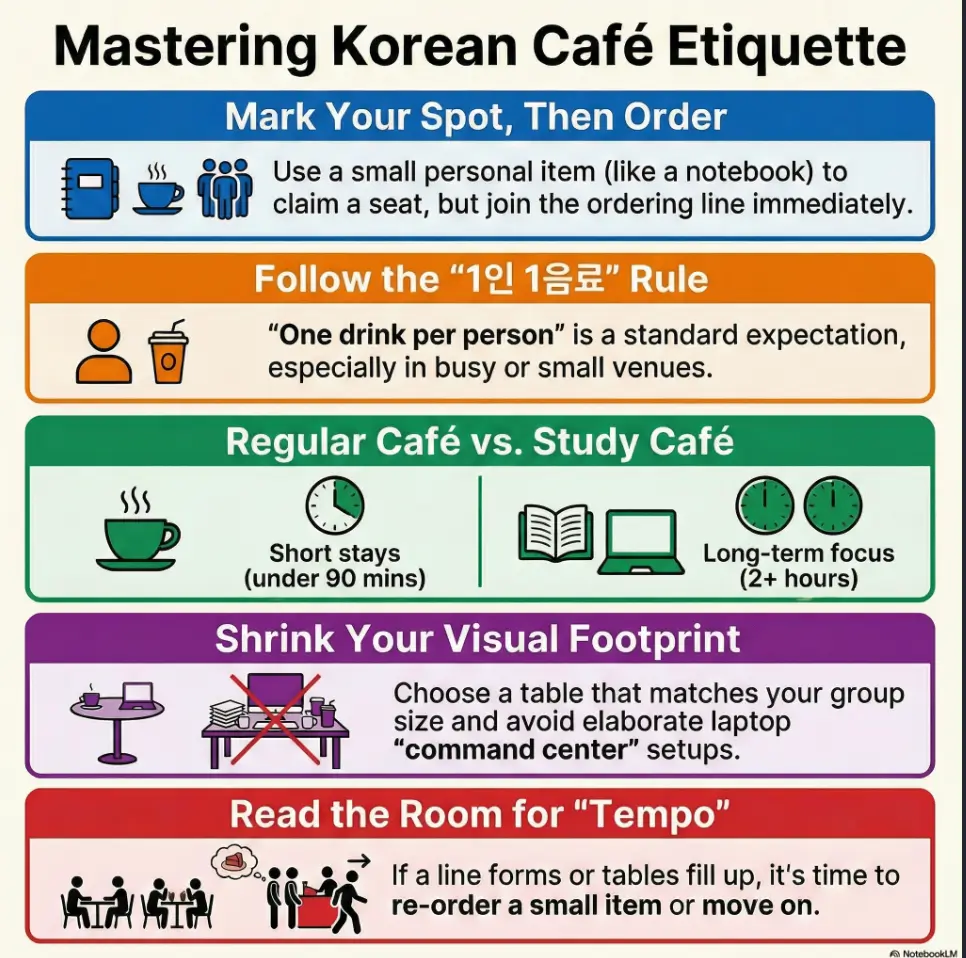
In many Korean cafés, “a seat” is part coffee-shop, part micro-lease. You’re not just buying a latte, you’re buying a slice of calm. That’s why seat-saving exists, and why it also has boundaries.
The “order-first” expectation (and when it flips)
Most of the time, the cleanest move is: order first, then sit. It signals you’re a real customer, not a seat hunter. But you’ll also see the flip: someone walks in, drops a tote bag on a chair, then queues to order. That’s common, especially when the line is long and the seating is scarce. The key difference is speed. If you mark a seat and then disappear into a 12-minute photo shoot of the pastry case, you’ve crossed into “quietly weird.”
I learned this the hard way in Hongdae on a rainy Saturday. I sat first (because my umbrella was leaking like a tragic novel), then went to order… and came back to a polite stranger standing by my chair, looking at my notebook like it was a contested border. No drama, but I felt the message: “We do this differently here.”
How Koreans “mark” a seat: tote bag, notebook, jacket
Seat markers tend to be small, soft, and unmistakably personal: a canvas tote, a notebook, a folded jacket. It’s rarely a full barricade. Think “bookmark,” not “construction site.” The marker is a whisper: I’m here, I’m ordering, I’ll be right back. (If you like decoding unspoken “message objects,” you’ll notice similar patterns in KakaoTalk etiquette too.)
- Mark one seat, not a kingdom
- Order promptly (minutes, not “eventually”)
- Match your setup to the café’s vibe
Apply in 60 seconds: Put one small item down, join the line, and order immediately.
Don’t do this: reserving 4 seats with 1 person’s stuff
This is the universal “nope.” One person saving an entire 4-top with a laptop, charger, hoodie, water bottle, and a moral philosophy textbook… while friends are “coming soon”… reads as selfish in any language. If your group hasn’t arrived, claim one seat, order, and be ready to adjust once you see how crowded it is.
One drink per person: rule, request, or social contract?
“One drink per person” in Korea often lives in that gray zone between policy and culture. Sometimes it’s posted as 1인 1음료. Sometimes nobody says anything… until the café fills and the staff’s smile tightens by one millimeter.
Where it’s strict: small cafés, tourist zones, peak hours
Small cafés have small margins and smaller seating. In busy areas (think subway hubs, popular streets, and trend cafés), staff may enforce minimum orders more directly. This isn’t personal. It’s just math: a packed shop can’t stay open if half the seats are occupied by “one iced americano, two laptops, three hours.”
One timely example of the pressure cafés feel: in 2025 reporting about South Korea’s café-work culture, even big chains like Starbucks Korea were discussed as posting reminders about not turning shared tables into full office setups. That’s not “anti-remote work.” It’s a boundary around space.
Where it’s flexible: quieter neighborhoods, dessert-heavy cafés
In calmer neighborhoods, owners often recognize regulars and tolerate more variety: sharing a dessert, ordering tea instead of coffee, lingering longer when there are plenty of empty tables. Dessert-heavy cafés sometimes treat the “one item per person” expectation as satisfied by cake, bingsu, or a pastry, especially if drinks are already ordered. But if a sign says “one drink per person,” don’t lawyer it. Just follow it.
How staff communicate it: signage, polite reminders, table checks
Korean service often avoids confrontation when it can. So the messaging tends to be indirect: a sign near the register, a tiny table tent, or a gentle check-in: “One drink each, please.” If you’re unsure, look for signage near the entrance, register, or on the table. If you see it, treat it as the rule of the house, like taking shoes off in someone’s home (the same “house rules are the house rules” logic shows up clearly in Korean templestay etiquette for foreigners).
Micro-moment script: what to say if you’re waiting for a friend
Here’s a simple, calm line you can use at the counter or if staff asks:
- “My friend is arriving in 5 minutes. We’ll order for them as soon as they get here.”
- “We’ll each get a drink. Could we sit first, then order right away?”
Short. Clear. No over-explaining. The goal is to show you understand the norm. If you want your “polite-but-not-overly-formal” tone to land cleanly, it helps to know a few Korean honorifics for tourists and the common “safe” options in everyday service talk.

Study cafés vs regular cafés: the point everyone misses
This is where most visitors (and plenty of newcomers) get stuck: they treat every café like it’s meant for hours of work. In Korea, the business model matters more than your intentions.
Study café = “paid focus space” (different economics)
A study café is closer to a library with benefits: you’re paying for time and quiet, not primarily for drinks. Many offer desks, partitions, stronger “do not disturb” energy, and sometimes snacks or coffee stations depending on the place. In January 2026, a U.S. military community travel outlet described study cafés as a quiet, library-like space rather than a Starbucks-style café, which captures the core idea: you’re renting focus.
Regular café = “turnover business” (ambience is the product)
Regular cafés sell a mood. The latte is the receipt, but the real product is ambience: music, lighting, design, and that gentle social hum. Turnover matters. Seats are part of the offering, but not infinite. So when you camp, you’re borrowing something valuable.
Here’s what no one tells you: why outlets and Wi-Fi become “rationed”
Outlets and Wi-Fi are the unofficial currency of “work-friendly.” If a café gets overrun by long-stay laptop users, the first defensive moves are predictable: fewer accessible outlets, passwords that change daily, or subtle discouragement around large setups. It’s not hostility. It’s a pressure valve.
Show me the nerdy details
Think of seating as a capacity constraint. If a café has 30 seats and peak demand fills them, each seat-hour has an opportunity cost. Adding outlets increases the average seat-time per customer, which can lower turnover. Study cafés price time directly, so longer stays are profitable. Regular cafés price drinks, so very long stays can become economically lopsided if orders don’t continue.
- Study café = time-based focus
- Regular café = vibe + turnover
- Work-friendly café = middle ground
Apply in 60 seconds: If you plan to stay 2+ hours, search “study cafe” or “coworking” before defaulting to a trend café.
Time limits: the unspoken timer (and how to read it)
Many cafés don’t use formal timers. They use atmosphere. And atmosphere, like music, has tempo changes.
Busy-day cues: line at the door, full tables, staff pacing
If there’s a line, if every table is taken, if staff are doing that fast walk with purpose, your “allowed time” shrinks. No one will announce it. But you can feel it the way you feel a crowded subway platform: the space has a new urgency.
My personal rule: if you arrive and see three groups waiting, don’t settle in for a long session unless you’re actively ordering and taking a small table. That’s not about guilt, it’s about social fluency.
Quiet-day cues: empty seats, slower music, fewer refills
On quiet weekdays, the same café that feels strict on Saturday can feel like a gentle cocoon. If there are many empty seats, you can usually stay longer without friction. You’ll notice staff refilling water stations slowly, music softer, and a general “no rush” mood.
Curiosity gap: the subtle signals staff use instead of confronting you
Instead of direct confrontation, you’ll often get hints:
- Cleaning the table next to you repeatedly
- Walking past and making brief eye contact
- Checking table markers or receipts during peak times
If you notice these, you don’t need to panic. Just respond like a considerate adult: reorder, downsize, or choose a study café next time.
Seating etiquette: table size, splitting, and the “solo at a 4-top” issue
Korean café seating is a quiet choreography. You don’t need perfect steps. You just need to avoid stepping on toes.
Best practice: match table size to your party
If you’re solo, aim for a single seat, bar seating, or a 2-top. If you’re two people, choose a 2-top unless the café is empty. This sounds obvious, but when you’re carrying a backpack and a laptop, the empty 4-top looks like a life raft. Resist the temptation when it’s busy.
If you must take a big table: the “shrink your footprint” method
Sometimes the only open seat is at a larger table. If you take it, do two things:
- Compress: keep your bag on your lap or under the chair, not on the next seat.
- Stay flexible: if a group arrives and the café is full, be ready to move.
This isn’t about being “nice.” It’s about reading scarcity and responding gracefully.
Let’s be honest… your laptop is not a VIP pass
A laptop in Korea is common. A laptop that expands into a full command center is not. If you need a mousepad, an external keyboard, a stand, and a power strip… that’s not café behavior anymore. That’s study café or coworking behavior. (No shame. Just the right habitat.)
Ordering strategy: how to be respectful without overpaying
You don’t need to order five lattes to “earn” your chair. You just need to look like you understand how the place survives.
If you’re staying longer: how Koreans “pace” orders
A common pattern is simple: order one drink, settle in, then add a small item later if you’re staying a long time, especially when the café gets busy. It’s the same logic as tipping in some cultures: you’re signaling respect for the system without turning it into a performance.
I do this with a second drink only when it makes sense. Sometimes it’s a refill. Sometimes it’s a small pastry. Often it’s just me noticing a line forming and thinking, “Okay, I’ve borrowed enough calm for one receipt.”
Sharing dessert vs separate drinks: what’s acceptable
If the café has a posted minimum, follow it. If it doesn’t, a practical middle ground for two people is: two drinks or one drink each plus a shared dessert, depending on the venue and crowd level. Dessert cafés are often more forgiving about shared items, but again, signage wins.
Water, self-serve stations, and clearing your tray (varies by café)
Many cafés provide self-serve water, napkins, and sometimes return stations. Some expect you to return trays; others clear tables for you. The safest move is to look around: if you see a tray return area with other customers using it, follow suit. If you’re unsure, asking with a smile works: “Do I return the tray here?” (If you enjoy learning “local logic” through everyday rituals, the Korean banchan refill rules are another surprisingly useful window into how Korea signals fairness and boundaries.)
Noise, calls, and “study energy”: the vibe rules
Korean cafés can be lively, but the “work/study” ones often run on a hush that’s more felt than enforced.
Quiet cafés: whisper-level culture (even without signs)
If you walk in and hear mostly keyboard taps and ice clinking, that’s your cue. Keep your voice low. Don’t play audio without headphones. And if you’re laughing loudly, it’s okay, just notice it and dial down. Think of it like entering a concert hall during rehearsal: nobody shouts, even though it’s not “forbidden.”
Phone calls: when it’s okay to step outside
Quick calls happen. But long, animated calls at a quiet café are the fastest way to become “that person.” If you need to take a call longer than 30 seconds, step outside or move to a louder café. Your future self will thank you when you don’t feel the room’s collective side-eye.
Keyboard sounds, meetings, and Zoom etiquette
Typing is normal. Mechanical keyboards that sound like tiny fireworks are not. Zoom meetings are the biggest mismatch. If you have a meeting, pick a coworking space, a louder café, or a study café that allows phone booths. Korea has plenty of purpose-built places for this; your job is just to choose them on purpose.
Who this is for / not for
For: tourists, exchange students, digital nomads, first-time Korea visitors
If you want to avoid awkward misunderstandings while still enjoying Korea’s incredible café scene, this guide is for you. It’s also for anyone trying to figure out the difference between “I’m welcome to sit” and “I’m accidentally causing a small problem.”
Not for: anyone needing guaranteed hours-long seating (use a study café/coworking)
If you need a guaranteed seat for 4–8 hours, with outlets and stable quiet, don’t gamble with a regular café. That’s what study cafés and coworking spaces are designed for. You’ll feel more relaxed, and the café staff will feel more relaxed too. Everyone wins. ☕️
Common mistakes: the fastest ways to look inconsiderate
This section exists so you don’t have to learn through discomfort. I’ve collected these not as “rules,” but as recurring social friction points.
Mistake #1: saving seats “forever” before ordering
If you mark a seat, order soon. “Soon” usually means right now, not after you check messages, compare menus, and debate oat milk vs soy like it’s a graduate thesis.
Mistake #2: one drink, two people, two laptops
This is the classic mismatch: the café pays rent in Seoul prices, and your table pays back in one receipt. If you’re two people working, plan for two orders or choose a study café.
Mistake #3: camping during peak time with no re-order
Peak time is when turnover matters most. If the café fills and you’ve been sitting for a long time, reordering a small item is a simple way to stay aligned with the space you’re using.
Mistake #4: taking calls at the quietest café in the neighborhood
If you’re in a whisper-level café, treat it like one. Step outside for calls. Keep it clean. Keep it calm.
Curiosity gap: why “being polite” still fails if you pick the wrong venue
You can be perfectly polite and still be “wrong” for a space. A trend café built for photos and fast turnover will feel tense if you try to work there for hours. A study café will feel tense if you bring loud friends. Etiquette is less about manners and more about matching purpose. (Same principle, different setting: even something as simple as Korean bowing (jeol) becomes easy once you understand what the moment is “for.”)
- Order timing matters more than seat-saving itself
- Peak hours change the “normal” rules
- Choose the venue that fits your plan
Apply in 60 seconds: If you’re working 2+ hours, search “study cafe” on NAVER Map or Kakao Map first.
Choose the right spot: a quick café-type decision guide
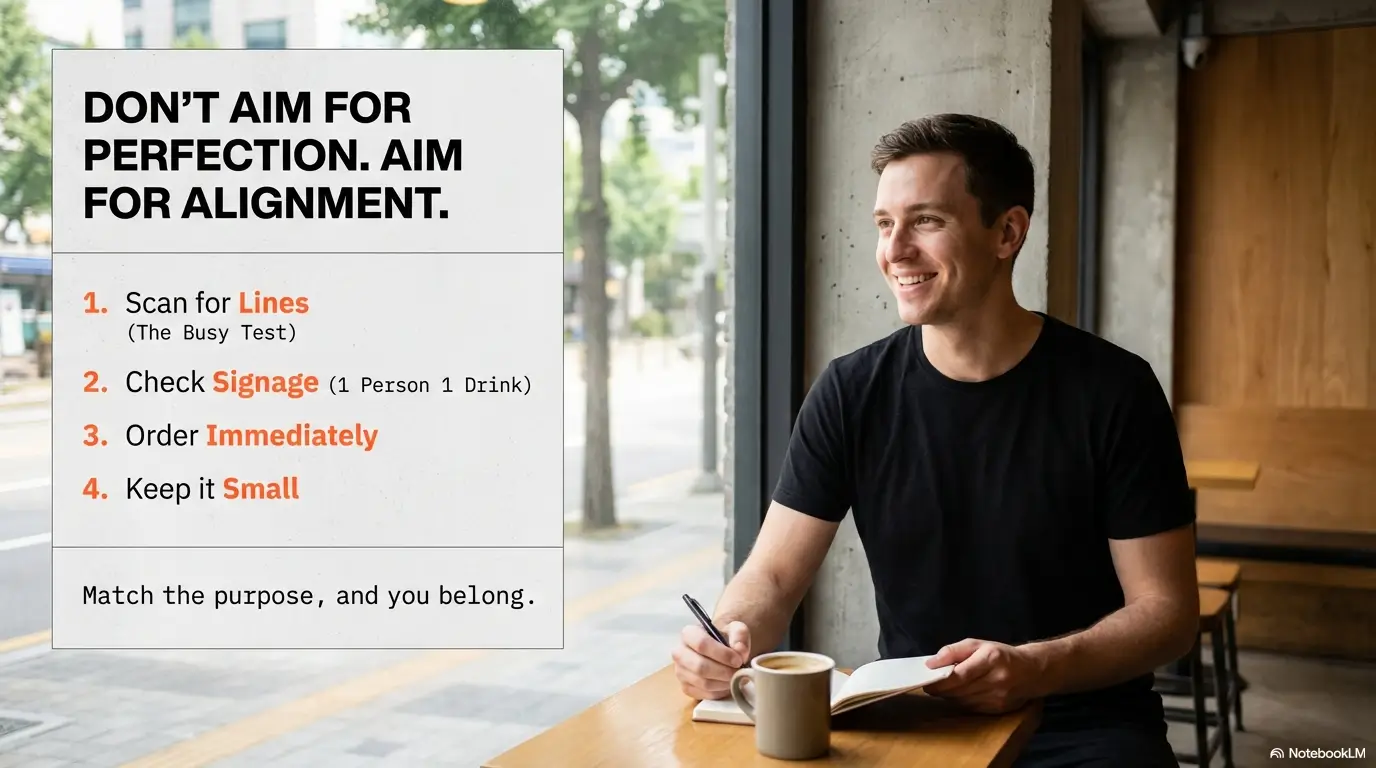
This is the part that saves you time, money, and micro-embarrassment. The goal is not to be perfect. The goal is to be compatible.
Trend café (photos first) vs neighborhood café (regulars first)
Trend cafés often have tighter seating, more traffic, and stronger minimum-order expectations. Neighborhood cafés can be more flexible, especially off-peak, but they also tend to be smaller and more sensitive to people occupying space without ordering. In both cases: look for signs, watch the crowd, and keep your setup reasonable.
Work-friendly café vs study café vs coworking
Here’s a simple operator-level comparison:
- Regular café if: you’ll stay ~30–90 minutes, light laptop use, flexible vibe
- Work-friendly café if: you’ll stay 1–3 hours, need outlets/Wi-Fi, can reorder if it gets busy
- Study café if: you’ll stay 2–8 hours, need quiet, want “rent-a-desk” clarity
- Coworking if: you have calls/meetings, need phone booths, or want business-grade comfort
Neutral next step: Decide your stay length first, then choose the venue that prices that length fairly.
Map heuristic: subway hubs vs side streets
If you’re near a major subway hub, assume higher turnover pressure. Side-street cafés often have a gentler pace. This isn’t always true, but as a heuristic it’s surprisingly reliable. I use it constantly when I’m traveling: if a café is right by a station exit, I keep my stay short unless it’s explicitly work-friendly.
Infographic: The Café Choice Compass (60-second pick)
Under 90 min: regular café usually fine.
2+ hours: study café or work-friendly.
Line + full seats: order immediately, keep it short, or relocate.
Need outlets? Choose places that signal “work-friendly” or a study café.
If you see minimum-order or time-limit signs, treat them as non-negotiable.
Next step: one concrete action
Before you walk in, run the 10-second check: line + seating + signage
This is the simplest habit that prevents 80% of awkward café moments:
- Line: Is there a queue?
- Seating: Are most tables full?
- Signage: Do you see “1인 1음료,” time limits, or laptop restrictions?
If there’s a line, seats are full, or you see minimum-order signs, order immediately and keep your stay short or choose a study café for long sessions.
- Yes if: no line, open seats, and you can keep your setup small.
- Yes if: you’re happy to reorder if it gets busy.
- No if: it’s peak time and you plan to stay 2+ hours.
- No if: you need calls/meetings (choose coworking).
Neutral next step: If two “No” items apply, search “study cafe” and save yourself the tension.
Enter your situation. You’ll get a polite, practical suggestion.
Result: You’re probably fine. Keep your setup compact and enjoy.
Neutral next step: If the café shifts from quiet to busy, reassess in 30 minutes.
Short Story: The day my tote bag taught me Korean café math (120–180 words) …
I once ducked into a tiny café near a university, the kind with four tables and a playlist that sounded like snowfall. Every seat was taken except one chair at a 4-top. I hesitated, then sat, carefully stacking my bag on my lap like it contained fragile glass. I ordered immediately, smiled, and opened my laptop for what I swore would be “just 45 minutes.” Then the café filled. A line formed.
Two students hovered near my table, eyes politely scanning for space. Nobody asked me to move. Nobody scowled. But the room’s temperature changed. It was subtle, like the moment a song modulates into a new key. I looked down at my single drink, looked at the line, and realized the real etiquette wasn’t written anywhere: when space becomes scarce, the most respectful thing you can do is become smaller, faster, or gone.
FAQ
Can you save a seat in a Korean café before ordering?
Yes, it’s common to mark a seat briefly (tote bag, notebook) if you order right away. The longer you delay, the more it reads as inconsiderate, especially when the café is busy.
Is “one drink per person” a real rule in Korea?
Often, yes. Some cafés post it as 1인 1음료. In busy areas and smaller cafés, it may be enforced. If it’s posted, treat it as a house rule, not a suggestion.
How long can you stay in a Korean café with one drink?
It depends on crowd level and venue type. If the café is quiet, longer stays are often tolerated. If there’s a line or full seating, the polite move is to reorder or leave.
Are Korean cafés okay for studying or working on a laptop?
Many are, but not all. “Work-friendly” cafés usually have outlets and a calmer atmosphere. Trend cafés and very small cafés may prefer faster turnover.
What’s the difference between a study café and a regular café in Korea?
Study cafés sell time + focus. Regular cafés sell drinks + ambience. If you need guaranteed hours and quiet, study cafés are built for that purpose.
Do Korean cafés have time limits or minimum orders?
Some do, especially in high-traffic areas. The best indicator is signage. If you see time limits or minimum orders, follow them exactly.
Is it rude to take a phone call inside a Korean café?
In quiet cafés, long calls are frowned upon. If your call will last more than about 30 seconds, stepping outside is usually the best move.
Do you need to clear your table or return trays in Korea?
It varies. Some cafés have return stations; others clear tables for you. Look around and follow what locals are doing, or ask staff briefly.
What if small talk gets too personal while you’re sharing a table?
It’s rare, but it happens. If you want a graceful way to set boundaries without awkwardness, keep a few lines from Korean personal questions etiquette in your back pocket.
Conclusion
Remember the feeling from the beginning, that tiny moment of “Am I doing this right?” Here’s the loop closure: you don’t need perfect etiquette. You need alignment. Order promptly, keep your footprint small, and choose the place whose business model matches your plan. That’s the whole game.
If you do one thing in the next 15 minutes, do this: open your map app and save two backup spots near you. One “work-friendly” café. One study café. The next time a place is packed or strict, you won’t feel trapped, you’ll feel prepared. And if you want a broader “social fluency” toolkit (café life included), explore the Korean culture hub and pick the etiquette topics that match your daily life.
Last reviewed: 2026-02-20