
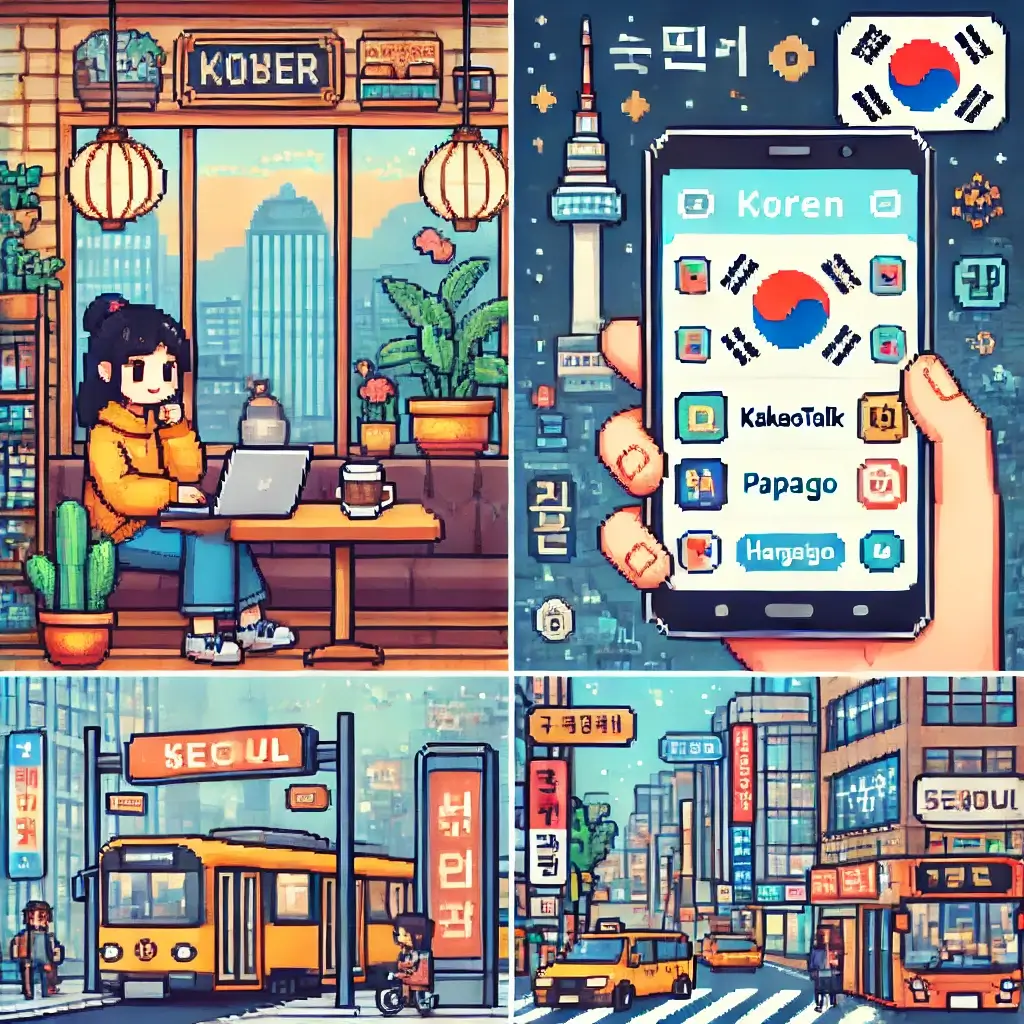
5 Survival Korean Hacks for Digital Nomads That Go Beyond the Phrasebook
Are you a digital nomad or long-term traveler dreaming of working from a bustling cafe in Seoul, hiking through the serene mountains of Jeju, or exploring the ancient streets of Gyeongju?
Korea is an incredible destination, full of vibrant culture, mouth-watering food, and a super-fast internet connection that makes a nomad’s heart sing.
But let’s be real, the language barrier can feel like a brick wall.
I get it.
I’ve been there, pointing hopelessly at a menu and hoping for the best, or trying to explain a complex issue to a taxi driver with nothing but hand gestures.
And let me tell you, while those “100 Essential Korean Phrases” lists are a great start, they won’t get you very far in a country where nuance and context are everything.
This isn’t your average language guide.
We’re going to dive deep into the real, human-level hacks that will make you feel less like a tourist and more like you actually belong.
It’s about survival, yes, but it’s also about thriving.
Ready to unlock Korea?
Let’s do this.
—
Table of Contents
—
1. Beyond the Phrasebook: The Cultural Mindset
Most guides start with a list of words, but I want to start with something more important: the why.
Why do Koreans speak the way they do?
Understanding the cultural context behind the language is like having a superpower.
It’s the difference between saying a phrase and truly communicating.
K-dramas, for all their glorious plots, show you a glimpse of this, but living it is another story.
There are two concepts you absolutely need to grasp: nunchi and jeong.
Nunchi (눈치) is often translated as “eye measure” or “the ability to read the room.”
It’s about social awareness, picking up on subtle cues, and understanding the unspoken expectations in any given situation.
For example, if you walk into a restaurant and it’s completely packed, your nunchi tells you not to take a seat at the only empty table that’s clearly waiting for a family of four.
It’s a feeling, a sixth sense that helps you avoid social faux pas.
As a nomad, you’ll use nunchi constantly—in cafes, on the subway, or even during a brief conversation with a shop owner.
It helps you anticipate what someone needs before they even ask, and it’s a deeply respected trait in Korean society.
You don’t just learn this from a book; you learn it by observing and immersing yourself.
Jeong (정) is a bit harder to explain, as it’s a profound emotional bond or feeling of attachment that can exist between people.
It’s the warmth and affection that builds up over time, the feeling of shared humanity that makes you want to take care of someone.
A small act of kindness, like a restaurant owner giving you an extra side dish because they see you’re enjoying your meal, is an expression of jeong.
This isn’t a transactional relationship; it’s a human one.
Don’t be surprised if a shopkeeper offers you a small discount or a fellow cafe-goer helps you navigate a confusing machine.
This is what makes Korea so special—it’s a culture built on these deep, unspoken connections.
When you approach your language learning with a mind open to these concepts, the phrases you learn will suddenly have more meaning and impact.
It’s not just about what you say, but the spirit in which you say it.
And that, my friend, is your first and most powerful survival hack.
—
2. Hacking Hangeul: Your Secret Weapon
Forget everything you think you know about learning a foreign alphabet.
Hangeul (한글), the Korean alphabet, is arguably the most brilliant and logical writing system in the world.
It was created in the 15th century to be easy for anyone, regardless of social class, to learn.
And it works.
I’m not kidding when I say you can learn the basics of reading Hangeul in a single afternoon.
Seriously.
Think of Hangeul as your skeleton key.
Without it, you are constantly wandering in a dark room, fumbling for an English translation that may or may not exist.
But once you know Hangeul, the lights turn on.
You can read menus, understand subway signs, recognize street names, and suddenly a world of information is accessible.
The sounds are phonetic, so you can sound out words even if you don’t know their meaning.
This is a game-changer.
I remember one of my first times in Korea, getting on the wrong bus because I couldn’t read the signs.
A few weeks later, after dedicating just a few hours to Hangeul, I was confidently navigating the Seoul bus system.
It wasn’t magic; it was the power of knowing the alphabet.
So, where do you start?
Plenty of free resources online can teach you Hangeul in an interactive, engaging way.
Don’t just watch a video once; dedicate some time to practice writing and sounding out the letters.
The reward is immediate and immense.
You’ll be able to tell 김치 (kimchi) from 비빔밥 (bibimbap), and 서울 (Seoul) from 부산 (Busan).
This one hack alone will give you more confidence than a dozen phrasebooks ever could.
It’s the most efficient use of your time as a new arrival, hands down.
—
3. Essential Apps & Tech You Can’t Live Without
Let’s be honest, digital nomads rely on tech to survive.
But relying on your usual apps in Korea is a surefire way to get lost and confused.
Google Maps, for instance, is notoriously unreliable in South Korea due to government restrictions on mapping data.
It’s not that it doesn’t work at all, it’s that it just doesn’t work well.
So, what’s a savvy nomad to do?
You swap your Western tech for the local favorites.
First and foremost, you need a new mapping app.
My go-to is Naver Maps (네이버 지도) or Kakao Maps (카카오맵).
They are lightyears ahead of Google Maps for navigation within the country, providing accurate public transportation routes, walking directions, and real-time traffic updates.
They have English interfaces, so you don’t even need to be fluent in Korean to use them, but knowing Hangeul will help you input place names with greater accuracy.
Get it downloaded, get it set up, and you’ll thank me later.
Your second non-negotiable is a good translation app.
While Google Translate is okay for simple words, Papago (파파고), also from Naver, is specifically designed for Korean-English translation and is far more accurate and intuitive.
It has an image-to-text translation feature that is an absolute lifesaver for reading menus or street signs.
I’ve used it to translate a sign for “no parking” that looked like a “welcome” sign to me, and it saved me a huge headache.
Third on the list is KakaoTalk (카카오톡).
This is the dominant messaging app in Korea, and it’s how everyone communicates.
If you’re making new friends, meeting up with a local, or communicating with a landlord or a local business, this is the app you’ll use.
It’s more than just a messenger; it’s a social hub, with features like group chats, video calls, and a built-in payment system (Kakao Pay).
Last but not least, a Korean dictionary app like Naver Dictionary is a fantastic resource for when you’re just learning and want to look up a word on the fly.
It gives you example sentences and pronunciation guides, which are invaluable.
Embracing this local tech ecosystem is a crucial step towards making your life easier and more integrated into the Korean community.
It’s not just about the words you speak; it’s about the tools you use to navigate your environment.Download Naver Maps & Take Control of Your Navigation!
—
4. Mastering Key Social & Dining Scripts
Let’s move on to the actual words, but not just the one-off phrases you learn in a book.
We’re talking about the complete social scripts, the little routines that show you understand the cultural flow.
The single most important phrase you’ll learn is “Annyeonghaseyo” (안녕하세요), which means “Hello.”
But the script doesn’t end there.
When you greet an elder or a respected figure, a slight bow is also part of the package.
It shows respect and humility, which is highly valued.
A simple phrase like “Gamsahamnida” (감사합니다), for “Thank you,” is a great start.
However, you should also learn “Jal meokgesseumnida” (잘 먹겠습니다), which means “I will eat well.”
This is what you say before you start eating a meal, and it’s an acknowledgement of the hard work that went into preparing it.
It’s a small, beautiful custom that instantly makes you look less like an outsider and more like you’re part of the communal dining experience.
Another essential one is “Jal meogeosseumnida” (잘 먹었습니다), which is the past tense version of the phrase, meaning “I ate well.”
You say this to the host or the restaurant staff after your meal, and it’s a simple but powerful way to show your gratitude.
Ordering food can be intimidating, but there’s a simple script for that too.
Walk up to the counter, point at the menu item (if you can’t read it), and say “Igeo juseyo” (이거 주세요).
It means “Give me this, please.”
For two of something, you can say “Igeo du gae juseyo” (이거 두 개 주세요).
Once you get your food, you can say “Gamsahamnida,” and a pleasant exchange is complete.
Navigating these social scripts is like learning the choreography of a dance.
You might not understand the whole song, but if you know the basic steps, you can keep up with the rhythm.
This is where a little preparation goes a very long way.
I highly recommend a fantastic resource for learning these kinds of practical, conversational scripts in a fun way.
It’s not a dry textbook, but a platform built for real-world application.Unlock Conversational Korean with Talk To Me In Korean!
—
5. Navigating Life: Transportation & Practical Survival
Okay, you’ve got your mindset and your apps. Now let’s get you around without any fuss.
The public transportation system in Korea is famously efficient, clean, and well-connected.
But you need a T-Money card (티머니 카드).
This is a reloadable transportation card that you can use on buses, subways, and even in some convenience stores and taxis.
You can buy one at any convenience store or subway station and top it up as needed.
It saves you from fumbling for cash every time and often gives you a slight discount on your fare.
The subway system in major cities like Seoul and Busan is incredibly easy to use, especially with your new Hangeul skills and a reliable app like Naver Maps.
The lines are color-coded, and most stations have announcements in both Korean and English.
When you get on a bus, remember to tap your T-Money card both when you get on and when you get off.
Failing to tap out can result in a charge for the maximum fare, which is a rookie mistake you don’t want to make.
Don’t be afraid of the buses; they are an excellent way to see the city and often go places the subway doesn’t.
For longer journeys, the KTX high-speed train is your best friend.
You can book tickets online or at the station, and it’s a comfortable, fast way to travel between major cities.
Knowing a few phrases for getting around is also crucial.
When getting in a taxi, simply saying the name of your destination, like “Hongdae Ipgu (홍대 입구), gajuseyo” (가주세요), which means “to the Hongdae entrance, please,” will get you where you need to go.
Don’t forget to practice saying the names of places and streets, as a wrong pronunciation could send you to a completely different part of town!
Finally, for general travel inspiration and official information, you can’t go wrong with the official tourism site.
It has everything from practical travel guides to cultural festival information, all in English.Explore Korea with the Official Tourism Site!
—
Conclusion: Your Korean Journey Awaits
So there you have it.
Five hacks that will transform your experience in Korea from a daunting challenge into an exciting adventure.
It’s not just about memorizing phrases; it’s about understanding the culture, using the right tools, and embracing the nuances that make Korea so unique.
By learning a little Hangeul, downloading the right apps, and mastering a few key social scripts, you’re not just surviving, you’re genuinely connecting with the people and places around you.
Remember, every expert was once a beginner.
Be patient with yourself, embrace the mistakes as learning opportunities, and don’t be afraid to try.
The Korean people are known for their hospitality and generosity, and a little effort on your part goes a very long way.
Your Korean adventure is just beginning, and with these tools in your back pocket, you’re more than ready for it.
Go forth, explore, and enjoy every moment.
survival korean, digital nomad, long-term travel, hangeul, korea