
Mastering the Unspoken Rules of KakaoTalk
In the world of Korean digital communication, a single “read receipt” without a reply can speak louder than words. Whether it’s navigating 읽씹 (read-and-ignore) or balancing hierarchy in group chats, your digital tone defines your relationships.
Cleaner, kinder communication that still sounds like you.
Table of Contents
Start Here First — What “Good Manners” Means on KakaoTalk
Why etiquette is about closeness, not one universal rule
Many newcomers look for one universal rule—“Reply within X minutes and you’re polite.” That sounds efficient, but Korean messaging culture often works by relationship distance first, rule second. The same delay can feel normal from a senior coworker, slightly tense from a new date, and totally fine from a close friend who already knows your rhythm.
I learned this the awkward way after sending a long “professional” response to a friend who had simply asked, “먹었어?” (“Did you eat?”). My polished paragraph looked formal and distant. They replied with a single “오…ㅋㅋ” and I could almost hear the emotional brakes squeal.
The hidden variable: age, hierarchy, and relationship stage
Hierarchy matters in Korea more than many US users expect. Age, workplace rank, and how long you’ve known each other can all shift what “normal” looks like. In early-stage relationships, brief acknowledgment messages carry a lot of social weight. In established circles, speed matters less if trust already exists. If you want a deeper background on how meaning is often conveyed indirectly, this guide on Korean indirect communication patterns gives useful context.
Think of etiquette here as a three-part equation:
- Relationship stage (new / established)
- Context (logistics / emotional / work urgent)
- Power distance (peer / senior-junior)
Let’s be honest… speed matters less than signal clarity
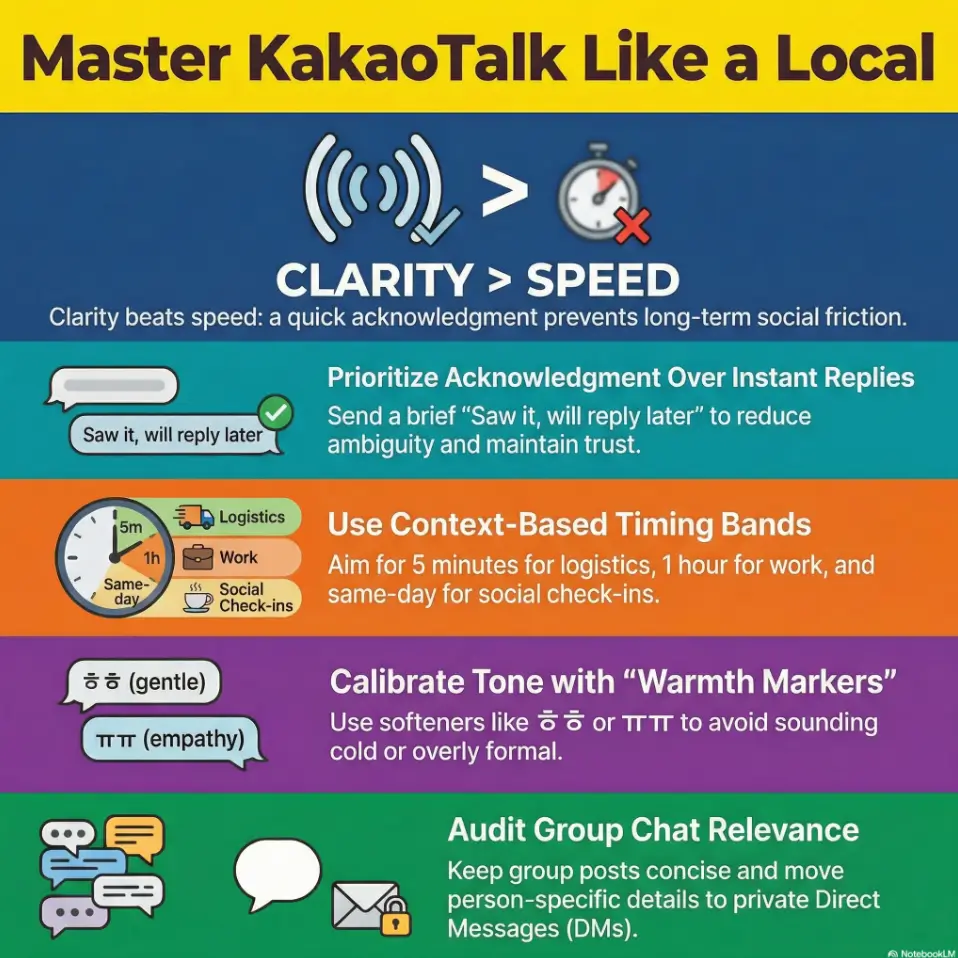
If you remember one line, make it this: clarity beats speed. A 3-second acknowledgment can prevent a 3-day misunderstanding. “봤어요, 저녁에 답할게요” (“Saw it, I’ll reply tonight”) often performs better than either instant half-replies or total silence.
- Use brief acknowledgments when context is unclear.
- Adjust tone for hierarchy and relationship stage.
- Prioritize clarity over instant replies.
Apply in 60 seconds: Save one acknowledgment line in your notes app and paste it when busy.
읽씹 Decoded — When Read-and-Ignore Feels Offensive (and When It Doesn’t)
What “읽씹” communicates in close friends vs coworkers vs dating
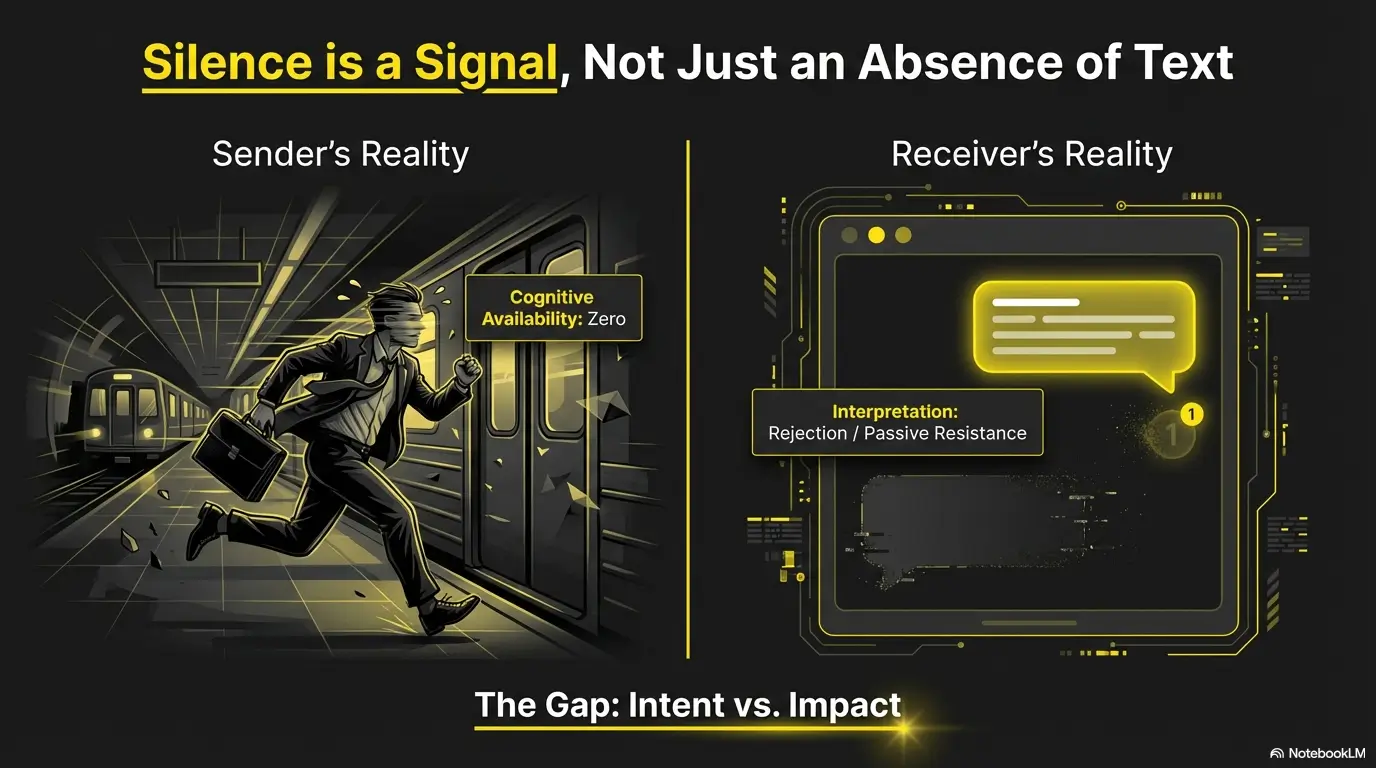
읽씹 (read-and-ignore) is less a strict offense and more a context-sensitive signal. In close friendships, short silence might mean “busy, talk later.” In work chats, silence after reading a task request can be read as passive resistance. In dating, repeated read-without-reply often gets interpreted as emotional distancing, even if that wasn’t your intention.
I once coached a student who thought she was being “non-needy” by replying late to everyone. Her classmates read it as selective coldness because she replied quickly only to practical requests. She hadn’t changed her personality; she had accidentally changed her social pattern.
“Saw it, can’t reply now” signals that prevent friction
These lightweight bridges work extremely well:
- “봤어요! 이동 중이라 이따 답할게요 🙂”
- “확인했어요. 저녁에 정리해서 보낼게요.”
- “읽었어요! 지금 회의라 늦게 답장할게요.”
These lines do three jobs in under 20 characters of social meaning: acknowledgment, reason, and expected timing.
The gray zone: when silence is interpreted as rejection
Silence becomes risky when the original message includes emotional vulnerability, scheduling dependence, or clear requests for action. If someone asked, “Can we talk tonight?” and you read it but leave it hanging, the emotional interpretation arrives before your eventual explanation.
Rule of thumb: for messages involving feelings, commitments, or logistics that affect others, acknowledge first—even if the full answer comes later.
Show me the nerdy details
In communication theory terms, read-receipt platforms increase “perceived accountability.” The sender sees a receipt and infers your cognitive availability, even if your practical availability is zero. Acknowledgment messages reduce ambiguity cost by adding temporal metadata (“later tonight”) and intent metadata (“I saw this”).
Reply Timing Rules — How Fast Is “Polite Enough” in Real Life?
5-minute, 1-hour, same-day: context benchmarks that actually work
Most people do better with bands than rigid deadlines. Use these practical timing bands:
- 0–5 minutes: urgent logistics, live coordination (“I’m downstairs”).
- within 1 hour: work planning, group decisions with dependencies.
- same day: social check-ins, non-urgent personal threads.
Notice this is about relevance, not virtue. You’re not “good” because you reply instantly; you’re effective because you signal correctly for the situation.
Work chat vs social chat: different clocks, different expectations
Work chat has dependency pressure: your delay can block someone else’s progress. Social chat has emotional pressure: your delay can trigger interpretive anxiety. These pressures feel different, but both are manageable with one habit—micro-acknowledgment.
Here’s what no one tells you… late replies can be fine if your opener is right
A delayed reply that begins with context usually lands well:
- “늦게 봤어요. 지금 답할게요.”
- “어제 정신없어서 이제 봤어요. 고마워요!”
That first line is not “just manners.” It is emotional repair at low cost.
- Use urgent/important/routine timing bands.
- Treat dependency messages as higher priority.
- When late, open with context before content.
Apply in 60 seconds: Create 3 canned openers for urgent, routine, and delayed replies.
Decision Card: Reply Now vs Acknowledge Now, Answer Later
When A (Reply now): live logistics, safety, or blocked team tasks.
When B (Acknowledge now): emotional or complex topics when you need mental space.
Trade-off: A saves coordination time; B protects tone quality and relationship trust.
Neutral next step: Send one acknowledgment line, then set a real follow-up window.
Group Chat Dynamics — Don’t Accidentally Become “That Person”
When to reply in-thread vs DM the sender
Group chat etiquette is really attention management. If the content benefits everyone, keep it in group. If it’s a single-person clarification, move to DM and return only the final relevant update to the group. This reduces notification fatigue and social noise.
Message length, tagging, and notification fatigue
Five one-line bursts can feel louder than one clean paragraph. Many Korean group chats value compactness and relevance, especially when members span different ages or departments. Use tagging sparingly. Mentioning everyone for minor updates can quietly damage trust.
Timing etiquette for announcements, jokes, and side conversations
Announcements: lead with actionable line first. Jokes: read room temperature before piling on. Side chats: split off quickly. One of my early mistakes was posting a playful meme right after someone shared schedule changes; I thought it eased tension, but it diluted urgency. The fix was simple: wait, acknowledge task-related items, then lighten tone later.
Eligibility Checklist: Should this message stay in group?
- Yes/No: Does everyone need this information?
- Yes/No: Will this message affect group schedule or decisions?
- Yes/No: Can this be one concise post instead of five bursts?
Neutral next step: If any answer is “No,” move detail to DM and post one clean summary back in group.
Emoji Tone in Korean Context — Why 🙂, ㅎㅎ, ㅋㅋ, and ㅠㅠ Aren’t Interchangeable
Warmth vs distance: how tiny symbols change perceived attitude
Emoji and text laughter in Korean carry subtle temperature cues. “ㅎㅎ” often feels gentler or softer. “ㅋㅋ” can feel playful, but in some contexts can read as dismissive if paired with blunt content. “ㅠㅠ” can signal sadness, frustration, or empathetic softness. Even the same symbol can shift meaning by relationship and sentence framing. If you want broader examples, see this practical overview of everyday Korean slang in context.
Overly formal punctuation that can sound cold
Short declarative lines ending in periods can sound neutral in English but slightly stiff in casual Korean chat. This isn’t a hard ban—just a register issue. If the relationship is warm, soften with one friendly marker rather than over-correcting with ten emojis. The same register shift appears in polite vs casual Korean speech choices, where tone can outweigh literal wording.
Emoji mismatch: friendly intent, awkward impact
A classic mismatch: sending a neutral smile after bad news. You intended kindness; the receiver reads emotional distance. If topic is sensitive, mirror seriousness first, then add warmth.
- Better: “아이고, 진짜 힘들었겠다 ㅠㅠ 지금 괜찮아?”
- Risky: “아 그렇구나 🙂”
Show me the nerdy details
Digital pragmatics treats these symbols as prosodic markers—text-based substitutes for tone, rhythm, and facial expression. In high-context messaging cultures, symbol choice carries interpersonal indexing (“we are close,” “I’m careful,” “I’m joking”). The practical implication: match symbol intensity to topic severity and relationship intimacy.
Mistake #1: Over-Explaining Delays — Why Long Apologies Can Backfire
The concise acknowledgment formula (short, warm, clear)
When people feel guilty about delay, they often send autobiography-length apologies. Ironically, this can shift burden onto the other person (“Now I must comfort you”). Keep it short:
Acknowledge → Context → Timing
- “늦게 봤어요! 이동 중이었어요. 저녁 8시쯤 답할게요.”
When a one-line reply is better than a paragraph
If the other person asked a simple logistical question, a one-line answer plus acknowledgment is often ideal. Respect is often measured by usefulness, not emotional volume.
Repair line examples after a slow response
- “답 늦어서 미안해요. 지금 확인했고 바로 진행할게요.”
- “늦게 답했네요. 기다리게 해서 미안해요.”
- “읽고 생각이 필요했어요. 지금은 이렇게 정리됐어요…”
These lines restore trust without over-dramatizing delay.
- Lead with acknowledgment, not excuses.
- Give a concrete follow-up time.
- Answer the original request directly.
Apply in 60 seconds: Save one “late reply repair” line and reuse it consistently.
Mistake #2: Porting US Text Habits Directly — Don’t Copy-Paste Your iMessage Style
Directness vs softness: phrasing that feels respectful in Korean norms
US texting often rewards speed and blunt clarity. Korean chat often rewards calibrated softness, especially with newer or hierarchical relationships. You do not need to become someone else; you only need to add two layers: acknowledgment and polite framing.
I once sent a perfectly normal US-style line to a senior collaborator: “Need this by 4.” Accurate, efficient, and socially sharp as broken glass. One small change fixed it: “가능하시면 4시 전까지 부탁드려도 될까요?” Same request, very different emotional footprint. If honorific nuance still feels slippery, a quick primer on how Korean honorifics shape politeness can help.
The “no response needed” line that reduces pressure
In group settings, consider adding “답장 안 해도 돼요” (“No reply needed”). It signals consideration and lowers social load, especially when broadcasting information.
Read receipts are not consent to immediate labor
This one matters for global teams: seeing a read receipt doesn’t entitle instant work. Good etiquette includes boundaries. If after-hours response is not expected, make that norm explicit. Teams with explicit norms usually experience fewer misunderstandings than teams with unspoken assumptions.
Short Story: The message that looked polite but landed wrong
I remember a project week when three time zones were colliding and everyone was exhausted. A US teammate sent, “Can you confirm now?” to a Korean colleague at 10:40 p.m. local time. It wasn’t rude in intent—just urgent in tone. No reply. Fifteen minutes later, he sent “?” and then “Saw you read it.” Now it sounded accusatory.
The next morning, the colleague replied with an apology and the task done, but the trust dip was obvious. We rewrote one line in our team playbook: “If urgent, state urgency + why + fallback time.” A week later, the same scenario came up. New message: “Urgent for tomorrow deck—if tonight is hard, can you confirm by 9 a.m. your time?” Response came in 4 minutes, warm and clear. Same request, different respect architecture.
Coverage Tier Map: Message Sensitivity Level 1→5
- Tier 1: Casual updates — low sensitivity, flexible timing.
- Tier 2: Basic logistics — acknowledge within same day.
- Tier 3: Shared deadlines — acknowledge quickly, confirm owner.
- Tier 4: Emotional topics — prioritize tone and empathy markers.
- Tier 5: Conflict/high stakes — move to call or documented channel.
Neutral next step: Label your next message Tier 1–5 before pressing send.
Who This Is For / Not For
For: US travelers, exchange students, K-drama/K-pop fans, global coworkers, new couples
If you are entering Korean messaging culture from outside it, this guide is for you. It is especially useful if your intent is respectful participation rather than “perfect native performance.” You do not need flawless slang. You need stable, kind, predictable signaling. If you’re building broader cultural context, this companion guide to Korean culture basics for newcomers pairs well with messaging etiquette.
Not for: legal disputes, harassment cases, workplace policy violations
Etiquette advice is not a substitute for safety or legal process. If messages involve threats, harassment, coercion, or policy violations, prioritize documentation and formal channels.
If stakes are high, move from etiquette to documented communication
For high-stakes cases, switch medium: email summary, HR process, or formal escalation. Casual tone markers are helpful in daily chat, not enough for legal or compliance matters.
- Use chat scripts for everyday misunderstandings.
- Escalate serious issues to documented systems.
- Protect yourself with clear records when needed.
Apply in 60 seconds: Decide now which topics belong in chat vs email/official channels.
Common Mistakes — Quick Audit Before You Hit Send
Leaving logistics messages unanswered after reading
If someone can’t act until you confirm, silence creates hidden cost. A one-line acknowledgment can save 20–40 minutes of downstream confusion in team settings.
Flooding group chats with one-line bursts
Rapid-fire bursts feel conversational to the sender, noisy to everyone else. Combine thoughts into one concise post when possible.
Using sarcasm + neutral emoji in mixed-culture chats
Sarcasm loses signal across culture and language. Add clarity markers or avoid sarcasm in new/mixed groups. This is especially true when people are also navigating culturally loaded Korean words and expressions that carry extra social meaning.
Confusing “busy” with “ignoring” without context
Don’t guess intent from timing alone. Ask one clarifying question before building a story in your head.
Infographic: 30-Second KakaoTalk Send Check
Show me the nerdy details
This check compresses four risk types: coordination risk (purpose), audience risk (group vs DM), affective risk (tone mismatch), and temporal risk (delay ambiguity). In practice, most friction comes from one of these four, not grammar errors.
Next Step — One Concrete Action to Use Today
Create a 3-line “delay reply” template in your notes app
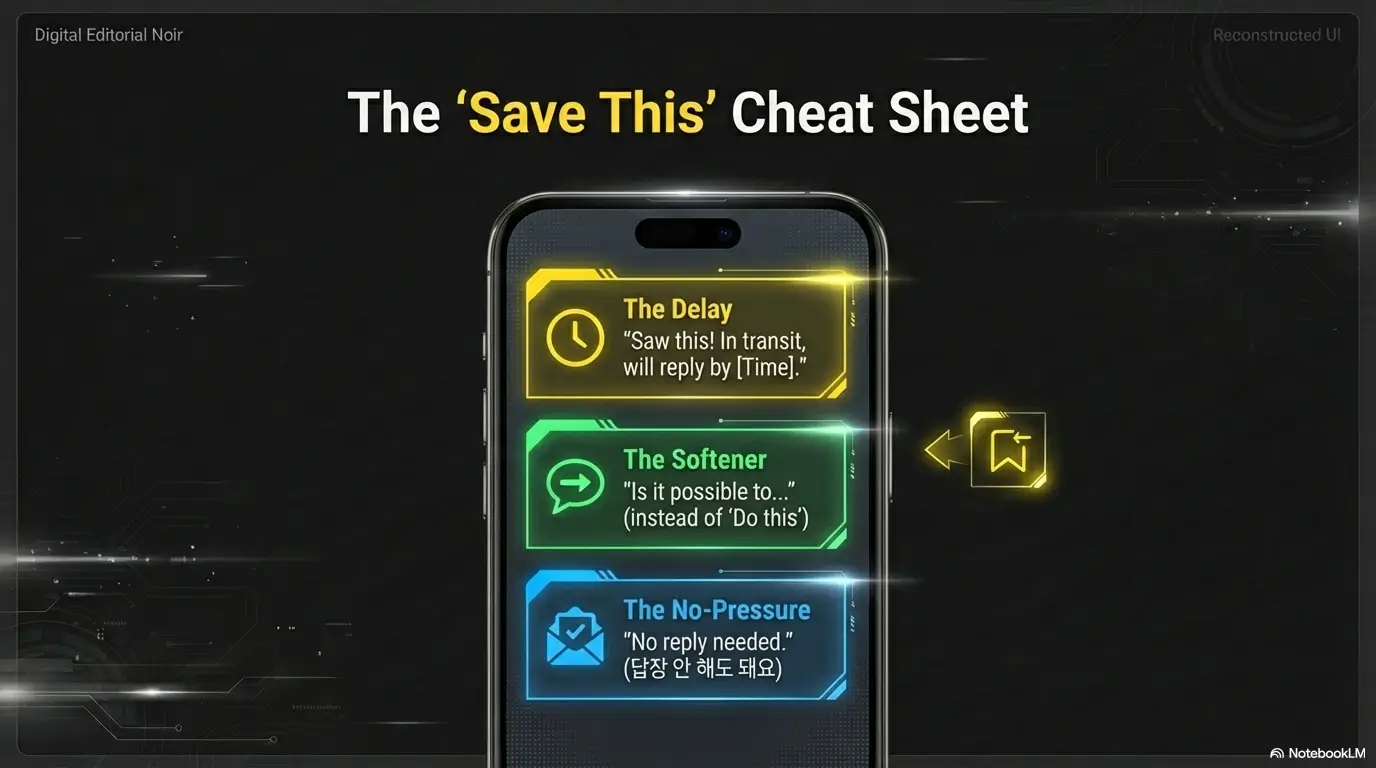
- “봤어요!” (Saw this!)
- “지금은 이동 중이라” (I’m in transit right now)
- “저녁에 답할게요 🙂” (I’ll reply this evening 🙂)
That tiny template works because it protects both sides: your bandwidth and their uncertainty. If you use it consistently for one week, people quickly learn your communication rhythm and stop over-interpreting gaps.
In my own workflow, this reduced chat anxiety more than any productivity app ever did. Fancy systems are nice. Predictable courtesy is better.
Bonus: a compact template library for real situations
- Work urgent: “확인했습니다. 30분 내 업데이트 드릴게요.”
- Social delay: “늦게 봤어! 오늘 좀 정신없었어 ㅠㅠ 이따 길게 답할게.”
- Group noise control: “상세는 DM으로 보낼게요. 핵심만 공유하면…”
- No response needed: “참고만 부탁드려요. 답장 안 하셔도 됩니다.”
Pick 4–6 lines and keep them handy. Repetition builds trust faster than brilliance. If your messages are mostly with travelers or newcomers, you can also borrow polite, concise phrasing habits from this Korean digital nomads phrasebook.
FAQ
Is it rude to read a KakaoTalk message and reply later?
Not automatically. It depends on message type and relationship. For logistics or emotional check-ins, acknowledge quickly and answer later. For low-stakes chat, delayed replies are often normal.
How long should I wait before following up on KakaoTalk?
For urgent logistics, follow up in 15–60 minutes depending on deadline. For routine work threads, same-day follow-up is usually reasonable. For social chat, wait longer and keep tone gentle.
What does 읽씹 mean in dating vs friendship?
In dating, repeated 읽씹 can feel like emotional withdrawal. In friendships, occasional read-without-reply is often tolerated if the overall pattern is warm and reliable.
Do Koreans expect instant replies in group chats?
Not instant, but context-aware. If your response affects decisions or schedules, faster acknowledgment helps. For non-urgent chatter, delayed participation is common.
Which emojis sound polite on KakaoTalk?
There is no universal list, but softer markers (like ㅎㅎ or empathetic wording with ㅠㅠ when appropriate) often feel warmer than neutral punctuation alone. Match emoji intensity to message seriousness.
Is “ㅋㅋ” always friendly, or can it sound dismissive?
It can be either. In playful context with rapport, it reads friendly. Paired with blunt disagreement or sensitive content, it can land as dismissive.
Should I apologize for every delayed reply?
No. Over-apologizing can feel heavy. Use a concise acknowledgment, one line of context, and a clear follow-up time.
When should I move from group chat to direct message?
Move to DM when detail is person-specific, sensitive, or likely to create notification fatigue. Return to group only with concise updates relevant to everyone.
Conclusion — Close the Loop in 15 Minutes
At the start, we said the real risk isn’t “bad manners”—it’s the mismatch between what you mean and what your message signals. That’s the loop, now closed. You don’t need perfect Korean slang. You need a repeatable system: acknowledge, contextualize, and set timing. Do that, and 읽씹 anxiety drops, group friction falls, and your tone travels better across culture. If you’re also navigating other social contexts in Korea, related etiquette guides like Korean bowing basics, Korean wedding cash gift etiquette, and Korean funeral etiquette for foreigners can round out your communication instincts.
Here’s your 15-minute action plan:
- Build a 6-line reply template bank (work, social, delayed, group, empathy, no-response-needed).
- Set a personal timing rule (urgent within 15–30 min acknowledgment; routine same day).
- Run the 30-second send check before sensitive messages.
Small scripts, steady habits, better relationships. That’s the whole game.
Last reviewed: 2026-02.