
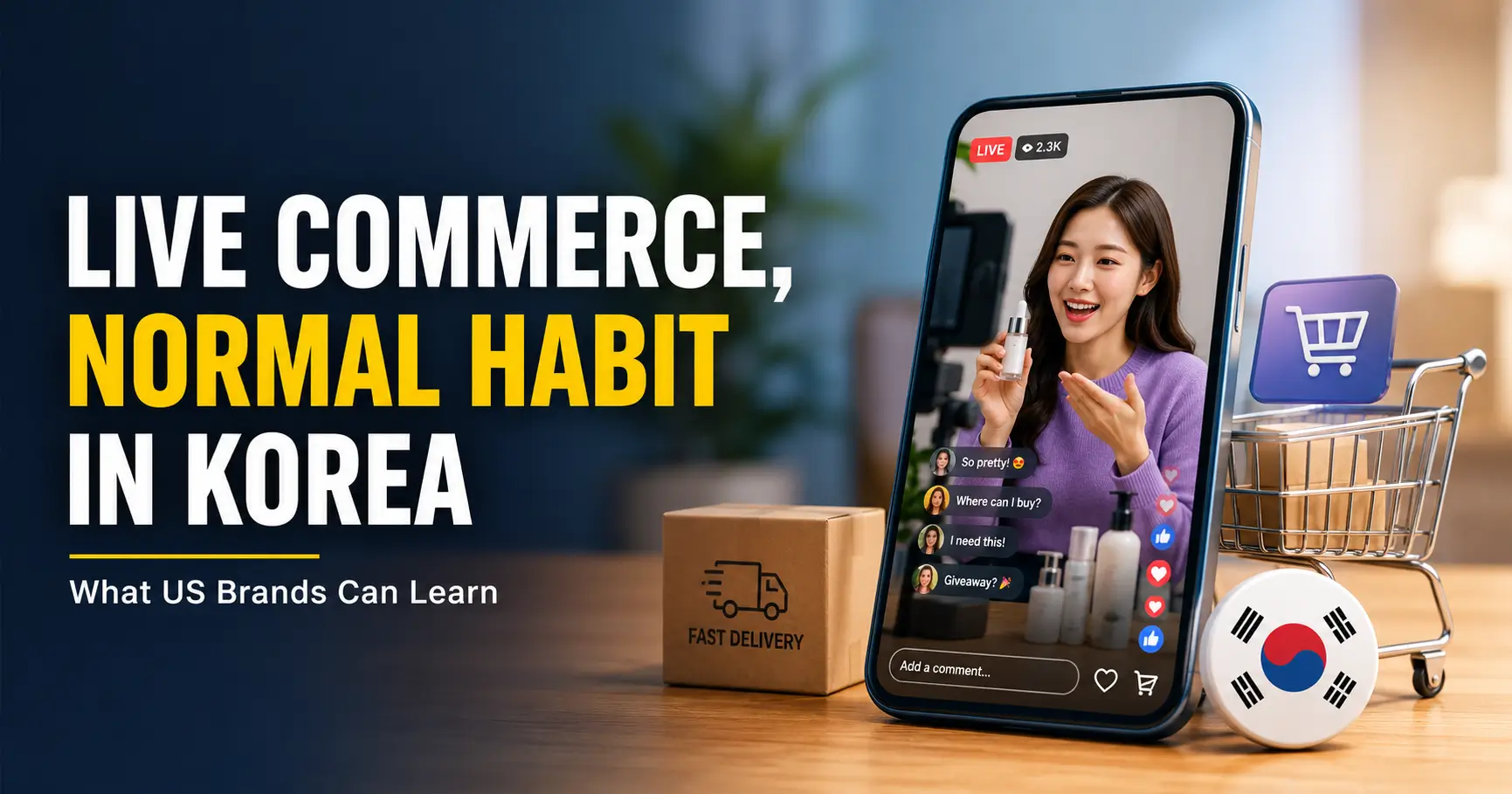
Korea retail culture guide
How Live Commerce Became a Normal Shopping Habit in Korea
And What US Brands Can Learn From It
Live commerce in Korea did not become normal because shoppers suddenly wanted a louder product page. It became normal because the country already had the ingredients simmering: mobile-first buying, fast delivery expectations, beauty and food discovery, platform trust, and a public chat window where hesitation could be answered before it hardened into “maybe later.”
For US and UK marketers, the real lesson is not “start a livestream and toss coupons at the screen.” That is the glitter, not the engine. Korea’s live shopping habit works because entertainment, proof, service, and checkout sit close together. The stream does not merely sell. It reduces uncertainty in public.
This guide breaks down why Korean live commerce moved from novelty to routine, where the buyer psychology lives, which categories trained the habit, and how brands can borrow the thinking without copying the costume. Think less stage show, more sales floor with a heartbeat.
Understand the habit
See why live shopping felt natural inside Korea’s mobile routines.
Read the psychology
Learn how hosts, chat, proof, and urgency soften buyer doubt.
Apply it carefully
Use Korea’s lessons without forcing a copy-paste strategy.
Core idea: Korean live commerce became routine when watching, asking, comparing, and buying collapsed into one comfortable mobile ritual. 🛒
Snapshot
This article is for marketers, e-commerce operators, creators, retail analysts, and culturally curious shoppers who want to understand Korean live commerce as a habit, not a passing retail stunt. You will learn why it worked, what buyers actually respond to, which mistakes waste money, and how to study one Korean live shopping session like a strategist.
Table of Contents
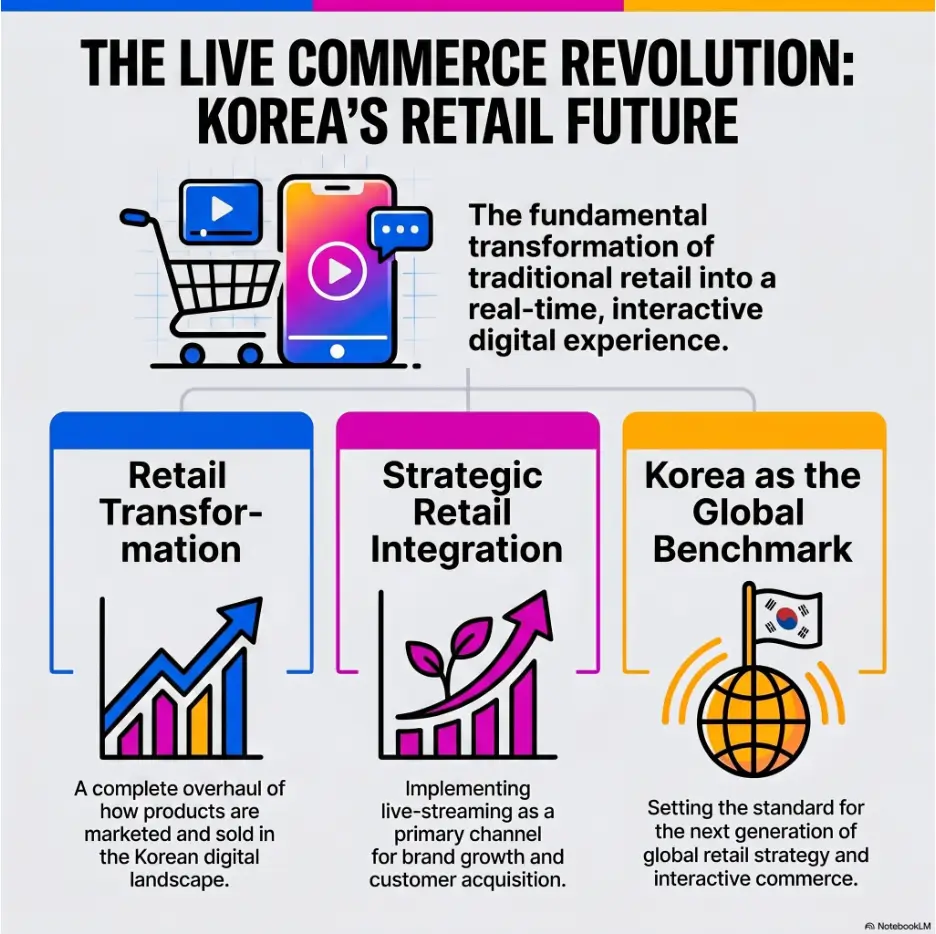
Why Korea Was Ready Before the Live Button Appeared
Korean live commerce feels modern, but its roots are practical. The habit did not bloom in a glass box. It grew in a country where mobile shopping, rapid delivery, app-based payments, creator culture, beauty tutorials, food demos, and real-time messaging already lived near each other.
That matters because a new retail behavior rarely succeeds by asking people to become someone else. It succeeds when it gives an existing behavior a shorter path. Korean shoppers were already tapping, comparing, reviewing, chatting, and buying on phones. Live commerce simply stitched those actions into one moving surface.
Mobile shopping was already muscle memory
In Korea, the phone is not a second screen for commerce. For many shoppers, it is the main counter, cashier, catalog, review archive, and delivery tracker. Live commerce benefited from that cultural muscle memory.
A shopper did not need to learn a strange new journey. They opened an app they already trusted, watched a host explain a product, asked a question, grabbed a coupon, and checked out before the rice cooker beeped in the kitchen. That small friction drop is not glamorous, but it is powerful.
Fast delivery made impulse buying feel safer
Urgency works best when the after-purchase experience feels dependable. In Korea, fast delivery expectations made a live shopping purchase feel less risky. The shopper could think, “If this is useful, I will have it soon. If it is wrong, the return policy should be clear.”
That is a quiet difference from markets where delivery is slow, return rules are fuzzy, or customer service feels like a maze with fluorescent lighting. Live commerce can create desire, but logistics decides whether that desire becomes habit.
Product discovery moved from search bars to screens
Traditional e-commerce asks shoppers to type what they want. Live commerce often catches shoppers before they know the exact search term. A host shows a sunscreen texture, a rice cake cross-section, a jacket fit, or a storage box in a real room. Discovery becomes visible, not abstract.
This is why live commerce is especially useful for products where the written description is a poor substitute for the thing itself. “Moisturizing but not sticky” becomes more persuasive when someone presses the cream into skin under bright lights and answers a viewer asking about oily T-zones.
Key takeaway
Korea did not need live commerce to invent mobile shopping. It needed live commerce to make mobile shopping feel more explainable, social, and immediate.
| Existing Korean shopping behavior | Live commerce added | Why it mattered |
|---|---|---|
| Mobile-first browsing | Live video inside familiar apps | Less learning friction |
| Fast delivery expectations | Time-sensitive buying moments | Impulse felt less risky |
| Heavy review reading | Public chat and real-time Q&A | Questions surfaced before checkout |
| Beauty and food discovery | Demonstration, texture, freshness cues | Products became easier to judge |
| Platform loyalty points | Coupons, rewards, and app alerts | Watching felt economically useful |
The Trust Layer: Why Korean Shoppers Listen Before They Click
Trust in live commerce is not a single switch. It is a stack of small signals: who is speaking, how they handle questions, whether the product is shown honestly, whether the price makes sense, and whether the platform feels accountable if something goes wrong.
In a normal product page, doubt often hides in private. In a live shopping session, doubt becomes visible. One shopper asks, “Does this run small?” Another asks, “Is the pan induction-safe?” A third asks, “Can I use this on sensitive skin?” The answers help everyone watching.
Hosts became the new product page
A strong live commerce host is not just a presenter. The host is part demonstrator, part editor, part customer-service translator, and part human filter. That is why treating hosts like ordinary influencers misses the point.
Good hosts know how to slow down at the exact moment a shopper might hesitate. They repeat sizing details, compare use cases, hold products closer to the camera, read skeptical comments without flinching, and make the purchase feel inspected rather than pushed.
Real-time questions replaced review-page digging
Reviews still matter. But live commerce gives shoppers a faster path to specific answers. Instead of scanning twenty reviews for one sentence about fabric thickness, the viewer can ask directly and watch the host pinch, stretch, fold, or compare the item.
That does not remove the need for honest reviews. It changes the sequence. The live session often becomes the first confidence check, while reviews, ratings, and return policies become the safety net underneath.
“Show me the texture” changed beauty shopping
Beauty is one of the clearest examples. A product page can say “lightweight serum.” A host can show how quickly it absorbs, whether it leaves shine, how it layers under makeup, and how the bottle dispenses. The screen becomes a small laboratory.
For shoppers who have wasted money on products that looked perfect online and behaved badly at home, that demonstration is not decoration. It is loss prevention.
Trust signal checklist for live shopping
- The host answers uncomfortable questions, not only easy ones.
- The product is shown in use, not merely held up like a trophy.
- Shipping, returns, sizing, ingredients, or warranty details are stated clearly.
- The discount is easy to understand without mental gymnastics.
- The replay or product page preserves important details after the stream ends.
Naver, Coupang, Kakao, YouTube: The Platform Stack That Made It Normal
Korean live commerce became normal partly because it did not live in one lonely corner of the internet. It appeared across platforms Korean shoppers already used for search, messaging, shopping, content, loyalty, and payments.
That platform stack matters for US brands studying Korea. A livestream is not only content. It is distribution, checkout, search, alerts, rewards, returns, and data. When those pieces sit close together, live commerce feels less like a stunt and more like an ordinary shopping option.
Naver made live shopping feel searchable
Naver is not just a search engine in the Korean market. It sits near shopping, content, reviews, blogs, maps, and everyday discovery. When live shopping is connected to search behavior, it becomes easier for shoppers to find, compare, revisit, and verify.
For a brand, that changes the planning question. The live session should not vanish after the broadcast like steam from a kettle. It should become searchable evidence: product answers, clips, replay value, offer context, and buyer reassurance.
Coupang made convenience the default expectation
Coupang trained many shoppers to expect speed and simplicity. That expectation affects how live commerce is judged. If the stream creates excitement but the checkout or delivery experience feels slow, the spell breaks.
The Korean lesson is blunt: live commerce is not a cure for weak operations. It magnifies them. If the product, price, delivery, and return path are clear, the stream can accelerate trust. If they are messy, the stream puts the mess under brighter lights.
Kakao added social proximity to commerce
Kakao’s strength comes from closeness. Messaging, gifting, alerts, communities, and daily communication create a social doorway into commerce. Live shopping can feel more natural when it arrives through a familiar social environment rather than a cold promotional blast.
For marketers, the takeaway is not “copy Kakao.” It is to ask where the shopper already feels socially comfortable. A live shopping invite sent into the wrong context feels noisy. In the right context, it feels like a useful tap on the shoulder.
YouTube raised the ceiling for creator-led shopping
YouTube-style video behavior also shaped expectations. Viewers were already used to learning from creators, watching product comparisons, and trusting people who could explain, test, and entertain without sounding like a shopping mall loudspeaker.
Creator-led shopping works when the creator’s credibility survives the sale. The audience must feel that the explanation came first and the transaction came second, even when the business goal is obvious.
Useful official context
For broader market context on Korea’s digital trade and consumer environment, official trade and investment resources can help marketers separate durable behavior from temporary buzz.
Explore KOTRA Korea Market ResourcesThe Deal Clock: How Urgency Became Entertainment
Urgency is one of the most misunderstood parts of live commerce. Bad urgency feels like pressure. Good urgency feels like a clear opportunity with a visible clock, a simple reason, and enough product confidence to make the decision feel fair.
Korean live commerce often turns the deal itself into part of the show. Coupons unlock during the broadcast. Bundles appear for a limited window. Viewers compare price, quantity, and bonus items in real time. The offer becomes something to watch, not just something to read.
Limited-time coupons created low-friction urgency
A time-limited coupon works best when the shopper already understands the product. If the offer appears too early, it can feel pushy. If it appears after demonstration, Q&A, and comparison, it can feel like a sensible next step.
This is where many brands get the rhythm wrong. They lead with discount fireworks before building confidence. The better sequence is simple: show the product, answer doubt, clarify the offer, then make checkout easy.
Bundles made the cart feel practical, not reckless
Bundles are common in live commerce because they make a larger cart feel more rational. A skincare set, pantry bundle, family snack pack, or seasonal home kit can feel useful if the host explains who it is for and how quickly it will be used.
The trick is to avoid bundle fog. If viewers cannot understand the price advantage, item count, shipping rule, or return limitation, the bundle stops feeling generous and starts feeling like homework.
Don’t confuse urgency with pressure
Pressure says, “Buy now or lose.” Useful urgency says, “Here is the window, here is the reason, here is the value, and here is what to check before you decide.” The second version respects the buyer’s intelligence.
That distinction matters for long-term habit. If viewers feel tricked, they may buy once and leave. If they feel helped, they come back for the next session.
| Urgency tactic | When it helps | When it backfires | Safer alternative |
|---|---|---|---|
| Countdown coupon | After product value is clear | Before viewers understand the product | Place it after the demo and Q&A |
| Limited bundle | When the bundle solves a real use case | When the bundle is hard to compare | Show unit price or practical savings |
| Low stock message | When inventory is genuinely limited | When scarcity feels theatrical | Explain stock limits honestly |
| Host-only deal | When the host adds education or trust | When it feels like a random discount | Connect the deal to a clear shopper need |
Beauty, Food, Fashion: The Categories That Trained the Habit
Not every category is equally suited to live commerce. Korea’s habit was trained by categories where demonstration reduces uncertainty quickly. Beauty, food, fashion, and lifestyle goods gave shoppers reasons to watch because the screen could reveal something the product page could not.
That is the core category test: does live explanation make the product easier to judge? If yes, the format has a job. If not, the stream may become an expensive version of a static page.
Beauty needed demonstration, not description
Korean beauty shopping already had a strong culture of tutorials, texture talk, shade comparison, skin-type questions, and routine building. Live commerce fit that world almost too neatly.
A good beauty stream can show product finish, layering, packaging size, application method, and common mistakes. It can also answer sensitive questions without making shoppers search through a mountain of scattered reviews.
Food sold better when viewers could see freshness cues
Food is emotional, visual, and practical. A host can slice fruit, steam dumplings, open packaging, show portion size, compare gift sets, or explain storage. That makes the buying decision feel less imaginary.
For premium food, regional specialties, and seasonal bundles, live commerce can make freshness and gifting value easier to understand. The screen becomes a tasting room without the taste.
Fashion benefited from motion, sizing, and styling talk
Fashion product pages often hide the most important questions: how does it move, where does it cling, how sheer is it, what height is the model, and does the color change under different light?
A live stream can answer those questions quickly. Hosts can try on sizes, style one piece several ways, and respond to body-shape questions in real time. That turns a risky purchase into a more informed one.
Lifestyle goods turned the home into a showroom
Home storage, kitchen tools, cleaning devices, bedding, and small appliances benefit from context. Shoppers want to see scale, noise, assembly, cleaning, and where the item fits in an actual room.
For these categories, live commerce works best when the host shows daily use, not just polished features. A mop should meet a floor. A blender should meet frozen fruit. A storage basket should meet the chaotic cabinet where good intentions go to nap.
Key takeaway
The best live commerce categories are not simply “popular.” They are categories where demonstration, comparison, and public Q&A reduce the buyer’s fear of wasting money.
| Category | What live video proves | Best shopper question to answer |
|---|---|---|
| Beauty | Texture, finish, shade, routine fit | “Will this work for my skin type?” |
| Food | Freshness, portion size, packaging, gifting value | “Is this worth the price compared with buying locally?” |
| Fashion | Fit, movement, styling, fabric behavior | “How will this look on someone shaped like me?” |
| Home goods | Scale, use case, storage, cleaning, setup | “Will this actually make my day easier?” |
| Creator products | Credibility, use story, audience fit | “Do I trust this person’s recommendation?” |
Who Live Commerce Works For, And Who Should Pause
Live commerce is not a magic lantern. It works best when there is something meaningful to show, explain, compare, or answer. A weak product does not become strong because someone smiles at it under studio lights.
For US and UK brands studying Korea, the smarter question is not “Should we do live shopping?” It is “What buyer hesitation could a live format solve better than our current product page?”
Best for brands that need demonstration
Live commerce is a strong fit when the product has visible proof. Beauty finish, food quality, fashion fit, appliance function, craft detail, and comparison shopping all benefit from a person showing the buyer what matters.
Small brands can also use live commerce well when explanation beats ad spend. A founder who can explain why a product exists, what problem it solves, and who should skip it may build more trust than a glossy ad ever could.
Best for creators who can explain while selling
Creator-led live shopping works when the creator understands the audience’s doubts. The magic is not charisma alone. It is diagnosis. The creator knows what viewers fear, what they compare, and what would make them feel foolish after buying.
A creator who says, “This is not for you if…” often becomes more credible, not less. That kind of restraint is rare enough to feel fresh.
Not for brands with unclear service promises
If shipping, returns, sizing, ingredients, warranties, delivery windows, or customer support are unclear, live commerce may expose the problem faster. Viewers will ask. The chat will not politely ignore missing information.
Before paying for a studio, host, creator partnership, or live shopping software, brands should fix the basics. The cost of a live commerce setup is easier to justify when the buying path behind it is sturdy.
| Approach | Best for | Typical cost level | What to compare before paying |
|---|---|---|---|
| Good: simple in-house live session | Small brands testing demand | Low | Phone quality, lighting, host clarity, replay plan |
| Better: platform-native live shopping | Brands with active app or marketplace presence | Medium | Checkout flow, coupon tools, audience alerts, analytics |
| Best: creator or hosted commerce program | Brands with proven products and clear margins | Higher | Creator fit, service level, return policy, content rights, post-stream use |
Before you spend money
Do not pay for live commerce production until you can answer five basics: who the buyer is, what doubt the stream will remove, what offer is simple enough to understand live, how fulfillment works, and how the replay will keep selling after the broadcast.
The Habit Loop: Why Viewers Came Back Again
A one-time live shopping event can create sales. A habit creates repeat attention. Korea’s live commerce became routine because platforms and sellers gave shoppers reasons to return even when they were not actively hunting for a specific product.
The habit loop is simple: a cue brings the viewer in, the stream gives useful entertainment, the offer rewards attention, and the delivery experience confirms the decision. Repeat that enough times and live shopping stops feeling unusual.
Same-time broadcasts created appointment shopping
Live commerce borrows from television but compresses the path to purchase. A scheduled broadcast gives shoppers a reason to show up at a specific time. The difference is that the viewer can ask questions, claim a coupon, and buy without leaving the screen.
For brands, consistency matters. A random live session can feel like an interruption. A recurring format can become a small ritual: Friday beauty deals, evening food specials, seasonal home refreshes, or creator picks after payday.
Push alerts turned commerce into a daily tap
Push alerts are powerful because they connect timing with intent. A shopper may not search for a product, but a timely notification can invite them into a session that feels relevant enough to sample.
The danger is alert fatigue. If every alert screams discount, shoppers stop listening. Better alerts tell the viewer why the session is worth attention: a limited restock, a useful comparison, a seasonal problem, or a host known for honest demonstrations.
Loyalty points made watching feel economically useful
Rewards, points, and app benefits can make watching feel productive. Even when viewers do not buy, the session may still feel tied to future savings, product knowledge, or platform loyalty.
This is one reason live commerce can be sticky. It is not only a purchase moment. It is a research moment, a reward moment, and sometimes a social moment, all bundled into one small rectangle of light.
Live commerce habit loop
1. Cue
App alert, creator post, platform banner, or scheduled show.
2. Confidence
Demo, comparison, chat answers, and host credibility.
3. Offer
Coupon, bundle, loyalty points, or live-only deal.
4. Checkout
Low-friction payment, clear shipping, visible return path.
5. Repeat
Good delivery experience makes the next stream easier to trust.
What US Brands Usually Miss About Korea’s Live Shopping Habit
The biggest mistake is treating Korean live commerce as a format instead of a system. A format is “person talks on camera while products appear.” A system is platform trust, mobile checkout, audience alerts, delivery expectations, host credibility, and post-stream replay working together.
US brands can learn a great deal from Korea, but adoption will not copy exactly. The US market has different platform habits, delivery norms, creator relationships, category expectations, and privacy attitudes. Translation beats imitation.
Korea’s live commerce is infrastructure, not only content
A beautiful stream cannot compensate for a clunky cart. A charming host cannot rescue unclear shipping. A coupon cannot fix a return policy that reads like it was written in a basement by a tired printer.
Before launching live shopping, brands should audit the full journey. How does a viewer enter? How do they ask? How do they compare? How do they buy? What happens after the stream? The boring questions often decide the exciting results.
The shopper is comparing, chatting, and buying at once
Live commerce shoppers are not passive. They may watch the stream, check reviews, compare a competitor, message a friend, read the chat, and inspect the return rule in the same few minutes.
That means vague claims die quickly. The host and product page must work together. If the host says “premium fabric” and the page does not list material details, trust leaks out of the funnel.
The best broadcasts reduce uncertainty in public
Public uncertainty is not a problem to hide. It is the raw material of a good live session. Every thoughtful question in the chat is a chance to help dozens or thousands of quieter viewers.
Brands should prepare for the questions that usually block purchase: price, size, ingredients, compatibility, delivery time, returns, durability, authenticity, care instructions, and who should not buy.
Show me the nerdy details
Live commerce often works because it compresses several conversion steps into one session. Awareness comes from the platform alert or creator audience. Evaluation comes from the demonstration. Objection handling happens in chat. Social proof appears through comments, purchase counters, or repeated questions. The offer provides a decision window. Checkout closes the loop. The replay can then become a long-tail asset for shoppers who missed the live event.
The strategic question is not whether livestreaming is popular. The better question is whether the format shortens the distance between doubt and proof. If it does, the stream has commercial value beyond entertainment.
For related cultural context, readers studying Korean consumer behavior may also find it helpful to look at how Korean convenience stores shape daily buying habits and why Korean gift sets carry practical social meaning.
The Conversion Psychology Hidden Inside the Chat Window
The chat window is not decorative. In Korean live commerce, it often acts like a public sales floor. Viewers ask, compare, joke, doubt, confirm, and sometimes persuade each other without any official script.
That is why brands should treat chat design and moderation as part of conversion strategy. A stream with unanswered questions feels abandoned. A stream where the host and support team respond well feels alive and accountable.
Social proof appears before the checkout page
In many e-commerce journeys, social proof appears as ratings or reviews below the product description. In live commerce, social proof can appear before checkout through comments, viewer count, repeat questions, and visible buyer reactions.
This does not mean brands should fake excitement. Viewers are quick to notice theater. Real social proof is strongest when it feels specific: “I bought this last month and the size ran true,” or “The refill pack lasted my family three weeks.”
Objections surface while the product is still being shown
In a normal product page, objections may never reach the seller. The shopper simply leaves. In live commerce, objections appear while the seller still has a chance to answer.
That is commercially valuable. If five viewers ask about sizing, the host can pause and show the size chart. If several ask about delivery before a holiday, the support team can clarify shipping cutoffs. The stream becomes a diagnostic tool.
Viewers learn from other buyers’ questions
Many viewers never type. They lurk, read, and decide quietly. A strong chat helps those silent shoppers because someone else asks the question they were carrying.
That public learning is one of live commerce’s underrated strengths. The brand does not need to guess every objection in advance. The audience helps reveal the decision map.
Short Story: The Jacket That Sold After the Second Question
A small fashion seller runs a quiet evening stream. The jacket is good, but the first ten minutes feel flat. The host talks about color, fabric, and discount. Viewers drift in and out like birds testing a branch.
Then someone asks, “Is it warm enough for early winter?” The host stops, puts on a knit underneath, turns sideways, and explains the lining. Another viewer asks about shoulder width. The host brings out a measuring tape.
The chat changes. The jacket is no longer a pretty object. It becomes a solved problem: commuting, layering, sizing, weather, price.
The lesson is small but sharp. The sale did not begin with the discount. It began when the host treated doubt as useful information.
Key takeaway
The chat window is where live commerce turns private hesitation into shared decision support. Brands that answer well can turn objections into trust.
Bad Live Commerce Lessons to Copy From Korea
Korea offers valuable lessons, but not every visible tactic should be copied. Some tactics work because they sit inside Korean platform habits, delivery norms, and consumer expectations. Remove the system and the tactic can wobble.
For US and UK teams, the goal is to borrow the logic, not the surface. Copying the format without the service promise is like borrowing a restaurant’s menu but forgetting the kitchen.
Don’t copy the format without copying the service promise
If Korean shoppers trust a live deal partly because delivery and returns feel familiar, then a brand in another market must build its own confidence signals. Shipping windows, returns, customer service, and product guarantees need to be visible before the hard sell begins.
This is especially important for higher-priced items. The more expensive the product, the more the stream must prove that the buyer will not be stranded after checkout.
Don’t over-script the host until the stream feels plastic
A script can protect accuracy. Too much script can suffocate trust. Viewers often respond to hosts who can explain naturally, notice confusion, and adjust without sounding like a brochure learned to breathe.
The better approach is a structured run-of-show with room for genuine answers. Give the host product facts, claims to avoid, demonstration points, offer details, and escalation rules. Then let the conversation breathe.
Don’t fake scarcity when viewers can smell theater
Fake scarcity is expensive in the long run. It may lift a single event, but it teaches viewers to distrust the next one. Live commerce depends on repeat attention, so credibility is not a soft metric. It is inventory for the future.
Use urgency only when it is real: limited stock, seasonal supply, event-only bundle, shipping deadline, or a negotiated live discount. Explain it plainly.
| Common mistake | Why it wastes money | Better move |
|---|---|---|
| Starting with discounts | Attracts bargain hunters before building product confidence | Open with the problem and demo |
| Ignoring replay value | Limits the stream to one time slot | Clip answers, save demos, and improve product pages |
| Using a poor host fit | Weakens trust even if the audience is large | Choose someone who can explain the product honestly |
| Hiding return details | Creates hesitation near checkout | State shipping, returns, and support clearly |
| Measuring only live sales | Misses research, remarketing, and content value | Track replay views, product-page lift, email signups, and repeat buyers |
Consumer protection context
Teams planning live shopping should stay grounded in fair advertising, transparent pricing, and clear customer communication. Official consumer guidance can help keep promotions honest.
Review FTC Advertising Guidance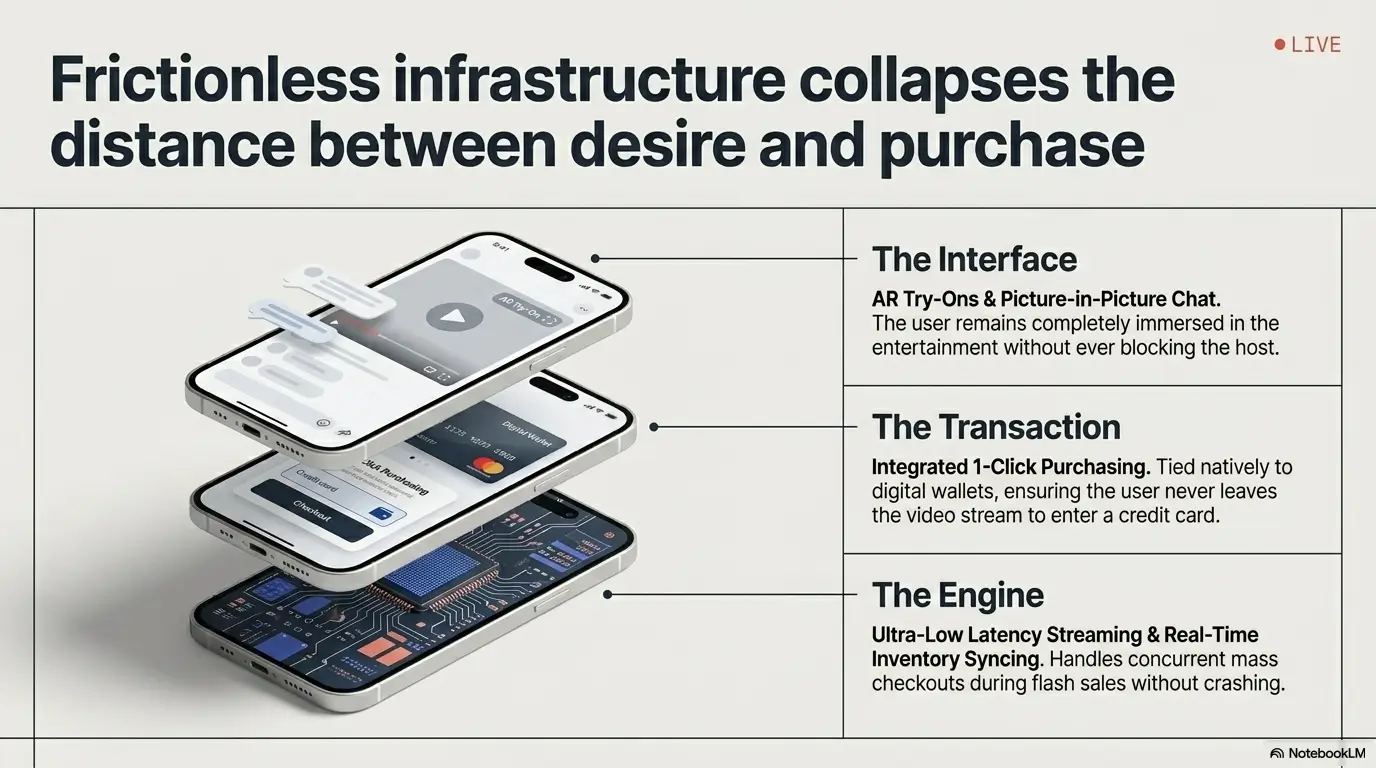
FAQ
Why did live commerce become popular in Korea?
Live commerce became popular in Korea because it matched existing consumer habits: mobile shopping, fast delivery, app-based payments, strong platform loyalty, beauty and lifestyle discovery, and real-time messaging. It did not ask shoppers to start from zero. It made familiar shopping behavior more visual, social, and immediate.
Is Korean live commerce different from QVC?
Yes. Korean live commerce shares some DNA with TV shopping, but the mobile environment changes the experience. Shoppers can comment, ask questions, compare products, claim app coupons, use platform rewards, and check out quickly from the same device. It is more interactive and more tightly connected to everyday mobile shopping.
Which products sell best through live commerce in Korea?
Products that benefit from demonstration tend to perform well. Beauty, food, fashion, home goods, lifestyle items, and creator-recommended products are natural fits because viewers want to see texture, fit, portion size, freshness, scale, or real use before buying.
Why do Korean shoppers trust livestream hosts?
Trust depends on the host, platform, product, and service promise. Strong hosts demonstrate clearly, answer difficult questions, explain who the product is and is not for, and make pricing or delivery details easy to understand. Trust grows when the host feels useful rather than merely promotional.
Can US brands copy Korea’s live commerce model?
US brands can borrow the principles, but they should not blindly copy the format. Korea’s model works within a specific mix of mobile platforms, delivery expectations, app behavior, and consumer trust. US brands should adapt the logic: reduce uncertainty, show proof, make checkout simple, and treat chat as part of the sales floor.
How does live commerce help reduce buyer hesitation?
It reduces hesitation by answering questions while the product is being shown. Viewers can see demonstrations, read other shoppers’ concerns, watch the host compare options, and understand the offer before checkout. That public objection handling can make the purchase feel less risky.
Is live commerce mainly for younger shoppers?
Younger shoppers may be comfortable with video and chat-based buying, but live commerce is not only a youth behavior. The format can work for any shopper who values demonstration, clear answers, convenient checkout, and trustworthy service. Category and platform fit matter more than age alone.
What makes a live shopping broadcast successful?
A successful broadcast has a clear buyer problem, a credible host, visible product proof, responsive chat, a simple offer, transparent delivery and return details, and a replay plan. The best streams do not merely entertain. They help viewers decide with less regret.
Study One Korean Live Shopping Session Like a Buyer
The smartest next step is not to launch a live commerce program tomorrow. It is to study one session carefully. Choose one Korean live shopping session in a category you understand, then watch it as a buyer, not as a marketer hunting for shiny tactics.
Give yourself 15 minutes. That is enough to see the hook, the host’s trust signals, the first objections, the offer design, and the way the platform nudges viewers toward checkout.
The 15-minute live commerce study plan
- Pick one category, such as beauty, food, fashion, or home goods.
- Watch the first five minutes and write down the opening promise.
- Note every trust signal before the first major discount appears.
- Track the first five questions in the chat and how the host answers.
- Look at the product page or replay afterward and see what details survived beyond the live moment.
That small exercise will teach more than a stack of trend reports because it shows the machine in motion. You will see whether the host builds confidence, whether the chat reduces doubt, whether the offer is clear, and whether the platform makes buying feel natural.
Final practical checklist
- Can you name the buyer hesitation the stream solves?
- Can the product be demonstrated better than it can be described?
- Can the host answer real objections without sounding scripted?
- Is the deal easy to understand in under 10 seconds?
- Are shipping, returns, and service details visible before checkout?
- Will the replay still help shoppers after the live session ends?
Korea’s live commerce habit was not built by video alone. It was built by reducing the distance between curiosity and confidence. Watch one session with that lens and the lesson becomes clearer: the future of shopping may not be louder. It may simply be more answerable.
Last reviewed: 2026-06