
Korean Dating Culture and Everyday Style
Why Matching Couple Looks in Korea Feel More Normal
Than Costume-Like
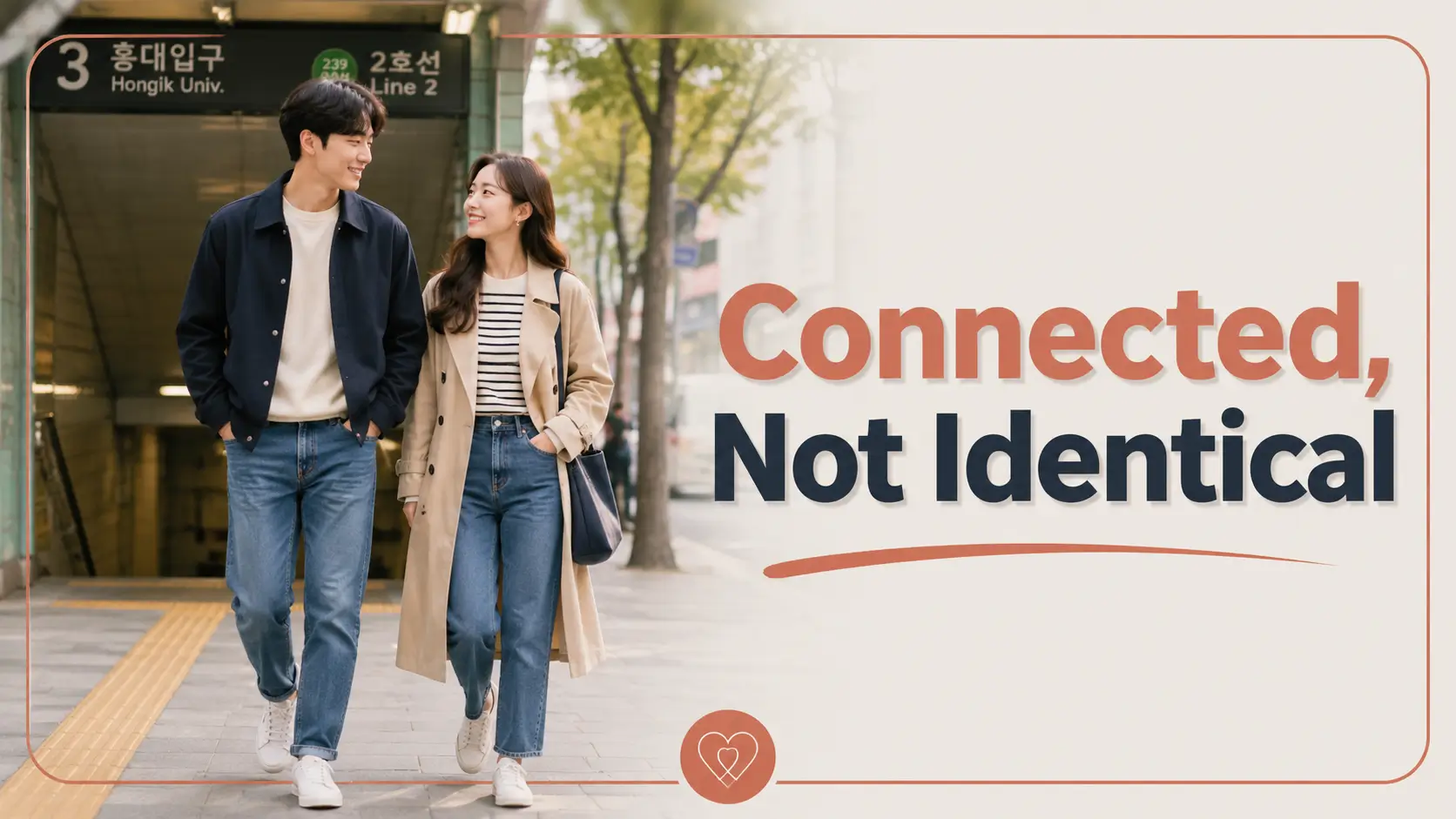
Two people step out of a Seoul subway station wearing navy coats, white sneakers, and slightly different shades of denim. Nothing about them announces a theme. There are no matching slogans, novelty graphics, or identical head-to-toe uniforms. Yet when they walk side by side, the visual connection becomes clear. Their outfits seem to finish each other’s sentence.
That quiet coordination is the key to understanding why matching couple looks in Korea often feel ordinary rather than theatrical. The most successful examples are not really about copying clothes. They are about creating a shared visual rhythm while allowing two distinct people to remain visible inside it.
This guide explains the cultural habits, retail patterns, styling techniques, and social signals behind Korean couple fashion. It also shows how to borrow the idea without buying a novelty set, suppressing personal taste, or spending an entire date dressed as a coordinated sofa display.
See the difference
Learn why coordination reads differently from exact duplication.
Build a wearable look
Use one shared anchor instead of matching every garment.
Avoid the costume trap
Protect comfort, individuality, and real-life practicality.
✨ The goal is not to look identical. It is to look intentionally connected.
Snapshot: This article is for readers curious about Korean dating culture, travelers planning coordinated outfits, and couples who like the idea of matching but dislike anything costume-like.
You will learn what makes a Korean-inspired couple look feel natural, which details matter most, what commonly goes wrong, and how to assemble a comfortable outfit from pieces you may already own.
Table of Contents
Matching Does Not Always Mean Wearing the Same Outfit
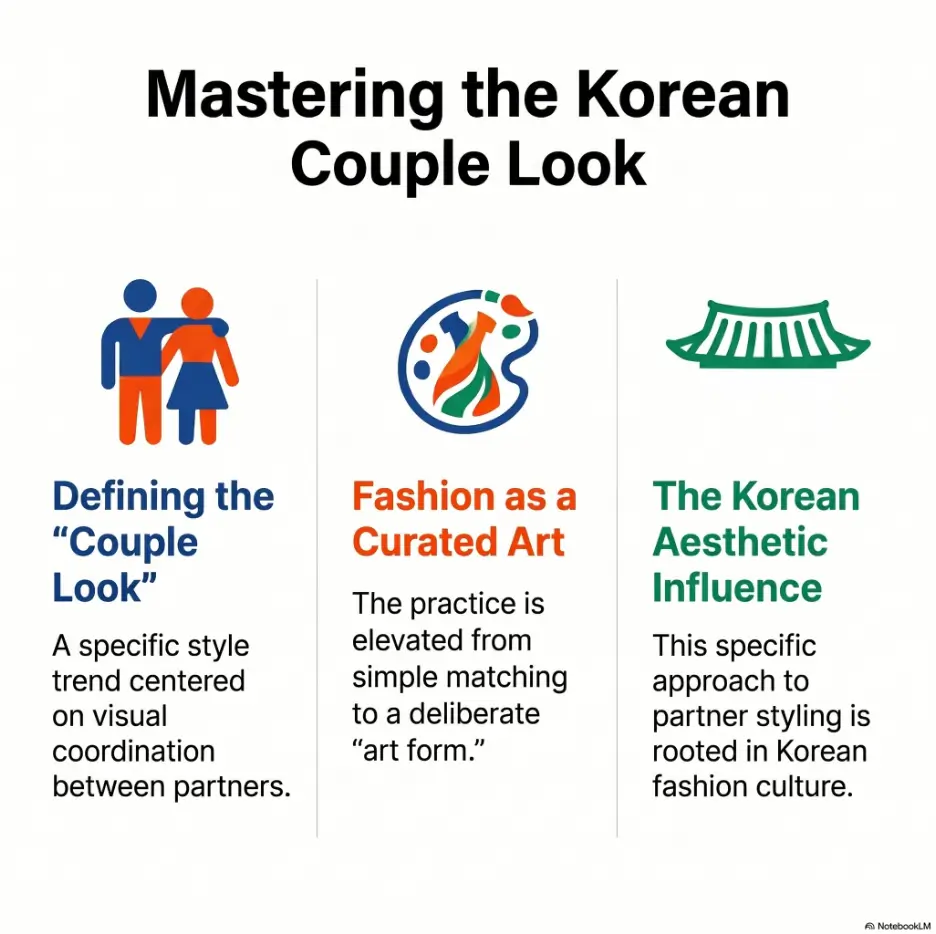
Many English-speaking readers hear “matching couple outfits” and picture identical sweatshirts printed with KING and QUEEN, two copies of the same holiday pajama set, or a novelty T-shirt designed primarily for a photograph. That version exists in Korea too, but it is only one branch of a much larger styling tree.
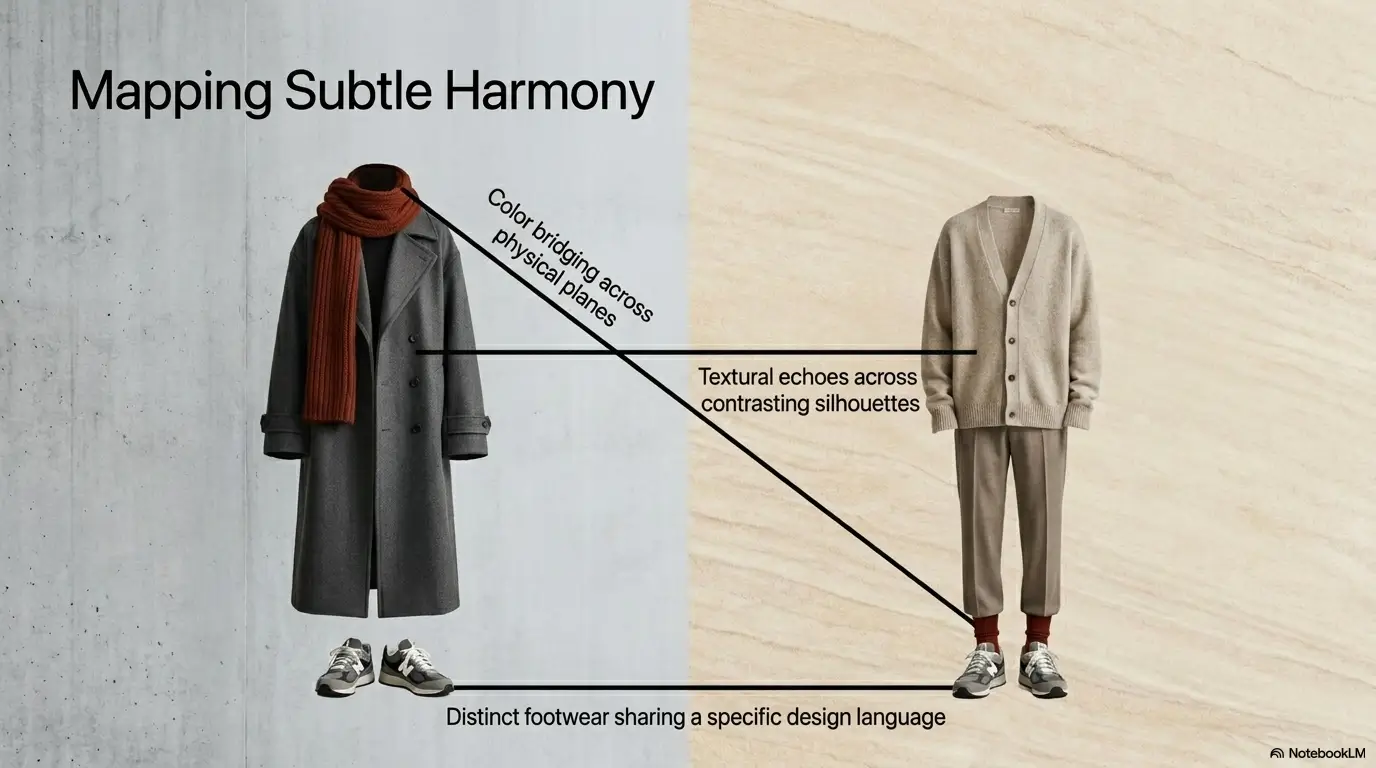
In everyday Korean couple fashion, matching often means repeating a limited number of visual cues. The couple may wear the same family of colors, similar outerwear lengths, related fabrics, or shoes with comparable visual weight. One person may wear a charcoal knit while the other wears a charcoal scarf. One may choose a camel coat while the other carries a camel bag.
The result becomes fully visible only when the two outfits enter the same frame. Separately, each person looks normally dressed. Together, the styling creates a small conversation between color, shape, and texture.
Korean couple looks often repeat a visual cue, not an entire wardrobe
Think of coordination as quotation rather than photocopying. One outfit introduces an idea, and the second repeats it in another form. A cream cardigan can answer a cream baseball cap. A denim jacket can echo a denim skirt without using the same wash or cut.
This gives each partner room to wear silhouettes that suit their body, climate preferences, and personal habits. A person who dislikes fitted clothes can choose a relaxed overshirt, while the other wears a structured jacket in the same color. The relationship between the outfits remains visible without demanding identical proportions.
That distinction matters because clothing is physical. It sits on shoulders, rubs against skin, changes how easily someone moves, and affects whether they feel like themselves. A successful couple look respects those realities instead of sacrificing them to visual symmetry.
Color, texture, and silhouette can create connection without duplication
There are four main styling channels through which outfits can communicate with each other: color, material, shape, and accessory. Most natural-looking couple outfits use one primary channel and perhaps one quiet supporting channel.
| Shared cue | Example | Why it feels natural |
|---|---|---|
| Color | Navy coat with navy knit | The repetition is visible without requiring the same garment |
| Texture | Two wool outer layers in different colors | The outfits share a seasonal mood |
| Silhouette | Both wear relaxed trousers and short jackets | The proportions feel related from a distance |
| Accessory | Similar white sneakers or black caps | The link is easy to notice but low-pressure |
Color is usually the easiest entry point because it does not require matching brands or cuts. Texture is subtler. Two people wearing brushed wool, soft cotton, or washed denim can feel coordinated even when the colors differ. Silhouette creates the most sophisticated effect, but it can require more experimentation because proportions change from body to body.
Why Western observers may notice the matching before the individual styling
People tend to notice what feels culturally unusual to them. A visitor who rarely sees coordinated couples at home may immediately register the shared coats or matching shoes. A Korean passerby may simply see two people dressed neatly for the same season.
This difference in attention can make couple looks appear more deliberate from the outside than they feel to the people wearing them. The couple may have spent only two minutes agreeing to wear beige. The observer sees a social statement; the couple sees Tuesday.
Key takeaway
A Korean-inspired couple look can be built by repeating one visual cue. Exact duplication is optional, not the definition.
The Hidden Difference Between Coordination and Costume
A costume asks the viewer to notice the concept before the people. Coordination works in the opposite order. You see two individuals first, then recognize the connection between their clothes.
This is why identical outfits can sometimes feel more theatrical than related outfits. Perfect sameness produces a strong visual signal. That signal may be charming at an amusement park, anniversary photo shoot, or themed event, but it can become loud during an ordinary lunch, long train ride, or workday errand.
Costumes flatten individuality; coordinated looks leave room for two personalities
Imagine one partner prefers clean, tailored clothing while the other lives happily in oversized layers. Buying two identical fitted jackets will probably delight one person and irritate the other. Choosing two jackets in the same color family, one structured and one relaxed, creates a better result.
The visual bond remains, but neither person becomes a supporting actor in someone else’s outfit fantasy. This is a small but important rule: the relationship should appear through the clothes, not replace the people wearing them.
Everyday fabrics keep the styling grounded in ordinary life
Cotton sweatshirts, denim, wool coats, knitwear, sneakers, and simple button-down shirts are common in Korean-inspired couple looks because they already belong to everyday wardrobes. Their familiarity lowers the dramatic temperature.
Novelty details do the reverse. Oversized printed declarations, cartoon pairs, shiny synthetic sets, or clothes designed only as a matching package can make the couple concept more noticeable than the styling. That may be exactly what a couple wants, but it is not the only route.
For a more natural effect, begin with clothes that would make sense even if the other person were not present. Then add one shared feature. This creates outfits that can survive both a photograph and the rest of the day.
The “recognizable but deniable” rule behind successful couple styling
The best coordinated looks often pass a simple test: strangers can notice the relationship, but each wearer could reasonably say, “I would have worn this anyway.” That is the sweet spot between invisible and overproduced.
Consider two outfits built around olive green. One person wears an olive field jacket with black jeans. The other wears a black coat, cream trousers, and an olive knit. The outfits clearly relate, but neither looks dependent on the other for coherence.
Short Story: The Subway Platform Test
Maya and Daniel planned to wear matching beige jackets for a weekend in Seoul. In the hotel mirror, the idea looked neat. Ten minutes later, Daniel admitted that his jacket felt too stiff and warm.
Instead of forcing the plan, he changed into a navy overshirt and kept a beige cap. Maya wore her beige jacket with navy trousers.
On the subway platform, their outfits looked more connected than the original pair of jackets. The beige moved from coat to cap; the navy moved from trousers to overshirt. Each color appeared once in each outfit, but in different proportions.
The practical lesson was almost embarrassingly simple: coordination improved when they stopped trying to match the same item. Comfort returned, personality returned, and the visual connection became quieter but stronger.
Show me the nerdy details
Visual coordination often works through repetition, similarity, and proximity. When two related colors or shapes appear close together, the eye groups them. Exact sameness creates a very strong grouping signal, while partial repetition creates a softer one.
That softer signal is useful in couple styling. It lets the viewer perceive connection without losing the boundaries of each individual outfit.
Why Public Couple Identity Can Feel Less Awkward in Korea
Clothing does not operate alone. Matching couple looks make more sense when viewed beside other shared objects and rituals that can mark a relationship in Korea: couple rings, matching phone cases, shared profile images, coordinated accessories, anniversary counting, photo booths, and date-specific gifts.
None of these practices is universal, and couples vary enormously by age, personality, region, and social circle. Still, the symbolic vocabulary is familiar enough that coordinated clothing can be read without lengthy explanation.
Dating milestones often have visible, shared rituals
Some Korean couples pay close attention to relationship milestones such as the 100th day, anniversaries, birthdays, or first trips together. The importance of any particular milestone depends on the couple, but the broader habit of marking shared time can encourage shared objects.
A matching item becomes a portable memory. It can recall a trip, a first winter together, a university festival, or an afternoon spent choosing something both people liked. The emotional value may be private even when the object is publicly visible.
Readers interested in the broader social context can compare this with other aspects of Korean couple culture and relationship rituals. Clothing is one expression among many, not a stand-alone national rule.
Couple rings, phone cases, and clothing belong to the same symbolic language
A ring is small but persistent. A phone case is practical but highly visible. A coordinated coat is seasonal, larger, and more changeable. Each object offers a different level of public signaling.
Couples can choose the volume that suits them. One pair may happily wear identical sneakers. Another may prefer matching watch straps hidden beneath sleeves. The important point is not intensity. It is mutual agreement.
Public affection can be understated while shared objects carry the message
Physical affection and relationship display do not always move together. A couple may avoid dramatic gestures in public yet feel comfortable wearing similar coats or rings. The clothing becomes a low-verbal, low-contact way of saying, “We arrived together.”
This helps explain why the outfit itself may not be the central point. The deeper appeal lies in choosing something jointly and carrying that choice into public space.
Key takeaway
The outfit may matter less than the shared act of choosing it. Couple fashion is often a relationship ritual disguised as wardrobe planning.
How Retail and Media Make Couple Looks Easier to Wear
Culture creates permission, but stores supply the raw material. Korean retail makes subtle coordination relatively easy because many brands offer neutral palettes, unisex basics, repeated seasonal colors, and similar silhouettes across product categories.
A couple does not necessarily need to enter a shop selling dedicated matching sets. They may simply find two compatible items in the same collection, mall, online marketplace, or neighborhood shopping district.
Unisex fits reduce the “his costume, her costume” effect
Relaxed sweatshirts, boxy shirts, varsity jackets, simple caps, and straight-cut outerwear can move easily between gendered departments. This makes it possible for both partners to select related pieces without requiring a rigid masculine-feminine pairing.
Unisex does not mean one size or one shape works equally well for everyone. It means the design language is broad enough to be adapted. One partner can size down for a cleaner line while the other chooses a roomier fit.
Neutral palettes make coordinated purchases feel practical
Black, white, gray, navy, beige, cream, brown, denim blue, and muted green appear frequently in casual Korean styling. These colors are useful because they combine easily with existing wardrobes.
A pair of matching neon jackets may create one unforgettable photograph. Two well-chosen gray knits can be worn for years, together or separately. Practical reuse removes some of the pressure from buying coordinated items.
Dramas, celebrity styling, and social media normalize visual pairing
Repeated exposure changes what feels ordinary. When viewers see coordinated dates in dramas, matching airport outfits, photo-booth images, campus couples, and seasonal social posts, the visual pattern becomes familiar.
This does not mean media invented the behavior or that viewers copy it mechanically. Media and daily life feed each other. Familiar practices appear on screen, screen images circulate, and the public becomes more fluent in reading subtle visual pairing.
For a wider view of how personal presentation works in everyday life, the discussion of Korean men’s grooming culture helps show why coordinated appearance can be understood as care and preparation rather than vanity alone.
Why accessible basics outperform novelty matching sets
Basics are flexible. A navy sweatshirt can join jeans, skirts, cargo pants, or tailored trousers. A novelty pair printed with romantic characters has fewer lives outside the couple context.
Budget-conscious couples should prioritize cost per wear. Two versatile pieces that coordinate occasionally are usually a better purchase than a matching set that both people tolerate for one photo session.
The Couple-Look Flow
1. Anchor
Choose one shared color, fabric, shape, or accessory.
2. Adapt
Let each person choose a flattering cut.
3. Quiet
Reduce competing colors and loud graphics.
4. Comfort
Check weather, movement, shoes, and layers.
5. Together
Judge the outfits side by side, not alone.
Why Subtle Details Do More Work Than Identical Clothes
Subtle coordination often feels more intimate because it rewards a second look. The connection is not shouted across the room. It becomes apparent through repeated sneakers, a shared accent color, similar trouser volume, or related outerwear.
This is also the easiest approach for couples with different style identities. The minimalist does not need to wear a floral shirt. The maximalist does not need to surrender every interesting detail. Both can agree on one anchor and then interpret it differently.
Shared sneakers can connect two otherwise different outfits
Shoes are powerful because they sit at the visual base of an outfit. Two pairs of white sneakers can connect a dress and cardigan to jeans and a bomber jacket. They create a repeated punctuation mark without controlling everything above them.
The shoes do not need to be the same model. Similar color, sole thickness, or style family may be enough. This is useful for partners with different foot needs, budgets, or brand preferences.
One repeated accent color creates a cleaner visual relationship
Choose one color that appears in a small proportion on both people. Burgundy might appear in one person’s scarf and the other’s sneakers. Forest green might appear in a cap and a tote bag.
The rest of the clothing should remain relatively calm so the repeated accent can do its work. If every garment competes for attention, the shared color disappears into visual traffic.
Similar proportions can match even when the garments do not
Two outfits can feel related because they distribute volume similarly. Both may combine a short jacket with wider trousers, or a long coat with a narrow lower half. This is coordination through silhouette rather than product.
Silhouette matching can look polished, but it should not override body comfort. “Similar” is enough. One person’s wide-leg trousers may be much narrower than the other’s and still create a shared proportion.
The unexpected reason neutral colors can feel more intimate
Muted colors allow the relationship between the outfits to appear before the clothes demand attention for themselves. Beige, charcoal, navy, cream, and brown create soft transitions rather than hard visual collisions.
This does not make bright colors wrong. It simply means bright coordination requires more editing. A repeated red can be elegant when used in small areas. Two full red outfits may become the event before the date has even begun.
Key takeaway
The smaller the shared detail, the more freedom each partner retains. Shoes, hats, bags, scarves, and accent colors are excellent low-pressure anchors.
Where Couple Looks Go Wrong
Most unsuccessful couple outfits fail for ordinary reasons. The pieces are uncomfortable, the styling ignores one partner’s taste, the garments suit a photo but not the weather, or the couple tries to repeat too many details at once.
The problem is rarely a lack of fashion knowledge. It is usually a lack of editing and honest conversation.
Exact duplication can flatten personal style
Two identical outfits create a strong graphic effect, but they can also erase the qualities that make each person look comfortable and recognizably themselves. One neckline, trouser rise, or jacket length rarely serves two bodies equally.
When buying the same item, change at least one major variable: color, fit, layering, or styling. The shared garment remains visible, but each wearer regains authorship.
Loud slogans may turn affection into a public announcement
Printed phrases can be playful, especially for a private event or intentionally humorous photo. In daily life, however, they may attract more attention than either partner expected.
Ask a practical question before buying: would each person willingly wear the item alone? If the answer is no, the purchase has a narrow job and should be priced accordingly.
Poor fit makes coordination look forced
An outfit cannot feel effortless when someone keeps tugging a sleeve, adjusting a waistband, or regretting the shoes. Comfort is not separate from style. It shapes posture, movement, facial expression, and how long a person can enjoy the day.
Try the complete outfit while sitting, walking, climbing stairs, and wearing any bag or coat you plan to carry. A mirror records appearance. Movement reveals whether the outfit belongs to real life.
Do not prioritize the photograph over the actual day
An outfit that looks perfect for one posed image may become irritating after six hours of walking, eating, and changing temperatures. This is especially important for travel days in Korea, where a date may include subway transfers, steep neighborhood streets, heated indoor spaces, and long café stops.
Plan for the least glamorous moment: carrying shopping bags, removing outerwear, standing in line, or walking back to the station. If the coordinated look still works then, it is probably a good one.
Mistake checklist
- Matching every color, garment, and accessory at once
- Buying a set before checking whether both people like the fit
- Choosing shoes for the photo rather than the walking distance
- Ignoring temperature differences between partners
- Treating reluctance as a styling problem instead of a boundary
- Purchasing pieces neither person will wear separately
Key takeaway
If one partner feels disguised, the outfit is no longer expressing closeness. It is preserving evidence of a negotiation nobody enjoyed.
Who This Style Suits and Who May Prefer Something Else
Matching couple fashion is optional. It is not evidence of a stronger relationship, greater affection, or superior cultural understanding. Some people enjoy visible shared rituals. Others prefer relationships that leave almost no trace in their clothing.
The healthiest version begins with curiosity rather than obligation. Both partners should be able to say yes, no, or “only the sneakers” without emotional penalties.
It works best for couples who enjoy small shared rituals
People who already enjoy choosing restaurants together, collecting trip souvenirs, marking anniversaries, or planning photographs may find coordinated clothing naturally appealing. The outfit becomes another joint project.
It also suits couples who enjoy visual play. Deciding how one color can move through two outfits can feel more like a puzzle than a romantic performance.
Travel photos, dates, anniversaries, and casual weekends are easy starting points
A special but low-pressure day gives the experiment a natural frame. A weekend market, museum visit, café date, or anniversary walk offers enough meaning to make coordination fun without turning it into a formal production.
Travelers can also use one shared color to create visual continuity across photos without packing duplicate outfits. A pair of white sneakers, navy jackets, or beige accessories may connect several days of clothing.
It may not suit partners who dislike visible relationship symbols
Some people experience matching clothes as charming. Others experience them as exposure. That discomfort can come from personality, workplace concerns, cultural background, past relationships, gender expectations, or a simple dislike of coordinated presentation.
No styling trick can convert a boundary into enthusiasm. The correct response is not to make the matching subtler until the reluctant partner stops objecting. It is to choose another shared ritual.
A better alternative for reluctant dressers: match one accessory only
Accessories provide the smallest useful dose. Try similar caps, phone straps, socks, tote bags, key rings, watchbands, or shoe colors. The shared element can remain private enough to feel comfortable while still carrying personal meaning.
| Comfort level | Matching approach | Visibility |
|---|---|---|
| Very cautious | Matching key rings, socks, or phone straps | Mostly private |
| Low-key | Similar sneakers, caps, or bags | Noticeable on a second look |
| Comfortable | Shared color family or related outerwear | Clearly coordinated |
| Enthusiastic | Same garment styled differently | Strong visual link |
| Event-focused | Identical full outfits | Deliberately theatrical |
How to Build a Natural Korean-Inspired Couple Look
The easiest method is the one-anchor system. Choose one element that both outfits will share, then let everything else support it. This reduces shopping, protects individuality, and creates a clearer visual result.
You can use clothing you already own. In fact, starting with existing wardrobes often produces a more believable outfit because the pieces already suit each person’s habits and body.
Step 1: Choose one shared anchor
Your anchor can be a color, fabric, shape, or accessory. Pick the category that creates the least resistance.
- Color: navy, beige, gray, denim blue, olive, burgundy, or cream
- Fabric: denim, wool, cotton jersey, corduroy, or leather
- Shape: short jackets, long coats, relaxed trousers, or oversized knits
- Accessory: white sneakers, black caps, canvas totes, or simple scarves
Do not add a second anchor until the first one is visible. Many outfits become less coordinated, not more, when couples add matching shoes, coats, hats, bags, and colors all at once.
Step 2: Choose separate pieces that suit each person
One person might wear the shared color near the face while the other prefers it below the waist. One may choose a fitted knit while the other wears a loose overshirt. The anchor remains stable even as the expression changes.
Body shape, sensory comfort, mobility, and temperature preference should outrank visual symmetry. A cold-sensitive partner may need a heavier coat. Someone who walks all day for work may require supportive shoes. The outfits can still relate.
Step 3: Keep the supporting pieces visually quiet
Once the anchor is chosen, reduce unrelated competition. If the shared element is olive green, build around black, cream, denim, brown, or gray rather than adding several other bright colors.
Quiet does not mean boring. Texture, layering, jewelry, and personal accessories can add interest without confusing the shared cue.
Step 4: Use the three-second check
Stand several feet apart, then look at both outfits together for three seconds. The connection should be noticeable without requiring an explanation. At the same time, neither person should resemble a uniformed employee of the relationship.
If the outfits do not connect, repeat the anchor once more in a small place. If they feel too identical, remove one repeated item or change its shade.
Five-minute wardrobe checklist
- Place one possible anchor item from each wardrobe on the bed.
- Check whether the colors or textures genuinely relate.
- Build each outfit independently around comfort and fit.
- Remove one loud element from each outfit.
- Put both outfits on and judge them side by side.
| Situation | Easy shared anchor | Separate styling choices |
|---|---|---|
| Casual café date | Gray knitwear | Cardigan with skirt; crewneck with jeans |
| Autumn walk | Camel or brown accents | Coat on one person; scarf and bag on the other |
| Travel day | White sneakers | Different supportive models and separate clothing palettes |
| Museum visit | Navy outerwear | Short jacket with trousers; long coat with dress |
| Summer evening | Light denim | Overshirt on one person; skirt or jeans on the other |
Key takeaway
Build two good outfits first. Then create a bridge between them. Do not build one outfit and force the second person to become its duplicate.
What Matching Looks Reveal About Modern Korean Dating Culture
Couple fashion is not a direct map of Korean relationships. Clothing cannot explain every expectation, conflict, generation, or personality. It does, however, reveal a useful tension between individuality and belonging.
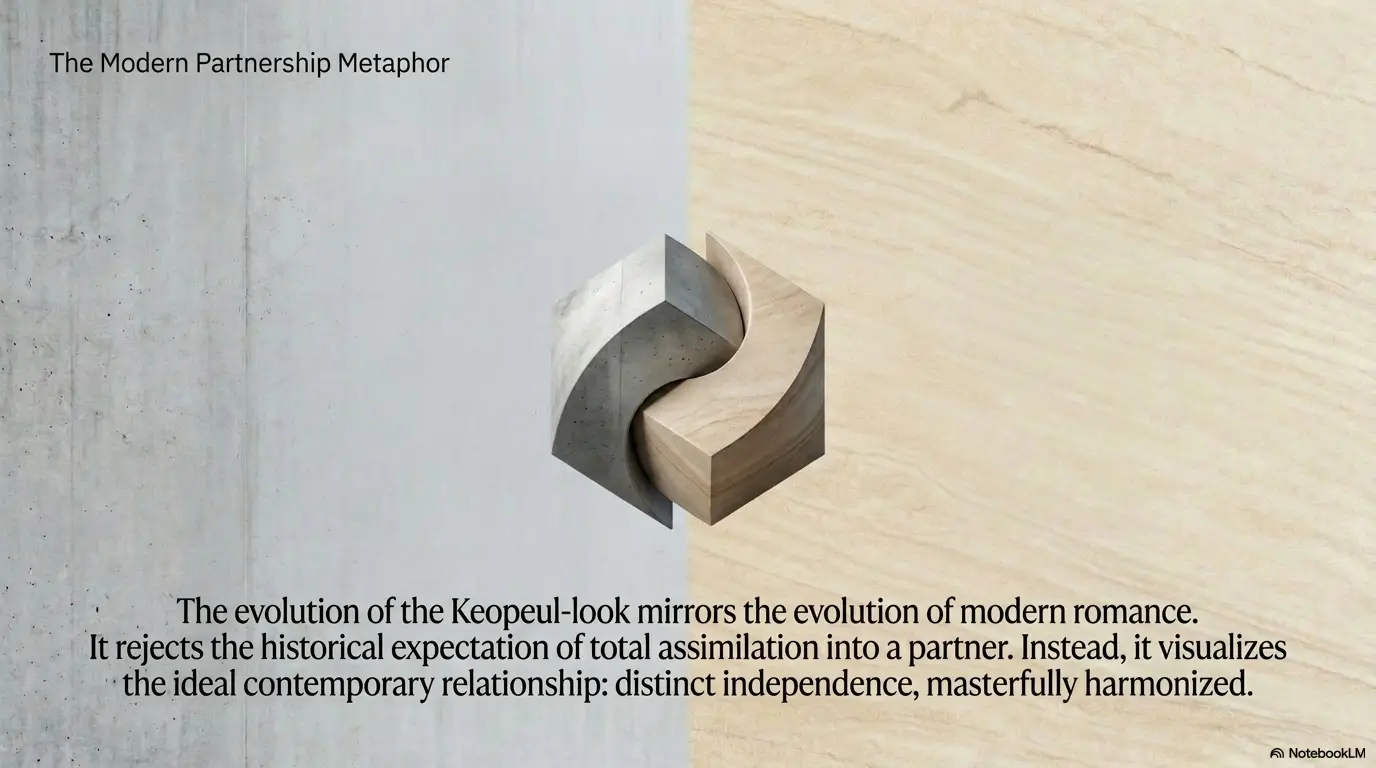
The coordinated outfit says two things at once: “I am myself” and “I am part of this pair.” The most natural versions succeed because neither sentence cancels the other.
Shared style turns private affection into a soft public signal
A couple look can make a relationship visible without requiring a verbal announcement. It is legible to friends and strangers, but it does not demand a response.
This softness explains why coordination can feel less confrontational than overt slogans or dramatic gestures. It is present in the visual field but remains open to interpretation.
Coordination offers visibility without dramatic physical affection
Two people do not need to perform romance continuously for the relationship to be recognizable. Shared clothing can carry part of that communicative work while they walk, shop, wait for coffee, or sit quietly on the subway.
The signal is woven into ordinary behavior rather than placed above it. That is one reason it can feel less costume-like in a setting where viewers already understand the code.
The look balances belonging with individual presentation
Modern couple styling often depends on negotiation. Each person must decide how much sameness feels affectionate and how much feels restrictive. That conversation mirrors a broader relationship question: how do two people create a shared identity without shrinking their separate ones?
Clothes provide a low-stakes place to practice the answer. One shared color, two separate outfits.
Why the trend survives even as fashion changes
Specific garments rotate. Varsity jackets give way to minimalist coats; fitted jeans give way to relaxed trousers; one sneaker shape replaces another. The underlying desire remains stable: to make a relationship briefly visible through everyday objects.
This is also why the practice can adapt across age groups. Younger couples may coordinate streetwear or campus clothing. Older couples may wear related outdoor jackets, hiking hats, or muted travel outfits. The visual vocabulary changes, but the shared rhythm remains recognizable.
Understanding that wider rhythm is easier when placed beside other forms of social identity, including the ways Seoul neighborhood identity shapes everyday presentation. Clothing responds not only to romance, but also to place, age, work, and community.
Key takeaway
The clothing changes with each season. The deeper idea does not: two people choose a visible point of connection while remaining recognizably themselves.
FAQ About Matching Couple Looks in Korea
Do Korean couples really wear matching clothes often?
Some do, but it is not universal. Coordinated outfits are visible enough to be culturally familiar, especially among younger couples and during dates, trips, anniversaries, or photo-friendly outings. Many other couples never match their clothes at all.
Are matching outfits expected in Korean relationships?
No. They are an optional form of couple expression, not a requirement. Expectations depend on the individuals involved. A healthy choice should be mutual rather than treated as proof of affection.
What is the difference between a Korean couple look and identical outfits?
Identical outfits repeat the same garments. A broader Korean couple look may repeat only a color, texture, silhouette, brand family, or accessory. Each person can wear a different outfit while still looking visually connected.
Do men in Korea feel comfortable wearing coordinated couple clothing?
Comfort varies by person. Some men enjoy matching items, while others prefer a subtle shared accessory or no visible coordination. It is safer to treat preference as individual rather than assuming a national attitude.
Are matching couple looks mainly for younger people?
Younger couples may use more obvious fashion-based coordination, but shared colors, outdoor clothing, travel hats, sneakers, and related jackets can appear across age groups. The styling often becomes subtler with age rather than disappearing.
What colors are commonly used in Korean couple outfits?
Neutral and muted colors are easy to coordinate, including black, white, navy, gray, beige, cream, camel, denim blue, olive, and brown. Seasonal accent colors such as burgundy or pale blue can also work when used sparingly.
Can tourists wear matching outfits in Korea without looking strange?
Yes. Coordinated couples are familiar in shopping districts, tourist sites, cafés, campuses, parks, and photo booths. A comfortable, understated outfit will rarely attract unusual attention.
How can a couple coordinate without appearing overly staged?
Repeat one element only, choose different cuts, and keep the remaining colors simple. Both outfits should look complete when viewed separately. Shared shoes, a single accent color, or related outerwear are reliable starting points.
Your 15-Minute One-Anchor Outfit Test
Open both wardrobes and choose one connection you already own. White sneakers are easiest. Denim, navy outerwear, gray knitwear, black caps, or cream tops also work well.
Set a timer for 15 minutes. Do not shop, browse inspiration photos, or build an elaborate concept. The point is to discover how little matching is actually required.
The practical plan
- Minutes 1 to 3: Choose one shared anchor from clothes or accessories you already own.
- Minutes 4 to 8: Each person builds a complete outfit independently around that anchor.
- Minutes 9 to 11: Stand together and identify the loudest unrelated element.
- Minutes 12 to 13: Remove or replace that distracting element.
- Minutes 14 to 15: Walk, sit, add coats or bags, and confirm that both outfits remain comfortable.
From a short distance, the result should feel connected without looking like a uniform. If the link is too weak, repeat the anchor once in a smaller detail. If the link is too strong, change one shade, shape, or layer.
That is the quiet secret behind why matching couple looks in Korea can feel so normal. The strongest examples do not erase two wardrobes. They create a narrow bridge between them, then allow both people to cross in their own clothes.
Your next move
Choose one shared element, build two separate outfits, and take a three-second look from across the room. Connection first. Costume optional.
Last reviewed: 2026-06