
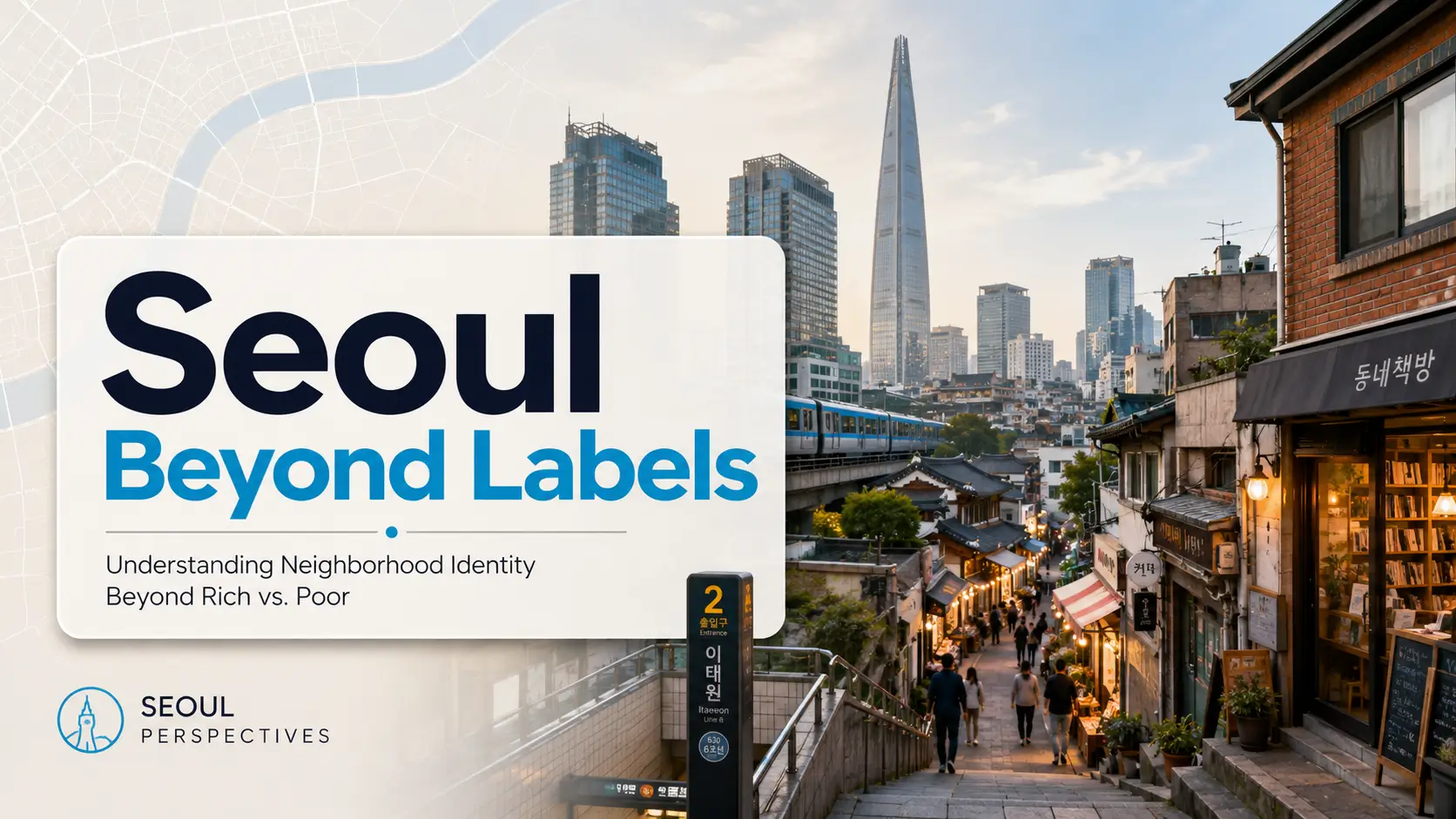
Seoul can trick a newcomer in the first ten minutes. One subway exit shows glass towers, a bakery with perfect fruit tarts, and people walking like their calendar has teeth. Five minutes later, a side street offers repair shops, stairways, old villas, school vans, tiny churches, and a market stall where steam rises from fish cakes like a small weather system.
How neighborhood identity works in Seoul beyond simple rich vs poor maps is not a question of money alone. It is a question of transit, schools, housing types, redevelopment, apartment brands, old markets, family memory, nightlife, office clusters, and the social weather attached to place names.
Guess wrong, and Seoul becomes a flat cartoon: Gangnam rich, Hongdae young, Itaewon foreign, old alleys cute. That map is easy. It is also clumsy.
Better lens. Sharper walk. Kinder reading.
- ✓ Read Seoul neighborhoods without reducing people to income.
- ✓ Choose places to stay, study, work, or explore with more confidence.
- ✓ Understand why one subway stop can feel like a different city.
- ✓ Notice the human story behind cafés, apartments, markets, and construction fences.
Map the City in Layers, Not Labels
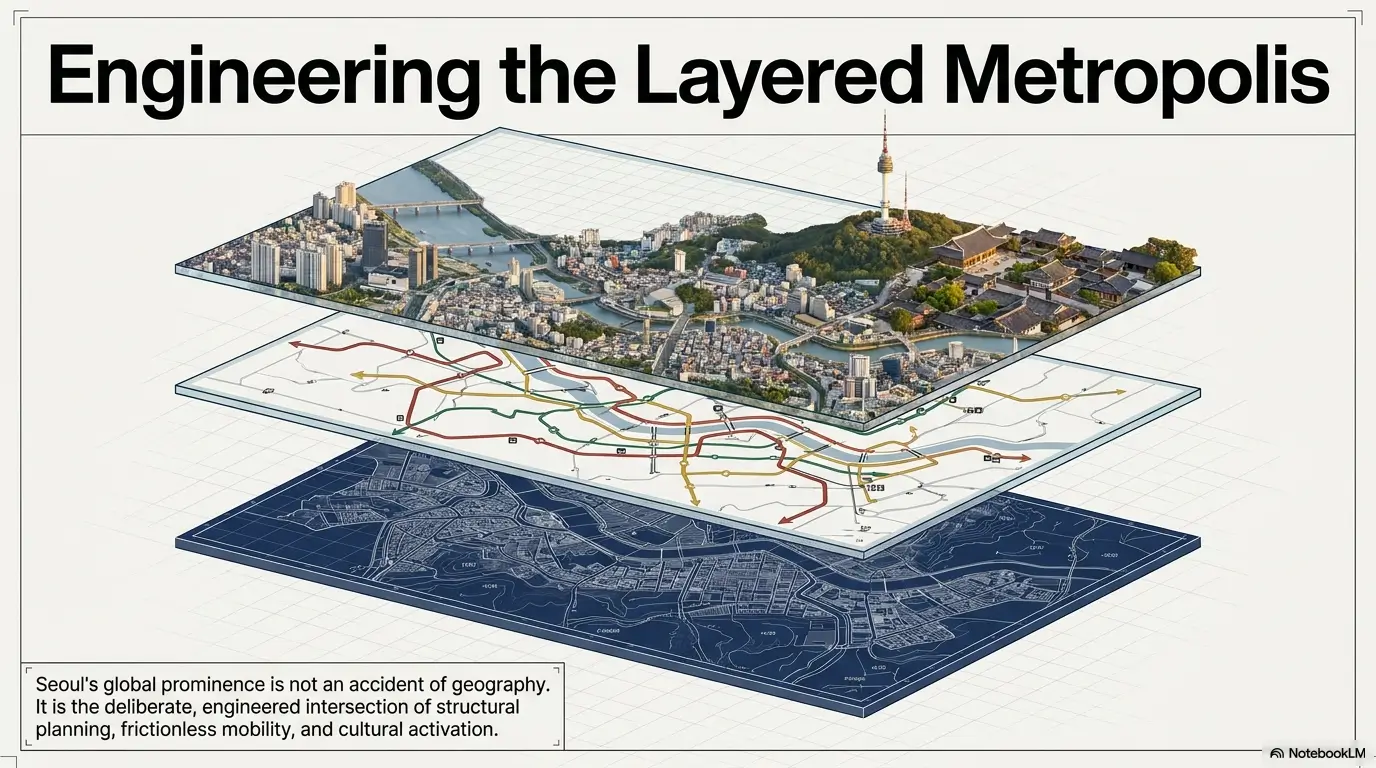
Think of Seoul less like a wealth chart and more like a layered musical score. One line is money. Another is subway access. Another is schooling. Another is memory. Another is the old market smell of sesame oil, rain on pavement, and late-night buses sighing at the curb.
The richest reading comes when those lines are heard together.
Contents — choose a section
Table of Contents
Who This Is For, And Who Should Skip It
For readers trying to “read” Seoul without stereotypes
This guide is for readers who want a more humane map of Seoul. Money is part of the story, of course. Nobody who has glanced at Seoul rent, apartment prices, or a jeonse deposit can pretend otherwise. For a practical housing angle, the difference between monthly rent, deposit risk, and area reputation becomes especially clear when comparing apartments for rent in Seoul, South Korea.
But money is not the whole city. A neighborhood can be expensive and sleepy, affordable and culturally magnetic, old and powerful, new and fragile, famous and misunderstood. Seoul refuses to stay obediently inside one color-coded map.
For expats, travelers, students, and culture-curious readers
Neighborhood identity affects everyday choices. It shapes where you stay, where you meet friends, what cafés feel comfortable, how long your commute feels, which schools people mention, and what first impression your address may carry.
Foreign residents often learn this gradually. First comes the station name. Then the gu. Then the dong. Then the hidden layer: “near which exit?” or “above the hill?” or “on the quiet side?” Seoul teaches by friction, one transfer at a time.
Not for anyone hunting a ranking list
This is not a “Top 10 richest Seoul neighborhoods” article wearing a nicer coat. It will not hand you a ladder and invite you to climb over everyone else.
It gives you a lens. A lens is slower than a ranking, but far more useful. Rankings make you point. Lenses help you notice.
- Price is only one layer of identity.
- Transit, schools, housing, and memory change how a place feels.
- Visitors and residents read the same district differently.
Apply in 60 seconds: Pick one Seoul neighborhood you know and name three signals beyond income.
The First Mistake: Treating Seoul Like a Wealth Heat Map
Why “Gangnam equals rich” is too small a story
Gangnam is the obvious door into the topic. It is internationally famous, media-friendly, and loaded with symbolic capital. It suggests private academies, plastic surgery clinics, sleek offices, wide roads, branded apartments, and a certain polished velocity.
But even Gangnam is not one thing. Gangnam Station feels different from Apgujeong. Daechi-dong is not the same social story as Sinsa. Office workers, students, clinic patients, café hoppers, families, tutors, landlords, and exhausted commuters all use the area differently.
Gangnam is not simply rich. It is aspiration, education pressure, infrastructure, media shorthand, consumer culture, and a very busy set of crosswalks that seem personally offended by slow walkers.
Income is visible, but identity is sticky
Income leaves clues: apartment complexes, store types, cars, school zones, clinic density, and the price of a coffee that arrives wearing architectural foam. But neighborhood identity often survives long after buildings change.
A place can keep its old reputation even after rents rise. A once-industrial district can become fashionable while older residents still remember machine noise and lunch counters. A student area can become tourist-heavy while still being described through its youth culture.
This stickiness matters. It means Seoul neighborhoods carry memory like fabric carries scent.
Pattern interrupt: The map is not the meal
A housing price map tells you pressure. It does not tell you personality.
It cannot show whether elders still greet each other by the vegetable shop, whether students fill cafés after exams, whether the hill makes groceries feel like a gym membership, or whether a shiny new apartment complex has quietly rewritten the social script of the street.
Decision Card: Price Map vs Identity Walk
| Use this | When it helps | What it misses |
|---|---|---|
| Price map | Comparing rent, purchase pressure, and broad affordability | Daily rhythm, memory, food culture, and social texture |
| Identity walk | Choosing where to stay, live, study, or explore | Precise market pricing and contract risk |
Neutral action line: Use price maps for pressure, then walk the area for meaning.
Place Names Carry Social Weather
Why saying “I live in X” can say more than address
In Seoul, a place name can carry social weather. Say a district, and people may quietly infer commute style, school access, rent level, apartment type, lifestyle, age cohort, or family background.
These inferences are not always fair. They are not always accurate. But they exist.
Someone saying they live in a central office district may be read differently from someone naming a university area, riverside apartment zone, hillside villa cluster, or suburban-feeling edge district. The address becomes a small biography, whether the person wants it or not.
Dong, gu, station name: three different identities
Seoul has administrative districts, legal neighborhoods, station names, apartment complexes, landmarks, and unofficial “near” zones. A person may say they live in Mapo-gu, near Hongdae, by a particular station, or close to a landmark. Each choice tells a slightly different story.
The gu gives official geography. The dong narrows it. The station name gives practical movement. The apartment complex gives social and housing context. The landmark gives emotional orientation.
This is why two people can technically live in the same area but describe it completely differently.
The quiet power of “near”
“Near Hongdae” may be more socially useful than the official address. “Near Seongsu” can suggest cafés, creative offices, and weekend crowds. “Near Gangnam Station” implies convenience, density, and a certain level of urban voltage.
Nearness is not only distance. It is association.
In Seoul, “near” is a social umbrella. Sometimes it keeps you dry. Sometimes it hides the actual street you live on.
Mini Checklist: Decode a Seoul Address Signal
- Yes/No: Does the person name the gu first?
- Yes/No: Do they switch to a subway station when explaining convenience?
- Yes/No: Do they mention a famous nearby area instead of the exact dong?
- Yes/No: Does the apartment complex or landmark become the real identifier?
Neutral action line: Ask yourself which identity layer is doing the work: official district, transit, reputation, or landmark.
Subway Lines Create Neighborhood Personalities
Transit is not just movement, it is status
In Seoul, subway access is a daily-life currency. A home near a useful station may feel closer to opportunity than a geographically closer place with awkward transfers.
Transit shapes desirability because it changes time. It affects sleep, school drop-offs, social plans, office commutes, airport access, and the quiet calculation of whether dinner across town is worth it.
For visitors, the subway is transportation. For residents, it is a mood system.
A 20-minute transfer can change a neighborhood’s story
Two neighborhoods may sit close on a map but feel far apart if the transfer is clumsy. A clean direct line can make a place feel central. A short distance with stairs, buses, or transfer tunnels can feel like a tiny expedition with fluorescent lighting.
This is one reason foreigners choosing housing should not only ask, “How far is it from the center?” They should ask, “How many transfers? Which line? Which exit? How steep is the final walk?”
Anyone who has carried luggage up a station staircase in July understands urban theory very quickly.
Station-area life vs hilltop life
Station areas tend to gather cafés, pharmacies, convenience stores, clinics, fast food, real estate offices, and evening foot traffic. Hilltop areas may be quieter, more residential, cheaper or more scenic, and sometimes inconvenient in ways the listing photos politely forgot to mention.
In Korea, practical mobility also intersects with daily manners. For example, Korea subway lost and found culture reflects how much of urban life passes through stations, trains, and the small rituals of shared movement.
Rent, deposits, apartment values, commercial pressure
Lines, transfers, exits, hills, last-train habits
Branded apartments, villas, officetels, hanok clusters
Hagwons, school reputation, family demand
Markets, alleys, food routines, elder networks
Cafés, studios, renewal, construction, displacement anxiety
Apartment Brands, Old Villas, And The Architecture Of Reputation
Why buildings become social shorthand
Architecture in Seoul speaks before people do. A branded high-rise apartment complex says one thing. An older villa says another. An officetel near a business district says something else. A hanok cluster carries heritage, tourism, preservation, and real estate tension all at once.
Buildings become shorthand because they bundle many signals: parking, elevator access, management quality, security, school zones, noise, heating systems, maintenance, and social status.
Sometimes a building is just a building. In Seoul, it often arrives carrying a résumé.
The “new apartment glow” effect
New apartments can change a neighborhood’s image quickly. They bring parking, elevators, security gates, landscaped courtyards, standardized layouts, and brand names that appear in conversation like quiet badges.
The glow is not only cosmetic. New apartments can attract families, shift nearby businesses, increase pressure on old shops, and change school demand. One complex can become a local landmark before the trees in its courtyard have learned how to look relaxed.
Don’t do this: assuming old housing means low value
Older housing does not automatically mean low value. It can mean central location, student affordability, creative energy, old community ties, renovation potential, or redevelopment anticipation.
It can also mean poor insulation, limited parking, no elevator, tricky maintenance, or damp corners that treat your socks like a science experiment.
The point is not to romanticize age. It is to read it carefully.
Show me the nerdy details
When reading housing signals in Seoul, separate building type from neighborhood identity. A branded apartment complex may raise perceived prestige, but its effect depends on school access, station distance, road layout, age of nearby housing, commercial services, and redevelopment timing. Older villas may suggest lower monthly cost, but some sit in highly desirable central areas. Officetels often cluster near transport and office zones, making them practical for single workers or students. Hanok areas can mix preservation, tourism, ownership cost, and cultural branding. The useful method is to compare three things: the building’s internal convenience, the street’s daily services, and the wider district’s reputation.
School Districts Make Invisible Borders
Education turns neighborhoods into aspiration engines
In Seoul, education can brand a neighborhood as strongly as architecture. School reputation, hagwon density, peer networks, and family planning create invisible borders that may not appear on tourist maps.
This is where culture becomes logistics. A family may choose an area not because it is fashionable, but because it makes a child’s schedule, academy route, peer group, and future applications feel more manageable.
For foreign families, the pressure can feel startling. A helpful starting point is understanding Korean hagwons for foreign families, because private education is one of the hidden engines behind neighborhood demand.
The childless resident still feels the school map
Even if you do not have children, school-driven demand can shape your life. It affects rent, cafés, traffic, tutoring centers, stationery stores, quiet hours, buses, and the number of children in matching backpacks appearing at 4 p.m. like a very organized migration.
School reputation can also alter the tone of local commerce. Some streets become family-service corridors. Others feel tuned to exam life, with cafés doubling as study annexes and parents conducting logistics with the focus of air-traffic control.
Here’s what no one tells you: schools can brand streets
Education prestige does not always attach to a whole district. It can attach to micro-areas, certain apartment complexes, specific walking routes, and particular hagwon clusters.
That means two streets in the same dong may carry different social readings. One feels like family ambition. Another feels like student survival. A third simply wants everyone to stop blocking the bakery doorway.
- Hagwon access can affect housing demand.
- Family schedules shape local streets and shops.
- Education signals often work at micro-neighborhood scale.
Apply in 60 seconds: When studying a neighborhood, search not only the station but also nearby schools and academy streets.
Markets, Alleys, And Food Memory Build Local Belonging
Traditional markets give neighborhoods a second language
Traditional markets make neighborhoods speak differently. They are not just places to buy vegetables, side dishes, fish, socks, rice cakes, or a lunch so hot it fogs your glasses with authority.
They are daily social systems. Vendors remember regulars. Elders pause at familiar stalls. Office workers know which soup place moves fastest. Children learn that a neighborhood has smells, voices, shortcuts, and small negotiations.
For visitors, markets are atmosphere. For residents, they are infrastructure with a heartbeat.
The smell of roasting chestnuts beats a spreadsheet
A spreadsheet can compare rent. It cannot compare the feeling of a winter street where roasted chestnuts, tteokbokki sauce, wet umbrellas, and bus exhaust create a strangely comforting civic perfume.
Food memory is one reason locals may love an area outsiders dismiss as ordinary. A grandmother’s market, a school-route kimbap shop, a late-night dumpling place after military leave, a café where someone studied for exams: these memories become part of local identity.
Korean food rituals often carry more social meaning than they first reveal. Even a simple meal culture question, such as why Koreans ask if you ate, opens the door to understanding how care, familiarity, and belonging are expressed through food.
Why “old Seoul” is not one thing
Old Seoul can mean preserved heritage. It can mean working-class continuity. It can mean tourist nostalgia. It can mean commercialized retro branding with Edison bulbs and coffee prices that have entered their villain era.
Those are different stories. A market serving residents is not the same as a retro alley designed for weekend photos. A historic hanok cluster is not the same as an aging neighborhood under redevelopment pressure.
Illustrative Scenario: The Soup Shop Behind Exit Three
A friend once took me to a small soup shop behind a subway exit in northern Seoul. Nothing about it looked famous. The sign was faded, the tables were close, and the menu had the confidence of a place that did not need English translations to survive. At lunch, office workers arrived first, then two older women with shopping bags, then a student who ate quickly with his headphones still in.
My friend said, “This area looks plain, but people know where to come.” That sentence stayed with me. The neighborhood’s identity was not in a brochure. It was in the timing of lunch, the owner remembering who wanted extra green onion, and the way people shared space without performing charm for visitors. The lesson is simple: when reading Seoul, do not only look for the famous street. Look for the place where regulars stop checking the menu.
Gentrification Changes The Story Before It Changes The Signboard
When cafés arrive before consensus
In Seoul, cafés, studios, galleries, dessert shops, and boutique stores can change a neighborhood’s image before residents agree on what has happened.
A district may still have old workshops or long-time residents, but social media begins telling a different story. Suddenly the area is “hidden,” “creative,” “vintage,” or “up-and-coming.” These words can be useful. They can also be tiny bulldozers in velvet gloves.
Seongsu, Euljiro, Ikseon-dong: useful but incomplete examples
Seongsu, Euljiro, and Ikseon-dong are often used as examples of Seoul’s cultural transformation. Industrial texture, printing alleys, hanok lanes, warehouses, and old streets became part of a new visual economy.
These examples are useful because they show how old urban textures can become cultural capital. But they are incomplete if we only talk about aesthetics.
Behind the coffee, tiles, exposed pipes, and careful signage are questions about rent, ownership, labor, tourism, resident comfort, and who gets to define the neighborhood’s new identity.
The risk: mistaking aesthetic charm for local consent
Visitors should be careful with “cool old alley” language. Not every aged surface is an invitation. Not every workshop district wants to become a weekend backdrop. Not every quiet lane is improved by being discovered loudly.
The respectful reader of Seoul notices beauty without claiming ownership over it.
Coverage Tier Map: Reading Gentrification Without Flattening It
| Tier | What you notice | Better question |
|---|---|---|
| 1 | Pretty cafés | Who used this space before? |
| 2 | New foot traffic | Who benefits from the new attention? |
| 3 | Rising rents | Which residents or shops feel pressure? |
| 4 | Brand repositioning | Who controls the new story? |
| 5 | Cultural replacement | What memory disappears from public view? |
Neutral action line: Enjoy the street, but ask who carried it before it became photogenic.
Redevelopment Produces Winners, Losers, And New Myths
Urban renewal changes identity, not just buildings
Redevelopment does more than replace old structures with new ones. It changes street rhythm, business mix, school demand, traffic, housing access, and the emotional map residents carry.
Seoul has long wrestled with how to improve safety and infrastructure while preserving community memory. Urban regeneration, apartment redevelopment, public space upgrades, and renewal projects can all alter how a neighborhood is perceived.
For older communities, this connects with a wider social issue: Korea’s aging neighborhoods often carry both practical maintenance concerns and deep local continuity.
The before-and-after photo hides the middle
Before-and-after images are tidy. Real redevelopment is not tidy.
Between the old street and the new complex come construction years, compensation debates, rent pressure, business turnover, family stress, noise, dust, uncertainty, and people wondering whether they will still belong after the ribbon-cutting.
A glossy image can hide the middle, and the middle is where much of the human cost lives.
Common mistake: calling every upgrade “progress”
Better lighting, safer buildings, wider sidewalks, cleaner drainage, and more accessible stations can genuinely improve daily life. Progress is not fake.
But upgrades can also thin culture if long-time shops disappear, elders lose familiar routes, small landlords cash out, or local rituals no longer fit the new rent structure.
The honest sentence is not “redevelopment is good” or “redevelopment is bad.” It is “redevelopment redistributes comfort, risk, memory, and power.”
- New buildings can improve safety and convenience.
- Construction years create stress before benefits appear.
- Community memory can fade even when infrastructure improves.
Apply in 60 seconds: When you see a new complex, look for what local services survived nearby.
Youth Districts, Office Districts, And Night Districts Run On Different Clocks
A neighborhood can have multiple identities by hour
Seoul neighborhoods change by time of day. A district at 11 a.m. may be all delivery trucks, office lunches, and café laptops. At 7 p.m., it may become friends, couples, and dinner smoke. At midnight, it may reveal bars, taxis, convenience stores, and people negotiating the last train with spiritual seriousness.
This clock-based identity matters. You cannot understand a neighborhood by visiting once.
Hongdae is not just nightlife, Yeouido is not just finance
Hongdae is often described through nightlife, indie culture, students, and youth energy. But it also has residents, office workers, artists, tourists, schools, and streets that feel completely different before the evening crowd arrives.
Yeouido is often read as finance and politics. Yet it also has parks, churches, apartment life, riverside walks, and weekend families. The label is not wrong. It is simply too narrow.
Seoul’s famous neighborhoods are usually true and false at the same time. That is what makes them interesting rather than merely marketable.
Time is a neighborhood filter
When choosing where to stay or live, visit at different hours if possible. Morning tells you commute. Afternoon tells you services. Evening tells you food and noise. Late night tells you safety, transit options, and how the area behaves after the official day removes its tie.
For office-heavy areas, workplace culture also shapes local identity. The lunch rush, after-work dinners, and team routines are easier to read when you understand Korean office lunch culture and how work life spills into nearby streets.
Hills, Rivers, And Edges Shape Social Meaning
Seoul’s geography is not background decoration
Seoul is not a flat grid politely waiting to be explained. Mountains, rivers, bridges, slopes, highways, rail lines, and old village edges shape daily life.
A hill can make a cheap room cheaper, a view more desirable, a grocery trip harder, and winter walking more dramatic than anyone requested. A river can add prestige, leisure, and beauty, but it can also create crossing logic and mental distance.
South of the river, north of the river: useful, then dangerous
The Han River divide is a common mental shortcut. South of the river often brings associations with newer development, business districts, education pressure, and certain kinds of status. North of the river often evokes older Seoul, history, universities, government, cultural sites, and denser old urban fabric.
Useful? Sometimes.
Dangerous? Very, if treated as destiny. There are wealthy, creative, old, new, quiet, loud, expensive, affordable, convenient, and inconvenient places on both sides.
Micro-geography makes micro-status
In Seoul, micro-geography matters. River access, park adjacency, hilltop views, station distance, bus frequency, bridge proximity, and whether the final road feels safe at night can all affect neighborhood meaning.
Two homes may share the same station name. One is a flat five-minute walk past cafés. The other is a fifteen-minute uphill climb that makes every bag of rice feel like a moral test.
- Hills affect daily comfort.
- Rivers and bridges affect mental distance.
- Station distance changes convenience and perceived value.
Apply in 60 seconds: Check the walking route, not just the station name.
Compare a neighborhood through the routine you will live
For a constructed housing search, map the journey to work or school, groceries, clinics, transport and the route home after dark. Visit at more than one time if possible and inspect the exact dwelling. A district’s reputation for wealth, nightlife or education cannot establish every street’s conditions or your lease costs. Ask whose experience a neighborhood description reflects and whether it matches your needs rather than treating a ranked map as a complete account of daily life.
| Focus | What to check |
|---|---|
| Routine | Map your real destinations and travel times. |
| Address | Inspect the street and exact dwelling. |
| Perspective | Ask whose needs the neighborhood label describes. |
A reader question: Can one famous street represent the whole district?
Use it as one place to investigate. Compare actual routes and services at your address, and keep claims about the wider district separate from observations on that street.
How To Read A Seoul Neighborhood In 20 Minutes
Step 1: Start at the subway exit
The first five minutes around a subway exit tell you who the area serves. Look at signs, storefronts, buses, school vans, office towers, clinics, pubs, cafés, real estate offices, and the pace of people leaving the station.
Are they commuters? Students? Families? Tourists? Office workers? Older residents? Delivery riders? The mix tells you more than a slogan.
Step 2: Walk away from the main road
Main roads are the city’s public face. Side streets are the diary.
Walk five minutes away from the station. Notice housing type, small businesses, laundry shops, churches, clinics, workshops, study cafés, playgrounds, stairways, and whether older businesses remain beside new ones.
This is where a neighborhood stops performing and starts breathing.
Step 3: Look for the “third places”
Third places are neither home nor work. Cafés, parks, libraries, gyms, laundries, small restaurants, markets, and benches show who uses the neighborhood when nobody is rushing.
A district with only destination businesses may feel lively but thin. A district with everyday third places often has stronger local belonging.
Step 4: Compare day and night
A neighborhood’s daytime identity may not survive sunset. Student areas expand. Office areas empty. Nightlife zones wake up. Family streets become quiet. Tourist streets change languages.
For practical Seoul life, this also connects to etiquette. A visitor who understands Seoul café etiquette will read café-heavy neighborhoods more accurately, especially where laptop culture, seating pressure, and quiet social codes shape the mood.
Quote-Prep List: What To Gather Before Choosing A Seoul Area
- Your main daily destination: school, office, hospital, airport route, or language academy.
- Your maximum comfortable commute, including transfers and final walk.
- Your noise tolerance: nightlife, roads, construction, school zones, or market streets.
- Your housing needs: elevator, heating, parking, sunlight, deposit comfort, and building age.
- Your daily-life needs: groceries, cafés, gyms, parks, clinics, and late-night transport.
Neutral action line: Compare neighborhoods by the day you will actually live, not the photo that looks best online.
Common Mistakes When Explaining Seoul Neighborhoods
Mistake 1: Using one famous district to explain the whole city
Gangnam, Itaewon, Hongdae, and Seongsu are useful examples. They are not universal keys.
When one famous district is asked to explain the whole city, it becomes overloaded. Gangnam becomes all wealth. Hongdae becomes all youth. Itaewon becomes all foreignness. Seongsu becomes all trendiness. Seoul is too large, layered, and stubborn for that.
Mistake 2: Confusing expensive with elite
Expensive does not always mean elite. Elite does not always mean trendy. Trendy does not always mean convenient. Convenient does not always mean culturally rich. Cultural richness does not always mean comfortable housing.
These signals overlap, but they are not identical. Treating them as the same is how people get surprised by a beautiful area with a painful commute, or a modest-looking area that everyone quietly respects.
Mistake 3: Treating “local” as automatically authentic
Local can mean resident-centered. It can also mean marketed, staged, preserved, contested, or newly branded for visitors.
Authenticity is not a stamp on an alley wall. It is a relationship between people, place, memory, and use. Sometimes the most authentic place is not photogenic. Sometimes it closes early and has plastic stools.
Mistake 4: Ignoring renters, students, elders, and small business owners
Neighborhood memory is often carried by people who do not appear in glossy urban stories. Renters know the building problems. Students know cheap meals and late buses. Elders know what used to be there. Small business owners know the rhythm of the street.
Ignore them, and your map becomes expensive but empty.
- Famous districts are examples, not templates.
- Expensive and meaningful are not the same thing.
- Residents carry details outsiders miss.
Apply in 60 seconds: Rewrite one stereotype about Seoul as a question instead of a conclusion.
FAQ
Is Gangnam really the richest part of Seoul?
Gangnam is one of Seoul’s most symbolically wealthy and high-status areas, especially because of education, business, media image, clinics, shopping, and apartment reputation. But Seoul’s identity map cannot be reduced to Gangnam alone. Other areas carry prestige through old wealth, river access, school zones, cultural capital, centrality, or quiet residential status.
Why do Seoul neighborhoods feel so different from one subway stop to the next?
Seoul changes quickly because subway lines, redevelopment history, land use, schools, nightlife, markets, housing types, and road patterns can shift within a short distance. One station may serve offices. The next may serve students, apartments, hospitals, or nightlife. The map looks continuous, but daily life often has sharp edges.
What makes a Seoul neighborhood prestigious?
Prestige can come from school access, apartment brand reputation, commute convenience, address symbolism, family networks, safety, amenities, river views, parks, and media narratives. It is rarely one factor. A prestigious area usually bundles several benefits into one recognizable place name.
Are older Seoul neighborhoods less desirable?
Not necessarily. Older neighborhoods may be affordable, central, culturally rich, socially rooted, and full of small businesses. They may also have maintenance issues, limited parking, narrow roads, no elevators, or redevelopment pressure. Older does not mean worse. It means you need to read the trade-offs.
Why do some Seoul areas become trendy so quickly?
Areas can become trendy when lower initial rents, strong transit, visual character, creative industries, cafés, galleries, social media, and redevelopment anticipation line up. Once visitors arrive, the neighborhood’s public identity may change faster than its residential reality.
How should foreigners choose where to stay in Seoul?
Choose by trip purpose first. For nightlife, prioritize late transport and noise tolerance. For food, choose areas with markets and restaurant density. For study or work, prioritize commute and quiet sleep. For cultural sites, consider central access. For families, check walkability, parks, clinics, and station convenience.
What is the biggest misunderstanding about Seoul neighborhoods?
The biggest misunderstanding is assuming money explains everything. Money matters, but Seoul neighborhood identity also comes from movement, memory, education, architecture, geography, age, commerce, and reputation. A flat wealth map cannot hold the full city.
Conclusion: Make Your Own Three-Layer Seoul Map
The first trick Seoul plays is speed. It makes you think you understand a neighborhood because the subway exit, apartment towers, cafés, or price signals speak loudly. But the quieter clues matter just as much.
A better map has at least three layers: price signal, daily-life signal, and memory or culture signal. Price tells you pressure. Daily life tells you use. Memory tells you belonging.
Within the next 15 minutes, pick one Seoul neighborhood and write three labels for it: price signal, daily-life signal, and memory/culture signal. Then compare those labels with what you would notice at the subway exit, five minutes into the side streets, and after dark.
That small exercise turns Seoul from a flat ranking into a living city. The map begins to breathe. The chestnuts roast. The train doors open. The place name stops being a label and starts becoming a story.
Last reviewed: 2026-05.
Practical example and reader question added October 20, 2026. Existing source dates are retained; this addition is not a fresh verification of every earlier claim.