
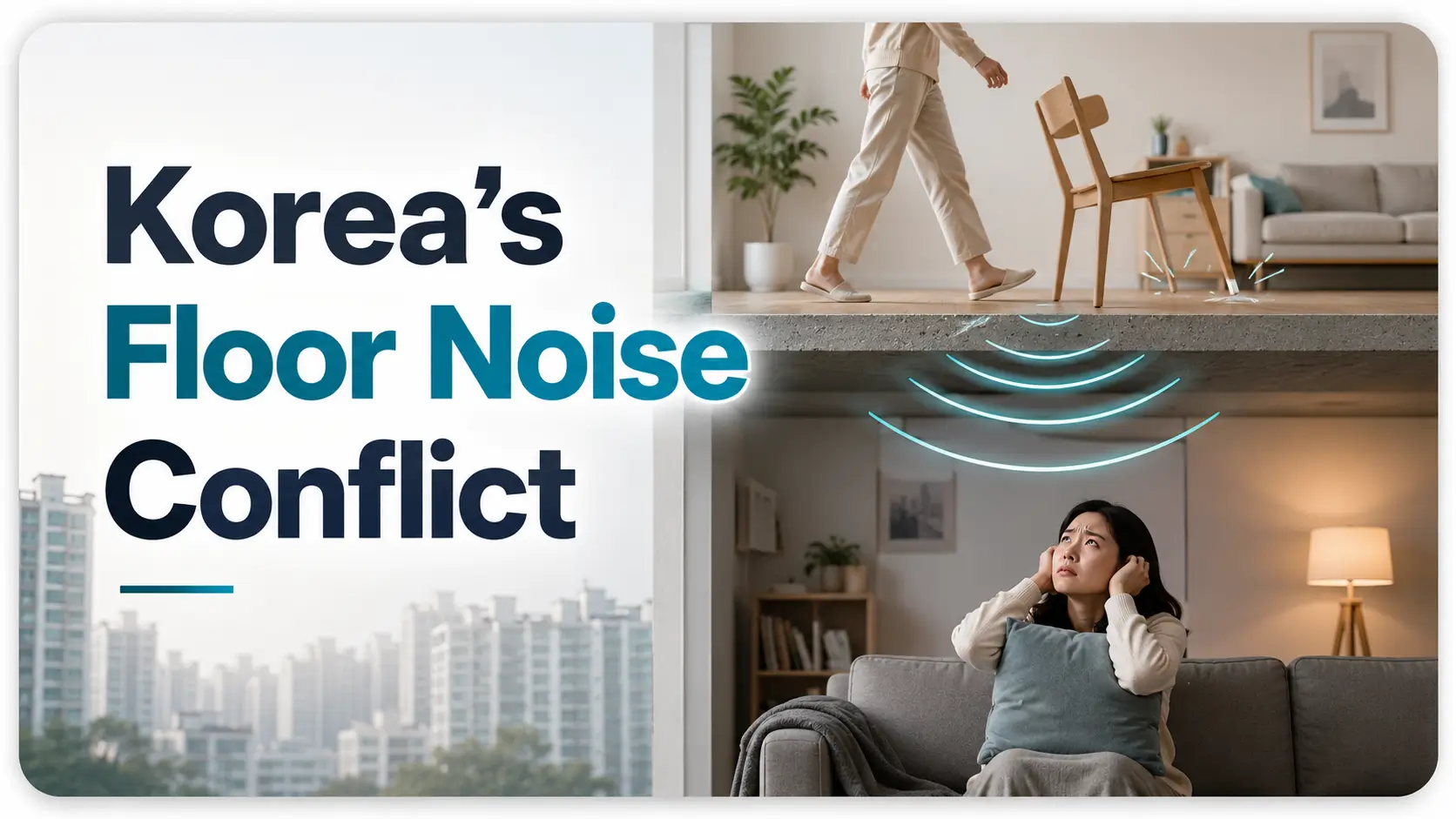
A Korean apartment can be beautifully efficient: warm floors, fast elevators, a convenience store downstairs, delivery at the speed of a drumroll. Then, at 12:37 a.m., one chair scrapes above you, and the whole home changes temperature.
Floor noise in Korea is not just a housing complaint. It is a collision between dense apartment living, sleep, family routines, concrete structures, social pressure, and the quiet hope that home will be the one place where your nervous system can finally loosen its tie.
For US readers, the issue may sound familiar at first: noisy upstairs neighbors, thin floors, late-night footsteps. But Korea’s version has a sharper emotional edge because apartment life is so central to status, family planning, daily convenience, and urban identity. Guess wrong, and a practical noise problem can turn into blame, retaliation, anxiety, or fear.
Here is the useful way in:
- • Less blame.
- • More pattern.
- • Better language.
- • Safer next steps.
Floor noise became one of Korea’s most emotional housing problems because ordinary domestic sounds can feel like repeated boundary violations when residents are tired, crowded, unable to escape, and unsure whether the problem is behavior, building design, or both.
The Floor Noise Map: Sound, Stress, and Social Meaning
Think of Korean floor noise conflict as a four-layer problem, not a single decibel problem.
- Sound: footsteps, chair dragging, running children, pets, appliances, doors, and vibration.
- Timing: early morning, late night, exam season, childcare hours, remote work, and post-commute exhaustion.
- Control: residents often cannot move, remodel, sleep elsewhere, or prove intent.
- Meaning: repeated sound can start to feel like disrespect, neglect, or invasion.
The practical goal is not to decide who is morally flawless. The goal is to reduce noise, lower emotional heat, and keep people safe.
Contents — choose a section
Table of Contents
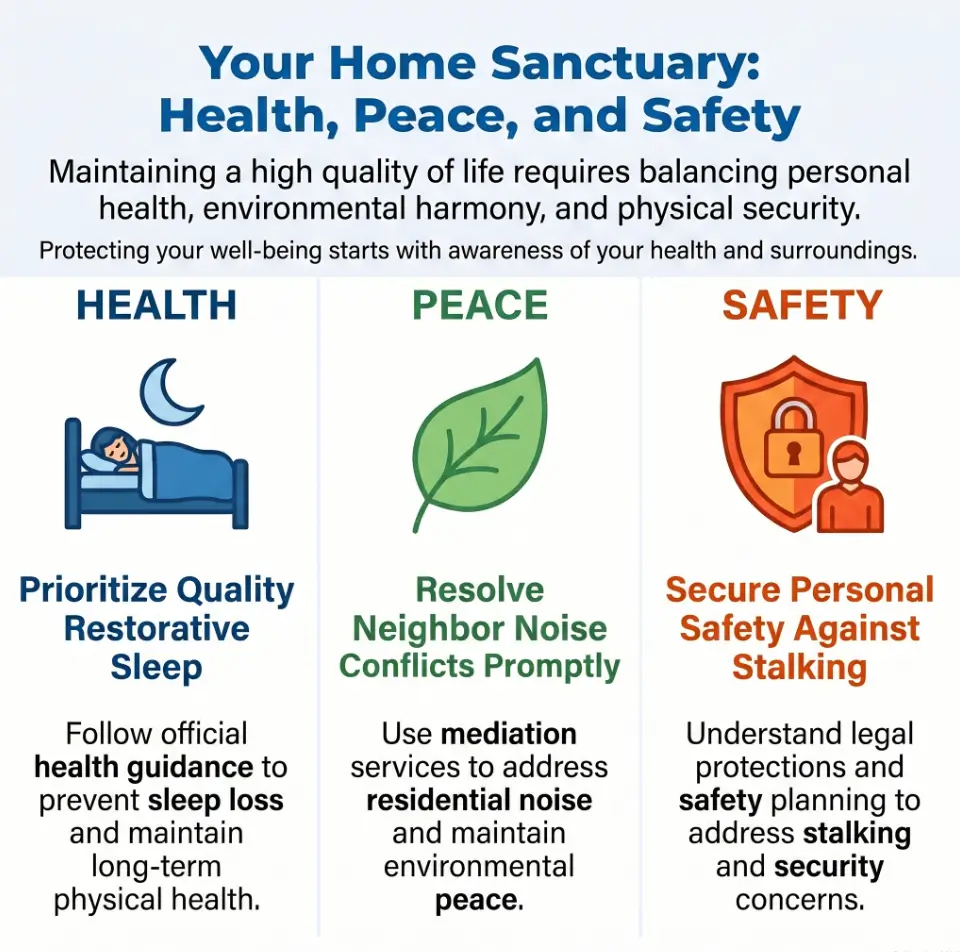
Floor Noise Is Not Just Sound. It Is a Boundary Being Crossed
Sound is physical. Floor noise is psychological.
That is why the same thump can feel mildly annoying at 3 p.m. and almost insulting at 1 a.m. The ear hears impact. The mind hears, “They know I am down here and they do not care.” Sometimes that interpretation is wrong. Sometimes the upstairs household truly is being careless. Often, the most painful part is not knowing.
Why a ceiling can start to feel like a person
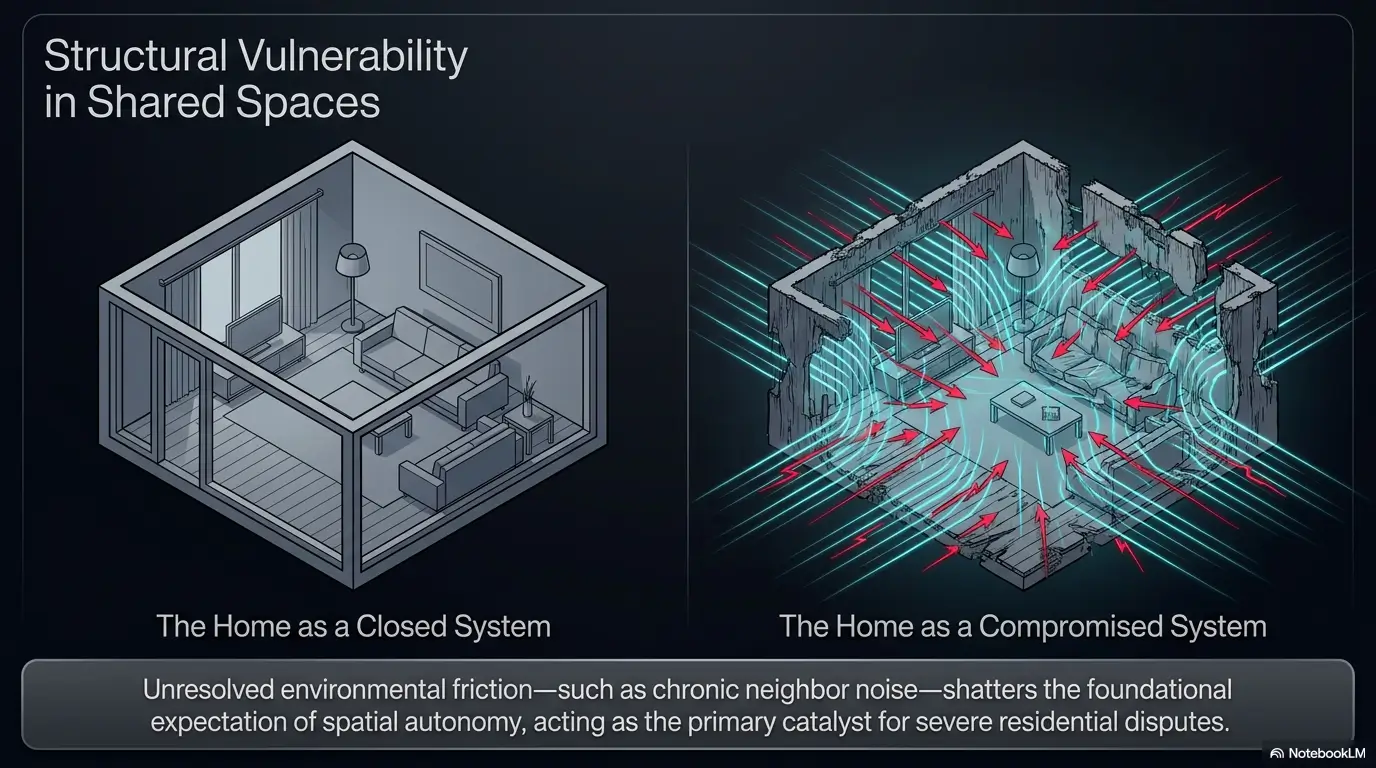
In a detached home, noise usually has distance. A lawn mower across the street is irritating, but it belongs to the outside world. In a high-rise apartment, sound arrives from inside your private shell. The ceiling becomes a messenger. Not a polite one. More like a tiny bureaucrat with a stamp pad.
When footsteps repeat above the bed, residents may stop experiencing the noise as random vibration. They begin to imagine the upstairs person: the heel walker, the child runner, the chair dragger, the mysterious midnight furniture philosopher.
This is where the emotional fuse begins. The sound becomes attached to a human intention, even when the structure itself may be amplifying ordinary movement.
The difference between “I hear noise” and “I feel invaded”
Noise complaints escalate when the resident downstairs feels there is no clean boundary left. The apartment door is locked. The curtains are closed. The lights are off. Yet someone else’s routine is still entering the room.
That creates a strange domestic contradiction. You are alone, but not alone. You are at home, but your body feels watched by sound.
US readers who have lived under a heavy-footed upstairs neighbor know the feeling. In Korea, the feeling can be stronger because apartment living is not a niche lifestyle. It is the mainstream housing script for many families, couples, retirees, and young workers.
Here’s what no one tells you: sound becomes emotional when escape feels impossible
People tolerate inconvenience better when they can leave, fix it, price it, or predict it. Floor noise resists all four.
You may not be able to move because of school zones, jeonse deposits, mortgage pressure, lease terms, work commute, or family needs. You may not be able to prove the sound is above the legal threshold. You may not even know whether the noise comes from directly above, diagonally above, or through structural pathways that make the building behave like a concrete telephone.
- Do not assume every sound is intentional.
- Do not dismiss repeated noise as “nothing.”
- Separate the sound pattern from the person you imagine behind it.
Apply in 60 seconds: Write one sentence that describes the sound without blaming the neighbor.
Korea’s Apartment Culture Made the Problem Unusually Intimate
To understand floor noise in Korea, you need to understand the apartment itself. It is not merely a place to sleep. It can be a family investment, a school-zone strategy, a commute machine, a social marker, and a small kingdom of daily convenience.
That is a lot of meaning to stack inside one tower.
Korean apartment complexes often offer security desks, parking, playgrounds, parcel rooms, community facilities, recycling zones, and easy access to schools or transit. They are efficient in a way that can feel almost symphonic on a good day. On a bad night, the symphony has one percussionist upstairs who will not stop rehearsing.
High-rise living turned strangers into vertical neighbors
In many US neighborhoods, neighbor conflict travels horizontally: fence lines, driveways, dogs, leaf blowers. In Korean apartments, conflict travels vertically. The person affecting your sleep may live directly above your pillow.
This creates an unusually intimate relationship between strangers. You may never share a meal, never know each other’s names, and still know when someone’s child gets home from taekwondo, when a chair moves, and when the washing machine enters its final heroic spin.
That intimacy can feel unfair because it is not chosen. Korean social life already carries delicate rules around age, titles, respect, and indirect communication. Readers curious about that social texture may find it useful to compare floor noise etiquette with Korean politeness in everyday interactions, where tone often matters as much as content.
Shared walls, shared floors, separate lives
Apartments compress routines. One household is putting a toddler to sleep. Another is returning from a company dinner. Another is doing laundry after a late shift. Another is studying for exams. Another has a dog who believes 6 a.m. is a spiritual invitation.
No one may be trying to harm anyone. Yet the building stitches their private schedules together.
This is why the problem is so stubborn. The conflict is not only between neighbors. It is between incompatible rhythms.
Why apartment prestige can hide everyday discomfort
Korean apartments can carry prestige. A well-located complex may symbolize success, stability, and good planning. That makes floor noise more emotionally awkward. Residents may think, “I worked this hard to live here, and I still cannot rest?”
Property anxiety deepens the sting. If the home is a major financial asset, repeated noise is not just irritating. It can feel like a threat to the meaning of the purchase itself.
This is one reason Korean housing topics often carry emotional voltage. The same pattern appears in issues like jeonse deposit protection, where home is not just comfort but risk management.
The Real Trigger Is Often Time, Not Volume
Many floor noise arguments sound like they are about loudness. They are often about timing.
A child running at 4 p.m. may be tolerated as family life. The same running at 11:40 p.m. can feel like a small domestic thunderstorm wearing socks. A chair dragged once during dinner is ordinary. A chair dragged repeatedly after midnight becomes a character in your sleep story, and not a charming one.
Midnight footsteps hit differently than afternoon footsteps
Night changes the meaning of sound. The city quiets. The apartment settles. The body expects recovery. A footstep that would disappear into daytime traffic now arrives clean and sharp.
This matters because residents often argue from different clocks. The upstairs person may think, “I only walked to the bathroom.” The downstairs person may think, “That woke me up again after I finally fell asleep.”
Both can be true. Truth, annoyingly, sometimes has bunk beds.
The after-work silence people desperately protect
Korea’s work culture can be demanding, with long commutes and dense social expectations. After a long day, home silence becomes more than a preference. It becomes a recovery tool.
For readers exploring Korean daily life more broadly, Korean office culture helps explain why the evening apartment can feel like a refuge after a day of hierarchy, speed, and social alertness.
When that refuge is interrupted by repetitive impact noise, the irritation lands on an already-tired body. It is not just “noise.” It is the last thread being tugged.
Children’s play noise and the exhausted adult downstairs
Children are not machines. They run, jump, drop toys, forget instructions, and experience hallways as runways. Parents know this. Downstairs neighbors know this too, until the tenth thump during bedtime.
This is where compassion and boundaries must share a cup of tea. Parents may feel judged for normal child behavior. Downstairs residents may feel trapped by noise they did not consent to. Neither side needs a villain costume for the problem to be real.
Decision Card: Is This a Timing Problem or a Volume Problem?
| Signal | Likely issue | Better first move |
|---|---|---|
| Mostly late night or early morning | Timing conflict | Ask for quiet hours and specific behavior changes. |
| Heavy impact at any hour | Impact behavior or poor sound isolation | Document patterns and involve management if repeated. |
| Occasional appliance or plumbing sound | Building system noise | Ask management to inspect before blaming one unit. |
Neutral action line: Identify the time pattern before choosing the communication channel.
Who This Is For, and Who It Is Not For
This guide is for readers who want to understand Korea’s floor noise problem without flattening it into a cartoon. It is not a manual for winning a neighbor war. The internet already has enough matches. We need more lamps.
For readers trying to understand Korean housing stress without caricature
If you are a US reader, traveler, expat, student, researcher, or Korean culture writer, floor noise offers a surprisingly revealing window into modern Korea.
It touches architecture, family life, urban density, sleep, real estate pressure, and communication style. It also explains why Korean media often treats apartment sound not as a minor nuisance but as a social wound.
For a wider view of how local systems shape daily behavior, Korea’s public complaint system shows how residents often turn private frustration into formal channels when informal conversation feels risky or ineffective.
For residents dealing with repeat upstairs or downstairs conflict
This guide is also for residents who need a calmer script. If you are dealing with repeated floor noise, your first task is not to diagnose someone’s character. It is to identify pattern, timing, source, and safe communication options.
If you are the upstairs household receiving complaints, your task is not to collapse into shame or defensiveness. It is to test practical changes: mats, slippers, furniture pads, quiet hours, appliance timing, and clearer communication.
Not for people looking to blame one side automatically
Some downstairs neighbors exaggerate, retaliate, or harass. Some upstairs neighbors ignore clear harm. Some buildings are acoustically unforgiving. Some complaints are really about stress, sleep, or fear. A useful response has to hold all of that without spilling the soup.
- Assume the other side may not know what you hear.
- Assume repeated disruption still deserves action.
- Assume escalation can make the home feel unsafe for everyone.
Apply in 60 seconds: Replace “They are doing this on purpose” with “This pattern is hurting my rest.”
The Emotional Math: Small Sounds Plus No Control Equals Big Anger
Floor noise conflict follows a simple emotional equation:
Repeated sound + tired body + no control + unclear intention = anger that feels bigger than the sound itself.
This does not mean the anger is fake. It means the anger is carrying more than sound. It is carrying fatigue, uncertainty, helplessness, and the humiliating feeling of not being able to protect your own home.
Why repeated low-level noise can feel worse than one loud crash
A single loud crash startles. Repeated low-level noise trains the body to wait for the next one.
That waiting is exhausting. You pause the movie. You stop reading. You stare at the ceiling. You wonder whether to complain, whether it will help, whether it will make things worse. Your home becomes a listening station. No one moved in hoping to become a ceiling detective.
Sleep loss turns patience into dry leaves
Sleep is not decorative. The CDC notes that adults generally need adequate sleep for health and functioning, and chronic sleep disruption can affect mood, concentration, and safety. When floor noise repeatedly interrupts rest, a polite resident can become brittle very quickly.
That is why a complaint after three bad nights may sound sharper than the actual sound log suggests. The real issue is accumulated depletion.
Let’s be honest: “just ignore it” rarely works in a small apartment
“Just ignore it” is often offered by people who are not lying awake under the sound. In a compact apartment, repeated impact noise occupies the same air as your bed, desk, kitchen table, and patience.
Ignoring may work for one evening. It rarely works for months.
A better goal is not emotional numbness. It is specific observation followed by proportionate action.
Mini Calculator: Your Floor Noise Pattern Score
Use this simple private tool to decide whether the issue is occasional annoyance or a pattern worth documenting. It does not store data.
Output: Enter your pattern and calculate.
Neutral action line: Use the result only as a reflection tool, not as proof against a neighbor.
Children, Elders, Pets, and Chairs: The Everyday Sources That Start Wars
The tragedy of many floor noise disputes is that the sources are often ordinary. The problem is not a nightclub above your bed. It is life.
Children run. Elders walk carefully but may step heavily. Pets scratch, jump, and gallop with surprising theatrical commitment. Chairs scrape. Laundry machines vibrate. Parents come home late. Students pace while memorizing. Everyone is normal. Everyone is also, occasionally, unbearable.
Running children and the guilt loop for parents
Parents in Korean apartments often live inside a guilt loop. They tell children to walk softly. The children remember for eight seconds, which is legally forever in toddler time, then resume being kinetic weather.
Downstairs neighbors may be sympathetic at first. But sympathy thins when noise repeatedly disrupts sleep, study, remote work, or recovery from illness.
Korean family life also includes a strong network of grandparents, childcare pickups, hagwons, and after-school routines. If you want the broader family context, Korean grandparents and childcare offers a useful companion lens.
Chair dragging, heel walking, laundry cycles, and late-night routines
Some of the most hated sounds are not dramatic. Chair legs on hard floors. Heel-first walking. A drawer slammed out of habit. A laundry spin cycle after midnight. A dropped phone that sounds, downstairs, like a small meteor with poor manners.
These sounds are fixable more often than people think. Felt pads, rugs, indoor slippers, appliance timing, and furniture layout can reduce the sharpest edges.
They do not solve everything. But they show good faith, and good faith is the cheapest soundproofing material humans have invented.
Why normal life upstairs can sound unreasonable downstairs
Impact noise is sneaky because it travels through structure. The upstairs neighbor may honestly believe they are moving normally. The downstairs neighbor may honestly hear heavy thuds.
This is why direct accusation often fails. “You are stomping on purpose” invites denial. “We hear repeated heavy footsteps near the bedroom after 11 p.m.” gives the other person a chance to adjust without losing face.
Quote-Prep List: Before You Buy Mats, Pads, or Soundproofing Help
- Measure the rooms where impact noise is most likely: living room, hallway, child’s play area, dining space.
- List the worst time windows: bedtime, early morning, remote-work hours, study hours.
- Identify the sound type: footsteps, chair scraping, jumping, appliance vibration, pet movement.
- Check whether furniture pads, rugs, slippers, or play mats could address the behavior before paid work.
- Ask whether products reduce impact noise, airborne noise, or both, because these are not the same.
Neutral action line: Match the fix to the sound type before spending money.
Common Mistakes That Make Floor Noise Conflict Worse
Floor noise disputes become dangerous when frustration turns into performance. Ceiling banging. Angry notes. Speaker retaliation. Doorway confrontation. Group chat shaming. The problem stops being noise and becomes a contest over dignity.
That contest rarely has winners. It has tired residents and one building manager quietly considering a career in beekeeping.
Mistake 1: Treating every sound as intentional disrespect
Intent matters, but you rarely know it at first. A child may be running because bedtime collapsed. An elder may be walking heavily because of knee pain. A tenant may not realize a chair leg has become an acoustic villain.
Start with observable facts. Save moral conclusions for later, if they are needed at all.
Mistake 2: Retaliating with ceiling banging or speaker noise
Retaliation feels satisfying for five seconds. Then it expands the conflict. The upstairs household may become defensive or frightened. Other neighbors may be affected. Management may see both sides as part of the problem.
In Korea, where apartment communities can be dense and socially watchful, retaliation can also travel through rumor faster than a delivery scooter.
Mistake 3: Sending emotional messages before documenting patterns
A message written at 1:13 a.m. after being woken up for the fourth time may be emotionally honest. It may also be strategically terrible.
Write the angry version in your notes app if you must. Then do not send it. Let the sentence cool down. Morning language tends to wear shoes. Midnight language carries a frying pan.
Mistake 4: Expecting one apology to fix a structural problem
Sometimes a neighbor apologizes and still cannot eliminate the noise. That does not make the apology fake. It may mean the building carries sound too easily or the household routine needs multiple small adjustments.
Look for repeated improvement, not instant silence.
- Describe time, sound, and duration.
- Avoid claims about motive.
- Use management before personal confrontation escalates.
Apply in 60 seconds: Draft one complaint sentence that contains no insult, diagnosis, or threat.
Don’t Do This: The Neighbor Note That Turns a Problem Into a Feud
A neighbor note can be a bridge or a lit match. The difference is usually specificity.
“Stop being selfish” is not a request. It is a verdict. “Could you reduce running or heavy footsteps in the bedroom area after 10 p.m.?” is a request. It gives the other household something to do.
Why accusation-heavy language backfires
Accusation triggers self-defense. Once a neighbor feels morally attacked, they are less likely to listen to the content. They start defending their identity instead of adjusting their behavior.
This is especially important in Korean communication, where indirectness, face-saving, and hierarchy can shape conflict. A useful comparison is Korean indirect communication, which explains why bluntness may land differently than intended.
The safer script: specific time, specific sound, specific request
Use a short structure:
- Time: “Around 11 p.m. to 1 a.m.”
- Sound: “Repeated running or heavy footsteps near the bedroom.”
- Effect: “It has been waking us up.”
- Request: “Could you help reduce impact noise during those hours?”
That script is not magic. But it gives the conversation a floor, which is more than the ceiling has been giving you lately.
Keep the door open, not the wound
A good note leaves room for cooperation. It says, “There is a problem we need to solve,” not “You are the problem.”
If direct contact feels unsafe or culturally awkward, go through building management. Many Korean apartment complexes have management offices, security staff, or resident channels that can pass along complaints without turning the hallway into a courtroom.
Illustrative Scenario: The Chair at 11:48
Min-jun was not an angry man. He was a tired man, which is sometimes angrier. For two weeks, a chair scraped above his bedroom almost every night around 11:48. He imagined the upstairs neighbor dragging furniture just to test his sanity. One night, he wrote a note with the emotional temperature of hot oil. His wife read it, folded it once, and said, “This note wants a war.”
The next morning, he rewrote it: “We hear chair-dragging sounds near our bedroom most nights around midnight. Could you add pads or move the chair more gently during late hours?” Two days later, a small reply came through management: “We did not know. We added felt pads.” The noise did not vanish, but it softened. More importantly, the ceiling stopped feeling like an enemy. The lesson was not that politeness fixes every conflict. It was that specific language gives peace a place to stand.
The Building Itself May Be the Quiet Villain
It is tempting to treat floor noise as a personality test. But buildings have personalities too. Some are calm. Some are thin-skinned. Some behave like they were designed by a committee of cymbals.
Korean officials have recognized inter-floor noise as a serious public issue. The Ministry of Environment has discussed stricter standards for inter-floor noise, including daytime equivalent noise standards, and Korea has operated public services to help mediate noise disputes. The details can change over time, but the official attention itself tells you something: this is not merely a private annoyance.
Impact noise travels through concrete, pipes, and structure
Floor impact sound is not only what happens in the air. It can travel through slabs, walls, pipes, columns, and connected materials. That is why the sound source may not be exactly where the downstairs resident thinks it is.
A dropped toy in one room may sound like it came from another. A diagonal unit can sometimes seem directly overhead. A building can turn ordinary motion into a confusing acoustic riddle, and not the fun kind with a prize at the end.
Why “I was barely walking” can still be true
The upstairs resident may be telling the truth when they say they were barely walking. The downstairs resident may also be telling the truth when they say it sounded heavy.
This is the central paradox of floor noise. Lived experience differs by location. The person producing the sound feels intention. The person receiving it feels impact.
Better flooring helps, but it does not perform miracles
Rugs, foam mats, slippers, furniture pads, and appliance pads can help reduce impact. They are practical first-line tools. But they are not a spellbook. They may reduce sharpness without creating silence.
For people moving into Korea, housing inspection matters. A practical move-in mindset, like the one in a Korean apartment move-in checklist, can help residents pay attention to noise, floor materials, management rules, and neighbor expectations before the boxes are stacked like cardboard mountains.
Show me the nerdy details
Floor noise usually involves a mix of airborne sound and structure-borne impact sound. Airborne sound travels through air, such as voices or television audio. Impact sound begins with physical contact, such as footsteps, jumping, chair movement, or dropped objects, then moves through the building structure. Concrete slabs can transmit vibration in ways that make source location hard to identify. Mats and rugs often help most with impact sharpness, while sealing gaps and improving wall or ceiling assemblies may matter more for airborne sound. In apartment disputes, the practical challenge is that residents experience the sound subjectively, while formal measurement may require specific procedures, locations, and time windows.
Floor Noise Response Ladder
Track time, sound type, duration, and room. Keep it factual.
Try mats, pads, slippers, appliance timing, and quiet hours.
Use specific, calm language through the safest channel.
Use management, official services, or outside help if conflict repeats.
A Better Response Ladder Before Things Become Personal
The best response to floor noise is boring in the beginning. That is a compliment. Boring means documented, calm, specific, and hard to misread.
Once a dispute becomes personal, every new sound becomes evidence. Every silence becomes suspicious. Every hallway encounter grows teeth. A response ladder helps you act before the emotional courtroom opens.
Step 1: Track the pattern without turning it into a diary of rage
Keep a short log for one to two weeks if the issue repeats. Note:
- Date
- Start and end time
- Sound type
- Room where it is heard
- Effect, such as waking a child or interrupting sleep
A log should be boring. If it starts to read like a revenge novel, put the pen down and drink water.
Step 2: Start with polite, concrete communication
Ask for one realistic change. “Please be quieter forever” is too broad. “Could you reduce running in the living room after 10 p.m.?” is usable.
If you are the upstairs neighbor, respond with practical steps instead of abstract reassurance. “We added pads to the dining chairs and will avoid laundry after 10 p.m.” is stronger than “We are not noisy people.”
Step 3: Use building management or mediation before direct escalation
In many Korean apartment complexes, management offices can pass along concerns. This is often safer than repeated direct confrontation, especially when emotions are already high.
Korea has also used public mediation services for inter-floor noise issues, including services connected with the Korea Environment Corporation. Procedures and eligibility may change, so residents should check current official channels rather than relying on old forum advice.
Step 4: Know when safety matters more than being “right”
If there are threats, stalking, property damage, repeated harassment, or fear of going home, stop treating the issue as a normal complaint. Safety comes first.
Use building management, local authorities, trusted contacts, or emergency services as appropriate. Do not keep escalating direct contact just to prove a point. A correct point can still be a dangerous hallway.
Eligibility Checklist: Is It Time to Ask for Outside Help?
- Yes/No: Has the noise pattern repeated for more than one week?
- Yes/No: Does it happen during sleep or work-critical hours?
- Yes/No: Have you tried one calm, specific request?
- Yes/No: Has either side retaliated, threatened, or harassed?
- Yes/No: Does direct contact feel unsafe?
One-line next step: If you answered yes to safety concerns or repeated failed contact, use management or official mediation instead of another direct confrontation.
Neutral action line: Escalate the process, not the emotion.
When Floor Noise Becomes a Health and Safety Issue
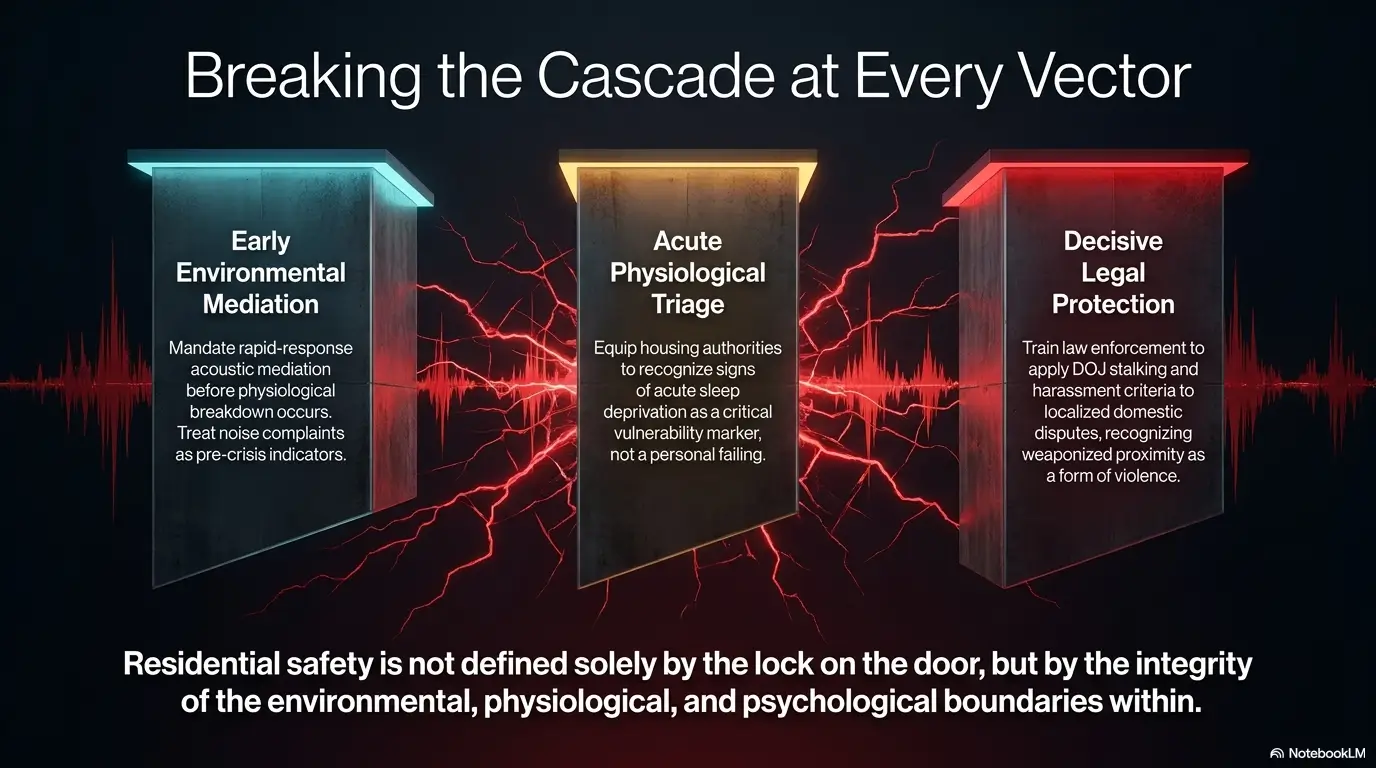
Most floor noise disputes begin as inconvenience. Some become health and safety issues. The shift happens when sleep, anxiety, family stability, or personal safety starts to suffer.
This section is not medical or legal advice. It is a practical warning label for a problem that can look small from the outside and feel enormous from the bed at 2 a.m.
Sleep disruption, anxiety, and family stress are real consequences
Repeated noise can affect mood, concentration, and relationships. A parent may snap at a child after several bad nights. A remote worker may dread afternoon thuds during calls. An elder may become fearful of moving around the home if downstairs complaints are frequent and harsh.
The point is not to dramatize every footstep. The point is to recognize when the home stops functioning as a place of recovery.
When repeated conflict needs outside help
Outside help can mean different things: building management, resident committees, official mediation, counseling support, legal advice, or police help when safety is at risk.
If you are an expat or foreign resident in Korea, language can complicate the process. Cultural context helps too. Articles on Korean apology phrases and Korean texting formality can help you avoid messages that sound colder or harsher than you intended.
Warning signs: threats, stalking, property damage, or fear of going home
Take these signs seriously:
- Threatening notes, messages, or calls
- Repeated visits to the door after being asked to stop
- Ceiling banging, wall pounding, or speaker retaliation
- Damage to property
- Following, filming, or monitoring behavior
- Fear of entering common areas
At that point, do not frame the issue as “just noise.” Treat it as a safety and conflict-management issue.
- Save messages, logs, and photos if safe to do so.
- Avoid private confrontation when threats appear.
- Use formal channels when direct contact increases risk.
Apply in 60 seconds: Identify one trusted person or office you would contact if the conflict escalated tonight.
FAQ
Why is floor noise such a big issue in Korean apartments?
Floor noise is a major issue in Korean apartments because many people live in dense high-rise housing where impact sound can travel through floors and structures. The problem becomes emotional because home is tied to rest, family life, property value, status, and privacy. Repeated sound can feel like a personal invasion even when the source is ordinary daily movement.
Is floor noise mostly caused by bad construction?
Construction can be part of the problem, especially when floor impact sound travels easily through slabs and connected structures. But behavior also matters. Running, jumping, chair dragging, late-night appliances, and hard-heeled walking can make a difficult building feel much worse. Most disputes involve both building conditions and household habits.
Why do upstairs neighbors often say they are not making much noise?
They may be telling the truth from their perspective. The person upstairs experiences their action as light walking or normal movement. The person downstairs experiences the transmitted impact. Structure-borne sound can make ordinary movement seem louder, heavier, or closer than the upstairs resident expects.
What is the polite way to complain about floor noise in Korea?
A polite complaint should be specific, calm, and practical. Mention the time, sound type, and effect without accusing the neighbor of bad character. For example: “We hear repeated heavy footsteps near the bedroom after 11 p.m., and it has been waking us up. Could you help reduce impact noise during those hours?”
Can rugs or mats really reduce apartment floor noise?
Rugs, mats, slippers, and furniture pads can reduce some impact noise, especially sharp sounds from footsteps, toys, and chair legs. They usually do not create silence. They work best when paired with quiet hours, better appliance timing, and awareness of high-impact areas such as hallways and play spaces.
Why does floor noise feel more stressful at night?
At night, the building is quieter, the body expects sleep, and even moderate sounds feel sharper. Night noise can also trigger anticipation: once awakened, a resident may wait anxiously for the next thud. That waiting can become more stressful than the original sound.
Should residents contact building management before confronting neighbors?
Often, yes. If direct contact feels awkward, unsafe, or likely to cause embarrassment, building management can pass along a neutral message. This is especially useful when the source is uncertain, when emotions are high, or when previous direct communication has failed.
When does a floor noise dispute become a safety concern?
It becomes a safety concern when there are threats, stalking, property damage, repeated harassment, fear of going home, or retaliatory noise meant to intimidate. At that stage, residents should stop relying on direct confrontation and use formal support, management, local authorities, or emergency help as appropriate.
Keep a noise log without claiming you know the source
Write the date, time, duration, location in your home and a plain description such as impact sounds or music. Separate that record from a guess about which neighbor caused it. Ask management what procedure applies and what information it needs. A quiet recording or one loud event cannot settle every question about source, building transmission or liability. Use the stated mediation or complaint route instead of retaliating with noise or publishing a neighbor’s identity.
| Focus | What to check |
|---|---|
| Record | Time, duration, room and observed sound. |
| Uncertainty | Mark a suspected source as unconfirmed. |
| Process | Use the building’s contact and follow-up procedure. |
A reader question: What should I request from management?
Ask for the next step, the responsible contact and how an unresolved issue is followed up. Keep the response with the log and describe any immediate safety concern separately.
Next Step: Make the Problem Specific Before You Make It Emotional
The chair scrape from the introduction matters because it shows the whole problem in miniature. One small sound can become enormous when it arrives at the wrong time, repeats without explanation, and enters the one place a person expected to rest.
That is how floor noise became one of Korea’s most emotional housing problems. It is not only about decibels. It is about density, timing, sleep, money, family routines, construction, etiquette, and the fragile dignity of being left in peace at home.
Write down three details: time, sound type, and duration
Do this before sending a complaint, buying products, or assuming intent. Three details are enough to turn a vague grievance into a solvable pattern.
- Time: When does it happen?
- Sound type: What do you hear?
- Duration: How long does it last?
Choose one calm communication channel
Pick the safest channel: management office, written note, resident app, or carefully worded message. Do not use every channel at once. That can feel like a swarm.
If you are new to Korean apartment life, it may also help to understand nearby daily norms such as recycling in Korea for foreigners and Korean delivery etiquette. Apartment peace often depends on many small shared habits, not one grand rule.
Ask for one realistic change, not a total personality transplant
Good requests are narrow. Ask for reduced running after 10 p.m., pads under dining chairs, no laundry spin cycle after midnight, or mats in a child’s play area. Do not ask the neighbor to become a silent ghost with a mortgage.
Your concrete next step within 15 minutes: open a note and write three entries using only time, sound type, and duration. Then draft one calm sentence that asks for one specific change. That small act turns the ceiling from a battlefield back into a building surface, which is where it belongs.
Last reviewed: 2026-05.
Practical example and reader question added October 20, 2026. Existing source dates are retained; this addition is not a fresh verification of every earlier claim.