

The Invisible Arrival: A Guide to Korean Delivery Etiquette
In Korea, delivery rarely “arrives.” It materializes, gets photographed, and vanishes. My first week I waited by the door like a well-trained sitcom character, only to find dinner already parked in the hallway with a timestamped photo and zero drama.
Korean delivery culture is a speed-first, low-contact system where “leave at door” (문 앞) is often the default, proof comes via photo, and small choices like 공동현관 (main entrance) access and review culture quietly shape how smooth your next order feels.
If you’re a US traveler or expat, the confusion isn’t the food. It’s the etiquette layer: Should you share an apartment lobby doorcode? Do you need to tip? Why does a door photo feel normal here? Keep guessing and you pay the awkward tax: missed calls, hallway laps, wrong-building panic, and the occasional cold meal.
This guide gives you copy/paste delivery note templates, simple Korean phrases, and calm recovery scripts for the common failures (wrong floor, no entry, “somewhere safe”). It’s written from lived trial-and-error, the kind that ends with soup in one hand and dignity in the other.
Save this. Use it once. Feel the whole system click.
Keep scrolling.
The rules are simple.
The vibes are not.
Let’s make them predictable.
Table of Contents
Main idea: Korea’s delivery culture optimizes for speed, low-contact, and clear proof. Your job is to be specific, safe, and easy to find.
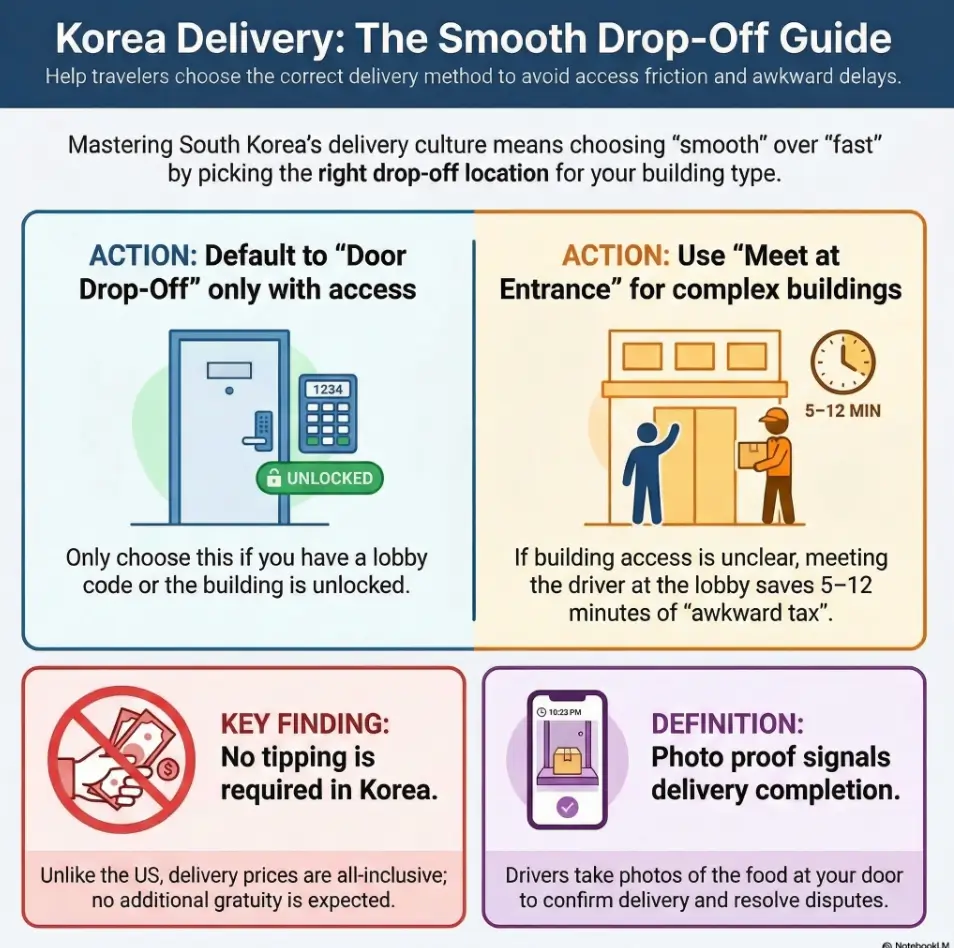
- Default: Door drop-off + photo.
- Friction point: 공동현관 access, especially codes.
- Hidden lever: Reviews, which actually affect outcomes.
Who this is for / not for
Who this is for
- US visitors, students, expats, and digital nomads ordering Baemin/Coupang Eats/Yogiyo-style delivery in Korea (especially if you’re still setting up Korean phone plans for Americans and figuring out the basics)
- Anyone in an apartment or officetel with a lobby door (공동현관) and unclear entry norms (if you’re new to Korean housing systems, this pairs well with a Korean apartment move-in checklist)
- People confused by photo proof, contactless drop-off, and “review etiquette”
Who this is not for
- You only use hotel concierge delivery (no lobby entry needed)
- You want legal advice about access control disputes (this is culture + practical etiquette)
- Be specific, not poetic, in notes.
- Protect building security and your privacy.
- Use reviews like a functional tool, not a diary.
Apply in 60 seconds: Save one “quiet door drop-off” note in your phone now.
Leave-at-door first: why “문 앞” is the default (and what it signals)
What “leave at door” really means in Korea
In the US, “leave at door” still often comes with a vibe of maybe I’ll knock, maybe I’ll text, maybe I’ll hover outside your soul. In Korea, “문 앞” is usually cleaner: drop, document, disappear. It’s less “social interaction avoided” and more “efficiency respected.” The hallway is treated like a brief loading dock, not a social stage.
My favorite part of this system is also the part that confused me at first: the photo. That picture is basically the receipt, the handshake, and the “we’re good” all folded into one square.
How to write delivery notes that actually work (English + simple Korean)
Short, concrete instructions beat paragraphs. Delivery drivers are moving fast, juggling multiple drop-offs, and reading on a small screen. Your note should feel like a crisp stage direction, not a memoir.
- Good: “Leave at door, no bell. Please be quiet.” / 문 앞에 두세요. 벨 누르지 마세요. 조용히 부탁드려요.
- Bad (too vague): “Please be careful and don’t make noise if possible thank you so much.”
Show me the nerdy details
Why short notes win: drivers skim. Concrete verbs (“leave,” “call,” “no bell”) map cleanly to actions. Adjectives (“careful,” “quiet”) only help when paired with a specific behavior (“no bell,” “don’t knock”). Also, hallway acoustics amplify small sounds, so “no bell” prevents the loudest, most avoidable noise.
Pattern interrupt micro-H3: Let’s be honest…
If your note is vague, the hallway becomes a guessing game. And the prize is you, barefoot, checking the wrong door, holding your phone like it owes you money.
- YES if your building allows deliveries to your floor and you can receive photos/texts.
- YES if you want quiet service (sleeping baby, Zoom call, jet lag).
- NO if your building blocks entry and you’d need to share a code to enable it.
- NO if your address is frequently confused with a near-identical building name.
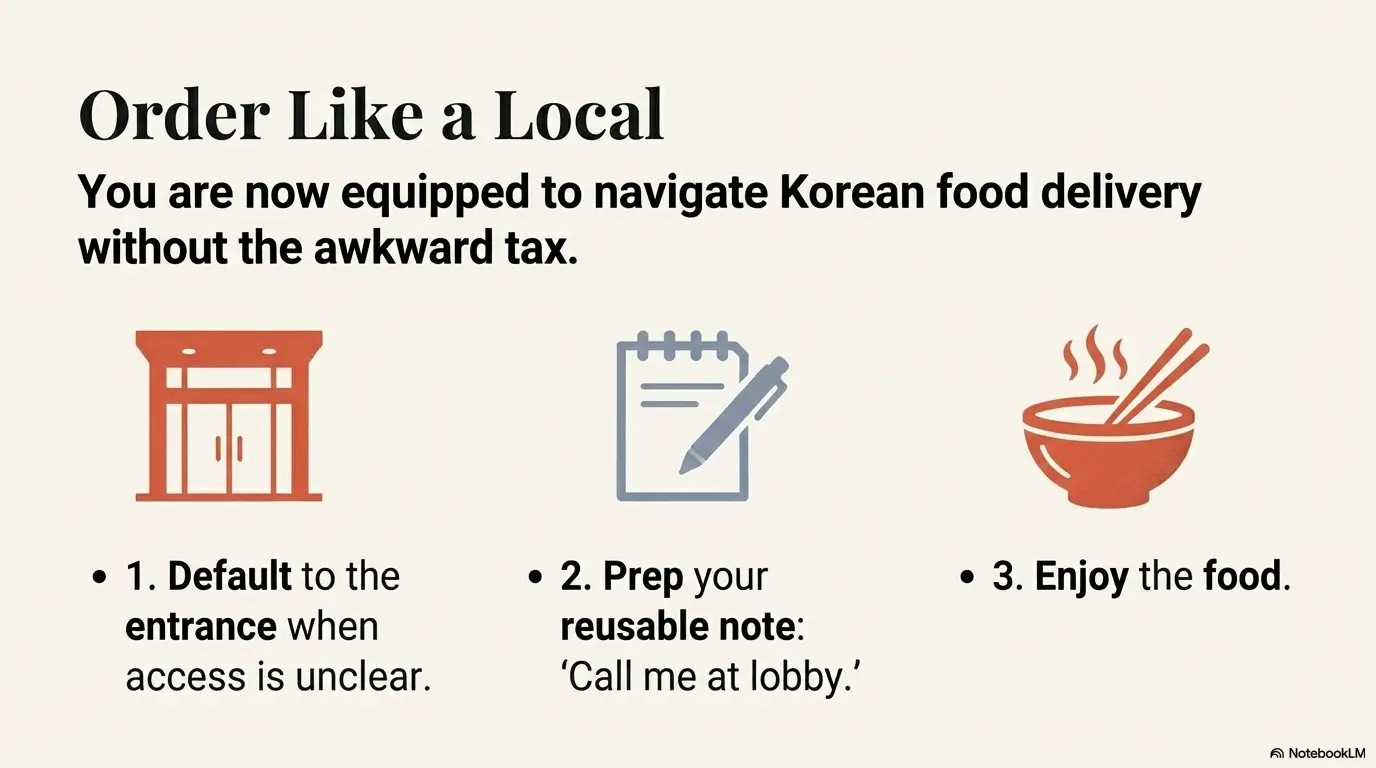
Next step: If two or more “NO” apply, switch to “call me at lobby” for this order.
If you want one trustworthy rule that works even on a tired brain: choose the option that asks the driver to do the least risky thing.
Apartment lobby doorcodes: the unspoken rules (공동현관 매너)
Why people get tense about doorcodes
공동현관 access is where polite Korea meets practical Korea, and they sometimes argue in the stairwell. Many buildings treat entry codes as collective security. Sharing them casually can feel like handing out a spare key, even if the intent is harmless. Some complexes also have explicit “no code sharing” rules, and residents have learned the hard way that tailgating and spam entry are real.
I’ve watched the social temperature change in group chats the moment someone posted an entry code “for convenience.” It’s not that people are rude. It’s that they’re protecting the building’s boundary, which is basically the neighborhood’s heartbeat.
Better options than texting a code
- “Call me” handoff at lobby door: simple, respectful, and widely understood.
- Meet-at-entrance: the polite default when unsure, especially in officetels.
- One-time access methods: if your building supports them (some do, many don’t).
- Entry requires a shared code
- Building rules are strict
- Driver sounds unsure or rushed
Trade-off: costs you 2–6 minutes, saves awkwardness.
- Driver can enter without code sharing
- Your building commonly receives deliveries
- You’ve had clean deliveries here before
Trade-off: fastest option, depends on access clarity.
Neutral action: For your next order, pick the left option once and notice how smooth it feels.
What to do if the app forces “enter code” vibes
Sometimes the UI makes it feel like a code is expected. You can still steer the outcome with a note that offers a safer alternative.
- “도착하면 전화 주세요. 공동현관에서 받겠습니다.” (Call me when you arrive. I’ll receive it at the lobby.)
- “공동현관 비밀번호 공유 어려워요. 도착 시 연락 부탁드려요.” (I can’t share the lobby code. Please contact me on arrival.)
Add landmark cues: building name, tower number, gate direction
Korean complexes can look like copy-paste architecture, especially at night. If your building has multiple towers or gates, include one clean anchor: building name in English + 동/타워 + which entrance. The goal is to reduce wrong-building risk without oversharing personal details.
Photos, timestamps, and “proof”: how to read them without panic
Why you’ll often get a door photo
That photo is doing three jobs: confirming location, reducing disputes, and helping you find your order in a hallway that looks like every other hallway. If you’re from a place where door photos feel like surveillance theatre, take a breath. Here, it’s usually closer to a delivery receipt than a documentary.
I once lived in a building where every door looked identical, down to the same shade of beige. The photo saved me from committing the most humiliating act in modern life: kneeling to read someone else’s unit number while holding hot soup.
Privacy basics for US readers
- Avoid putting sensitive information in notes beyond what’s needed to complete the delivery.
- Don’t request risky behavior (e.g., “leave inside lobby door,” “tailgate in,” “go past security”).
- If you’re concerned about personal data handling, stick to official app channels (and if you’re messaging through Kakao, it helps to know the norms: KakaoTalk etiquette) and avoid sending codes via open chat where possible.
If you want official context for how personal information is treated in Korea, the government’s Personal Information Protection Commission provides English materials on privacy and data handling standards.
Reviews aren’t small talk: they’re a second payment stream (리뷰 문화)
What reviews do in practice
Reviews in Korea aren’t just “feedback.” They’re closer to a quiet market signal. They influence visibility, promos, and how merchants interpret recurring issues (packaging, missing sides, late delivery). On some platforms, they can also intersect with points or coupons, which is why you’ll see a steady stream of photo reviews that look like they were shot under museum lighting.
I used to treat reviews like optional fluff. Then I noticed something: when I wrote a short, specific, calm review after a great delivery, my future orders from the same place were weirdly consistent. Not guaranteed, not magical, but… noticeably smoother.
What makes a “good Korean-style review”
- Short + specific: “Arrived hot, sealed well, all sides included.”
- Operational details: packaging, temperature, accuracy, speed, notes followed.
- Photo reviews: useful when the packaging or portion is the point; unnecessary when it’s just proof you have food.
Pattern interrupt micro-H3: Here’s what no one tells you…
A tiny, precise review can buy you better outcomes next time than a long complaint ever will. Long complaints often read like a weather report: lots of emotion, unclear action.
Show me the nerdy details
Why “short + specific” wins: it creates actionable signals. Merchants can’t fix “I was disappointed,” but they can fix “soup leaked because lid wasn’t sealed.” Platforms also tend to surface reviews that contain concrete attributes, which is why you’ll see recurring language around temperature, packaging, and accuracy.
- Order time and store name
- The delivery photo (or screenshot)
- What’s missing or wrong in 1 line (e.g., “No side dish, drink missing”)
- Your preferred fix: refund or resend (pick one)
Neutral action: Screenshot the delivery photo now if something feels off.
Tipping, fees, and the money awkwardness (US instincts vs Korea reality)
Why tipping isn’t the center of gravity
If you arrive with US instincts, your brain may search for the “tip moment” like it’s a missing puzzle piece. In Korea, tipping is not the default social ritual in the same way. The system leans more on platform fees, structured delivery charges, and standardized flows. Appreciation often shows up as clear instructions, fast pickup at the lobby, and a short review when service is good.
I remember fumbling for cash once, feeling like I was about to do something kind… and also maybe deeply confusing. The driver was already halfway down the hall, moving like a person who has a schedule, not a scene.
When extra kindness matters
- Bad weather (heavy rain, snow, heat waves)
- Complicated buildings (multiple towers, confusing gates)
- Heavy orders (big drinks, multiple bags)
In those moments, kindness looks less like money and more like making their job easier. Being ready at the lobby saves time. A note that prevents a wrong-building walk saves stress. A short “thank you” in Korean lands with the right softness (and if you want to tune the politeness level, a quick refresher on Korean honorifics for tourists helps).
Simple gratitude phrases that fit local tone
- 감사합니다! (Thank you!)
- 고생하셨어요. (You worked hard.)
- 조심히 가세요. (Go safely.)
Pick your inputs:
- A: Minutes to walk to lobby and back (usually 2–6).
- B: Minutes lost if the driver can’t enter and you scramble (usually 4–12).
- C: Stress multiplier (1 = calm day, 2 = tired/jet lag, 3 = you have a meeting in 5 minutes).
Result: If (B × C) is bigger than A, choose “call me at lobby” and move on with your life.
Common mistakes (don’t pay the “awkward tax”)
Mistake 1: Sharing the lobby code like it’s a Wi-Fi password
It can backfire because it collides with building rules and security culture. Even if one driver is trustworthy, the habit trains your system toward the risky default. If you live there long-term, the safest move is to build a routine that doesn’t require casual code sharing.
Mistake 2: Writing notes that are polite but unusable
“Please be careful” is kind, but it’s not a map. Better: “Leave at door, no bell, please be quiet” or “Call me at lobby, I will come down.” Make your kindness operational.
Mistake 3: Ignoring building geography
Tower numbers, building names, gates, and elevator oddities matter. If your complex has 동/타워 and multiple entrances, add a single crisp cue. It prevents the classic comedy: driver at Gate A, you at Gate B, both convinced the other is living in a parallel universe.
Mistake 4: Treating reviews like optional fluff
In Korea, reviews often function like a feedback lever. A good review is not a novel. It’s a small tool that signals what “good” looked like today.
It was raining hard enough to make the streetlights look like watercolor. I ordered soup, the kind that feels like a blanket with a heartbeat. The app asked for a lobby code, and my US brain said, “This is normal, right?” so I typed it in. Two minutes later, the driver called anyway, voice calm but firm.
They couldn’t use the code, and someone behind them was waiting at the door. I ran downstairs, half-apologizing to the air. We met at the entrance, exchanged the bag, and the driver nodded like we had solved a small puzzle together.
That night I changed my default note to “Call me at lobby.” The next order arrived without drama. Not faster, exactly. Just smoother. And smooth, I learned, is the real luxury.
The “delivery note” template: copy/paste that saves you (US-friendly)
These templates are designed to be pasted quickly, understood instantly, and safe for buildings with stricter rules. Keep them short. Use one. Repeat until it becomes boring (boring is good). 😌
For door drop-off (quiet, no bell)
English: Leave at door. Please don’t ring the bell or knock. Thank you!
Korean: 문 앞에 두세요. 벨 누르지 마시고 노크도 하지 마세요. 감사합니다!
For lobby handoff (no code sharing)
English: Please call me when you arrive. I’ll come to the lobby entrance.
Korean: 도착하면 전화 주세요. 공동현관(입구)에서 받겠습니다.
For tricky buildings (landmarks + floor guidance)
English: Building: [NAME], Tower/동: [#]. Entrance: [Gate A/B]. Please call on arrival.
Korean: 건물명: [NAME], [동/타워 #]. [출입구/게이트]로 와주세요. 도착 시 연락 부탁드려요.
- Pick one default (door or lobby).
- Keep it under 2 lines.
- Add one location cue only if needed.
Apply in 60 seconds: Save your chosen template as a text shortcut on your phone (e.g., “;deliver”).
Edge cases: when the system breaks (and how to recover calmly)
Wrong building / wrong floor
First: check the photo. Then compare building name and tower/동 signage near the entrance. If you’re in a complex with multiple similar buildings, the fastest fix is usually a calm, simple message that gives the driver one new anchor.
- Korean: “사진 위치가 다른 것 같아요. [건물명/동] 확인 부탁드려요.” (I think the photo location is different. Please check the building/tower.)
- Korean: “제가 [출입구]로 내려갈게요. 전화 주세요.” (I’ll come down to the entrance. Please call.)
Driver can’t enter / won’t take code
This is not a moral failure. It’s a systems moment. The best next message is cooperative and fast (and if you want ready-made “I’m sorry / let’s fix it” lines that sound natural, bookmark Korean apology phrases).
- Korean: “공동현관 앞에서 받을게요. 지금 내려갈게요.” (I’ll receive it at the lobby entrance. I’m coming down now.)
Food left “somewhere safe” but not your door
In some buildings, “safe” means a shelf near the entrance, a parcel area, or near the guard desk. Look for patterns: where do packages usually sit? Where do neighbors leave deliveries? This is also where the photo becomes your best friend.
Show me the nerdy details
Why “somewhere safe” happens: building policies and social norms. Some complexes discourage hallway clutter. Some guards redirect deliveries. Some drivers avoid upper floors to respect rules or save time. The photo acts as a location hash, reducing confusion without requiring a long back-and-forth chat.
문 앞 / 공동현관 / 전화 요청
Multiple stops, short dwell time
공동현관 rules, security, entry limits
Photo + timestamp reduces disputes
Visibility, consistency, incentives
Use it: If step 3 feels risky, switch to “call me at lobby.”
Mini-glossary: the 12 Korean terms you’ll see on delivery screens
Access + location terms
- 공동현관 = shared building entrance/lobby door
- 문 앞 = in front of your door
- 경비실 = security/guard office
- 출입구 = entrance
- 동 / 호 = building/tower number / unit number
Contact + instructions
- 전화 주세요 = please call me
- 벨 누르지 마세요 = please don’t ring the bell
- 노크하지 마세요 = please don’t knock
- 조용히 부탁드려요 = please be quiet
- 도착하면 연락 주세요 = contact me when you arrive
- 여기 두세요 = leave it here
- 감사합니다 = thank you
FAQ
Yes. “문 앞” is commonly the default because it’s fast, contactless, and easy to verify with a photo. If your building allows it, it’s usually the smoothest option.
Often, no. Many buildings treat codes as sensitive. A safer norm is “call me at lobby” or “I’ll meet you at the entrance,” especially if you’re unsure of building rules.
Use a short template: “문 앞에 두세요. 벨 누르지 마세요.” (Leave at door. Don’t ring the bell.) Or “도착하면 전화 주세요. 공동현관에서 받겠습니다.” (Call me when you arrive. I’ll receive it at the lobby.)
Usually for proof of delivery and dispute prevention, and to help you locate the drop-off spot in similar-looking hallways. Treat it like a receipt image more than a personal surveillance moment.
Tipping isn’t the default norm the way it is in many US contexts. Appreciation is more commonly expressed through clear instructions, quick pickup at the lobby when needed, polite messages, and practical reviews.
Use “call me on arrival” and meet at the entrance. Add one landmark cue (building name, tower/동, gate). This usually resolves the friction without creating a security risk.
They matter more than many US readers expect. Short, specific reviews help merchants and can influence visibility and consistency. When service is good, a one-sentence review is a low-effort “thank you” that can pay you back later.
Next step
Do this once: set a “default delivery note” you can reuse
Pick one template from above. Save it in your phone notes or as a keyboard shortcut. Then paste it every time until it becomes muscle memory. The goal is not to be fluent. The goal is to be predictable and easy to deliver to.
Conclusion
Here’s the curiosity loop we opened at the start: why does Korean delivery feel like food teleportation? Because the culture is built around low friction, and low friction needs three things: clear instructions, safe access norms, and proof that doesn’t require a conversation. Once you stop waiting at the door like it’s a movie scene, and start writing notes like an operator, the whole system gets calmer.
If you want deeper official context on privacy and personal data handling, Korea’s legal framework includes the Personal Information Protection Act in English, and major platforms also publish their privacy notices in English. Read them once, not in a panic, and you’ll feel more in control.
Your 15-minute action: Save one delivery note template, decide your default (door vs lobby), and place your next order using only that script. The reward is small but addictive: fewer calls, fewer hallway laps, and a life that feels slightly less like an improv show.
Last reviewed: 2026-03-07