

“The room notices your manners before your melody.”
At Noraebang, the person who gets invited back is rarely the best singer. Success isn’t about vocal range or chasing high scores. It’s about turn-taking, microphone etiquette, and the small signals that make everyone feel comfortable.
“`- ✔ Share the Stage: Rotate turns fairly and avoid the “one-person residency.”
- ✔ Read the Room: Choose crowd-pleasers that keep the group energy open.
- ✔ Playful Scores: Treat the scoring system as a game, not a competition.
Get the etiquette right, and the room becomes yours.
“`Fast Answer: Noraebang etiquette is less about singing well and more about reading the room. In most Korean karaoke settings, good manners mean sharing turns fairly, not monopolizing the mic, respecting group energy, keeping scoring playful, and choosing songs that fit the moment. If you can rotate smoothly, invite quieter people in, and avoid turning the room into a solo concert, you are already doing most things right.
Contents — choose a section
Table of Contents
First things first: what noraebang etiquette actually means
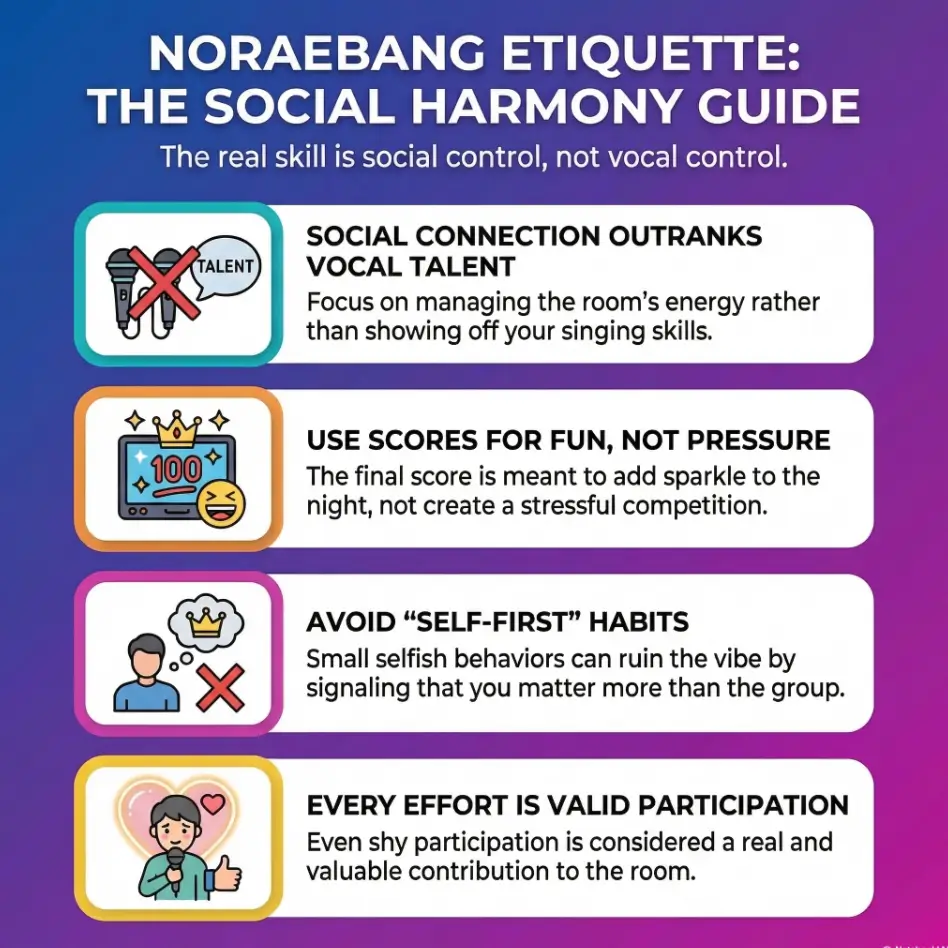
It is not about vocal talent
The quickest misunderstanding foreigners make is assuming noraebang is a talent test. It usually is not. In a private-room setting, the social reward comes from being pleasant to sing with. That means knowing when to go big, when to stay light, and when to leave a little oxygen in the room for everyone else.
A group can enjoy an imperfect performance without a high machine score. Ask how turns are shared rather than treating applause as a universal response.
It is about room management
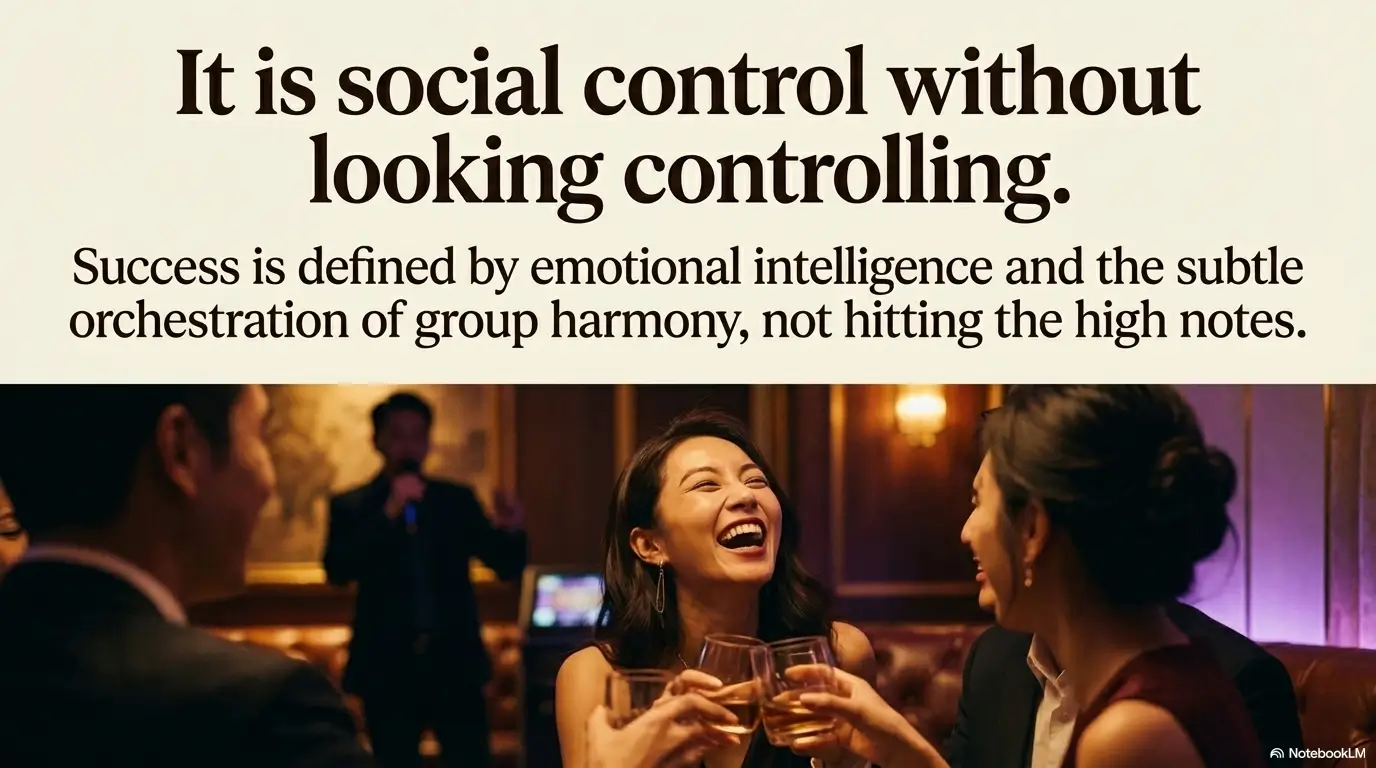
Noraebang is closer to hosting than performing. The room has a pulse. Turn-taking shapes it. Microphone behavior signals respect. Song choice tells the group whether you understand the moment. The Korea Tourism Organization’s English materials increasingly describe noraebang as part of Korea’s broader “room culture,” and that framing is useful. The room itself is the event. The room is the instrument. The room remembers.
- Good etiquette protects group energy
- Good etiquette lowers embarrassment for shy singers
- Good etiquette makes even a mixed-language group feel easy
Let’s be honest…
Nobody remembers the highest note as much as they remember the person who made them feel invisible. That is the bruise people carry home. Noraebang manners exist to prevent that bruise.
- Think like a guest and a host at the same time
- Protect other people’s chance to join
- Use your choices to help the room, not dominate it
Apply in 60 seconds: Before you add a song, look around and ask yourself who has not had a comfortable chance yet.
Eligibility checklist: should you queue another song right now?
Use this yes-or-no check before hitting the remote again.
- Yes: At least 2 other people have sung since your last turn
- Yes: The room still feels upbeat, not fatigued
- Yes: Your next song is different enough in mood to help the flow
- No: Quiet guests are still hovering at the edge
- No: You already have multiple songs sitting in the queue
Neutral next action: If you get two “no” answers, wait one round and become the cheer squad for someone else.
Turn-taking rules: how to sing without hijacking the night
Queue gently, not aggressively
The remote is small, but power gathers around it like weather. The most common etiquette failure is not rude speech. It is silent over-queuing. One person keeps sliding in “just one more” until the screen resembles their private setlist. In a casual friend group, people may tolerate this for a while. In mixed groups, work gatherings, or first-time meetings, it lands badly much faster.
A useful rule is boring in the best way: start by adding only one song. Then let the room breathe. If the queue stays light and people are slow to choose, add another later. If others are clearly waiting, keep your finger off the button. Restraint at noraebang reads as emotional intelligence, and that is a currency that spends well.
Read the room before adding another track
There is no universal timer. There is only context. Are quieter people still smiling but not quite stepping in? Pause. Has the room dipped after three long ballads? Choose something shorter or brighter. Has the group become playful and loud? A duet or familiar chorus can revive momentum faster than another solo torch song.
Constructed example: A group becomes tired after several songs. Asking whether everyone wants a break is more useful than interpreting the quiet as a demand for another performance.
Fair rotation beats fast rotation
Many people imagine fairness means speed: let songs fly, keep things moving, next, next, next. But the better principle is balance. A slower, more even rotation feels more welcoming than a fast cycle that keeps favoring the boldest people. When the room is mixed in age, language, or familiarity, balanced rotation matters even more.
Here is the hidden social math: the person who sings a little less than they could often comes across much better than the person who sings exactly as much as they want.
Practical check: Confirm the actual terms and preferences using the questions below. A generic score or budget formula cannot establish a required payment, contract charge or social obligation.
Here’s what no one tells you…
People often judge your manners long before they judge your singing. In group karaoke, your first reputation is built with your queue behavior, not your chorus.
Microphone rules: what the mic says about you before you sing
Do not cling to the microphone between songs
The microphone has a strange gravity. Once it is in your hand, it can feel natural to keep holding it while browsing songs, talking, or waiting for someone else to decide. That tiny habit reads more territorial than most people realize. When your song ends, pass the mic promptly. Even setting it down clearly and neutrally can be better than half-holding it like a monarch with a velvet scepter.
I still remember a room where one guest never actually said, “I am in charge,” but managed to communicate it all night through posture alone. Mic in hand. Thumb near the remote. Knees angled toward the screen. Nobody argued. Everybody noticed.
Offer, do not force
Inviting someone to sing can be kind. Forcing them into the spotlight is another story. Shy guests are often deciding whether the room is safe. A gentle “Want this one?” or “We can duet if you want” gives them a path in. A loud ambush with the mic already pointed at their face turns their hesitation into a public event.
This matters even more for U.S. travelers dining with Korean coworkers or new acquaintances. In those rooms, kindness is usually quiet. Pressure is usually loud. The same principle shows up in Korean indirect communication, where soft invitations tend to work better than public insistence.
Shared-mic moments need tact
Duets are delightful when invited. They are intrusive when assumed. Do not jump into another person’s verse just because you know the song and the spirit has moved you. Harmony can be charming. Hijacking is still hijacking, even with better pitch.
- Join only if invited or clearly signaled in
- Take chorus space, not the whole verse
- Leave the emotional center of the song with the person who picked it
Hygiene and practical courtesy
This is the least glamorous section and maybe the most useful. Avoid yelling directly into the mic from zero distance. Be mindful when sharing equipment closely. If a venue offers disposable covers or wipes, use them without turning it into a stage monologue about germs. Practical courtesy is still courtesy.
Infographic: the 4-step noraebang flow that keeps the room happy
1. Queue one
Add a single song, then stop touching the remote like it owes you money.
2. Sing your turn
Keep your energy matched to the room, not to your secret audition fantasy.
3. Pass fast
Hand off the mic or set it down clearly. Do not hover with it.
4. Cheer and reset
Clap, laugh, encourage, and make the next person feel easier about joining.
Scoring culture: when the score matters, and when it absolutely does not
Treat scoring as entertainment, not judgment
Most noraebang scoring systems are theater wearing the outfit of science. Yes, the numbers can be funny. Yes, they can trigger competitive sparks. No, they should not become the emotional constitution of the room. A high score is nice confetti. A low score is not a moral failure, nor evidence that the machine has uncovered your true worth as a citizen.
Korea’s tourism content around coin noraebang even references “perfect score” events on certain machines, which tells you something important: the score is often part game, part gimmick, part reward loop. Treat it lightly unless the group has explicitly chosen a competition format.
Some groups care more than others
Friends may roast each other and keep moving. Coworker groups often keep scoring gentler, especially where hierarchy is present. Mixed-age groups can vary wildly. What matters is not your personal philosophy about numerical justice. It is whether the room is using the score as seasoning or as structure.
Do not become the score police
Nothing drains a room faster than forensic outrage about why someone got 94 and someone else got 87. Machines from TJ Media and Kumyoung can feel mysterious because they are mysterious. You can laugh at the chaos goblin inside the box. You do not need to cross-examine it.
Show me the nerdy details
Noraebang scoring is influenced by more than raw pitch. Timing, note tracking, sustained tone, machine settings, and even how a track is mixed can shape the result. That is one reason two equally enjoyable performances can receive noticeably different scores. Treat the number as a game mechanic, not an objective measurement of musical worth.
- Celebrate high scores lightly
- Never mock a low score
- Do not argue with the machine as if it were a court
Apply in 60 seconds: The next time a number flashes up, react to the fun of the moment, not the seriousness of the ranking.
The real trap
Turning karaoke into a performance audit can drain the room faster than a bad ballad trilogy. And a bad ballad trilogy is already working hard.
Group manners: the invisible rules that make people invite you back
Clap, react, and stay engaged
You do not need to behave like a game-show audience. But visible engagement matters. Looking at your phone through someone else’s entire song, then waking up only when your own intro starts, is one of the clearest bad-manners signals in any karaoke culture. Tiny reactions travel far: clapping at the end, singing a chorus line, nodding along, laughing with rather than at.
Offer help with lyrics or a duet only if wanted. Encouragement should leave the other person free to decline.
Support different comfort levels
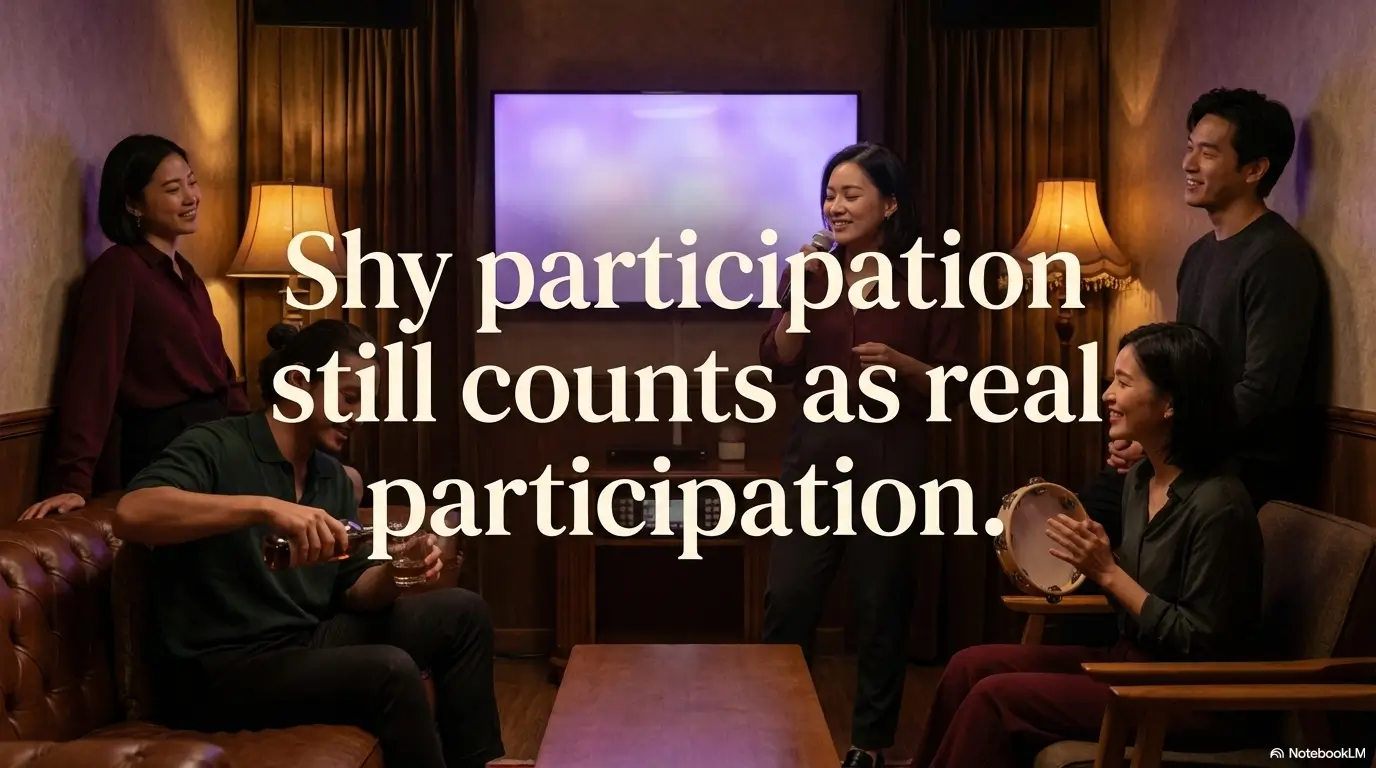
Some people sing one song all night. Some join only on choruses. Some never touch the remote but become essential because they cheer everybody else on. Do not confuse quieter participation with bad participation. A warm room has space for different intensities.
Match the vibe of the gathering
A college friend group may welcome glorious chaos. A company outing may reward more restraint. A late-night second round may become louder, sillier, and more forgiving than an early evening stop after dinner. Context is not decoration. Context is the rulebook nobody prints.
Energy management matters
Not every song should be a vocal mountain. Not every song should be a meme pick. The best guests help the room breathe. They vary tempo, mood, and emotional weight. After two power ballads, a lighter familiar track can feel like opening a window. After three joke songs, one sincere crowd-pleaser can give the night a spine again.
Coverage tier map: what changes from vibe tier 1 to 5
- Tier 1: New group, quiet room, cautious energy. Choose safe, short, familiar songs.
- Tier 2: People are warming up. Add one playful chorus-friendly pick.
- Tier 3: Comfortable room. Duets and mixed-language songs work well.
- Tier 4: High energy. Big sing-alongs are welcome, but rotation still matters.
- Tier 5: Controlled chaos. You can get sillier, but still do not erase other people.
Neutral next action: Identify the current tier before choosing your next move.
Song choice etiquette: your pick changes the whole room
Choose for the room, not just for yourself
Your song pick is a social message. It says, “I am thinking about us,” or “I am thinking only about me.” Familiar songs pull people in. Overly long songs can stall momentum. Niche deep cuts work best once the room is already relaxed and generous. If nobody knows your 8-minute masterpiece, the room is not failing you. The room is giving you information.
A good first song is rarely your most impressive song. It is the song that lowers the room’s risk. That might be something upbeat, recognizable, and not punishingly long. Save the emotionally volcanic breakup anthem for later, when the room has earned it and perhaps the room has also earned ear protection.
Language choice can be strategic
English songs are common and often helpful in mixed groups. Korean hits can be excellent when others know them. Alternating languages can keep more people included. Seoul’s English-language materials explain the word “noraebang” simply as the “room where you sing,” and that simplicity is useful here too. This is not a language exam. It is a shared room experience. If you are nervous about sounding polite in the room, a quick grasp of Korean honorifics for tourists can help you relax before the first song even starts.
Mood sequencing is a real skill
Start safer before going obscure. Use upbeat songs to revive tired energy. Use duets to help hesitant people enter. Use sentimental songs carefully when the room is drifting toward emotional weather. Good sequencing feels effortless from the outside, but it is one of the highest forms of noraebang competence.
One tiny rule with huge payoff: if your pick requires a five-minute explanation, it is probably the wrong moment.
Decision card: when to choose A vs B
A. Familiar crowd-pleaser
Best when the room is mixed, people are shy, or energy is fading.
B. Personal favorite deep cut
Best when the room is already relaxed, your turn is clearly yours, and others have had plenty of space.
Time/cost trade-off: A gives faster group payoff. B gives stronger self-expression but higher room-risk.
Neutral next action: If you are unsure, choose the option that makes one more person likely to sing after you.
Illustrative scenario: A newcomer asks to listen for the first round and joins a later duet voluntarily. The group leaves room for both choices. This illustrates an option, not a reported social outcome.
Don’t do this: the fastest ways to become “that person” in the room
Do not queue a personal concert setlist
Back-to-back solo picks feel self-centered even when you are cheerful about them. The room should not become your audition tape, your healing retreat, or your accidental residency. If you want three songs in a row, book your own room on another night and commune with destiny there.
Do not mock weak singers
Karaoke works because people risk imperfection together. Even a joking jab can shut someone down for the rest of the night. The room becomes colder not because of the joke itself, but because everybody suddenly remembers they could be next.
Do not weaponize Korean culture
This is a subtle trap for visitors who know just enough to become dangerous. Avoid acting like the self-appointed etiquette enforcer. Correcting every tiny behavior with a lecture about “how Koreans do it” can be socially worse than the original mistake. Use your knowledge to make people comfortable, not to score cultural points. The same caution applies when talking about broader Korean personal questions etiquette or social norms in mixed settings.
Do not disappear into your phone
Repeated phone-checking reads as disengagement, especially if you spring back to life only for your own turns. There is no need to cosplay monastic focus, but visible participation is part of the social contract.
- Do not monopolize the queue
- Do not turn jokes into ridicule
- Do not use your phone like a privacy curtain
Apply in 60 seconds: Put your phone face down for two full songs that are not yours.
Common mistakes
Mistake 1: confusing enthusiasm with domination
Big energy is wonderful. Taking over is not. The line between them is whether other people feel more included because of your energy or less included because of it.
Mistake 2: treating every song like a solo spotlight
Group karaoke rewards generosity more than virtuosity. Your best moments may come from backing someone else up, not from hunting your personal peak.
Mistake 3: misreading scoring as serious ranking
Machines entertain first, evaluate second. If you treat every score like an exam result, the room starts wearing school uniforms in its soul.
Mistake 4: pushing shy people too hard
Invitation feels kind. Pressure feels public. Public pressure can make someone smile while internally planning never to come back.
Mistake 5: picking songs that only you can enjoy
A room full of listeners is not the same as a room full of participants. Song choice should create openings, not just expression.
Mistake 6: ignoring age or hierarchy in mixed groups
In some settings, social dynamics shape who sings first, how teasing works, and how wild the room can get. What feels harmless in a close friend circle can feel reckless in a work context.
- If you are the newcomer, start conservative
- If the room loosens later, you can loosen with it
- It is harder to recover from “too much” than from “pleasantly restrained”
Work dinner vs friend night: why the same behavior lands differently
Coworker noraebang has extra layers
When noraebang follows a company dinner, the atmosphere may look relaxed while still carrying invisible structure. Seniority can influence who sings first. Teasing should stay lighter. Lyrics, dance moves, and overall performance style usually deserve a bit more restraint. The smartest move is not to be timid. It is to be calibrating.
At a work gathering, check the practical arrangements and your own boundaries. Taking part in a song or staying late should not become proof of commitment.
Friend-group noraebang is usually looser
Closer friends often welcome louder participation, stranger song choices, and more playful scoring drama. But even here, the basics still apply. Chaos is not the same as selfishness. The room can be rowdy and still be fair.
Mixed groups require the most awareness
These are the rooms where etiquette matters most because nobody shares the same assumptions. Travelers, expats, students, coworkers, cousins, the one person who came only because everyone insisted, the K-pop expert, the person whose last karaoke experience was in a bowling alley in Ohio in 2019. Mixed groups are human weather systems.
The safest principle is simple: follow the most conservative social temperature first. You can always get sillier later. It is harder to reverse an overcooked first impression.
Quote-prep list: what to gather before you choose your first song in a mixed group
- Who has already sung and who has not
- Whether the room reacts more to humor, nostalgia, or pure sing-along energy
- Whether hierarchy is present and visibly shaping turn order
- Whether language choice is narrowing or widening participation
Neutral next action: Use those four clues before your first pick, not after your second mistake.
If you are shy: how to participate without making it weird
You do not have to sing first
Watching one or two rounds is normal. Many shy people assume that delaying their first turn looks awkward. Usually it does not. It simply looks like observation, which is often wise. You are not auditioning for spontaneity points.
Low-pressure entry points work best
Pick a short, familiar song. Ask for a duet. Cheer others actively before your turn. These are not consolation tactics. They are smart tactics. You are building comfort before exposure.
A shy guest can listen, chat or leave at the agreed time. Neither singing nor explaining a private reason is required to make a polite choice.
Let’s be honest…
The group usually wants your participation, not your perfection. And participation has many shapes. Sing one verse. Clap hard for someone else. Hold the tambourine like a tiny thunderstorm. There are gentle ways in.
- You can wait before your first turn
- Duets are excellent bridges
- Supportive energy is part of the culture of the room
Apply in 60 seconds: Decide now on one easy entry move: a duet, a short chorus song, or active cheering for two others first.
Agree on the queue before the first song
With a new group, ask whether people want one song each, shared songs or a looser queue. If you add several favorites, make clear that others should take turns between them. Ask before joining someone’s solo or filming their performance. A high score is entertainment, not an objective judgment of another person’s ability. If the room time is almost over, agree whether to extend before anyone commits the group to an extra charge.
A reader question: Can I pass when my turn comes?
Yes. Say you will listen for now or suggest a group song if you prefer. Sharing the room does not require every guest to sing solo.
Next step
Before your next noraebang night, use this one-rule checklist
If you remember only one rule, let it be this: make the room easier for the next person. That principle quietly solves most etiquette questions before they become awkward.
- Add only one song at first
- Cheer for two people before your own turn
- Pass the mic quickly
- Treat the score like confetti, not a verdict
- Choose one song for the room before one song for yourself
This is where the hook closes. The confidence you want at noraebang does not come from sounding impressive. It comes from understanding the room well enough that you stop fearing it. Once that happens, singing becomes the easy part.
For travelers building confidence across Korean social spaces, the same read-the-room instinct also helps with Seoul cafe etiquette and other everyday group settings.
FAQ
Is it rude to sing multiple songs in a row at noraebang?
Usually, yes, unless the group is tiny or everyone is explicitly encouraging it. Fair rotation is the safer norm, especially in mixed or first-time groups.
Do people share microphones in Korean noraebang?
Sometimes, especially during duets or energetic group moments, but you should not assume shared-mic access without invitation. Joining naturally is good. Taking over is not.
Are karaoke scores taken seriously in Korea?
Often they are playful, but context matters. Some groups enjoy competition. Others treat the score as background theater. Unless the room clearly wants a contest, keep your reaction light.
What if I cannot sing Korean songs?
That is usually fine. English songs are common in many noraebang settings, especially in mixed or international groups. A well-chosen familiar English song can be a very smart first pick.
Should I clap and cheer even if someone is bad?
Yes. Supportive reactions help keep the room fun and low-pressure. The point is not to pretend every performance is divine. The point is to reward participation and courage.
Is it rude to look at my phone while others sing?
It can be. Repeated phone-checking reads as disengagement, especially if you seem fully awake only when your own song starts. Brief checking is human. Entire-song detachment is different.
Who should sing first in a group?
It depends on the room. Sometimes the most outgoing person starts. In work or hierarchy-shaped settings, social cues may guide the order more carefully. If unsure, let the room reveal its preferences before jumping in.
Can I invite someone to duet if they seem shy?
Yes, but gently. Offer once, make it easy to decline, and do not turn the invitation into public pressure. The best duet invitation feels like an open door, not a spotlight trap.
What songs are safest for first-time noraebang guests?
Shorter, familiar, upbeat songs with broad recognition usually work better than long niche picks. Your goal is to lower risk and widen participation.
Is noraebang etiquette different from Western karaoke bar etiquette?
Often yes. Private-room dynamics can make turn-taking, group inclusion, and room energy more important than public-stage flair. The room is smaller, more social, and more revealing. That wider contrast becomes even clearer if you have been comparing different slices of Korean culture as a visitor.
The last note
Noraebang etiquette sounds complicated until you strip away the neon and remember the human core. Share turns. Pass the mic. Keep scoring playful. Notice the shy people. Choose at least some songs for the room. That is the whole lantern, really. Everything else is decorative paper and disco lights.
If you are heading to noraebang within the next 15 minutes, do one tiny preparation step now: pick one safe first song and one backup duet option. Then promise yourself you will cheer for two people before worrying about how you sound. That single shift turns nerves into usefulness, and usefulness into confidence. And if the night stretches into other shared spaces afterward, knowing a little KakaoTalk etiquette can help you carry that good impression beyond the singing room.
Last reviewed: 2026-03.
Practical example and reader question added October 20, 2026. Existing source dates are retained; this addition is not a fresh verification of every earlier claim.