

Mastering the Art of the Korean Refusal
Korean drinking etiquette doesn’t usually punish you for saying no. It punishes you for making the table feel like you’re saying no to them.
The real challenge for travelers, expats, and new hires at Hoesik (회식) isn’t the alcohol—it’s keeping face and rapport intact. This playbook makes refusal feel natural and “boring” in the best way possible.
The Smooth Navigator’s Protocol:
- 1 Pick your one reason and stick to it.
- 2 Use natural phrases and two-hand cues to signal respect.
- 3 Keep your non-alcoholic drink visible at all times.
- 4 Join the ritual with water or tea—then let the night keep moving.
Stop the “just one shot” spiral. Stay inside the circle without the hangover.
Table of Contents
Who this is for / not for
Korean drinking etiquette can feel like a fast-moving dance where everyone knows the steps but you. This guide is for the moments when you need to step off the dance floor without stepping on anyone’s toes.
For: visitors, expats, interns, remote workers, dates, in-laws, team dinners
- You’re traveling in Korea and want to decline alcohol without looking cold.
- You’re a new hire (or intern) navigating 회식 (hoesik) team dinners.
- You’re dating and want to keep things charming, not clinical.
- You’re meeting family and want polite boundaries without a speech.
For: people who don’t drink, are pacing, or need a clean exit without drama
- Non-drinker (personal choice, recovery, religion, preference).
- Pacing (jet lag, early morning, long week).
- Health or medication (you do not owe details).
Not for: situations where safety is at risk (harassment, coercion)
If someone is coercing you, blocking you from leaving, or escalating, this becomes a safety issue, not an etiquette puzzle. Use the “hard stop” section below and prioritize leaving or getting help from staff, colleagues, or a trusted friend.
Not for: “I want to shame drinking culture” conversations (different playbook)
There’s a time for cultural critique. A dinner table is usually not it. Here, the goal is to keep rapport intact while staying firm.
- Warmth signals respect.
- A short reason reduces awkward follow-ups.
- An alternative keeps you inside the ritual.
Apply in 60 seconds: Pick one “pacing” line and one “alternative toast” line now.
Pressure-proof mindset: decline the drink, keep the bond
The hidden rule: you’re refusing the alcohol, not the person
In many Korean social settings, a drink offer is a tiny packet of goodwill. When you refuse, the fear is not “you hate alcohol.” The fear is “you’re refusing closeness.” So your job is to separate those two things out loud.
I learned this the hard way at my first company dinner in Seoul: I said “No thanks, I don’t drink,” with the same tone I’d use to refuse a spam call. The table didn’t explode, but the air got oddly thin. Later, a colleague told me, kindly, “It sounded like you were refusing us.” That sentence rewired my approach.
“Face” in one sentence: reduce embarrassment for everyone
Face is not vanity. It’s social friction management. The best refusal makes it easy for the other person to smile and move on without looking rejected or corrected.
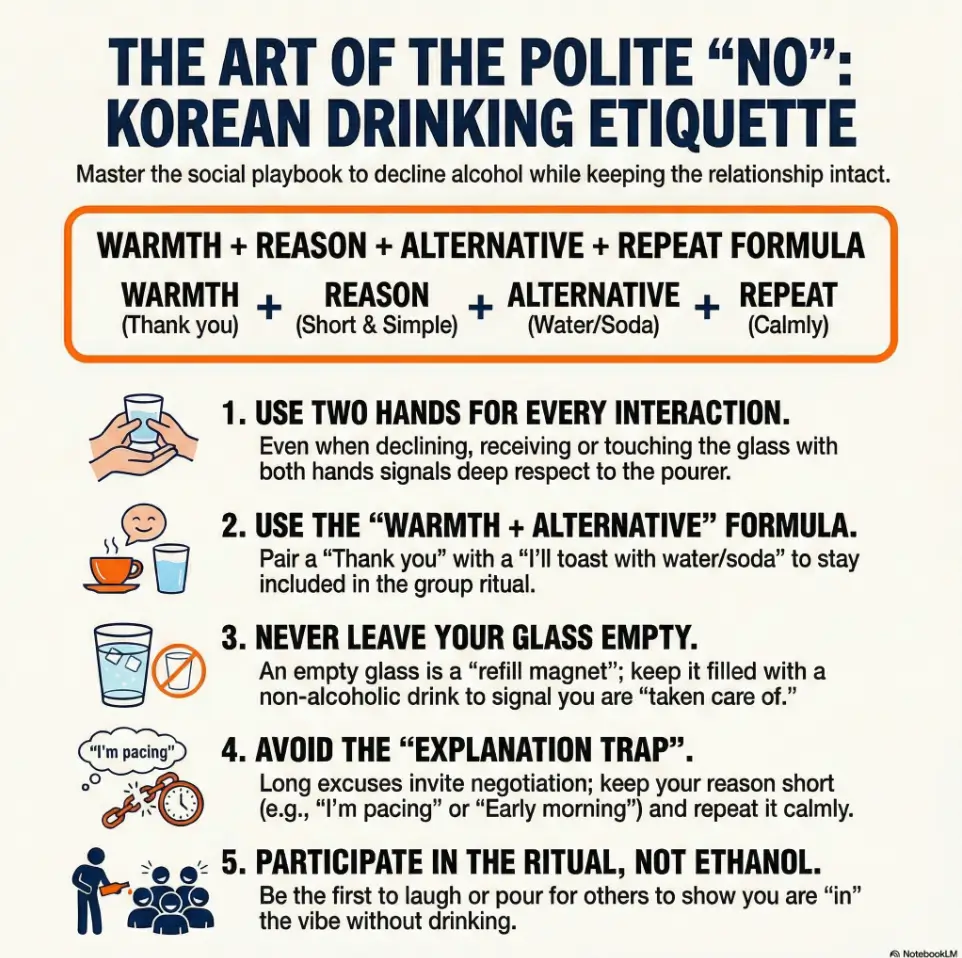
Micro-script formula: Warmth + Reason + Alternative + Repeat
This formula works because it gives people something to do next. You’re not creating a void. You’re redirecting the flow.
- Warmth: “Thank you” + friendly tone
- Reason: short, socially safe (“pacing,” “early morning”)
- Alternative: toast with water/tea/soda, or “I’ll eat well instead”
- Repeat: same sentence, calmer each time
Let’s be honest… the awkwardness is usually your pause, not your “no”
Most pressure starts in the silence after you hesitate. People fill silence by offering “solutions” (“Just one shot,” “Half cup,” “Beer only”). A short line delivered quickly prevents that negotiation from spawning.
Show me the nerdy details
In conversation analysis, hesitation and repairs (self-corrections, long pauses) signal uncertainty. In group drinking contexts, uncertainty often gets “helped” by the group. A crisp refusal reduces the chance that others treat your boundary as a problem to solve.
Money Block: Decision card (When A vs B)
- If pacing: “I’m pacing tonight” + keep a non-alcohol drink visible.
- If abstaining: “I don’t drink, but I’m happy to toast with water” + repeat calmly.
- If hierarchy is strong: add respect cues (two hands, slight nod) and keep it short.
Apply in 60 seconds: Choose your lane (pacing vs not drinking at all) before you sit down.
First 30 seconds: what to do with your hands, glass, and timing
Your words matter, but your hand choreography matters more than people admit. In Korean drinking etiquette, showing respect often looks like small, visible gestures. The good news: you can do those gestures even while declining.
Accepting a pour vs accepting a drink (yes, they’re different)
Sometimes someone pours automatically. That’s not a contract. If your glass gets filled, you can still choose not to drink. In fact, in some settings it’s smoother to accept the pour (to avoid embarrassing the pourer) and then switch to the “alternative toast” move when it’s time to clink.
Glass etiquette that signals respect even while declining
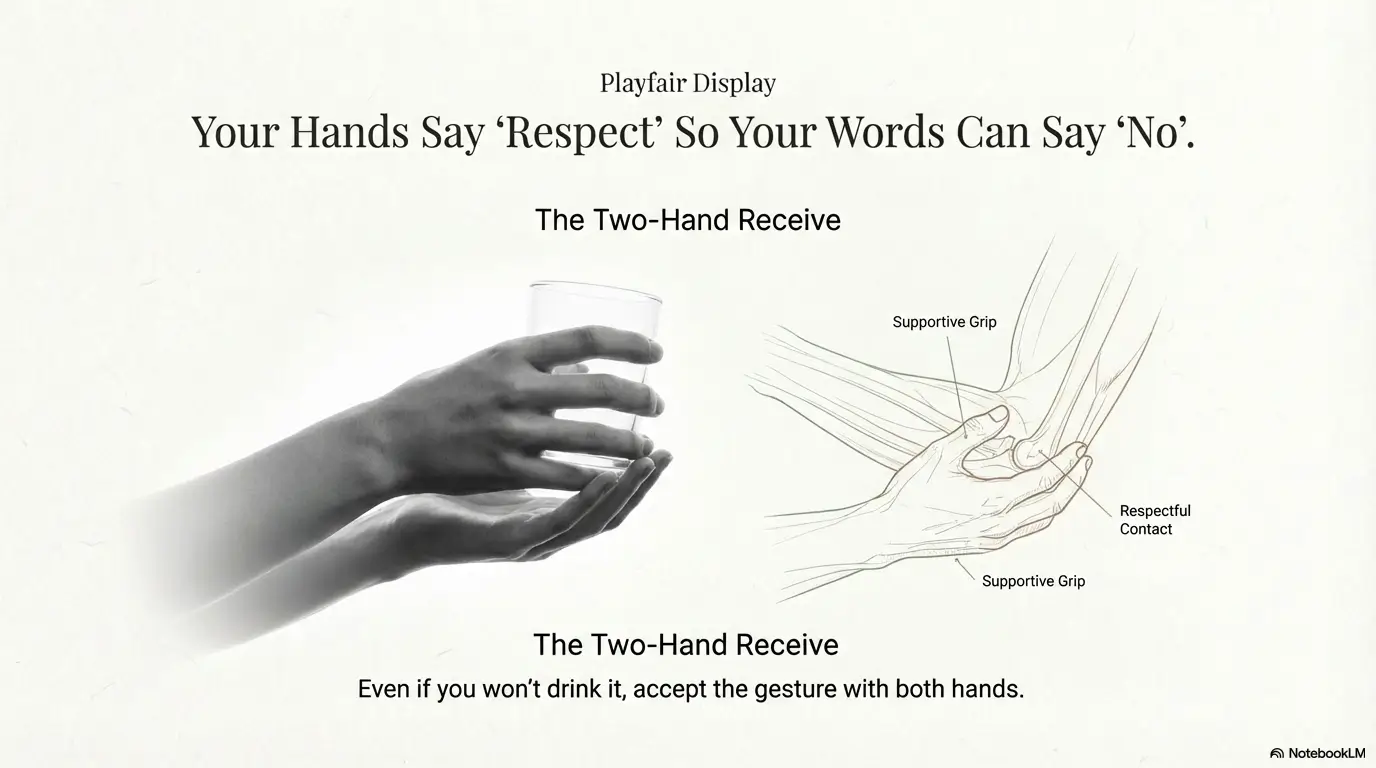
- If someone offers a drink directly, receive the glass with two hands (or one hand + supporting wrist) and say thanks.
- Keep your expression warm. A tiny nod does a lot of work.
- If you’re not drinking, keep your non-alcohol drink in your hand during toasts so you look “in.”
Timing hacks: decline before the bottle is hovering over you
The easiest refusal is the early one. When you sit down, you can casually set expectation:
“I’m pacing tonight, so I’ll stick to tea/water.”
It lands better as a “plan” than as a “reaction.”
Seating & pour dynamics: why the “senior pours” moment matters
If a senior is pouring, people may read refusal as a direct interpersonal rejection. That’s why your respect cues matter most in that moment: two hands, gratitude, short reason, alternative toast. (If you want the “why” behind these soft signals, skim Korean indirect communication patterns and you’ll see the logic click.)
Personal note: I once tried to stop a senior’s pour by putting my palm over the glass like I was blocking a penalty kick. It worked, technically. It also looked like I was swatting away kindness. Don’t do my rookie move.
Money Block: Mini calculator (pacing without awkwardness)
Mini calculator: How to say “I’m pacing” with a believable plan
- Hours you’ll be out: 2 / 3 / 4
- Drinks you want max: 0 / 1 / 2
- Alternate with: water / tea / soda
Output line: “I’m pacing tonight, so I’m doing [one drink max / no alcohol] and sticking to [water/tea].”
Neutral next step: Decide your max before the first toast.
Polite Korean phrases that sound natural (not textbook)
Below are lines that work because they’re short, warm, and hard to negotiate with. Think “closed doors with soft curtains.” Use the Korean first if you can, then English if needed. Your accent is fine. Your intention is what people feel.
“I’m okay for now” lines that don’t invite negotiation
- 지금은 괜찮아요. (Jigeumeun gwaenchanayo.) “I’m okay for now.”
- 저는 이걸로 갈게요. (Jeoneun igeollo galgeyo.) “I’ll stick with this.” (hold up water/tea)
- 감사해요, 저는 패스할게요. (Gamsahaeyo, jeoneun paeseu halgeyo.) “Thanks, I’ll pass.”
“I’m pacing” lines that feel socially safe
- 오늘은 천천히 마실게요. (Oneureun cheoncheonhi masilgeyo.) “I’ll drink slowly tonight.”
- 오늘은 페이스 조절 중이에요. (Oneureun peiseu jojeol jung-ieyo.) “I’m pacing tonight.”
- 내일 아침이 일찍이라서요. (Naeil achimi iljjigiraseoyo.) “I have an early morning.”
“Health/meds” lines: how to say it without oversharing
You can keep it vague. In most contexts, “health” is a social shield people respect. Also, it’s truthful that alcohol can interact with medications. (If you want a broader “how to sound respectful fast” cheat code, Korean honorifics for foreigners pairs beautifully with these short refusals.)
- 오늘은 건강 때문에 술은 어려워요. (Oneureun geongang ttaemune sureun eoryeowoyo.) “For health reasons, alcohol is tough today.”
- 약 때문에 오늘은 술은 안 마셔요. (Yak ttaemune oneureun sureun an masyeoyo.) “Because of medication, I’m not drinking today.”
- 설명은 길게 못하지만, 오늘은 패스할게요. (Seolmyeongeun gilge mot hajiman, oneureun paeseu halgeyo.) “I can’t explain much, but I’ll pass today.”
“Tomorrow morning” lines: the universal shield
- 내일 일정이 있어서요. (Naeil iljeongi isseoseoyo.) “I have plans tomorrow.”
- 내일 컨디션을 지켜야 해서요. (Naeil condishyeoneul jikyeoya haeseoyo.) “I need to keep my condition for tomorrow.”
- 오늘은 여기까지만요. (Oneureun yeogikkajimanyo.) “Just up to here for today.”
Here’s what no one tells you… the first sentence should be short enough to breathe through
If you can’t say it in one calm exhale, you’ll start negotiating with yourself mid-sentence. Short lines keep you steady.
Short Story: “The Bottle Hover”
Short Story: I was at a team dinner near Gangnam, new badge, new anxiety, new everything. The boss lifted the soju bottle and it drifted toward me like a polite satellite. I’d rehearsed a whole paragraph about jet lag, hydration, and “being productive tomorrow.” The moment arrived and my brain went blank. I panicked and said, too loudly, “NO, NO, I’M OKAY!” Silence. Someone laughed, but it wasn’t mean. It was that laugh people use to patch an awkward hole.
A teammate leaned in and quietly fed me a line: “오늘은 천천히 마실게요.” I repeated it, softer. The boss nodded like it was the most normal thing in the world, poured someone else, and the dinner kept moving. That night taught me the real secret: you don’t need the perfect boundary. You need the smoothest boundary.
The “alternative toast” move: keep the ritual, change the liquid
This is the move that saves you in Korea: keep the ritual, swap the liquid. You’re not opting out of belonging. You’re opting out of ethanol.
Water, tea, soda, and non-alcohol beer: what’s most accepted where
- Work dinners: water, soda, or tea is usually fine if you’re confident about it.
- Older relatives: tea or water often reads as “I’m taking care of myself.”
- Bars: non-alcohol beer or a mocktail can help you blend in visually.
How to clink (or not) without looking dismissive
- Hold your glass with two hands if the person is senior.
- Smile, make eye contact, and keep your glass slightly lower than the senior person’s glass.
- If the table is doing rapid-fire “건배!” moments, you can clink once, then simply raise your glass without clinking every time.
When to pour for others even if you’re not drinking
Pouring can be a respect gesture, not a consumption commitment. If you’re comfortable, you can help pour beer into someone’s glass (with the bottle supported by your other hand) while you keep your own drink non-alcoholic. It signals you’re participating in care, not rejecting it.
Snack strategy: food as your quiet ally
If your hands are busy with food (anju), your glass stays less empty. Order or reach for something you can nibble slowly. It gives you a “rhythm” that isn’t just drink-to-drink. (This pairs nicely with dinner-table basics like Korean banchan refill rules, since “how you participate” is often more visible than “what you drink.”)
Show me the nerdy details
In many group dining settings, “participation” is visually tracked: clinking, pouring, reacting, eating, laughing. Swapping the liquid keeps the participation signals intact, which reduces social monitoring and decreases attempts to “fix” your behavior.
Curiosity gap: why they keep refilling you even after you said no
It’s often care-signaling, not a challenge
In some Korean contexts, refilling is a way to say: “Are you okay? Are you included? Are you taken care of?” Especially if you’re a guest, people may equate an empty glass with neglect.
Group harmony: why someone else may “manage” your glass
Someone may refill you to prevent the group from noticing you’re not drinking. It can be a strange kindness. You can accept the care while still declining the drinking: “Thank you, I’ll toast with water.”
The “one-shot culture” myth vs modern reality in workplaces
Yes, Korea has a strong drinking tradition. But modern workplaces and friend groups are more mixed than the stereotype suggests, and plenty of people pace or skip. Etiquette still matters, but you’re not the first person at that table to choose “no alcohol tonight.”
When it’s about hierarchy (and how to respond without freezing)
If a senior insists, it can feel like a loyalty test. Your best tool is respectful repetition with a consistent reason. The moment you switch reasons (“health” then “early morning” then “diet”), it can sound like negotiation. (If you want a clean mental model for “who outranks who,” start with Korean honorifics for tourists and keep it simple: respect cues first, explanation last.)
- Use one reason, repeated calmly.
- Keep your alternative drink visible.
- Thank the person before you redirect.
Apply in 60 seconds: Decide your “one reason” and stick to it all night.
💡 Read the official Korean drinking etiquette guidance
Common mistakes that accidentally sound rude
Mistake: long explanations that read like excuses
When you over-explain, you accidentally invite debate. People start offering workarounds: “One shot won’t hurt,” “Beer is lighter,” “Just sip.” Keep it short, then redirect.
Mistake: refusing the pour in a way that embarrasses the pourer
Avoid dramatic blocking gestures. Instead, use the glass and timing: hold your non-alcohol drink already, or gently angle your glass away while saying, “Thank you, I’m okay for now.”
Mistake: joking too sharply (“I don’t do that stuff”) at the wrong moment
Sharp jokes can land like judgment. If you want humor, make it about yourself, not the culture: “Trust me, my tolerance is embarrassing.”
Mistake: disappearing without a closing line
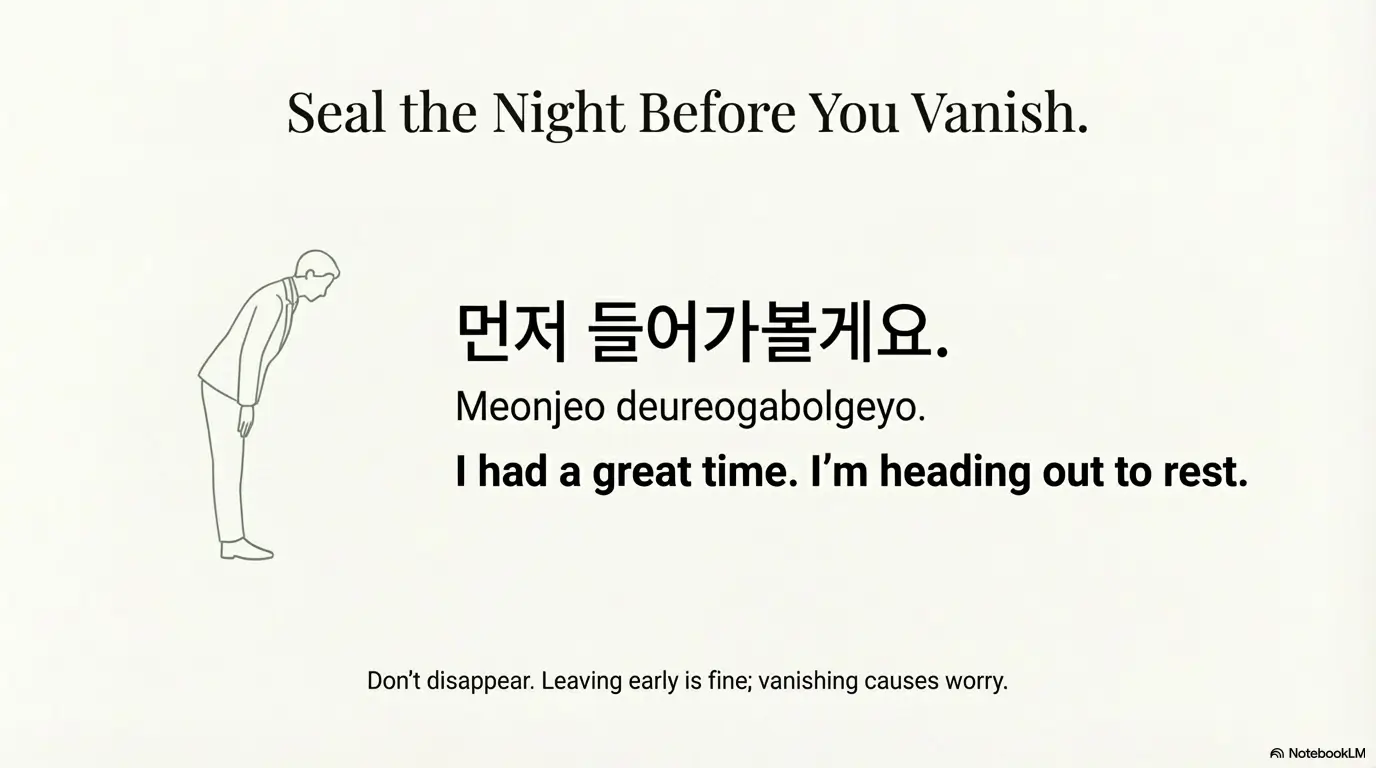
Leaving early is fine. Vanishing is what causes worry or gossip. One line prevents that: “I’m heading out to rest. Thank you for tonight.” (If you’re going to message people afterward, keep it smooth with KakaoTalk etiquette so your exit reads warm, not abrupt.)
Don’t do this: the 7 pressure-triggers that invite more pushing
- Don’t: say “maybe later” if you mean “no.” (It invites scheduling.)
- Don’t: leave your glass empty if you don’t want refills. (Empty glass is a refill magnet.)
- Don’t: blame the host (“You’re making me drink”). (Creates defensiveness.)
- Don’t: turn it into a lecture about alcohol. (Triggers “prove you wrong” energy.)
- Don’t: accept “just one shot” as a compromise if it’s not safe for you.
- Don’t: switch reasons repeatedly. (Sounds negotiable.)
- Don’t: reject the whole ritual. (Swap liquid instead.)
Money Block: Eligibility checklist (binary yes/no + next step)
Eligibility checklist: Which refusal style should you use tonight?
- Yes/No: Do you need zero alcohol (meds, recovery, health)?
- Yes/No: Is there a boss/senior at the table?
- Yes/No: Can you keep a non-alcohol drink in hand the whole time?
Next step: If “zero alcohol” is Yes, use the broken record line + alternative toast from the start.
Neutral next step: Set your plan before the first pour.
Curiosity gap: the hierarchy puzzle (boss vs colleague vs in-laws)
Same table, different power dynamics, different script. Here are four modules you can plug in without sounding like you memorized a phrasebook in a panic.
With a boss: how to decline while still showing alignment
Keep it respectful, brief, and consistent.
- 감사합니다. 오늘은 페이스 조절 중이라서 물로 건배하겠습니다.
(Gamsahamnida. Oneureun peiseu jojeol jung-iraseo mullo geonbae hagetseumnida.)
“Thank you. I’m pacing tonight, so I’ll toast with water.” - 오늘은 술은 어렵고, 분위기는 끝까지 같이할게요.
(Oneureun sureun eoryeopgo, bunwigin eun kkeutkkaji gachi halgeyo.)
“Alcohol’s tough today, but I’ll stay with the vibe.”
Tiny move that helps: keep your posture attentive during toasts. I once watched a non-drinker earn instant respect simply by being the first person to laugh at the boss’s joke and the last to leave the table. Drinking wasn’t the point. Belonging was.
With colleagues: how to avoid becoming “the vibe-killer”
- 나 오늘 컨디션이 애매해서, 콜라로 갈게. (Na oneul condishyeoni aemaehaeseo, kollaro galge.) “My condition’s iffy, I’ll go with cola.”
- 너희는 편하게 마셔. 난 물로 같이 건배할게. (Neohuineun pyeonhage masyeo. Nan mullo gachi geonbae halge.) “You drink comfortably. I’ll toast with water.”
With older relatives: respectful refusals that don’t sound “Western cold”
- 감사해요. 오늘은 건강 때문에 술은 못 마셔요.
(Gamsahaeyo. Oneureun geongang ttaemune sureun mot masyeoyo.)
“Thank you. For health reasons, I can’t drink today.” - 대신 맛있게 많이 먹을게요. (Daesin masitge mani meogeulgeyo.) “Instead, I’ll eat a lot.”
With a date: keeping it charming, not clinical
- 나 오늘은 천천히 갈래. 너는 편하게 마셔. (Na oneureun cheoncheonhi gallae. Neoneun pyeonhage masyeo.) “I’m going slow today. You drink comfortably.”
- 난 술은 패스하고, 너랑 대화는 풀로 할게. (Nan sureun paeseuhago, neorang daehwaneun pullo halge.) “I’ll pass on alcohol, but I’m all in for conversation.”
- Boss: two hands + calm repetition.
- Colleagues: casual tone + alternative drink in hand.
- In-laws: gratitude + “I’ll eat well” redirect.
Apply in 60 seconds: Save one script per context in your phone notes.
Escape hatches: what to say when the pressure doesn’t stop
The “broken record” line (repeatable, calm, final)
Pick one line and repeat it exactly. Same words. Softer voice each time.
- 감사해요, 저는 오늘은 술은 안 마셔요. (Gamsahaeyo, jeoneun oneureun sureun an masyeoyo.) “Thanks, I’m not drinking today.”
- 오늘은 여기까지만 할게요. (Oneureun yeogikkajiman halgeyo.) “Just up to here today.”
The “I’ll join the next round” redirect (without drinking)
- 저는 물로 같이할게요. 다음 건배는 같이해요. (Jeoneun mullo gachi halgeyo. Daeum geonbaeneun gachihaeyo.) “I’ll do water. Let’s do the next toast together.”
- 술 대신 안주에 집중할게요. (Sul daesin anjue jipjunghalgeyo.) “I’ll focus on the food instead.”
Bathroom reset + ally recruitment (quiet, effective)
If pressure is persistent, take a short break. On your way back, recruit one ally with a sentence like:
“If they offer again, can you help me stick to water?”
This works because social pressure is often social. An ally changes the math.
Hard stop: when leaving is the most respectful move
If someone won’t respect a clear boundary, staying can build resentment and ruin the night. A clean exit protects everyone’s dignity.
- 오늘 정말 즐거웠어요. 먼저 들어가볼게요. (Oneul jeongmal jeulgeowosseoyo. Meonjeo deureogabolgeyo.) “I had a great time. I’ll head in first.”
- 내일을 위해 오늘은 여기까지 할게요. 감사합니다. (Naeireul wihae oneureun yeogikkaji halgeyo. Gamsahamnida.) “For tomorrow, I’ll stop here. Thank you.”
Money Block: Quote-prep list (what to gather before comparing)
Quote-prep list: Prep these 5 things before a Korean team dinner
- Your “one reason” (pacing, early morning, health).
- Your “alternative drink” (water/tea/soda) and how you’ll keep it visible.
- Your boss-level script (short, respectful, two hands).
- Your colleague-level script (casual, friendly, no lecture).
- Your exit line (leave early without drama).
Neutral next step: Save the scripts in your notes app.
Next step: one concrete action
Do this now, before you need it: save a 3-line script you can copy/paste. If you want it to sound more natural, keep the English version too, then choose based on the room.
Copy/paste-ready (3 lines)
- “I’m good for now, thank you.” / 지금은 괜찮아요. 감사합니다.
- “I’m pacing tonight, I’ll toast with water.” / 오늘은 페이스 조절 중이라 물로 건배할게요.
- “Please enjoy, I’ll join the 분위기 without drinking.” / 편하게 드세요. 저는 술 없이 분위기 같이할게요.
One last operator tip: if you truly need zero alcohol because of medication, you do not need to explain beyond “I’m on medication.” That’s not “being difficult.” That’s being alive tomorrow. (If the table starts probing, your safest detour is a polite boundary plus a topic change, and Korean personal questions etiquette gives you ready-made ways to redirect without sounding icy.)
FAQ
Is it rude to refuse a drink in Korea?
Not inherently. It’s smoother if you protect rapport first: thank them, give a short reason, offer an alternative toast, and repeat calmly. The “rude” feeling usually comes from embarrassment or a sudden vibe drop, not the refusal itself.
What’s the most polite Korean phrase to decline alcohol?
A solid all-purpose line is “감사해요, 저는 오늘은 술은 안 마셔요.” (“Thank you, I’m not drinking today.”) If you want it softer: “지금은 괜찮아요.” (“I’m okay for now.”)
Can I toast with water or soda at a Korean dinner?
Yes. The ritual is often the social glue. Hold your glass respectfully (two hands with seniors), smile, and join the “건배.” Keeping a non-alcohol drink in hand also reduces refills.
How do I refuse a shot without embarrassing the person offering?
Don’t block dramatically. Use warmth and a quick redirect: “감사해요. 오늘은 페이스 조절 중이라서요. 물로 건배할게요.” (“Thank you. I’m pacing. I’ll toast with water.”) Then lift your water and smile.
What if my boss keeps pushing me to drink at a company dinner?
Use the broken record line, plus respect cues: two hands, slight nod, same sentence repeated. Don’t rotate excuses. If pressure continues, use an exit line and leave politely rather than escalating.
Is it okay to say I’m on medication without explaining?
Yes. “약 때문에 오늘은 술은 안 마셔요” is enough. Many medications can interact with alcohol, and public health guidance warns about serious harms when alcohol is mixed with certain drugs and medicines.
Conclusion
Remember the curiosity loop from the start, the hovering bottle problem? Here’s the truth: the bottle hovers when the table thinks you’re drifting away from connection. Your goal is to stay connected while declining the alcohol. That’s why “Warmth + Reason + Alternative + Repeat” works. It keeps the flow moving, saves face, and lets you be fully present without paying a soju tax.
If you want to go even smoother, skim an official overview of Korean drinking customs (Korea.net is a government-run portal) and keep your scripts ready. And if your reason is medication or safety, trust that boundary fully.
One infographic: “The No-Pressure Refusal Flow”
“Thank you.” Smile. Nod.
“I’m pacing.” “Early morning.”
“I’ll toast with water/tea.”
Same words, calmer voice.
If pressure becomes coercion: use a closing line, leave, and recruit help.
💡 Read the official alcohol risk guidance
💡 Read the official medicine interaction guidance
Your 15-minute next step: open your notes app, paste the 3-line script pack, and label it “Korea dinner.” Then practice saying the first line once, out loud, like you’re placing a cup on a table: steady, unhurried, no apology.
Last reviewed: 2026-02-23