

Decoding the Banchan Experience: Effortless Refills, Zero Anxiety
The first time you sit down in Korea, banchan arrives like it has its own backstage crew—tiny plates multiplying faster than your brain can price-check them. If you’re wondering whether these side dishes are free, you’re not being anxious—you’re being efficient. (If you’re building a bigger mental map of etiquette and daily life here, start with this Korean culture guide and come back.)
“Banchan are the soul of the Korean table—kimchi, pickled vegetables, and sprouts that balance every bite. While most are included and refillable, the rules can shift by dish and setup.”
You don’t need fluency to navigate the table. With a simple 30-second scan for signals like Self-Bar (셀프바) or Refill (리필), and one reliable line of dialogue, you can keep your meal warm and your budget intact. No guessing, just manners. (For more survival phrases in real-life situations, keep a tab on this Korean digital nomad phrasebook.)
Table of Contents
1) Banchan basics: what “free” usually means
Included vs ordered: the one-line test
Here’s the simplest way to stay calm: If it arrives without you ordering it, it’s usually included. Banchan is part of the Korean table rhythm—rice, soup, and side dishes working together like a small orchestra. Official Korean tourism descriptions of a traditional “Han-sang” meal talk about rice alongside multiple side dishes (banchan) as a standard table setup, not an add-on you negotiate dish by dish.
That said, Korean restaurants are not one giant hive mind. Some places are generous, some are strict, and some are quietly modernizing how they handle refills (especially with self-serve stations). Your job isn’t to “memorize Korea.” Your job is to read this restaurant.
Refill culture: common, but not automatic everywhere
In many everyday spots, refills are normal—particularly for vegetable-based banchan. A Korean English-language news feature once quoted a baekban (home-style set meal) owner saying refill requests are basically “obvious” in that kind of restaurant. That tracks with real life: in baekban places, banchan isn’t decoration. It’s the meal’s backbone.
But “common” doesn’t mean “automatic.” Staff might pace refills, wait until you’re deeper into the main dish, or assume you’re done if your table looks like a battlefield of half-touched plates (more on that later).
Quick vocabulary you’ll actually hear (리필, 추가, 셀프바)
- 리필 (refill): “Top it up again.” Often used casually.
- 추가 (additional): The important one—this can imply an extra portion and sometimes a charge, especially when paired with ₩.
- 셀프바 (self bar): A self-serve station, often for water, rice, and sometimes banchan.
Personal note: the first time I saw “셀프” on a sign, I assumed it was an English salad brand. It wasn’t. It was Korea gently telling me, “Friend, please stop waiting for water like it’s a luxury service.” (Also: 셀프/서비스/핸드폰 같은 단어는 여행자를 슬쩍 속일 때가 있어요—헷갈리면 Konglish words to avoid를 한 번만 훑어두면 마음이 편해집니다.)
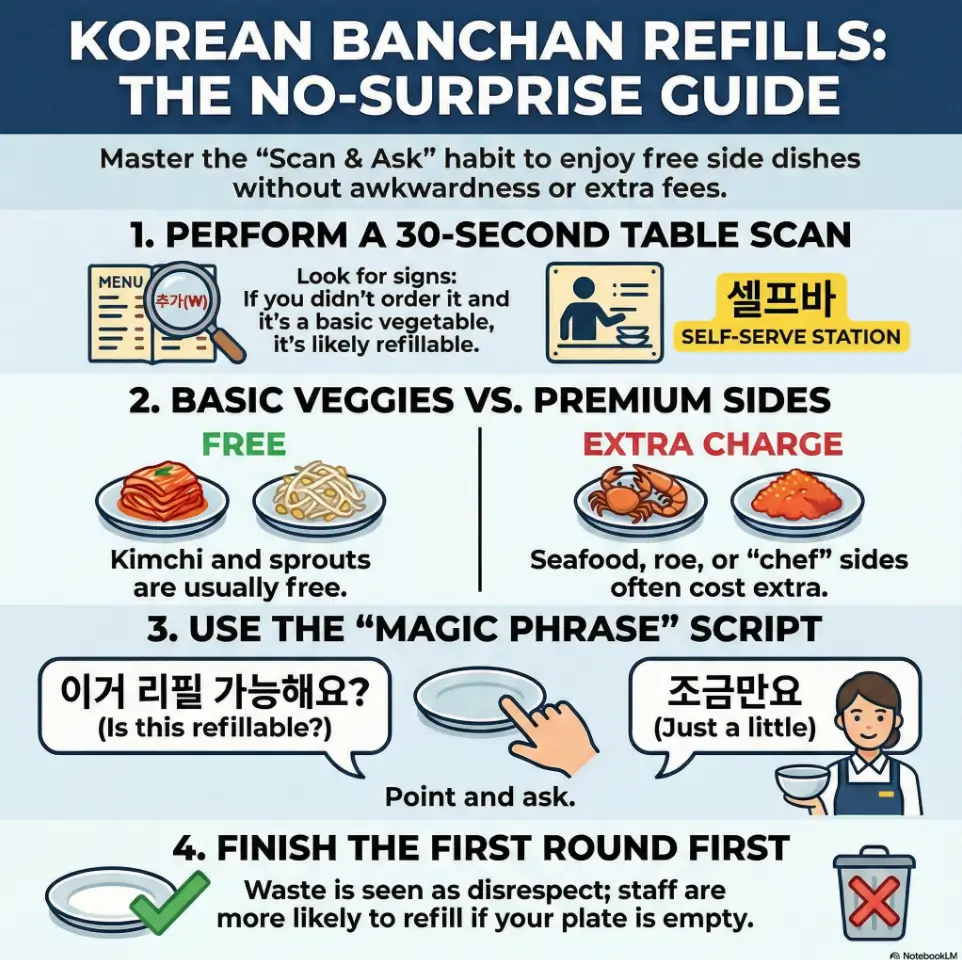
2) Spot the rules fast: 30-second table scan
Look here first: menu corners, wall signs, receipt lines
If you want the “operator” move—the one that prevents 95% of awkwardness—do this before you ask for seconds:
- Menu corners: Look for tiny notes near set meals (especially lunch sets).
- Wall signs: Korea loves a practical sign. If refills are limited, you’ll often see it.
- Receipt language: If something was charged, it’s usually itemized.
You’re scanning for patterns, not perfect translation. Your eyes want to catch: 추가, 셀프, 무한 (unlimited), 1인 1회 (per person, once), or any little “₩”. (If won amounts and Korean number formatting still feel slippery, this Korean numbers mistakes guide will save you from the classic “one extra zero” panic.)
- Menu corner notes decide most “charge vs free” outcomes
- Wall signs often explain 셀프바 or refill limits
- Receipts clarify whether “extra” was added
Apply in 60 seconds: Before asking for more, glance at menu corners for “추가(₩)” or “셀프바”.
“셀프바” changes everything (and it’s a good thing)
A self-serve bar often means two things:
- You can refill some items yourself (water, rice, sometimes kimchi or simple sides).
- Staff are less likely to do “automatic refills,” because the system expects self-service.
This is usually a win for travelers: fewer language moments, fewer “Did they hear me?” seconds, and you can take a small portion without feeling like you’re asking for a whole second plate. If you want the gentle language that fits these moments, it helps to know the difference between polite vs casual Korean—because tone does half the work.
Show me the nerdy details
Self-serve stations reduce the labor cost of repeated table-side refills and make portion control easier. Restaurants can keep a consistent standard set while letting customers self-manage “a little more” without staff involvement. For diners, it shifts the etiquette from “requesting” to “taking responsibly.”
If they don’t bring more… is that a “no,” or just pacing?
Sometimes it’s not a refusal. Sometimes it’s timing. In busy places, staff may wait until your first round is mostly finished (or until the meat is on the grill and the table is clearly “in motion”). If you ask early, they may smile, nod, and… vanish into the kitchen like a character in a folktale. That doesn’t automatically mean “no.” It often means “later.”
Personal note: I once asked for more lettuce before the BBQ even arrived. The server looked at my empty grill like it was a philosophical question. I learned patience in exactly 4 seconds.
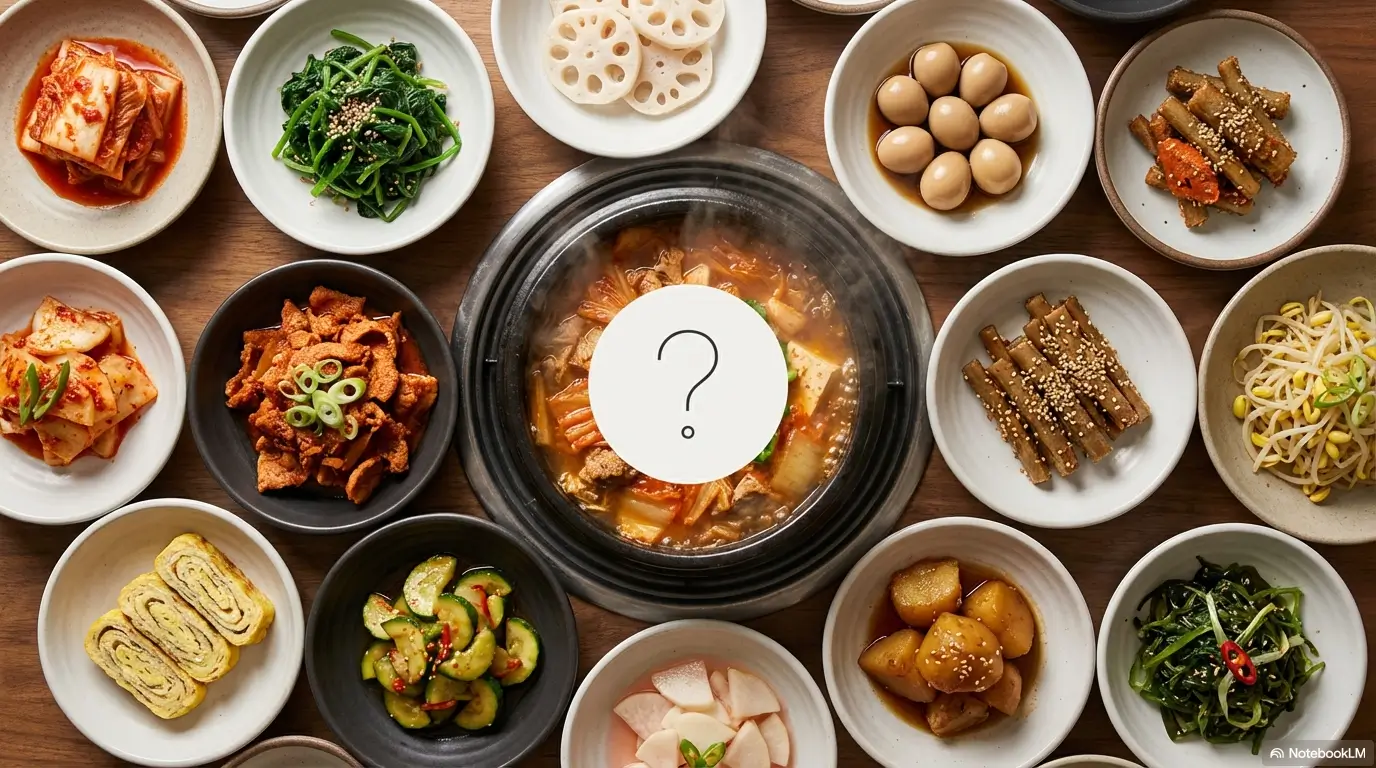
3) Refill expectations: what usually is refillable
The “likely refill” list (kimchi, pickles, sprouts, salad-y sides)
If you’re asking what’s “safest” to request seconds of, it’s usually the vegetable-based basics:
- Kimchi (various types)
- Pickled vegetables (단무지-style, jangajji-style)
- Seasoned sprouts (콩나물)
- Simple salads or lightly dressed greens
Why? These tend to be lower-cost per portion, easy to prep in batches, and central to the meal’s balance. In many places, refilling these feels as normal as refilling water. (If this part of the table makes you curious, this guide to Korean street food also helps you recognize what’s “staple” vs “special” at a glance.)
Korean BBQ patterns: lettuce/ssam items, garlic, sauces
In BBQ restaurants, banchan behaves like a little ecosystem around the grill:
- Lettuce/perilla leaves (for wraps)
- Raw garlic, peppers
- Ssamjang and other sauces
These are often refillable—but not always unlimited. Some restaurants portion control hard when the place is packed or when certain greens are expensive or seasonal.
Personal note: the most “refill-friendly” BBQ places are the ones that bring greens in modest plates. It signals a rhythm: small, repeatable, waste-free.
Soup/stew side logic: why banchan behaves differently there
In stew-centric places (think kimchi jjigae, sundubu, doenjang), the “main” already includes a pot of something substantial. Banchan may be simpler, fewer, and less likely to be endlessly refilled without asking—because the soup is meant to carry the meal.
4) The surprise exceptions: when they do charge
Premium banchan: fish roe, specialty jeotgal, seasonal “chef” sides
Here’s the quiet truth: not all banchan are created equal. If the side dish looks like it took real labor, rare ingredients, or careful plating, the restaurant may treat it as a premium side—especially in higher-end dining or specialty places.
Examples that are more likely to be limited or charged (varies by restaurant):
- Fish roe or seafood-heavy sides
- Jeotgal (fermented seafood) in more premium styles
- Seasonal “chef’s side” plates that change frequently
- Anything that feels like a mini main dish (not just a condiment)
Portion control: “one set per person” restaurants
Some restaurants run on a strict per-person logic. You’ll see it most often when:
- The place is small and constantly full
- They do set meals with a fixed number of banchan
- They’ve had issues with waste or “buffet behavior”
They may still be kind. They may still refill. But the system is tighter—especially if you’re in a big group and the table is requesting refills like it’s a competitive sport.
Here’s what no one tells you… “free” can mean “free once”
Some restaurants include a standard round of banchan and will refill only certain items, or only once. The language clue is usually right there: “추가” with a won sign, or a note like “추가 시 비용” (fee for additional).
- Vegetable staples are the safest refill ask
- Seafood or specialty banchan is more often controlled
- “추가(₩)” is your big warning label
Apply in 60 seconds: If a banchan feels like a mini entrée, ask “리필 가능해요?” before requesting seconds.
Money-Saver Table: “Free vs Charged” Patterns You’ll Actually See (2026)
| Scenario | What “free” usually means | Typical range | What to do |
|---|---|---|---|
| Baekban / home-style set meals | Refills are often normal for basics | ₩0 (for staples), otherwise menu-listed | Ask for small refills (“조금만요”) |
| Korean BBQ (greens + sauces) | Many items refillable, but portion-controlled | ₩0–menu-listed (especially for extra greens) | Use self-bar if offered; request modest plates |
| Premium/specialty banchan | Included once; extras may be charged | Menu-listed (추가 ₩…) | Ask first; don’t assume “unlimited” |
| Self-serve banchan bar (셀프바) | Refills are self-managed; staff refills less common | ₩0 within the bar’s items | Take small portions; return as needed |
Neutral next step: If you see any “추가(₩)” note, decide your refill plan before you request seconds.
5) The ask without awkward: phrases that work (even if you’re shy)
The safest line: “이거 리필 가능해요?” (Is this refillable?)
This sentence is the key that opens most doors:
이거 리필 가능해요?
“Is this refillable?”
It’s polite, clear, and gives the staff an easy “yes/no” without drama. If the answer is “yes,” you’re in. If the answer is “it’s extra,” you just saved yourself that weird end-of-meal moment. (If you like understanding why tiny endings matter in Korean politeness, bookmark this Korean honorifics guide for later.)
“조금만요” = your secret weapon for small portions
If you only learn one softener phrase, make it this:
조금만요 — “Just a little, please.”
This does three things at once:
- Signals you’re not trying to “game the system”
- Reduces waste (which is a major cultural friction point)
- Makes it easier for staff to say yes, quickly
Let’s be honest… your tone matters more than perfect Korean
You can say the right words and still feel “off” if your tone sounds demanding. The best vibe is: curious, respectful, practical. Smile. Point at the dish. Ask once. Then accept the answer like an adult. That’s the whole skill.
Personal note: I used to over-explain (in English!) like I was writing a legal brief. Now I just point, smile, and ask “리필 가능해요?”—and my life is quieter.
- Ask “리필 가능해요?” before you request multiples
- Add “조금만요” to keep it friendly and waste-free
- Point + smile beats perfect grammar
Apply in 60 seconds: Use “이거 리필 가능해요? 조금만요.” as your default script.
Eligibility Checklist: Are Free Refills Likely Here?
- Yes if: the banchan is basic veg (kimchi/pickles/sprouts) and the place feels like a casual neighborhood spot.
- Yes if: you see a 셀프바 and the item is on the bar.
- Maybe if: it’s BBQ greens/sauces during a busy rush.
- No (or ask first) if: it looks premium (seafood/roe/specialty plate) or the menu shows 추가(₩).
- No if: you barely touched the first round (waste signal).
Neutral next step: If you hit any “Maybe/No,” ask the refill question once before requesting seconds.
💡 Read the official Korean dining and banchan guidance
6) Who this is for / not for
For: first-timers, budget travelers, expats, Korean-food newbies
If your goal is to enjoy Korean food without social friction or surprise charges, you’re exactly the reader this is for. Especially if you:
- Are new to Korea and don’t want to “perform confidence”
- Want to keep meals within a budget without being stingy
- Are traveling with friends who snack banchan like it’s popcorn
Not for: people who want “unlimited everything” guarantees
I can’t promise unlimited refills everywhere because Korea isn’t one restaurant. What I can promise is a repeatable habit that makes you look competent and keeps you safe from surprise bills.
Special case: large groups + shared dishes (rules can tighten)
In a group, restaurants may pace refills because the table’s demand can spike fast. If you’re eight people deep and everyone wants more kimchi, more lettuce, more garlic, more everything—some places will accommodate, others will slow you down.
Personal note: I’ve watched a large table turn into a refill factory. The staff didn’t get angry; they just quietly shifted to “small portions only” mode. That was the lesson. (If you’re planning a first trip and want the “less friction” basics in one place—entry points, pacing, and what to do each day—this 14-day South Korea itinerary pairs well with the dining side of things.)
7) Common mistakes that trigger side-eye (or fees)
Mistake #1: Asking for refills after barely touching the first round
This is the fastest way to get a gentle “no” (or a slower yes). In Korea, waste reads as disrespect. If you want a refill, show you can finish what you already have—or ask for a smaller portion.
Mistake #2: Treating banchan like an all-you-can-eat buffet
Even when it’s generous, the spirit is hospitality—not a competitive eating challenge. If you stack empty plates and demand more like you’re speedrunning dinner, you’ll feel the atmosphere cool.
Mistake #3: Confusing banchan with paid add-ons (치즈, 계란찜, extra lettuce)
This one gets travelers all the time. Not everything that “arrives on the table” is banchan. Common paid add-ons include:
- 치즈 (cheese add-ons, often for spicy dishes)
- 계란찜 (steamed egg), sometimes included, sometimes not
- Extra greens or special wrap sets in BBQ places
The fix is simple: if it sounds like an “upgrade,” ask first.
- Finish the first round before asking for more
- Request small portions to avoid “buffet energy”
- Assume “upgrades” may cost extra
Apply in 60 seconds: When in doubt, ask for “조금만요” and wait for the answer.
Decision Card: Ask Staff vs Use the Self-Bar
Choose A: Ask staff
- No 셀프바 visible
- You want the same item refilled
- The item looks premium or unusual
Best script: “이거 리필 가능해요? 조금만요.”
Choose B: Use the 셀프바
- There’s a clear self-serve station
- The item is on the bar
- You want small, repeated portions
Best behavior: take a little, return later, avoid piling plates.
Neutral next step: Pick A or B once, then stick to it for the rest of the meal.
8) Don’t do this: refill etiquette that saves you money and face
“Small refill” strategy: reduce waste, get faster yeses
If you want a refill culture hack that works across most restaurant types, it’s this:
- Ask for a small amount
- Finish it
- Ask again only if needed
This keeps the table clean, signals respect, and avoids the impression that you’re collecting banchan like souvenirs.
Don’t stack plates like a buffet line (even when it’s self-serve)
Self-serve doesn’t mean “act like you’re stocking a bunker.” Take small portions. Leave space. Return as needed. It’s not about shame—it’s about rhythm.
Personal note: I once watched someone build a tower of tiny plates. The tower didn’t fall, but the mood did.
If it’s crowded: when “refill later” is the polite play
In a rush, staff are triaging tables. If you sense the room is at capacity and the servers are sprinting, wait until your main dish arrives or until you’ve cleared most of the first round. You’ll get better results, and the interaction will feel smoother.
9) Restaurant types: refill rules by scenario
BBQ (고기집): lettuce, sauces, and the “ssam ecosystem”
In BBQ restaurants, the real refill pressure points are greens and wraps. Some places will happily bring more lettuce or perilla leaves; others will point you to a 셀프바; others will treat “extra wraps” as an add-on. Read the signals:
- If greens arrive in a modest plate: refills are more likely, especially if you finish them.
- If greens arrive in a large pile: the restaurant may expect you to manage within that portion.
- If there’s a 셀프바: that’s your refill lane.
Casual meals (백반/기사식당): banchan is the point—refills often normal
In home-style set meal places, banchan isn’t a side quest. It’s the structure. This is where you’re most likely to see refill generosity for basics—especially if you’re eating normally and not wasting food. (Again, this is the “refills are obvious” vibe that Korean restaurant owners themselves have described in interviews.)
Bars & late-night spots: fewer banchan, more paid sides
Late-night spots often serve fewer complimentary banchan—sometimes just a couple of simple items. The business model leans toward paid side dishes (anju), so “extra banchan” may not be a thing.
Personal note: I once asked for more banchan at a late-night place and realized… the main dish was the side dish. Different universe.
Buffets vs set menus: “unlimited” wording you can trust
If a restaurant is truly unlimited, they’ll usually say it clearly—especially for buffets. For non-buffet restaurants, “unlimited” may apply to specific items (like certain banchan) rather than everything on the table.
- Baekban places lean refill-friendly for staples
- BBQ places are refill-friendly, but portion-controlled
- Late-night spots lean toward paid sides
Apply in 60 seconds: Identify the restaurant type first, then choose your refill approach.
Infographic: The 30-Second “No-Surprise-Bill” Scan
Step 1 — Look for words
✅ 리필 (refill)
⚠️ 추가(₩) (additional with fee)
✅ 셀프바 (self-serve)
Step 2 — Judge the dish
🥬 Basic veg? Safer.
🦐 Premium/seafood? Ask first.
🧀 “Upgrade” vibe? Assume paid.
Step 3 — Use the one script
이거 리필 가능해요?
+ 조금만요 (just a little)
→ prevents awkwardness + fees
10) Next step: your one-move “no-surprise-bill” habit
Do this every time: scan for “추가(₩)” + ask “리필 가능해요?” before requesting multiples
Let’s turn this into a habit you can run even when you’re tired, hungry, and slightly overwhelmed by the table’s abundance:
- Scan for “추가(₩)” or “셀프바” (10 seconds).
- Decide whether you’ll self-serve or ask staff (5 seconds).
- Ask once if it’s unclear: “이거 리필 가능해요?” (5 seconds).
That’s it. It’s not about speaking Korean fluently. It’s about running the same little system every time. The more you understand how words carry culture, the calmer you’ll feel—this essay-style guide on Korean words and cultural nuance is a good companion read.
Bonus: request “조금만요” to keep it friendly and waste-free
“조금만요” isn’t just polite—it’s strategic. It keeps refills in the “of course” category rather than the “are they trying to…?” category.
Mini Calculator: How Much Refill Should You Ask For?
Use these 3 inputs to choose the safest refill size (no math degree required):
- Party size: 1–2 / 3–4 / 5+
- First round eaten: <50% / 50–90% / >90%
- Room status: calm / busy
Output:
- If <50% eaten → don’t refill yet. Ask later or take less next time.
- If 50–90% eaten → ask for small refill (“조금만요”).
- If >90% eaten → normal refill is fine; small refill if it’s busy.
Neutral next step: Run this once per meal before your first refill request.
Short Story: The Kimchi Refill That Taught Me the Whole System (120–180 words) …
I was new enough to Korea that every meal felt like a test I didn’t study for. At a tiny neighborhood restaurant, banchan arrived—kimchi, sprouts, a pickled something I couldn’t name. I ate the kimchi like it was oxygen and then froze: do I ask for more? I watched other tables like an undercover agent. Nobody asked. Nobody announced anything. The staff just moved, quietly, like they already knew what everyone needed.
Finally, I pointed—small smile, small voice: “이거 리필 가능해요?” The server glanced at my mostly-empty plate, nodded once, and brought a modest refill. No eyebrow raise. No sigh. No charge. What made it work wasn’t my Korean. It was the evidence: I’d finished it, I wasn’t wasting, and I asked like a human. That’s the whole system in miniature.
FAQ
1) Is banchan always free in Korea?
It’s usually included with your meal in most traditional Korean restaurants, but not universally “free forever.” Some places limit refills, use self-serve bars, or charge for premium/specialty sides. Your safest move is to scan for “추가(₩)” and ask “리필 가능해요?”
2) Can I ask for seconds of banchan?
Yes—especially for basics like kimchi or pickled vegetables. The polite approach is to finish most of what you have, then ask for a small refill: “이거 리필 가능해요? 조금만요.”
3) Why did a restaurant charge me for extra banchan?
Common reasons: the banchan was considered premium, the restaurant limits extra portions, or the request was treated as an “additional order” rather than a refill. Charges are often posted on menus with “추가(₩).”
4) What does “추가 ₩1,000” mean on the menu?
“추가” means additional. If it’s paired with a won amount, it signals that extra portions of that item may cost money. If you’re unsure whether your request counts as “추가,” ask first.
5) Is banchan refillable at Korean BBQ?
Often yes for many items, but BBQ places can be more portion-controlled—especially with greens and wrap items. If there’s a 셀프바, use it. If not, ask staff and request a small portion.
6) Is rice free and refillable too?
Many casual restaurants include rice with the meal, and some offer extra rice via a self-serve station. But it varies—especially in set menus or premium restaurants—so look for signs or ask politely.
7) Can I take leftover banchan to-go?
Sometimes yes, sometimes no. It depends on the restaurant’s policy and the type of banchan. If you want to take leftovers, ask simply and politely near the end: “포장 가능해요?”
💡 Read the Korean dining etiquette basics
💡 Read the banchan culture and refill norms overview
Conclusion
So—is banchan free? In most Korean restaurants, yes: it’s included, and many basics are refillable. But the real skill isn’t memorizing rules. It’s avoiding the one thing that causes awkwardness everywhere on earth: uncertainty + assumptions. Your fix is beautifully small: scan for “추가(₩)” and “셀프바,” then ask one sentence—“이거 리필 가능해요?”—before you request multiples. Add “조금만요,” and you’ll look like someone who belongs at the table.
If You Got Charged: A Calm 2-Minute “Check Before You Stress” List
- Snap a photo of the receipt line item (what exactly was charged).
- Check the menu corners for “추가(₩)” or refill notes.
- Recall whether the item was premium (seafood/specialty) vs basic veg.
- If you want to ask, keep it neutral: “이거 추가 맞아요?” (Is this an additional item?)
Refill Generosity Tier Map (1–5)
- Tier 1: Strict limits; most extras treated as 추가
- Tier 2: Staples refillable once; premium controlled
- Tier 3: Staples refillable; ask politely
- Tier 4: Very refill-friendly for basics; waste-sensitive
- Tier 5: Self-bar + friendly refills; easiest for travelers
Neutral next step: Save this page and run the 30-second scan at your next meal.
If you want a next step you can do in 15 minutes: pick one restaurant type you’re most likely to visit this week (BBQ, baekban, or stew), and practice the same refill script once. Just once. You’ll feel the difference immediately—less hesitation, fewer “should I?” loops, and a meal that stays warm instead of turning into a quiet budgeting anxiety. If your trip is still in the planning stage, it also helps to know the basics before you even land—this South Korea airports overview and travel insurance for South Korea guide keep the “surprise cost” theme consistent from airport to dinner table.
Last reviewed: 2026-01