

Navigating Korean Funeral Etiquette: A Simple Guide to Condolence Money (부의금)
A Korean funeral hall can feel like a quiet airport terminal: everyone moves with practiced ease, and you’re holding an envelope like it might bite. The fix isn’t perfect Korean. It’s a tiny system—decide the amount, label the envelope, say one safe line—and let the room do the rest. If you want the wider context beyond money (clothes, timing, the room layout), start with this Korean funeral etiquette for foreigners guide so the whole experience feels less mysterious.
Korean condolence money (부의금/조의금) is a cash contribution given to the bereaved family as practical support and solidarity. It’s typically handed in a plain envelope at the reception desk, recorded in the guestbook (방명록), and kept intentionally simple so guests don’t create extra work during grief.
“Guessing in the lobby costs you twice: social awkwardness now, and regret later.”
This guide provides you with copy-ready envelope writing (front + back), a “safe range” for coworkers, the 2-minute desk-to-bow flow, and text templates for when you can’t attend—without over-explaining. I’m not grading etiquette from a distance; I’m sharing the exact “don’t panic” script that works when your brain goes blank.
Table of Contents
1) Who this is for / not for
For you if…
- You’re a non-Korean invited to a Korean funeral hall (장례식장) or asked about 부의금/조의금.
- You want envelope writing you can copy in 30 seconds.
- You can’t attend and need a short, culturally safe message.
Not for you if…
- You’re handling family-level formal rites with religious/region-specific steps.
- You’re asked to represent an organization officially (in that case, follow your company/HR protocol first).
Quick honesty: the first time I went to a Korean funeral hall, my brain did that thing where it forgets every social rule it has ever learned. I was holding an envelope like it was a live animal. The fix wasn’t courage—it was a simple script. That’s what this is.
2) The “why” behind 부의금
What the money signals (and what it doesn’t)
Condolence money in Korea is less “payment” and more solidarity in cash form. It helps with real costs, yes—but socially it says: “You’re not carrying this alone.” That’s why it’s handed in a quiet, structured way at the reception desk and recorded in the guestbook. It’s also why clarity matters: families use the record to thank people and (later) reciprocate in similar situations.
If you grew up in a place where flowers are the default, the Korean system can feel blunt at first. But it’s also practical—like a well-designed tool: predictable, quick, and not demanding emotional performance from guests.
Curiosity gap: Why cash—not flowers?
Flowers do happen in Korea, especially from organizations, but the guest flow at many funeral halls is built around the reception desk: envelope → name → guestbook → bow. It reduces friction. And in grief, friction is the enemy. The best etiquette is the one that doesn’t create extra work for the family. (If you’re curious how “cash-gift logic” shows up in a very different life event, this Korean wedding guide explains the parallel system without making it weird.)
- Use the standard flow (desk → guestbook → brief condolences).
- Make the envelope identifiable (name on the back).
- Keep your visit short unless the family clearly pulls you in.
Apply in 60 seconds: Save one condolence text template now (you’ll thank yourself later).
3) Amount rules foreigners get wrong (and the “safe range”)
The practical baseline: the amount most people won’t side-eye
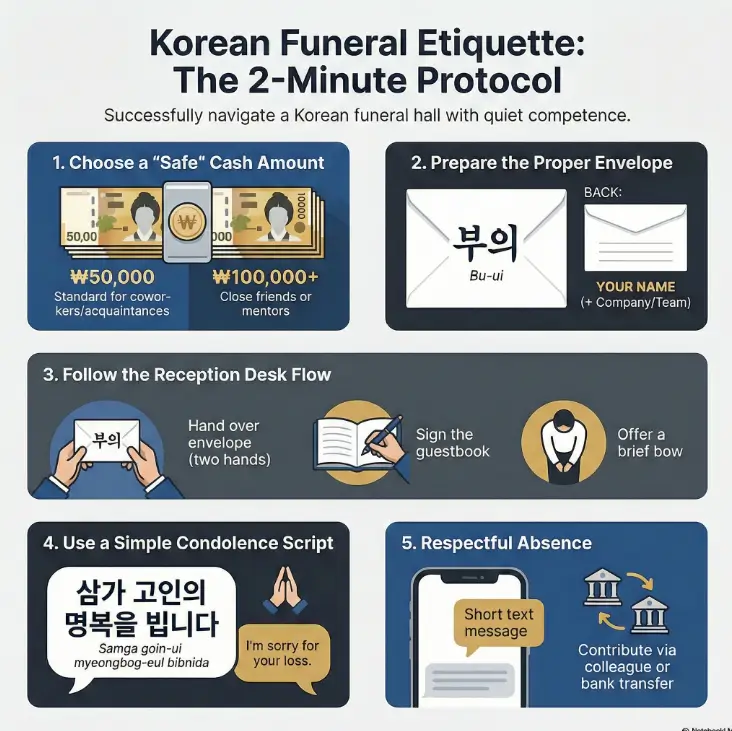
For many coworker and acquaintance situations, English-language etiquette guidance and real-life workplace norms commonly cluster around ₩50,000 as a baseline and ₩100,000+ for closer relationships. The exact “right” number is not a universal law—it’s a local consensus shaped by your team, your closeness, and sometimes the seniority dynamics of the workplace.
My own mental trick: don’t ask “What is correct?” Ask: “What would be least likely to create awkwardness?” That question tends to land you in the practical range.
The “odd number” logic (and when people mention it)
You’ll sometimes hear a preference for amounts that “start odd” (like 30,000 / 50,000 / 70,000). Real practice varies, and modern life has sanded down some of the superstition, but the pattern still pops up—especially in older etiquette explanations. The simplest approach: follow what your Korean coworkers do, and if you can’t check, stick to a widely accepted baseline. (If numbers make you anxious in general—especially under time pressure—this Korean numbers mistakes guide is a surprisingly calming read.)
Show me the nerdy details
In gift-cash cultures, the number is rarely “just a number.” It carries signals: closeness, reciprocity, group belonging, even calendar logic. In Korea, condolence/wedding gift amounts tend to standardize into familiar bands so people don’t have to invent a new decision under stress. If your workplace has a common norm (e.g., “everyone does 50”), copying it is usually the most respectful move because it keeps you aligned with the group rather than spotlighting you.
Curiosity gap: Is ₩50,000 “too little” in 2026?
If your fear is “I’ll look cheap,” here’s the calmer frame: context beats calendar year. In many workplaces, ₩50,000 still functions as a “standard coworker baseline,” while ₩100,000 signals stronger closeness or a higher-seniority/social expectation. Some teams (especially tight-knit or senior-heavy ones) lean upward. That’s why the best strategy is to check one person if you can.
- Yes to ₩50,000: coworker/acquaintance, large office, not close.
- Lean ₩100,000+: close colleague, mentor/boss, your team norm is higher.
- Unsure? Copy the workplace standard (ask HR/one trusted coworker).
Apply in 60 seconds: Text one colleague: “What’s our usual amount for this situation?”
A simple amount range table you can use without overthinking
| Relationship | Common Range (KRW) | Notes |
|---|---|---|
| Acquaintance / distant coworker | ₩50,000 | Often treated as the “safe baseline” in many offices. |
| Closer coworker / small team | ₩50,000–₩100,000 | Let team culture decide; match what peers do. |
| Boss / mentor / very close | ₩100,000+ | Higher amounts can signal closeness and respect; avoid showing off. |
Neutral action: If you’re unsure, mirror the most common amount in your group.
Mini calculator: “What should I give?” in 10 seconds
Practical check: Use the specific questions below. A generic formula cannot establish an obligatory gift, safe treatment, legal protection or the right purchase for every situation.
4) Envelope writing: exactly what to write (front + back)
Front of the envelope: pick ONE (simple is best)
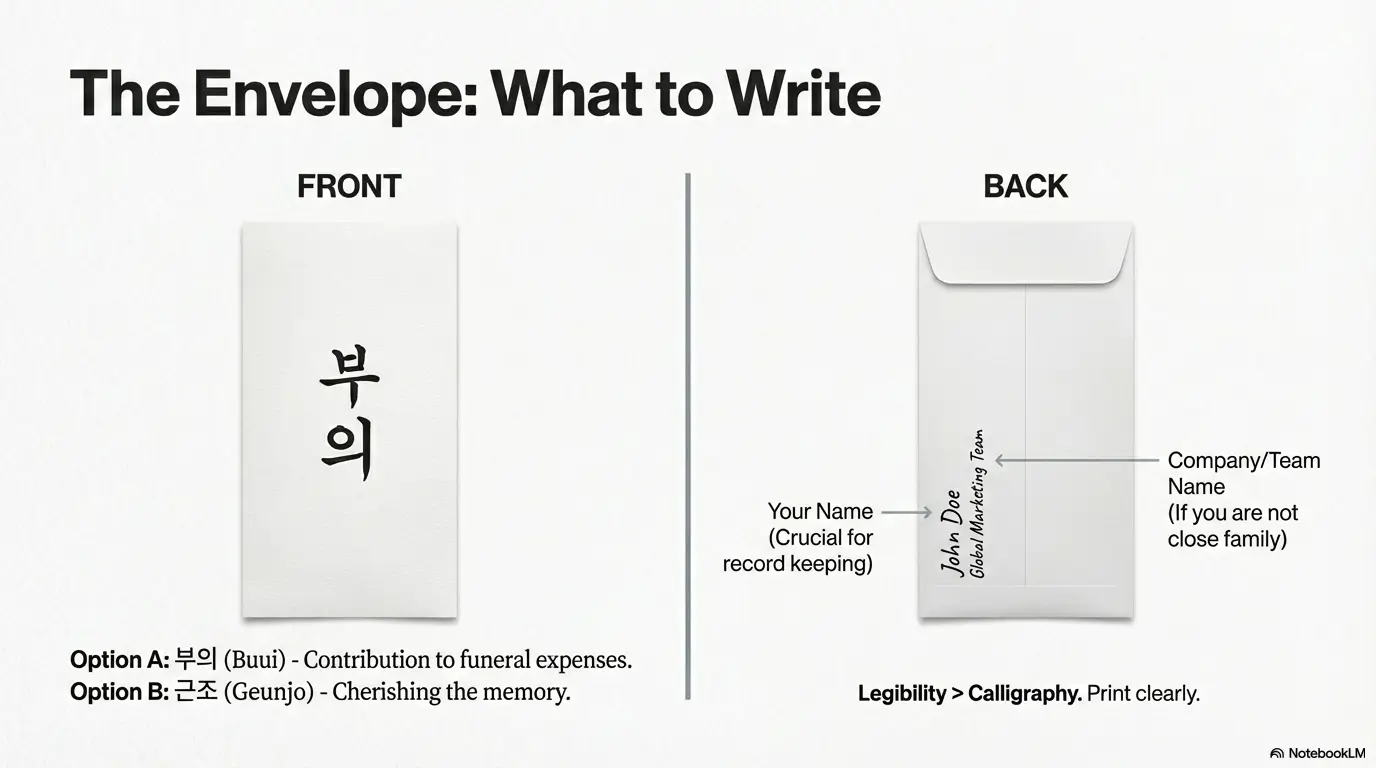
You only need one short condolence word on the front. The most commonly seen options in “how-to” guidance include 부의 or 근조. If you can write one neatly, you’re done. Don’t stack multiple phrases like you’re decorating a cake—this is not that kind of event.
Back of the envelope: the detail families actually need
On the back, write your name. If there’s any chance of confusion (common name, large organization), add your affiliation—team/company/school. This is the quiet kindness foreigners often miss: it makes it easier for the bereaved family to track contributions and later express thanks.
Let’s be honest… you’re not being graded on calligraphy
The goal is legibility, not artistry. If your handwriting is shaky, print clearly. If you can’t write Korean well, writing your name in English is still better than anonymous cash. I’ve seen even fluent Korean speakers scribble under stress—funeral halls are not stationery competitions.
Copy-ready envelope templates
Front (choose one):
- 부의
- 근조
Back:
- Your Name
- Optional: Company/Team
Neutral action: Write the envelope at home (or at your desk) before emotions and noise enter the picture.
5) Step-by-step at the funeral hall (the 2-minute flow)
The order most halls expect
Think of it as a quiet, efficient sequence. If you follow the flow, you’ll blend in effortlessly—even if your Korean is limited.
- Arrive quietly and lower your voice (even if you’re nervous and want to “act normal”).
- Go to the reception desk (접수/부의) and hand over the envelope (two hands is a safe default).
- Sign the guestbook (방명록) with your name (and affiliation if helpful).
- Offer brief condolences—a short phrase, a small bow, or both.
- Stay briefly; if invited, you may share a simple meal. If not, it’s okay to leave politely.
Infographic: The 2-minute “Don’t Make It Weird” Flow
Quiet voice, phone on silent
Envelope in, name recorded
Name + affiliation if needed
Short phrase + small bow
Brief visit; follow family cues
Neutral action: Screenshot this flow and keep it in your phone for “future you.”
What to say in-person (short, safe lines)
You don’t need a speech. Two lines is plenty. If you can say one, say one. The room will do the rest.
- “애도를 표합니다.” (A formal “My condolences.”)
- “삼가 고인의 명복을 빕니다.” (A respectful condolence phrase often used in Korea.)
- “상심이 크시겠습니다.” (“You must be heartbroken / I’m sorry for your loss.”)
My personal rule: if my mouth starts trying to explain itself, I stop. Funerals reward restraint. Say less, mean more. And if you’re unsure about the bowing moment specifically, this Korean bowing (절) etiquette guide breaks down the “what do I do with my body?” question in a way your nervous system can actually follow.
Illustrative scenario: A visitor checks the correct room and asks a designated organizer where an envelope is accepted. This is a constructed example, not a reported funeral visit.
I stepped aside, turned my body slightly away (so I wasn’t flashing cash), wrote my name and team, took one breath, and handed it over with both hands. The staff didn’t blink. Later, my coworker messaged a simple “thank you,” and I felt the strange relief of doing the right thing in a hard moment. The lesson wasn’t “be perfect.” It was: be clear, and don’t make the family solve a puzzle.
6) If you can’t attend: what to text, and how to send money
The message structure that sounds respectful (not robotic)
The safest structure is short and predictable:
- Acknowledge the loss
- Express condolences
- Say you can’t attend (one line; no long excuses)
- Offer support (simple, practical)
Copy-ready templates (English + Korean-leaning)
English (coworker-safe, short)
I’m so sorry for your loss. I can’t make it to the funeral, but I’m thinking of you and your family. Please let me know if there’s anything I can do.
English (slightly more formal)
I was very sorry to hear the news. Please accept my sincere condolences. I’m unable to attend the service, but I’m keeping you and your family in my thoughts.
Korean-light (copy and send)
부고 소식 듣고 마음이 무거웠습니다. 직접 조문하지 못해 죄송합니다. 삼가 고인의 명복을 빕니다.
Korean-light (very short)
삼가 조의를 표합니다. 직접 조문하지 못해 죄송합니다.
Neutral action: Pick one template and save it in your notes as “Korea condolence.”
Curiosity gap: Should you send 부의금 if you don’t attend?
In many workplaces and friend groups, yes—people still send a condolence contribution even if they can’t attend, especially if the bereaved person is a coworker and the team is responding collectively. The key is to follow the group’s method so your gesture is easy to receive. In Korea, that often means sending via a trusted colleague or using a standard digital transfer method the team already uses.
Practical options you’ll hear in real life: a teammate collects envelopes, a group chat coordinates, or someone shares a bank transfer route. Apps and tools vary (KakaoTalk, KakaoPay, Toss, and regular bank transfers via KB Kookmin Bank, Shinhan Bank, or Woori Bank come up often). The etiquette principle stays the same: reduce friction for the grieving person. If you want to calibrate tone in Korean beyond these templates, skim a quick refresher on polite vs casual Korean and keep everything safely formal.
Decision Card: When A vs B
- Time cost: 20–60 minutes (often enough)
- Social clarity: highest
- Best when: close coworker, small team, you can physically get there
- Time cost: 3–5 minutes
- Social clarity: depends on team norm
- Best when: travel/illness/conflict, or team is coordinating contributions
Neutral action: Choose the option that creates the least burden for the family and your team.
7) Common mistakes (the ones that create avoidable awkwardness)
Mistake #1: Bringing no envelope and freezing at the desk
Many funeral halls can provide envelopes, but walking in unprepared adds stress at exactly the wrong moment. If you can, bring a plain envelope in advance. If you can’t, ask quietly at the reception desk with a small gesture—staff are used to helping.
If you need an envelope or help with its placement, ask discreetly. Do not assume a person’s reaction or a national rule from that exchange.
Mistake #2: Writing nothing on the envelope (or forgetting your name)
Anonymous cash creates administrative pain. Writing your name is not “about you.” It’s about letting the family track contributions without detective work.
Mistake #3: Over-explaining why you can’t attend
Keep the “can’t attend” line short. Long explanations can accidentally sound like you’re asking to be forgiven rather than offering sympathy. One sentence is enough: “I’m unable to attend, but I’m thinking of you.”
Mistake #4: Treating the reception desk like a casual cashier moment
Don’t open the envelope at the desk, count bills in public, or linger while the line builds. Prepare beforehand. Move with the flow. Quiet efficiency is respectful.
Quote-prep list (so you don’t ping the grieving person)
- Funeral hall name + location (or a map pin)
- Visiting window (many are open over multiple days)
- Team norm for contribution amount (ask HR/one trusted coworker)
- If sending money: who is collecting and how (colleague / group method)
- Your copy-ready condolence message (saved in notes)
Neutral action: Gather these details from your team—avoid asking the bereaved person logistics.
8) Don’t do this: the “quiet-room” don’ts foreigners miss
Don’t #1: Loud greetings + energetic small talk
Funeral halls are low-volume, low-drama spaces. Even if you’re nervous (and nervous people get chatty), match the room. A soft voice is not coldness—it’s courtesy.
Don’t #2: Treating it like a “drop-by visit” with a long hang
Unless you’re close family or explicitly invited to stay, brief is often best. A respectful 10–20 minute visit can be more appropriate than a long presence that forces conversation.
Here’s what no one tells you…
The “right” behavior is often less about perfect rules and more about not increasing the family’s workload. Confusion, delays, loudness, repeated questions, and complicated apologies all create extra labor. The cleanest etiquette is the one that disappears. (If you want a “whole-life” comparison point, notice how differently energy and ritual play out in modern vs traditional Korean weddings—and why funerals reward restraint even more.)
- Keep your voice low and your visit short.
- Don’t ask the bereaved person to manage logistics.
- Follow the flow: desk → guestbook → condolences → exit.
Apply in 60 seconds: Put one plain envelope in your desk drawer today.
FAQ
Q1) How much condolence money should I give in Korea as a coworker?
If you’re a typical coworker (not very close), ₩50,000 is commonly treated as a safe baseline. If you’re close, on a small team, or following a higher workplace norm, ₩100,000+ is common. When in doubt, copy what your Korean coworkers do.
Q2) Is ₩50,000 acceptable in 2026, or is ₩100,000 now standard?
Many recent “how-to” guides and everyday workplace norms still recognize ₩50,000 as a baseline—especially for acquaintances and standard coworker situations—while ₩100,000 often signals higher closeness. The safer predictor isn’t the year; it’s your team’s culture.
Q3) What do I write on the front of a Korean condolence envelope (부의금)?
Keep it simple. Common choices include 부의 or 근조. Pick one and write it neatly. More words do not equal more respect here.
Q4) Do I put my name on the envelope, and where exactly?
Yes—write your name on the back. If you think the family might not recognize your name or your name is common, add your team/company to reduce confusion.
Q5) Can I attend briefly and leave without eating?
Yes. It’s generally acceptable to attend, offer condolences, and leave politely—especially if you have a time constraint. If you’re invited to eat, it’s okay to decline gently, but if the family clearly encourages you and you can stay, sharing a short meal can be part of the social support.
Q6) What should I text in English (or simple Korean) if I can’t attend?
Use a short structure: acknowledge → condolences → can’t attend → offer support. Example: “I’m so sorry for your loss. I can’t make it to the funeral, but I’m thinking of you and your family.” If you want a Korean-light option, use: “직접 조문하지 못해 죄송합니다. 삼가 고인의 명복을 빕니다.” If you want to be extra safe with formality (especially with seniors), reviewing a few examples from a Korean honorifics guide can help you avoid accidental casualness.
Q7) Is it rude to send condolence money if I don’t go to the funeral?
In many workplace settings, it’s not rude at all—people often contribute even if they can’t attend, especially when a team is coordinating support. The key is to follow the group’s method so it’s easy and not awkward for the bereaved person.
Q8) Should I give cash in new bills, and does the condition matter?
Crisp bills are generally preferred because they look intentional and respectful (and they’re easier to handle). That said, perfection isn’t the point—clean and presentable beats “brand new” if that’s what you can do quickly.
Q9) What if I don’t know the deceased well—do I still go or contribute?
If it’s a coworker in your direct team, many people still attend briefly or contribute as part of workplace solidarity. If you’re not in the same circle, follow your organization’s cues. When in doubt, a short condolence message is almost always appropriate.
Q10) What should I do if I already made a mistake on the envelope?
Fix it quietly if possible (write your name on the back, rewrite neatly on a new envelope). If it’s too late, don’t spiral. The family is grieving; they will not be auditing handwriting. A brief, sincere condolence matters more than stationery accuracy.
10) Next step (one concrete action)
Make a “2-minute condolence kit” now
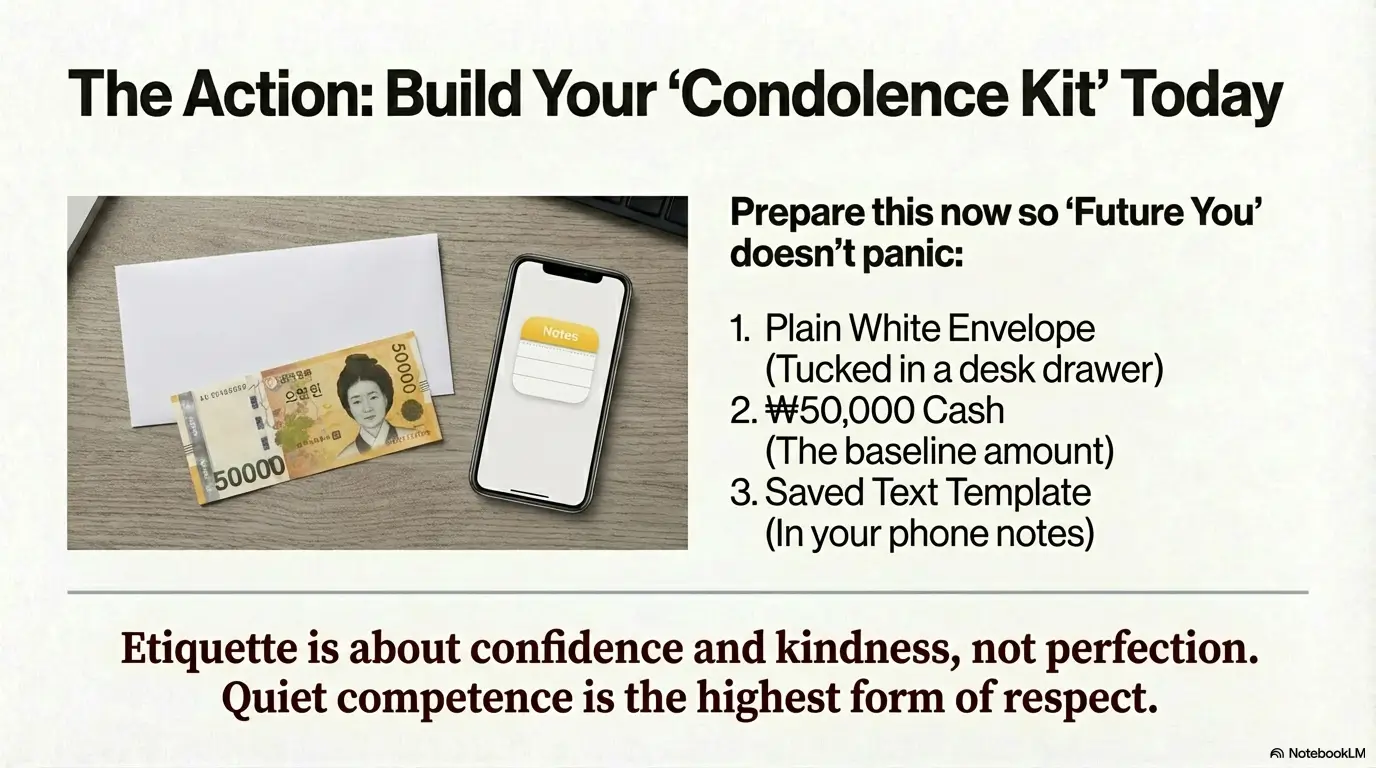
This is the tiny habit that saves you from future panic. Put a plain envelope and a baseline amount of cash (whatever is locally appropriate for your life—often ₩50,000 for coworker situations) in your desk or bag. Then save one message template in your phone. The goal is not to be morbid. The goal is to be ready when life does what life does.
- 1 plain envelope (white is safest)
- Your baseline cash amount (decide once, don’t re-decide in public)
- A saved condolence message (English + Korean-light option)
I keep mine in the back of a drawer like a spare umbrella—rarely used, always appreciated when needed.
Conclusion
Remember the fear from the hook—the “everyone knows the rules but me” feeling? Here’s the truth: Korean funeral etiquette is less about secret rules and more about not creating extra burden. If you do four things—prepare an envelope, pick a safe amount, write your name, and keep your words brief—you will be respectful. You won’t need perfect Korean. You won’t need to perform grief. You’ll simply show up (or show support from afar) in a way that helps.
Your 15-minute next step: build the 2-minute condolence kit and save one message template. Future you will step into difficult rooms with steadier hands—and that, quietly, is what good etiquette is for. And if you want to keep building your “Korea social fluency” without turning life into a test, browsing a broader Korean culture guide can make these moments feel less like guessing.
Last reviewed: 2026-01-19