

You can be fluent, competent, and culturally curious—and still freeze the moment a Korean funeral hall line starts moving and you’re holding a plain white envelope like it’s stage equipment.
The real challenge of Korean funeral etiquette is the atmosphere: everything is quiet, fast, and “everyone else seems to know.” While you’re trying to look respectful, your brain is doing last-minute math—bujeui-geum (condolence money), envelope writing, and the sequence of bows—without a single sign that says “Start here.” If you want broader context around what “polite” looks like in daily life, this Korean culture and etiquette hub helps you see the bigger pattern behind the small rituals.
This guide gives you a calm, repeatable script you can run in order. Instead of guessing and risking the one thing you’re trying to avoid—signaling distance or disrespect by accident—you can follow the natural rhythm of the room.
The “Jo-Mun” Flow
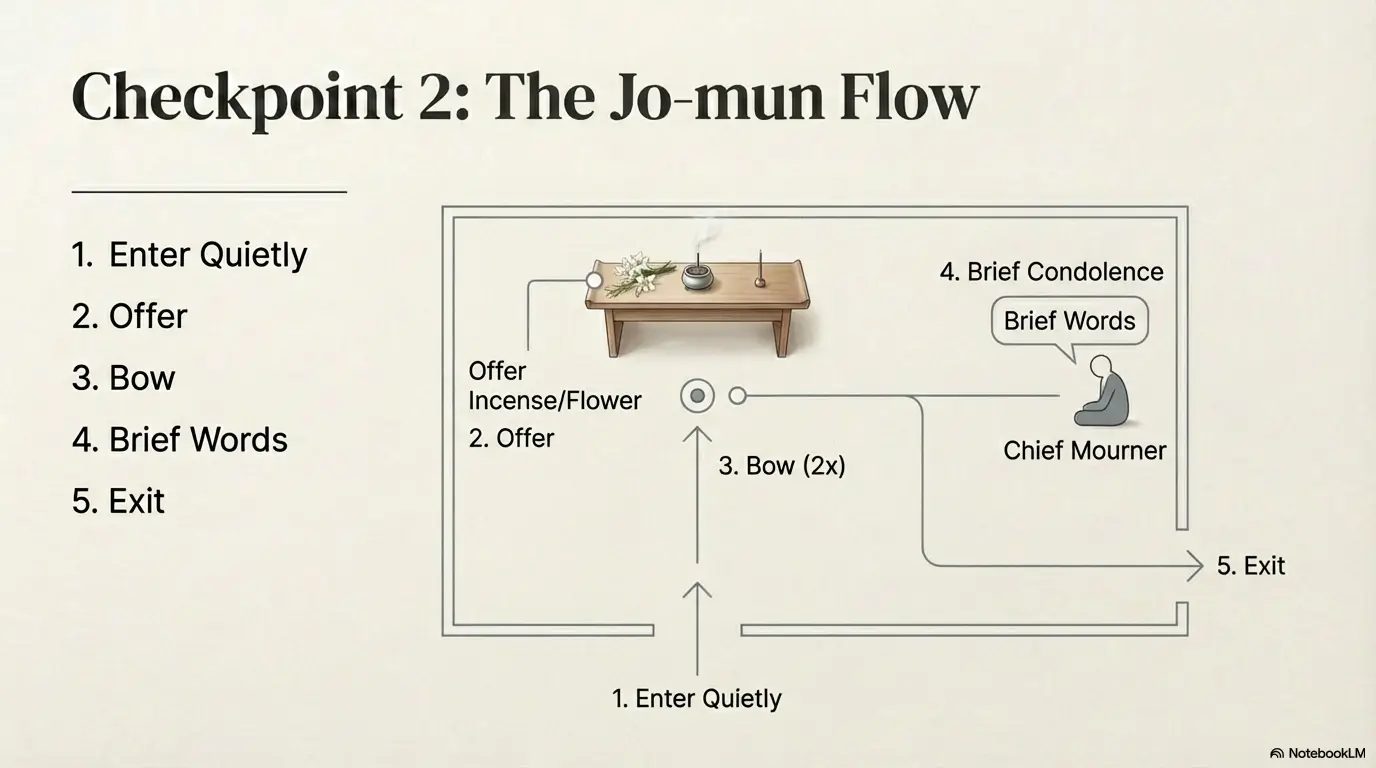
Enter quietly → Approach the altar → Offer incense or a flower → Bow to the deceased → Share a brief condolence with the bereaved → Exit smoothly.
Built like a checklist, not a lecture. Here’s the part that makes it easier: You don’t need perfection. You need the room’s rhythm.
Contents — choose a section
Table of Contents
Who this is for / not for
For you if…
- You’re attending a Korean funeral hall (장례식장 / 빈소) for a coworker’s family member, a friend’s parent, or someone you know socially.
- You want a simple “do this in order” script that prevents awkward moments.
- You’re worried you’ll “stick out” for the wrong reason.
Not for you if…
- You’re immediate family (different responsibilities, longer stays, different seating and roles).
- You’re attending a separate ancestral rite (제사) rather than a modern funeral hall flow.
A quick reality check: most foreigners don’t “mess up” because they’re disrespectful. They mess up because the system is unfamiliar and the emotional temperature is high. One common first-timer scene looks like this: you arrive five minutes late from work, you’re scanning for instructions, and you realize everyone seems to know where to go except you. This guide is built for that moment.
- Move in the same order as the line.
- Keep your visit brief if you’re not close family.
- Use standard envelope wording; don’t improvise.
Apply in 60 seconds: Save this page and skim the “Reception desk sequence” section before you step inside.
Condolence money amount: the 60-second decision tree
Let’s be honest: you’re not asking “what number is correct.” You’re asking, “How do I avoid signaling disrespect?” In Korea, condolence money is a practical form of support for the bereaved family’s funeral costs. The amount is usually read through the lens of relationship + setting, not personal grandstanding.
Start here: relationship → setting → your role
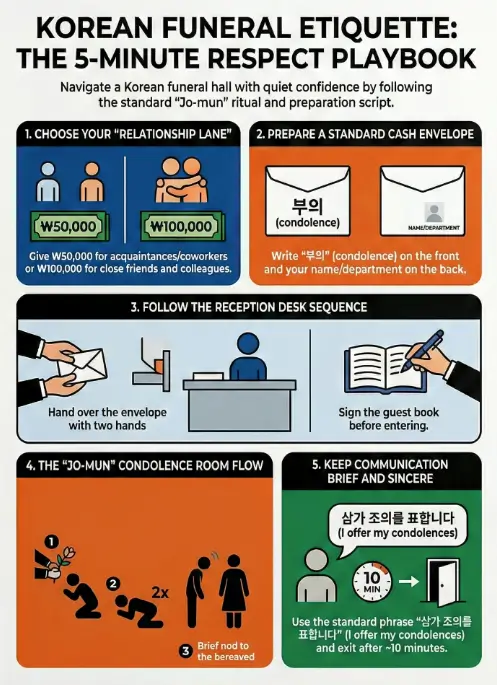
- Coworker (not close) / acquaintance: Many people choose a “standard guest” lane around ₩50,000.
- Close coworker / friend: Often clusters around ₩100,000, sometimes higher depending on closeness and local norms.
- Group visit (team/department): You may be asked to match the team’s shared norm to avoid one person being wildly off-pattern.
Let’s be honest… you’re not asking about money
If you’re from the U.S., it can feel transactional—like the number is the headline. In many Korean workplaces, the “headline” is whether you showed up with the right shape of respect: envelope, quiet tone, brief visit, correct flow. The amount matters, yes, but mostly as part of that broader signal—and this is where small Korean number mistakes can quietly trip people up under pressure.
Open loop: the number people notice (and it’s not “the biggest”)
The amount that stands out is usually the one that’s way out of pattern for your relationship level. Being wildly low can read as distance; being wildly high can create discomfort. The safest strategy when you don’t know the local norm is to mirror your group (team, cohort, friend circle) or choose a common “lane.”
Show me the nerdy details
In fast-moving social systems, humans use “default amounts” as shorthand for closeness. That’s not uniquely Korean—it’s a general pattern in gift economies. What changes is the shared default. In Korea’s funeral hall context, the default is reinforced by the reception desk workflow (guestbook + envelope + standardized phrasing), which quietly turns a chaotic emotional event into a repeatable social ritual.
Money Block: “Is this my lane?” eligibility checklist
- Yes/No: Are you immediate family? (If yes, this guide isn’t your workflow.)
- Yes/No: Are you attending as a coworker/acquaintance? (If yes, “standard lane” amounts are normal.)
- Yes/No: Are you genuinely close and involved? (If yes, moving up a lane is reasonable.)
Apply in 60 seconds: Decide your lane before you reach the reception desk so you’re not doing math in a quiet line.
The “₩50,000 vs ₩100,000” reality (and when each fits)
If you remember only one thing, remember this: for many modern funeral halls, especially in work and social contexts, the most common decision is not “Do I give money?” It’s “Which lane am I in—₩50,000 or ₩100,000?”
₩50,000: the common “standard guest” lane
This often fits when you’re attending as a general coworker (not a close friend), a neighbor, or an acquaintance—someone who wants to show respect without claiming intimacy. Another common first-timer scene: you’ve met the bereaved coworker twice at office events. You’re going to the hall because you’re a decent human and because your team is going. That’s “standard guest” territory.
₩100,000: the “we actually know each other” lane
This often fits when you’re close enough that you’d text them on a hard day, not just react with an emoji. Think: close coworker you collaborate with daily, a friend you’ve shared real life with, a mentor, or someone whose family would recognize your name without a long introduction.
Curiosity gap: why some people talk about “odd numbers”
You may hear talk about amounts “starting with odd numbers” or certain combinations being considered “clean.” In practice, many modern guests choose what is simple and socially legible—often ₩50,000 or ₩100,000—because these amounts are easy to prepare, easy to record, and easy to interpret in a hurry.
Money Block: quick “amount range” table (practical, not sacred)
| Relationship (typical guest role) | Common practical lane | Notes |
|---|---|---|
| Coworker (not close) / acquaintance | ₩50,000 | A “standard guest” signal; brief visit is normal. |
| Close coworker / friend | ₩100,000 | Signals real connection; still keep the visit calm and short unless asked to stay. |
| Very close / “family-adjacent” friend | ₩100,000+ | Local norms vary; if unsure, match the family’s circle or ask a trusted Korean friend quietly. |
Neutral next step: Pick your lane, prepare the cash, and focus your energy on the flow—that’s what reduces mistakes.
Cash + logistics: bills, ATM, and “what if I forgot?”
In many Korean funeral halls, cash condolence money is standard enough that the building is designed around it. That’s why you’ll often see ATMs in or near the hall. If you forgot cash, you’re not the first person to discover this problem while wearing office shoes and trying to look composed.
Cash is normal (and the building expects it)
The system assumes cash-in-envelope because it’s fast to hand over, fast to record, and doesn’t force the bereaved family into awkward payment logistics at the worst possible time.
What to bring
- A plain white envelope (many halls provide them at the desk, but having one saves stress).
- Cash prepared in your chosen “lane.”
- A pen (there’s usually one, but it’s the kind of pen that disappears when you need it most).
Open loop: why the front desk feels like a “checkpoint”
Because it is. The reception desk is the family’s record-keeping hub: guest list, envelopes, sometimes flower deliveries, and traffic control. The “checkpoint” vibe isn’t hostility—it’s structure.
Money Block: mini calculator (no storage, no drama)
Practical check: Use the specific questions below. A generic formula cannot establish an obligatory gift, safe treatment, legal protection or the right purchase for every situation.
Envelope writing: what to write on the front and back
This is the part that makes confident adults sweat. The good news: you don’t need calligraphy. You need standard words—the kind everyone recognizes—and your name. If writing Korean feels intimidating, a quick refresher on Hangeul literacy basics can make the “I can’t write this” panic shrink fast.
Front (center): the standard words
A common, safe choice is 부의 (sometimes written with Chinese characters). You may also see alternatives like “근조” or “조의.” If you can write only one thing, write 부의 in the center. It’s legible and widely understood.
Back (lower area): your identity
Write your name on the back. In work situations, adding your company/team can help the bereaved family recognize you later—especially if they’re receiving many visitors quickly.
Quick examples (copy-ready)
- Front: 부의
- Back: Your Name (Company/Team optional)
Another common first-timer scene: you can speak Korean conversationally, but your handwriting feels like it belongs to a toddler holding a crayon. That’s okay. Neat and simple beats fancy and wrong.
- Front: one standard word (부의 is a safe default).
- Back: your name (and team if relevant).
- Keep it clean—no jokes, no “cute” messages.
Apply in 60 seconds: Practice writing “부의” once on scrap paper before you arrive.
The reception desk sequence: where the money actually goes
The reception desk is your anchor. If you do the desk correctly, the rest becomes easier because you’re following a well-worn script.
Step 1: hand the envelope (or place it as directed)
You’ll usually give the envelope at the desk before entering the condolence room. Use two hands if possible, keep it quiet, and let staff guide you if the setup is different.
Step 2: sign the guest book
Add your name; in workplace contexts, add your affiliation. This is part of how the family later recognizes who came, especially in a high-volume hall.
Step 3: follow the cues (you won’t be abandoned)
Most funeral halls are built for orderly flow. If you freeze for one second, just watch the person ahead of you. The line is your teacher.
A Korean government “While in Korea” etiquette feature has explained the basic reception-desk logic in plain terms—cash in an envelope, your name on the back, and standard condolence wording on the front. That’s the same backbone most modern halls still follow: simple, standardized, repeatable.
“Jo-mun” steps inside the funeral hall (modern funeral room flow)
“Jo-mun” is the respectful sequence visitors perform in the condolence room. You don’t need to memorize a ceremonial choreography. You need to understand the order and the tone.
The core order (what most visitors do)
- Enter quietly.
- Approach the altar area when it’s your turn.
- Offer incense or a flower (the hall’s setup will make this obvious).
Bow (often two bows to the deceased’s portrait, depending on local practice).
If you want a quick confidence boost on form, this guide to Korean bowing (jeol) basics explains what your body is trying to do when your brain blanks.
- Offer brief condolences to the bereaved (a short phrase is enough).
- Exit calmly so the next visitor can proceed.
Here’s what no one tells you…
If you freeze, that’s normal. The most respectful move is to become small and follow the line. The room is built for repetition; your job is to move with it, not to stand out.
The 10-minute visit rule (why short is respectful)
For coworkers and acquaintances, many visits are intentionally brief. The bereaved family may receive dozens or hundreds of visitors. Lingering can accidentally create pressure on them to “host” you emotionally when they’re exhausted.
You arrive with a coworker who whispers, “Just follow me,” and then immediately disappears into a crowd. Great. You’re alone, holding a white envelope, trying to look like a person who knows what a condolence room is. The hallway feels like an airport gate: quiet, fast, and full of people who seem to have done this before.
Then you notice something: no one is improvising. Everyone is following the same small sequence—desk, book, room, bow, short words, exit. The building isn’t asking you to be culturally perfect; it’s asking you to be gently predictable. So you do one brave, boring thing: you pick a person ahead of you and mirror their pace. Your shoulders drop. Your breathing slows. You stop performing and start participating. The room receives you as “a respectful guest,” which is all you came to be.
What to say: simple phrases that don’t backfire
Funerals punish verbosity. Not because words are bad—but because the bereaved family is carrying weight, and your job is to add support without adding demand. Keep your words short, sincere, and standard.
Safe, short condolences (Korean + English intent)
- 삼가 조의를 표합니다. (I offer my condolences.)
- 마음 깊이 위로의 말씀을 드립니다. (My deepest sympathies.)
- 많이 힘드시죠… (This must be very hard…) — gentle, if you know the person well.
What not to do (words)
- Don’t interrogate details (“What happened?”) unless the family opens that door.
- Don’t push “at least…” reframes. Funerals are not optimism workshops.
- Don’t give long speeches in a crowded room.
Open loop: the most respectful sentence is sometimes silence
Sometimes the best “sentence” is a small bow and a quiet, “I’m so sorry.” If you’re worried your Korean isn’t good enough: sincerity is a language the room already understands. If you want a quick grounding on choosing the right register, this polite vs casual Korean guide helps you avoid sounding accidentally too intimate—or too stiff.
Money Block: decision card (what to do if you can’t speak Korean)
- When A: You can speak Korean comfortably → say one standard condolence phrase.
- When B: You can’t → bow, keep eye contact gentle, and say a short English condolence quietly.
- Trade-off: Short and sincere beats long and awkward every time.
Apply in 60 seconds: Memorize just one phrase: “삼가 조의를 표합니다.” If you’re studying Korean and want to understand why certain endings feel safer in formal settings, this Korean honorifics guide is a strong companion piece.
Common mistakes: condolence money + envelope errors
These are the mistakes that create the most “oh no” energy—mostly because they’re easy to avoid.
Mistake 1: giving money without an envelope
Even if you’re rushed, use a plain envelope. Many halls have envelopes at the desk, but asking for one in a crowded moment can spike your stress. If you’re living in Korea long-term, keep one envelope in your bag.
Mistake 2: writing nothing (or writing something “cute”)
Standard wording exists for a reason: it’s universally legible in a sensitive setting. Avoid humor, emojis, or personalized slogans on the envelope.
Mistake 3: over-explaining your amount
The envelope handoff is not a negotiation. Quiet, clean, done.
A common expat awkward moment: someone tries to compensate for uncertainty with extra friendliness—loud voice, long explanation, nervous laughter. In a funeral hall, that well-meaning energy can feel jarring. The room prefers calm.
Don’t do this: funeral hall behavior that reads as disrespect
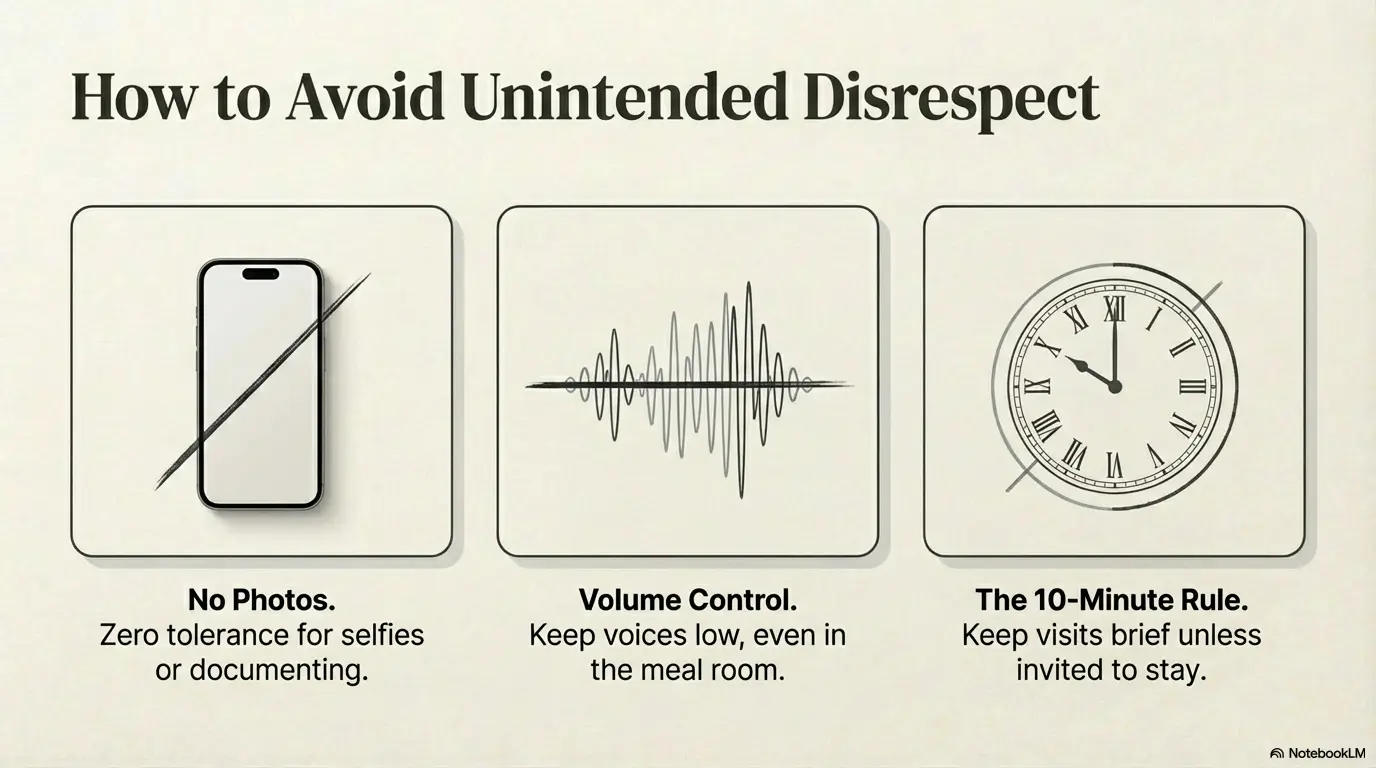
Mistake 1: loud voice + long hangouts in the condolence room
Keep your voice low and your presence brief. If you want to support the bereaved, support them with ease, not extended interaction they must manage.
Mistake 2: selfies, photos, or “documenting”
Default to photo-free. Even if the hall looks visually striking, this isn’t content. This is someone’s grief.
Mistake 3: treating the meal room like a social event
If you’re invited to eat, eat quietly, be grateful, and avoid turning the table into a party. Another common first-timer scene: someone tries to lighten the mood by being “the funny one.” Save that gift for a different room, a different day.
Infographic: the respectful 6-step flow (printable-in-your-head)
Neutral next step: Screenshot this flow and keep it handy for the hallway moment.
After you pay respects: leaving well + follow-up etiquette
The quiet exit (the best exit)
The best exit is a small nod, a small bow, and then you go. No big goodbyes in the condolence room. The room is built for many visitors; your smooth exit is part of the kindness.
If you couldn’t attend: transfer + message
In modern Korea, some people send condolence money via bank transfer when they genuinely cannot attend. If you do this, pair it with a short, respectful message. Keep the wording plain. If you’re a coworker, a simple “I’m so sorry for your loss” is enough. If you’re closer, you can add one line offering practical support.
Follow-up text template (copy-ready)
- “I’m so sorry for your loss. I’m here if you need anything.”
- “Please take care of yourself these days.”
- Work-safe: “My condolences. I’m thinking of you and your family.”
Another common expat worry: “If I go, do I have to stay all night?” Usually, no—especially for coworkers and acquaintances. If the family asks you to stay longer, you’ll know. Otherwise, brief and respectful is normal.
FAQ
1) How much condolence money should I give at a Korean funeral as a coworker?
Many coworker visits fall into a “standard guest” lane—often around ₩50,000—especially if you weren’t close. If you were genuinely close, ₩100,000 is a common “close relationship” lane. If your team has a shared norm, matching it is usually the safest move.
2) Is ₩50,000 enough if I wasn’t close?
In many modern workplace contexts, yes—especially if your relationship was polite but not intimate. The respectful signal comes from doing the full flow (envelope, guestbook, jo-mun, quiet tone), not from “winning” with a number.
3) Do I need to bring cash to a Korean funeral hall?
Often, yes—cash-in-envelope is a common default. Many halls are set up with nearby ATMs because this is so common. If you’re unsure, ask a trusted coworker before you arrive so you’re not scrambling in the hallway.
4) What do I write on the condolence envelope?
A safe default is writing “부의” on the front (center) and your name on the back. In workplace settings, adding your team/company on the back can help the bereaved family recognize you later.
5) Can I write the envelope in English if I can’t write Korean?
If you truly can’t write Korean, write your name neatly and add your affiliation (company/team). Many people will still recognize the gesture. If you can write just one Korean word, “부의” is a common, simple choice.
6) What is “jo-mun,” and what are the steps?
“Jo-mun” refers to the condolence-room sequence: enter quietly, approach the altar, offer incense or a flower (depending on setup), bow, offer brief condolences to the bereaved, then exit calmly. Follow the line if you’re unsure.
7) What should foreigners wear to a Korean funeral hall?
Aim for conservative, dark, simple clothing (think: work-appropriate and non-flashy). If you’re coming from work and can’t change, remove loud accessories and keep the overall look subdued.
8) How long should I stay if I’m not family?
Many coworker/acquaintance visits are brief—often around 10 minutes for the condolence-room flow, plus a short meal if invited. If the family wants you to stay longer, they will usually signal it through conversation or invitation.
9) Is it okay to eat the meal at the funeral hall?
If you’re invited or it’s part of the common flow, yes. Eat quietly, express gratitude, and keep it low-key. Treat it as support for the family’s hosting effort, not as a social hangout.
10) What should I avoid saying to the bereaved?
Avoid pushing details, minimizing (“at least…”), or trying to fix grief with motivational statements. Short, sincere condolences are safest.
When you do not know the funeral hall’s practice
At an unfamiliar funeral hall, quietly ask the person guiding visitors what the family would prefer. “어떻게 하면 될까요?” means “What should I do?” If religious gestures are unfamiliar or conflict with your beliefs, ask whether a quiet pause or a bow to the family would be appropriate. The purpose is to support the bereaved, not to complete a universal sequence perfectly. Keep photography and personal questions out of the visit unless the family specifically invites them.
A reader question: What if I make a small mistake?
A brief apology and a calm adjustment usually serve the family better than a long explanation. Follow the family’s guidance and avoid asking them to reassure you repeatedly.
Next step: do this before your next funeral hall visit
Make a “funeral hall ready” mini-kit (2 minutes)
- 1 plain white envelope (keep it flat in a small pocket)
- Cash in your default lane (many people choose ₩50,000 as a baseline unless they know they’ll need ₩100,000)
- A small pen
This tiny kit isn’t about being morbid. It’s about being kind under pressure. When grief is in the room, nobody needs you doing frantic ATM math while people wait behind you.
If you want deeper cultural context beyond the modern hall workflow, the National Folk Museum of Korea’s English materials on Korean life passages and rites can give helpful background—without turning your next visit into a research project.
How this guide avoids awkwardness (without over-explaining)
Plenty of guides say “bring money” and “bow politely.” Useful—but incomplete. The real stress points for foreigners are more specific: the reception desk sequence, the envelope wording, and what to do with your body in the condolence room when you’re half-panicking.
The three places awkwardness actually happens
- The reception desk: you don’t know whether to sign first or hand the envelope first.
- The envelope: you worry your writing will look wrong.
- The condolence room: you don’t know how long to stay or what to say.
The fix: treat it like a simple reminder script
- Desk: envelope → guestbook → follow the line.
- Envelope: front “부의” → back your name (team optional).
- Room: offer → bow → short condolence → exit calmly.
If you want a narrative-style walkthrough of the “one envelope, two bows, three days” rhythm (and how Koreans explain it in modern life), Korean English-language reporting has also covered the practical basics in a way that’s easy to visualize.
- Match the room’s quiet tone.
- Use standard wording and standard flow.
- Keep your visit brief unless invited to stay.
Apply in 60 seconds: Before you enter, repeat the three words in your head: Desk → Room → Exit.
Conclusion
Remember the curiosity loop from the beginning—the envelope that suddenly feels like a microphone? Here’s the quiet truth: you don’t need to “perform” Korean culture. You need to follow a simple, human script that Korean funeral halls have made repeatable on purpose. Pick a reasonable lane (often ₩50,000 or ₩100,000), write one standard word on the front, your name on the back, do the reception desk sequence, and let the line guide your jo-mun steps. That’s respect.
Your next step, within 15 minutes: make the mini-kit (one envelope, a pen, and your default cash lane). It’s a tiny action that prevents the one moment you never want to have—fumbling in silence while grief waits behind you.
Last reviewed: 2026-01-15
Practical example and reader question added October 20, 2026. Existing source dates are retained; this addition is not a fresh verification of every earlier claim.