

Korean teen life is often described with blunt instruments: long hours, uniforms, and the relentless pressure of cram schools. But that framing misses where the day actually becomes legible. The real story lives in the lunch line, the five-minute desk nap, and the supervised study hall that makes “after school” feel like a mere technicality.
For many, the friction isn’t a lack of information, it’s misreading it. A cafeteria meal is reduced to curiosity; a napping student is flattened into a stereotype. Without the social texture and accumulated fatigue, a late school day is treated as pure discipline rather than a shared human experience.
This is where the picture sharpens. We follow the rhythm of the day, from the midday social reset to the academic extension after sunset, to move beyond the “hot takes” and find the lived reality beneath the routine.
Contents — choose a section
Table of Contents
Focus builds early. Energy is still usable.
Food, reset, social navigation, brief relief.
A few minutes of stillness can matter more than they look.
Attention gets more expensive.
The day hardens into discipline.
For many students, the real finish line moves.
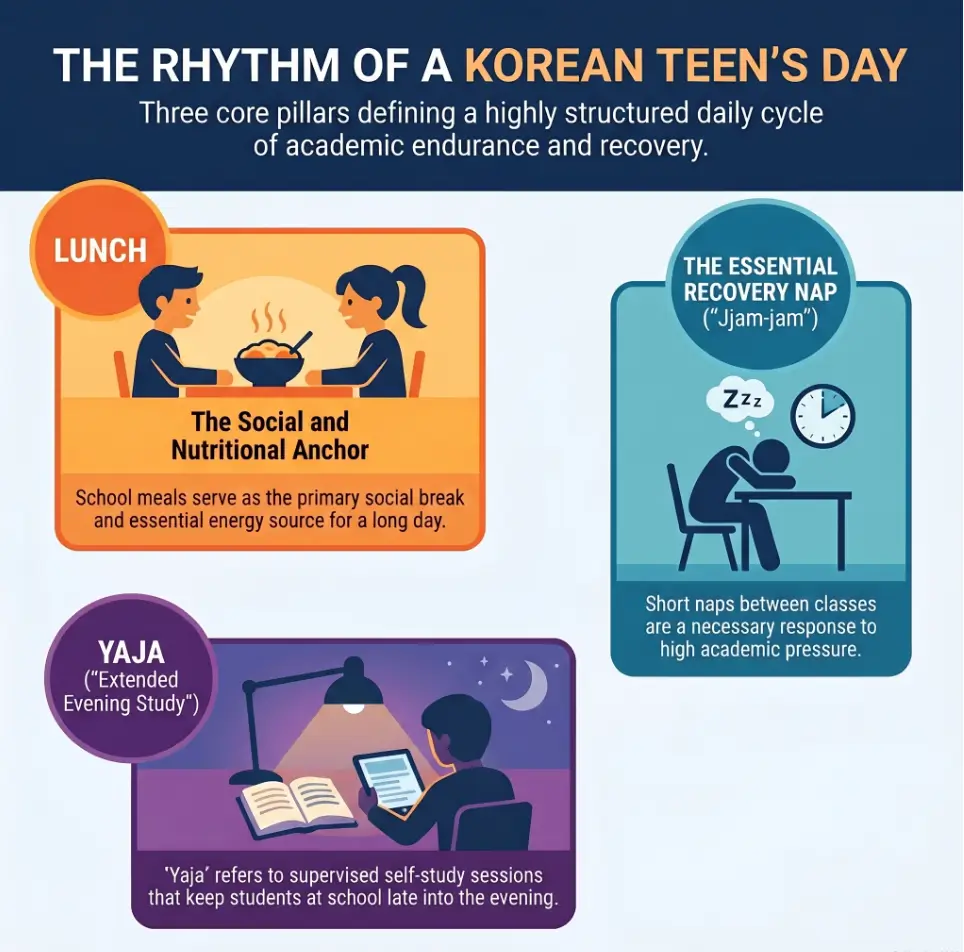
Start With the Rhythm: Why Korean Teen Life Feels Structured Hour by Hour
The school day is not just classes. It is a sequence of energy management
One of the easiest mistakes outsiders make is assuming Korean school life is best understood through test scores, college admissions, or the headline word “competition.” Those matter, of course. But daily life is felt through time before it is felt through ideology. Teenagers do not wake up each morning thinking in abstractions. They think in chunks: first period, lunch, the drowsy stretch after midday, the moment the classroom clock becomes the most dramatic object in the room, the question of whether the day actually ends when the formal timetable does.
That is why lunch, short rest, and study hall matter so much. They are not decorative breaks tucked between “real” things. They are the hinges. If you remove them from the story, Korean teen life starts to look flatter, harsher, and less intelligible than it really is.
Why outsiders notice the schedule before they understand the culture
Schedules are visible. Culture is slower. A foreign reader can instantly notice that students stay at school late, eat together, and may study again after the last class. What is harder to see at first glance is that this rhythm is also communal. Time is often shared rather than individually customized. A US teenager might be more used to a day fragmented by electives, clubs, sports, part-time work, or a looser social sense of after-school ownership. In Korea, even when experiences vary widely by school and family, the atmosphere often feels more collectively timed.
Students may describe similar school routines in very different ways. A matter-of-fact tone does not establish whether someone is exhausted or content. Ask about the student’s own experience rather than treating this article as a record of interviews.
- Time structure shapes mood as much as academic content does
- Shared routines create both solidarity and pressure
- The “between” moments explain the whole system
Apply in 60 seconds: When reading about Korean schools, ask what students are doing at noon, at 4 p.m., and at 10 p.m. The answers reveal more than a ranking chart.
Lunch Comes First: Why the Midday Meal Is Bigger Than “Just Eating”
School lunch works as a social reset, not only a food break
Lunch in Korean schools is practical, social, and symbolic all at once. It is food, obviously. Teenagers are not abstract creatures nourished by ambition and algebra alone. But lunch also changes the emotional temperature of the day. The classroom loosens. Voices rise. The body returns to the scene like a forgotten character entering in act two. A tray is not just a tray. It is one of the few institutional moments when school says, in effect, you are not only a student brain. You are a tired person who needs to eat.
Korea’s Ministry of Education maintains a dedicated school meals function and has repeatedly described school lunch safety as a major policy concern, which reflects how central school lunch culture in South Korea is to the school environment itself.
Why cafeteria routines can reveal hierarchy, friendship, and pace
Lunch also reveals group life with surprising clarity. Who sits with whom. Who eats fast. Who lingers. Who makes jokes. Who looks briefly relieved to be outside the strictest mode of classroom attention. In any country, lunch can expose the social architecture teenagers live inside. But in Korea, where group belonging often carries visible weight, the cafeteria can act like a little x-ray machine. Friendship, hierarchy, ease, awkwardness, routine, all of it flickers there.
This is one reason lunch scenes often feel memorable in recollections of school life. They are organized, but less formal. The day relaxes without fully unclenching. It is not chaos. It is scheduled humanity.
What a shared tray can quietly teach about group life
For US readers, the difference is often less about the existence of lunch than about its texture. American school lunch can be social too, of course, but the Korean version is frequently read through a more collective lens. The meal may feel less like a series of separate consumer choices and more like participation in a shared institutional rhythm. That does not make it automatically better. It just means it often carries more communal meaning than outsiders expect, much like broader patterns of Korean seating hierarchy and group order do in other everyday spaces.
And yes, teenagers remain teenagers everywhere. Someone is still picky. Someone is still grumpy. Someone still regards vegetables with the emotional seriousness usually reserved for betrayal. Civilizations differ; side dishes still lose public relations battles.
Look Closer at Lunch: What US Readers Often Miss on the First Pass
Korean school lunch can feel more collective than individually customized
A US reader encountering Korean school culture for the first time may focus on the menu: rice, soup, side dishes, shared timing, the visible regularity of it all. But what often matters more than the menu is the structure around it. Lunch is a collective pause built into a tightly managed day. That difference is subtle, yet powerful. A meal becomes a social reset because everyone is arriving there from the same machine-like morning sequence.
Think of it less as a restaurant model and more as a communal station in a long rail line. Students are carried there together, stop together, then move on. The sameness is part of the meaning.
The meal matters, but the timing and atmosphere matter too
When readers say, “So Korean students eat lunch at school, what is the big deal?” the real answer is that lunch tells you what the rest of the day has demanded. A peaceful lunch in a loosely scheduled environment feels different from a peaceful lunch in a pressure-heavy environment. The same spoonful of soup can taste like routine in one context and rescue in another.
Constructed illustration, not a reported event: a fictional narrator once heard a former student describe lunch not as the happiest part of the day, but as the moment when the day became briefly breathable. That phrasing stayed with me. It was not romantic, not dramatic, just exact. Breathable. Sometimes one honest adjective explains an entire institution.
Here’s what no one tells you: lunch is one of the few moments the day briefly softens
This softening matters. It reminds us that rigid systems do not run only on rules. They also run on recovery. Without some kind of reset, the later parts of the day become harder to understand. Lunch is where energy is restored, friendships are rehearsed, and the emotional pace of the day is quietly renegotiated.
That is why you cannot treat lunch as filler when describing Korean teen life. It is one of the day’s most revealing rooms.
You will miss the social reset, group timing, and emotional relief built into it.
You understand why a meal can matter even before discussing the menu.
Neutral next step: Compare what lunch interrupts, not only what it serves.
Napping Is Not Laziness: Why Midday Rest Makes Sense in Context
A short rest can reflect exhaustion, not indifference
To some US readers, the idea of students napping at school can sound almost comedic. Are they really that tired? Are teachers allowing this? Is it normal or just internet folklore dressed in fluorescent classroom lighting? The answer is more nuanced than a simple yes or no. Not every student naps. Not every school treats rest the same way. But the image resonates because it reflects a real truth: many Korean students live inside demanding schedules, and short periods of visible tiredness are not shocking in that context.
Recent Korean reporting on adolescent sleep, drawing on national survey data, said average sleep duration among student respondents was about six hours and that only a small share reached eight hours or more, while other reporting highlighted that roughly half of Korean high school students were getting under six hours. Those figures should not be treated as the whole story for every student, but they do help explain why a head-on-desk moment is often read as fatigue rather than laziness.
Why packed schedules make even brief downtime feel necessary
Once you understand the broader rhythm, napping stops looking like a quirky national habit and starts looking like a pressure valve. Morning classes require attention. Afternoon classes often demand attention when energy is already thinning. After-school study, commuting, homework, and private academy time may still wait ahead. In that setting, ten quiet minutes can feel less like indulgence and more like triage.
There is something almost tender in this, though the tenderness is accidental. Systems that demand endurance often produce tiny improvised shelters inside themselves. A folded jacket becomes a pillow. A desk becomes a harbor. Teenagers, being clever animals, build comfort out of whatever wood is nearby.
What napping reveals about the pressure underneath the polished routine
Napping matters because it punctures the fantasy of seamless performance. From the outside, highly organized school cultures can look efficient, disciplined, even elegant. But visible tiredness reminds us that efficiency is paid for by bodies. Eyes sting. Necks ache. Attention frays. The day may look polished on paper and still feel grinding in lived experience.
This does not mean Korean teen life is only exhaustion. That would be another simplification, merely wearing darker clothes. It means fatigue is part of the picture, and short rest is one of the ways that truth appears in public.
Show me the nerdy details
When readers compare school systems, they often over-focus on formal timetable differences and under-focus on cumulative sleep loss. Mechanism matters here: a student with a long commute, late-night self-study, and early classes may appear “unmotivated” at noon while actually operating in a sleep deficit. That changes how lunch and rest periods should be interpreted.
Study Hall Changes Everything: How Self-Study Extends the Day Beyond Classes
Study hall is where the academic mood of the day hardens
If lunch is where the day softens, study hall is where it firms up again. This is the part many outsiders underestimate. They imagine the school day as classes plus homework. But in Korea, supervised self-study and related after-school academic time have long played a major role in how students experience education. The formal teaching portion may end, yet the discipline structure continues. The atmosphere shifts from instruction to endurance.
Korean education research has also examined self-directed learning and school policy around structured academic time, which helps explain why “study” in Korea is not always a private, floating activity but often something arranged within institutional frames.
Why “school is over” does not always mean students are done
This can be surprising for US readers because the phrase “after school” often implies release into personal time. In Korea, that line can be blurrier. Students may remain in classrooms or supervised spaces for additional study. Even when they physically leave school, the academic day may simply migrate elsewhere.
I have always thought this is one of the most revealing differences between systems: not whether students study hard, but where the culture expects that studying to happen. When a society pushes learning into visibly organized blocks, the day feels more collectively owned. That ownership can create accountability, but it can also make tiredness feel official.
The line between discipline and fatigue gets thin here
Study hall is one of those institutional ideas that can look noble or oppressive depending on where you stand. In its best reading, it offers structure, accountability, quiet space, and a clear transition from class time to independent work. In its worst reading, it becomes the extension cord of academic pressure, stretching the day past the point where the mind is still fresh enough to benefit.
Both readings can be true at once. That is the part worth keeping. Systems are often double-sided. A thing can be helpful and wearying. Useful and heavy. A ladder and a load.
- Academic time may continue after formal instruction ends
- Institutional structure can support focus and intensify fatigue
- The phrase “done for the day” may not map neatly across cultures
Apply in 60 seconds: When comparing school systems, ask where independent study is expected to happen and who supervises it.
After the Final Bell? Not Exactly: How Evening Study Reshapes Teen Time
Formal school hours and real student hours are often not the same thing
Here is where many foreign readers finally feel the floor shift. The bell rings. Surely that means school is over. Not necessarily. For many Korean students, the formal day and the lived day are not the same unit. Evening may still contain school-led study, private academy sessions, homework, exam prep, commuting, and the mental residue of performance pressure. The timetable says one thing. The body says another.
This is part of why midday rest matters so much. It exists inside a longer arc. A tired student at 1 p.m. is not only reacting to the morning. That student may already be carrying yesterday evening and bracing for tonight.
Why private academies and self-study can stretch the day deep into evening
Not all students attend hagwon to the same degree, and not all families manage education in the same way. Korea is not a single household with one giant planner app and a national sleep deficit pasted to the fridge. Still, Korean hagwons and after-school study culture have been a highly visible part of the educational ecosystem for decades, and their existence changes how the entire school day is felt. Evening is no longer purely leisure space. It becomes contested territory.
That contest matters emotionally. Free time starts to feel conditional, negotiated, even a little fictional. Teenagers still make jokes, send messages, snack, scroll, gossip, flirt, stall, and behave like teenagers. But the day’s architecture often presses around those moments more tightly than many US readers would expect.
Let’s be honest: the word “free time” can become slippery in this system
Slippery is the right word because free time may technically exist and still feel difficult to inhabit. A student can have thirty minutes and not experience it as freedom if the next obligation is already standing in the doorway. This is one reason foreign observers sometimes misread Korean teen life as robotic. It is not that students are emotionless or endlessly compliant. It is that the day is crowded, and crowded days leave different fingerprints on the spirit.
The image that returns for me is evening classroom light, pale and slightly tired, making even ambition look sleepy. It is not an image of failure. It is an image of cost.
- Yes: You want to understand why short rest matters.
Next step: Map the whole day, not just official class hours. - Yes: You are comparing US and Korean school culture.
Next step: Separate formal school time from total academic time. - No: You want one simple national rule.
Next step: Expect variation by school, region, family, and student track.
Neutral next step: Keep “How late does the learning day really run?” as one of your core comparison questions.
Who This Is For and Not For
This is for readers trying to understand the lived rhythm of Korean teen school life
This article is for readers who want more than the tourist-brochure version of Korean education and more than the panic-documentary version too. Parents comparing school cultures. Students trying to understand classmates, exchange partners, or friends. Educators interested in how time structure shapes behavior. Writers and culture-curious readers who know that the truth of a society often hides in ordinary routines rather than in grand speeches.
This is for parents, students, educators, and culture-curious readers comparing school systems
It is especially useful for US readers because American assumptions about school time often build around stronger separation between institutional hours and personal hours. That difference can make Korean teen life look unusually dense unless you learn to read the day from inside its own logic.
This is not for readers looking for one universal rule that fits every Korean school
It is not for people who want a cartoon. Korea contains wide variation. Middle school is not high school. Academic tracks differ. Family expectations differ. Urban and regional experience can differ. Some students feel held by structure. Others feel pinned by it. Most live somewhere in the complicated middle, which is inconvenient for hot takes and excellent for reality.
Whenever a culture gets flattened into a single sentence, somebody’s actual life falls through the cracks. Usually several somebodies.
Common Mistakes: What Foreign Readers Get Wrong About Korean Teen Schedules
Mistake one: treating lunch, naps, and study hall as isolated habits instead of one system
This is the most common error. Lunch becomes a food article. Napping becomes a quirky video clip. Study hall becomes an “education pressure” paragraph. But these pieces belong together. Lunch resets energy. Napping reveals its depletion. Study hall extends the logic of organized endurance. Once you see the three as connected, the entire rhythm sharpens.
Mistake two: assuming every student experiences the schedule in the same way
Another mistake is treating structural patterns as emotional uniformity. Two students can live inside the same timetable and experience it very differently. One may like predictability and group flow. Another may feel quietly cornered by the same routine. Culture gives form, but people still bring temperament, family life, ambition, resistance, humor, and weariness into that form.
Mistake three: confusing endurance with comfort
Foreign admirers sometimes mistake visible endurance for visible ease. A student who keeps going may simply be… keeping going. There is dignity in stamina, yes. There is also strain. A polished routine can still ask a lot from a young nervous system. That tension matters if you want to speak accurately rather than romantically.
In other words, “they handle it” does not automatically mean “it feels fine.” Anyone who has ever smiled while carrying too many grocery bags already knows this principle in their bones.
Show me the nerdy details
Comparative education writing often fails when it confuses descriptive patterns with universal outcomes. Structural habits such as school lunch timing, rest behavior, or supervised study should be read as institutional signals, not as proof that every student is equally well adapted to them.
Don’t Flatten the Story: Why “Strict but Successful” Misses Too Much
High structure can produce both solidarity and strain
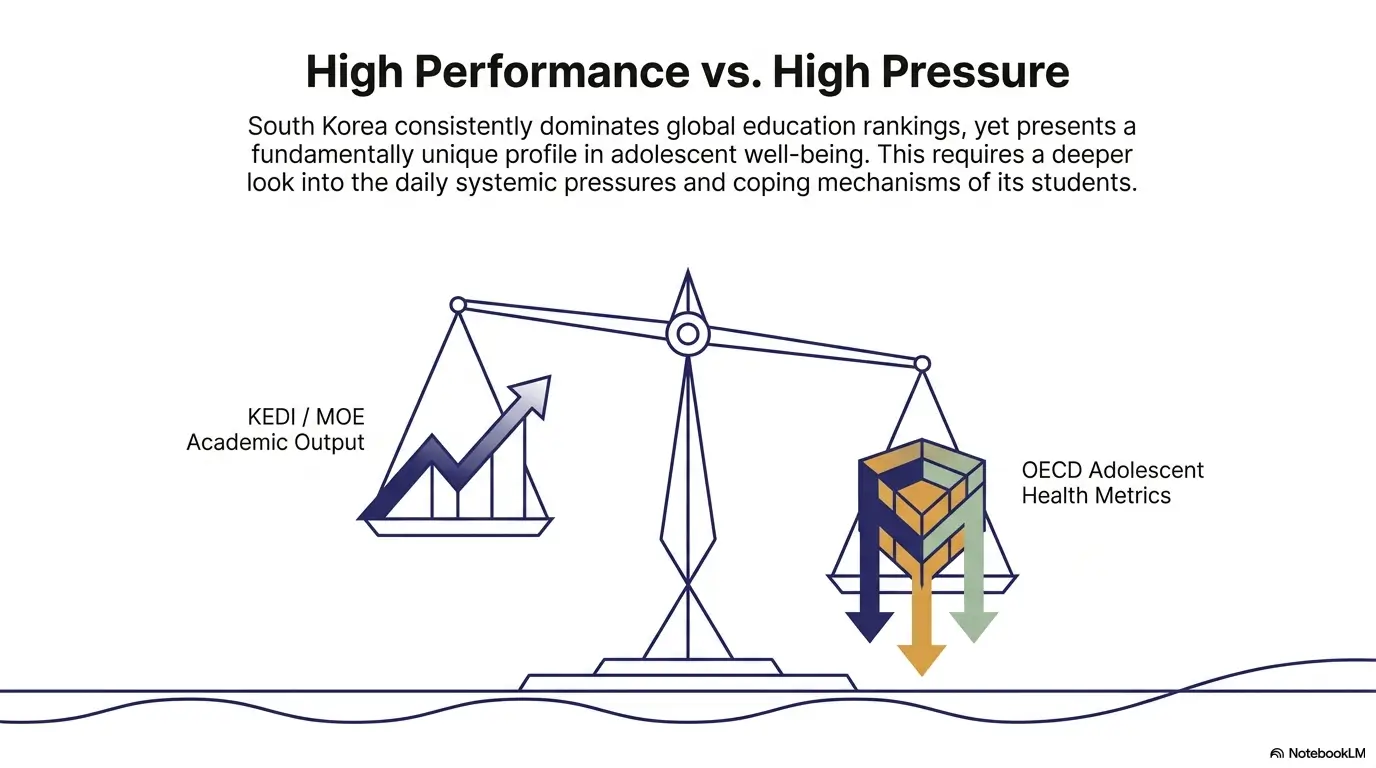
The phrase “strict but successful” sounds efficient, which is precisely why it is so tempting. It gives the mind a neat little shelf to place Korea on. Unfortunately, real life keeps slipping off that shelf. High structure can help coordinate effort, reduce ambiguity, and create shared habits. It can also produce fatigue, narrow the meaning of rest, and turn adolescence into a long negotiation with scheduled time.
Both sides belong in the picture. Leave one out and you get propaganda, either glowing or gloomy.
Why efficiency is only one part of the picture
Efficiency explains systems from above. Emotional texture explains them from within. A schedule may appear rational and still feel heavy in the muscles. A school lunch may be nutritionally organized and still function emotionally as relief. A study hall may improve productivity for some students while deepening tiredness for others. Human beings are annoying that way. We keep insisting on being more than a spreadsheet.
The emotional texture matters as much as the timetable
Whenever I read discussions of Korean teen life that focus only on outcomes, I feel the absence of atmosphere. Where is the cafeteria noise? The slumped shoulder at 2 p.m.? The strange mixture of joking and pressure? The way friendship survives inside institutional rhythm like a plant growing through pavement? If you miss those things, you may still know facts, but you do not yet know the day.
- Structure can support belonging and intensify pressure
- Outcomes do not erase emotional cost
- Atmosphere is part of accuracy, not decoration
Apply in 60 seconds: Replace judgment words with observation words: rhythm, fatigue, reset, group flow, extension, cost.
Small Moments, Big Meaning: What These Routines Teach About Korean Teen Life
Lunch shows how community is practiced in ordinary time
Lunch is where school becomes visible as social life rather than pure instruction. It teaches that community is not built only through ceremonies or slogans. Sometimes it is built through repeated ordinary timing. Line up. Sit down. Eat. Complain mildly. Laugh suddenly. Continue. Community often looks less like a banner and more like a tray balanced with practiced hands.
Napping shows where tiredness quietly enters the frame
Napping teaches something less cheerful but equally important. It shows where the body begins asking to be noticed. Young people are often treated as if they are infinitely elastic. They are not. They recover better than adults in some ways, perhaps, but they are not machines that convert ambition into focus without friction. A classroom nap, however brief, reminds us that the body votes even when the timetable does not ask for its opinion.
Study hall shows how ambition becomes routine rather than event
Study hall may be the clearest sign that ambition in Korea often appears not as dramatic striving but as repetition. Sit down again. Continue again. Keep the line moving. There is something almost monastic in that, though monasteries usually offer better branding for silence and less exam prep. Ambition, in this context, is not always loud. Often it is furniture.
And that may be the deepest lesson of all. Korean teen life is not shaped only by spectacular pressure. It is shaped by the ordinary repetition that makes pressure livable, legible, and hard to escape.
Illustrative Scenario: A former exchange student once told me that the first thing she misunderstood about her Korean classmates was not how hard they studied, but how evenly they carried the day. At lunch, they laughed and traded side dishes. After lunch, one boy put his head down for a few minutes, then lifted it as if returning from underwater. Later, when classes ended, she assumed everyone would scatter into private life.
Instead, the room slowly reorganized itself for more studying. No one announced that this was tragic. No one announced that it was noble. It just happened, with the quiet inevitability of chairs being moved. She said that was the moment she understood something important: Korean teen life was not built only from pressure, but from shared adaptation to pressure. What looked severe from a distance felt, up close, strangely communal.
Comparison Trap Ahead: How Korean Teen Life Differs From Common US Expectations
US readers may expect stronger separation between school, rest, and personal time
American readers often bring an invisible assumption into the comparison: that school time, rest time, and personal time should be more clearly separated. Once school ends, personal life is expected to regain authority. Korea often reads differently because those borders can feel more porous. Study spills outward. Rest becomes shorter and more tactical. Lunch carries unusual weight because it sits inside a day that does not loosen easily.
Why Korean school culture can feel more collective and endurance-based
This does not mean US teens live stress-free lives. They absolutely do not. They face different pressures, different fragmentation, different forms of exhaustion. But the Korean pattern can feel more collectively choreographed. Many students move through similar institutional beats, and that choreography changes the emotional meaning of each beat. Lunch becomes communal relief. Napping becomes visible fatigue. Study hall becomes organized continuation.
What the comparison reveals about both systems, not just one
The comparison is most useful when it reveals blind spots in both directions. Korea can remind US readers that shared routine can create community and seriousness. The US can remind Korean observers that personal time and institutional limits also matter. Neither system emerges pure. Both are trying, in very different keys, to solve the same old human problem: how to educate young people without making time itself feel hostile.
Add three things: formal classes + after-school study + commute.
If the total pushes far past a typical workday, lunch and short rest become easier to interpret as recovery tools, not luxuries.
Neutral next step: Use total time load, not just class hours, when comparing student life across countries.
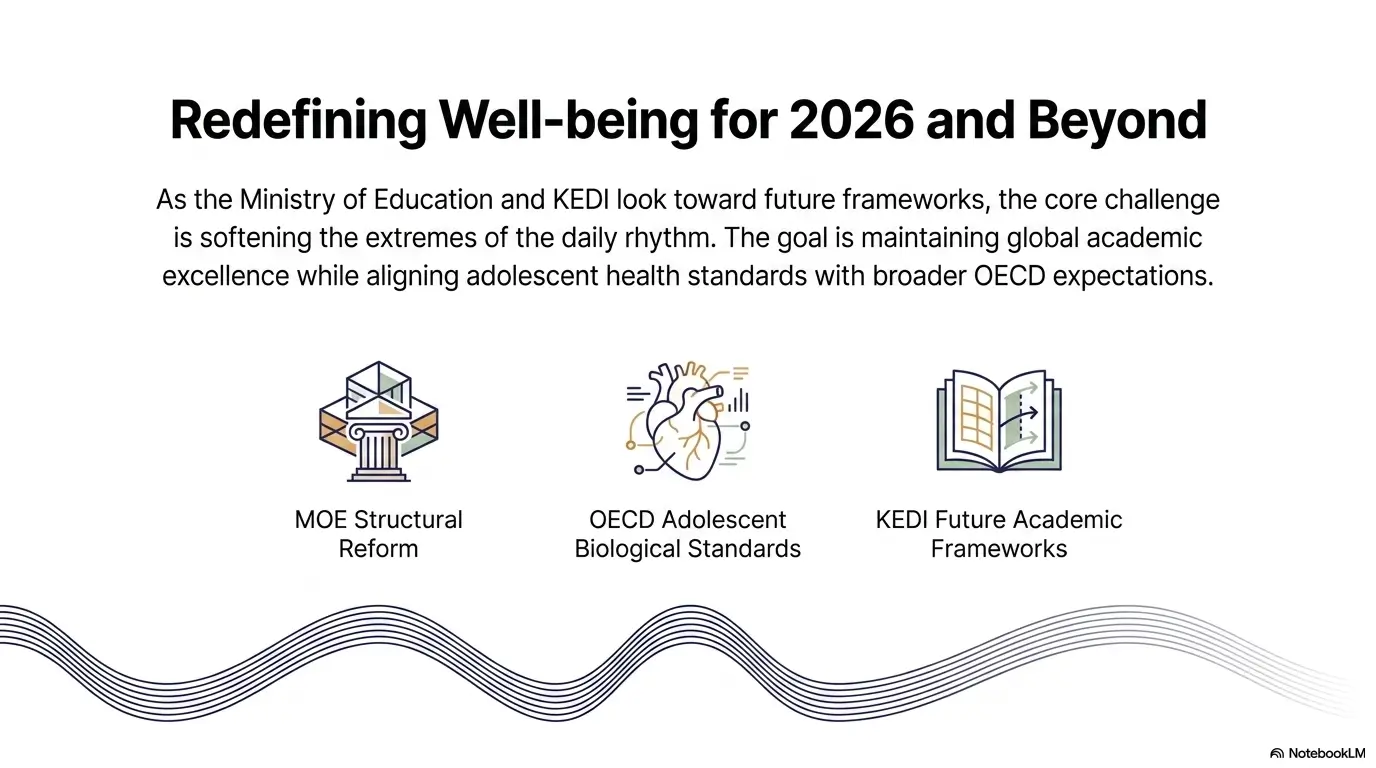
Read the student’s actual day before adding another activity
Write one ordinary weekday from leaving home to going to bed. Include meals, travel, school sessions, study periods and time needed to decompress. Ask the school which supervised periods are required and which arrangements vary by grade or day. A headline about Korean teen life cannot tell you whether a particular student has a free lunch break or an optional study session. Use the real timetable when discussing workload with the student.
| Focus | What to check |
|---|---|
| Schedule | Use the current timetable for the actual grade. |
| Requirements | Identify required and optional supervised periods. |
| Wellbeing | Discuss workload and rest with the student. |
A reader question: Can a parent assume a gap in the timetable is free study time?
Ask what happens during it and what the student needs. Travel, meals, rest and administrative tasks may occupy time that looks empty on a simplified schedule.
Next Step: One Concrete Way to Read Korean Teen Life More Accurately
Stop asking whether the routine seems “too strict” first and ask what problem each part of the day is solving
If you want one practical method for reading Korean teen life more accurately, start here: do not begin with judgment. Begin with function. What problem is lunch solving? Hunger, yes, but also social reset. What problem is napping solving? Not laziness, but accumulated fatigue. What problem is study hall solving? Focus, accountability, extension of academic time, and sometimes the management of collective expectations.
When you ask functional questions first, the picture becomes more humane. You stop treating students as symbols and begin seeing them as people moving through a demanding architecture of time. Some parts of that architecture support them. Some parts wear them down. Many do both at once.
That is the curiosity loop from the beginning of this article, and here is the answer plain and clean: lunch, napping, and study hall shape Korean teen life because they organize how students recover, relate, and keep going inside a long shared day.
In the next 15 minutes, try this small exercise: take any image or anecdote about Korean school life and ask three questions. Where is the energy restored? Where is the fatigue visible? Where does the day actually end? You will understand far more, and much more honestly, than if you begin with slogans. If you want to widen the frame further, it can help to pair this school-day lens with related pieces on Korean school uniform culture, how Korean campus clubs shape student social life, and even the etiquette of Korean group chat culture, because teenage routine is never built from schedule alone.
FAQ
Do Korean students really nap at school?
Some do, especially when schedules are demanding and sleep is short, but it is not a universal rule for every school or every student. The broader point is that visible tiredness in the school day is understandable in the context of long academic hours and sleep pressure.
How long is lunch in Korean schools?
It varies by school and level, so there is no single number that fits every student. What matters most for cultural understanding is not just the length, but the role lunch plays as a collective reset inside a highly structured day.
Is study hall mandatory for all Korean teens?
No. Practices differ by school, grade, policy environment, and student pathway. But structured self-study and supervised academic time have been significant enough in Korean education culture that many students and observers understand the school day as extending beyond ordinary classroom teaching.
Why do Korean students stay at school so late?
Because formal class time may be followed by school-based study, homework, commuting, or private academy attendance. The lived learning day can be much longer than the official timetable suggests.
Do all Korean high schools follow the same schedule?
No. Variation matters. Academic focus, local norms, family expectations, and school-level practices all shape the rhythm differently. Any honest article about Korean teen life should leave room for that variation.
How does Korean teen life compare with US high school life?
One of the biggest differences is often how tightly academic time, rest, and personal time are braided together. US readers may expect clearer separation between school and private life, while Korean school culture can feel more collectively timed and endurance-based.
Is school lunch considered important in Korea?
Yes. Public policy attention to school meal systems and safety shows that lunch is treated as a serious part of the school environment, not merely cafeteria logistics. Readers who want a fuller food-and-routine angle can also look at why soup is often treated as a full meal in Korea and the everyday logic behind Korean banchan refill rules.
Do Korean students get enough rest during the school week?
Not always. Recent reporting and research on adolescent sleep in Korea suggest that many students sleep less than recommended, which helps explain why short midday rest can feel meaningful.
Last reviewed: 2026-04.
Practical example and reader question added October 20, 2026. Existing source dates are retained; this addition is not a fresh verification of every earlier claim.