

The Silent Architecture of the Korean Table
In Korea, seating hierarchy rarely announces itself with a speech. It reveals itself in a doorway pause, a chair no one touches first, and the tiny ripple of adjustment when the wrong person sits too quickly. A seat signals age, rank, and honor long before the first dish lands.
This social logic often catches Anglo-American readers off guard. While a room may feel warm and casual, the underlying structure is anything but random. Whether in office meetings or family gatherings, everyone else is reading cues you were never taught.
Instead of guessing and risking an awkwardness that polite hosts will quietly remember, this guide turns vague etiquette fears into a practical pattern. We move beyond ceremonial fantasy to focus on what actually happens in real rooms.
The secret isn’t memorizing furniture—it’s learning to read status, hospitality, and timing. Once you see the pattern, the room makes sense.
Table of Contents
Start Here First: Who This Is For / Not For
This is for you if you are a US traveler, expat, student, or professional in Korea
If Korea is new to you, seating can feel like a tiny social minefield disguised as furniture. The room looks casual. The chairs look innocent. Then everyone pauses for half a second, and suddenly you realize this was never really about comfort. It was about order, courtesy, and a shared understanding you did not grow up with.
This is for you if Korean dinners, office meetings, or family invitations make you second-guess where to sit
That second-guessing is not overthinking. It is usually your social radar doing its job. Many Americans are trained to read friendliness as informality, but Korean warmth often coexists with structure. A room can be kind and hierarchical at the same time. That is the part many visitors miss on day one.
This is not for readers looking for rigid rules that apply identically in every Korean setting
There is no universal seat map you can memorize and carry around like a laminated survival card. A startup office in Pangyo, a grandmother’s holiday table in Busan, and a client dinner in Seoul can all follow the same underlying logic while looking very different in practice.
This is not for formal diplomatic, royal, or highly ceremonial protocol guidance
This guide stays in everyday life: meals, meetings, work dinners, family homes, and social gatherings. We are interested in the practical layer, the one most likely to save you from that very specific feeling of having sat down too early and suddenly becoming aware of your own elbows.
- Look for age, rank, and host role
- Expect warmth and structure to coexist
- Use observation before action
Apply in 60 seconds: Before your next Korean gathering, decide that you will wait three beats before sitting.
Seating Hierarchy Means More Than a Chair
Why seating in Korea can signal respect, role, and relational order
In many Korean contexts, seating is a visible shorthand for invisible relationships. Who hosts, who is older, who holds authority, who is being honored, and who should be served first can all shape placement. That does not mean every Korean person is mentally assigning chairs with military precision. It means the room often has a social geometry beneath the surface.
How age, rank, host status, and family position shape the room
Age matters. Seniority matters. Host responsibility matters. In family settings, elders are often centered with quiet intention. In work settings, role and rank become more legible. Korea.net’s cultural coverage regularly describes respect for elders as a deeply rooted norm in Korean life, which helps explain why deference often appears not only in language and greeting, but in spatial behavior too. It is also why readers who are still learning how Korean honorifics work for foreigners often find that speech level and seat choice are part of the same social pattern.
Why Americans often read the room too casually at first
American social habits often favor speed, ease, and visible egalitarianism. “Grab any seat” is practically a civic religion in many workplaces. Korea can feel different. The atmosphere may still be warm, but the choreography is less random. A visitor can misread that difference as stiffness when it is often just care expressed through order.
A common scene looks like this: a foreign guest enters a private dining room, spots the chair with the best back support, and sits. No one scolds them. Nobody gasps. But there is a subtle reshuffling, a little ripple of correction, and now the host has to solve a problem that did not need to exist. That is the whole game. Seating hierarchy is not about perfection. It is about reducing relational friction.
Show me the nerdy details
In cross-cultural etiquette, spatial choices often function as low-verbal status signals. They help the group coordinate service flow, speaking order, and hospitality without lengthy explanation. That is why one “wrong” seat can matter more in a small private room than in a loud cafeteria.
At Korean Meals: The Seat Usually Speaks First
Who typically gets the best seat at the table
At Korean meals, the most honored seat often goes to the eldest person, the most senior guest, or the person the meal is being organized around. In a restaurant private room, that seat may be farthest from the door. In another layout, it may be the place with the clearest central position or easiest service access. The principle matters more than the exact coordinates.
Why the eldest or most senior guest may be placed farthest from the door
Traditionally, the seat farther from the entrance can read as more protected and more honored. That is not a law of physics. It is a recurring pattern. The host may choose a less comfortable or more practical seat in order to guide service, pour drinks, greet late arrivals, or handle logistics. In other words, the host sometimes chooses duty over comfort, which is its own kind of status performance.
How hosts often sit strategically rather than comfortably
A good host is often half social conductor, half air-traffic controller. They may sit near the edge, by the door, or in a spot that lets them monitor dishes, coordinate introductions, or keep the senior guest centered. If you are invited out by a Korean colleague, do not assume the “best” chair belongs to the person paying. Often the opposite is true. That same logic shows up in other dining rituals too, including Korean banchan refill rules and the quiet expectations around who initiates service and who receives it first.
What younger diners should notice before pulling out a chair
Watch who gets gestured toward first. Notice who everyone naturally makes space for. If chopsticks are already placed, see whether one position looks slightly more central or ceremonially arranged. A three-second delay can save you ten minutes of social cleanup. That tiny pause is cheaper than an apology, and much cheaper than becoming “the foreigner who sat in grandfather’s seat” in somebody’s family photo story.
- If the host points: sit where indicated immediately and gratefully.
- If no one points yet: wait and watch who the room treats as senior.
- If the room is chaotic: choose a modest side seat, ready to move if needed.
Neutral next step: practice spotting the host seat and the honored seat before you touch the chair.
In Korean Meetings: Status Enters Before the Agenda
How seating can mirror company hierarchy and decision-making power
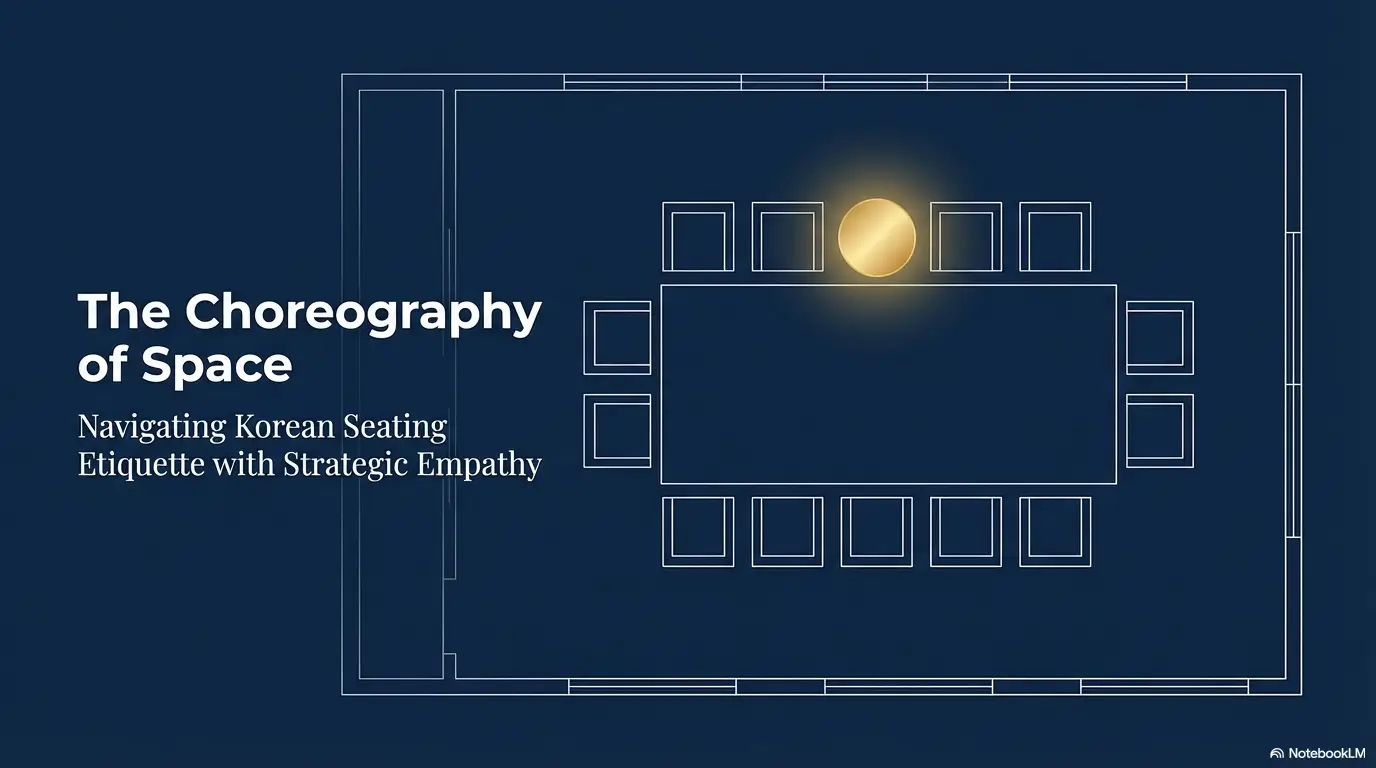
Business meetings in Korea often reveal the org chart before anyone opens the slide deck. Senior leaders may take the clearest focal seat. Guests may be placed with intention. Team members may cluster by role or reporting line. This does not mean every Korean office feels rigid. Many do not. But compared with many US meetings, there is often more sensitivity to who represents what level of authority.
Why the most senior person may sit facing the room or screen
The focal seat tends to support visibility, speaking control, and symbolic leadership. In a boardroom, that can mean the head of the table. In a smaller meeting room, it may mean the chair facing the screen or facing the doorway. Invest Korea’s business materials note Korea’s ongoing preference for face-to-face interactions and relationship-based business culture, which helps explain why physical positioning in meetings still carries weight. If you are also navigating exchange rituals in professional settings, it helps to understand how to hand business cards politely in Korea, because seating and greeting often belong to the same opening choreography.
How guests, clients, and executives are often positioned with intention
If there is a client, a senior guest, or an outside executive, seating may be arranged to show welcome and respect. Sometimes the most important dynamic is not internal rank but guest status. A junior internal employee may happily sit in a lesser seat while the visitor receives the position of honor. Hierarchy in Korea is not always about who has the biggest title in the room. It is also about hospitality.
What seat choice can accidentally imply in a business setting
Taking the focal seat too quickly can read as overconfidence, ignorance, or simple haste. None of those are fatal. But they are unhelpful. One US professional I once saw described a Korean client meeting as “surprisingly formal in a very quiet way.” That is a good description. The formality is often less theatrical than in movies. It hides in pacing, introductions, card exchange, and yes, chairs.
- Focal seats often signal authority or guest honor
- Hosts may choose practical seats instead
- When unsure, let the host place you
Apply in 60 seconds: In your next Korea-facing meeting, enter the room expecting that seating may already have a social logic.
At Family Gatherings: Affection Still Has an Order
How elders are usually centered in the social geometry of the room
Family gatherings in Korea can feel warm, busy, generous, and highly structured all at once. Elders are often placed centrally, both physically and symbolically. That could mean the most stable seat, the most visible position, or simply the spot everyone naturally orients around. A holiday meal can be full of laughter while still carrying a strong internal map of age and kinship.
Where married-in family members, younger adults, and children often end up
Younger adults may take side seats or less prominent positions. Children are often guided where convenient. Married-in relatives sometimes move carefully through the room’s hierarchy, especially in more traditional households. The exact arrangement varies by family, region, generation, and the level of formality. Still, the center of gravity usually remains clear: elders first, others following in relation to them.
Why holiday tables can feel warm and structured at the same time
This is where many outsiders get confused. In the US, warmth is often coded as informality. In Korea, warmth can be deeply compatible with form. A grandmother can press fruit into your hand with fierce tenderness and still expect the room to know where she sits. No contradiction. Just different choreography. The same tension appears during major family holidays, whether you are learning Seollal etiquette for foreigners or trying to survive the emotional weather of Chuseok etiquette in Korea.
Here’s what no one tells you: kindness does not cancel hierarchy
That sentence is worth keeping in your pocket. A Korean family can be incredibly generous to a foreign guest and still preserve the elder’s place without discussion. If you are welcomed warmly, do not mistake that warmth for a signal that hierarchy has vanished. The structure is often still there, only softened by affection.
- Private dining room with an elder present: Yes
- Holiday or family event in someone’s home: Yes
- Casual student café hangout with same-age friends: Usually less
- Client dinner or formal office meal: Yes
Neutral next step: if two or more “Yes” conditions apply, wait for seating cues instead of improvising.
The Hidden Logic: Doorways, Visibility, and Honor Seats
Why the seat far from the door may matter
Across many East Asian contexts, the seat farthest from the door can carry prestige because it feels more sheltered and more central. In Korea, that pattern appears often enough to be useful, especially in restaurants and private rooms. But do not worship the door like it is a magical compass. Layout matters. The “best” seat depends on how the room actually functions.
How room layout changes the “best” seat without changing the principle
A square table, a long conference room, a floor-seating setup, and a living room with sofas can all express hierarchy differently. What stays stable is the principle: the most respected or honored person is usually placed with intention, and others position themselves around that logic. Think less “Which exact seat is always correct?” and more “Which seat this room appears to treat as most honored?”
Why visibility, hosting, and service flow affect placement
Visibility matters because senior people are often expected to anchor the interaction. Service flow matters because hosts need access. Doorways matter because entrances create exposure and interruption. This is not decorative etiquette. It is functional symbolism. The room is being arranged for respect, efficiency, and a clear pecking order, but with nicer food.
One small anecdotal pattern is almost funny once you start seeing it: the chair with the easiest exit is not always the winner. In many US contexts, that seat feels ideal. In many Korean contexts, the “best” seat may involve being the most visibly honored, not the most tactically mobile. Chairs, it turns out, have philosophies.
Show me the nerdy details
Door-based honor patterns show up in many traditional etiquette systems because entrances symbolize vulnerability, interruption, and service traffic. Seats farther from that disruption can become markers of protection or esteem. Modern rooms soften the symbolism, but the logic often survives.
Before You Sit: The 10-Second Pause That Saves You
Look for the eldest person, the host, or the ranking guest first
If you remember one rule, remember this one. Before you sit, identify the likely senior person, the host, or the honored guest. That gives you the social north star for the room. Everything else becomes easier after that. In practice, this gets even easier when you already have a feel for how age works in Korean social situations, because many seating cues begin there.
Wait for verbal cues, hand gestures, or who begins moving
Many seating decisions are signaled nonverbally. A hand sweep. A deferential pause. A host saying “Please, here.” A cluster of younger people waiting. You do not need fluency in Korean to read these cues. You need patience. Observation is the cheapest etiquette skill you will ever learn.
When it is smarter to hover briefly than commit too fast
In the US, hovering can look awkward. In Korea, a brief respectful pause can look thoughtful. The key is keeping it short and calm. Do not freeze like a malfunctioning museum guide. Just remain pleasantly available while the room declares its logic. Ten seconds is often enough.
Let’s be honest: most etiquette mistakes happen in the first five seconds
Not after dinner starts. Not halfway through the meeting. In the opening moment. People are carrying coats, orienting themselves, reading status, deciding who goes first. That is when impatience causes the most damage. The good news is that the fix is tiny.
If you can answer “yes” to at least 2 of these 3 questions, you are probably safe to sit:
- Do you know who the senior person or honored guest is?
- Has the host gestured or spoken?
- Have one or two clearly senior people already started sitting?
Output: 0–1 yes = wait. 2–3 yes = sit calmly where indicated or in a modest seat.
Neutral next step: rehearse this checklist before a work dinner so your body does not rush ahead of your brain.
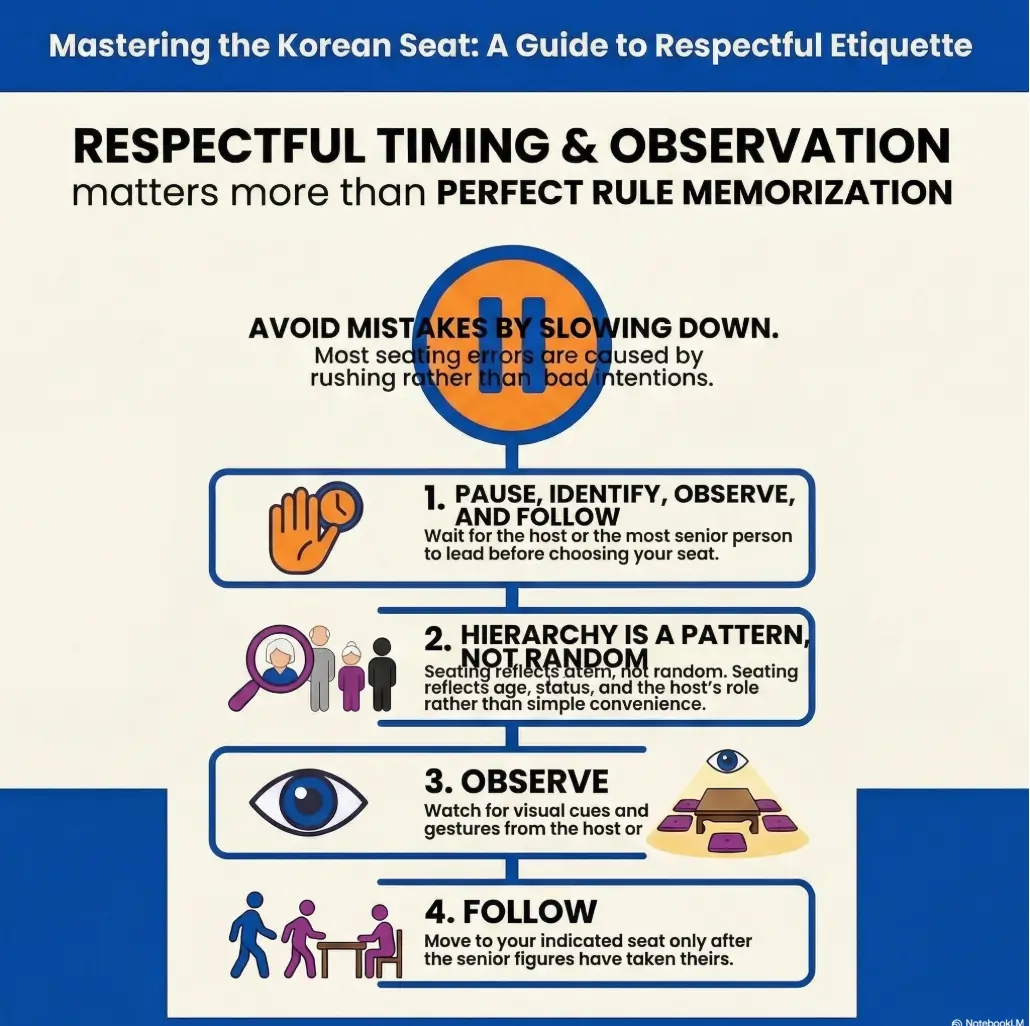
Infographic: The Korean Seating Hierarchy Quick Scan
Do not grab the nicest seat on instinct.
Find the elder, host, or ranking guest.
Watch for gestures, language, and movement.
Sit where directed, or choose a modest side seat.
Common Mistakes Americans Make With Korean Seating Hierarchy
Sitting first because the room feels informal
This is probably the most common error. The room may feel relaxed. People may smile. Shoes may already be off. None of that automatically means free-for-all seating. Informality in tone does not erase hierarchy in structure. For many visitors, this confusion overlaps with other mixed-signal moments in Korea, including personal questions that feel intrusive but are often socially normal.
Taking the center or “best-looking” seat without reading status cues
Many Americans are trained to optimize for convenience. Good view, easy exit, nice back support, closest to the screen. That logic is practical, but in Korea it can accidentally communicate self-prioritization. The seat that looks best to you may be socially reserved for someone else.
Assuming family warmth means hierarchy disappears
Family gatherings often produce the biggest misunderstandings because they look emotionally open. A foreign guest gets waved in. Food appears instantly. Everyone is kind. Then that guest sits too casually, and the room has to rebalance around them. The kindness was real. The hierarchy was also real.
Treating business seating like a US open-office coffee chat
Even modern Korean companies that speak casually and work fast may preserve status cues in meetings and dinners. If you import Silicon Valley beanbag energy into the wrong room, the mismatch can be comic in a bad way. Not tragic. Just avoidable.
Short Story: A US professional visiting Seoul for a partner dinner once walked into a private room after a long day, spotted the chair with the best view of the wall-mounted screen, and sat immediately. The room did not freeze. It did something more Korean than freezing: it adjusted politely. A colleague smiled, another moved a place card, and the host performed a graceful little rerouting maneuver that made everything look effortless.
Afterward, the visitor said the awkwardness was subtle enough that he almost missed it, which made it more useful, not less. That dinner became his permanent rule: if a Korean room looks simple, assume it may be socially more structured than it appears. Chairs are often the first test because they reveal whether you are entering the room as a consumer of convenience or as a participant in relationship.
- Warmth does not equal randomness
- The nicest-looking seat may not be yours
- A short pause prevents most errors
Apply in 60 seconds: Replace “I’ll just sit anywhere” with “I’ll read the room for five seconds first.”
Don’t Do This: Small Moves That Read Bigger Than You Think
Do not rush into the seat with the best back support or view
Yes, your spine matters. But the social cost of claiming the honored seat by accident is usually higher than the ergonomic benefit of that one excellent chair. Let the room reveal who belongs there first.
Do not separate yourself from the group unless directed
Sometimes foreign guests, trying to be polite, drift to the edge of the room or choose a faraway seat so they will not “bother anyone.” This can backfire. It may signal detachment, confusion, or refusal of hospitality. In Korean social settings, being appropriately included can be more respectful than self-exiling.
Do not force an elder or senior person to ask you to move
This is the quiet nightmare. Most people will not correct you bluntly. The host will solve it diplomatically. But making a senior person or family elder wait while the room rearranges around your seat is exactly the friction you want to avoid.
Do not overcorrect and create awkwardness by refusing every seat
There is another trap here, and it is the trap of performative humility. If the host points to a seat, take it. Do not argue. Do not insist three times that someone else should sit there unless the situation clearly requires it. Hesitation is good. Resistance is not. The art is to be adjustable, not theatrical. The same principle applies in other small Korean rituals too, including shoe etiquette inside Korean homes, where respectful adjustment matters more than dramatic self-consciousness.
- Who is oldest or highest-ranking
- Who appears to be hosting
- Which seat is farthest from the doorway or most central
- Whether place settings or folders suggest pre-arrangement
- Whether others are clearly waiting
Neutral next step: keep this list on your phone before a family dinner or office meal.
Not Every Korean Table Follows the Same Script
How modern workplaces may soften traditional rules
Younger companies, international teams, university settings, and casual gatherings often loosen traditional hierarchy. A startup lunch may feel almost entirely informal. A professor might wave everyone into random seats. A younger Korean friend group may not care at all. Flexibility is real.
Why younger Koreans may act more flexibly in casual settings
Generational change matters. Globalized workplaces matter. Friend groups matter. Urban life matters. But softened rules do not mean erased instincts. Even people who act casually with peers may switch into more traditional patterns in front of parents, clients, or senior colleagues. Context changes the temperature quickly. In the same way, a casual group chat can feel loose until suddenly everyone begins following unwritten timing rules you also see in KakaoTalk etiquette in Korea.
How restaurants, homes, and conference rooms change the etiquette texture
Restaurants tend to make the hierarchy visible because of service flow and table position. Homes can feel more fluid but still protect elder-centered seating. Conference rooms often show rank through focal placement. The same person who tells you “Anywhere is fine” in a café may become more status-aware the moment a client or older relative enters.
The rule beneath the rules: read the people, not just the furniture
This is the real principle. Do not memorize one old formula and force it onto every room. The furniture can mislead you. The people usually tell the truth. If everyone is moving loosely and the oldest person has already sat casually, the room may be truly flexible. If several people are hovering and glancing at one seat, the room is telling you exactly what matters.
Show me the nerdy details
Social rules often survive as “context triggers.” People may behave casually by default but revert to stronger hierarchy cues when age gaps widen, outsiders arrive, or hospitality obligations increase. That is why one person can seem very informal on Tuesday and highly protocol-aware on Thursday.
When You Are the Foreigner in the Room: What Actually Works
Why polite hesitation is usually safer than confident guessing
If you are the outsider in the room, you are not expected to know every nuance. What people often notice is not whether you know everything, but whether you are trying to show respect. A brief, calm pause communicates that beautifully. It says, “I am paying attention,” which is often more valuable than perfect performance.
How to accept guidance without making the moment heavy
If someone points you to a seat, smile, thank them, and sit. Do not make a whole emotional opera out of your humility. The room wants ease. Accepting help gracefully is part of good etiquette too. You are not being judged for not being born in Korea. You are being read for whether you can follow the room once it speaks. When the moment does go sideways, a little familiarity with common Korean apology phrases can help you recover with grace instead of panic.
Simple phrases and body language that buy you grace
A small gesture toward the chair and a questioning expression often work even without language. If you speak a little Korean, a gentle “Yeogi anjayo?” or “Here?” can help. So can waiting for the host’s hand signal. Soft eye contact, a small nod, and a willingness to adjust do more work than a memorized etiquette speech ever will.
Here’s the quiet trick: follow the slowest, most respectful person in the room
This is the trick I recommend most. Find the person who appears most careful with elders or guests and use them as your timing model. The fastest person in the room is often the least useful guide. The slowest respectful person is usually giving you the map.
Korea’s official tourism ecosystem also regularly presents etiquette experiences and cultural classes for visitors, which is a quiet reminder that these customs are learnable, not mystical. You do not need clairvoyance. You need attention. The larger lesson also connects to Korean indirect communication: what matters is often not the loud instruction, but the quiet cue.
- Pause before sitting
- Accept guidance quickly and lightly
- Copy the room’s most respectful rhythm
Apply in 60 seconds: Choose one phrase, one nod, and one pause you will use the next time seating feels uncertain.
FAQ
Is there always a “head of the table” in Korea?
No. Some rooms make the honored seat very obvious, while others distribute status more subtly. The principle is consistent more often than the exact furniture pattern.
Where should a guest sit at a Korean dinner?
Usually where the host indicates. If there is no guidance yet, avoid taking the most central or clearly honored seat until you see who the room is organizing around.
Do younger Koreans still follow seating hierarchy?
Often yes, but with varying intensity. Casual friend groups may be flexible, while family gatherings, work dinners, and meetings with older people often preserve stronger hierarchy cues.
What happens if I sit in the wrong seat?
Usually nothing dramatic. Someone may quietly redirect the arrangement. The social cost is typically small if you respond gracefully and adjust without defensiveness.
Are business meetings stricter than family meals?
Sometimes, but not always. Client meetings and formal business meals can be especially structured. Family settings may feel warmer, yet still maintain strong elder-centered seating.
Does the oldest person always sit first?
Not always, but the eldest or most senior person is often given the first or most honored seating cue. Waiting briefly helps you see how this specific room handles it.
Is seating hierarchy different in restaurants versus homes?
Yes. Restaurants often make status more visible because of door position and service flow. Homes can be softer in tone, but elder and host-centered patterns still matter.
Should I wait to be told where to sit in Korea?
In many situations, yes. A short pause is usually smart, especially at business meals, formal invitations, and family gatherings with elders present.
Next Step: Use the Pause-Observe-Follow Rule at Your Next Korean Gathering
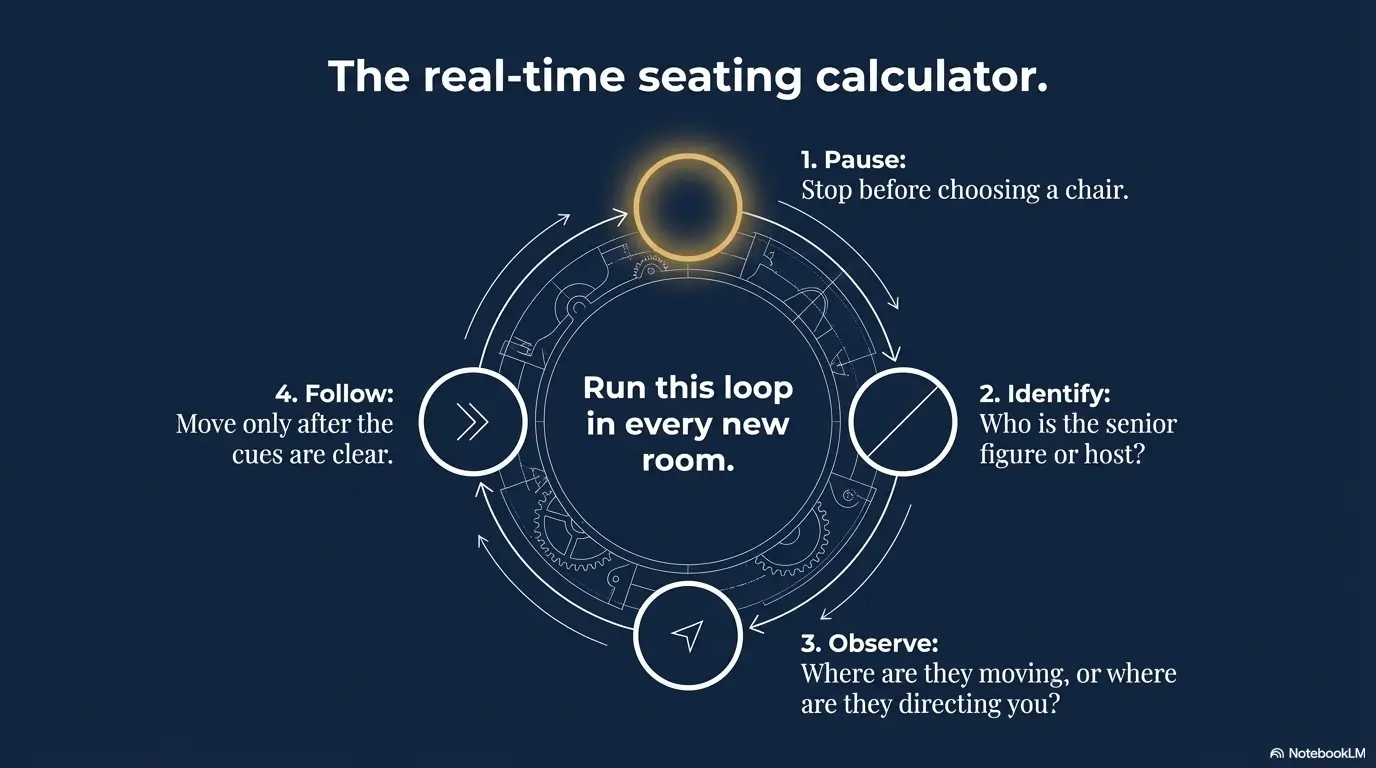
Pause for a few seconds before sitting
The hook at the beginning of this article was that the chair starts talking before anyone does. By now the answer is clear: the chair is usually speaking the language of respect, host duty, age, and role. You do not need to decode every dialect of that language. You only need one reliable operating system.
Observe who the room treats as senior, host, or honored guest
If you can spot those three forces, the rest usually falls into place. Not perfectly. Not mathematically. But well enough to move through the room without causing quiet turbulence. That is a win.
Follow the cue instead of trying to decode every rule in advance
The best practical rule is the simplest one: pause, observe, follow. Use it at dinners, office meetings, holiday tables, and family homes. It protects you from rushing, keeps you open to correction, and helps you participate respectfully instead of performing confidence you do not need.
For a quick 15-minute next step, save a note on your phone with three prompts: Who is senior? Who is hosting? Who is everyone waiting on? Ask those three questions the next time you enter a Korean room. Most of the answer will appear before anyone speaks.
Last reviewed: 2026-03.