

More Than a Meal: The Hidden Music of Korean Greetings
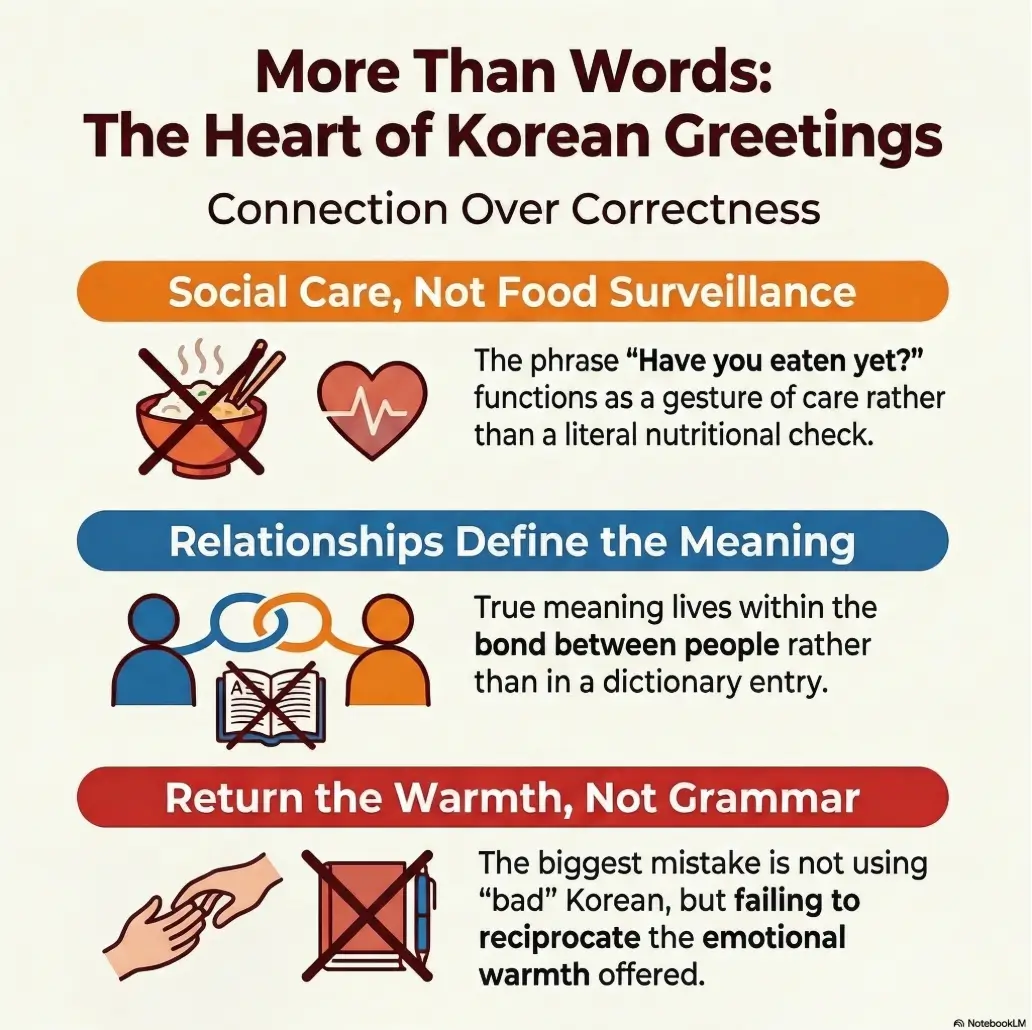
“Have you eaten yet?” can sound oddly intimate in English, almost too specific for small talk. In Korea, though, that question usually is not a food audit. It is often a soft check-in, a tiny social bridge, and sometimes a way of asking whether life is treating you gently today.
That is where many Anglo-American readers get tripped up. You understand the words, answer them literally, and still leave the moment feeling slightly off, as if you followed the grammar but missed the music.
Keep guessing, and the cost is small but real: cooler conversations, misread warmth, and missed chances to build rapport in Korean daily life. This post helps you read what “have you eaten yet?” really means, spot the difference between simple politeness and actual hospitality, and reply in a way that sounds warm rather than wooden.
Because the literal meaning is only the first layer. The social meaning is where the real story begins, and that is the part most translations leave out.
Table of Contents
Start Here First: Who This Is For / Not For
This is for you if Korean small talk feels friendly but slightly confusing
If you have ever stood there smiling while your brain translated every syllable but still missed the point, you are in exactly the right room. A lot of foreigners understand the words and still misread the social weather. That is normal. Language is not only vocabulary. It is choreography.
This is for you if someone in Korea keeps asking about meals and you suspect there is more underneath
There usually is. In many cases, the question works less like a census of your lunch and more like a soft welfare check. Not dramatic. Not heavy. Just a gentle pulse check: Are you okay? Are you taking care of yourself? Are we warm with each other today?
This is for you if you want to respond naturally without overexplaining yourself
That is the sweet spot. Most people do not need a flawless Korean sentence or a graduate seminar in East Asian pragmatics. They need one or two easy replies that sound relaxed, kind, and socially awake.
This is not for you if you are looking for a grammar-only Korean textbook breakdown
This article is about use, not just structure. Grammar matters, of course, and Korean honorifics do change how you ask about meals depending on age and status. The National Institute of Korean Language’s learner dictionary notes that Korean has developed honorific forms, and that verbs such as “to eat” shift in polite speech. If you want a fuller orientation to how Korean honorifics affect everyday interactions for foreigners, that broader framework helps. But the bigger story here is human. What matters most is not merely the sentence. It is the emotional work the sentence is doing.
- Translation alone will miss the tone
- Warmth matters more than precision
- A short reply plus a return question usually works
Apply in 60 seconds: Memorize one easy line: “Yes, I did. How about you?”
What the Question Really Means: Care First, Calories Second
Why “Have you eaten?” often works like “How are you?” in Korean social life
For many English speakers, “How are you?” is safe because it sounds general. It leaves the door half-open. “Have you eaten?” sounds oddly detailed by comparison, as if someone has skipped straight to your calendar, pantry, and digestive timeline. But in Korea, the question often lands as a familiar, low-pressure greeting. It is practical, embodied, and emotionally legible. It asks about a basic human need instead of demanding a performance of mood.
I remember first hearing it from an older woman who clearly did not need my dietary report. The tone was not investigative. It was closer to the way someone might straighten a crooked collar without making a speech. That is the energy. Small care. No trumpet section.
How food became a language of concern, warmth, and ordinary affection
Korean public cultural materials consistently describe food as central to everyday social life, not merely fuel. Official introductions to Korean food culture emphasize the shared table, the structure of a meal, and the communal logic of dishes served together. That matters because when a culture repeatedly turns meals into shared ritual, asking whether someone has eaten naturally becomes a shorthand for whether they are being looked after. You can see this logic even more clearly in customs around shared side dishes and banchan refill etiquette, where the table itself quietly teaches relationship.
Why the literal translation can mislead English-speaking readers
Literal translation makes the phrase sound narrower than it feels. English often tucks care inside mood language: “How’ve you been?” Korean can tuck care inside meal language: “Did you eat?” One sounds emotional. The other sounds practical. Underneath, both can be carrying roughly the same cargo.
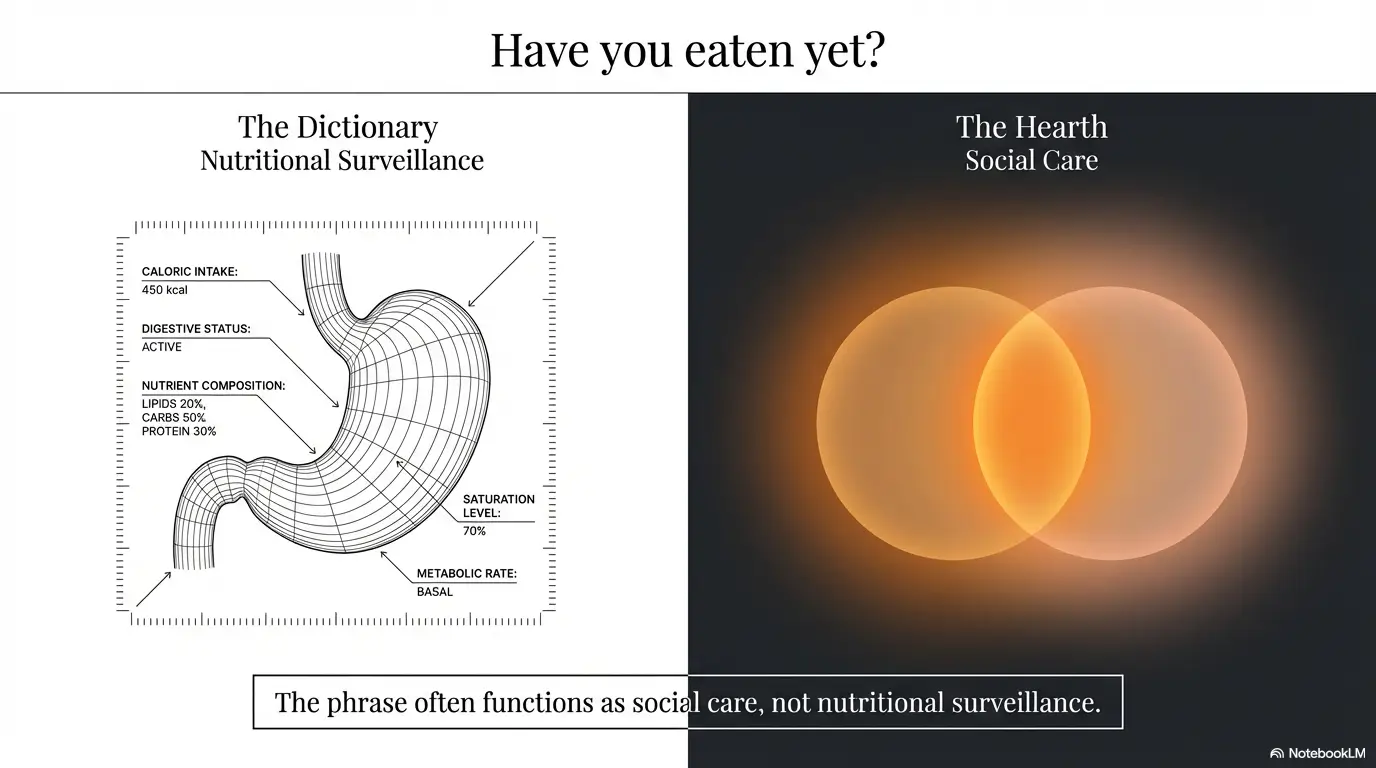
In other words: the literal sentence is about food, but the social function is often about well-being, ease, and relationship.
Show me the nerdy details
In pragmatics, the same sentence can do different jobs depending on context. “Have you eaten?” may be a literal information-seeking question, a greeting, a care signal, or an invitation prelude. Korean everyday speech leans heavily on this kind of context-based interpretation, which is why direct one-to-one English mapping often feels clumsy.
Beneath the Words: Why Meals Carry Emotional Weight in Korea
How shared meals became shorthand for stability, care, and belonging
Meals are never just calories in any culture, but in Korea they often carry unusual relational density. A meal says you were thought of. A side dish says someone planned for your presence. A repeated invitation says you are not floating at the edge of the room. Official government introductions to Korean food culture describe a dining structure built around shared dishes, rice, soup, and side dishes arranged for communal eating. That design nudges meals toward relationship almost by architecture.
When I first lived around Korean neighbors, I noticed something subtle. People rarely performed concern through abstract language first. They asked whether I had eaten. They handed over fruit. They wrapped food in containers that made refusing feel like trying to argue with weather. It was not dramatic intimacy. It was domestic gravity.
Why older generations may use food questions more instinctively than direct emotional language
Many older Koreans grew up in a social world where direct emotional disclosure was not always the default public style. Concern was often shown through action, routine, and provisioning. A younger American might ask, “Are you doing okay?” An older Korean might ask, “Did you eat?” The emotional content is often there in both. The wrapping paper is different.
How scarcity, recovery, family rhythm, and hospitality still echo in everyday speech
It would be lazy to reduce the whole phrase to one historical cause. Still, it is fair to say that societies touched by hardship often remember food with unusual moral force. Meals can become symbols of steadiness, dignity, and care. Even when modern life changes rapidly, old echoes remain. That is why the question can feel ordinary and loaded at the same time, like a plain ceramic bowl that somehow carries a family history in its glaze.
Coverage Tier Map: What the question may mean
Tier 1: Basic greeting near meal time
Tier 2: Casual care check from a friend or coworker
Tier 3: Hospitality signal from a host or elder
Tier 4: Relationship-maintenance cue showing remembered concern
Tier 5: Actual invitation or practical offer to eat
Neutral action: Listen for tone, timing, and whether they ask a follow-up.
Not Really About Lunch: When the Question Is Just a Social Doorbell
How the phrase opens conversation without demanding personal disclosure
This is one reason the phrase works so well. It opens a human channel without forcing depth. “How are you?” can accidentally corner someone into lying politely. “Did you eat?” lets them answer lightly while still receiving care. It is a conversational doorbell, not a medical intake form.
Why it can feel gentler than asking about your mood, stress, or private life
Food is personal, yes, but it is also socially shareable. You can answer quickly. You can answer warmly. You can pivot. You do not have to confess your inner weather system. That makes the question useful in families, offices, neighborhoods, and those in-between relationships where full emotional honesty would feel like arriving at brunch with a cello.
When the question is simply a soft landing, not an invitation to a full story
Foreigners often over-answer here. The Korean speaker asks a feather-light check-in, and the response arrives like a quarterly life update. You do not need to explain intermittent fasting, your delayed train, your relationship to carbohydrates, or the tragedy of airport sandwiches. A brief, warm answer is usually enough.
Try this rhythm: answer, soften, ask back.
Context Changes Everything: Same Words, Different Meanings
What it can mean when a parent, aunt, or grandparent asks
In family settings, the phrase often carries straightforward affection. It may be as routine as asking whether you slept well. It can also signal habit. Older relatives may ask because caring through food is simply what they do. If you say no, you may trigger immediate logistics. Not philosophy. Logistics. “Sit down.” “Wait here.” “There’s rice.” “Have some fruit.” The pantry becomes a personality.
What it can mean when a coworker, classmate, or neighbor asks
In these contexts, the phrase is frequently lighter. It can mean “hello,” “how’s your day,” or “we are on decent terms.” If a coworker says it in passing around noon, do not assume a lunch invitation. If a classmate asks before afternoon class, it may simply be conversational glue. If a neighbor asks while handing you a package, it is likely social warmth with no hidden agenda. This is part of a larger pattern in Korean indirect communication, where the real message often lives in tone, setting, and implication rather than in blunt wording alone.
What it can mean when someone says it in a dating or flirtation context
Now the air changes a little. In dating, meal language can carry extra attention because food is one of the easiest respectable ways to show interest without making a grand speech. “Did you eat?” may still be just kind, but it can also signal remembered care, a desire for continued contact, or a low-pressure way to move toward “Let’s get a meal sometime.” Romance often enters through side doors, not trumpets.
What timing, tone, and setting reveal that the translation hides
Same words. Different temperature. A rushed tone in the hallway is not the same as a slow text at 9:30 p.m. A host asking at your doorway is not the same as a colleague muttering it near the elevator. Tone tells you whether the phrase is ceremonial, habitual, affectionate, flirtatious, or practical.
- Family questions often carry practical care
- Workplace questions are often lighter
- Dating context can add attention and subtext
Apply in 60 seconds: Before replying, identify the setting: family, work, neighbor, or dating.
Here’s Where Foreigners Misread It Most
Mistaking warmth for nosiness
This is probably the most common trap. Americans are often trained to protect privacy by filtering personal questions quickly. So when someone asks about eating, the reflex can be, “Why is this your business?” In Korea, that reaction may miss the intention entirely. The question often belongs less to surveillance and more to social maintenance. Readers who have felt similarly caught off guard by Korean personal questions that sound more intimate than they are will recognize the same emotional puzzle here.
Answering too literally and missing the relational cue
“Yes, chicken salad at 11:47.” Technically correct. Socially tragic. Not offensive, necessarily, just a little sterile. The more natural move is to answer briefly and return some warmth. Think of it as catching a ball, not submitting a form.
Assuming every meal-related question is an actual invitation to eat together
Not every “Did you eat?” means “Let’s get lunch now.” Sometimes it is just a greeting. Sometimes it is care. Sometimes it is both. You have to read the rest of the sentence, the body language, and whether there is a concrete follow-up like “Let’s go,” “I made extra,” or “What are you doing after work?”
Treating the phrase as empty small talk when it may signal genuine care
The opposite mistake also happens. Some foreigners decide the phrase is just Korean wallpaper, a cultural script with no emotional content. But often the speaker really is checking whether you are okay in the most ordinary, non-theatrical way available. The point is not to become sentimental about every question. The point is to stop flattening it.
Good rule: Do not assume the phrase is meaningless. Do not assume it is a dinner reservation. Let context earn the interpretation.
Don’t Do This: Responses That Make the Moment Feel Colder Than It Is
Giving a flat yes-or-no answer and ending the conversation too fast
“Yes.” Full stop. It is not rude in a criminal sense. It is just a little frosty, like handing someone a teacup made of office fluorescent light. You do not need elaborate warmth. Just enough to signal that you recognized a relational gesture.
Responding defensively as if your eating habits are being inspected
If the speaker is clearly not judging you, there is no need to march out the shields. “Why?” or “I’m not hungry” in a clipped tone can create unnecessary distance. The other person may feel they have accidentally stepped on your foot in a dark room.
Overcorrecting with a long explanation about your diet, schedule, or nutrition plan
I have seen this happen in two languages and three cafeterias. The Korean speaker asks a tiny question. The foreigner produces a TED Talk. Resist. Save the biography of your meal prep containers for people who have explicitly requested that adventure.
Using sarcasm when the other person is trying to be kind
Sarcasm does not travel well across languages even on its best day. When the phrase is functioning as care, ironic replies can make the moment feel oddly sharp. Better to stay simple and warm. The same principle applies in other delicate exchanges, including everyday Korean apology phrases and their emotional weight, where tone carries more than literal wording.
Eligibility Checklist: Is your reply helping?
Yes/No: Did I answer briefly?
Yes/No: Did I sound relaxed rather than defensive?
Yes/No: Did I offer a small return question or warmener?
Yes/No: Did I avoid overexplaining?
Neutral action: If you missed two or more, shorten the reply and add “How about you?”
What to Say Instead: Natural Replies That Sound Warm, Not Wooden
Simple responses for casual situations
Here are a few easy English replies that work well:
- “Yes, I did. How about you?”
- “Not yet. You?”
- “I did, thanks. Have you?”
Notice the pattern. None of them are dramatic. None of them overperform cultural fluency. They simply receive the warmth and send a little back.
Slightly warmer replies when you want to keep the conversation going
- “Yes, I just ate. What about you?”
- “Not yet. I’m figuring out lunch now. Did you?”
- “I did, thankfully. It’s been a busy day. How about you?”
That extra half-sentence helps. It makes you sound human, not machine-translated by a nervous toaster.
Gracious replies for elders or hosts
With older people or hosts, a little extra politeness helps. You do not need to sound theatrical. Even in English, you can soften the tone:
- “Yes, thank you. Have you eaten?”
- “Not yet, but I’m okay. Thank you for asking.”
- “Yes, I did. Thank you. How about you?”
If you are replying in Korean, honorific choice matters. Learner dictionary materials from the National Institute of Korean Language note that the honorific form of “to eat” changes in polite speech, which is why beginners will hear forms like 식사하셨어요? in respectful settings rather than only casual meal language. For a fuller sense of when speech level shifts, see this guide to Korean honorifics for tourists navigating everyday situations.
Polite ways to answer when you have not eaten yet
This is the answer many foreigners overcomplicate. You can just say:
- “Not yet, but I’m okay.”
- “Not yet. I’ll eat soon.”
- “Not yet. Have you?”
These replies are honest without accidentally turning the other person into your emergency catering department.
Easy follow-up questions that return the warmth
- “How about you?”
- “Did you eat?”
- “What did you have?”
The third one is more conversational and should be used when the vibe is already easy. The first two are safe almost everywhere.
Show me the nerdy details
Casual Korean often drops particles in everyday speech, which is why learners frequently hear “밥 먹었어?” rather than a more textbook-shaped form. That does not make it sloppy. It makes it natural. Spoken language trims what context can already carry.
Let’s Be Honest… Sometimes It Is About Food
How to tell when the question is a real prelude to an invitation
Sometimes the phrase is absolutely about food. Not symbolically. Not philosophically. Literally. The clue is momentum. If the question is followed by “Let’s eat,” “I made extra,” “Come join us,” or “What do you want to have?” the social train has left the station and it is heading toward actual lunch.
Clues that someone may actually want to feed you
- They ask where you are or what time you are free
- They mention a specific dish, place, or plan
- They are a host, elder, or relative with food nearby
- They repeat the question after you say you have not eaten
- They look mildly offended by the concept of your remaining hungry
That last one sounds comic, but it is real. In some homes, “I’m fine” does not beat “Sit down, I cut fruit already.” Hospitality can move with the unstoppable force of a grandmother carrying peeled pears. The same practical warmth appears in settings like solo dining in Korea, where eating is often less emotionally isolated than many visitors expect.
When saying “not yet” may trigger practical hospitality, not just conversation
This is where foreigners sometimes panic and feel they have created inconvenience. Relax. If someone offers food after you say you have not eaten, it is often not a burden story in their mind. It is simply the next natural step in care. You are allowed to accept warmly. You are also allowed to decline politely if needed.
Decision Card: When A vs B
A. You want to keep it light: “Not yet, but I’ll eat soon. Have you?”
B. You sense a real offer coming: “Not yet. That’s kind of you, thank you.”
Time trade-off: A keeps the exchange short. B leaves room for hospitality.
Neutral action: Choose the reply that matches whether you want the conversation to open or close.
Here’s What No One Tells You… The Phrase Can Be Relational Calibration
How Koreans sometimes use meal talk to measure closeness and social temperature
This is the layer many guides skip. The phrase is not only care. It can also help people gauge warmth. Close people check in more. Warm workplaces do it more naturally than cold ones. Someone who remembers to ask may be signaling, “I am keeping the thread between us alive.” That does not make every meal question profound. It just means the phrase can quietly do relational maintenance.
Why a simple food question can signal inclusion, attention, or remembered care
When someone asks the same small question across time, it can mean you are now inside their mental map. They remembered you as a person who gets hungry, busy, tired, overworked, or alone. That may sound embarrassingly basic. It is also how care often works in real life: not as fireworks, but as repetition.
What it means when someone stops asking altogether
Not always anything dramatic. People get busy. Life tilts. But in some relationships, the absence can be felt. If someone once asked often and then does not anymore, the emotional temperature may have cooled, or the rhythm may have changed. Social warmth is sometimes measured not by grand confessions but by whether the small rituals are still alive.
That is the hidden sophistication of the phrase: it can be ordinary and meaningful at once, like a hallway light that is also a signal someone expected you home.
Short Story: The text message that was not about rice
One evening, after a week of missed schedules and thin patience, I got a short message from a Korean acquaintance I was not yet close to: “Did you eat?” That was it. No emoji. No larger speech. I stared at it longer than the sentence deserved, mostly because it arrived on a day when the world had felt all elbows. I wrote back, “Not yet. Busy day. You?” Within three minutes, a second message appeared: “Then eat something warm.”
We did not become instant best friends. No violin swelled. But the exchange changed the weather. It reminded me that some cultures place concern in the pantry instead of in the poetry. Since then, I have trusted the phrase more. Not because it is mystical, but because it is efficient in the most human way. It asks almost nothing and can still carry a surprising amount of tenderness.
Common Mistakes: The Tiny Social Missteps That Create Big Misreadings
Confusing cultural warmth with pressure
Sometimes foreigners feel pushed because the question lands repeatedly. But frequency does not always equal pressure. In many cases it equals habit. The safest reading is often: “This is how concern gets wrapped here.”
Taking translation at face value instead of reading tone and relationship
A literal translation can be a useful ladder. It is not the house. You still need tone, age difference, setting, and rhythm. Otherwise you end up interpreting a violin piece by reading only the title of the score.
Ignoring hierarchy, age, and familiarity in your response style
Korean is deeply sensitive to status, age, and relationship distance. Even if you answer in English, you can still reflect that sensitivity through tone. A breezy “Yep” to a close friend is different from a respectful “Yes, thank you” to a professor, older neighbor, or parent of a friend. Age and rank shape far more than meal talk alone, which is why guides to the Korean age system and its social ripple effects can unexpectedly improve your everyday politeness too.
Missing the chance to build rapport with one easy return question
This is the easiest upgrade in the whole article. If someone asks whether you ate, ask back. That tiny mirror often does more rapport work than perfect pronunciation ever could.
- Read tone before dictionary meaning
- Match respect level to the relationship
- Use one simple follow-up question
Apply in 60 seconds: Add “How about you?” to your default answer from now on.
If You Want to Sound More Natural: Read the Feeling, Not Just the Sentence
Why emotional intent matters more than exact wording
Beginners often hunt for the perfect formula, but natural interaction rarely rewards obsession with perfect wording alone. It rewards timing, ease, and emotional matching. If the speaker sounds kind, answer kindly. If the tone is casual, keep it light. If the speaker is older or hosting you, add a shade more respect.
How to mirror warmth without pretending to be culturally fluent
You do not need to cosplay as a local sage. In fact, overdoing it can sound stranger than being simply warm. A modest reply is better than an impressive one that feels memorized. One clean sentence, a soft tone, a return question. That is plenty.
Why a modest, kind answer usually works better than a perfect one
Language learners often assume mistakes are mostly grammatical. In social life, many mistakes are actually tonal. People forgive vocabulary errors all day long. What they remember is whether you felt closed, stiff, dismissive, or gracious. That is one reason even seemingly simple encouragements like the Korean phrase “fighting” and what it really means can feel warmer in practice than their literal translation suggests.
Mini Calculator: How warm should your reply be?
Input 1: Relationship distance: close / medium / formal
Input 2: Setting: casual / work / host-family
Input 3: Your goal: end quickly / stay friendly / open conversation
Output: The more formal the relationship and the more host-like the setting, the more your reply should include thanks and a return question.
Neutral action: Use the shortest warm answer that still matches the setting.
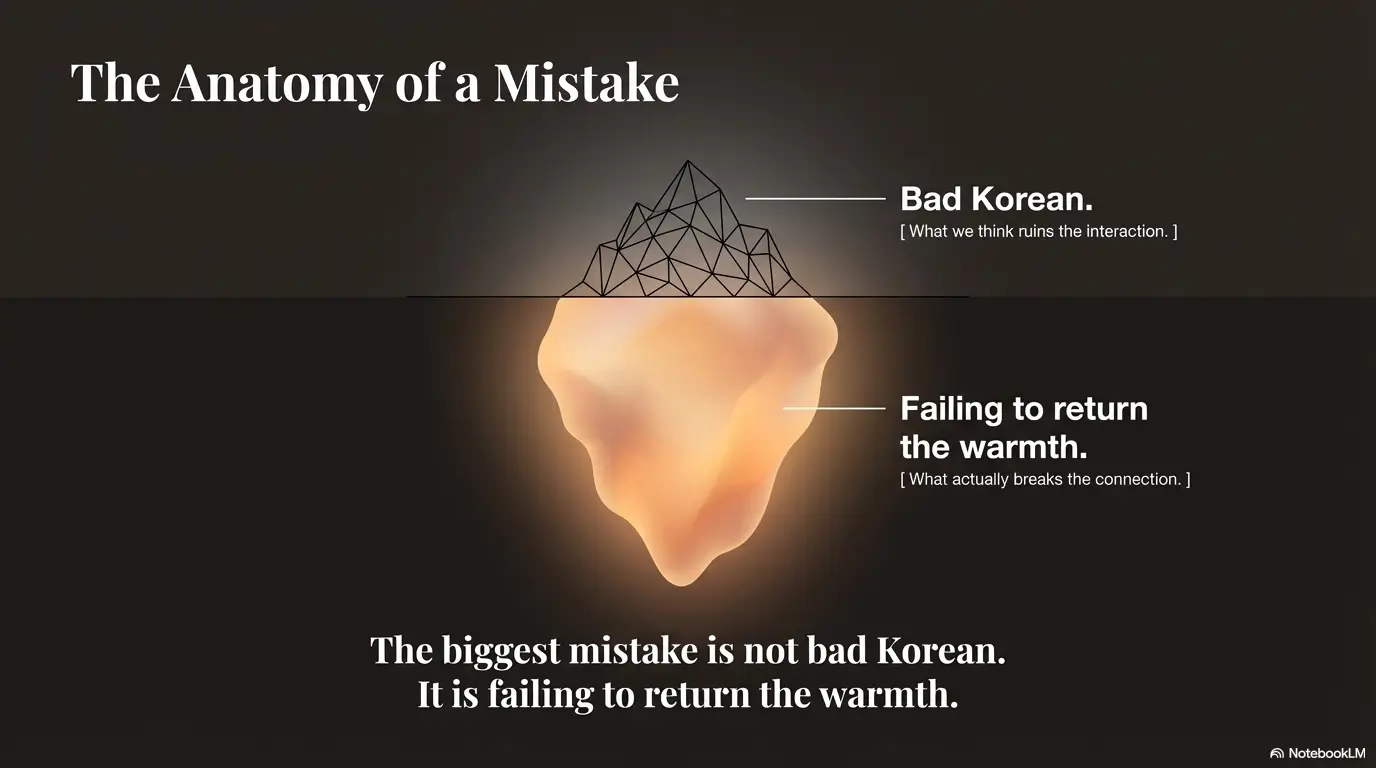
Infographic: How to decode “Have you eaten yet?” in Korea
Literal layer
Question about whether you ate.
Social layer
Greeting, check-in, or sign of ordinary care.
Context layer
Family, work, dating, and hospitality all change the meaning.
Best response
Answer briefly, sound warm, and ask back.
FAQ
Is “Have you eaten?” the Korean version of “How are you?”
Sometimes, yes. Not perfectly, but often closely enough for practical purposes. It can function as a warm check-in rather than a literal inquiry about your meal.
Are Koreans actually inviting me to a meal when they ask this?
Not always. Many times it is just a greeting or care cue. It becomes a likely invitation when the speaker follows up with a plan, a place, a dish, or an offer.
Why do older Koreans ask this question so often?
For many older Koreans, care is often expressed through routine concern, practical attention, and food-related language. Asking whether you ate may feel more natural than directly asking about emotions.
Is it rude if I say I have not eaten yet?
No. It is usually fine. Just say it gently. If the person is hosting you or older, be prepared that they may respond with actual hospitality.
What is the best polite reply in Korean or English?
In English, “Yes, I did. How about you?” works beautifully in many situations. In Korean, the best version depends on formality, but learners often hear casual forms with friends and more respectful forms with elders.
Does this question mean someone cares about me personally?
Sometimes yes, sometimes only lightly. It can range from routine social warmth to genuine personal concern. The relationship and tone tell you which one you are hearing.
Is this used in business, dating, and family settings differently?
Absolutely. In work settings it may be polite glue. In families it often carries straightforward care. In dating it can become a soft signal of remembered attention.
Why does the question sound so intimate compared with American small talk?
Because American small talk often hides care inside abstract mood language, while Korean everyday speech can hide care inside concrete daily needs like meals. One culture sounds airy. The other sounds embodied.
Next Step: Try One Warmer Reply This Week
The easiest upgrade is to answer briefly and return the care
If you remember nothing else, remember this: do not over-translate and do not under-respond. Receive the question as a small act of human regard. Then answer in the same register. That is the whole dance.
A simple formula: answer, soften, ask back
It works because it is flexible. “Yes, I did. How about you?” “Not yet, but I’m okay. Have you?” These are ordinary lines. That is their strength. Social grace is often just accuracy plus gentleness.
One concrete practice line: “Yes, I did. How about you?” or “Not yet. Have you?”
Try one this week. Use it with a classmate, neighbor, coworker, elder, or host. Watch how the moment changes. Not dramatically. Just enough. And that is often how real cultural fluency begins, not with grand mastery, but with one small phrase landing correctly in the hand.
Official tourism and cultural materials about Korea consistently point to the centrality of meals, etiquette, and relational awareness in daily life. Once you see that, the question stops sounding odd. It starts sounding elegant. A check-in you can carry in your pocket. A little bowl of language that holds more than it first appears to. It belongs to the same wider fabric as other forms of everyday etiquette, from why tipping in Korea works differently to the social care embedded in small acts at the table.
Last reviewed: 2026-03.
The curiosity loop from the opening closes here: the question is rarely just about whether food passed your lips. More often, it is a tidy, everyday way of asking whether life has held you gently enough to keep going. In the next 15 minutes, pick one reply and make it yours. That single adjustment will do more for real-world fluency than memorizing ten isolated textbook phrases ever could.