

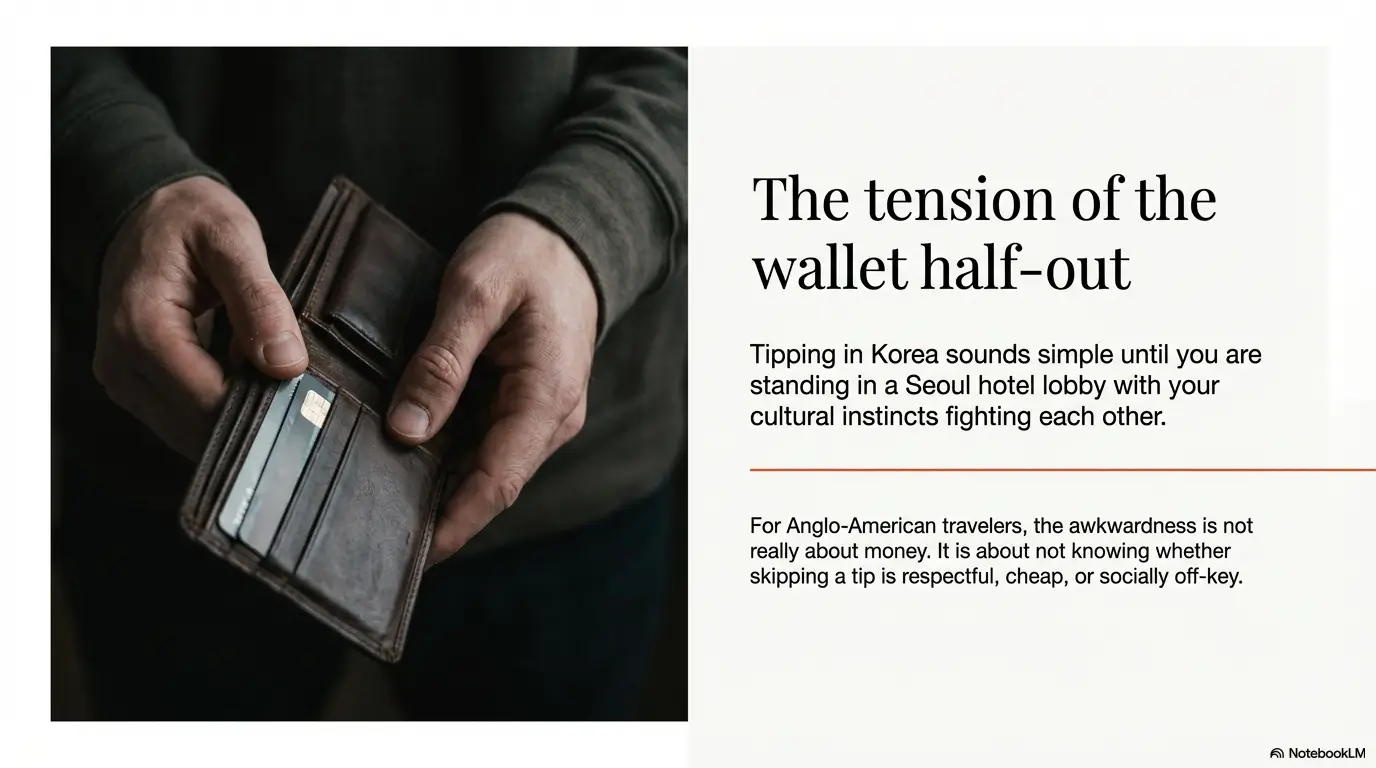
Tipping in Korea is one of those travel questions that sounds simple until you are standing in a Seoul hotel lobby with your wallet half out and your cultural instincts fighting each other. For most visitors, the safest rule is not “tip a little.” It is “don’t tip by default.”
That feels strangely difficult for Anglo-American travelers because the awkwardness is not really about money. It is about not knowing whether skipping a tip is respectful, cheap, or socially off-key in hotels, taxis, hair salons, and private tours. Keep guessing, and you risk turning an ordinary service moment into a small, unnecessary performance.
This guide helps you replace the US tipping reflex with a cleaner Korea travel etiquette rule. The goal is not to memorize dozens of exceptions; it is to understand where tipping feels awkward, where it may be quietly acceptable, and why those are not the same thing.
“Not every premium service is a tip moment. Not every accepted tip was required. And the more routine the service, the simpler the answer usually becomes.”
Contents — choose a section
Table of Contents
Fast Answer
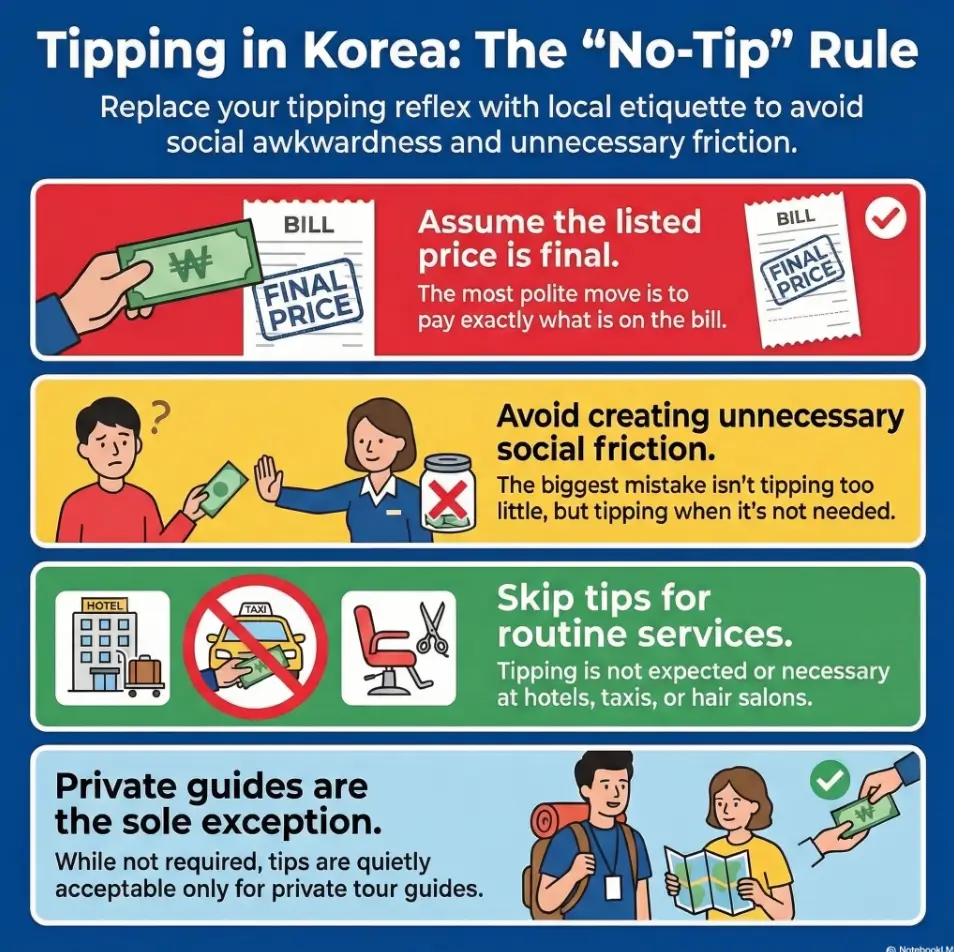
In South Korea, tipping is generally not customary. Official Seoul tourism guidance says tipping is not a Korean custom and may be accepted by some people but refused by others, while the Korea Tourism Organization’s travel basics position Korea as a tourist-friendly destination where core travel norms are built into the service structure rather than gratuity habits. For most visitors, the safest default is no tip for taxis, salons, and standard hotel interactions. The main exception is the occasional private, tourist-facing service where a small cash thank-you may be accepted naturally rather than expected.
- Taxis: usually no tip
- Hair salons: usually no tip
- Private guides: sometimes acceptable, still not mandatory
Apply in 60 seconds: Save this phrase: “I’ll assume no tip unless the service is private, exceptional, and clearly tourist-facing.”
Who this is for / not for
This is for you if you are
- A US traveler used to tipping by default
- Visiting Seoul, Busan, Jeju, or other tourist-heavy areas
- Unsure what to do in hotels, taxis, hair salons, or on private tours
- Trying to avoid a well-meant but awkward cultural miss
This is not for you if you need
- Corporate expense-policy guidance for business hospitality
- North Korea travel etiquette
- A restaurant-only tipping guide
- Legal advice about service fees or mandatory charges
I wrote this for the traveler who wants to be respectful without becoming performative. That matters more than people admit. I still remember the first time I spent a long stretch in East Asia and felt the phantom itch to leave cash everywhere, as if gratitude would evaporate unless folded into bills. It did not. A warm thank-you, a steady tone, and not making staff chase you down with rejected cash turned out to be the more elegant language.
Start here: The one-rule mindset that prevents most tipping mistakes
The safest default is this: don’t tip first.
That sounds blunt, but it prevents about 90 percent of the awkwardness. Korea’s service culture does not generally run on gratuities. Official Seoul travel guidance says tipping is not customary, and the city’s money guidance adds that service personnel usually do not expect tips, while some major hotels and upscale restaurants may already include a service charge. In other words, “good service” and “tip-worthy service” are not automatically the same category in Korea.
The easiest mental switch for Americans is this: gratitude without automatic cash. In the US, not tipping can feel like failing a moral exam. In Korea, automatic tipping can feel like reading from the wrong script entirely. Not offensive in every case, but a little out of tune, like clapping on the wrong beat at a concert hall. If you want a wider feel for how everyday courtesy works beyond money, Korea’s social rhythm often makes more sense once you understand Korean indirect communication and the way politeness is often signaled without bluntness.
Let’s be honest… if you feel rude not tipping, you are probably still using a US script. That is not a character flaw. It is muscle memory. But travel gets smoother when you stop assuming your home country’s friction points are universal.
Decision card: When “no tip” is probably right
A: The service was routine, fast, and transactional.
B: The setting is a taxi, standard hotel, chain salon, or local business.
C: You are reaching for cash mainly because “that’s what I do in America.”
If A + B are true, skip the tip and offer a clear thank-you instead.
Neutral next step: Decide before the interaction starts so you do not improvise under social pressure.
One more subtle point. Korea Tourism Organization resources consistently frame travel basics around practical systems, helplines, transportation, and tourist information centers, not around gratuity customs as a necessary add-on. That is a small but meaningful clue: the travel infrastructure assumes service is delivered as part of the price, not built on an after-the-fact percentage ritual.
Hotel tipping in Korea: awkward in some moments, quietly fine in others
Hotels are where many Americans get twitchy. You check in, someone helps with bags, someone else answers a question, and suddenly your wallet starts warming up like a nervous engine.
Here is the baseline: most hotel staff in Korea do not expect a tip. Official Seoul guidance says tipping is not customary, and Visit Seoul’s money page says it will not generally be expected by service personnel, while noting that many major hotels and upscale restaurants add a 10 percent service charge. That means the “do I owe extra?” panic is usually unnecessary.
Front desk, housekeeping, bell staff: what usually happens
A hotel’s own policy matters more than a blanket rule based on price or foreign visitors. Ask if unsure and accept a refusal without turning the exchange into a test of gratitude.
When an international luxury hotel feels different from a business hotel
This is the gray zone. In foreigner-heavy luxury hotels, staff may be familiar with global tipping habits. Familiarity, though, is not the same as expectation. A tip can feel more natural there, especially for unusually attentive service, but “not tipping” is still normal by Korean standards. The difference is mostly about acceptance, not obligation.
The difference between “accepted” and “expected”
This distinction saves people. A tip may be accepted in a high-touch luxury environment without anyone blinking, yet still not be culturally expected in the way it would be in New York or Las Vegas. Think of it as a possible courtesy, not a built-in wage supplement.
- Standard hotel stay: usually no tip
- Luxury international hotel: maybe accepted, still not expected
- Service charge may already be built in at upscale properties
Apply in 60 seconds: Check the bill or service context before reaching for cash.
Where hotel tipping gets less awkward
There are a few situations where a small thank-you can feel more natural:
- Bag help during a genuinely high-touch luxury stay
- Private concierge-style help that goes beyond routine service
- Long-stay situations where repeated help builds rapport
Here’s what no one tells you… a tip can feel more natural in a foreigner-heavy hotel than in a local mid-range property. But even there, the more Korean your environment feels, the more “no tip, warm thanks” remains the elegant default.
Taxi tipping in Korea: the cleanest answer is usually no
If you only remember one service category clearly, make it taxis. Metered rides in Korea are usually not tip moments.
This fits both the broad official “tipping is not customary” guidance from Seoul tourism and the wider Korean travel information ecosystem, which treats transport as a priced service rather than a gratuity-driven one. Card payments also make the old “keep the change” habit less relevant than it used to be. In cities where Kakao T, card readers, and exact fare systems are common, the American rounding reflex has fewer natural places to land. Travelers trying to reduce friction on arrival often find that planning basics like Korean phone plans for Americans matter more than any taxi tip decision, because connectivity solves directions, apps, and payment confusion before it starts.
Metered rides are not tip moments
Short city ride from Seoul Station to your hotel? No tip. Airport taxi with standard routing? No tip. Late-night ride home after too much fried chicken and a little too much optimism? Also no tip. The meter is the meter.
The only gray zone: rounding up
When paying cash, a tiny round-up may happen. But that is better understood as convenience, not culture. It is the difference between “I do not need these coins” and “I am participating in a local tipping norm.” Those are not the same sentence wearing different hats.
What not to do
Do not force extra money on a driver after change is returned. Do not treat refusal as shy modesty. And do not convert every short ride into a tiny etiquette seminar conducted beside a curb. The goal is smoothness, not drama.
Mini calculator: rounding or tipping?
A small leftover amount is usually convenience rounding, not a true tipping norm.
Neutral next step: Use card when possible if you want to avoid this decision entirely.
I have had taxi moments where the strongest instinct was to overcompensate for language anxiety with money. That never actually improved the exchange. A clear destination, calm tone, and being ready with payment did far more.
Hair salon tipping in Korea: where Americans most often overcorrect
Hair salons are where many Americans slip into overcorrection. The appointment feels personal. Multiple staff may shampoo, dry, or assist. The bill may be premium. Every nerve ending whispers, surely I tip here.
Usually, no. Korean salons generally price service into the bill rather than relying on US-style gratuities. That makes the listed price the real price. The luxury or prestige feel of the salon does not automatically convert the interaction into a tip-based model. Official Seoul guidance that tipping is not customary applies here too, even if some foreigner-friendly businesses are familiar with international habits.
Why multiple staff touching your appointment does not mean multiple tips
This is the exact mental trap. In a US salon, more hands can imply more invisible gratuity math. In Korea, it more often reflects workflow. One person shampoos, another assists, the lead stylist finishes, and nobody expects you to perform end-of-service arithmetic like a game-show contestant under fluorescent lighting.
How premium pricing already signals the service structure
Premium Korean salons, especially in neighborhoods known for beauty services, often charge accordingly. The bill is not a teaser trailer. It is the movie. That is one reason trying to tack on extra cash can feel out of place rather than generous. Travelers who want broader context on beauty culture sometimes confuse etiquette with aesthetics, but those are separate lanes. A style trend or the history behind Korean hair history and Korean hairstyles does not mean the service model follows US salon tipping rules.
What to do instead of tipping
- Compliment the stylist clearly and directly
- Rebook if you liked the result
- Leave a positive review on Google, Naver, or the booking platform
- Bring reference photos and communicate respectfully
Small but important… foreigner-friendly salons may understand tipping. But understanding tipping is not the same as expecting it. That distinction matters. A salon in Seoul that serves a lot of overseas clients may not be startled by a tip, yet that still does not make tipping standard.
Show me the nerdy details
Why does salon tipping feel so confusing for Americans? Because the service has three traits that trigger the US tipping reflex: high touch, visible expertise, and multiple staff interactions. In Korea, those same traits often sit inside a fixed-price system. So the emotional signal says “tip,” but the local pricing structure says “already included.” When those two systems collide, travelers mistake familiarity for obligation.
Tour guides in Korea: the one category with the most social flexibility
If hotels are gray and taxis are clear, tour guides are the category with the most genuine flexibility.
Why? Because private guiding sits closer to a personal service relationship, especially when the guide is problem-solving in real time, translating, adapting the itinerary, helping with mobility, or rescuing the day when trains, weather, or timing go crooked. In those cases, a small cash thank-you can feel more like appreciation than confusion. Even then, it is not mandatory.
Group tours vs private guides: the etiquette split
Big bus tours, packaged day tours, and standardized sightseeing products often remain no-tip by default. The experience is structured, priced, and repeatable. Private guides are different. The more custom, extended, and personal the service becomes, the more socially flexible the thank-you can feel.
When tipping a guide feels acceptable
- Full-day custom itinerary support
- Extra translation or problem-solving
- Mobility help, family coordination, or unusual patience
- Airport coordination or high-touch service beyond the booking scope
When not to force it
- If the guide hesitates or declines
- If the tour already states service charges or gratuities
- If the exchange starts feeling ceremonial instead of natural
Illustrative scenario: A traveler checks a private tour booking and learns that the agreed price includes the service. The traveler asks whether a gratuity is optional before deciding what to do. This is a constructed example, not a reported booking.
A small cash thank-you at the end felt natural, not because Korea had secretly become a tipping culture, but because the service had crossed into deeply personal territory. The guide accepted it easily. On another day, with another guide, the same gesture might have been politely refused. That is the point. This category is flexible, not formulaic. If your broader trip includes social situations beyond tours, you may notice the same pattern in other etiquette zones, from Chuseok etiquette for foreigners to everyday relationship rules shaped more by context than by rigid scripts.
- Group tour: usually no tip by default
- Private guide with extra help: small thank-you may land well
- If declined once, stop there
Apply in 60 seconds: Decide based on how customized and above-baseline the service actually was.
Before you decide on a guide thank-you, gather these 4 facts
- Was the itinerary private or shared?
- Did the guide solve problems beyond the booked scope?
- Does the booking page mention service charges or gratuities?
- Will you hand it over discreetly, without a public scene?
Neutral next step: If two or more answers are “yes,” you are in the acceptable gray zone, not the awkward one.
Awkward vs acceptable: a quick decision filter before you hand over cash
This is the section I wish more travel guides included, because what people really want is not philosophy. They want a pocket filter.
It’s probably awkward if…
- The service was routine and fully transactional
- You are in a taxi, chain salon, or standard local business
- You feel you are tipping because “Americans always do”
- You are pressing cash into the moment to fix your own discomfort
It’s probably acceptable if…
- The service was private, extended, and clearly above baseline
- The provider works regularly with international guests
- You can offer it discreetly without making the moment theatrical
- You are fully prepared for the person to decline
Infographic: The 10-second Korea tipping filter
Usually awkward
Taxi ride
Routine hotel interaction
Standard salon visit
Cash offered after a refusal
Sometimes acceptable
Private guide with extra support
High-touch luxury help
Tourist-facing service with real customization
Small, discreet thank-you that can be declined
Rule: The more routine the service, the less natural the tip. The more private and above-baseline the service, the more flexible the etiquette.
I think of this as social weather. Routine services in Korea tend to have clear skies: no tip needed. Private guide situations can get a little cloudy: not dangerous, just variable. The mistake is bringing an umbrella to every room in the house.
Common mistakes
Don’t do this: turning “thank you” into a negotiation
Pressing cash on someone after they decline is the fastest route to discomfort. Repeating “please, please” until the exchange becomes sticky does not read as extra kind. It reads as refusing to hear the social answer. In Korea, one polite refusal may be entirely sincere. This is one reason even a little language awareness helps. Knowing a few Korean apology phrases or a calm gratitude line often lands better than trying to repair uncertainty with money.
Don’t do this: assuming every premium service wants a tip
Expensive does not mean tip-based. Luxury branding is not the same as US hospitality norms. A higher bill may already reflect the service level, the location, the staff training, and the time involved. Visit Seoul’s money guidance explicitly notes that many major hotels and upscale restaurants add a 10 percent service charge, which is another reason not to pile assumption on top of price.
Don’t do this: using restaurant logic everywhere
Taxi, beauty, and tour contexts behave differently. A single “20 percent everywhere” rule is tidy in the way a suitcase balanced on one wheel is tidy. It looks stable until you touch it.
- Do not insist after a refusal
- Do not assume expensive equals tip-based
- Do not import one US rule into every Korean service setting
Apply in 60 seconds: If your thank-you is making the interaction longer and stranger, stop.
Better than a tip: how to show appreciation in ways that land well
There are forms of appreciation that travel beautifully across cultures, and they matter more than many visitors think.
Non-cash signals that work
- A warm verbal thank-you
- A respectful tone and slight bow
- A positive review on Google, Naver, or the booking platform
- Punctuality and clear communication
- Rebooking or referrals when appropriate
These are not consolation prizes. They often fit local expectations better than extra cash. Korea Tourism Organization resources highlight practical travel support tools such as the 1330 Korea Travel Helpline and official tourist information systems, which tells you something about the wider travel culture: clear communication and orderly interactions are valued. A service worker who gets a respectful customer, accurate timing, and a clean review may feel more genuinely appreciated than one forced into an awkward cash exchange. In fact, if you are trying to understand the everyday manners that make Korea feel smoother, guides on Seoul cafe etiquette or even Korean delivery etiquette reveal the same quiet principle: clarity and consideration usually matter more than performative gestures.
An honest review can describe what actually helped you. Do not claim a review will produce more business than a tip, or make praise a substitute for paying the agreed bill.
The script section: exact wording that keeps the exchange graceful
Most etiquette mistakes are not failures of morality. They are failures of scripting. So here are lines you can actually use without sounding like you swallowed a phrasebook whole.
If you decide not to tip
“Thank you, everything was great.”
“I really appreciated your help today.”
“The service was excellent.”
If you offer a small thank-you to a guide
“Thank you for taking such good care of us today.”
“This is a small token of appreciation.”
“No pressure at all, but I wanted to thank you.”
If they refuse
“Of course, thank you again.”
“I understand. I’m very grateful.”
“I really appreciated your help.”
If you want to soften your tone even more, a little awareness of Korean honorifics for tourists or the broader logic behind Korean honorifics for foreigners can help you sound respectful without becoming stiff or theatrical.
Coverage tier map: from “clearly no” to “maybe acceptable”
Tier 1: Taxi, chain café, standard local shop → no tip
Tier 2: Standard hotel desk or housekeeping → no tip
Tier 3: Luxury hotel high-touch help → maybe accepted, not expected
Tier 4: Shared or packaged tour → usually no tip by default
Tier 5: Private guide with above-baseline help → acceptable gray zone
Neutral next step: Place your situation in a tier before the service ends.
FAQ
Do you tip hotel staff in Korea?
Usually no. Most hotel staff do not expect tips, though a small thank-you may be accepted in some high-end international settings. Official Seoul tourism guidance says tipping is not customary, and the city’s money guidance says service personnel generally do not expect it.
Do you tip taxi drivers in Korea?
Usually no. The safest traveler default is no tip for regular taxi rides. If you leave a tiny leftover amount when paying cash, that is better understood as convenience rounding than as a true local tipping custom.
Is it rude to tip in Korea?
Not automatically rude, but it can feel unnecessary or awkward because tipping is not customary. Some people may accept it, while others may refuse it. That is exactly why pushing after a refusal is a bad move. Official Seoul guidance says “some people may receive it while some may refuse.”
Should Americans tip tour guides in Korea?
This is the most flexible category. It is still not mandatory, but some private guides may accept a small thank-you more naturally than taxi drivers or salon staff, especially when the service is highly personalized and above baseline. That is a social judgment call, not a fixed rule.
Do you tip hairdressers in Korea?
Usually no. Korean salons generally price service into the listed bill rather than depending on a US-style gratuity model. A direct compliment, rebooking, and a strong review usually fit better.
Can you leave the change in a Korean taxi?
You can, especially in a cash situation, but it is better understood as rounding for convenience than as formal tipping etiquette. With card payments now common, many travelers can avoid the issue entirely.
Do luxury hotels in Seoul expect tips?
Expectation is still low by Korean standards, though staff at international luxury properties may be more familiar with foreign tipping behavior. Visit Seoul also notes that many major hotels and upscale restaurants add a 10 percent service charge.
Are service charges already included in Korea?
In many Korean service settings, travelers are not expected to add gratuity. Visit Seoul specifically notes that many major hotels and upscale restaurants add a 10 percent service charge, which is another reason routine extra tipping is often unnecessary.
What is better than tipping in Korea?
A sincere thank-you, respectful behavior, punctuality, and a positive review often fit local expectations better than extra cash. Those forms of appreciation tend to land cleanly across almost every service setting.
Separate a tip from a fee already on the bill
When a tour, hotel or other service mentions a gratuity or service charge, read the booking terms and ask what is already included. An optional tip, a compulsory charge and an unpaid balance are different things. Do not assume a foreign platform’s default tipping screen establishes the local employee’s expectation. If you wish to offer something extra, ask discreetly whether it can be accepted and respect a refusal without insisting.
A reader question: How can I show appreciation without leaving cash?
A direct thank-you, a factual positive review or recognition through the business’s feedback channel can express appreciation. Follow the recipient’s preference and the service’s policy.
Final word: save this rule before your flight
So here is the curiosity loop from the beginning, closed without fuss: the real skill is not memorizing one universal Korea tipping rule. It is learning which moments are routine and which are genuinely above baseline. In Korea, most service moments are routine in the best sense of the word. Efficient. Competent. Already priced. Already complete.
That is why the one sentence worth saving to your phone is this: “In Korea, I will assume no tip unless the service is private, exceptional, and clearly tourist-facing.”
If you do one practical thing in the next 15 minutes, make it this: paste that sentence into your notes app, then add three tags under it: taxi = no, salon = no, private guide = maybe. Travel gets easier when the rule is settled before the moment arrives. And if your trip includes other quietly tricky social moments, it helps to build the same kind of pocket rules for things like noraebang etiquette or how to refuse alcohol in Korea, where confidence comes less from memorizing everything than from understanding the mood of the room.
Last reviewed: 2026-03.
Practical example and reader question added October 20, 2026. Existing source dates are retained; this addition is not a fresh verification of every earlier claim.