

Seollal etiquette can make an ordinary doorway feel strangely ceremonial. One minute you are carrying fruit, straightening your sleeves, and practicing “새해 복 많이 받으세요” under your breath. The next, you are trying to remember who to greet first, whether a standing bow is enough, and why someone has asked your age before you have even found the tea.
For many Anglo-American readers, the stress is not simply “getting it right.” It is not knowing which details matter most, which customs are flexible, and which tiny gestures quietly shape the room. Keep guessing, and a warm family visit can start to feel like a social obstacle course built from hierarchy, timing, sebae, gift money, and age questions.
This guide helps you handle Seollal etiquette with calm, readable confidence. You will learn what to say, how to bow without overperforming, when sebaetdon makes sense, and how to answer age-related conversations without sounding rude, stiff, or defensive.
The approach here is practical, not theatrical.
Real-room useful.
Respect first, perfection never.
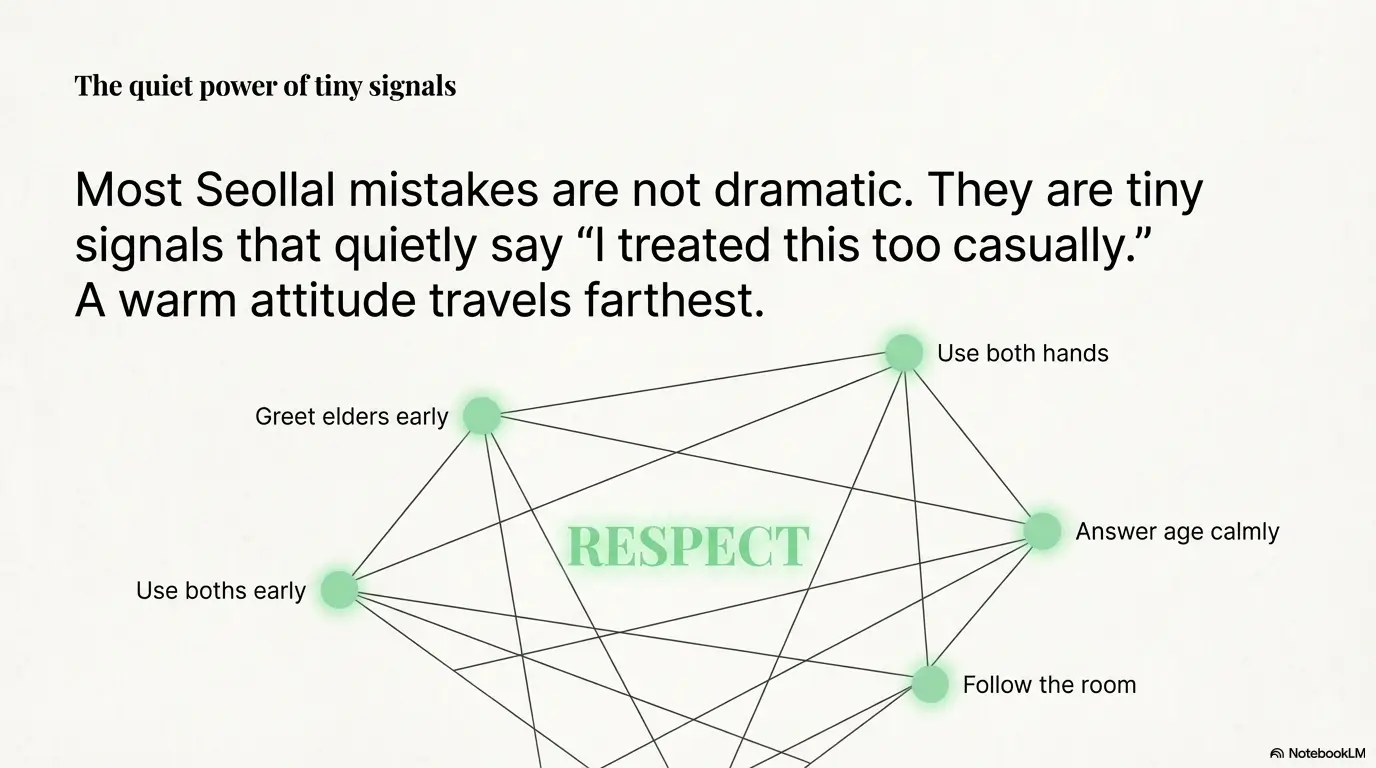
Because most Seollal mistakes are not dramatic. They are small, preventable, and easy to fix once you know where to look.
Contents — choose a section
Table of Contents
Why Seollal Feels High-Stakes Fast
Why one holiday can suddenly feel like a social exam
Seollal has a way of turning ordinary humans into self-conscious furniture. You walk in planning to smile, say hello, and not spill soup. Then someone lowers their voice, an elder enters, shoes line up by the door like a row of moral witnesses, and suddenly your hands feel too empty or too full. That rising pressure is not imaginary. Seollal often carries family memory, hierarchy, gratitude, and habit all at once.
For many visitors from the United States, the confusing part is not that the gathering feels formal. It is that it feels formal and affectionate at the same time. People may feed you, ask whether you are eating enough, worry about the cold, and then still expect you to greet elders before you sit down. Warmth and structure live in the same house here.
What US visitors often misread about Korean family warmth and formality
A common mistake is assuming that kindness cancels etiquette. It does not. In many families, kindness is the atmosphere and etiquette is the choreography. One does not replace the other. A host can be generous and still notice whether you offered something with one hand. An aunt can laugh easily and still expect that grandparents are greeted first.
A welcoming family may still have a planned order for greetings, meals or ceremonies. Ask the host what applies to this visit instead of assuming either strict formality or complete informality.
The hidden tension: respect, hierarchy, and not wanting to offend
What makes Seollal feel delicate is that many actions are interpreted relationally. Who greets first. Who bows. Who receives money. Who pours. Who sits where. None of these details exist in a vacuum. They answer a quiet question: Do you understand what kind of room this is?
Korea Tourism Organization describes Seollal as one of Korea’s most celebrated holidays and notes that it centers on paying respect to ancestors and gathering with family, which helps explain why small gestures can feel more loaded than they would at an ordinary lunch.
- Friendly does not mean casual
- Respect is often shown through timing
- Observation matters before participation
Apply in 60 seconds: Before entering, decide who you will greet first and how you will hold your hands when offering or receiving something.
Who This Is For / Not For
This is for US visitors, expats, spouses, students, coworkers, and multicultural families
This guide is for the person who wants to be decent, not dazzling. It is for the American spouse visiting Korean in-laws for the first time. The exchange student invited by a host family. The expat boyfriend trying not to freestyle his way into a social pothole. The multicultural family member who has heard three different versions of “what we usually do” and would like one grounded map.
This is for people attending family Seollal gatherings for the first time
First-time gatherings are where tiny uncertainties become oversized. Do I bow? Do I speak first? Do I bring an envelope? Why did everyone suddenly ask my age before asking what I do? This article is built for that exact moment, when your social battery is fine but your cultural battery is blinking red.
This is not for legal immigration advice, formal religious instruction, or region-specific ceremonial disputes
It is also worth saying what this is not. This is not legal advice, a theological ruling, or a final answer to every family’s ceremonial preferences. Some homes are highly traditional. Others are light-touch and modern. Some include ancestral rites. Some simplify them. Some families treat foreign guests gently; some fold you in quickly because you are already considered family. Real life is more varied than the internet’s loudest auntie.
- Yes: You want practical behavior guidance for a real Seollal gathering
- Yes: You are worried about greetings, bows, gifts, or age questions
- No: You need legal interpretation or a family-specific ceremonial ruling
Neutral next action: use this guide to build a first-minute plan, then confirm any family-specific expectations with your host.
New Year Greetings First: What to Say Before You Overthink It
The safest Seollal greetings for elders, peers, and hosts
The safest phrase for most situations is simple: 새해 복 많이 받으세요. It means, broadly, “Please receive lots of New Year blessings.” If your pronunciation is imperfect but your tone is gentle, you are already doing well. This is not opera. Nobody is scoring your vowels with a tuning fork.
For elders, pair the phrase with a slightly slower delivery, eye contact, and respectful posture. For peers, a lighter tone is fine. For hosts, gratitude helps: “초대해 주셔서 감사합니다” if you can say it, or “Thank you for having me” with a small bow if your Korean is limited.
When to say “새해 복 많이 받으세요” and when tone matters more than perfection
Say it early. That matters more than saying it elaborately. If you wait too long because you are crafting the perfect line in your head, someone else will have entered, sat down, and poured tea while you are still mentally conjugating. Better to offer a sincere short greeting than arrive as a polite delay.
Constructed example: A visitor worries about delivering a long Korean greeting perfectly. A short greeting and a question about what to do next can make the interaction clearer and less demanding.
English-friendly options when your Korean is limited
If your Korean is limited, these work well:
- “Happy New Year. Thank you for having me.”
- “새해 복 많이 받으세요. 만나서 반갑습니다.”
- “It’s my first Seollal. I’m grateful to be here.”
Let’s be honest… a sincere short greeting beats a memorized speech delivered stiffly
The point of the greeting is not to showcase your language ambition. It is to enter the room in the right spirit. A brief greeting with good posture, a soft voice, and both hands visible often lands better than a long speech delivered like a hostage video.
Show me the nerdy details
In etiquette-heavy settings, people often evaluate a greeting by sequence, tone, and body language before lexical perfection. That is why short Korean or even respectful English can succeed when paired with early timing and an appropriate bow.
Sebae Bowing Without Panic
What sebae is and why it carries emotional weight
Sebae is the formal New Year bow, traditionally offered to elders as a sign of respect and a wish for blessings in the new year. It carries emotional weight because it is not just a movement. It is a compressed message: respect, gratitude, continuity, family. That is why people remember the feeling of it even when they forget the exact angle of someone’s elbows.
The National Folk Museum of Korea explains that Seollal is tied to traditional rites and seasonal customs, and in practice that means gestures are rarely “just gestures” inside older or more tradition-minded families. If you want a broader primer on the physical grammar behind respectful greetings, this guide to Korean bowing etiquette and jeol gives helpful extra context.
Who usually performs sebae and in what order
Children commonly perform sebae to elders. In many homes, younger family members do it first, then greetings and blessings follow, sometimes with gift money for children. Adults may also bow, especially in more traditional families or when meeting senior relatives. In modern households, the ritual may be simplified, replaced with a smaller bow, or handled more casually.
Your best move is not to guess heroically. It is to watch the first one or two interactions if possible, then follow the household’s version. Tradition is real. Variation is also real.
How deep the bow should be in practical real-life settings
If the family is doing formal sebae, follow their lead. If not, a respectful standing bow is often enough for guests or non-Korean family members. Deep sincerity beats theatrical overcorrection. You do not need to fold yourself into ornamental origami.
What to do if you physically cannot bow fully
If you have mobility limits, injury, pregnancy-related discomfort, back pain, or another physical reason, do not force a full bow. Offer a smaller bow and a warm verbal greeting. Most reasonable families care more about your attitude than your spinal ambition. A quiet explanation through your spouse, host, or a simple “My back is not great, but I wanted to greet you properly” goes a long way.
Here’s what no one tells you… most families notice effort and attitude before technical precision
This is one of the kindest truths about Seollal. People often notice whether you tried, whether you seemed respectful, whether you were willing to follow the room. Technical perfection matters less than internet folklore suggests, especially for foreigners and first-time participants.
- Watch the family’s version first
- Use a smaller bow if needed
- Warm effort usually outranks flawless form
Apply in 60 seconds: Ask your host privately, “Would you like me to do a full sebae or a respectful standing bow?”
Illustrative scenario, not a reported event: Before Seollal, a guest asks the partner’s family about greetings, bowing and gifts. The host explains which activities are optional, and the guest states a need for a standing greeting. Planning replaces a guessed rulebook.
The room relaxed in one breath. What saved him was not perfect technique. It was visible respect, no defensiveness, and the willingness to be a little embarrassed without turning brittle. That is the hidden etiquette skill many people miss: let the moment be human. A family gathering is not a museum reenactment. It is a living room with memory in it.
Gift Money Culture: When It Is Given, Expected, or Misread
What sebaetdon means in family settings
Sebaetdon is New Year gift money, often given after sebae, especially to children. In some families, unmarried younger adults may also receive it. In others, once you are married, employed, or clearly a grown-up who owns at least one pan on purpose, the flow reverses. Context matters.
Who usually gives gift money and who usually receives it
Traditionally, elders give to younger family members. But modern practice varies. Some families keep it for children only. Some extend it to students. Some skip money altogether and focus on meals, gifts, or simply gathering. The awkwardness usually begins when guests assume money is expected like a holiday ticket. It is not.
How children, unmarried adults, and married adults may be treated differently
Marital status, age, and family custom can all shape who gives and who receives. This is one reason Seollal can feel like a social spreadsheet that nobody emailed you in advance. An unmarried adult in one family may receive an envelope with affection. In another, that same adult may be expected to bring fruit, dessert, or a small host gift instead. Neither household is the universal rule.
When a small envelope is welcome and when it can feel awkward
If you are a foreign guest or partner meeting the family, do not assume that bringing cash envelopes is automatically correct. Often a thoughtful host gift is safer than trying to reverse-engineer the family’s money ritual. Gift money can be lovely inside an existing family pattern. Outside that pattern, it can land with a little social skid. Readers who want a parallel example of how cash etiquette changes by event can also compare it with Korean wedding cash gift etiquette, where the relationship and occasion shape what feels appropriate.
Cash, envelope, both hands: the tiny details that change the moment
If you do give or receive money, use a clean envelope when possible and offer or receive it with both hands. That tiny detail changes the emotional texture of the exchange. One hand can read as casual. Two hands read as attentive. Etiquette often lives in the wrist.
| Situation | Safer move | Why |
|---|---|---|
| First visit as guest | Bring a host gift | Less risk of misreading family money customs |
| You already know children receive sebaetdon | Ask your spouse or host what is normal | Confirms amount and who participates |
| You receive an envelope | Accept with both hands and thanks | Shows respect, not entitlement |
Neutral next action: ask one family insider whether money is part of this household’s Seollal rhythm.
Age Questions Arrive Early: Why Koreans Ask So Soon
Why “How old are you?” is often social calibration, not intrusion
To many Americans, asking age early can feel abrupt, especially if it appears before the gentler Western sequence of hobbies, weather, and lightly fictional enthusiasm about parking. In Korea, the question often works as social calibration. People are trying to locate the right speech level, title, and relational posture. It can feel personal. It is often functional first.
How age shapes language level, titles, and seating dynamics
Age may affect how someone addresses you, how deferential their language becomes, or how they place you in the relational map of the room. Even when the gathering is relaxed, that mental map still operates in the background. The question is often less “Tell me your private life” and more “Help me not misstep.”
The difference between curiosity, hierarchy, and conversational efficiency
Of course, real life is messy. Sometimes the question is practical. Sometimes it is habitual. Sometimes it is a little nosy. Human beings remain gloriously consistent across cultures in their ability to mix usefulness with curiosity. But it helps to assume the kindest plausible meaning first. That alone can lower your stress level by about 30 percent.
When the question is practical and when it starts to feel too personal
If the room keeps pushing beyond age into marriage pressure, income, children, or body commentary, the tone can shift from social calibration to something more intrusive. That happens in every culture, just with different wallpaper. The key is responding without escalating the room unless you truly need to.
Korea’s Ministry of Government Legislation explains the legal age standard introduced in 2023. That does not mean every age-related rule or social conversation uses the same convention. For official purposes, check the applicable rule and required birth-date information; for a family greeting, you may ask which convention the speaker means or decline to share your exact age.
- It may shape speech level and titles
- It is often asked for speed, not drama
- You can answer briefly without overexplaining
Apply in 60 seconds: Prepare one direct age answer and one soft deflection before you arrive.
Answering Age Questions Gracefully
Simple direct responses that sound calm, not defensive
The easiest answer is the calm one. “I’m 31.” “I was born in 1994.” “I’m in my early thirties.” Delivered with a small smile, these answers usually let the room sort itself out and move on. The trouble starts when people answer as though they are contesting a parking ticket.
Direct is often easier than clever. Clever tends to travel badly across generations, languages, and holiday stress.
Soft deflection phrases when you do not want to give an exact age
If you prefer not to answer exactly, try a soft edge instead of a hard wall:
- “I’m around the same age as your son.”
- “I’m in my thirties.”
- “I always get nervous with age math, but I’m in my early forties.”
- “I’m a little shy about numbers, but I’m not very young anymore.”
These responses work because they offer enough information to keep the room socially functional without opening every drawer in your private life.
How to answer if Korean age customs confuse the conversation
If someone starts using a Korean-age framework or you sense confusion, keep it light: “I’m 29 by international age,” or “I was born in 1997, if that’s easier.” Birth year often solves the problem elegantly because it lets the other person do the cultural conversion in their own head. Never underestimate the power of outsourcing arithmetic.
What to say when you are older than expected or younger than assumed
If someone reacts with surprise, do not overreact in return. A smile and “I get that a lot” or “Yes, people guess both ways” keeps the moment soft. You do not need to defend your face like a dissertation.
How to keep the mood warm after answering
After the age answer, redirect gently:
- “And how about you?”
- “Is Seollal always this lively in your family?”
- “I’m still learning everyone’s names, but I’m happy to be here.”
If you expect broader personal questions beyond age, it helps to review some Korean personal questions etiquette in advance, because the logic behind those conversations often overlaps.
Show me the nerdy details
A good age response does three jobs at once: it gives enough information for relational positioning, avoids visible irritation, and offers an easy conversational bridge so the room can move on without friction.
Input 1: exact answer or age range
Input 2: warm tone phrase such as “I’m happy to be here”
Input 3: redirect question
Output: “I’m in my early thirties. I’m still learning, but I’m happy to be here. Is your family always together for Seollal?”
Neutral next action: write your own version in one sentence and rehearse it once.
Don’t Step in This: Common Seollal Mistakes Foreigners Make
Treating the event like a casual brunch instead of a family rite
This is the largest category of preventable pain. Seollal may include laughter, children, snacks, and television in the background, but it is still a meaningful family holiday. Showing up with an energy of “fun little cultural content moment” can make you look unserious even if you are well-intentioned.
Waiting too long to greet elders
If you are introduced to elders and drift into side conversation first, the delay can read poorly. Greet early, then relax. Front-load respect. It makes the rest of the visit easier.
Offering one-handed gifts, drinks, or envelopes
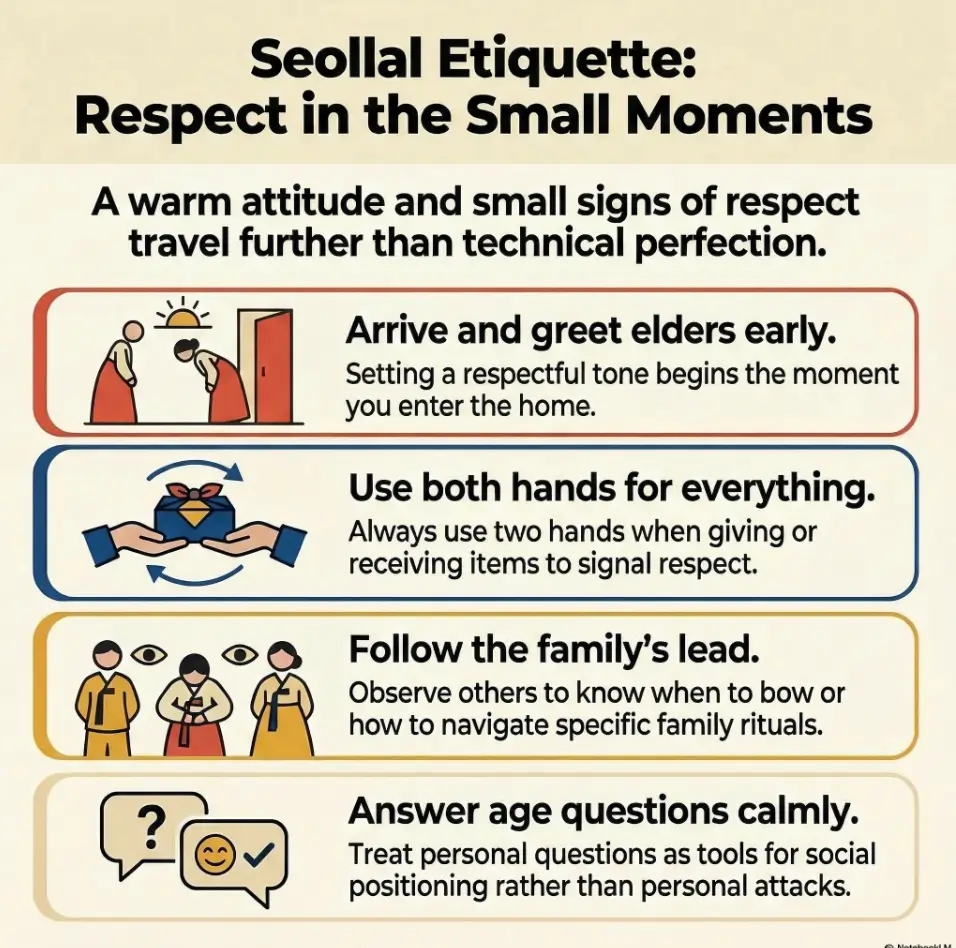
One-handed exchanges are a classic unforced error. Use both hands when giving or receiving gifts, drinks, or envelopes, especially with elders. It takes no extra money, no language skill, and almost no time. Yet it changes the entire feeling of the moment.
Over-joking about age, marriage, salary, or family pressure
Holiday humor is a slippery hallway. Self-aware jokes can work among peers. Sarcasm about marriage pressure, salary, children, or “So when are you giving me money?” can land badly with older relatives. Keep your comedy small and kind. You are aiming for warmth, not a Netflix special.
Dressing too casually because “it’s just family”
In many places, “just family” means sweatpants and a damaged T-shirt that has seen history. At Seollal, safer clothing is neat, modest, and intentional. You do not need full hanbok unless the family expects it or invites it. You do need to look like you understood the day had a spine.
- Greet elders first
- Use both hands
- Dress one level neater than your instinct says
Apply in 60 seconds: Check your outfit, your first greeting line, and whether you can receive an envelope or drink with both hands.
Don’t Force Modern Answers Into Traditional Moments
Why debating the custom in the middle of the gathering rarely ends well
You may have thoughtful views on hierarchy, age culture, gender roles, or how your own family does holidays. Keep them. Treasure them. But Seollal dinner is usually not the best arena for converting a room full of elders to your philosophy of relational modernity. Mid-gathering debates tend to produce heat without light.
When “In America we usually…” helps and when it hardens the room
Comparisons can be useful when they build understanding. They fail when they sound like correction. “In America we usually do X” can be read as informative, defensive, or dismissive depending on tone. If you use it, make it light and curious, not superior. A sentence can wear shoes or stomp. Choose the shoes.
How to stay authentic without sounding dismissive
You do not need to impersonate a different personality. You can be sincere, slightly awkward, and honest. “I’m still learning, so please forgive me if I do this clumsily” is often more powerful than pretending complete fluency with customs you met three days ago.
The quiet skill of respectful observation before participation
Observation is underrated because it looks passive. It is not. In unfamiliar social settings, observation is a form of respect and intelligence. Watch who rises first. Watch how gifts are handed over. Watch whether younger relatives sit before or after elders are settled. Rooms teach, if you stop trying to lead them immediately.
I think of this as chair wisdom. Before you become a voice in the room, become a pair of eyes. It saves everyone trouble.
Family Scripts That Save You Social Energy
The safest first five lines when entering a Seollal gathering
When nerves rise, scripts save energy. Here are strong first lines:
- “새해 복 많이 받으세요. 초대해 주셔서 감사합니다.”
- “Happy New Year. Thank you for welcoming me.”
- “It’s my first Seollal, so I’m still learning, but I’m very glad to be here.”
- “Please let me know if there is anything I should do.”
- “The food smells wonderful. Thank you for preparing all this.”
A polite mini-script for greeting grandparents or older relatives
“새해 복 많이 받으세요. 뵙게 되어 반갑습니다.” Pair that with a bow suited to the family setting. If you are speaking English: “Happy New Year. It’s really nice to meet you. Thank you for having me.” Slow is better than clever.
A practical script for receiving gift money or gifts
Accept with both hands and say thank you. If using Korean, “감사합니다” is enough. If you want a fuller line: “감사합니다. 잘 받겠습니다.” Do not open the envelope theatrically unless the family clearly does that in front of everyone.
A script for age questions you want to answer briefly
“I’m 33.” “I was born in 1992.” “I’m in my thirties.” Then bridge out: “I’m still learning everyone’s titles, though.” That little turn often earns a smile because it shows cultural awareness without making a scene. If titles and speech levels still feel slippery, a quick read on Korean honorifics for foreigners can make this section much easier to live out.
A script for spouses, partners, and in-laws meeting family circles
“Thank you for welcoming me. I’ve heard so much about your family.” That line works because it centers the family, not your nerves. It is the social equivalent of laying down a soft rug before entering the room.
- The names or titles of the eldest relatives you will meet
- Whether a full sebae is expected, optional, or not done
- Whether a host gift is more appropriate than money
- Your exact age-answer script or birth-year response
- Any physical limitation that may affect bowing or seating
Neutral next action: text your host these questions before the visit, not at the doorway.
When the Room Changes: Modern, Mixed, and International Seollal
How younger urban families may do a lighter version of tradition
Not every Seollal gathering looks like a period drama with impeccable hanbok folds and a philosopher-grandfather in the corner. Many younger urban families keep the spirit of respect while simplifying the form. They may do a short greeting instead of a full sequence of bows, skip stricter ritual elements, or gather around a regular dining table instead of staging the day formally.
What changes in intercultural marriages and bilingual households
Intercultural families often create a braided version of the holiday. Korean greetings may appear alongside English explanations. One partner may coach the other quietly before entering. Children may bounce between languages with the unbothered confidence of tiny diplomats. In those households, sincerity and flexibility often matter even more than formal precision.
When tables, chairs, or simplified bows replace stricter form
Modern life also changes the body language of tradition. Older relatives may prefer chairs. Families with injuries or accessibility needs may simplify bows. Some homes prioritize comfort without feeling that respect has evaporated. That is not “doing it wrong.” It is culture breathing.
How to read the family’s real standard instead of the internet’s loudest version
The internet tends to reward absolutes. Real households tend to reward adaptation. Your task is not to serve the loudest comment section. It is to serve the actual room you are in. Ask the insider. Watch the first ten minutes. Follow the family’s real standard. If you are also navigating other major Korean family holidays, this comparison with Chuseok etiquette for foreigners helps show what stays constant and what shifts by occasion.
Official travel and culture pages in Korea continue to present Seollal as a major family-centered holiday with both traditional customs and modern public celebrations, which matches what many visitors notice in practice: the holiday remains important, but the form varies by family and setting.
Greet elders early. Keep your tone soft and your posture attentive.
Watch whether bows are formal, light, or simplified.
For gifts, drinks, and envelopes, both hands send respect.
Direct, brief, warm. Then redirect gently.
Common Mistakes
Mistaking friendliness for informality
A family can be warm and still expect structure. Do not confuse affection with a lack of expectation. This single misread causes a surprising amount of avoidable awkwardness.
Assuming every Korean family follows the same rules
There is no single Korean family operating manual. Some households are traditional. Some are modern. Some are mixed. Some are exhausted and just trying to get everyone fed before the rice cakes stage a rebellion.
Thinking perfect Korean matters more than respectful body language
Language matters. Body language often matters first. A clumsy phrase with good posture can win more goodwill than polished words delivered with careless timing.
Forgetting that gift-giving, receiving, and pouring are also etiquette moments
People often focus so hard on greetings and bows that they forget the ordinary moments also communicate respect. How you pass a plate, accept tea, or receive a small gift can shape the whole impression.
Answering age questions with visible irritation
Even if the question catches you off guard, visible annoyance tends to make the room feel colder than the question itself. A brief answer or soft deflection preserves your dignity while protecting the atmosphere.
FAQ
What should I say on Seollal if I speak very little Korean?
The safest phrase is 새해 복 많이 받으세요. If that feels like a mouthful, say it slowly and add “Thank you for having me.” A sincere short greeting is better than a long memorized speech delivered stiffly.
Do foreigners need to do sebae?
Not always. Some families will appreciate a respectful standing bow. Others may invite a fuller sebae. The safest move is to ask your host privately what their family expects and follow that version.
Is sebae only for children?
No. Children are the most common participants, but adults may also bow to elders in more traditional families or in specific family settings. Practice varies widely.
Do I need to bring gift money to a Seollal family gathering?
Usually, not by default. A host gift is often safer for first-time guests. Gift money tends to work best when it is already part of that family’s established pattern.
How much money is appropriate if I give an envelope?
There is no universal amount that fits every family, age group, or relationship. Ask a family insider. The correct amount is the one that fits the household’s norm, not a number copied from a random thread online.
Is it rude to refuse gift money?
A gentle first refusal may happen in some families, but outright refusal can also create awkwardness. If an elder clearly intends to give it, receiving with both hands and gratitude is often the smoother choice.
Why do Koreans ask age so quickly during Seollal?
Often because age helps people choose titles, speech level, and social positioning. It may feel abrupt to Americans, but it is frequently functional rather than intrusive in intent.
Can I decline to answer an age question?
Yes, but a soft deflection works better than a hard shutdown in most family settings. Try an age range, birth year, or a gentle line such as “I’m a little shy about exact numbers, but I’m in my thirties.”
What should I wear to a Seollal family visit?
Choose neat, modest, slightly dressy clothing unless the family tells you otherwise. You do not need to overdress, but you should look intentional.
What if I accidentally bow incorrectly or use the wrong phrase?
Recover lightly. Smile, apologize briefly if needed, and continue respectfully. Most families respond far better to humble recovery than to panic or defensiveness. If you need a graceful fallback line, a few Korean apology phrases can be useful to have in your pocket.
Ask the host how to join Seollal greetings
Before a family gathering, ask whether the household plans sebae, a meal, games or another activity. If you are unfamiliar with the bow, request a demonstration privately instead of relying on a diagram during the gathering. Gift money arrangements can depend on the family and relationship; ask whether guests need to prepare anything rather than assuming every adult gives money to every younger person. Your host’s actual plan is more useful than a universal age-based chart.
A reader question: How can I answer an age question without a long discussion?
If you want to answer, giving your birth year can clarify what you mean. If you prefer not to, use a polite boundary and change the subject; a holiday greeting does not require disclosure.
Next Step
Learn one greeting, one bowing rule, and one age-answer script before you go
If this whole topic has felt like a social maze, here is the honest closing note: the maze is smaller than it looks. You do not need to master every custom. You need three things ready before the door opens: one greeting, one bowing plan, and one calm answer to the age question. That alone covers an astonishing amount of ground.
Write your exact first 30 seconds on paper and rehearse it once
Here is a practical fifteen-minute next step. Write down your first thirty seconds. Not in your head. On paper. Your greeting. Your posture cue. Your age answer. Whether you will bring a host gift. Whether you should wait for a full sebae or follow a smaller bow. Rehearse it once, not seventeen times. Enough to settle your nerves, not enough to become haunted by your own script.
Seollal is not asking you to become flawless. It is asking you to be teachable, observant, and kind in visible ways. That is why the curiosity loop from the beginning closes here: this holiday feels high-stakes because small gestures are meaningful, but that same truth is also your advantage. Small gestures are learnable. A two-handed exchange is learnable. A warm age answer is learnable. A respectful bow, even an imperfect one, is learnable.
And once you know that, the room changes. The door stops feeling like a test and starts feeling like what it really is: an invitation to participate with care.
Last reviewed: 2026-03.
Practical example and reader question added October 20, 2026. Existing source dates are retained; this addition is not a fresh verification of every earlier claim.