

A missed call in Korea can look trivial and then quietly rearrange your whole day. One unanswered ring, and a delivery drifts off course, a clinic assumes you are not coming, or a simple meetup turns into a small urban treasure hunt. That is why Korean phone calls still matter more than many foreigners expect, even in one of the world’s most hyper-connected messaging cultures.
For many Anglo-American readers, calls now feel like interruptions while texts feel normal, polite, and efficient. In Korea, the signal can be different. A call often means the issue is moving now, the handoff is happening live, or someone needs immediate confirmation rather than another beautifully written message.
This post helps you read Korean calling culture with better instincts, especially around delivery drivers, appointments, workplaces, relationships, and last-minute coordination. You will see when a call is practical, when it carries emotional weight, and how to respond without needing perfect phone Korean.
The approach here stays grounded in everyday situations, service logic, and the kinds of real misunderstandings foreigners actually run into. Because this is the part many people miss:
- • Texting is common.
- • But closure often still happens by voice.
Once you understand that, Korea starts feeling a lot less abrupt and a lot more legible.
Contents — choose a section
Table of Contents
Why Phone Calls Still Carry Weight in Korea
Why a call can feel more serious than a text
For many foreigners from the United States, a call has become the digital equivalent of someone knocking on the bathroom door. It feels urgent, maybe intrusive, maybe avoidable. In Korea, though, a phone call often still carries the weight of real intent. It says: I need to confirm this now, I am present in this interaction, and I am not just tossing a message into the wind to see whether it lands.
A communication channel can have different practical uses across people and institutions. Confirm the requested action instead of assuming that every caller expects intimacy, urgency or obedience.
How voice contact still signals urgency, sincerity, or commitment
Voice adds texture. Tone answers questions that text leaves dangling like wet laundry. Are you upset? Are you lost? Are you really coming? Did you understand the address? In fast-moving, real-world situations, Korean callers often prefer the speed of voice because it shortens ambiguity. That is not old-fashioned. It is efficient in the way a sharp kitchen knife is efficient.
A global 2025 digital report from DataReportal notes that voice calls still rank among the top channels for work-related communication, which helps explain why even in highly digital societies, calling remains stubbornly alive. Korea is famously wired, but wired does not always mean text-only. If you are already trying to decode how messaging etiquette works on KakaoTalk, this is the missing second half of the picture.
- Calls often mean “let’s resolve this now”
- Voice reduces ambiguity faster than text
- Ignoring the signal can create avoidable friction
Apply in 60 seconds: Reframe unknown local calls as possible coordination, not automatic annoyance.
Why foreigners often misread “just call me” as optional
One small trap is that foreigners sometimes hear “call me” as a flexible suggestion, almost decorative. In practice, it can mean “this will work much better by phone,” or even “please do not make this harder by texting a paragraph.” Korea is full of systems that reward immediate coordination. A call is not always more intimate. Often it is simply more usable.
Who This Is For / Not For
This is for US travelers, expats, students, coworkers, and spouses adjusting to Korean communication
This guide is for the person who keeps seeing missed Korean numbers and feels a little dread. It is for the American student who can write a graceful message but freezes when a delivery rider calls. It is for the spouse who thinks, “Why are we calling for this when we already texted?” It is for remote workers, foreign residents, and long-stay travelers trying to decode the rhythm of ordinary Korean communication without turning every errand into a case study.
This is for foreigners confused by frequent calls from delivery drivers, offices, shops, or acquaintances
If you have ever missed a call from a clinic and then discovered your appointment had effectively floated into limbo, you are in the right room. If you have ever watched a Korean friend resolve in 18 seconds what took you 14 messages and one apology, you are also in the right room. There is no shame in this. Most cross-cultural friction begins not with rudeness but with different assumptions about what counts as responsive.
This is not for people looking for formal telecom policy or legal compliance advice
This is a cultural and practical guide, not a policy manual. We are talking about social meaning, service habits, and everyday adaptation. Think less “telecommunications regulation” and more “how not to accidentally look unavailable when you are simply nervous.”
Where the Surprise Starts: Korea Is Not Always Text-First
Why messaging apps did not fully replace calling in everyday Korean life
KakaoTalk is everywhere, of course. Anyone who spends a week in Korea can feel its gravity. But foreigners often make a second leap that is much shakier: if messaging is dominant, then calling must be secondary in all meaningful situations. That is where the floor tilts. Korea adopted digital tools with astonishing speed, yet some practical habits stayed loyal to the phone because the phone still wins at immediacy.
A building-access request should be verified through a known contact, even if it arrives by phone. Ask for an approved delivery arrangement rather than sharing a general door code with an unverified caller.
How service culture rewards fast verbal confirmation
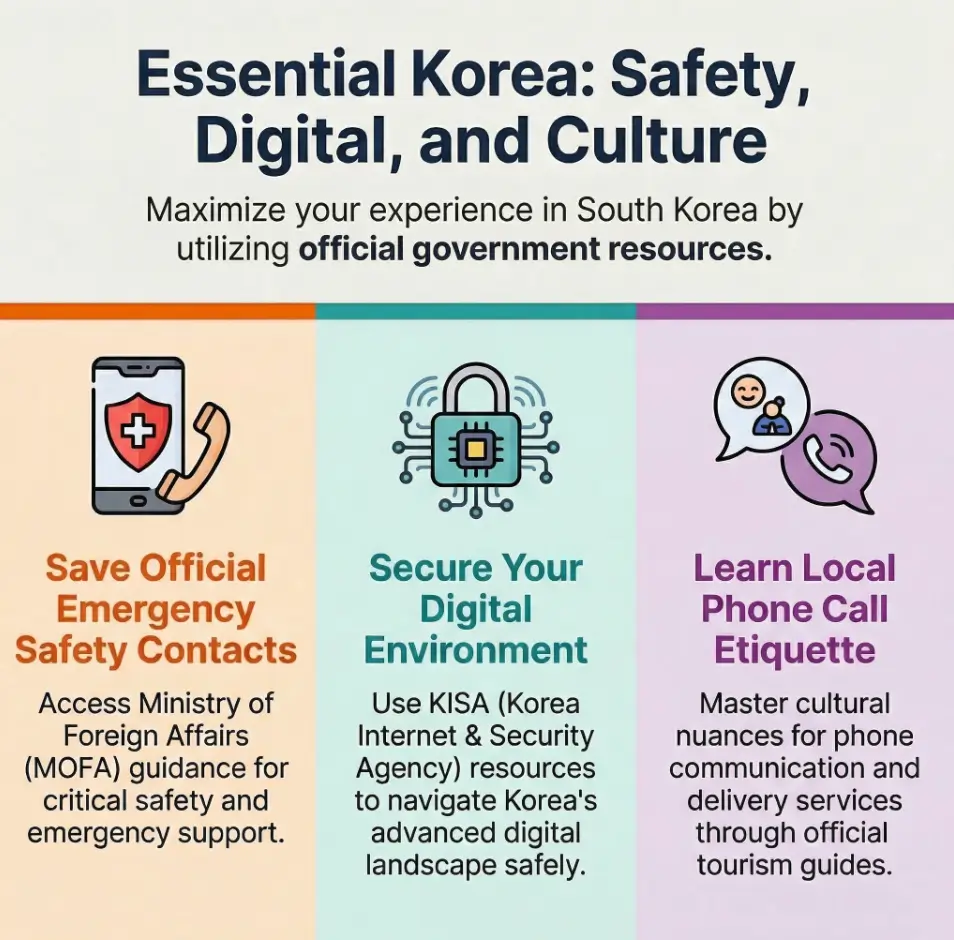
Korean service culture often values speed, certainty, and low-friction confirmation. That helps explain why calls remain so common in delivery, pickups, appointments, and repairs. The official VisitKorea tourism resources aimed at foreigners still devote space to delivery logistics, multilingual ordering tools, and practical coordination, which is a quiet hint that real-world service interactions in Korea often still revolve around fast confirmation rather than leisurely asynchronous chat.
Why practical coordination often beats asynchronous convenience
Texting is wonderful for many things: sending an address, sharing a photo, leaving a paper trail, avoiding language panic. But when both sides need a yes-no answer and need it now, the phone often beats text on pure physics. It turns waiting into resolution. In Korea, that still matters more often than foreigners expect. This is also why even people who study Korean indirect communication styles can still be surprised by how direct a practical phone call feels.
Quick reality check: if a plan is moving, a call may not be an escalation. It may simply be the engine.
In Daily Life, Calls Often Move Things Faster
Why delivery, repairs, reservations, and pickups still run on quick calls
Daily life in Korea is filled with tiny junctions where location, timing, and access have to align. A delivery rider reaches your building but cannot find the right entrance. A repair worker is five minutes early. A restaurant wants to confirm whether you still want the outdoor table because it started to rain. None of these situations are dramatic, but each one benefits from a call because the answer depends on immediate back-and-forth.
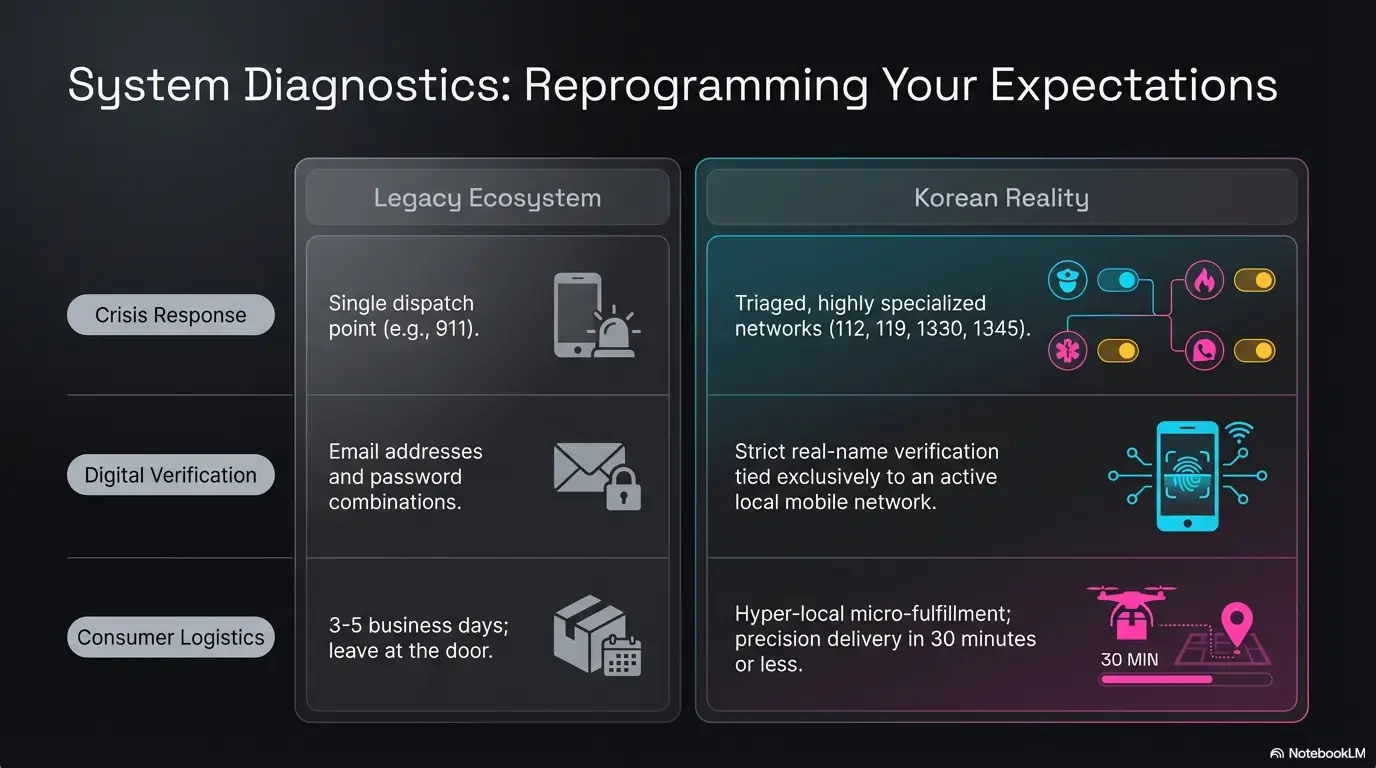
VisitKorea’s English-language resources for foreigners explicitly note that many Korean delivery platforms require local phone-number verification and emphasize live contact during deliveries, especially in complicated pickup situations. That is not a footnote. It tells you something basic about the operating culture: voice contact is still built into how the service layer works. If you want the broader food-and-logistics context, it pairs naturally with a guide to Korean delivery etiquette for foreigners.
How businesses use calls to prevent delays, no-shows, and address confusion
From the business side, a call is risk control. It reduces no-shows. It confirms directions. It avoids translation delays. It helps workers move to the next task without waiting for your text bubble to bloom and vanish and bloom again. Many Korean businesses are not trying to invade your peace. They are trying to keep a schedule from turning into soup.
Decision card: Text vs. Call
Use a text when: you are sharing an address, a name, a room number, a written question, or something that benefits from a record.
Use a call when: someone is already on the move, timing is changing, the location is confusing, or an answer is needed in under 2 minutes.
Neutral next step: Send the details by text, then call to confirm if the matter is moving now.
Here’s what no one tells you: sometimes the call is the service
This is the part that surprises newcomers. Sometimes the service is not just the food, the booking, or the repair. The service is the final human handoff made possible by a quick call. It is the rider checking whether to leave the order at the security desk. It is the stylist asking whether you are still coming because the next slot is closing in. In that sense, the call is not extra. It is the hinge that lets the service complete itself.
In Relationships, A Call Can Mean More Than Efficiency
Why calling can signal care, effort, and emotional presence
Outside logistics, calls can carry emotional weather. Not always. Not in every family, every age group, every couple, every workplace. But often enough that the pattern matters. A call can feel warmer than text because it costs slightly more. It asks for attention now, not later. It signals, “I am willing to step into this moment with you,” even if the conversation only lasts a minute and a half.
Constructed example: A person calls family after arriving home to reassure them. That can be a relationship habit, but it does not establish an obligation for every family or prove the meaning of another person’s call.
How older relatives, colleagues, or partners may read texting-only habits
Text-only habits can be read as distant, overly efficient, or strangely formal depending on context. Older relatives may hear too much cool air in them. Colleagues may see them as incomplete when the matter is time-sensitive. Partners may read silence after a missed call as avoidance rather than simple call-anxiety. None of this is universal, but enough of it is common that foreigners benefit from knowing the pattern before it misfires.
Let’s be honest: “I texted already” does not always feel sufficient in Korea
Sometimes the foreigner is technically right and socially wrong. The information was indeed sent. The address was indeed typed. The message was indeed clear. And still, the other person wanted a call because the emotional or practical layer of the interaction had not been closed. This is not irrational. It is a different threshold for what counts as completed communication.
Show me the nerdy details
Text is low-interruption and highly searchable. Voice is high-bandwidth and fast for uncertainty. In cultures or systems that reward rapid confirmation, voice stays alive even when messaging apps dominate routine chatter.
The Hidden Logic: Why Koreans Sometimes Call Instead of Explaining by Text
Why tone, speed, and back-and-forth matter in uncertain situations
Calls shine when the situation has moving parts. Tone tells you whether the request is casual or urgent. Immediate back-and-forth lets both sides test understanding in real time. Text can do this too, but more slowly, and often with more room for embarrassment. On a phone, people can interrupt, clarify, repeat, and finish.
How calls reduce ambiguity when plans are changing in real time
If the train is late, the weather shifts, the address is wrong, the office closes early, or the building entrance is locked, the phone has a practical elegance. It handles living situations better than static text. Korea, for all its digital sophistication, is still a place where many daily systems have been optimized around this kind of quick human confirmation.
Why some people see long texts as slower, colder, or easier to ignore
Long texts can feel careful to the sender and heavy to the receiver. They ask the other person to read, interpret, decide, and reply while multitasking. A call can feel lighter because it compresses all that labor into one small exchange. This is especially true when the other person is working, driving between stops, managing customers, or trying to finish a task with one hand and a weather problem.
Pull-quote: Sometimes a call is not more personal than a text. It is simply less wasteful.
- Calls compress clarification into one exchange
- They lower ambiguity when timing changes
- They can feel less burdensome than long texts
Apply in 60 seconds: For anything changing in real time, call first and text the written details after.
What Foreigners Often Get Wrong About Korean Calling Culture
Why declining calls too often can create the wrong impression
The biggest mistake is treating every incoming call as optional unless the person is intimate, senior, or officially important. In Korea, repeated non-answering can make you seem unavailable, not serious, or difficult to coordinate. That does not mean you must answer every number like a game-show contestant. It means patterns matter. One missed call is normal. Five missed practical calls without follow-up starts telling a story you probably did not mean to tell.
How “I do not like phone calls” may sound more rigid than intended
Many foreigners mean this sentence as a preference. Some Korean listeners may hear it as a boundary that blocks normal coordination. The distinction matters. Better alternatives are softer and more functional: “My Korean on the phone is weak,” or “Please text details first, and I can call if needed.” That keeps the bridge open.
Why missed unknown numbers can become missed opportunities
Unknown Korean numbers are often not random. They may be a rider, clinic, office, school, realtor, installer, or store. This is why missing calls can turn into missed appointments, delayed orders, or extra friction. Korea’s Ministry of Foreign Affairs also maintains English-language safety resources and public phone contacts for foreigners, a reminder that practical phone responsiveness remains a real part of navigating life here. The same logic shows up in housing too, especially if you are juggling move-in details or apartment logistics, which is why articles like a Korean apartment move-in checklist become surprisingly relevant.
Eligibility checklist: Do you need a call strategy in Korea?
- Yes if you order delivery, visit clinics, book services, or meet people by address
- Yes if you miss unknown local numbers more than once a week
- Yes if your Korean is fine on text but shaky on the phone
Neutral next step: Save 3 phone phrases and one callback script in your notes app today.
Don’t Do This: Assuming Every Call Is Intrusive
Why frequent calls are not always a boundary violation
From an American messaging-first perspective, multiple calls can feel aggressive. Sometimes they are. But in Korea, context matters more than count. Two calls from a delivery driver in five minutes may simply mean the person is outside, cannot enter, and has ten more stops. A second call from a clinic might mean your appointment window is collapsing. Calling can be repetitive without being rude.
How context changes the meaning of repeated calling
Ask three questions. Who is calling? What is moving right now? What happens if no one resolves it in the next few minutes? If the answer points to service, access, timing, or safety, repeated calls often mean urgency rather than entitlement.
When a second or third call signals urgency rather than rudeness
An unknown number may be legitimate or fraudulent. Check the message and verify through an established contact route before providing information or returning a call that demands urgent action.
Don’t Do This: Treating Texting as a Complete Substitute
Why some situations still expect immediate voice confirmation
Texting works beautifully until the other side needs confirmation, not information. This is the distinction foreigners often miss. You may have sent the necessary facts, but the other side may still need a live answer to move. “I sent a message” and “the interaction is complete” are not always the same sentence in Korea.
How text-only responses can slow down real-world logistics
A text can sit unread while the caller is already at your building. It can be half-understood by someone juggling other tasks. It can be missed under a cascade of app notifications. Text is often the better archive, but not always the better accelerator.
Why a call back is sometimes better than a perfectly written message
Many foreigners hide inside beautifully composed text because it feels safer. I understand the instinct. I have done its cousin: that polished, over-explained message written partly for clarity and partly to avoid the small terror of live speech. Yet a 15-second callback often does more. The grammar may wobble. The nouns may arrive wearing the wrong shoes. Still, the interaction gets finished.
Mini calculator: If a text exchange takes 6 messages over 12 minutes, but a callback solves it in 40 seconds, the phone saves both time and stress. Neutral next step: For the next practical issue, try one callback before writing a long explanation.
Common Mistakes
Ignoring unknown Korean numbers that turn out to be delivery or service calls
This is the grand classic. It happens because many foreigners are trained by spam-heavy environments to distrust unknown numbers by default. Sensible instinct, wrong country-context in some situations.
Replying too late when the other person needed immediate coordination
A delayed text can be perfectly polite and completely useless. Timing matters as much as wording when a person is already on the move.
Writing long English-heavy messages when a short call would solve it faster
A long, elegant English paragraph may feel more respectful than broken phone Korean, but the receiver may prefer a ten-second call and one repeated keyword. Communication is not a literature contest, even if some of us keep trying to make it one.
Assuming younger Koreans always prefer text over voice
Younger Koreans text constantly, yes. But “uses messaging all day” does not equal “never wants calls.” Generational trends exist; situational logic still wins surprisingly often.
Mistaking efficient calling for personal pressure or aggression
Some calls are blunt because the situation is blunt. That does not always mean the person is angry. Sometimes they are simply busy, outdoors, moving, or trying to close the loop fast.
Infographic: When a Korean Phone Call Usually Matters Most
Driver, courier, technician, agent, coworker already in transit.
Appointment shift, delay, arrival window, closing time change.
Wrong entrance, gate code, lobby handoff, pickup spot confusion.
Family reassurance, dating tension, colleague misunderstanding.
Rule of thumb: if at least two boxes apply, answer or call back quickly.
When Calls Matter Most: Situations Foreigners Should Watch Closely
Delivery drivers, couriers, and food orders
This is the loudest example because so many foreigners encounter it first. Korea’s delivery culture is famously developed, and official tourism resources for foreigners openly discuss how local services rely on practical coordination, address precision, and phone-based verification. If you miss the call, you may miss the handoff rhythm that makes the system work so quickly.
Clinics, salons, landlords, schools, and local offices
These settings often use calls for confirmation, schedule changes, or directional help. Landlords may call instead of typing out an explanation of a lock, a boiler, or a trash schedule. Clinics may call because the issue is immediate and awkward to explain by text. Schools and local offices may default to the phone because it is still the shortest route to certainty. For some readers, this overlaps with wider questions about rental life and deposits, including jeonse deposit protection and jeonse insurance.
First meetings, changing plans, and last-minute coordination
Meeting a person for the first time by a subway exit in Seoul has a certain comic potential even on a good day. Add rain, crowds, and a battery at 11 percent, and the phone suddenly becomes a sacred object. In these moments, a call is not ceremonial. It is simply the best map available.
Family, dating, and workplace moments where tone matters more than wording
Tone can rescue or ruin meaning. In family and dating contexts, especially, a short call may carry reassurance that no amount of tidy texting quite reproduces. In work, a call can show initiative when things change quickly. The trick is not to romanticize calling. It is to recognize where tone still does work that text cannot fully do on its own.
Quote-prep list: Before an important practical call, gather your name, address, building entry detail, room number, and one fallback phrase. Neutral next step: Put those items in one phone note so you are not inventing language under pressure.
If You Hate Calls, Here Is the Smarter Adaptation
When short, functional calls are enough
You do not need to become a phone-loving extrovert with cinematic confidence. Most practical calls in Korea are not long. They are tiny bridges. Ten seconds. Twenty-five seconds. A quick yes, a location check, a “please leave it at the lobby,” a “I am coming down now.” The goal is not eloquence. The goal is completion.
How to prepare simple Korean call phrases in advance
Preparation works better than bravery. Save a few phrases:
- “Yeoboseyo?”
- “Jamkkanman-yo.”
- “Munsae ap-e nwa juseyo.”
- “Ije gayo.”
- “Munjaro bonae juseyo.”
Even one or two of these can keep the interaction alive long enough to solve the problem. Fluency is not the gate. Responsiveness is. If you are still building a foundation, guides on Korean honorifics for foreigners, polite vs. casual Korean, and Konglish words to avoid can quietly sharpen your instincts.
Let’s keep it real: fluency matters less than responsiveness
This is the most liberating part. Many callers do not expect a full speech. They want confirmation. If you answer, say one clear phrase, and signal that you are engaged, you have already improved the situation. A small, imperfect response is often better than elegant silence.
How to combine text and call without sounding cold or overwhelmed
The best hybrid move is simple: answer or call back quickly, solve the immediate problem, then text the written details if needed. Voice for closure, text for accuracy. That combination travels well in Korea. It also mirrors the broader social pattern behind Korean apology phrases and other everyday expressions where tone and timing matter as much as vocabulary.
- Keep calls short and task-focused
- Use text for written confirmation after
- Practice 3 phrases instead of chasing fluency
Apply in 60 seconds: Save one callback template and three core Korean phrases in your favorites note.
Illustrative scenario, not a reported event: A resident who finds calls difficult asks a legitimate service provider to confirm arrangements by text. Agreeing on a workable channel can support coordination without treating accessibility or language needs as bad manners.
Ten minutes later she discovered the driver had been at the side entrance used for motorcycle drop-offs. The food arrived eventually, but so did the realization: nobody had been rude, nobody had failed at technology, and nobody had wrong intentions. They were simply using different assumptions about the fastest way to close a small gap. The next week she answered with one phrase, one building clue, and one laugh at herself. The problem was over before anxiety had time to unpack its suitcase.
FAQ
Why do Koreans call instead of text?
Often because voice is faster for coordination. If timing, location, or tone matters, a short call can solve the issue more cleanly than several messages.
Are phone calls considered more polite in Korea?
Not always more polite in every context, but often more serious or more responsive. In practical situations, calling can feel more committed than texting alone.
Is it rude not to answer a call in Korea?
One missed call is normal. Repeatedly not answering, especially in practical situations, can make you seem hard to reach or hard to coordinate with.
Why do Korean delivery drivers call so often?
Because handoff details matter. Entrances, elevators, security desks, gate codes, and pickup zones often require live confirmation in the moment.
Do younger Koreans still prefer phone calls in some situations?
Yes. Younger Koreans may message constantly, but many still use calls when the issue is moving in real time or needs fast resolution.
Can texting back replace returning a missed call in Korea?
Sometimes, but not always. If the matter is urgent or time-sensitive, a callback is often more effective than a written reply.
Why do Korean businesses confirm things by phone?
Calls reduce no-shows, clarify timing, and help businesses keep schedules moving. In many cases, the phone is the fastest risk-control tool.
What should foreigners say if they are not comfortable speaking Korean on calls?
Use a short bridge phrase such as asking the person to send details by message, or say one simple functional line and follow with a text. Responsiveness matters more than polish.
Prepare one call and one written confirmation
Before calling a clinic, landlord or business, write the question, your relevant reference number and the detail you need confirmed. Open with “문의드릴 게 있어서 전화드렸습니다” (I called because I have a question). If you miss a date or price, repeat it back and ask whether the information can be sent in writing. A call can resolve an ambiguity quickly, while a written record helps prevent a later disagreement about what was arranged.
A reader question: Do I have to handle everything by telephone?
No. Ask which contact channels the organization supports and explain any language or accessibility need. Use the channel suited to the task rather than treating calls as a national rule.
Next Step
Save three short Korean phone phrases for real-life use and start returning missed practical calls instead of only texting back
The hidden curiosity at the start of this article was simple: why can such a small thing as a phone call change the emotional temperature of daily life in Korea? By now the answer should feel less mysterious. The call still matters because it sits at the crossroads of speed, sincerity, and practical closure. It is not a relic. It is a living shortcut used by service workers, families, coworkers, and strangers trying to get real life unstuck.
So here is the honest next step, one you can do within 15 minutes. Save three Korean phrases. Turn missed-call anxiety into a script. The next time a practical Korean number calls, answer if you can. If you cannot, call back quickly instead of writing a long apology first. That one small change will not solve every cultural misunderstanding, but it will spare you many of the most annoying ones, and a few of the loneliest ones too. And if you are still building the larger toolkit for daily life, related reads like Korean phone plans for Americans, Korean personal questions etiquette, and Seollal etiquette for foreigners can help the whole landscape make more sense.
Coverage tier map: Your adaptation path
Tier 1: Recognize practical calls and call back quickly.
Tier 2: Save 3 Korean phrases for delivery and appointments.
Tier 3: Use call + text together for moving situations.
Tier 4: Learn how tone changes meaning in family, dating, and work.
Tier 5: Stop reading every call through your home-country habits alone.
Neutral next step: Move up one tier this week, not all five today.
Last reviewed: 2026-03.
Practical example and reader question added October 20, 2026. Existing source dates are retained; this addition is not a fresh verification of every earlier claim.