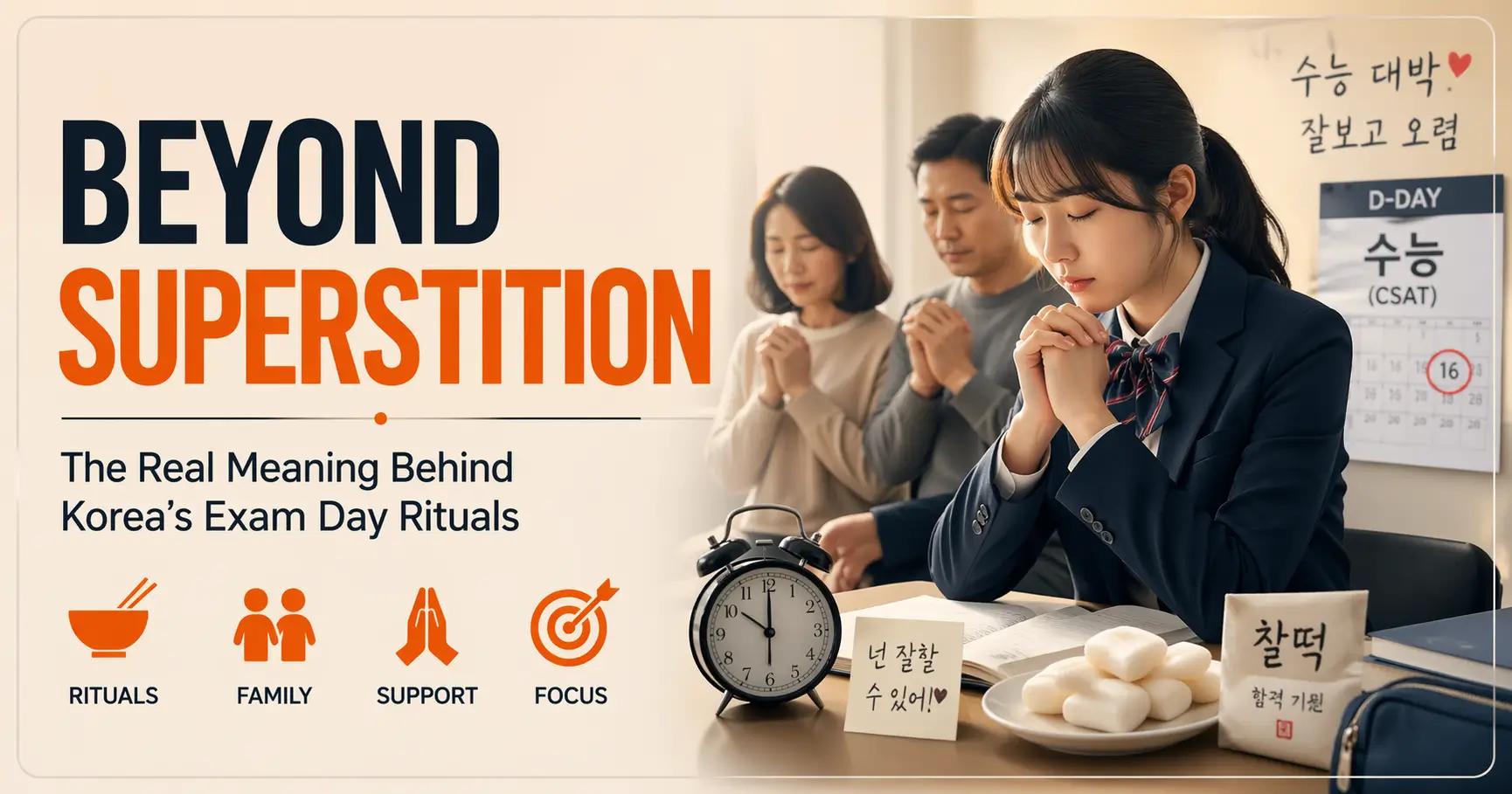
On a major exam day in South Korea, the country can seem to hold its breath. Planes have been delayed for listening sections, police have helped late students reach test sites, and outside school gates, sticky rice cakes, whispered prayers, and careful silence can make the morning feel closer to a rite than a routine.
For Anglo-American readers, Korean exam day rituals can be easy to misread as quaint superstition or parental overreaction. That reading misses the real story. These customs make sense inside a culture where the CSAT, or Suneung, can carry years of family sacrifice, social pressure, and future opportunity in a single day.
Miss that context, and you miss what the ritual is actually doing.
This post helps you read Korean exam day rituals as emotional infrastructure rather than cultural ornament, so you can understand the role of symbolic foods, family choreography, and Korea’s high-stakes education culture with more accuracy and less cliché. It draws on the logic visible in the rituals themselves: what families repeat under pressure, what communities publicly honor, and what fear looks like when it dresses itself in order.
Once you see the structure, the whole morning changes:
- ✨ What looked theatrical starts to look humane.
- ✨ What looked superstitious starts to look practical.
- ✨ And what felt foreign starts to feel deeply recognizable.
Contents — choose a section
Table of Contents
Fast Answer: Why Korean exam day rituals feel almost sacred is that they are not merely about superstition or test anxiety. In Korea, major exam days can carry the emotional weight of family hope, social pressure, and future opportunity all at once. The rituals surrounding them help turn fear into order, giving students, parents, and communities a way to feel they are doing something meaningful when the stakes feel immense.
Korean exam day rituals are really about controlling the uncontrollable
When one test feels bigger than one morning
There is a point in every high-pressure culture when an exam stops being an academic event and starts behaving like weather. It arrives on the calendar, everyone knows it is coming, and ordinary plans bend around it. In Korea, that feeling has long been especially visible around the College Scholastic Ability Test, often called the CSAT or Suneung. For many families, the exam is not just a test of knowledge. It feels like a gate, a ranking device, a social signal, and a referendum on years of sacrifice, all compressed into a single day.
Constructed illustration, not a reported event: a fictional narrator once heard a Korean parent describe exam day with a sentence that stayed with me because of its plainness: “It is only one day, but it has been living in our house for years.” That is the right scale. The exam morning is brief. The emotional rehearsal is not. By the time the student walks out the door, the family has already spent months, sometimes years, arranging sleep schedules, tutoring budgets, meal routines, transportation plans, and emotional weather around this one ritualized moment.
That is why the day feels larger than itself. A ritual appears whenever people need form around something too heavy to hold with logic alone. Weddings do this. Funerals do this. Graduation ceremonies do this. Korean exam day rituals live in that same neighborhood. They do not erase uncertainty. They make uncertainty bearable enough to walk through.
Why rituals grow strongest where uncertainty feels most expensive
Rituals thrive where the price of uncertainty is felt as steep. The more people believe that one missed bus, one bad night’s sleep, one cracked nerve, or one unlucky emotional spiral might have outsized consequences, the more they look for stabilizing habits. In a low-stakes setting, breakfast is just breakfast. In a high-stakes setting, breakfast starts carrying symbolism, timing, and memory. It becomes a kind of household engineering.
This is not uniquely Korean, but Korea offers a particularly vivid example because education has been tied so tightly to status mobility, family pride, and social comparison. A student is not just taking a test. The family may feel they are cashing in thousands of small acts of discipline. Suddenly, chance feels expensive. Ritual steps in like scaffolding around a trembling building.
And that is the thing outsiders often miss: ritual is not proof that a culture is irrational. Very often it is proof that people are trying to remain functional under pressure. A parent who lays out a “lucky” snack and checks the transit route twice is not necessarily claiming to control fate. More likely, they are trying to keep panic from becoming the loudest person in the room.
The point is not magic alone, but emotional structure
When people describe exam rituals as superstition, they usually flatten the most interesting part. The real function is not magical thinking alone. It is emotional structure. Ritual provides sequence. Sequence provides steadiness. Steadiness gives frightened people somewhere to stand.
Think of it this way. Advice is often abstract. “Do your best” is a cloud. “Eat this, leave at this time, wear this layer, say this phrase, breathe here, wait there” is a staircase. Human beings climb staircases much better than clouds. That is why rituals endure even among people who half-laugh at them. A family may not literally believe a sticky rice cake can alter a score. But they may absolutely believe that a calm student, a peaceful breakfast, and a loving send-off can alter a morning. That is already enough.
- The ritual gives sequence to stress
- The family uses symbols to create calm
- Meaning matters even when belief is mixed
Apply in 60 seconds: Read any exam custom by asking, “What anxiety is this helping people carry?”
The “sacred” feeling starts before the student leaves home
Small breakfast choices can carry oversized meaning
One of the most quietly revealing parts of exam day is breakfast. On paper, it is a practical matter: food, digestion, energy, timing. In the household imagination, though, breakfast becomes moral, symbolic, and emotional. People think carefully about what should be served, what should be avoided, and what the meal should feel like. Some foods are chosen because they are easy, warm, familiar, and unlikely to upset the stomach. Others carry symbolic meaning, especially if their texture or language implies “sticking” to success or holding onto answers.
That is the curious beauty of ritualized food. It works on more than one level at once. The food nourishes the body. The symbolism steadies the mind. The repetition creates familiarity. A familiar meal can be a small mercy on a day when everything else feels oversized and sharp-edged. Under stress, novelty is not charming. It is sabotage wearing a neat little hat.
For an illustrative student, a familiar breakfast or quiet routine may feel reassuring before an exam. That is one possible preference, not an account of the author’s own exam experience or an explanation of every student’s rituals. Ask what support the individual wants.
Family words, gestures, and silences become part of the ritual
On exam morning, families often speak differently. Some become extra cheerful. Some become extra quiet. Some offer little phrases of encouragement. Others deliberately avoid saying too much, as if one wrong sentence might add a gram of unnecessary weight. This emotional editing is part of the ritual too.
What matters is not only what is said but how carefully the atmosphere is composed. A father might drive more slowly than usual. A mother might wake earlier and hover, pretending not to hover. A grandparent might offer a prayer, a blessing, or a practical instruction delivered with the gravity of a proverb. Even silence can feel ceremonial. It is a silence full of restraint, like everyone has agreed not to jostle the student’s concentration with unnecessary chatter.
In many households, people are not performing for tradition so much as for emotional efficiency. They are trying to remove friction. That can mean less arguing, less improvisation, fewer jokes that could land badly, fewer questions that demand cognitive effort. On an ordinary school day, someone might say, “Did you pack your ID? Did you check your pencils? Are you nervous?”
On exam day, even loving questions can feel like stones in a pocket. The ritualized household knows this and trims speech accordingly. If you have seen how silence in Korean conversation can carry respect, restraint, or emotional intelligence rather than emptiness, this part of exam morning becomes easier to understand.
How ordinary routines turn ceremonial under pressure
The most striking thing about Korean exam day is how little it sometimes takes for an ordinary routine to become ceremonial. Buttoning a coat. Setting down a bowl. Tying a shoe. Waiting by the door. These are daily actions, yet the atmosphere changes them. Under pressure, repetition acquires solemnity.
That is one reason the day can feel almost sacred without being strictly religious. Sacredness often comes from heightened attention. The action itself may be simple. What changes is the density of meaning packed inside it. When a family checks the route twice and leaves early, they are not just being punctual. They are protecting the student’s emotional bandwidth. When a sibling keeps the house quieter than usual, that too becomes a kind of offering.
There is something deeply humane in this. People cannot take the test for the student. They cannot absorb the score. They cannot negotiate with time. But they can alter the texture of the morning. They can make the path to the door feel steadier, kinder, less cluttered. A ritual is often just care made visible.
Eligibility checklist: Is what you are seeing on exam day “just a quirky custom,” or is it part of a larger emotional system?
- Yes: The family changes tone, timing, and food choices.
Next step: read the morning as emotional planning. - Yes: Ordinary actions suddenly feel ceremonial.
Next step: notice the pressure level underneath the behavior. - No: You only see one symbolic object and nothing else.
Next step: avoid over-interpreting a single custom.
Neutral action: Use the checklist before you decide a ritual is “superstition.”
Sticky foods, lucky symbols, and the logic behind them
Why foods like taffy and rice cake symbolize “sticking” to success
If you ask many non-Korean observers what they know about Korean exam rituals, they often mention sticky foods first. Rice cake, taffy, or other foods associated with clinging and holding on become symbolic because they echo a wish: may the answers stick, may the student stick the landing, may success hold fast rather than slide away. This is the part of exam culture that photographs well and travels easily as a cultural anecdote. It is also the part most vulnerable to being trivialized.
The symbolism is not random. Language, texture, memory, and sound all matter. A sticky food offers a tactile metaphor. People do not just think in abstract sentences. They think with the body too. Texture can carry hope. In a tense household, symbolism is efficient because it says a lot without requiring a speech. A plate can become a sentence. A gift bag can become a blessing.
That is one reason ritual food travels so well across generations. A grandmother may understand it one way, a student another, a parent a third. Yet everyone can participate. The symbol is flexible enough to hold different degrees of belief. It asks very little and offers emotional coherence in return. Frankly, that is a pretty good trade on a high-stakes morning.
What symbolic choices reveal about hope, memory, and language
Symbolic choices reveal how hope likes to dress itself. Sometimes hope speaks in theology. Sometimes it wears the clothing of routine. Sometimes it arrives as wordplay, texture, or tiny prohibitions. In Korean exam culture, the symbolic layer often shows how language and emotion braid together. People remember sayings, habits, and objects not because they have been scientifically validated as score enhancers, but because they give shape to communal memory.
One small symbol can carry several messages at once: we are with you, this day matters, we are trying to help, we have not left you alone with the fear. That is why even lightweight rituals can survive in very modern settings. The modern student may live on apps, timetables, online mock tests, and algorithmically ranked practice questions. Yet the emotional brain still responds to symbol. People remain deliciously pre-digital in this way. We carry spreadsheets in one hand and omens in the other.
Constructed illustration, not a reported event: Illustrative Scenario: A student a fictional narrator once interviewed for a broader education piece told me that the most memorable object from her exam period was not a notebook or practice test but a tiny packet of sticky candy her aunt had slipped into her bag. She did not believe the candy could change her score. She said that part plainly, almost with embarrassment. But when she found it on the bus ride, she laughed for the first time that morning.
“It made me feel like my family had sent a little joke and a little prayer at the same time,” she said. That is the logic people miss. The object did not need mystical force. It changed her body first. Her shoulders dropped. Her breathing eased. She stopped feeling alone. Sometimes ritual works sideways. It touches the nervous system through affection, and only then does meaning arrive.
Here’s what no one tells you: the ritual works even when nobody fully believes in it
This may be the most important point in the whole article. Rituals do not require unanimous literal belief to function. They require participation, repetition, and enough emotional openness for the act to matter. That is a lower threshold than many skeptics imagine.
A family can be half-amused and fully sincere at the same time. A student can roll their eyes and still feel comforted. A parent can know perfectly well that no food is a substitute for preparation while also feeling that symbolic care has its place. Human beings are not tidy creatures. We operate with layered beliefs. We can love the ritual without mistaking it for a machine.
Seen this way, exam customs stop looking like failed science and start looking like successful social technology. They coordinate feeling. They compress support into manageable acts. They signal belonging. And on days when performance anxiety can turn the air brittle, even small rituals can make the morning more inhabitable.
Show me the nerdy details
Rituals often work through predictability, embodied cues, and shared meaning rather than direct causal force. In stress psychology, structured sequences can reduce perceived chaos and support attentional control. In cultural analysis, symbolic acts also operate as social signals, showing who belongs, who cares, and what a group values under pressure.
This is not just student stress, it is family choreography
Parents, grandparents, and siblings often perform the day together
One of the easiest mistakes is to imagine exam day as a solitary student drama. In reality, many Korean families experience it as a group performance, even when the student is the only one sitting for the test. Parents may reorganize work schedules. Grandparents may pray. Siblings may lower the volume of their own lives for the day. The student is at the center, but the emotional labor radiates outward.
That is why the word choreography fits. Each person has a role, even if the roles are unofficial. One person handles transportation. One manages food. One keeps the atmosphere calm. One delivers encouragement in the family dialect of care, whether that dialect is chatty, practical, spiritual, or comically awkward. Every family has its own grammar. Some people hug. Some hand over vitamins like battlefield medics. Some just say, “Go carefully,” which contains more love than a paragraph.
When viewed through this lens, ritual is not decorative. It is a coordination system. Families use it to align around a student without creating chaos. A ritual helps everyone know how to help without stepping on each other’s toes. That may be especially important in a moment when too much visible anxiety from parents can spill onto the student like a second backpack.
Support can look practical, spiritual, or quietly theatrical
Support on exam day comes in different costumes. Sometimes it is practical: driving the student, packing pencils, checking documents, mapping the route, preparing a familiar meal. Sometimes it is spiritual: prayer, blessings, temple visits, church support, or the quiet invocation of luck. Sometimes it is quietly theatrical: a lucky charm, a favorite phrase, a symbolic snack, a carefully staged atmosphere of normalcy when everyone is obviously not normal at all.
Theatrical does not mean fake. It means people are using form to manage emotion. There is tenderness in that. A parent who pretends to be calm may be performing calm so the student can borrow it. Anyone who has ever hosted a tense holiday meal already understands this technology. You adjust your tone, your timing, even your eyebrows. Civilization is mostly people managing other people’s nervous systems without making it too obvious.
And because support appears in different forms, outsiders should be careful about what counts as care. One family’s prayer is another family’s logistics spreadsheet. One grandmother brings sticky rice cake. Another checks whether the student has spare tissues and a second pen. Both are participating in the same emotional economy: helping the student feel accompanied rather than exposed.
Why the family’s emotional discipline matters as much as the student’s
Students are not the only ones being tested on exam day. Families are being tested too, though unofficially. Can they keep their anxiety from leaking everywhere? Can they offer support without suffocation? Can they avoid turning love into pressure? That is not easy. Anyone who has ever cared deeply about someone else’s outcome knows the temptation to overmanage the moment.
In Korean exam culture, the family’s emotional discipline matters because the student is often already carrying enough internal noise. A panicked household can make a difficult morning worse. A regulated household can help the student preserve concentration. This is another reason rituals feel sacred. They ask not only the student but the family to submit to form, restraint, and collective purpose.
- Support is distributed across family roles
- Atmosphere management is part of the care
- Emotional discipline protects the student’s focus
Apply in 60 seconds: When reading exam stories, ask who else is quietly doing labor around the student.
Public silence, prayer, and encouragement make the day feel national
Why communities often treat exam day with unusual seriousness
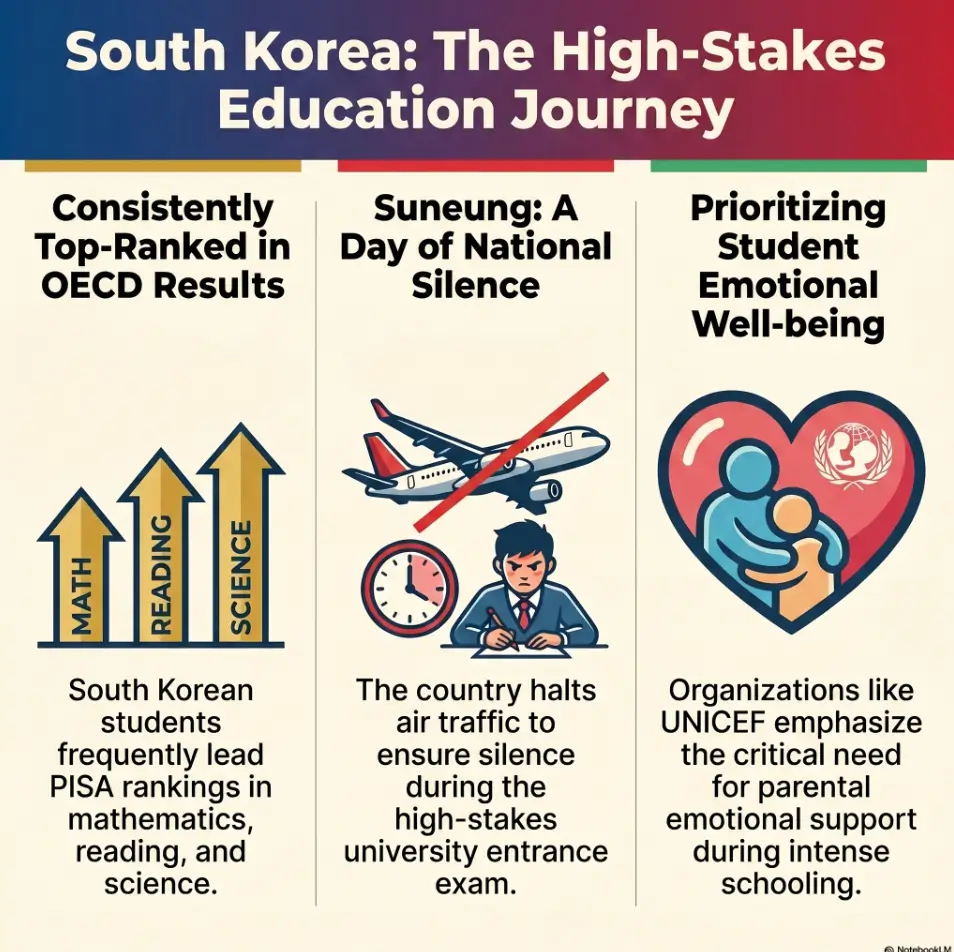
Korean exam day can feel startling to outsiders because the atmosphere is not confined to private homes. Communities notice. Schools notice. Local neighborhoods notice. Media coverage notices. Religious communities may hold special prayers. Younger students may gather to cheer for seniors. In some years, even the broader public rhythm appears to bend around the day in visible ways, which reinforces the sense that something larger than one family is happening.
This is a key reason the day feels sacred rather than merely stressful. Sacredness often emerges when a community collectively marks a moment as important. The collective attention does not make the exam holy in a doctrinal sense, but it does elevate the day into public ritual territory. A private fear is acknowledged by the crowd. That changes its emotional temperature.
There is also something very Korean in the coexistence of intensity and order here. The public does not usually behave as though chaos is the proper tribute to importance. Instead, seriousness is expressed through coordination, respect, and visible support. The social message becomes clear: this day matters, and we know it matters.
The atmosphere outside test sites can feel part vigil, part send-off
If you stand outside certain test sites, the atmosphere can feel like a braid of contradictory moods: encouragement, hope, fatigue, prayer, adrenaline, and almost ceremonial restraint. Some groups cheer loudly before entry. Others fall into near-silence once the crucial moment arrives. Adults wait, watch, and pace. Students move with clipped purpose. It can feel part festival, part vigil, part train platform, part threshold ritual.
I have always thought threshold spaces tell the truth about a culture. Doorways, gates, stations, hospital corridors, school entrances. These are places where ordinary speech gets thinner and symbolism gets louder. Exam site gates on a major test day show Korea talking to itself about merit, fear, effort, and collective hope without needing to say all of it aloud.
There is a reason these scenes leave such a deep impression on foreign observers. The atmosphere reveals that education is not treated merely as private self-improvement. It has public significance. A test score may belong to a student, but the emotional event belongs to a wider web of people who have invested meaning in the outcome.
How collective attention turns a private test into a public rite
A rite is what happens when a private transition is publicly marked. That is exactly what exam day often becomes. The student enters the testing room alone, but not unaccompanied in meaning. Collective attention wraps around the event, making it legible as a social passage.
This matters because it helps explain why the rituals feel almost sacred instead of simply odd. Public rites always involve witness. Someone sees you crossing. Someone recognizes the weight of the moment. Someone confirms that the crossing matters. In Korean exam culture, that witness can come from family, peers, teachers, prayer groups, neighborhoods, and the larger social narrative around educational success.
Once you see that, the whole day becomes easier to read. It is not just an overreaction to a test. It is a culture staging the emotional terms of one of its most important sorting moments.
Decision card: When is exam-day behavior best read as belief, and when is it best read as social ritual?
| If you see | Read it as | Why |
|---|---|---|
| One lucky object only | Possible personal belief | The symbol may matter privately |
| Family, school, and community coordination | Social ritual | Meaning is being publicly organized |
| Atmosphere management and public seriousness | Collective emotional infrastructure | The ritual is helping people function together |
Neutral action: Use the card before you jump to a simplistic explanation.
Let’s be honest, the ritual is also a defense against panic
Ritual gives anxious minds something concrete to hold
When anxiety rises, abstraction becomes almost useless. “Relax” is among the least helpful words in the human language, right up there with “networking” and “moist.” What anxious minds need is not a command but a handle. Ritual provides handles. Wake at this time. Eat this food. Carry this item. Follow this route. Stand here. Say this phrase. Wait there.
Each step is small, but together they create a container. Containers matter because anxiety loves expansion. Left alone, it fills the room. Ritual says: no, you may occupy this corridor and no more. That is not a complete cure, of course. But it is often enough to keep a person moving. Movement is underrated. Many people do not need certainty. They need enough steadiness to keep taking the next correct step.
This is why I hesitate whenever people sneer at exam rituals. Panic is not defeated by mockery. It is defeated, or at least softened, by structure. A ritual is often structure with emotional memory attached. It tells the body, “We have been here before. There is a way through.”
Why repetition can calm people faster than advice
Advice requires interpretation. Repetition does not. That difference matters under stress. A repeated act can reach a person before language finishes loading. This is why athletes have routines, musicians have pre-performance habits, and patients invent strange little waiting-room behaviors. The body learns through rhythm.
Korean exam rituals often draw power from this same principle. Repetition shrinks the field of possible errors. It also lowers cognitive clutter. The student does not need a motivational lecture at 7:15 a.m. They need fewer surprises. The family does not need a theory of educational inequality over breakfast. They need shoes on, stomach settled, documents ready, car moving, air calm. There is a time for analysis and a time for sequence. Exam morning belongs mostly to sequence.
Constructed illustration, not a reported event: a fictional narrator once watched a violinist tap the same pocket three times before walking onstage. She knew perfectly well that the tapping did not improve intonation. But it brought her attention back into her body. That is how rituals survive modernity. They do not have to be intellectually triumphant. They only have to be emotionally useful.
The deeper function is steadiness, not certainty
It is important to say this plainly: rituals do not promise certainty. They promise steadiness. That is a humbler and much more realistic task. A student may still feel afraid. A parent may still be worried. The exam may still be difficult. Nothing in the ritual can remove those truths. What it can do is lower the chaos surrounding them.
Seen this way, the ritual becomes almost compassionate. It does not deny reality. It responds to reality with form. That is one reason it can feel sacred. Sacred things often arise where people meet limits honestly and still choose care.
- Concrete actions beat vague reassurance
- Repetition lowers mental clutter
- Steadiness is the real prize
Apply in 60 seconds: Replace the word “superstition” with “stress response” and see what becomes clearer.
Don’t reduce it to superstition and miss the social meaning
Why outsider readings often flatten the emotional reality
Outsider readings often fail because they are too eager to classify. Is the ritual rational or irrational? Modern or traditional? Religious or secular? Superstitious or symbolic? These are not useless questions, but they are often too blunt for the lived reality. Real households do not arrange themselves into clean academic categories before breakfast.
When outsiders flatten the ritual into superstition, they often erase the emotional conditions that make the ritual intelligible. They also ignore how layered participation can be. A family may include one devout believer, one skeptical teenager, one practical parent, and one grandparent who treats symbol as memory rather than doctrine. Yet they all still participate. The ritual survives because it can hold multiple meanings without breaking.
That flexibility is part of its strength. Social rituals that survive are usually not rigid machines. They are broad vessels. They allow different people to stand under the same roof of action for different reasons. The modern world has not eliminated this need. If anything, constant competition may have made it hungrier.
The rituals are not irrational when viewed as cultural coping tools
If we read these exam rituals as cultural coping tools, they begin to make immediate sense. Coping tools need not alter objective outcomes directly to be valuable. They can improve functioning, reduce conflict, coordinate support, and create emotional resilience under pressure. Those effects are not decorative. They are practical.
There is also a social intelligence in how these rituals distribute burden. Rather than asking the student alone to carry all the fear internally, the ritual externalizes some of it into actions the family and community can perform. This is psychologically shrewd. Fear becomes shareable. Support becomes visible. The student is still responsible for performance, but not abandoned to isolation.
In this way, ritual can be interpreted not as a failure of reason but as a supplement to reason. Preparation handles what can be prepared. Ritual handles what preparation cannot fully calm. The two are not enemies. They are colleagues with very different job descriptions.
What looks excessive from afar may feel humane from inside the system
From a distance, ritual intensity can look excessive. Up close, it may feel humane. That difference matters. People outside the system see symbols and pageantry. People inside the system often feel tenderness, solidarity, and the relief of being recognized. A ritual says, “We know this is difficult.” That recognition alone has moral weight.
There is a temptation, especially in cross-cultural commentary, to reward yourself for skepticism. You identify the irrational element, make a neat little diagnosis, and leave feeling modern. But sometimes skepticism is simply emotional under-reading. A better question is not, “Is this silly?” It is, “What suffering or pressure made this feel necessary?”
Show me the nerdy details
Anthropologists often distinguish between the observable form of a ritual and its social function. A symbol may seem minor in isolation but act as part of a wider system of bonding, coordination, and anxiety management. In high-pressure educational environments, these layers can overlap densely and become easy to misread if you look only at the symbol and not the surrounding structure.
Common mistakes Americans make when reading Korean exam culture
Mistaking ritual for blind belief instead of emotional management
A common American mistake is assuming that visible ritual must indicate deep literal belief. That reading reflects a cultural bias toward either-or categories. Either you believe the symbol has power or you do not. But many social rituals do not work that way. People may participate because the act conveys care, continuity, seriousness, or solidarity, even when they do not attribute direct causal force to it.
This misunderstanding is especially easy in a culture where individual belief is often treated as the main lens. Korean exam rituals are better understood through relationship and atmosphere. The question is not only, “Do you believe this?” It is also, “What does this allow us to do together under stress?”
Assuming students alone carry the pressure
Another mistake is imagining the pressure as purely student-centered. Americans sometimes narrate exam culture as if one teen is heroically grinding while everyone else watches from the sidelines. In many Korean contexts, that is incomplete. The pressure is distributed through parents, schools, relatives, peer groups, and neighborhood talk. Families often organize daily life around exam preparation in ways that are emotionally and financially significant.
That does not mean every family is the same, and it does not mean every parent is an education tyrant in cardigan form. It means the exam is socially embedded. Pressure comes from more than one direction, and support does too. If you ignore the surrounding web, the rituals will appear melodramatic instead of structurally sensible. The same wider adolescent ecosystem appears in other ways too, including how Korean teen life is shaped by school expectations, peer rhythms, and public performance.
Treating exam day customs as quaint rather than structurally revealing
Perhaps the biggest mistake is treating the customs as a cute cultural footnote rather than as a clue to something deeper. Rituals are x-rays. They show what a culture fears, values, and tries to protect. Korean exam customs reveal not only individual anxiety but a society that has made educational sorting highly consequential. The rituals are not side decorations on the story. They are evidence about the story’s core.
This is where cross-cultural reading gets interesting. A ritual around one exam morning can tell you about mobility, merit, comparison, family duty, and national imagination. It can tell you how societies convert abstract competition into ordinary behavior at the breakfast table. That is not quaint. That is diagnostic.
Quote-prep list: Before you explain Korean exam rituals to a US audience, gather these four interpretive ingredients.
- The role of family, not just the student
- The symbolic meaning of food and language
- The public atmosphere around the exam day
- The larger education pressure system
Neutral action: Check whether your explanation includes all four before publishing.
Do not separate the ritual from Korea’s education pressure cooker
Why exam rituals make more sense in a high-stakes academic culture
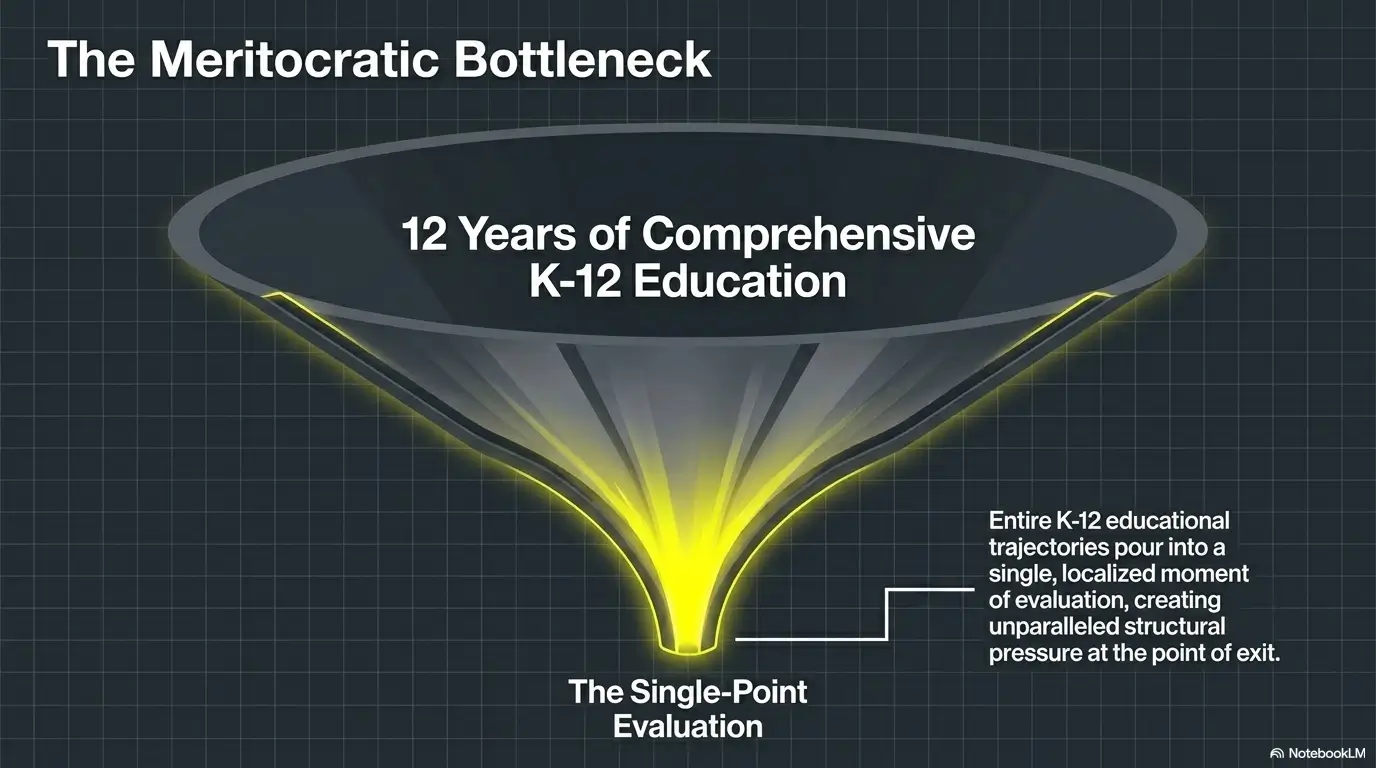
To understand the rituals, you have to understand the pressure system that feeds them. Korean education culture has long been shaped by intense competition, status signaling, and the belief that academic outcomes can meaningfully shape future life chances. The exact policy landscape shifts over time, and any single exam never tells the whole story, but the emotional reality remains clear: when education is experienced as a narrow bridge, people will approach the crossing with ritual seriousness.
That is why exam customs make more sense in Korea than they would in a setting where one test barely matters. If the consequences feel real, symbolic behavior grows roots. The ritual becomes proportionate not to the objective metaphysics of the symbol but to the subjective scale of the stakes. Pressure does not automatically produce ritual, but it fertilizes it beautifully.
A helpful comparison is this: the tighter the bottleneck, the more ceremonial the queue. People become sensitive to timing, luck, preparation, and emotional order because the passage feels consequential. Korea’s exam-day rituals reflect a society where that bottleneck has been felt sharply by generations. It also helps explain why discussions of schooling spill naturally into adjacent subjects like Korean school uniform culture, because even seemingly ordinary school practices often carry social meaning far beyond utility.
The ceremony grows where the consequences feel real
There is no sacred feeling without consequence. Or rather, consequence is one of the fastest ways ordinary events begin to glow with seriousness. The more people feel that an outcome can change a trajectory, the more they create symbolic protection around the moment. This is not exotic. Humans do this everywhere. Korea simply offers a concentrated version.
That concentrated version becomes especially legible because the ceremony is distributed across daily life. It is in the food, the speech, the route planning, the prayer circles, the school gate, the media attention, the sighs of parents, the silence of siblings. Consequence leaks into behavior. Behavior hardens into ritual. Ritual begins to feel sacred because the consequences underneath it are not imagined as trivial.
A ritual is often the shadow cast by competition
This may be the simplest sentence in the article. A ritual is often the shadow cast by competition. When competition intensifies, people rarely respond with pure efficiency alone. They respond with meaning. They invent, preserve, or deepen rituals because people are not machines that can process high stakes with spreadsheets alone. Even the most achievement-driven systems produce symbolic life at the edges.
So when you see exam-day customs in Korea, do not isolate them from cram schools, family expectations, peer comparison, institutional prestige, and broader cultural narratives about success. The ritual is not a separate curious layer. It is the emotional condensation of the whole climate. For readers trying to map that wider ecosystem, the world of Korean hagwons for foreign families offers another window into how educational aspiration gets organized in daily life.
- The ritual reflects pressure, not just tradition
- Competition gives symbols emotional force
- The ceremony is a social response to consequence
Apply in 60 seconds: When analyzing a custom, map the stakes around it before judging the custom itself.
Infographic: How Korean exam day rituals turn pressure into order
1. High stakes
One test feels tied to family hope, ranking, and future options.
2. Anxiety rises
Students and families want control where certainty is impossible.
3. Ritual appears
Food, timing, blessings, silence, and route checks create structure.
4. Meaning stabilizes
The student feels accompanied, and the family feels useful.
Who this is for, and who it is not for
This is for readers exploring Korean parenting, schooling, and social norms
This article is for readers who want to understand Korea with more care than a quick stereotype allows. If you are a writer, parent, teacher, student, journalist, expat observer, or culturally curious reader trying to understand why Korean exam culture can feel so emotionally charged, this lens should help. It is also useful for anyone comparing how different societies turn academic pressure into ritual behavior.
This is for writers, students, and observers seeking cultural context, not caricature
If your goal is nuance, welcome. If your goal is to produce a tidy little caricature about “strict Asian parents” and “superstitious exam customs,” this article will be mildly inconvenient for you, which I consider a public service. Real cultural understanding begins where lazy shorthand ends.
This is not for readers looking for a full policy history of Korean education reform
This is not a full legal or policy history of Korean education reform, admissions policy, or exam administration. Those are important topics, but they require a different article with a different architecture. Here, the focus is narrower and more human: why the rituals feel sacred, what social work they perform, and how to read them accurately.
Coverage tier map: What this article covers, and what it does not.
| Tier | What you get |
|---|---|
| Tier 1 | Meaning of the rituals themselves |
| Tier 2 | Family and community roles on exam day |
| Tier 3 | How rituals connect to pressure and competition |
| Tier 4 | Not a full policy timeline or admissions guide |
Neutral action: Use the map to decide whether you need cultural interpretation or policy research next.
FAQ
Why are Korean exam rituals so emotionally intense?
They are emotionally intense because the exam often carries meaning far beyond one morning. Families may connect it to years of sacrifice, future opportunities, social comparison, and household identity. The ritual intensity reflects the perceived stakes underneath the day.
Are these rituals religious, superstitious, or cultural?
They can be any combination of the three, depending on the family. Some people approach the rituals spiritually. Others treat them as symbolic habits or stress-management tools. Many participate without making sharp distinctions between those categories.
Do all Korean families follow the same exam day customs?
No. Families vary by region, religion, personality, class, and generation. Some emphasize prayer. Some emphasize practical logistics. Some keep the rituals light and humorous. Others make the day feel very solemn. The common thread is not identical custom but shared seriousness.
Why do certain foods matter on exam day?
Certain foods matter because they carry symbolic associations, especially around “sticking” to success or holding onto correct answers. But food choices also matter practically. Familiar, gentle, predictable food can reduce stress and help the morning feel stable. That overlap between emotional meaning and everyday eating habits appears elsewhere too in Korean life, including the social logic behind why Koreans ask if you ate as a form of care rather than simple curiosity.
Is the pressure mostly from parents, schools, or society?
Usually it is a mix. Parents matter, schools matter, peer culture matters, and wider social ideas about merit and success matter. That is why the pressure can feel so diffuse. It does not come from one source alone.
How is Korean exam culture different from US test culture?
Both cultures can produce test anxiety, but Korean exam day often feels more publicly ritualized and socially shared. The family and community roles tend to be more visible, and the atmosphere around a major exam can feel more nationally synchronized.
Do students actually believe the rituals help?
Some do literally, some partly, and some not at all. But even skeptical students may find the rituals comforting because they signal care, familiarity, and structure. Emotional usefulness does not require total belief.
Why does the whole country seem to notice exam day?
Because the exam has long held broad social significance. When a culture gives an educational event high symbolic and practical importance, public attention gathers around it. The day becomes a shared social moment, not just a private testing session.
Offer exam-day support that the student actually wants
Ask before organizing a gift, public message or early-morning send-off. A student may welcome encouragement but prefer fewer notifications and no surprise visitors. Agree on practical help such as transport, a familiar meal or a quiet evening. Check exam instructions for permitted items and arrival requirements rather than copying a ritual from a video. A good-luck gesture can express care, but it cannot predict or guarantee a result.
| Focus | What to check |
|---|---|
| Preference | Ask what encouragement is welcome. |
| Logistics | Follow the actual exam’s instructions. |
| Afterward | Offer rest and conversation without demanding a score estimate. |
A reader question: What should I say after the exam?
Let the student choose whether to discuss it. “수고했어요” acknowledges the effort; an immediate interrogation about scores or mistakes may not be the support they need.
Next step: read the ritual as a social language, not a curiosity
Watch for what the ritual protects, not just what it symbolizes
The best next step is simple. Stop reading the ritual only as a symbol and start reading it as protection. What is it protecting? Calm, dignity, focus, family usefulness, emotional steadiness, a sense of not being alone. Once you ask that question, the ritual becomes more legible and more humane.
Ask what fear, hope, and duty sound like in everyday gestures
Exam culture is not expressed only in policy documents or school rankings. It lives in tone of voice, breakfast choices, car rides, lucky snacks, text messages, prayer gatherings, and carefully managed silence. Fear, hope, and duty do not always arrive wearing dramatic costumes. Sometimes they arrive in a thermos and a packed pencil case. Even outside exam season, similar emotional codes appear in ordinary communication habits such as Korean texting formality and the layered etiquette of KakaoTalk etiquette.
Use this lens to understand Korean parenting culture more accurately
If you want to understand Korean parenting culture, exam day is a revealing place to look. Not because it offers a cartoon version of the culture, but because it concentrates several themes at once: care, competition, sacrifice, social comparison, public seriousness, and the longing to make uncertainty less cruel. Read the ritual this way, and the so-called sacred feeling stops seeming exaggerated. It starts seeming intelligible. The same family coordination becomes especially visible in other school-adjacent routines too, such as Korean childcare pickup culture and the quiet social training inside Korean school cleaning time.
In practical terms, that means this: within the next 15 minutes, take one Korean exam-day custom you have seen before, maybe a sticky rice cake, a parent praying, or a crowd outside a school gate, and reinterpret it using the four-part lens from this article. Ask what pressure produced it, who participates in it, what emotion it manages, and what kind of care it makes visible. That small exercise will teach you more than another dozen “fun facts” listicles ever will.
- The ritual protects people from chaos
- The family and community help carry the burden
- The sacred feeling comes from consequence, witness, and care
Apply in 60 seconds: Re-read one ritual you once dismissed and identify the human need inside it.
Last reviewed: 2026-04.
Practical example and reader question added October 20, 2026. Existing source dates are retained; this addition is not a fresh verification of every earlier claim.