

The Hidden Architecture of Korean Private Education
In Korea, private education is not a side dish. In 2025, families spent 27.5 trillion won on it, and hagwons remained part of everyday life for most students. That scale matters, but it can also mislead foreign families into thinking the local default must be the right answer for their child.
The real difficulty is not understanding that hagwons are common. It is understanding what they are actually doing in Korean family life. A hagwon can be tutoring, structure, language support, supervision, test prep, and parental reassurance rolled into one bright, fluorescent package.
“What looks like ambition is often logistics. What looks like ‘extra classes’ is often a whole family operating system.”
Get this wrong, and you can spend heavily on the wrong subject, the wrong schedule, and the wrong kind of pressure. This guide helps you make a calmer, sharper decision by judging hagwon fit based on your child’s school context, temperament, and actual needs rather than neighborhood panic.
Our guidance is grounded in ground-level realities: the data, the school-life pressures, and the small logistical needs that quietly drive big spending decisions. Because once you see the system for what it is, the decision changes completely.
Table of Contents
Start Here: What Hagwons Really Are, Beyond the Translation
Why “private academy” is technically right but culturally incomplete
If you translate hagwon as “private academy,” you are not wrong. You are just not done. The English phrase sounds tidy, maybe even a little elegant, like a violin school above a bakery. In daily Korean life, though, hagwons can be academic intensifiers, homework managers, language environments, after-school holding patterns, test-prep factories, and social signals all at once.
That is why foreign families often misread the system at first. They hear “academy” and imagine an optional enrichment activity. Many Korean parents hear something closer to “support system for a competitive school culture.” Those are not the same thing.
The real job hagwons do in Korean family life
Hagwons often solve several family problems in a single transaction. They can provide extra instruction, yes. But they also create a schedule, occupy late-afternoon hours, outsource some homework friction, and give parents the emotional relief of feeling that they are “doing enough.” That last piece matters more than people admit.
I once spoke with a parent who said, half laughing and half exhausted, that the math hagwon was not only for algebra. “It keeps the week from collapsing,” she said. That sentence explained more than ten brochures could.
How hagwons differ from tutoring, after-school care, and cram schools in the US
For US-based readers, the nearest comparison is a hybrid. A hagwon may look like tutoring, but the format is often more institutional. It may feel like after-school care, but the promise is usually more academic. It may resemble a cram school, but many students attend for months or years, not just before one exam.
In other words, a hagwon is often less like “help when needed” and more like a standing part of the child’s weekly operating system. Once you see that, the spending starts to make more sense, even if you still do not want that life for your own family.
- Translation alone hides the social function
- Many families buy structure, not only scores
- The same hagwon can solve different problems for different households
Apply in 60 seconds: Write down the one problem you want solved first: grades, language, routine, supervision, or confidence.
Money Follows Pressure: Why Korean Parents Spend So Much
Competition is only part of the story
Yes, competition matters. Korea has a long educational culture shaped by exams, prestige, and the practical reality that strong academic performance can open doors. But the hagwon economy is not powered by competition alone. It also runs on comparison, timing, habit, and fear of missing an invisible turn.
That fear is not always dramatic. Often it arrives wearing sensible shoes. A parent hears that classmates have already started advanced math. Another learns that a child’s English class assumes outside vocabulary work. A third realizes that pickup time from school and return time from work do not fit neatly together. Soon, a spending decision appears that feels less like luxury and more like infrastructure.
Social mobility, signaling, and the fear of falling behind
In many families, spending on education is experienced as a hedge against future regret. It is not merely “we want our child to excel.” It is also “we do not want to discover too late that everyone else quietly built a staircase while we stood admiring the wallpaper.”
There is also signaling. Parents signal seriousness to schools, to relatives, to other parents, and, not least, to themselves. That does not mean every choice is vain or irrational. It means money sometimes follows social weather as much as academic evidence.
Why “everyone else is doing it” becomes a budget decision
Peer behavior changes the emotional math. Once hagwon attendance becomes normal in a class or neighborhood, opting out can feel active rather than neutral. Families do not compare hagwon spending to zero. They compare it to the imagined cost of their child being the only one without extra support.
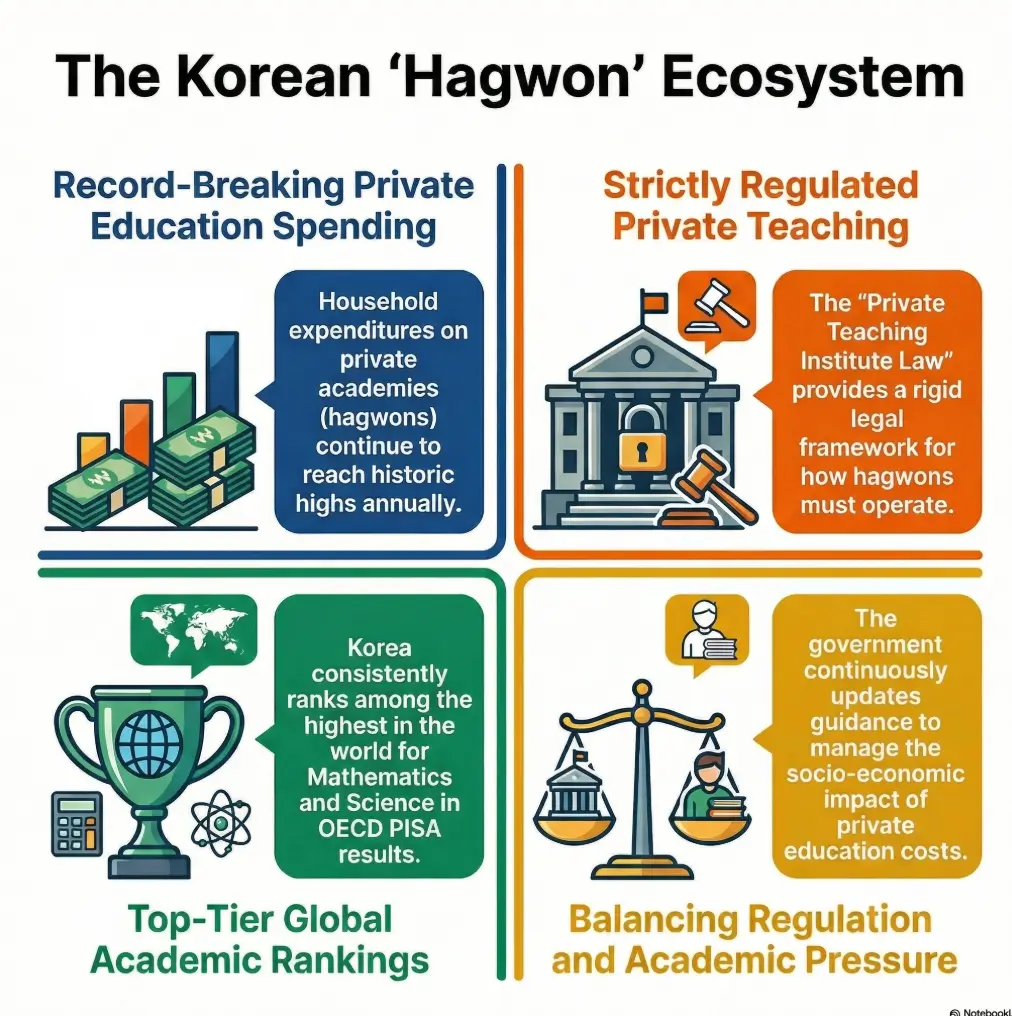
Recent Korean government data captures how large the market remains. The Ministry of Data and Statistics reported total private education spending of 27.5 trillion won in 2025, with 75.7% of elementary, middle, and high school students participating in some form of private education. That helps explain why hagwons can feel less like a niche choice and more like ambient culture.
Grades, exams, and future pathways create urgency.
Parents buy structure, supervision, and predictable afternoons.
Once classmates enroll, opting out feels riskier.
Families pay for possibility, not only current performance.
The Hidden Engine: What Parents Are Actually Buying
Test prep, routine, supervision, and academic pacing
Parents are not always buying “better teaching” in the purest sense. Sometimes they are buying repetition. Sometimes they are buying someone else to insist on homework. Sometimes they are buying a room in which the child is expected to sit down and work instead of dissolving into sofa static.
That does not make the purchase fake. It makes it more honest. A family can benefit from a well-run program even when the gains come partly from structure and consistency rather than pedagogical wizardry. Education markets are full of people pretending structure is a minor detail. It is not. Structure is often the whole machine.
Why hagwons often function as structure, not just instruction
Think of hagwons as scaffolding. Some children need only a little. Others need it for one subject and not another. Some barely need it at all, but their parents need an afternoon plan that does not involve three fights, two forgotten worksheets, and dinner at 9:40 p.m.
Foreign families sometimes feel guilty admitting this. They want every education choice to sound lofty and pure. Real life is less ceremonial. When both parents work, or when a child is adapting to a new school system, “this makes weekdays manageable” is a perfectly respectable reason to consider support.
Here’s what no one tells you: some families are paying for predictability as much as performance
Predictability has market value. It reduces friction. It lowers the number of nightly decisions. It can make a child feel held rather than perpetually negotiated with. The danger is that once predictability arrives, families can mistake calm for progress. Sometimes it is. Sometimes it is merely well-timed.
A good rule is this: if a hagwon is helping, you should be able to name what changed. Better quiz scores. Less homework conflict. More confidence speaking Korean. Fewer tears before math. If you cannot describe the gain, the payment may be feeding anxiety rather than solving a problem.
Who This Is For, and Who Should Probably Skip the Hagwon Race
Best for foreign families trying to decode local expectations before enrolling
If you are newly in Korea, or preparing to relocate, this is for you. You may be hearing the same sentence from three directions at once: “Most kids go.” That statement may be true in a broad sense and still deeply unhelpful in your specific case.
You need translation, yes, but also interpretation. What ages? Which subjects? What school context? What neighborhood? What family schedule? Local behavior is information. It is not automatically instruction.
Useful for parents weighing Korean school culture against their child’s temperament
Some children love a brisk, externally structured environment. Others can tolerate it for one subject. Others wilt under too much managed time. A child who looks “lazy” in one setup may become focused in another. A child who looks “high-achieving” may simply be highly compliant until the wheels come off.
I have watched families make beautiful decisions once they stopped asking, “What do successful Korean families do?” and started asking, “What kind of week makes our child more capable rather than more brittle?” That question has saved many budgets and several nervous systems.
Not for families looking for a one-size-fits-all verdict on whether hagwons are “good” or “bad”
There is no clean moral verdict here. Hagwons are neither angels in cardigans nor villains with whiteboards. They are tools embedded in a specific culture. Some are thoughtful and effective. Some are glorified urgency merchants. Some help for one season and hurt in the next.
If you came here hoping for a single yes-or-no answer, I am going to disappoint you in the useful way. Fit matters more than ideology.
- Yes or No: Is there a clearly defined problem to solve?
- Yes or No: Can your child handle one more fixed weekly commitment without obvious strain?
- Yes or No: Do you know whether the goal is school performance, language adjustment, routine, or exam prep?
- Yes or No: Can you trial one subject before expanding?
- Yes or No: Have you checked whether your child’s school already covers this well?
Neutral next step: If you answered “no” to three or more, do not scale up yet. Narrow the problem first.

Before You Copy the Locals: What Foreign Families Often Misread
High spending does not automatically mean high educational quality
One of the most expensive mistakes foreign families make is confusing local intensity with proof. A full parking lot is not evidence. A shiny lobby is not evidence. A waitlist is not evidence. Prestige can reflect reputation, location, network effects, or parental nerves just as easily as classroom quality.
Korean parents themselves know this, by the way. Many are not blindly impressed. They are constantly swapping information, recalculating fit, and quietly worrying that they, too, may be paying for branding plus fluorescent lighting.
A packed schedule can look impressive while producing very mixed results
There is a visual drama to a child with a full timetable. It looks serious. It looks like commitment. It also looks, from a distance, like success. But crowded schedules can hide fatigue, shallow retention, dependence on external prompting, and the slow erosion of family life.
A packed week can create the illusion of control while reducing the child’s actual ownership of learning. That trade can be worth it during certain seasons. It can also become a very expensive way to keep everyone too busy to notice that nothing meaningful is improving.
Why local parenting behavior may reflect anxiety, logistics, or status, not proof
The parent you meet at pickup may genuinely love a hagwon. They may also be defending a large monthly bill, managing a difficult commute, or repeating advice that made sense for a completely different child. Listen respectfully. Then separate testimony from transferability.
This is where foreigners sometimes become accidental tourists in someone else’s anxiety. They observe what locals do without seeing the pressures beneath it. A behavior that is rational inside one family’s constraints can be wasteful inside yours. The same thing happens in other parts of daily Korean life, where visible behavior can make more sense once you understand the social texture underneath, whether that is how Koreans use silence in conversation or the wider patterns of Korean indirect communication.
Show me the nerdy details
Korean law treats hagwons as regulated private teaching institutes rather than informal tutoring alone. The English version of the Act on the Establishment and Operation of Private Teaching Institutes and Extracurricular Lessons lays out the legal framework, and the law allows local superintendents of education to limit lesson hours in view of school classes and student health. That helps explain why hagwon choice is not merely a private-market whim. It sits inside a broader policy and social system.
Age Changes Everything: Why a Six-Year-Old and a Sixteen-Year-Old Need Different Answers
Early years: language exposure, routine, and social fit
For younger children, the question is rarely “How do we maximize performance?” It is usually “What kind of environment helps this child settle, communicate, and not hate the afternoon?” For a six-year-old, a language-focused hagwon may function partly as exposure and partly as rhythm. That can be useful. It can also be overkill if the child is already swimming in enough stimulation.
The trap here is adult projection. Parents imagine future gaps and pour stress into the present. Young children, meanwhile, are busy needing sleep, play, and a schedule that does not feel like airport security.
Middle years: acceleration, homework load, and confidence gaps
This is often the messiest stage. Some children begin to benefit from targeted support. Others get tangled in comparison. School expectations rise, social awareness sharpens, and confidence can wobble even in children who look outwardly fine. A useful hagwon at this age often clarifies pacing and reduces confusion. A bad one simply makes the child feel slower in a more organized room.
I have seen a child transform because one math instructor explained fractions clearly enough to remove a year of dread. I have also seen a child start to believe she was “behind” only because adults kept placing her beside faster students and calling that motivation. Same subject. Entirely different outcome.
Teen years: entrance exams, specialization, and real academic pressure
For older students, especially those in Korean academic tracks, the pressure becomes more concrete. Entrance exams, specialization, and ranking pressures can make hagwons feel less optional. This is the age where some families are not buying enrichment at all. They are buying exam strategy, volume, and endurance.
That said, not every teen needs the same response. International-school students, bilingual students, and relocating families may need very different support. A teenager preparing for Korean-language school assessments has one set of needs. A teenager applying to US or international universities has another. Treating all teens as one market is how families overbuy the wrong help.
- Choose one light hagwon when the child needs routine, one skill boost, or smoother transition.
- Choose subject-specific support when one area is the obvious bottleneck.
- Choose no hagwon for now when fatigue, commute, or school overload is already visible.
- Choose exam-focused support only when the student’s pathway genuinely depends on it.
Neutral next step: Match the setup to the child’s stage, not to neighborhood gossip.
Let’s Be Honest: Some Hagwons Help, and Some Just Industrialize Stress
Signs a hagwon is supporting learning
You should see clarity. The child understands what the class is for. Feedback arrives regularly. The workload is challenging but not carnivorous. Teachers can explain how they respond when a student does not understand, rather than simply how many worksheets they can generate per square meter.
Better signs are often quiet. Less resistance before class. More specific questions at home. Slightly steadier confidence. A child who can explain what they learned without sounding like a hostage reading a statement.
Signs a hagwon is mostly selling urgency
Watch for the performance of seriousness. Endless level labels. Constant comparisons. Marketing built on fear. Promises that sound grander than classroom reality. Adults who talk more about elite pipelines than about your child’s actual learning profile.
Urgency sells beautifully because parenthood contains a permanent vulnerability: the suspicion that one missed step might echo for years. Some businesses understand this a little too well. They do not merely serve concern. They cultivate it.
When more hours stop meaning more progress
At some point, volume becomes theater. A child can be so scheduled that nothing has time to sink in. Memory needs recovery space. Motivation needs a little oxygen. Family relationships need at least one evening that does not feel like a tactical retreat.
OECD’s Korea note on PISA 2022 is a useful reminder that Korea’s students perform strongly by international standards, but performance alone is not the whole human picture. That is one reason foreign families should resist the impulse to read every additional hour of study as inherently wise.
Short Story: A family I knew moved to Korea with one determined plan: their son would “blend in fast.” Within three weeks, he was enrolled in English, math, and Korean-language classes after school. On paper, the schedule looked magnificent, almost architectural. In real life, he began forgetting lunch boxes, crying over simple homework, and falling asleep in the car before dinner. Nothing was catastrophically wrong.
That was the danger. The week did not explode. It just hardened around him. When the parents finally stripped the schedule down to one Korean support class and one free evening, the change was almost embarrassingly ordinary. He laughed more. He remembered more. He started speaking up in class. The family did not discover a miracle method. They discovered that a child can drown quietly in a perfectly respectable timetable.
Common Mistakes Foreign Families Make With Hagwons
Mistake 1: enrolling too quickly because other parents sound certain
Confidence is contagious. So is panic disguised as expertise. Parents who have lived in Korea longer may speak with conviction, but they are still speaking from inside their own child’s profile, school context, and budget. Borrow their observations, not their conclusions.
Mistake 2: choosing prestige over fit, commute, and teacher quality
A “top” hagwon that requires a draining commute can become a tax on the whole household. Travel time, pickup logistics, and the child’s post-school energy are not side details. They are part of the educational outcome. A decent program ten minutes away can outperform a famous one that turns every Tuesday into a weather event.
Mistake 3: underestimating how exhaustion shows up before grades do
Children rarely announce burnout with a neat memo. It leaks out sideways. Irritability. Headaches. Strange procrastination. Flatness. The sudden inability to tolerate small frustrations. By the time grades visibly dip, the strain may have been building for weeks.
Mistake 4: treating every subject as equally urgent
Not all weak points deserve equal spending. A child may need Korean-language adjustment far more than extra English. Or math confidence far more than one more conversation class. Families lose money when they build support around prestige subjects rather than actual bottlenecks.
- Do not outsource judgment to louder parents
- Commute and fatigue count as educational costs
- Prioritize the subject creating the biggest real friction
Apply in 60 seconds: Circle one subject only. If you cannot name the priority subject, you are not ready to enroll broadly.
Don’t Build the Wrong Week: How Overscheduling Starts Quietly
The difference between productive routine and family-life erosion
Overscheduling rarely begins with a dramatic flourish. It begins with one practical choice. Then another. A Korean class because language matters. A math class because everyone says the pacing is fast. An English program because the child seems rusty. Suddenly Thursday evenings vanish into transit, snack wrappers, and the peculiar sadness of reheated rice at 9:15.
Routine should reduce family friction, not turn the entire home into a logistics company with feelings.
Why evenings disappear faster than parents expect
Every added class eats more than its posted minutes. There is travel, mental transition, late dinners, unfinished homework, bag packing, and the subtle cost of a child who never quite feels off duty. Parents often price only the tuition. The real fee is paid partly in time and calm.
Small signs your child’s schedule is becoming the problem
- The child has less patience for tasks they used to manage well.
- Dinner becomes a collision rather than a reset.
- Weekends turn into recovery instead of family life.
- You keep adding support without being able to name the resulting gain.
- The child has no unclaimed time left for reading, boredom, or ordinary play.
One of the oddest things about overscheduling is how respectable it can look from the outside. The calendar appears full of virtue. Inside the family, it may feel like a low-grade emergency with matching pencil cases.
Cost Without Context: What Families Should Ask Before Paying
What is included in the fee, and what quietly multiplies it
Base tuition is rarely the whole story. Ask about materials, tests, make-up classes, transport, seasonal intensives, registration fees, and whether the advertised number reflects the class you actually want. The clean monthly figure can turn out to be a decorative fiction.
How to compare outcomes without being dazzled by branding
Compare classes by clarity and relevance, not by swagger. What exactly does the program promise? What feedback do parents receive? How are groups formed? What happens if your child is lost, bored, or mismatched? Any place can say “high level.” Fewer can explain how they teach the child standing in front of them.
Which questions reveal whether a program fits your child or just flatters your fear
- What problem does this class solve in the next 8 to 12 weeks?
- How much homework is typical on top of school work?
- How do teachers respond when a student is struggling?
- What does success look like besides “moving up a level”?
- What kind of child tends not to thrive here?
Use this to price time as well as tuition.
Neutral next step: Compare two options with the same formula before assuming the “better” one is worth the extra friction.
Not All Subjects Behave the Same: English, Math, Korean, and Test Prep Need Different Logic
English hagwons: fluency goals versus school-performance goals
English is the subject most likely to seduce foreign parents into confusion. A fluent English-speaking child may need no English hagwon at all, or may need one only if the local school’s curriculum uses test formats unfamiliar to them. Meanwhile, a child who speaks English comfortably may still struggle with local grammar-heavy expectations. Same language. Different target.
Math hagwons: pacing, problem volume, and confidence risk
Math support can be brilliant when it clarifies sequence and fills gaps. It can also be brutal when it confuses speed with mastery. Some students thrive on volume. Others become less capable because they begin to associate math with perpetual inadequacy. Watch confidence as closely as scores.
Korean-language support for foreign or mixed-background children
For many relocating or mixed-background families, Korean support is the most rational spending category of all. It affects classroom understanding, peer relationships, teacher communication, and the child’s sense of belonging. A child can survive weak performance in one subject more easily than they can thrive while understanding only half the room. In that sense, language learning in Korea is never only academic. It sits beside social decoding, age awareness, and the subtler layers of Korean honorifics for foreigners that shape how children are addressed and how they speak back.
Test-prep academies and when they change the family equation
Test prep deserves its own logic. Once a family is preparing for specific entrance pathways, the hagwon question becomes less philosophical and more tactical. But even then, more is not automatically better. Specificity is better. A precise program aligned with the actual exam can outperform an impressive but generic treadmill of effort.
The most expensive sentence in education may be, “Let’s just add this too.”
Here’s the Part Families Miss: Your Child’s School Context Changes the Answer
Korean public school, private school, and international school families face different pressures
A child in Korean public school faces one set of classroom norms, language realities, and peer comparisons. A child in Korean private school may face another. A child in international school is often living under an entirely different curriculum and admissions logic. Treating these worlds as interchangeable is one of the fastest ways to waste money.
For example, a family in international school may feel pressure from local norms that are not tightly connected to their child’s academic pathway. Meanwhile, a family in Korean public school may underestimate how much Korean-language support shapes the child’s whole day, not just one grade line on a report card. Even everyday practices such as South Korean school lunch culture can remind foreign parents that school fit is lived through routines, not just curriculum documents.
Why hagwon decisions that make sense for one system can be wasteful in another
A strategy that makes sense for a Korean-school child preparing for locally competitive assessments may be excessive for an international-school child whose main issue is Korean adjustment or one weak subject. Families get into trouble when they import a decision from a different ecosystem and assume the same ROI will magically appear.
How peer group and curriculum shape the real need
Peer group matters because comparison does not happen in a vacuum. Curriculum matters because support should map to what the child is actually being asked to do. When families ignore those two forces, they often end up buying help for the wrong battlefield.
When I hear parents say, “But all the other kids are doing it,” I always want to ask the next question: Which kids, in which system, for what outcome? That question often clears the fog in under a minute.
Choosing Better: A Practical Filter Before You Enroll
Start with the child, not the neighborhood rumor mill
Before you compare brands, compare realities. What does your child actually need this month? Better Korean comprehension? Math gap repair? A calmer routine? A bridge into local school culture? The clearer the problem, the less likely you are to buy an expensive answer to a different question.
Judge by teaching clarity, feedback rhythm, and schedule realism
Three things matter more than most families expect: teaching clarity, feedback rhythm, and whether the schedule can coexist with an actual family life. A program does not need to feel luxurious. It needs to feel legible and sustainable.
What a trial class should tell you in the first week
A good trial does not need to reveal the child’s destiny. It should reveal whether the room makes sense for them. Can they follow? Are they stretched without panic? Do teachers seem observant? Does the child come home drained in a productive way, or simply flattened?
Try to make one decision at a time. Families who enroll gradually often look less impressive in month one and much smarter by month six.
- Your child’s school type and current grade
- One priority subject only
- Commute tolerance in minutes
- Weekly availability, including dinner and sleep realities
- Whether the problem is grades, language adjustment, confidence, or supervision
Neutral next step: Bring this list to every consultation so you compare programs on the same terms.

FAQ
Why are hagwons so common in Korea?
They are common because they serve more than one function. They support academics, create after-school structure, respond to competition, and reflect peer expectations. In many families, they solve scheduling and supervision problems as much as learning problems.
Do all Korean children attend hagwons?
No. Many do, but not all, and the pattern varies by age, region, income, school type, and subject. Even within the same school, attendance can mean very different things, from one light enrichment class to a tightly managed multi-subject schedule.
Are hagwons necessary for foreign kids living in Korea?
Not automatically. Some foreign children benefit a great deal, especially with Korean-language adjustment or one clearly weak subject. Others do better with no hagwon, a private tutor, school-based support, or simply more time to settle into a new system.
How many hagwons is too many for one child?
The number is less important than the effect. If sleep, mood, appetite, family time, or school engagement start to deteriorate, the schedule is probably too crowded. Too many families wait for grades to crash before admitting that the week itself has become the problem.
Are expensive hagwons usually better?
No. Higher prices may reflect location, reputation, branding, or selective intake as much as teaching quality. The better question is whether the class solves the specific problem your child has in a way that fits your family’s time and energy.
Can hagwons help with Korean language adjustment?
Yes, and for some families that is the most sensible use of them. Better Korean can improve classroom comprehension, friendships, confidence, and daily belonging. Just be careful to choose support that is appropriate for your child’s level rather than impressive on paper.
What is the difference between a hagwon and a private tutor?
A hagwon is usually an organized program with fixed schedules, groups, and curriculum. A private tutor is often more flexible and individualized. Hagwons may offer stronger structure. Tutors may offer better customization. The right choice depends on whether your child needs consistency, tailoring, or both. For some families outside Korea, the better comparison may feel closer to finding a private Korean tutor in NYC or sorting through the best Korean classes in NYC, where the real question is still fit, not prestige.
How do I know if my child is actually benefiting?
Look for specific changes: stronger understanding, better confidence, smoother homework time, or improved language function in daily school life. “They seem busy” is not evidence. “They can now explain what they learned and handle school with less friction” is much better evidence.
What should I ask before signing up?
Ask what the class is for, how progress is measured, how homework is handled, what happens when a student struggles, and what kind of child is not a good fit. Also ask about total costs, not just tuition, and what the weekly routine really looks like door to door.
Is it normal to feel pressure from other parents?
Completely. In a dense education culture, other parents’ choices can feel like information, judgment, and prophecy all at once. The goal is not to ignore that pressure theatrically. It is to translate it, then make a smaller and more precise decision than panic would suggest. That instinct to decode tone, context, and intent is useful far beyond school life, including in topics like Korean politeness and the subtler rules behind Korean personal questions etiquette.
Next Step: Make One Decision With a Cooler Head
Pick one subject, one goal, and one trial period before committing serious money
Here is the curiosity loop we opened at the start and can now close plainly: Korean parents often spend heavily on hagwons not because they are irrational, but because hagwons sit where schooling, status, scheduling, and hope all press on the same family budget at once. That explains the spending. It does not obligate your family to imitate it.
Your next move in the next 15 minutes should be small and concrete. Pick one subject. Name one goal. Set one trial period, ideally short enough to evaluate without becoming emotionally married to the invoice. That is how you avoid building a whole week around borrowed anxiety.
If the class helps, expand carefully. If it does not, you have learned something valuable at manageable cost. That is not failure. That is intelligent adaptation, which is what most families actually need when they enter a new education culture.
Do not build your child’s life around the loudest parent in the room. Build it around the child in your house.
Last reviewed: 2026-03.