
Beyond the Blazer: The Hidden Script of Korean School Uniforms
A Korean school uniform can do social work before a student says a single word. In Korea, a blazer, tie, or skirt often signals school identity, peer belonging, discipline, reputation, and pressure all at once.
That is where many Anglo-American readers misread Korean school uniform culture. They see dress code; they miss the social script. They notice the fabric and overlook the way uniforms can shape first impressions in hallways, on the street, and even in the minds of adults who have never met the student.
Keep guessing, and the topic collapses into the usual thin clichés: strict schools, obedient students, East versus West. Read it more carefully, and a much richer picture appears.
This post helps you understand how Korean school uniforms function as cultural signals, not just school policy. You will see why uniforms can create belonging, why they can intensify comparison, and why self-expression often survives in the smallest details—from shoes to outerwear to the angle of a tie.
The lens here is not stereotype or nostalgia. It is lived social meaning, grounded in the emotional trade-offs students actually navigate. Because once you see the blazer as culture, not cloth, the whole hallway comes into focus.
Fast Answer: Korean school uniforms are not just about dress code compliance. They often work as visible signals of school identity, peer belonging, social discipline, public image, and student status within a group. For US readers, the key difference is this: the uniform is not merely what a student wears to school. It can shape how that student is read before they even speak.
Table of Contents
Why Uniforms Mean More in Korea Than Many Americans Expect
Dress code is only the surface layer
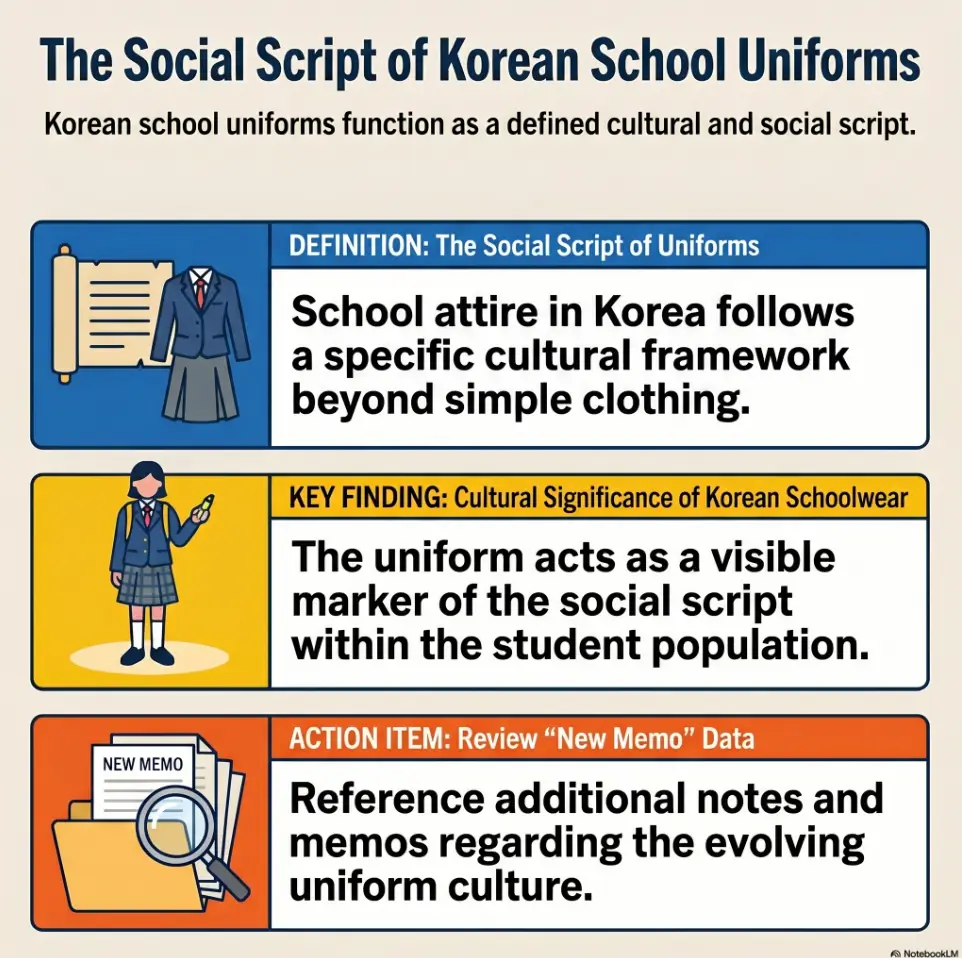
From a distance, the Korean school uniform can look tidy and simple. That is the trick of uniforms everywhere. They look straightforward from the outside and emotionally crowded from the inside. Many American readers first interpret uniforms through a familiar lens: policy, compliance, rebellion, punishment, freedom. That lens catches part of the picture, but not the whole room.
In Korea, the uniform often sits inside a broader system of school life where collective appearance matters more visibly. The uniform is tied to attendance, school rituals, student conduct, public image, and the daily choreography of moving through a highly structured environment. A teenager wearing a certain blazer is not just “following rules.” They are also being placed into a recognizable social frame.
I still remember the first time I watched students stream out near a Korean school gate in winter. The scene had the crisp rhythm of sheet music: dark coats, backpacks, matching silhouettes, tiny variations hiding in shoes and socks. It was orderly, but not silent. Order and personality were walking side by side.
The uniform often signals school life, hierarchy, and social belonging
Uniforms can communicate age identity, shared routine, and school affiliation in a single glance. In a society where school affiliation can carry reputational weight, that glance matters. People may infer things about discipline, expectations, exam culture, or neighborhood status from a uniform. That does not mean those inferences are always fair. It means they happen.
The outfit can become a social introduction before the student speaks. That is one reason the subject feels bigger in Korea than some Americans expect. The garment is doing relational work. It can mark who belongs where, who is old enough to be in which grade band, and which institution shaped the daily rules around them.
Why US readers can misread the system as “just stricter clothing rules”
Americans often arrive with a freedom-versus-control debate already loaded in their pockets. That debate is understandable. It is just incomplete. Korean uniform culture is not only about authority pressing down on individuality. It is also about how groups maintain visible coherence, how schools present themselves, and how students navigate belonging inside those systems.
That is why calling it “stricter clothing rules” feels a bit like calling an orchestra “people holding wood and metal.” Technically not false. Spiritually unemployed.
- They signal school identity in public.
- They affect how students are read by peers and adults.
- They sit inside a broader culture of group belonging.
Apply in 60 seconds: When you see a Korean school uniform, ask what social message it carries, not just what rule produced it.
Beyond Fabric, What Korean School Uniforms Quietly Communicate
Belonging, discipline, and school identity in one visual cue
A uniform condenses multiple meanings into one visible cue. It says, “I belong to this school.” It may also whisper, “This school has standards,” or “This student is expected to present a certain way.” For some students, that feels stabilizing. For others, it feels like they are wearing the school’s expectations on their sleeves, literally and otherwise.
Belonging matters more than many outsiders realize. Adolescence is already a high-voltage season of self-consciousness. A uniform can reduce one kind of daily friction by removing some clothing decisions and softening visible economic differences. At the same time, it can create new pressure around correct fit, proper styling, and acceptable presentation.
How uniforms become shorthand for reputation and expectations
In Korea, schools can develop reputations that reach beyond campus walls. Parents, students, neighbors, and even strangers may attach assumptions to certain schools. Uniforms then become shorthand. A blazer can suggest not only “student,” but also “student from that kind of school.” That may imply academic seriousness, neighborhood status, traditional discipline, or social prestige.
This is not unique to Korea in a total sense. British private school uniforms can signal similar things. Some US school districts carry neighborhood identity too. But in Korea, the visibility and everyday cultural familiarity of uniforms can make that shorthand feel sharper and more immediate.
Why the outfit can speak before the student does
Teenagers rarely enter social space as blank pages. Their haircut, phone case, shoes, posture, and uniform all speak first. In Korea, where uniforms are common and legible, that first impression can be particularly quick. The student may be perceived as diligent, privileged, ordinary, stylish, rebellious, serious, or school-proud before a single sentence lands.
This is where empathy matters. The uniform does not erase individuality. It simply means individuality often has to negotiate with a stronger visual frame. Many students become experts at speaking through small details because the large outline is already assigned.
Infographic: What a Korean school uniform may signal at a glance
School Identity
Which institution the student belongs to, and what that school is thought to represent.
Group Belonging
Membership, sameness, and the comfort or pressure of fitting into a visible collective.
Discipline Signals
How adults may interpret neatness, compliance, and seriousness through presentation.
Self-Expression Gaps
The small spaces where students style hair, bags, shoes, socks, and outerwear.
Eligibility checklist: Are you reading uniforms accurately?
- Yes / No: Are you treating the uniform as a social signal, not just a rule?
- Yes / No: Are you allowing for school-to-school differences?
- Yes / No: Are you considering how students themselves may feel inside the system?
Next step: If you answered “No” to two or more, slow your interpretation before making a cultural judgment.
The Hidden Social Script Behind Korean School Uniform Culture
Uniforms as a shared language of group membership
Every culture has social shorthand. In Korea, school uniforms function as one of those shorthand systems. They let people identify roles quickly. Student. School level. Group affiliation. Shared routine. Even when nobody says this aloud, the system is understood. That is what makes it a script rather than a mere outfit code.
Group membership is not always oppressive. Sometimes it is comforting. Adolescents often want two contradictory things at once: to belong and to stand out. A uniform can satisfy the first desire while making the second more complicated. That tension gives the culture around uniforms much of its emotional texture.
How sameness can reduce friction and create new kinds of pressure
Uniform advocates often point out the practical benefits. Fewer daily clothing decisions. Lower pressure to constantly perform fashion. A more consistent public appearance. There is some truth there. Sameness can reduce one category of visible comparison. But it rarely abolishes comparison. Teenagers are inventive little sociologists. If they cannot compare outfits freely, they will compare fit, tailoring, shoes, skin care, body type, brand of bag, coat, and who manages to look effortlessly correct while pretending not to try.
I have seen this in schools across cultures. Remove one ladder and another one quietly rolls in on wheels. Adolescence is efficient that way.
Here’s what no one tells you: equality in appearance does not erase status
This is the part many neat explanations skip. Uniforms may flatten some visual differences, but they do not erase social hierarchy. Family background, academic performance, confidence, speech style, neighborhood, and peer networks still matter. In some cases, the uniform may even intensify attention to the remaining differences because the baseline appearance is standardized.
Equality in clothing is not the same thing as equality in lived experience. That distinction matters for anyone trying to understand Korean school life honestly.
Organizations such as UNICEF often emphasize that children’s educational environments should support dignity and well-being. That is a useful reminder here. The question is not whether a uniform looks tidy. The deeper question is whether the surrounding culture lets students breathe inside it.
Show me the nerdy details
Standardized dress tends to reduce variation in one visible dimension while leaving other status markers intact. In social environments, people often shift attention from large visible differences to smaller ones. This is one reason uniforms can reduce some forms of comparison without eliminating social ranking altogether.
Not Just Tradition, Why Modern Korea Still Holds Onto Uniforms
Historical continuity, school structure, and public expectations
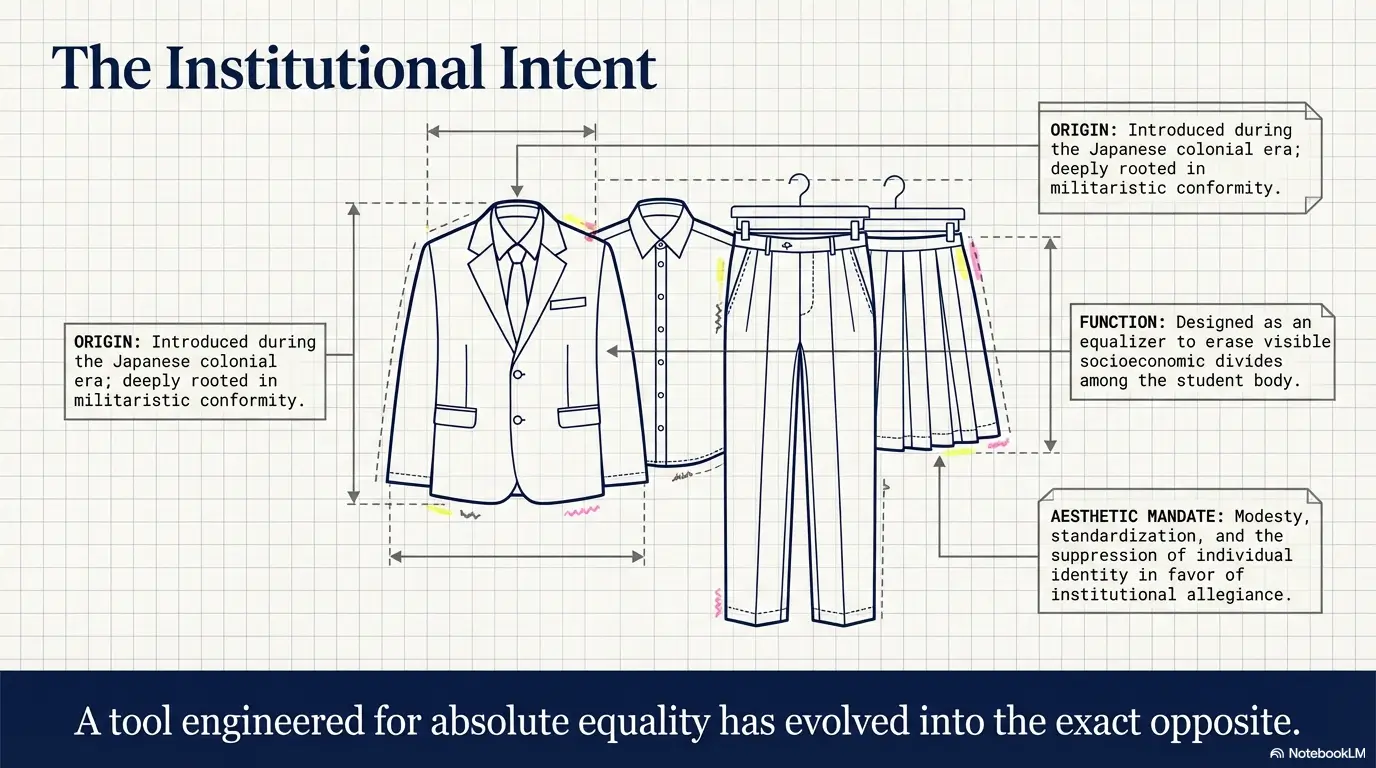
Uniforms persist in Korea partly because institutions do not disappear just because smartphones arrive. Modernity does not automatically dissolve inherited school structure. Many systems survive because they remain socially legible, administratively convenient, and publicly accepted enough to continue. School uniforms sit inside that kind of continuity.
There is also a simple fact worth noting: once a society becomes accustomed to reading students through uniforms, the absence of uniforms changes more than wardrobes. It changes public signals. Schools, families, and communities often resist that kind of sudden symbolic shift unless there is a strong reason.
Why uniforms persist even in a highly modern, trend-aware society
Korea is both deeply modern and highly aware of visual presentation. That combination does not kill uniforms. It can actually help them endure. A modern, trend-aware society is often intensely sensitive to image. Uniforms offer a controlled image. They let schools project seriousness and coherence even while students live in a culture saturated with fashion, media, and self-branding.
There is a strange little irony here. The more visually expressive the outside culture becomes, the more some institutions cling to clear visual rules inside their walls.
The tension between order and individuality keeps the debate alive
The debate survives because both sides are touching something real. Order can matter. So can student individuality. Public image can matter. So can emotional comfort. A society does not keep arguing about uniforms because the issue is trivial. It keeps arguing because uniforms sit exactly where control, identity, fairness, and adolescence collide.
Decision card: When uniforms feel helpful vs when they start to pinch
| When A | When B |
|---|---|
| Helpful: They reduce daily clothing decisions, clarify school identity, and create predictable norms. | Pinching: They become tools for over-policing bodies, style, comfort, or public image. |
| Time trade-off: less morning decision fatigue. | Emotional trade-off: more scrutiny around tiny deviations. |
Neutral action: Ask which problem the uniform is solving, and which new problem it may be creating.
Where Self-Expression Still Sneaks In
Hairstyles, bags, shoes, outerwear, and subtle styling choices
Teenagers are not famous for surrendering identity quietly. Even in stricter systems, self-expression leaks through the seams. In Korea, that may show up in hairstyle, bag choice, socks, shoes, phone accessories, coat styling, or the way a uniform is worn rather than merely owned. These choices can look tiny to adults and enormous to students. That is not hypocrisy. That is adolescence doing its daily engineering.
I have watched entire personality essays written in the margins of a school outfit: a carefully chosen backpack, a slightly oversized cardigan, shoelaces with intent, the practiced angle of a winter scarf. The uniform remains. The person insists anyway.
Small alterations, big signals: how students personalize within limits
Small changes often carry outsized meaning when the baseline is standardized. A hemline, the fit of a jacket, the choice of outerwear after school hours, even the neatness or looseness of a tie can become social signals. Students learn to read those signals fast. They are not only seeing “fashion.” They are seeing attitude, confidence, boldness, care, indifference, aspiration.
Let’s be honest… teenagers rarely stop expressing identity just because rules exist
This is where outsiders sometimes become oddly literal. They assume a uniform cancels identity because it standardizes appearance. But human beings are too inventive for that. Especially teenagers. Rules do not end expression. They redirect it. Sometimes the resulting creativity is almost comic in its precision. Give a young person ten square centimeters of permitted individuality and they will build a republic.
Uniform culture is not the absence of self-expression. It is self-expression under visible constraints.
- Hair, shoes, bags, and outerwear become identity channels.
- Minor alterations can carry major peer meaning.
- Uniforms often redirect expression rather than erase it.
Apply in 60 seconds: Look for the “small freedoms” students use before declaring that uniforms suppress individuality completely.
What Outsiders Get Wrong About Korean Uniform Culture
Mistaking conformity for obedience
One of the most common mistakes is to see a uniform and assume inner obedience. Visible conformity does not tell you what a student thinks, feels, resents, enjoys, negotiates, or jokes about. It only tells you what they are wearing in a context where that choice may be constrained. A student can be compliant in appearance and deeply independent in mind. They can also be proud of their school while criticizing its rules. Human beings are gloriously inconvenient that way.
Assuming every school enforces rules the same way
Not every Korean school operates identically. Enforcement can vary by school culture, administrators, region, era, and social climate. Some environments may be more rigid. Others may allow more flexibility in practice than outsiders assume. Treating all Korean schools as a single monolith is an easy shortcut and a poor analysis.
Reading uniforms only through a Western freedom-vs-control lens
The Western freedom-versus-control frame is emotionally powerful, especially for American readers. But it can flatten contexts where communal identity, school reputation, and visible order carry more social weight. The better question is not, “Are uniforms good or bad?” The better question is, “What work are uniforms doing in this setting, and for whom?”
Once you ask that, the topic becomes less cartoonish. It stops being a culture-war prop and becomes a lived social arrangement with trade-offs, contradictions, and real students inside it.
Don’t Reduce It to “Asian Strictness”
Why that shortcut flattens culture and misses local context
“Asian strictness” is one of those lazy phrases that sounds explanatory while explaining almost nothing. It collapses history, institutional habits, family expectations, academic pressure, and local school culture into a single vague fog of severity. This is not analysis. It is decorative stereotyping.
Korea has its own educational history, its own social tensions, and its own public debates about youth culture, fairness, conformity, and pressure. Uniform culture belongs inside those conversations. Once you reduce it to “Asian strictness,” you stop learning. You have chosen a label over a lens.
How family expectations, school image, and peer norms all overlap
Uniform meaning does not come only from schools. Families may value neatness, reputation, and visible seriousness. Schools may care about order and public image. Peers may police what counts as normal, cool, sloppy, or too much. These forces overlap. A student does not experience “the uniform” in isolation. They experience a web of expectations attached to it, much like the broader patterns discussed in Korean politeness and everyday social signaling.
The real story is not severity, but social meaning
Once again, the deepest question is meaning. What does the uniform communicate? What does it demand? What does it protect? What does it hide? Some students may feel pride. Some may feel pressure. Many feel both. That emotional doubleness is far more interesting, and more truthful, than a flat story about strictness.
UNESCO and OECD discussions around educational environments often remind readers that school systems are not only academic machines. They are social worlds. That is exactly the right frame here. A Korean school uniform belongs to a social world, not merely a wardrobe policy.
Show me the nerdy details
Cross-cultural errors often happen when observers apply a familiar domestic debate to a foreign institution without translating the surrounding social logic. With uniforms, that means overemphasizing personal liberty language while under-reading group norms, institutional symbolism, and reputational signaling.
Common Mistakes Americans Make When Interpreting Korean School Uniforms
Treating uniforms as proof that students have no individuality
This is probably the fastest wrong turn. Individuality does not disappear because clothing becomes standardized. It reroutes. It may become more verbal, more behavioral, more accessory-driven, more social, or more private. But it remains.
Assuming uniforms automatically create fairness
Uniforms can soften certain visible differences, but they do not guarantee emotional fairness, social equality, or reduced exclusion. They may help in one area and fail in another. A clean visual field is not the same thing as a just social environment.
Confusing aesthetic neatness with emotional comfort
A polished appearance can fool adults into thinking the system must feel calm from the inside. Not always. A hallway can look serene while students carry intense pressure around performance, peer judgment, or fitting in correctly. Beauty and ease are not twins. Sometimes they are barely cousins.
Forgetting that students themselves may feel both pride and pressure
American readers often want a simple verdict. Students themselves often live a mixed truth. They may like the sense of belonging and dislike the scrutiny. They may enjoy the look and resent the control. They may feel proud of their school and burdened by its reputation. This is not inconsistency. It is adolescence under institution.
Mini calculator: How many layers of meaning are you ignoring?
Count 1 point for each factor you have considered: school identity, peer pressure, family expectations.
Score 0–1: Your interpretation is probably too thin. Score 2: Better, but still incomplete. Score 3: You are finally reading the whole hallway, not just the blazer.
Neutral action: Revisit one assumption you made about uniforms and test it against all three factors.
Who This Is For and Not For
This is for readers trying to understand Korean school life beyond stereotypes
If you are curious about Korean school culture and want something more substantial than “they wear uniforms because the rules are strict,” this is for you. It is for readers who suspect that visible order can carry emotional complexity. Good instinct. It usually does.
This is for parents, teachers, expats, K-culture readers, and cross-cultural learners
Parents trying to understand a school environment, teachers comparing systems, expats reading daily cues, K-culture readers who notice uniforms in dramas and real life, and cross-cultural learners who want better interpretive habits can all use this framework. The goal is not to romanticize or condemn. It is to read more accurately.
This is not for readers looking for a simple “uniforms are good or bad” verdict
If you want a single moral stamp, this article will probably irritate you a little. Kindly. The topic is too human for a flat verdict. Uniforms can reduce one pressure and intensify another. They can build belonging and sharpen comparison. They can feel dignified to one student and suffocating to another. A true reading makes room for contradiction.
That is not evasiveness. It is respect for reality.
The Pressure Question Most Articles Skip
When uniforms create belonging
Let us give the pro-uniform argument its due. For many students, uniforms can create a stable sense of belonging. They can reduce morning clothing stress, offer visible inclusion in a group, and make school identity feel tangible. In uncertain adolescent years, tangibility can be a comfort. There is relief in not having to invent yourself from scratch at 7:10 a.m.
When uniforms intensify comparison, policing, or school-image pressure
But belonging has a shadow. When a school cares deeply about visual presentation, students may feel watched not only for compliance but for what their appearance says about the institution. That can turn uniforms into little billboards for school image. Peer groups may also police fit, styling, neatness, or “looking right” in ways adults underestimate.
I once heard someone describe uniforms as “less pressure because everybody looks the same.” I understood the intention. Then I thought of every teenager who knows that everybody never looks the same, not really. They just learn to hide the contest in smaller places.
Why the emotional experience can differ sharply by student, school, and setting
The emotional experience of uniforms differs because students differ. Schools differ. Families differ. A student who values order may feel reassured. A student already anxious about scrutiny may feel trapped. A school with gentle enforcement creates a different emotional climate than one that treats appearance as a public morality play.
This is the heart of the matter: the meaning of uniforms cannot be separated from the atmosphere around them.
Short Story: A friend once told me about changing schools and suddenly wearing a uniform with a much stronger public reputation. Nothing dramatic happened on the first day. No one gave a speech. But the feeling changed. Shop owners looked longer. Adults spoke with a slightly different assumption. Classmates seemed to carry the school name like a weather system around them.
The blazer had not grown heavier in any physical sense, but it felt heavier on the body. She said the strangest part was that she sometimes liked that feeling and sometimes hated it. It gave her instant belonging. It also made her feel like she had become a symbol before she had the chance to be a person. That paradox stayed with her more than the actual fabric ever did.
- In supportive settings, they can create ease and belonging.
- In high-pressure settings, they can magnify scrutiny.
- Student experience changes with context, not just policy.
Apply in 60 seconds: Ask not “Do uniforms work?” but “For which students, in which environment, and at what emotional cost?”
From Hallway Symbol to Cultural Signal, Why This Topic Still Matters
Uniforms shape first impressions inside and outside school
Uniforms matter because first impressions matter. They shape how students are read on the street, in shops, on transit, and among adults who never meet them personally. In Korea, where the visual category of “student in uniform” is culturally familiar, that reading can happen instantly. That gives uniforms social life beyond campus walls.
They sit at the crossroads of youth culture, authority, and national memory
School uniforms also matter because they sit where youth culture meets authority. They carry institutional memory. They show up in dramas, photos, nostalgia, public discourse, and personal recollection. Ask adults about school and the uniform often appears quickly, either as comfort, annoyance, pride, embarrassment, or some cocktail of the four.
Why a school blazer can reveal more about society than a rulebook ever could
A rulebook tells you what an institution says. A uniform often tells you what a society notices. It reveals what counts as proper, what belongs, what is watched, and how public image moves through ordinary life. That is why this subject deserves better than stereotype summaries. The blazer is not just cloth. It is social architecture you can wear.
If you want a serious reading of Korean school uniforms, start here: the question is not whether the clothing is formal. The question is what the formal clothing is helping people say, assume, and remember. In that sense, it overlaps with other Korean social cues, from how silence can carry meaning in conversation to the relational logic behind why texting in Korea can feel more formal than texting in the West.
FAQ
Why do Korean students wear school uniforms?
Many Korean students wear uniforms because schools use them to create visible identity, consistent presentation, and a shared sense of belonging. Uniforms can also reflect longstanding institutional habits and public expectations around student appearance.
Are Korean school uniforms required at every school?
No. Not every school operates the same way, and policies can vary. Many middle and high schools use uniforms, but enforcement and exact expectations may differ by school and setting.
Do Korean students actually like their uniforms?
Some do, some do not, and many feel both pride and annoyance at the same time. Students may enjoy belonging and school identity while disliking discomfort, policing, or limited clothing freedom.
Do uniforms reduce bullying or social inequality?
They can reduce certain visible clothing differences, but they do not erase hierarchy or guarantee fairness. Peer dynamics usually find other channels, such as fit, accessories, body image, school reputation, or social confidence.
Can students personalize or modify their uniforms in Korea?
Usually, students find smaller channels of personalization rather than total freedom. Hair, shoes, bags, socks, outerwear, and subtle styling choices often become the main ways identity shows through.
Why do Korean uniforms seem tied to school reputation?
Because uniforms visibly identify school affiliation. In a context where schools can carry strong public reputations, the uniform becomes a quick social shorthand for the institution behind the student.
Are Korean school uniforms more about discipline or identity?
They are often about both. Uniforms can support discipline, visual order, and school image while also creating a strong sense of group identity. The balance differs by school culture.
How is Korean uniform culture different from school dress codes in the US?
US dress codes are often framed around boundaries and permitted clothing choices. Korean uniform culture more often includes a shared prescribed appearance that carries stronger group symbolism and public school identity.
Next Step
Compare one Korean school uniform policy with one US dress code policy and note what each system is really trying to control: clothing, behavior, identity, or public image
Here is the fastest useful next move. Take one Korean uniform example and one US dress code example. Ask four questions. What is each system trying to regulate? Clothing? Behavior? Institutional image? Group belonging? Then ask a fifth question that matters even more: how does the student feel inside that logic?
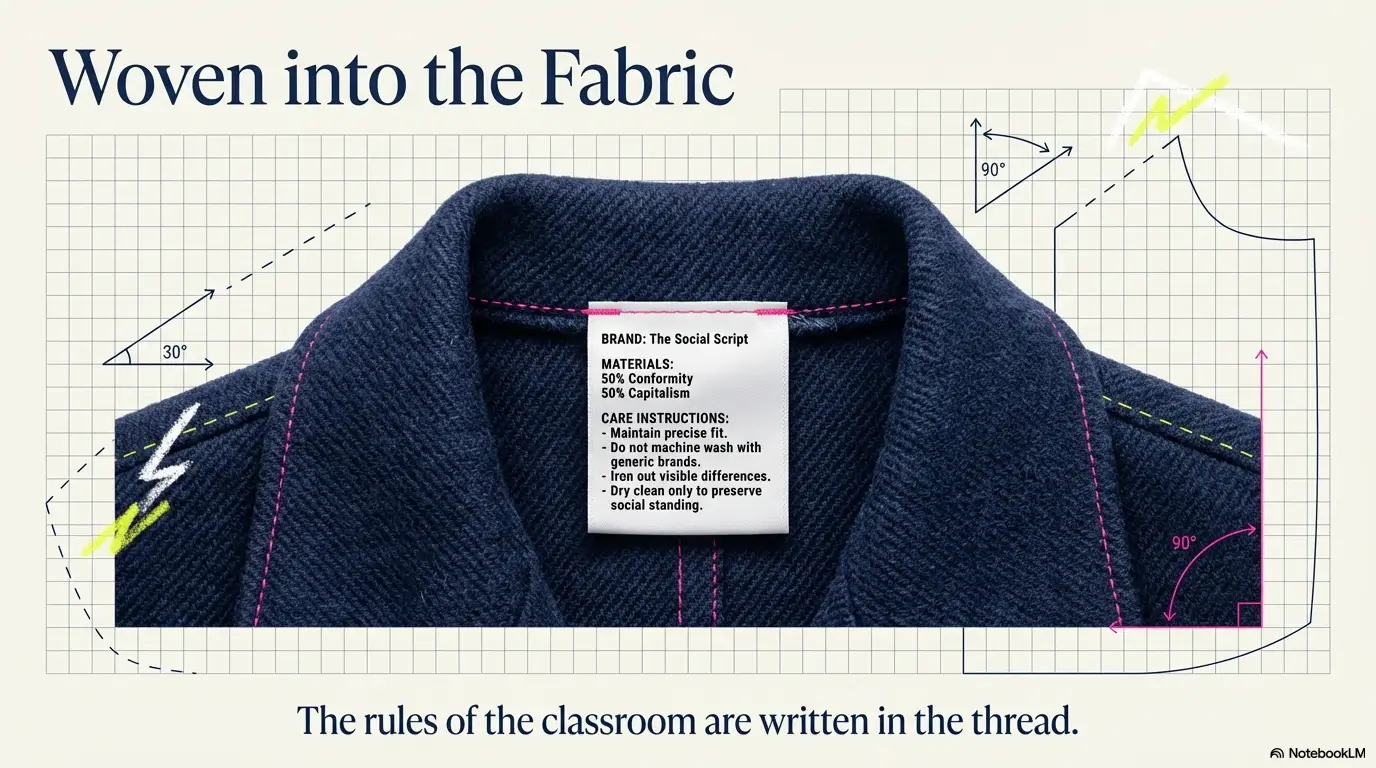
This small comparison can be done in 15 minutes, and it will teach you more than fifty lazy online takes. It closes the loop from the beginning of this article. A uniform in Korea is not just a dress code artifact. It is a visible carrier of social meaning. Once you see that, you stop reading the blazer as cloth and start reading it as culture. Readers who want to keep tracing how Korean institutions shape everyday belonging might also find South Korean school lunch culture useful, since food lines and lunchrooms often reveal the same mix of routine, hierarchy, and group feeling from a different angle.
Quote-prep list: what to gather before comparing school dress systems
- One actual uniform or dress code policy
- One note on enforcement style
- One note on student self-expression limits
- One note on public image or school identity
Neutral action: Put those four notes side by side and compare what the system is protecting.
Differentiation Map
What competitors usually do
- Explain what Korean uniforms look like
- Give a flat history summary
- Frame the topic as strictness versus freedom
- Generalize all Korean schools into one experience
- Ignore student emotion, peer signaling, and school reputation
How this outline avoids it
- Treats uniforms as a cultural signal, not just a garment
- Focuses on what uniforms communicate socially and emotionally
- Builds in misreading-prevention for US readers
- Includes nuance around belonging, pressure, and self-expression
- Avoids stereotype bait and “East vs West” simplifications
The real advantage of this approach is simple. It lets readers leave with sharper perception instead of louder assumptions. And that, frankly, is rarer on the internet than it should be. The same discipline helps when reading other Korean social codes too, whether in Korean group chat culture or in the way names and roles work in Korean titles versus first names.
Last reviewed: 2026-04.