
The Choreography of Connection
In Korea, getting someone’s name “right” is not always about the name at all. It is about relationship, rank, age, warmth, and social timing, which is why Koreans use titles instead of first names far more often than many Anglo-American readers expect.
That gap can create surprisingly awkward moments. A choice that feels friendly in English, like using a first name to sound open and relaxed, can land as abrupt, unfinished, or quietly overfamiliar in Korean speech. Keep guessing, and you risk reading warmth as coldness, or performing friendliness in a way that actually creates distance.
“This guide helps you understand Korean titles, honorifics, and kinship terms as a living social system. You will see when first names work, why titles sound more natural, and how to avoid the small mistakes that change the whole temperature of a conversation.”
Names identify. Titles position.
In Korean, that positioning often comes first. Let’s make the choreography visible before the next conversation begins.
Table of Contents

Start With the Real Reason: Names in Korea Carry Social Position
A name is not just a label, it is a relationship marker
In English, a name often acts like a clean little tag on a coat hook. It identifies. It points. It gets the job done. In Korean, the act of addressing someone usually does more work than that. It tells the listener how you are placing them socially and emotionally. Are they older? Younger? Senior at work? Close friend? Teacher? Customer? Someone you respect but do not yet know well? That relational positioning matters before the content of the sentence even lands.
I learned this the way many people do: by translating too literally in my head. “Why not just use the name?” sounds sensible until you realize the name is not the whole instrument. In Korean, the form of address is part of the music.
Why Korean speech often asks, “Who are you to me?”
This is the hidden logic many outsiders miss. Korean honorific systems are not only about “being polite” in the abstract. They encode how speaker and listener stand in relation to each other. Academic work on Korean address notes that appropriate terms of address are entangled with power, status, intimacy, and expectation, not just dictionary meaning. Research and linguistic descriptions also note that Korean often avoids direct second-person pronouns and relies instead on titles, kinship terms, or context-sensitive address forms.
First names can feel unfinished without a role attached
That is why a first name alone can sound abrupt or oddly bare in many situations. Not always rude. Not always forbidden. Just socially underdressed. It can feel like showing up to a formal dinner in socks and conviction. You are technically clothed, but the room still notices.
- Names identify people
- Titles position relationships
- Suffixes tune tone
Apply in 60 seconds: Before speaking, ask yourself one question: “What is this person’s role relative to me right now?”
Respect Comes First: Why Titles Often Sound More Natural Than Names
How titles signal courtesy before intimacy
One reason titles remain so common is that they let speakers start from safety. A title can show courtesy without forcing false closeness. In a workplace, classroom, or family introduction, that matters. You are not guessing at intimacy. You are honoring distance until the relationship tells you otherwise.
Why age and seniority still shape everyday address
Age matters in Korean interaction more visibly than it does in mainstream American speech. That does not mean every conversation is a miniature throne room. It means speakers often calibrate language according to relative age and seniority. The National Institute of Korean Language’s learner dictionaries define honorific speech as deferential language and explicitly note use toward older people or those of higher position. This is one reason guides to Korean politeness so often begin with placement before phrasing.
In Korean, sounding “correct” often matters more than sounding casual
This is where US readers sometimes misread the room. In American settings, casualness often performs friendliness. In Korea, correct address can perform care. Using the right title may sound less spontaneous to an English ear, but to a Korean ear it can feel thoughtful, socially literate, and pleasantly unembarrassing. There is a special kind of kindness in not making the other person do the labor of forgiving your over-familiarity.
- Yes: The person is older than you or clearly senior in rank
- Yes: You just met them
- Yes: You are in a workplace, classroom, or formal family setting
- No: You are close peers and have already shifted to casual speech together
Next step: If you checked 2 or more “Yes” items, start with a title or title-like form instead of a bare first name.
Not Just the Office: Where Titles Show Up in Daily Korean Life
At work: 직급 and job titles as social shorthand
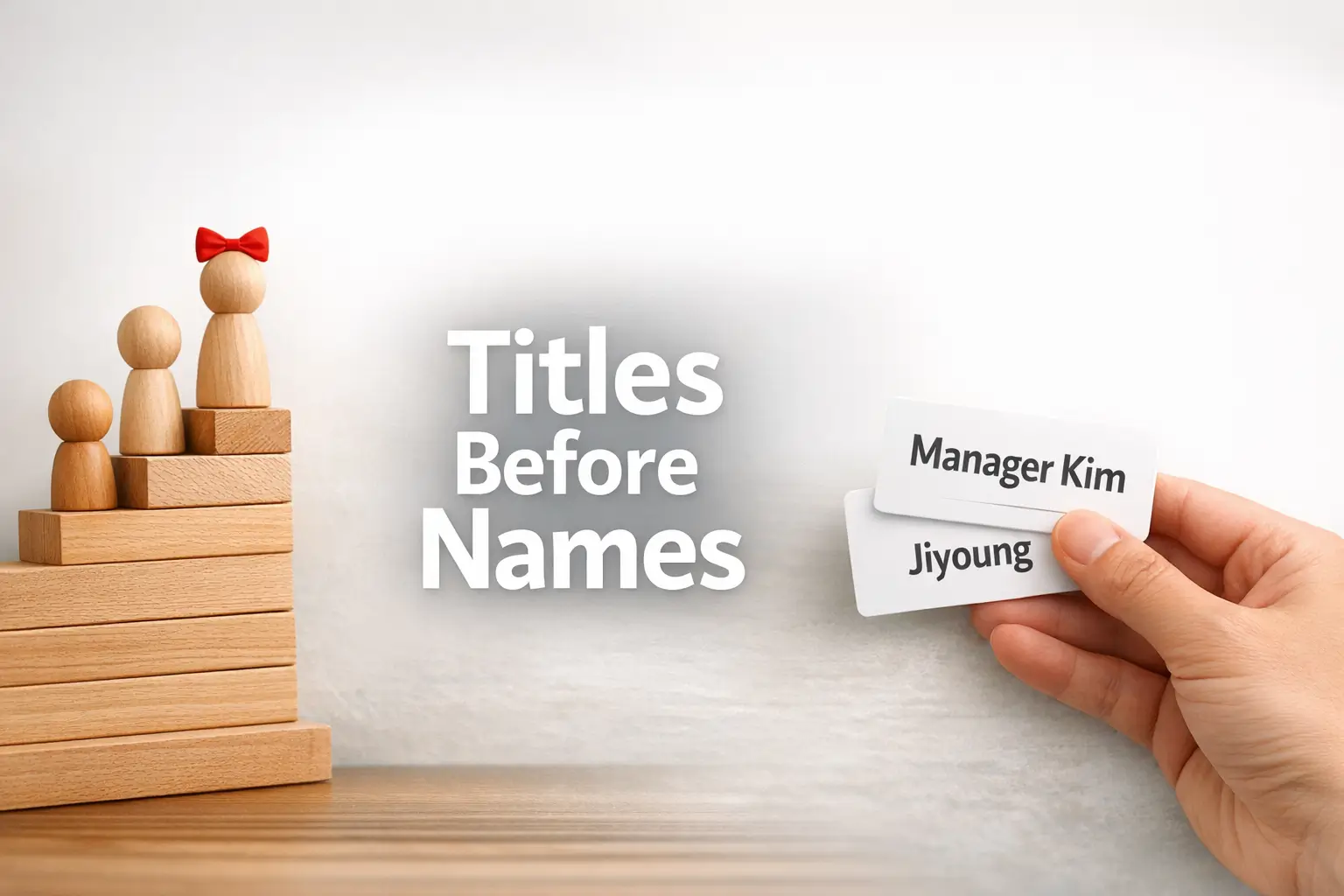
In Korean workplaces, job titles do real conversational labor. They are practical shorthand, yes, but also socially stabilizing shorthand. Calling someone “Manager Kim,” “Director Park,” or “Team Leader Lee” does not merely identify their job. It places them in the company’s conversational map. This is especially handy in group settings where several people may share a surname and where hierarchy affects turn-taking, deference, and expectations.
At school: teachers, seniors, juniors, and role-based address
Schools are another classic example. Teachers are typically addressed by title, not by first name. Seniors and juniors also often navigate school life through relationship terms such as sunbae and hubae. That word choice does not just say “older student” or “younger student.” It says how the social bridge is arranged. You can feel similar relationship-mapping at work in articles about Korean university orientation, where social role is often established before casual familiarity appears.
In families and neighborhoods: kinship terms that stretch beyond blood
This may surprise outsiders most. Korean kinship terms can stretch beyond strict blood relations. Official dictionary entries from the National Institute of Korean Language include examples where honorific family terms are used for people treated like family or for older adults in familiar community settings.
That is why a child may call a familiar older woman “auntie”-like terms, or an adult may use older-sibling terms socially rather than biologically. The terms carry relationship feeling more than courtroom genealogy.

Here’s the Twist: Titles Can Feel Warmer, Not Colder
Why “unnie,” “oppa,” or “sunbaenim” can sound affectionate
To many Americans, titles can initially feel refrigerated. Crisp. Formal. Slightly corporate. But relational terms in Korean often carry warmth precisely because they place people inside a bond. Calling someone unnie, oppa, or sunbaenim can signal affection, familiarity, admiration, and belonging all at once. The term is not a wall. It is sometimes the bridge itself.
How relational words create belonging inside a group
I have watched this dynamic click into place for learners almost like the moment a blurry lens sharpens. They assume titles create distance. Then they hear a younger person say a title full of fondness, teasing, and trust, and the whole theory collapses in the nicest possible way. Korean address is not only vertical. It is textured.
The emotional difference between distance and dignity
This distinction matters. Distance says, “Stay away.” Dignity says, “I know how to place you with care.” Many Korean titles are performing dignity. Sometimes they also perform closeness. Sometimes both. That doubleness is exactly why literal translation fails. English tends to split warm and respectful into different drawers. Korean often keeps them in the same cabinet.
Bold truth: In Korean, formality and affection are not enemies. They are often dance partners.
First Names Are Not Forbidden: They Just Follow Different Rules
When first names are normal among close friends and peers
Let us clear one foggy myth off the table. Koreans do use first names. Close friends of the same age often do. Peers may do. Families certainly do. Romantic partners may, though often mixed with pet names or relational terms. The issue is not a ban on first names. The issue is context.
Why first names often need a suffix or softener
Even when first names appear, they are frequently softened with endings or paired with speech levels that make the address feel socially coherent. A bare name can feel sharp. A name plus a suffix can feel natural. This is why two syllables may carry more social weather than a whole English sentence.
What changes when two people are the same age
Same-age friendship can loosen the system considerably. Age equality removes one major source of tension, though not the only one. Workplace roles, group culture, and personal preference still matter. Two 29-year-olds in a company meeting do not necessarily speak like two 29-year-olds at midnight over fried chicken. Context keeps scoring the scene.
| Situation | Safer choice | Trade-off |
|---|---|---|
| New coworker, older or senior | Title + polite speech | Feels formal, but low-risk |
| Close same-age friend | Name + agreed casual style | Warm, but only after mutual comfort |
| Unsure relationship | Ask preference politely | A little awkward for 5 seconds, helpful for months |
Neutral action: When uncertain, choose the option that can be relaxed later.
Don’t Miss This: The Suffix Often Matters as Much as the Name
Why adding “-ssi,” “-ah,” or “-ya” changes the tone completely
This is where non-Korean speakers often discover that one tiny syllable can swing the emotional weight of a sentence like a hinge. A suffix can turn a plain name into a polite one, an intimate one, or an inappropriately casual one. Not because the sound itself is magical, but because everyone in the conversation has spent a lifetime hearing what it signals.
The difference between polite naming and intimate naming
Roughly speaking, forms like -ssi can add polite distance, while vocative endings like -ah or -ya are intimate and typically reserved for close relationships or downward/equal address. Linguistic descriptions note that such casual endings are used among close friends or toward younger people, and can sound rude if aimed upward or used too early. Readers who want a wider map of these layered choices may also find a practical guide to Korean honorifics for foreigners useful here.
Small endings, big social meaning
I once watched a learner spend 10 minutes choosing the perfect noun in Korean, only to discover the real tone problem sat in the last syllable. It was almost comic. Like choosing an elegant suit and then wearing flippers. The sentence was grammatically fine. Socially, the shoes squeaked.
Show me the nerdy details
Korean address is not just about vocabulary. It is a stack of interacting systems: honorific nouns, humble verbs, speech levels, suffixes, pronoun avoidance, rank terms, kinship extensions, and situational expectations. That is why one English gloss almost never captures the full force of a Korean address form. The same lexical item can feel respectful, affectionate, hierarchical, awkward, or ironic depending on who says it, to whom, where, and in what speech level.
- -ssi usually softens with polite distance
- -ah/-ya usually marks closeness or downward/equal address
- A bare first name can feel exposed
Apply in 60 seconds: When you are tempted to use a first name, pause and ask whether the relationship has actually earned that level of casualness.
Common Misreadings: Why Americans Often Hear Titles as Stiff or Corporate
US naming culture tends to favor friendliness through first names
In the United States, many people are trained early to treat first-name use as a signal of openness, equality, and ease. Teachers may invite it. Bosses may insist on it. Brands use it in email subject lines as if they are trying to be your tennis partner. So when Americans hear titles used repeatedly, they may assume the relationship is cold.
Korean culture often favors respect through correct positioning
But Korean speech often begins from a different premise. The social success of an interaction depends not on flattening differences immediately, but on acknowledging them gracefully. Korea.net has described the Korean language as using extensive honorifics to reflect the speaker’s relationship to the subject and speech levels to reflect the relationship to the listener, and it has also noted that addressing people by given names can be perceived as impolite in some contexts.
Same goal, different route: connection built through form, not informality
That difference can be hard to feel from the outside. The American route to comfort often says, “Let us act equal quickly.” The Korean route often says, “Let us place each other correctly first, then relax naturally.” Same destination. Different bridge.
Neither system is morally superior. Each one has its blind spots. American first-name culture can become fake-fast intimacy. Korean title culture can feel exhausting to newcomers. But when you understand the logic, the system stops looking severe and starts looking precise. That is also why pieces on Korean indirect communication and silence in conversation often resonate with the same readers. The deeper pattern is calibration, not stiffness.
Common Mistakes: What Foreigners Get Wrong About Korean Titles
Mistake 1: assuming titles mean emotional distance
This is probably the biggest one. A title may mark care, not coldness. A respectful term may signal that the speaker knows where the edges are and values the relationship enough not to stomp across them in muddy boots.
Mistake 2: using a first name alone because it feels friendlier in English
What feels friendly in one language can sound startlingly direct in another. This happens all the time with well-meaning foreigners. They import the emotional logic of English into Korean and then wonder why the exchange lands with a soft social thud.
Mistake 3: treating every title as a rigid rule instead of a context cue
The opposite mistake is becoming so frightened of error that you speak as though every Korean interaction is a certification exam. It is not. Koreans know context matters, generations differ, and foreigners will not always hit the perfect note. The goal is not robotic correctness. It is informed sensitivity.
- Relative age
- Relative rank or role
- How close the relationship already is
- Whether the setting is public, private, formal, or casual
Neutral action: These four clues will solve more than half your uncertainty without memorizing 50 terms.
Let’s Be Honest: This Is Where Things Get Socially Risky Fast
Why copying K-drama speech can backfire in real life
K-dramas are delightful teachers of mood and terrible teachers of universal safety. They are full of heightened intimacy, compressed tension, class signaling, flirtation, and characters who can get away with lines that would sound bizarre coming out of a foreign coworker’s mouth on a Tuesday morning. Drama language is language under stage lights.
How over-familiar address can sound presumptuous, not charming
A term that reads as adorable in subtitles may sound presumptuous in real life if the relationship does not support it. That is especially true for kinship-like address and intimate endings. I know the temptation. You hear a term repeatedly, it starts to feel emotionally available, and suddenly your brain says, “Yes, I too shall speak like a lead in episode 11.” Your brain is not always a careful diplomat.
Why one wrong form of address can shift the whole tone of a conversation
Because address terms frame the relationship before content arrives, a mismatch can alter the tone of everything that follows. Even a perfectly ordinary request can sound brash if the address is too casual, too intimate, or too blunt. Learners often think the problem lies in vocabulary choice or grammar, when the real trouble entered the sentence in the first second. Research on Korean address and honorifics repeatedly notes how much social cognition is required to choose an appropriate form. The same warning applies when learners borrow tone cues from media instead of from lived context, a pattern that also surfaces in discussions of what “maybe” can really mean in Korean conversation.
- K-drama speech is stylized
- Real life is more context-bound
- Safe language ages better than performative fluency
Apply in 60 seconds: Retire any Korean term you learned from romance scenes until you know exactly who can say it to whom.
Don’t Do This: First-Name Logic Does Not Travel Cleanly Across Cultures
Why direct translation creates awkwardness
One of the quiet traps of intercultural communication is assuming you can translate not just words, but the emotional job those words do. You usually cannot. “Call me John” in English may invite ease. The direct Korean equivalent may not create the same social effect, because the surrounding norms differ.
The danger of asking to “just call me by my name” too early
Foreign professionals sometimes try to flatten the room by saying, “Please, just call me by my first name.” Sometimes that works. Sometimes it places the Korean listener in an odd position, because their comfort may depend on role-marked address, not its removal. What feels liberating to one person can feel like being asked to cross a bridge that has not been built yet.
When cultural simplicity becomes social friction
There is a minimalism that helps, and a minimalism that scrapes. The latter often arrives disguised as sincerity. “I am just being direct” is one of the most expensive sentences in cross-cultural life. Not financially expensive, granted. Spiritually expensive. It buys confusion at premium rates.
Title or role + polite speech
Name + polite suffix or stable relational term
Casual name use, intimate endings, or shared shorthand
Core idea: Korean address often starts with role clarity and relaxes with trust, not the other way around.
Here’s What No One Tells You: Titles Also Reduce Ambiguity
How titles clarify role, rank, and expected behavior instantly
There is also a practical reason titles endure. They are efficient. In fast-moving group settings, titles tell everyone who someone is within the interaction, what sort of deference is expected, and how to shape the response. That efficiency becomes especially useful in workplaces and schools where multiple people may share the same surname and where relative rank matters materially.
Why relational language helps groups stay orderly
Titles reduce friction because they embed context in the address itself. The form of address is carrying metadata. You do not have to build the social frame from scratch every time. You inherit it. That is not just politeness. It is compression.
In fast-moving social settings, titles can be efficient as well as polite
Think of it like good file naming. Not glamorous. Very useful. Everyone pretends they do not care, right until they need to find something quickly. Then the structure suddenly feels like love. The same instinct appears in visible social rituals such as Korean seating hierarchy, where position communicates expectations before anyone says much at all.
- Tier 1: Stranger or formal superior. Use title-first language.
- Tier 2: Known but not close. Title or name with polite suffix.
- Tier 3: Friendly peers. Name use becomes more possible.
- Tier 4: Close group bond. Relational terms may carry warmth.
- Tier 5: Intimate circle. Casual endings and shorthand may appear naturally.
Neutral action: Do not skip from Tier 1 to Tier 5 because subtitles made it look easy.
Who This Is For / Not For
This is for readers trying to understand Korean workplace, dating, school, or family dynamics
If you are working with Koreans, dating a Korean, visiting family, studying abroad, or simply trying to stop misreading social tone, this framework is for you. It is especially useful if you keep noticing that the literal dictionary meaning of an address term is not enough to explain its emotional feel.
This is for travelers, expats, students, and K-culture readers who want fewer awkward moments
It is also for the thoughtful observer. The person who can tell that something important is happening in the language but does not yet have the handle for it. The person who hears “oppa” or “sunbaenim” and senses there is more there than subtitle glue.
This is not for readers looking for a single universal rule that fits every Korean interaction
No one gets that rule, because it does not exist. Younger Koreans vary. Workplaces vary. Friend groups vary. Regions, class signals, company cultures, and individual preferences all matter. What you are getting here is not a magic password. It is a reliable compass.
Years ago, I watched a foreign student in Seoul try very hard to be warm. He had learned enough Korean to order coffee and enough K-drama to feel brave. When the barista, a woman a few years older, handed him the drink, he used her name exactly as it appeared on the nametag, with the confidence of a man throwing a paper airplane into weather he had not checked.
Nothing catastrophic happened. She was not offended. But the air changed. It was tiny, almost invisible, like a piano note played with the wrong finger. Later, a Korean friend explained the problem gently: it was not that he had used a “bad” word. He had used a socially unfinished one. A title, a suffix, or simply a more neutral response would have sounded smoother. That was the moment the whole system clicked. Korean address was not theater. It was fit.
Next Step: Learn One Safe Default Before You Try to Sound Natural
Start by using the person’s title plus polite speech when possible
If there is one habit that will save you the most embarrassment, it is this: start more respectfully than you think you need to, then relax only when the relationship clearly allows it. This costs very little and prevents a surprising amount of discomfort.
If you do not know the right title, ask how they prefer to be addressed
That question is not a sign of failure. It is a sign that you understand address is relational. In fact, it often lands well precisely because it shows care. People are usually more comfortable with a cautious question than a casual assumption delivered with great confidence and unfortunate timing.
One careful question prevents a surprising amount of awkwardness
That is the practical heart of this whole article. Do not chase instant naturalness. Chase accurate warmth. Naturalness comes later, usually as a side effect of listening well. If you want a broader beginner-friendly frame, articles on Korean honorifics for tourists can work as a useful companion piece before readers move into finer distinctions like the ones here.
- Title first is rarely a disaster
- Bare first names can be
- Questions are cheaper than repairs
Apply in 60 seconds: Memorize one sentence you can use when unsure: “How would you like me to address you?”

Conclusion
So here is the curiosity loop from the beginning, closed carefully. Koreans do not use titles instead of first names because they are cold, antique, or incapable of friendliness. They do it because Korean address is built to carry relationship with much finer grain. Titles help speakers show respect, locate hierarchy, signal belonging, avoid bluntness, and sometimes even express warmth more naturally than a first name could.
That is why the system can look formal from the outside and feel affectionate from the inside. The room was never trying to freeze you out. It was trying to place everyone properly before the conversation moved forward.
Your next step can be done in 15 minutes. Learn one safe default for work, one for casual peers, and one question for uncertain situations. That tiny trio will take you farther than a hundred memorized terms used in the wrong weather.
Last reviewed: 2026-04.
FAQ
Is it rude to call a Korean person by their first name?
Not automatically. Among close friends, peers, family members, and some modern workplaces, first names are perfectly normal. But in many situations, a bare first name can sound too direct or socially incomplete. The safest answer is that first-name use depends on age, rank, closeness, and setting, not just personal intention.
Why do Koreans ask age so early in a conversation?
Because age often helps determine speech level, address terms, and the general shape of the interaction. To many foreigners, the question can feel abrupt. In context, it often functions as a practical social calibration tool rather than pure nosiness. Readers who want the wider social backdrop may also enjoy why personal questions can arrive earlier in Korean conversation.
Do younger Koreans still use titles a lot?
Yes, though usage varies by context and generation. Younger Koreans may be more flexible in some friendship circles and workplaces, but titles, polite speech, and relational terms still remain very common. The system has shifted in places, not vanished.
Are titles more important in workplaces than among friends?
Usually yes. Workplaces tend to preserve titles more consistently because role and hierarchy matter to group coordination. Friend groups of the same age often relax the rules more quickly, though that depends on the group and how intimacy develops.
What is the difference between using a title and using “-ssi”?
A title usually names the person’s role, such as teacher, manager, or director. -ssi is a polite name suffix that can soften personal-name use. It does not function exactly like an English Mr. or Ms., and it does not replace the full social logic of titles, but it often helps make a name feel more appropriately respectful.
Why do Koreans use family terms for non-family members?
Because kinship terms in Korean can do social work beyond biology. They may mark age, affection, familiarity, or community placement. Official dictionary examples also show honorific family terms extending beyond literal family use in some contexts.
Can foreigners be excused for getting titles wrong?
Often yes, especially if they are clearly trying and receptive to correction. Most people can tell the difference between ignorance and arrogance. A small mistake made with humility is usually easier to forgive than a bold over-familiarity defended as “just being myself.”
When does a relationship become casual enough for first names?
There is no universal countdown timer. Usually it becomes clearer through repeated interaction, age equality, speech-level shifts, or explicit permission. If you are wondering, you probably still benefit from a small amount of caution. Ask, observe, and let the relationship earn the shortcut.