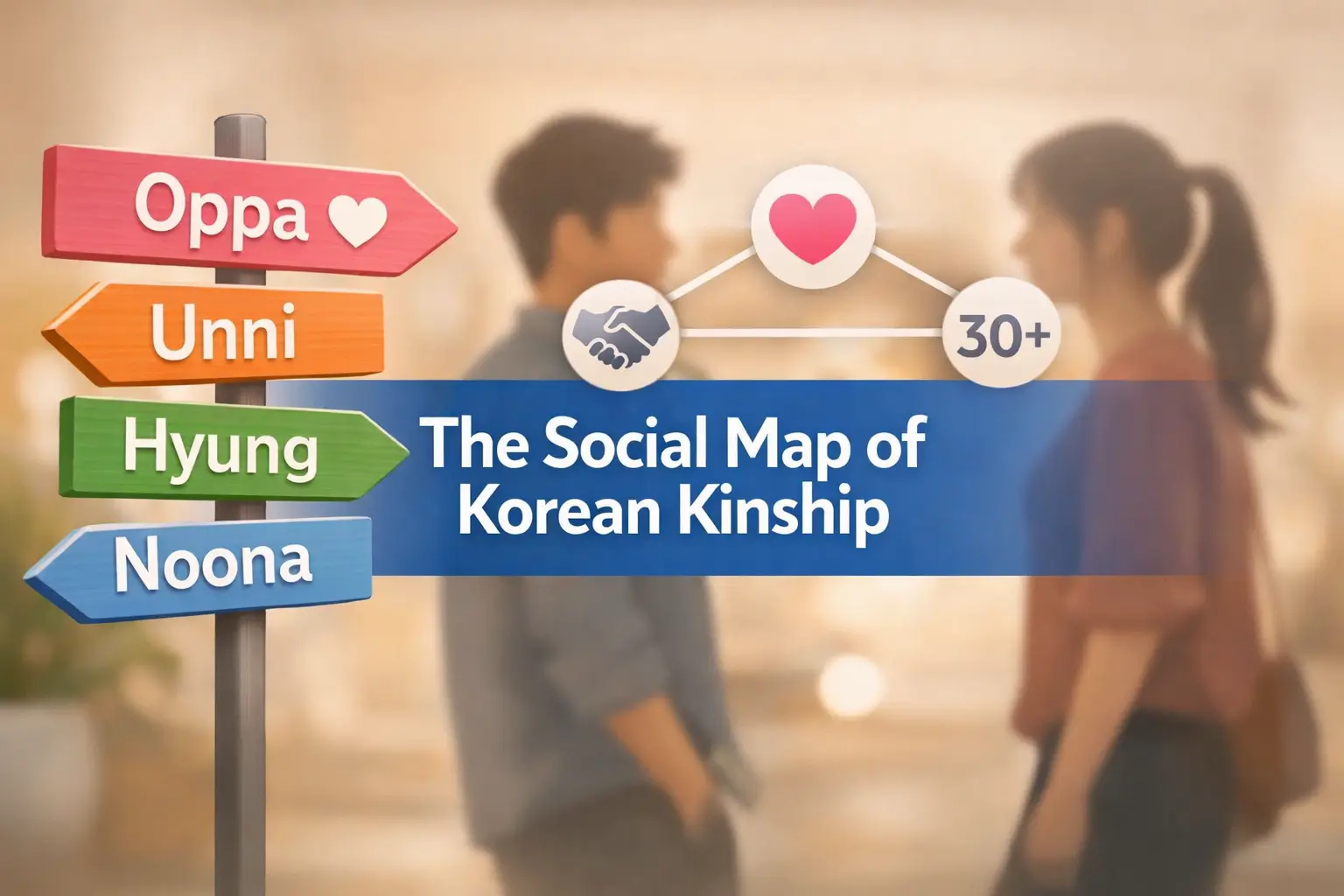
The Social Map of Korean Kinship
You can memorize oppa, unni, hyung, and noona in under two minutes and still get them wrong in real life. That is because these Korean kinship terms are not just vocabulary. They are social positioning disguised as simple words.
For many English-speaking learners, the confusion starts when dictionaries say one thing while K-dramas suggest another. The result is a strange kind of fluency: you know the translation, but not when the word will sound warm, awkward, or just plain off.
“Oppa, unni, hyung, and noona are relationship signals rather than neat labels. Once you see the social map underneath, the language becomes much easier to read.”
Fast Answer: Foreigners get confused by oppa, unni, hyung, and noona because these words do not behave like neat English labels. They depend on the speaker’s gender, the other person’s gender, age difference, closeness, setting, and tone. In real Korean, they do more than identify a person. They quietly define the relationship between two people.
Table of Contents
The First Confusion: These Are Not Just Family Words
The first mistake most learners make is very reasonable. They assume oppa means “older brother,” unni means “older sister,” hyung means “older brother,” and noona means “older sister.” Technically, yes. Practically, not enough.
Those English glosses are like sketching a whole city with four matchsticks. The outline exists, but the streets are missing.
In Korean, these words can refer to actual siblings. But they also spill into friendships, romantic relationships, close social circles, and some peer settings. That is why foreigners hear them everywhere and start thinking, “Wait, are these all siblings?” Usually, no. They are hearing social placement, not family census data.
A familiar beginner scene goes like this: someone hears a woman call a non-relative man oppa, stores it as “cute word for boyfriend,” and then carries that assumption into every conversation like a candle into a swimming pool. The flame dies fast.
The National Institute of Korean Language has long treated kinship and address terms as part of a broader system of Korean social language, not just household vocabulary. Its materials on family address forms also make clear that Korean naming practices are deeply relational and not always fixed by one rigid rule alone.
- Literal translation gets you started, not finished.
- Real meaning lives in the relationship, not just the noun.
- Hearing one term often tells you more about closeness than blood relation.
Apply in 60 seconds: The next time you hear one of these words, ask who is speaking, not just who is being named.

Who Says What, to Whom, and Why It Matters So Much
This is the first layer every learner needs, and it matters because the speaker’s gender changes the word itself. That is one reason translation charts feel tidy while actual usage feels like jazz played on moving stairs.
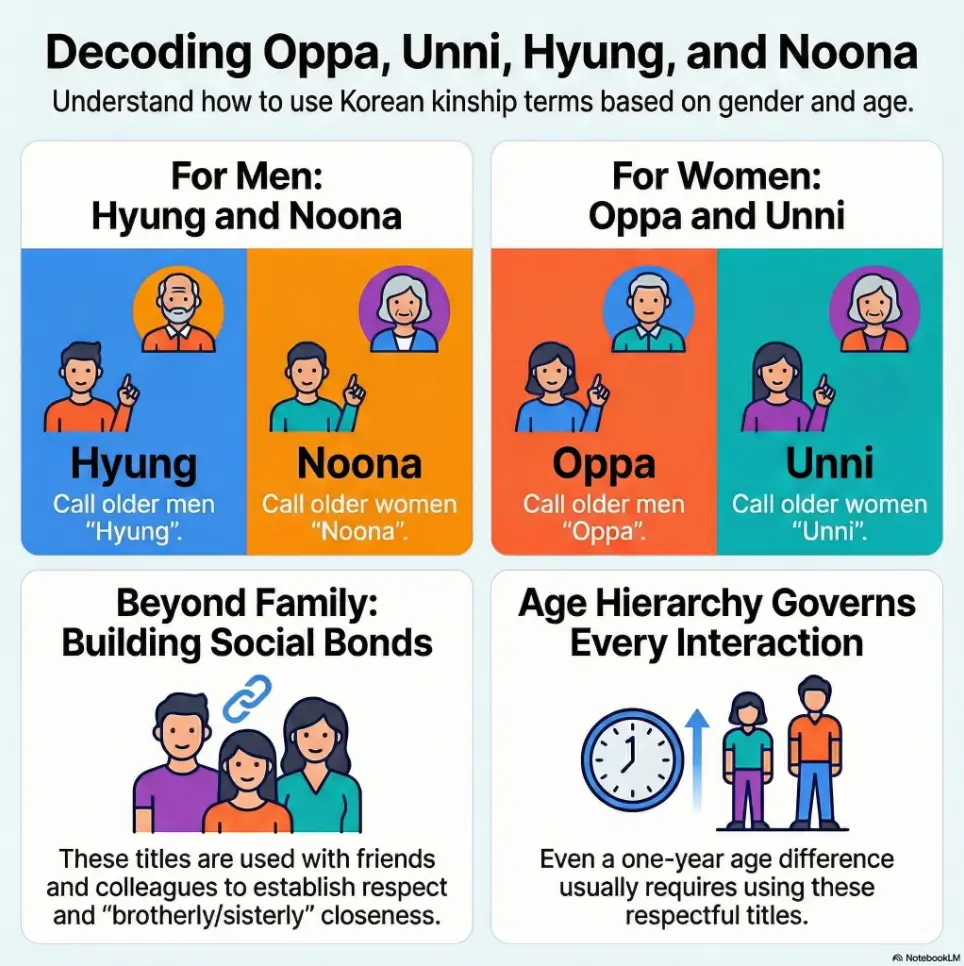
Oppa: said by a female to an older male
Oppa is used by a female speaker to an older male in a close enough relationship for that term to feel natural. That could be a real older brother. It could also be a male friend, a boyfriend, or someone in a socially warm older-male position.
Unni: said by a female to an older female
Unni is what a female speaker says to an older female. Again, this may be family, but it often extends beyond family into friendships and social groups where warmth and familiarity exist.
Hyung: said by a male to an older male
Hyung is used by a male speaker to an older male. Many foreigners know the definition but still miss the texture. In some contexts it feels brotherly, in others respectful, in others playful and deeply group-bound.
Noona: said by a male to an older female
Noona is used by a male speaker to an older female. It may be affectionate, casual, warm, or lightly flirty depending on context. The word itself does not automatically create romance. Tone and relationship do that work.
Why the speaker’s gender changes the word itself
This is where English speakers often hit a wall. English generally does not force you to encode the speaker’s gender in ordinary address terms this way. Korean often does. The National Institute of Korean Language explains that Korean kinship and address systems reflect distinctions such as gender, age, family line, and relationship role. A Korean-language institute article on gendered language also notes the speaker-based distinction between hyung/oppa and noona/unni.
Eligibility checklist: can you safely choose one of these words yet?
- Yes/No: Do you know the other person is older than you?
- Yes/No: Do you know whether the relationship is socially close enough?
- Yes/No: Do you know whether the setting is casual enough?
- Yes/No: Have you heard others around them use the same term naturally?
Next step: If two or more answers are “no,” default to the person’s name or a title.
Here’s the Part Foreigners Usually Miss: Age Is Not the Only Variable
Age matters, but age alone is not enough. This is where many technically correct learners still sound off.
Closeness changes whether the term feels natural
You can be younger than someone and still sound strange using oppa, unni, hyung, or noona if the relationship is not there. Korean is full of words that are grammatically possible and socially unconvincing. These are four of them.
Imagine meeting someone once at a language exchange and immediately calling them oppa because they are three years older. That may not land as warm. It may land as overfamiliar, performative, or oddly imported from drama logic.
Setting changes whether the term feels respectful, warm, or awkward
A café with friends, a university club, a family gathering, a workplace dinner, a retail counter, and a formal office meeting are not the same acoustic room. The same word can sound natural in one and misplaced in another. Korean social language is highly setting-sensitive. If you want to see how structure and age awareness surface in everyday group behavior, the same relational logic shows up clearly in Korean seating hierarchy as well.
Tone can make the same word sound affectionate, playful, formal, or teasing
Even within the same relationship, tone changes the weather. A stretched-out opppaaa in a drama is not the same creature as a quick, matter-of-fact oppa in ordinary speech. One is emotional spotlighting. The other may just be everyday address.
I have watched learners spend twenty minutes memorizing who says what, then freeze when they hear the same term spoken in three different tones. That is not failure. It is the moment they realize the word has muscles, not just bones.
Bold truth: In Korean, the emotional distance matters almost as much as the age difference.
Not a Dictionary Problem, a Relationship Problem
When learners get stuck here, they often blame memory. But memory is not usually the villain. The real problem is trying to solve a relationship system with a translation method.
English tends to let us use names widely and directly. Korean often asks a different question first: what is the relationship between speaker and listener, and what should the language reveal about it?
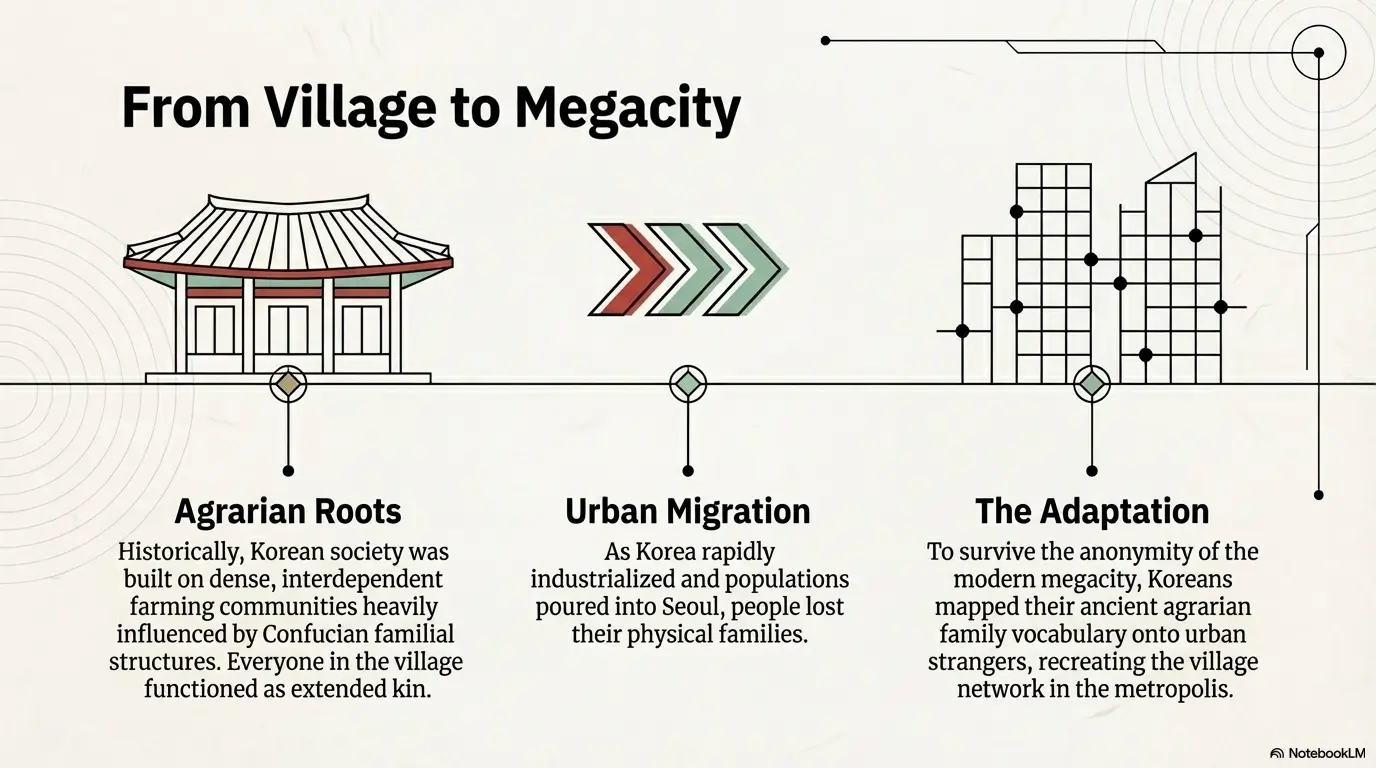
That means these terms work less like labels and more like relational positioning. They do not merely identify a person. They place that person inside a social map. Who is older. Who is closer. Who is inside the circle. Who is still outside the gate.
The National Folk Museum of Korea’s materials on family life and rites show how deeply family roles, age ordering, and social hierarchy have historically shaped Korean life. You do not need to carry Joseon-era etiquette into a coffee date, of course, but the larger cultural logic did not appear from nowhere. It grew out of centuries of role-conscious social organization.
That is why advanced learners can explain the terms perfectly and still hesitate in the moment. The issue is not semantics alone. It is social timing. That tiny pause before speaking is often a sign that your cultural instincts are waking up. In that sense, these kinship terms overlap with broader patterns of Korean indirect communication and the subtler rules of Korean politeness.
- English asks, “What is this person called?”
- Korean often asks, “What is this person to me?”
- That is why clean definitions still produce messy real-life choices.
Apply in 60 seconds: Replace the question “What does this mean?” with “What social distance is this showing?”
Don’t Do This: Treating Oppa Like a Universal Nickname
If one word has caused more foreign overconfidence than the others, it is oppa. Pop culture gave it glitter. Real life gave it brakes.
Why K-drama usage creates false confidence
Dramas use language like stage lighting. Everything is dialed for intimacy, tension, character chemistry, or emotional reveal. That does not make dramas fake. It makes them selective. Viewers hear oppa in concentrated doses and then assume it functions like a universal charm key.
Why repeating oppa everywhere can sound forced or juvenile
Outside the right relationship, repeated oppa can sound performative, babyish, or imported from fandom theater. Some Korean speakers may laugh it off. Others may feel secondhand embarrassment on your behalf, which is a social weather system best avoided.
When a name, title, or nothing at all is better
Sometimes the most natural choice is a name. Sometimes it is a title. Sometimes it is simply eye contact plus the sentence itself. New learners often underestimate how often Korean avoids the dramatic little label they were hoping to deploy. That is also why getting comfortable with Korean titles versus first names matters more than many beginners expect.
A useful internal rule is this: if you are excited to use the word, that is exactly when you should slow down. Linguistic confetti is still confetti.
Decision card: when a kinship term beats a name, and when it does not
| Situation | Safer choice | Trade-off |
|---|---|---|
| New acquaintance, age known, closeness low | Name or title | Less warmth, far less risk |
| Friend group, clear age order, others already use it | Kinship term may work | More warmth, moderate risk |
| Work or formal context | Title | More distance, better professionalism |
Neutral action: choose the option that lowers social risk first. Fluency grows better in calm air.
K-Drama vs Real Life: The Gap That Causes Most Mistakes
Dramas are useful. They are also deliciously misleading. They train your ear and distort your expectations at the same time, like learning city traffic from a car chase.
Why dramas amplify intimacy, tension, and emotional shorthand
Writers need emotional speed. A single oppa with the right tone can compress longing, irritation, affection, rank, history, and subtext into one beat. That is brilliant screenwriting. It is not always normal speech frequency.
Why real-life workplaces, classrooms, and casual groups use these words differently
In real life, people often choose titles, names, job roles, or context-specific alternatives. A university club may sound different from an office. A startup may sound different from a conservative company. A tight friend circle may sound different from a mixed social group where people still feel each other out.
Let’s be honest… many learners are copying scenes, not speech patterns
And that is okay at first. Everyone borrows from somewhere. But eventually you need to graduate from subtitle imitation to social perception. That is where naturalness begins. It is the same trap many learners hit when they rely too heavily on screen dialogue instead of studying how to learn Korean through K-dramas without copying drama logic into real life.
Korea.net recently reported that Korean relational words such as maknae were added to the Oxford English Dictionary in 2025, and that seonbae followed in 2026. That is a small but telling clue: even English is borrowing Korean social vocabulary because simple one-to-one replacements do not carry enough of the relational meaning.
Show me the nerdy details
Korean address terms belong to a broader sociolinguistic system where reference, respect, age, in-group belonging, and speaker identity all interact. That is why “translate the word” solves less than learners expect. In technical terms, you are not only mapping semantics. You are mapping indexical meaning: what the term points to socially.
Illustrative scenario, not a reported event: At dinner, several friends use different forms for the same older person. A learner asks how to address that person rather than copying the loudest speaker. The relationship and the person’s preference provide more guidance than age alone.
The Social Map Under the Word
Inside these four words travel at least three things at once: hierarchy, warmth, and belonging. That is why the “correct” word can still feel wrong in the wrong relationship.
How hierarchy, warmth, and belonging all travel inside one term
Hierarchy says who is older. Warmth says whether the relationship is intimate enough. Belonging says whether this kind of address is shared and accepted inside the group. Miss any one of those, and the word can wobble.
Why using the “correct” word can still feel wrong in the wrong relationship
Because language is not a math worksheet. A woman can say oppa to an older man she knows well. But if she barely knows him, the word may sound like she is skipping several pages of the social novel.
Why some Koreans invite these terms and others avoid them
Some people love them. They make interaction feel warm, lived-in, and relaxed. Others avoid them outside close circles because they prefer names, titles, or cleaner boundaries. Generational style, personality, work culture, and region can all shade the choice.
A common scene in Korean learning communities is this: one Korean friend says, “Call me unni,” and another never offers that lane at all. Neither is more correct. They are simply drawing their social lines in different places. If you have ever wondered why tone, pauses, and what goes unsaid matter so much, that instinct becomes easier to read once you understand how silence works differently in Korean conversation.
Infographic: The 4-step social filter before you say oppa, unni, hyung, or noona
1. Age
Are they clearly older than you?
2. Speaker role
Are you choosing the term that matches your gendered speaker position?
3. Closeness
Has the relationship earned that level of familiarity?
4. Setting
Would this sound natural here, or would a name/title be cleaner?
Rule of thumb: If you are unsure on Step 3 or Step 4, wait. Korean often rewards patience more than boldness.
Common Mistakes Foreigners Make With Oppa, Unni, Hyung, and Noona
Most mistakes do not come from ignorance. They come from partial knowledge plus too much confidence, which is a recipe with a very dramatic oven.
Using the right word with the wrong emotional distance
This is the classic error. The dictionary match is correct. The relationship match is not. It feels like arriving at a formal dinner in running shoes that happen to be the right color.
Assuming age alone gives automatic permission
Age difference opens the possibility. It does not guarantee the choice. Social permission still matters. That becomes even clearer once you understand the background rules in the Korean age system explained for foreigners.
Copying idol-fan language into normal conversation
Fan culture has its own temperature. Everyday interaction has another. Bringing one into the other can sound theatrical.
Forgetting that some situations favor titles over kinship terms
At work especially, a title may do cleaner, safer, more adult work than a kinship term. Korean has many elegant ways to avoid premature intimacy. That is also why readers who still feel shaky on the bigger picture may want a more general primer on Korean honorifics for foreigners.
Practical check: Use the specific questions and next steps below. A point score cannot establish someone’s intentions, your rights, or whether a social setting fits your needs.
- Right word, wrong distance is still wrong.
- Age creates eligibility, not automatic permission.
- Titles often save you when instinct is still under construction.
Apply in 60 seconds: Before using one of these words, ask whether you are naming a person or performing closeness.
Wait, So When Should You Actually Use These?
Here is the practical part. Most learners do not need more theory. They need a calmer decision rule.
Early-stage interactions: when caution is smarter than confidence
At the beginning, names and titles are often your best allies. They do not sparkle, but they travel safely. In Korean, safe is not boring. Safe is often how trust gets built.
Friendship settings: when these terms begin to sound natural
When you are in a genuine friend circle, the age relationship is known, others use the term, and the social air is relaxed, these words can start to feel natural. Notice the order there. Relationship first. Word second.
Work and school settings: when names or titles are safer
In professional or semi-formal environments, titles and names often beat kinship terms. A lot of foreign learners want a universal rule here, but the safer universal rule is this: do not force warmth where the culture of the setting prefers structure. School life and student groups can have their own variations too, which is one reason Korean university orientation culture often surprises newcomers.
Here’s what no one tells you… sometimes the best choice is to avoid the word entirely until invited
This is not failure. It is good judgment. Some Koreans will clearly signal the lane. Others will not. Listening is part of speaking.
A useful habit is to wait for one of three green lights: the person invites it, the group already uses it around them, or repeated interaction makes the closeness obvious. Until then, your restraint may sound more natural than your courage.
Who This Is For / Not For
This is for readers who hear these terms in K-dramas, K-pop, travel, friendships, or Korean learning
If you keep hearing these words and feel the meaning sliding around under your feet, this guide is for you. Especially if you want to sound human, not memorized.
This is not for readers looking for rigid one-to-one translation charts only
You can find those anywhere. They help for thirty seconds. Then real life arrives and starts rearranging the furniture.
This is especially useful for learners who want to sound natural, not just technically correct
That difference matters. Technically correct language can still sound emotionally misplaced. Natural language is not always the bolder choice. Often it is the more observant one.
A lot of people think fluency looks like speaking quickly. With Korean kinship terms, fluency often looks like pausing half a beat longer and choosing less. Readers who want the broader landscape beyond these four words may also find it useful to read a fuller guide to Korean honorifics in everyday use.
Why Even Advanced Learners Still Hesitate
Because knowing the rule is not the same as sensing the moment. Grammar often matures before social instinct does.
Knowing the definition is not the same as sensing the moment
You can know perfectly that a male speaker says noona to an older female and still have no clue whether saying it now would feel warm, weird, playful, presumptuous, or not worth the gamble.
Why social language often lags behind grammar skills
Grammar can be studied alone. Social language cannot. It needs timing, atmosphere, correction, memory, and a thousand tiny observations. It grows more like hearing than like math.
Why hesitation is sometimes a sign of cultural awareness, not failure
This is worth saying plainly. Hesitation can be intelligent. If you have moved from reckless certainty to careful reading, you are not getting worse. You are finally seeing the full shape of the problem.
Hesitation can be useful when a familiar term may be premature. Ask for the preferred address rather than performing intimacy. Even an advanced learner may need clarification when a new relationship or setting changes the expectations.
- Grammar knowledge arrives first.
- Social timing arrives later.
- The gap between them is normal, not shameful.
Apply in 60 seconds: Reframe uncertainty as observation in progress, not personal failure.
FAQ
What does oppa actually mean in real life?
In real life, oppa is a word a female speaker uses for an older male within a relationship that is socially close enough for that address to feel natural. It can be family, friendship, or romance, but it is not automatically romantic.
Is oppa romantic, or can it be platonic?
It can absolutely be platonic. The romantic feeling comes from context, tone, and relationship, not from the word alone. Pop culture often makes the romantic use more visible than the everyday one.
Can foreigners say unni, hyung, or noona naturally?
Yes, but naturalness depends on relationship, setting, and timing. Foreignness is not the main issue. Social fit is.
Is it rude to use these terms too early?
It can be. Not always dramatically rude, but it may feel overfamiliar, awkward, or too performative. A safer early strategy is to use names or titles until the social lane becomes clearer.
Why do K-dramas make these words sound more frequent than real life?
Dramas compress emotion and relationship tension for storytelling. Real life is more varied. Many everyday settings use names, titles, or other forms of address more often than viewers expect.
Do Koreans use these words at work?
Sometimes, especially in informal or close environments, but titles are often safer and more common in professional contexts. Company culture matters a great deal.
What should I say if I am not sure which term fits?
Use the person’s name or a title. This is often the cleanest, most natural choice while you read the relationship.
Can I just use someone’s name instead?
Often, yes. In many situations, a name or title is much better than forcing a kinship term too early. Korean naturalness often comes from choosing the less dramatic option.
Next Step: Learn the Relationship Before the Word
So here is the loop we opened at the beginning, now closed. Foreigners do not stay confused because these words are impossibly complicated. They stay confused because they are trying to solve a relationship system as if it were a vocabulary quiz. Once you stop asking only what the word means and start asking what relationship it performs, the fog thins fast.
In the next 15 minutes, try one small exercise. Think of one Korean interaction from a drama, a vlog, a friendship, or a real conversation. Before naming the word, write down four things: age, speaker gender, closeness, and setting. Then ask the better question: not “What does this mean?” but “Why does this sound right here?”
That is the turn. Not from ignorance to perfection. From translation to perception. And that is where Korean stops feeling like a list of words and starts feeling like a room you can actually walk through.
Last reviewed: 2026-04.