

The Nuance of Gratitude: Navigating Classroom Gift Culture in Korea
In Korea, the riskiest classroom gift is often not the expensive one. It is the one that quietly changes the temperature of a school relationship.
That is the friction foreign parents run into with classroom gift culture in Korea. A small thank-you can seem harmless through an American, British, or Australian lens, yet in a Korean school it may create pressure for a teacher, comparison among parents, or a private awkwardness no one wants to name out loud.
“The confusion is real because the item itself is rarely the whole story. Teacher gifts, parent group dynamics, school etiquette, and the anti-graft atmosphere all shape how a gesture lands.”
Keep guessing, and a kind instinct can turn into social static. This guide helps you read the situation more accurately, choose lower-pressure ways to show gratitude, and avoid the common mistakes that make foreign parents look either too forward or too distant.
You will see where gifts get sensitive, why group gestures are not automatically safe, and when a simple note works better than anything in a ribboned bag.
Table of Contents
Quick Infographic: The 5-step filter before any classroom gift
Is this school formal, relaxed, or strongly no-gift?
Does this person currently evaluate, guide, or recommend your child?
Can appreciation be shared, public, and low-pressure?
Is this near Teacher’s Day, graduation, evaluations, or a delicate school moment?
When unsure, choose a short note, class-wide thanks, or no object at all.
Bottom line: In Korean classroom gift culture, the social shape of the gesture matters more than the shopping effort.

Start Here: Classroom Gift Culture in Korea Is More About Context Than Cost
Why the same gift can feel thoughtful in one moment and uncomfortable in another
A small box of fruit, a coffee coupon, a flower, a handwritten card. None of these objects mean one thing by themselves. In one setting, they may read as ordinary gratitude. In another, they can feel like pressure, obligation, or an attempt to warm the air before a decision that should stay cool. That is why foreign parents are often baffled. They are evaluating the item, while Korean school culture is evaluating the relationship around the item.
The hidden rule: relationship balance matters more than generosity
In Korean schools, relationships have contour. Teacher and parent are not casually equal roles orbiting the same child. The relationship is structured, and structure changes how gestures are read. A gift can feel less like “thank you” and more like “please remember us kindly.” That does not mean every Korean parent is constantly decoding hidden motives like a detective in a trench coat. It does mean people are often alert to imbalance, especially where teachers, grades, recommendations, or classroom authority are involved.
What foreign parents often misread at first glance
Many foreign parents assume the safety question is mostly about price. Keep it under a certain amount, keep it tasteful, and surely that is enough. In practice, the better questions are these: Is the teacher currently responsible for my child? Is this public or private? Is this individual or group-based?
Could another parent see this and feel pressure to match it? Could the teacher feel put on the spot? Korea’s anti-graft framework sharpened these concerns in schools, and the education authorities have repeatedly reminded parents that gifts to teachers who are currently evaluating or guiding students are highly sensitive and often not permitted.
- Price is not the whole story
- Current teacher-child relationships matter most
- Public, modest, shared gestures are usually safer than private ones
Apply in 60 seconds: Before buying anything, write down who the recipient is, what role they hold now, and whether appreciation could be expressed without an object.
Before You Buy Anything: What “Appropriate” Usually Means in a Korean School Setting
Small, seasonal, low-pressure gestures versus anything that feels personal or expensive
The first question is whether the proposed gesture is permitted for this recipient and relationship. Modesty and good intentions cannot substitute for that check. Ask the school’s designated contact about the specific case before buying, and consider a straightforward written thank-you instead of an item.
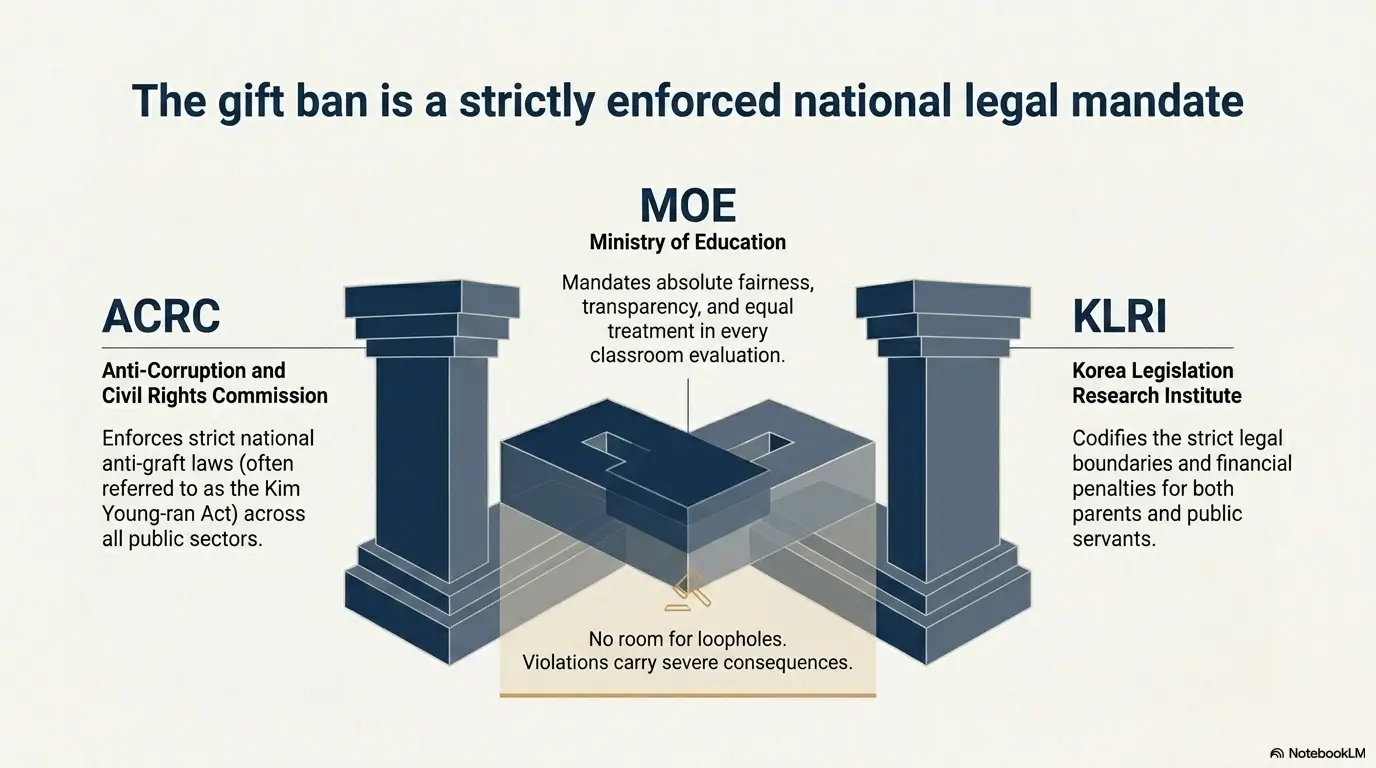
A simple public flower presented by a student representative on Teacher’s Day can be treated differently from a privately delivered gift from a parent to a homeroom teacher. The distinction is not decorative. It is structural. The Anti-Corruption and Civil Rights Commission has specifically said that publicly presented carnations or flowers by student representatives on Teacher’s Day may be allowed under social custom, while gifts from students or parents to teachers responsible for ongoing evaluation generally are not.
Why “nice” can become “too much” faster than many US parents expect
Constructed illustration, not a reported event: In the United States, generosity often signals involvement. In Korea, especially in school settings, generosity can cross a line faster because it risks changing the emotional temperature of the relationship. a fictional narrator once watched an expat parent prepare a beautifully packaged tea set for a teacher, convinced it was elegantly restrained. Every part of it was tasteful. That was the problem. It looked thoughtful enough to become memorable. In this context, memorable is not always your friend.
The quiet filter: would this create 부담, obligation, or comparison?
Korean parents often use a practical emotional filter: would this create burden, or 부담? That burden can land in three places at once. On the teacher, who now has to receive or refuse. On other parents, who may feel comparison creep in. And on the giver, who may later worry that the gesture was misunderstood. A good decision in this world is usually the one that leaves the fewest people mentally rearranging chairs after the moment has passed.
Eligibility checklist
- Yes / No: Is the teacher currently teaching, evaluating, counseling, or recommending your child?
- Yes / No: Would this be given privately rather than in an open, class-wide setting?
- Yes / No: Would another parent reasonably feel pressure to do something similar?
- Yes / No: Could the same appreciation be expressed by a note, class message, or shared gesture?
Neutral next step: If you answered “yes” to the first two questions, stop shopping and switch to a note or class-wide thanks.
Who This Is For, and Who It Is Not For
This is for parents navigating teachers, homeroom culture, and school etiquette in Korea
This guide is for foreign parents in local Korean schools, bilingual programs, mixed local-global communities, and everyday parent networks where classroom culture is partly visible and partly whispered into KakaoTalk at 10:47 p.m. It is for the parent who wants to be respectful without becoming stiff, thoughtful without becoming conspicuous, and socially awake without needing a doctorate in micro-awkwardness. The same backstage rhythm that shapes gifts often shows up in Korean group chat culture too, where what feels “optional” on the surface can carry a much stronger social undertow underneath.
This is not for corporate gifting, private tutoring arrangements, or university faculty relationships
These settings run on different expectations, different regulations, and different social codes. A hagwon, a private tutor, an after-school club, and a public school homeroom do not all share one neat rulebook. The stakes, the authority relationships, and the legal sensitivities are not interchangeable. That is why copying one person’s anecdote from another setting is risky. Korean etiquette often looks similar from far away, the way two train platforms can look connected until you realize one requires a completely different ticket. If your family is also weighing after-school options, how hagwons work for foreign families is its own separate cultural map.
If your child is in an international school, what may differ from local norms
International schools may have more explicit school policies, more Western-style parent communication, and different internal expectations around appreciation. Even then, the safest move is not assumption. It is policy plus atmosphere. Many international schools in Korea still sit inside a Korean social environment, and foreign families are often surprised to discover that informal parent dynamics can remain quite local even when the curriculum is not.
Illustrative Scenario: A mother new to Korea once told me she felt foolish for overthinking a thank-you gift. “It’s just a card and cookies,” she said. Then she paused and added, “But no one else seems to be doing that.” That pause was the real beginning of cultural fluency. She had noticed that school culture often reveals itself less through what people say and more through what they carefully do not do. She asked one experienced parent whether appreciation was usually handled individually or through class coordination.
The answer was simple: “Usually together, and usually smaller than foreigners expect.” She never sent the cookies. Instead, she joined a class message of thanks and later had her child write a short note at year’s end. Nothing dramatic happened. Which, in this topic, was exactly the success. Not every good outcome feels cinematic. Some arrive like a room that stays comfortable because no one turned the heater too high.
Teacher Gifts First: The Area Where Good Intentions Can Go Sideways
Why teacher-directed gifts carry more sensitivity than parent-to-parent gestures
This is the center of gravity. Gifts to other parents are one thing. Gifts to teachers are another planet entirely. Teachers occupy a role that is not just relational but institutional. They evaluate, guide, manage, and sometimes influence school experiences in ways that make private gifts feel charged even when everyone involved is sincere.
When appreciation is better expressed through words, class-wide thanks, or official channels
Education authorities in Korea have repeatedly put this in sharper terms than many parents expect. The Ministry of Education has published parent-facing materials about the anti-graft law, and Education Ministry guidance has also summarized the core point plainly: because parents and teachers are in a direct interest relationship around student evaluation and guidance, gifts are generally not allowed in that relationship. If you want the safest expression of gratitude, it is usually one of these three: a brief note, a public and class-based expression of thanks, or nothing material at all.
Here’s what no one tells you: the awkwardness often happens after the gift, not before it
Constructed illustration, not a reported event: Parents often imagine the risky moment is the handoff. Sometimes it is. More often, the trouble starts afterward. The teacher must decide how to handle it. Other parents may hear about it. The giver replays the moment and wonders whether it looked like lobbying in a cardigan. a fictional narrator has seen parents lose two peaceful evenings to post-gift analysis over something they thought would take thirty seconds. That is a terrible exchange rate.
Show me the nerdy details
The legal logic here turns less on sentimental intent than on role-based risk. Korean guidance has distinguished between publicly offered flowers by student representatives on Teacher’s Day and private gifts from students or parents to teachers with ongoing evaluation responsibilities. It has also flagged gift certificates and similar cash-equivalent items as especially problematic. The practical takeaway is simple: as the teacher’s present authority over your child increases, the tolerance for private gifting drops sharply.
- Current teacher relationships are legally and socially sensitive
- Private gifts create more risk than shared public appreciation
- Notes and class-wide thanks often do the job better
Apply in 60 seconds: Replace “What can I give?” with “What can I say clearly and respectfully without creating obligation?”
Group Gifts vs. Solo Gifts: Why the Safer Choice Is Often the Less Dramatic One
When class parents organize something together, and why that changes the tone
A group gesture can reduce the sense that one family is stepping forward to create a special private channel. That said, “group” is not a magic detergent that washes away every concern. A coordinated gesture can still become too much if it is expensive, personalized, or directed toward a teacher in a way that raises legal or ethical questions. Group action lowers the spotlight. It does not automatically change the stage.
How solo gifts can accidentally make other families or teachers uncomfortable
Constructed illustration, not a reported event: Solo gifts create asymmetry. Even when the amount is small, the message can feel bigger because it is singular. a fictional narrator has seen this happen with things as ordinary as bakery boxes and mobile coffee coupons. The object itself looked harmless. The private channel did the heavy lifting. It suggested closeness where institutional distance might have been wiser.
What to ask yourself before joining, declining, or suggesting a group gesture
Ask four things. Is the school already doing something official? Is the gesture going to a teacher with direct authority over children? Is participation voluntary in practice, not just in theory? And will declining make your child feel exposed? Those last two matter more than outsiders think. Parent groups can say “totally optional” with their words while radiating “please don’t make this weird” with everything else. This is one reason understanding KakaoTalk etiquette and how soft pressure travels through class chats can matter just as much as understanding the gift itself.
Decision card
Best when appreciation is already class-coordinated, public, and low-pressure.
Time/cost trade-off: Lower personal friction, lower social visibility.
Best when the plan feels too personal, too expensive, or legally fuzzy.
Time/cost trade-off: Slightly more social navigation now, less lingering worry later.
Neutral next step: Ask whether the appreciation is school-approved, class-wide, and truly optional before deciding.
Holiday Timing Matters: The Calendar Can Change the Meaning
Teacher’s Day, graduation, end-of-term, and class transitions as high-sensitivity moments
Timing is not decoration in Korean classroom gift culture. It is signal. Teacher’s Day can tempt families into thinking the whole country is collectively holding a gift basket. In reality, Teacher’s Day has become one of the most scrutinized moments for school-related appreciation because the anti-graft law forced a sharper boundary around what students and parents can offer teachers. The ACRC has published Teachers’ Day-specific guidance, including the distinction between public carnations from student representatives and other gifts that are not allowed in ongoing teacher-student relationships.
Why a gift during a delicate school moment can be read differently than the same gift later
Context changes with the calendar. A present offered before evaluations, recommendations, or classroom placements can feel loaded. The same object offered long after the direct relationship has ended may be treated differently. Official guidance has even noted that after a student has moved on from a previous homeroom or subject teacher, some limited forms of social gifting may be treated differently, while gift certificates still remain problematic.
Let’s be honest: sometimes timing is the message
A gift given during a sensitive period may communicate more than the giver intends. People do not have to believe you are trying to influence anything for discomfort to begin. They only need to wonder whether the gesture might be heard that way by someone else. In school life, second-order worry is often the real engine.
Constructed illustration, not a reported event: a fictional narrator once heard a parent say, “But I waited until after the meeting.” In her mind, that solved the issue. In the school’s emotional weather, it still sat too close to the event. Cultural timing is like perfume on an elevator. You may think the amount is small. The problem is that it travels.
Don’t Do This: Common Mistakes Foreign Parents Make Without Realizing It
Mistaking warmth for informality in a highly structured school relationship
Teachers in Korea may be kind, approachable, and genuinely caring. None of that automatically makes the relationship informal. Foreign parents sometimes read warmth as permission to improvise. The teacher smiles, responds quickly, seems grateful for involvement, and the parent assumes a more personal gesture would be welcome. Not necessarily. Professional warmth can still sit inside a carefully maintained boundary. This is part of a broader pattern in Korean politeness, where kindness and formality often coexist without canceling each other out.
Bringing a premium, branded, or overly personal item to a modest setting
A “good” gift often fails precisely because it is too well chosen. Premium fruit, department-store cosmetics, branded lifestyle goods, handwritten luxury stationery, artisan tea with a ribbon that looks like it pays taxes. All of these can feel more loaded than a foreign parent intends. Personal taste plus careful presentation can turn a small gift into a statement piece. Statements are risky in environments trying to stay ethically quiet.
Assuming US-style appreciation norms translate cleanly into Korean classrooms
US parents may be used to holiday collections, teacher wish lists, or end-of-year gifts that sit comfortably inside school culture. Korea is not a simple inversion of that system, but it is different enough that direct transfer causes trouble. The safest cross-cultural move is not to import your old instinct unchanged. It is to ask what the local system is trying to protect. In this case, it is trying to protect fairness, distance where needed, and a school climate less distorted by private gestures.
Seoul education authorities even reported, after the anti-graft law’s implementation, that large majorities of parents and teachers saw positive change in schools and a decline in practices such as money envelopes for teachers. Families who are new to the broader school environment may also benefit from understanding everyday campus norms through guides on Korean school uniform culture and South Korean school lunch culture, because gift etiquette rarely lives alone.
No gift-risk score can establish permission. Check the recipient’s role, current evaluation or guidance responsibility, applicable rules and school policy before any purchase or collection. A low price, public presentation or group contribution is not a legal clearance.
Don’t Overcorrect Either: Being So Careful That You Become Distant
Why total avoidance can also read strangely in relationship-based environments
Once foreign parents learn that gifts can be sensitive, some swing to the opposite extreme. They become so determined not to offend that they strip every interaction down to the emotional texture of a parking receipt. That can also feel odd. Korean school culture may be formal in structure, but it is not anti-warmth. It still values attentiveness, gratitude, and participation. The goal is not emotional starvation. It is proportion.
The difference between respectful restraint and visible disengagement
Respectful restraint says: I appreciate your work, I understand the setting, and I will not put you in a difficult position. Visible disengagement says: I am so afraid of getting this wrong that I have become socially absent. One of those communicates maturity. The other can make it look as though you are detached from school life. In many parent communities, presence matters even when presents do not.
What simple appreciation can look like when you want to stay well within bounds
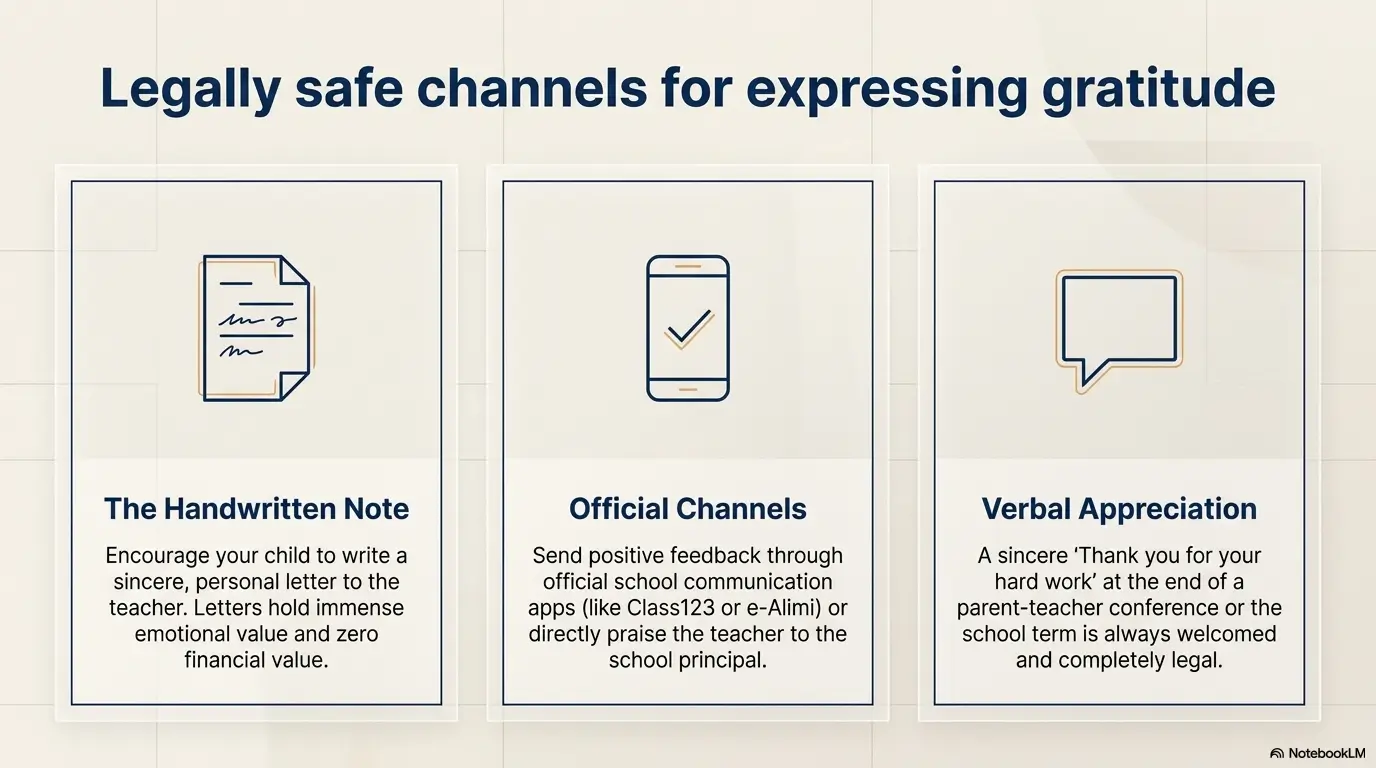
A concise thank-you note. A class-wide message of appreciation. Prompt, respectful communication. Participation in approved school events. Sending your child prepared, calm, and cooperative. These are not glamorous moves, but they often carry more long-term meaning than objects do. Culture sometimes rewards the parent who does the ordinary things reliably, not the parent who stages one impressive moment. Even the wording of that note matters, which is why understanding Korean texting formality can quietly help parents sound warm without sounding too casual.
- Skip the object when the object creates pressure
- Keep appreciation human and low-drama
- Show care through participation, not performance
Apply in 60 seconds: Draft a three-sentence thank-you note you could use at term’s end without attaching any gift at all.
Parent Group Dynamics: The Real Culture Sometimes Lives Outside the Classroom
KakaoTalk chats, room mothers, and informal coordination that newcomers may not expect
Much of the actual culture does not live in a handbook. It lives in parent chats, offhand comments, preexisting routines, and the mysterious efficiency of one experienced parent who seems to know everything before anyone else. Some classes have a visible organizer. Some do not. Some schools keep parent coordination minimal. Others have a stronger backstage rhythm. Newcomers often think the school building is the whole system. It is not. Half the atmosphere may be humming in a phone notification panel.
How social momentum can pressure parents into giving more than they intended
This is where many families get tugged along. No one wants to be difficult. No one wants their child to be the obvious exception. So parents go along with a plan that felt too much from the beginning. Sometimes the amount is tiny. Sometimes the issue is not money but emotional escalation. A simple appreciation can become a mini-production because no one wants to be the person who says, gently and correctly, “Maybe we do less.”
What to do when everyone else seems to know the script except you
Ask narrow questions, not broad ones. Instead of “What is normal in Korea?” ask “Does this school usually handle teacher appreciation individually, collectively, or not at all?” Instead of “Is a gift okay?” ask “Would a short class note be more in line with how this class does things?” Local social systems often answer better when the question is practical enough to use tomorrow morning. This habit also mirrors the logic of Korean indirect communication, where precise, low-drama questions often get better results than grand, abstract ones.
Quote-prep list
Before you respond to a parent-group plan, gather these four things:
- The school’s written policy, if there is one
- Whether the gesture is for a current teacher or former teacher
- Whether the plan involves money collection, gift cards, or premium items
- Whether participation is genuinely optional
Neutral next step: Reply only after you know the school rule and the exact form of the gesture.
When Children Are Involved: How to Keep the Gesture From Becoming a Performance
Why asking a child to deliver a gift can amplify the meaning
Children change the emotional optics of the moment. A parent handing over a bag is one thing. A child presenting a gift with visible coaching can feel more ceremonial, more loaded, and harder to refuse. It also risks putting the teacher in the least comfortable position of all: needing to respond warmly to a child while internally thinking, “This really should not be happening.”
Avoiding moments that make your child look favored, coached, or singled out
The safest kindness is ordinary. Once a child becomes the vehicle for a family’s gratitude, the moment can grow larger than anyone intended. Other children notice. Teachers notice. Your own child may absorb the idea that appreciation works best when it arrives wrapped and witnessed. That is not the lesson most parents are trying to teach, but children are excellent collectors of invisible scripts.
Keeping kindness ordinary instead of ceremonial
A short thank-you card written by a child at an appropriate time can be lovely when it does not function as a gift substitute dressed in paper clothes. The point is not to ban all warmth. It is to keep the child out of adult signaling games. In Korea, restraint often protects not only the teacher but also the child from being turned into a little ambassador of family strategy.
One foreign dad once joked to me, “I just wanted my son to learn gratitude, not deploy gratitude.” That was funnier than he knew. It is also the line many families need.
Common Mistakes
Choosing a gift before understanding the school’s tone
The first mistake is shopping too early. When you buy first, you begin emotionally defending the object before you understand the system. It becomes harder to let go of your idea because now the tea is already in the basket and the basket is already very cute.
Confusing private gratitude with public presentation
Public presentation and group participation do not determine whether a gift is permitted. The recipient’s role, duties, purpose and applicable rules must be checked first. Do not treat secrecy, visibility, low price or a large number of contributors as a substitute for that assessment.
Copying what one family did without knowing the backstory
You may see another family do something that appears acceptable. That does not mean it is wise to copy. Perhaps the teacher was no longer in charge of the child. Perhaps the school had a specific policy. Perhaps the parents themselves were quietly told not to repeat it. Anecdotes are the confetti of expat life. They are colorful and terrible at forming policy.
Treating “small” as safe when the context is actually the risky part
The item is not the whole message. The relationship, timing, visibility, and school culture do most of the speaking. That is why a small thing can still be the wrong thing, and a non-material gesture can be the better one.
- School tone comes before gift ideas
- Private gestures are not automatically gentler
- One family’s anecdote is not your policy guide
Apply in 60 seconds: Delete the shopping tab and write one sentence asking how appreciation is usually handled in your child’s class.
Next Step: Check the Recipient and Rules Before Any Gift
Before giving anything, check school tone, timing, and whether a group option exists
If you remember one rule, let it be this: smaller, simpler, more shared. Smaller means low emotional and material weight. Simpler means no premium flourish, no personalization that turns the object into a memory capsule, no hidden cash-equivalent item pretending to be harmless. More shared means class-wide, open, modest, and ideally aligned with what the school already treats as acceptable.
When in doubt, choose a brief thank-you note over a memorable object
A note has one enormous advantage. It lets gratitude stay gratitude. It does not create valuation questions, refusal discomfort, or comparison spirals. It also ages well. Months later, no one wonders whether the note crossed a legal or ethical line. It simply sits there having done its job with admirable modesty.
One concrete move for today: ask whether appreciation is usually handled individually, collectively, or not at all
This question works because it is socially intelligent without being dramatic. It does not announce that you are planning something. It does not force the other parent to judge your idea. It asks for a pattern. Patterns are where cultural survival lives.
The Real Takeaway: Respect Lands Better Than Impressiveness
Why cultural fluency here looks quiet, not dazzling
The foreign parent who handles this well is usually not the most generous-looking parent in the room. They are the one who understands the room. They know that Korean classroom gift culture is not a contest in taste, gratitude, or social ambition. It is a system built to protect fairness, reduce pressure, and keep school relationships from becoming transactional in mood even when nobody thinks they are doing anything wrong.
The best outcome is not being remembered for the gift
That may sound anticlimactic, but it is actually freeing. You do not need a perfect object. You need a clean interaction. The most successful appreciation gesture in this environment may be the one that leaves no residue of obligation behind. No whispered comparison. No teacher discomfort. No midnight second-guessing.
What foreign parents gain when they understand the atmosphere, not just the etiquette
You gain more than a rule. You gain the ability to feel the difference between warmth and pressure, between participation and performance, between “kind” and “too much.” That is the curiosity loop from the beginning of this article. The problem was never simply the gift. The problem was what the gift might accidentally ask other people to carry.
Within the next 15 minutes, choose one concrete move: ask how appreciation is usually handled in your class, draft a simple thank-you note for later, or decide in advance that no object will be part of your gratitude at all. Quiet choices often travel best here. For many families, this wider sensitivity grows alongside other lessons about Korean titles versus first names and the broader logic of Korean honorifics for foreigners, because classrooms are one place where status, respect, and restraint meet in very practical ways.
FAQ
Is it normal to give a homeroom teacher a gift in Korea?
In many cases, no. This is exactly where foreign parents need caution. Gifts to current teachers who guide or evaluate students are highly sensitive and often not allowed under the anti-graft framework and school ethics guidance. A brief note or class-wide thanks is usually safer.
Are group gifts safer than individual gifts?
A pooled gift is not automatically permissible. For a current teacher who evaluates or guides pupils, do not use a class collection to bypass the restrictions on gifts. Ask the school’s designated contact about the actual proposal and current rules, rather than treating a group decision as permission.
What kinds of gifts tend to feel too personal or too expensive?
Gift cards, premium branded goods, luxury foods, cosmetics, personalized keepsakes, and anything that looks specially curated for one teacher can feel too loaded. In Korean school settings, “beautifully chosen” can be exactly what makes it uncomfortable.
Is a handwritten note better than a physical gift?
Very often, yes. A short, sincere note usually communicates gratitude without creating pressure, valuation questions, or awkward refusal scenarios. It is one of the safest and most effective options.
What should foreign parents do if other parents are organizing something?
Ask practical questions before joining. Is it school-approved? Is it for a current teacher? Does it involve money collection, gift cards, or premium items? Is participation truly optional? A calm fact-finding step now can save a great deal of social discomfort later.
Are international schools and local Korean schools different on this issue?
They can be. International schools may have clearer written policies and different parent habits, but local Korean expectations can still shape the social atmosphere. Do not assume the language of instruction tells you the whole cultural story.
Can a child give a small thank-you item directly to a teacher?
That is risky if the teacher currently has responsibility for the child. Even if the item seems tiny, the act can amplify the meaning. A child-delivered gift is often harder to refuse gracefully and may create more pressure, not less.
What if I already gave something and now feel unsure about it?
Do not spiral. One uncertain gesture does not define you. The best next move is simply not to repeat it without better context. Shift future appreciation toward notes, public class messages, or school-approved channels, and let the moment pass without dramatizing it.
Last reviewed: 2026-04.