
Navigating the Social Weather: A Survival Guide to Korean University Orientation
Korean university orientation culture often surprises foreign students for one simple reason: the official schedule is not the hard part. The hard part is decoding the social weather around it, where welcome, group energy, senior guidance, and soft pressure arrive all at once.
Beyond campus maps and registration lies a landscape of group dinners, fast-moving KakaoTalk chats, and the subtle “senior-junior” signals. This guide helps you read the culture with accuracy and less panic, separating norms from rules so you can join what matters and step back when needed.
The real challenge is not “fitting in.” It is learning what deserves a yes, what deserves a polite no, and realizing that most of it was never as personal as it first felt.
Table of Contents
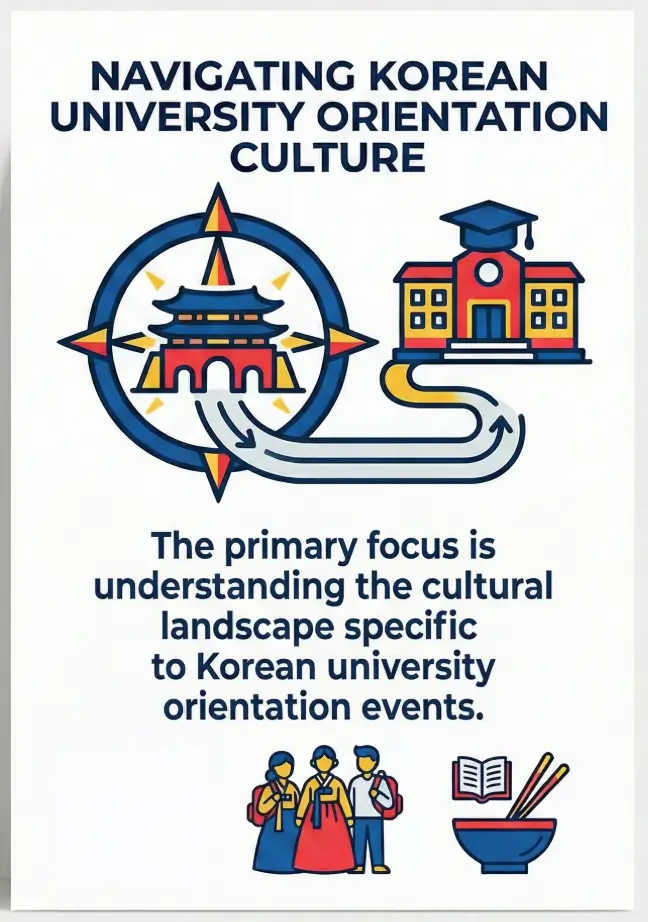
Infographic: The first-week rhythm many foreign students experience
1. Official welcome
Schedules, safety, registration, campus basics. This part feels clear and familiar.
2. Group bonding
Icebreakers, cheering, club invitations, chat groups, meal plans. Energy rises fast.
3. Hidden decoding
Who speaks first, how seniors guide, when “optional” means “noticed,” and how tone matters.
4. Real adjustment
You find your pace, your people, and your boundaries. The noise settles into pattern.
Orientation Culture First, Because the Real Surprise Is Not the Schedule
Why Korean university orientation often feels more social than purely informational
Many foreign students imagine orientation as a neat stack of practical tasks: pick up your ID, learn the library rules, locate the dorm, survive the campus map, go home. In Korea, those things exist, but they are often braided together with something less visible and more emotionally charged: the early formation of group belonging.
That can make the week feel oddly theatrical. Not fake, exactly. Just heightened. There may be chants, introductions, cohort photos, club recruitment, mentor pairings, dinners, and a steady current of “let’s all do this together.” For students from more individual-centered university cultures, it can feel like the campus is trying to speed-run friendship before you have even figured out which building contains your classroom.
I have seen students feel relieved by this and overwhelmed by it in the same afternoon. One exchange student once told me the schedule looked simple on paper, yet she went back to her room more tired from decoding social cues than from any lecture. That is common. The real labor of orientation is often interpretive. You are not just learning where things are. You are learning how people are with each other.
What foreign students usually expect versus what actually happens on the ground
Expectation: “I will get useful information and meet a few people.” Reality: you may be invited into a temporary little weather system where information, politeness, energy, and group performance all swirl together. The university may be trying to make students feel connected quickly, especially because the first weeks can shape retention, club involvement, and basic comfort on campus.
That does not mean every event is deep or every interaction is destiny. Quite the opposite. Some first-day bonding is very thin. Smiles are real, but not every smile means a lifelong friendship is hatching like a baby bird. That is good news. It means you do not have to extract permanent meaning from every awkward dinner or every chat notification you miss while showering.
The hidden curriculum is often group belonging, not just campus logistics
The hidden curriculum of orientation is simple: can you find a way to join enough of the social rhythm to become legible to the group, while still protecting your own comfort and values? That is the balancing act. Not blind assimilation. Not stubborn distance. Something steadier.
Think of orientation as two courses happening at once. The official course teaches you campus systems. The unofficial course teaches you tempo, tone, and relational expectations. Most confusion comes from realizing too late that the second course exists.
- Expect logistics and group bonding to be mixed together
- Do not judge the whole culture from one loud event
- Treat the first week as observation plus participation, not a personality exam
Apply in 60 seconds: Before arrival, tell yourself: “My job is to notice patterns, not to be perfect.”
Who This Is For, and Who May Need a Different Guide
Best for foreign undergraduates, exchange students, and international freshmen preparing for campus life
This guide is best for students who are about to enter Korean university life and want realistic expectations before their first week. That includes full-degree international students, exchange students, visiting program students, and freshmen who may know little or no Korean social context beyond pop culture, language apps, and hopeful guesswork.
It is especially useful for time-poor readers who do not want to collect fifty scattered anecdotes from social media. You need a working map, not a dramatic montage of “my roommate said” posts. Orientation can already feel like a crowded train platform. Useful advice should help you hear your own thoughts again.
Useful for parents, scholarship students, and language-program students who want context
Parents and scholarship sponsors often assume orientation is a neutral administrative event. Sometimes it is. Often it is not. It can shape early confidence, social ease, and your willingness to ask for help later. Language-program students may also benefit because many of the same dynamics appear in smaller forms: cohort bonding, senior guidance, group chats, polite attendance, and the soft pressure to participate beyond the classroom.
A parent once asked why their child sounded exhausted after “just orientation.” The answer was simple. Their child had been speaking English carefully, listening to Korean quickly, smiling on command, calculating when to bow, and guessing whether dinner was optional. That is not “just” anything.
Not enough on its own if you need visa, housing contract, or legal compliance guidance
This guide is not a visa manual, a dorm policy explainer, or legal advice. If you need immigration rules, housing contract terms, or official enrollment requirements, use your university’s international office and official government guidance. Orientation culture sits beside those systems, not above them.
Eligibility checklist: Is this guide the right starting point for you?
- Yes: You want to understand the social feel of Korean university orientation
- Yes: You are worried about fitting in, saying no, or reading the room
- No: Your urgent question is visa validity, dorm contracts, tuition deadlines, or legal compliance
- No: You need medical, legal, or immigration advice tailored to your case
Next step: Use this guide for the human side, and official channels for the formal side.
Show me the nerdy details
Many orientation problems are not caused by “bad culture” or “bad students.” They come from role confusion. Administrative onboarding, peer socialization, department identity-building, and club recruitment often overlap in one compressed window. That compression makes ordinary uncertainty feel larger than it is.
Group Energy Matters, Because Orientation May Feel Like a Social Test
Why icebreakers, cheering, club promotion, and cohort bonding can feel unusually intense
Group energy is one of the first things foreign students notice. Some orientations are calm. Others arrive like a brass band in a narrow hallway. Cheer routines, call-and-response moments, department slogans, club booths, and rapid-fire introductions can create the sense that everyone else got a script you somehow missed at customs.
There are practical reasons for this intensity. Universities want students to feel attached quickly. Departments want freshmen to feel proud of belonging. Clubs want members before schedules harden. Seniors may genuinely believe high energy helps shy students loosen up. Sometimes it does. Sometimes it feels like being hugged by a parade float.
I once watched a very quiet student from Europe survive a first-day icebreaker by saying only three careful sentences all afternoon. Later, the same student made two close friends during the walk back to the dorm. Big-group charisma was not the key. Simple endurance was.
How collective participation is often read as goodwill, not personal oversharing
In many settings, visible participation is not interpreted as “I am revealing my soul.” It is interpreted as “I am showing cooperative spirit.” That matters. You may think a chant, game, or group photo is silly. Others may see it as a small act of goodwill. The emotional stakes you assign may be much higher than the stakes everyone else assigns.
This is useful because it means you can often participate lightly. You do not need to become a louder version of yourself. A smile, a brief introduction, a clap at the right time, a polite presence at dinner, and a thank-you afterward can go further than one dazzling performance followed by disappearance.
What to do if you are private, shy, older than your peers, or simply exhausted
Private students often assume they have only two options: full performance or total withdrawal. There is a third way. Call it deliberate partial participation. Join the official beginning. Stay through the core activity. Leave the after-event politely. Reply briefly in the group chat. Show consistency rather than volume.
Older students, graduate students, or students returning to school after work experience may feel the atmosphere is too youthful for them. That discomfort is real. Still, you do not need to force yourself into a younger register. Quiet steadiness reads better than strained imitation. Nothing is more tiring than trying to cosplay nineteen when your nervous system has already earned a mortgage-level seriousness.
Use your energy like a budget. Spend enough to be seen as present. Save enough to stay sane for the week.
Mini calculator: your orientation energy budget
Give yourself 1 point each for these three items:
- You slept at least 6 hours
- You can follow the main language used without panic
- You have at least one private recovery hour later
If your score is 0–1, attend the core event and skip the longest optional add-on. If it is 2, stay for one social activity. If it is 3, you can experiment with one extra event without frying your brain.
Neutral action: Decide your exit point before the day starts.

Senior-Junior Signals Can Confuse You Before Anyone Explains Them
How sunbae-hoobae dynamics may quietly shape introductions, invitations, and tone
One of the more disorienting parts of Korean university life for foreign students is that warmth and hierarchy can coexist without contradiction. Seniors may be kind, helpful, funny, and generous while also occupying a position that carries social weight. This is often described through sunbae and hoobae dynamics, though how strongly it appears varies by campus, department, age mix, and personality.
You might notice seniors initiating introductions, guiding seating, organizing meals, adding students to chats, or suggesting how freshmen should navigate the first weeks. That can feel comforting. It can also feel directional in a way you are not used to. Neither reaction is foolish. You are noticing a real social structure.
A newly admitted student once told me, “They were so nice, but I still felt I had to be careful.” That sentence captures the dynamic beautifully. Kindness does not erase asymmetry. It only softens it.
Why politeness sometimes matters more than confidence in first-week interactions
In some Western campus cultures, confidence is the currency of belonging. In early Korean university interactions, politeness often matters more than foreign students expect. You do not need to appear dazzling. You need to appear respectful, cooperative, and not allergic to basic social grace.
That means little things can matter: greeting seniors first, thanking people who guide you, answering messages with basic courtesy, and avoiding an overly blunt tone that might sound normal in your home culture but abrupt in this one. This does not require self-erasure. It requires calibration.
A small practical rule helps here: when unsure, go one notch more polite than you think is necessary. Not ten notches. You are not auditioning to become an eighteenth-century court attendant. Just one notch.
Here’s what no one tells you: warmth and hierarchy often appear in the same moment
This is where many foreign students get tangled. They assume hierarchy means coldness, or warmth means equality. But early Korean campus culture may offer both at once. A senior may buy you a meal, remember your name, give genuine advice, and still expect a level of deference in tone or timing. If you understand that combination early, fewer moments will feel contradictory.
It also protects you from two opposite errors. One is romanticizing every senior gesture as pure friendship. The other is treating every difference in status as oppression. Most of campus life happens in the ordinary middle, where people are simply navigating a structure they themselves inherited.
- Read help and status as coexisting signals
- Favor respectful tone over performative confidence
- Do not assume every social difference is deeply personal
Apply in 60 seconds: Prepare one polite greeting and one polite thank-you in Korean before arrival.
Social Pressure Has Layers, and Not All of Them Are Obvious
Why “optional” events may not always feel optional in practice
One of the most important orientation truths is this: an event can be technically optional and socially noticeable at the same time. That does not mean you must attend everything. It means you should understand the difference between official obligation and social visibility.
If a dinner, retreat, or club session is framed as optional, some students will skip it with no problem. Others will feel quietly marked by absence, especially in small departments or tightly bonded cohorts. The effect depends on context. A huge university-wide fair carries different social weight than a small major-specific dinner where everyone is trying to memorize each other’s names.
I have seen students skip one event and be completely fine. I have also seen students skip everything for three days, then feel baffled that friend groups formed without them. That is not cruelty. That is momentum.
How group dinners, post-events, and club recruiting can create soft pressure
Soft pressure rarely sounds like a command. It sounds like “Come if you can,” “It will be fun,” “Everyone is going,” or the kind of Korean “maybe” that feels softer on the surface than it does in practice. It can arrive through repeated invitations, public group-chat mentions, or the simple discomfort of being the only person who leaves. Group dinners are especially powerful because meals do more than feed people. They stabilize social circles.
Post-events can also matter because the atmosphere often shifts after the official program ends. Students relax, seniors speak more casually, and smaller clusters form. Some of the real social mapping happens there. That said, not every student thrives in late-night bonding. If you do not drink, dislike loud venues, or tire easily, the same setting can feel less like bonding and more like endurance theater with side dishes.
The difference between genuine welcome and the feeling that you should keep up
Often, both are present. People may sincerely want to include you. At the same time, the pace may still be too fast for your personality, finances, health, or values. This is why simplistic advice fails. “Just join everything” is bad advice. “Protect your peace and skip it all” is also bad advice. The better question is: which invitations genuinely help you build familiarity, and which ones mostly drain you for little return?
That judgment gets easier when you notice whether an event offers real contact or just abstract attendance. A shared department meal with ten people may help more than a large loud social night with eighty. Quality of interaction beats quantity of appearances.
Decision card: When to go vs when to leave
| Situation | Better move | Why |
|---|---|---|
| Small department dinner | Attend at least the first hour | High relationship value, lower chaos |
| Late-night add-on after a long day | Leave politely if your energy is gone | Exhaustion makes social reading worse |
| Club promotion fair | Browse briefly, follow up later | You do not need to choose your identity in 12 minutes |
Neutral action: Aim for one high-value event per day rather than maximum attendance.
Don’t Misread Everything, Because Some Awkward Moments Are Not Personal
Why language gaps, fast speech, and inside jokes can make you feel excluded
Few things sting faster than a room laughing when you are still translating the first half of the sentence. Orientation can amplify that feeling because conversation moves quickly, jokes may rely on local references, and group energy rewards speed. You may feel left behind not because anyone rejected you, but because the pace favored native fluency.
This matters because many students interpret temporary confusion as evidence that they do not belong. That conclusion is usually too harsh. Fast speech is not a verdict. Group in-jokes are not always walls. Sometimes they are just proof that you arrived in the middle of a conversation already underway.
I remember one student describing a dinner where he barely spoke because everyone used slang he had never heard. Two days later, the same group helped him find a classroom, translated a notice, and saved him a seat. His first interpretation had been too final.
How unfamiliar humor or drinking culture may look harsher than it is
Humor does not travel cleanly. Playful teasing can sound sharp. Casual insistence around food or drink can feel pushy. Enthusiastic group behavior can look juvenile or invasive when you are tired and out of cultural context. Sometimes your discomfort comes from genuine mismatch, not actual harm. Those are different things.
That said, not everything should be excused as “just culture.” If people mock your identity, ignore repeated refusals, pressure you to drink, or make you feel unsafe, that is not a charming local custom you failed to appreciate. It is a boundary issue. The trick is learning not to label every awkward moment a red flag while also refusing to dismiss real problems just to seem adaptable.
When discomfort comes from culture shock, and when it is a real boundary issue
A useful test is whether the discomfort softens when you understand the context. Culture shock often becomes easier once explained. Boundary violations usually do not. If someone repeats behavior after you clearly say no, or if the situation threatens your safety, money, housing, or dignity, treat that seriously. If the discomfort mostly comes from speed, unfamiliar etiquette, or ambiguous tone, observation may help more than alarm.
Not every awkward moment deserves a grand theory. Sometimes you are hungry, jet-lagged, and sitting on a plastic chair under fluorescent lighting while trying to hear through three languages and one very enthusiastic club president. Under those conditions, almost anything feels ominous.
Show me the nerdy details
Cross-cultural adjustment often becomes hardest when three variables hit at once: language processing load, status uncertainty, and sleep debt. If you reduce even one of those, many “mysterious” social problems shrink. This is why good rest and one trusted contact can change the whole first week.
- Temporary confusion is not proof of rejection
- Repeated pressure after a clear no is a real problem
- Context can explain awkwardness, but it should not erase your safety
Apply in 60 seconds: Write down one sentence you can use when you need to pause and one when you need to refuse.
Boundaries Matter Early, Especially When You Want to Start Well
How to say no politely without sounding cold or ungrateful
Many foreign students delay setting boundaries because they fear looking rude. Ironically, vague avoidance can create more confusion than a clear, polite answer. In many settings, a brief refusal with warmth works better than a disappearing act. People can adapt to your limits more easily when they can actually see them.
You do not need a courtroom speech. A simple “Thank you, but I’ll head back early tonight,” or “I can join dinner, but not drinks afterward,” often does the job. If your Korean is limited, even a short phrase combined with a friendly tone and visible gratitude goes further than anxious overexplaining.
I once watched a student spend three days inventing increasingly baroque excuses to avoid late outings. When she finally said, gently, “I get tired quickly, so I usually leave after dinner,” people accepted it at once. The dramatic subplot existed mostly in her own mind.
What participation can look like when you do not drink, party late, or join every activity
Participation is not one single shape. You can attend the daytime program, join a meal, chat in the group thread, show up to one club fair, and still decline the late-night extension. You can say yes to coffee and no to alcohol. You can be friendly without becoming perpetually available.
This matters because some students think boundaries work only if they withdraw completely. That usually costs too much. It is often better to remain visible in lower-pressure spaces than to vanish from all shared spaces. Daylight is your friend here. Campus tours, lunch, class registration help, and smaller follow-up meetups usually carry less social friction than noisy nighttime bonding.
Let’s be honest: most students respect clear limits more than vague avoidance
Clarity creates trust. Vague behavior creates speculation. If you keep saying “maybe” when you mean no, others may keep asking because they think you are undecided. A respectful no, especially when paired with one alternative yes, tends to work better. “I can’t go tonight, but I’ll come to the department lunch tomorrow” is a small masterpiece of social engineering.
There is another benefit. Early boundaries teach people how to relate to you. They create a stable pattern. That is kinder to you and easier for others than swinging between overparticipation and sudden disappearance.
Boundary-prep list: what to gather before orientation starts
- Your earliest comfortable leaving time
- One sentence for declining alcohol politely in Korea or late-night plans
- One sentence for accepting a lower-pressure invitation
- A private reason you do not need to explain to anyone
Neutral action: Save those phrases in your notes app before arrival.
Common Mistakes Foreign Students Make During Korean University Orientation
Mistaking every group norm for a rule you must obey
This is one of the biggest errors. A norm is not always a rule. Students often copy what others do because it feels safer than asking what is actually required. If everyone joins a photo, dinner, or chant, you may assume refusal is impossible. Often it is merely noticeable, not forbidden.
The distinction matters because mistaking norms for rules leads to resentment. You end up doing things you never truly agreed to, then blaming the whole culture for your own untested assumption. Better to ask quietly, observe patterns, and separate official expectations from social habits.
Assuming friendliness always means deep friendship right away
Early warmth is often real, but it may be situational. Orientation compresses proximity. People are together for long hours, navigating uncertainty, and reaching for quick comfort. That can create fast intimacy that does not always translate into stable friendship. Do not panic when some first-week closeness fades. That is normal.
I have seen students become devastated when an orientation friend later grew distant. They had mistaken early alliance for long-term compatibility. Campus life usually sorts itself more slowly. Friendships often deepen later through class projects, repeated lunches, commuting routes, or one specific club where you keep seeing the same face in the same chair.
Skipping everything at once, then wondering why campus life feels harder later
Total withdrawal can feel protective in the moment. Sometimes it is necessary, especially if you are sick or overwhelmed. But if you skip every event, every meal, every chat, and every casual introduction, you may create a second problem for yourself: no one knows you well enough to include you later. Orientation is not the only chance to connect, but it is one of the easiest low-friction chances.
Saying yes to too much before you understand the time, money, and social cost
The opposite mistake is just as common. Students say yes to dinners, trips, club fees, matching shirts, post-events, coffee follow-ups, and maybe a volunteering plan they barely understood because the room was moving fast. Three days later they are broke, tired, and wondering why every pleasant invitation now feels like a trapdoor.
Remember this: early enthusiasm is expensive when translated into time, attention, and spending. You do not need to buy belonging at retail prices.
- Not every norm is a rule
- Not every warm interaction is instant friendship
- Not every invitation deserves an automatic yes
Apply in 60 seconds: For each new invitation, ask: “Is this required, useful, or just momentum?”
Don’t Try to Perform “Perfect Adaptation” in the First Week
Why overcompensating can leave you more isolated, not less
There is a particular kind of loneliness that comes from trying too hard to be easy. Some foreign students overcompensate by laughing at every joke, accepting every plan, hiding every discomfort, and acting more fluent, energetic, or flexible than they really are. On paper, this looks adaptable. In practice, it often builds a version of you that no one can actually meet.
That performance becomes exhausting because it removes the very signals others would need to know you accurately. Then, when you eventually pull back, people may feel surprised rather than informed. You have trained the room to expect a version of you built under adrenaline.
How to stay open without turning yourself into a mirror of the group
Healthy adjustment is selective. You learn a few phrases, adopt some polite habits, attend some events, and let your edges remain your own. You do not need to mirror every behavior to show respect. In fact, calm consistency often feels more trustworthy than eager overimitation.
I knew one student who worried because she was not “bubbly enough” for orientation. She eventually stopped trying to match the loudest people and started asking practical questions instead. Strangely, that made others trust her more. She became the person classmates messaged when they needed clear information. Her steadiness, once feared as dullness, became her social value.
What sustainable adjustment looks like after the first burst of orientation energy
Sustainable adjustment usually looks boring from the outside. You know a handful of names. You reply to important chat messages. You attend enough shared events to stay visible. You say no when needed. You find one or two spaces where you do not have to translate your whole personality. That is success. Not instant belonging. Not social domination. Not becoming the unofficial mascot of international resilience.
There is freedom in dropping the fantasy of perfect adaptation. It lets the first week be what it is: an opening scene, not a final judgment.
Short Story: A student arrived in Seoul determined to be “the easy international student.” During orientation, he attended every dinner, smiled through jokes he only half understood, and agreed to a weekend trip because everyone else seemed excited. By day four he had a headache, an empty wallet, and the eerie feeling that people liked a version of him that did not exist outside fluorescent cafeterias.
On the fifth day, he skipped the late outing, joined only the daytime department lunch, and admitted to two classmates that he was overwhelmed. The result was not rejection. One classmate said she had been overwhelmed too. The other walked him to the bookstore and showed him which chat messages actually mattered. Nothing cinematic happened. No swelling soundtrack. Just a smaller, truer beginning. And that quieter beginning turned out to be the one that lasted.
Practical Culture Clues Often Matter More Than the Official Presentation
What to notice about dress, punctuality, messaging apps, and response speed
If you want to understand orientation culture quickly, watch the practical clues. Dress is one. Not because there is one universal campus standard, but because clothing often tells you whether the day is treated casually, semi-formally, or department-proud. Punctuality is another. On some campuses, five minutes late is a shrug. In other settings, group movement is tighter and delay feels more visible.
Messaging apps matter too, especially KakaoTalk. Your first group chat can reveal the real rhythm of campus life faster than any brochure. Who replies instantly? Who posts reminders? Is the tone formal, cheerful, chaotic, meme-heavy, or oddly silent until one brave soul asks where everyone is? These little signals help you calibrate your own pace.
I have seen students ignore the chat for half a day and miss a room change. I have also seen students obsessively monitor every notification and lose their minds before noon. Balance, as ever, sits somewhere unphotogenic in the middle.
How seating, introductions, and meal dynamics can tell you more than the brochure
Watch where people sit, who speaks first, who serves, who pays, and how introductions happen. These details can teach you more about status and comfort than official speeches ever will. At meals, notice whether seniors guide the order, whether students wait for a cue to begin, and whether small acts of politeness ripple outward. None of this requires paranoia. It is simply field observation.
Why your first KakaoTalk group chat may reveal the real tempo of student life
The group chat is where official information and social tone often collide. A single thread may contain a room update, a joke, a photo request, three stickers, and one announcement everyone definitely should have read ten minutes ago. If you understand that early, you can keep the chat useful instead of letting it become a tiny electronic weather disaster.
Use a simple system: mute unnecessary noise, pin critical chats, and check at predictable intervals. You do not need to become a notification monk with perfect serenity. You just need a rhythm.
Show me the nerdy details
Digital onboarding shapes social belonging more than many students expect. The difference between “I missed the vibe” and “I missed a required update” can live inside the same app. Creating a small message routine reduces both anxiety and practical mistakes.
Friendship Starts Sideways, Not Always in the Big Orientation Moments
Why smaller follow-up interactions often matter more than loud first-day bonding
The loudest moments are not always the most important ones. Real connection often begins sideways: walking to the station together, sharing notes after a confusing announcement, eating convenience-store food on the dorm steps, asking where to print something, or laughing because both of you misunderstood the same instruction in different ways.
This is comforting because it means a mediocre orientation day does not doom your semester. If the big events feel flat, do not assume the social story is over. Large gatherings are terrible at revealing compatibility. Small repeated contact is much better at it.
Where foreign students often find steadier connection after orientation ends
Steadier friendships often emerge in three places: regular classes, clubs that meet repeatedly, and practical study or lab groups. There is less pressure there. Repetition replaces spectacle. You are no longer trying to perform instant rapport under bright lights and high-volume introductions.
I know students whose orientation felt lukewarm, yet who later built strong circles through language exchange groups, design projects, choir, volunteer clubs, engineering labs, or even the library line where the same faces kept appearing at 8:55 a.m. Human closeness is rarely as efficient as orientation planners hope. It grows like ivy, not instant noodles.
How one classmate, one club, or one lab group can change the whole semester
Do not underestimate the power of one good anchor person. One classmate who answers honestly. One senior who explains without showing off. One club that feels less like performance and more like breathing. Orientation culture can make belonging seem like a giant group outcome. Very often, it begins as a small relational accident.
So if the week feels uneven, lower the scale of your hope. Not smaller hope. More specific hope. You do not need to “find your people” by Friday. You need one decent next conversation.

FAQ
Do I have to attend every orientation event to make friends?
No. Attending everything is not necessary, and for many students it is a terrible strategy. What matters more is showing up to some high-value moments, especially smaller department or cohort events where repeated contact is possible. A few thoughtful appearances usually help more than exhausting total attendance.
Is drinking expected at Korean university orientation events?
It depends on the university, department, student culture, and the specific event. Some orientations have little or no drinking element. Others may include dinners or after-events where alcohol appears. You are not required to drink to be worthy of belonging. A polite, clear refusal is often enough, especially if you remain friendly and present in other ways.
What if my Korean is too weak to follow fast group conversations?
That is common. Focus on the basics first: learn key practical phrases, stay close to official notices, ask one trusted student for clarification when needed, and do not confuse language lag with personal failure. Many early misunderstandings come from speed, slang, and noise, not from a lack of intelligence or effort.
Are seniors allowed to tell freshmen what to do?
Seniors may guide, advise, organize, or suggest, especially during orientation. How strong that influence feels varies widely. Polite guidance is common. Pressure that ignores your safety or clear refusal is another matter. You can show respect without surrendering judgment.
How do I say no politely without damaging relationships?
Keep it short, warm, and definite. Thank the person, state your limit, and where possible offer a smaller yes elsewhere. For example: “Thank you, but I’m going back early tonight. I’ll see you at lunch tomorrow.” That is clearer and kinder than vague avoidance.
Will I be judged if I leave early or skip an after-event?
Sometimes people may notice. That is not the same as serious judgment. In many cases, leaving politely after the core part of an event is completely manageable. Repeated silent disappearance can create more confusion than one clear early exit.
Is orientation culture the same at every Korean university?
No. University size, region, department culture, club traditions, and the personalities of seniors all shape the experience. Some campuses feel highly structured and group-oriented. Others feel lighter and more practical. Use general patterns as a guide, not as a prophecy.
What should I wear to orientation activities?
Start neat, comfortable, and slightly more put-together than “just rolled out of bed.” You can adjust once you see the campus tone. Practical shoes matter more than style heroics. Orientation often involves more walking, standing, and waiting than new students expect.
Can I still build a social life if orientation goes badly?
Yes. Absolutely. Many strong friendships form after orientation, often in quieter and more natural settings. A rough first week can bruise confidence, but it does not predict the whole semester. Do not let one noisy chapter pretend to be the whole book.
Next Step: Do One Small Thing Before Arrival That Changes Everything
Learn three polite Korean phrases for greeting, declining, and thanking
You do not need perfect Korean. You need a few reliable phrases that reduce friction. A greeting, a thank-you, and a polite refusal can carry surprising weight in first-week situations. They are small bridges. They show effort without demanding fluency.
Join one official student channel before arrival and observe the tone
If your university or department has an official channel, join it early and watch quietly. Notice how people greet each other, how reminders are phrased, how quickly students reply, and what seems urgent versus ornamental. Observation before arrival can calm a lot of unnecessary anxiety. By the time you land, the atmosphere will feel less like static.
Decide your personal boundary line now, before social momentum chooses it for you
This may be the single most useful step. Decide in advance what you are comfortable with around late nights, alcohol, spending, travel, and social energy. When you choose your line ahead of time, you do not have to invent yourself under pressure. You simply apply what you already decided in a calmer room.
The hook at the beginning of this guide was that the real surprise is not the schedule. It is the strange braid of welcome, performance, politeness, and pressure. Once you understand that, orientation becomes easier to read. Not easy, exactly. But readable. And readable things are survivable.
In the next 15 minutes, do one concrete thing: write down your three phrases, your latest comfortable leaving time, and one lower-pressure event you will prioritize if the schedule gets crowded. That tiny plan will do more for your first week than any fantasy about perfect adaptation.
- Prepare three useful phrases
- Choose one high-value social setting to prioritize
- Set your boundary line before arrival
Apply in 60 seconds: Put those three items in your phone notes now so you can use them under pressure later.
Last reviewed: 2026-03.