
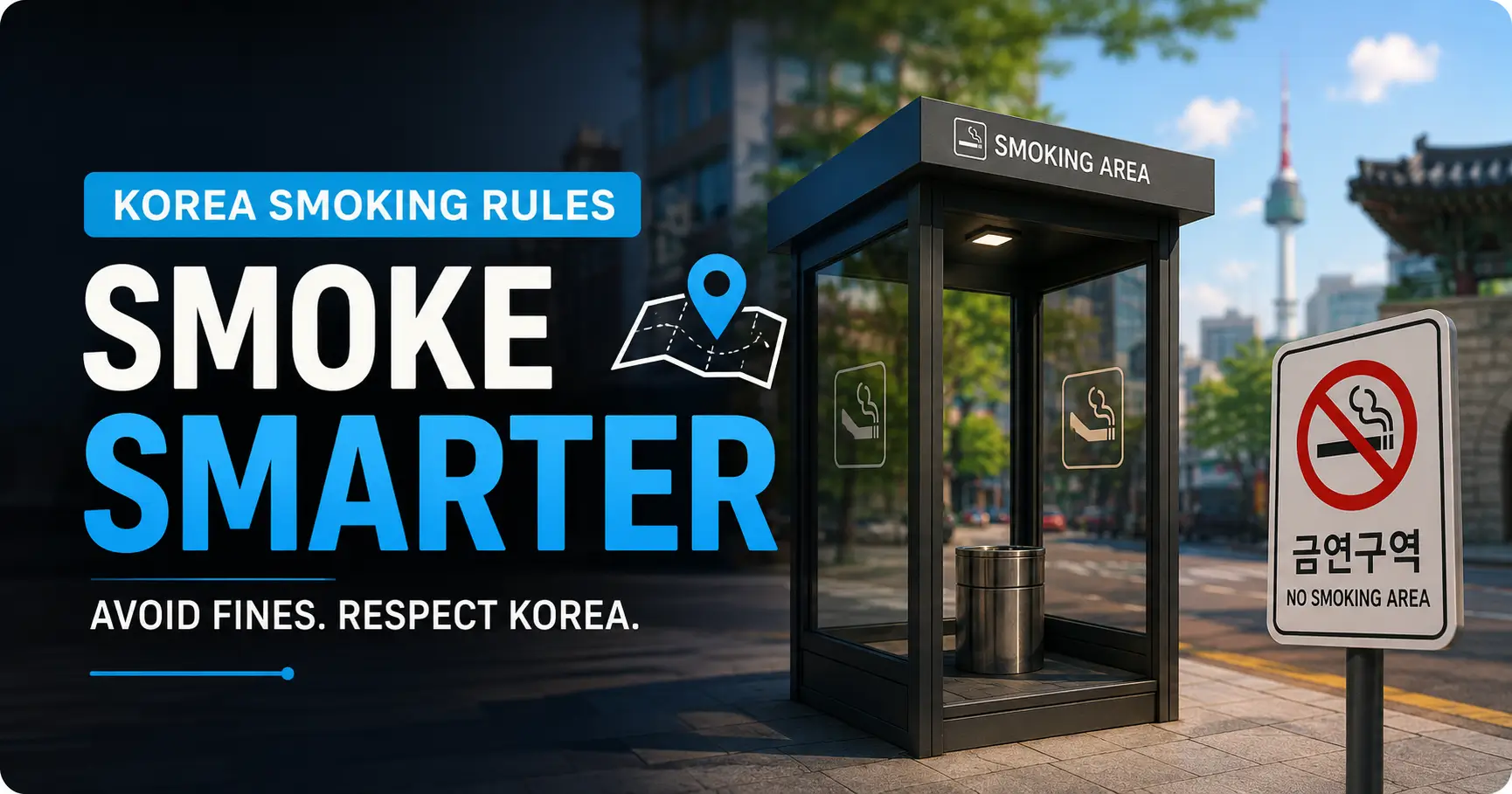
Navigating Korea’s Public Smoking Rules
A traveler steps out of a Seoul subway station, sees one person smoking beside a convenience store, another person glaring, and a red no-smoking mark painted on the pavement like a tiny civic trapdoor. That is the moment Korea’s public smoking rules stop feeling simple.
Why Korea’s public smoking rules feel more local than foreigners expect comes down to one practical truth: indoor restrictions are broad and easier to understand, while many outdoor rules depend on city, district, school-zone, subway-exit, park, street, and venue-level designations. Guessing can cost you money, embarrassment, or an awkward apology performed with the emotional texture of wet cardboard. This guide helps travelers, expats, exchange students, and first-time visitors decide where not to light up, how to read local signs, and why “outside” does not always mean “allowed.”
- ✔ Keep this simple.
- ✔ Look for signs.
- ✔ Use marked smoking areas.
- ✔ When in doubt, pause first.
The 10-Second Korea Smoking Rule
Treat Korea like a layered map, not a single rulebook. National law sets many smoke-free indoor places. Local governments add outdoor zones. Buildings and businesses may add their own rules. Your safest move is to smoke only in clearly marked smoking booths or designated areas.
Street-smart phrase: 흡연구역이 어디예요? It means, “Where is the smoking area?” Save it before your first coffee run.
Table of Contents
The Local-Rule Puzzle: Why “Public Smoking” Is Not One Simple Category
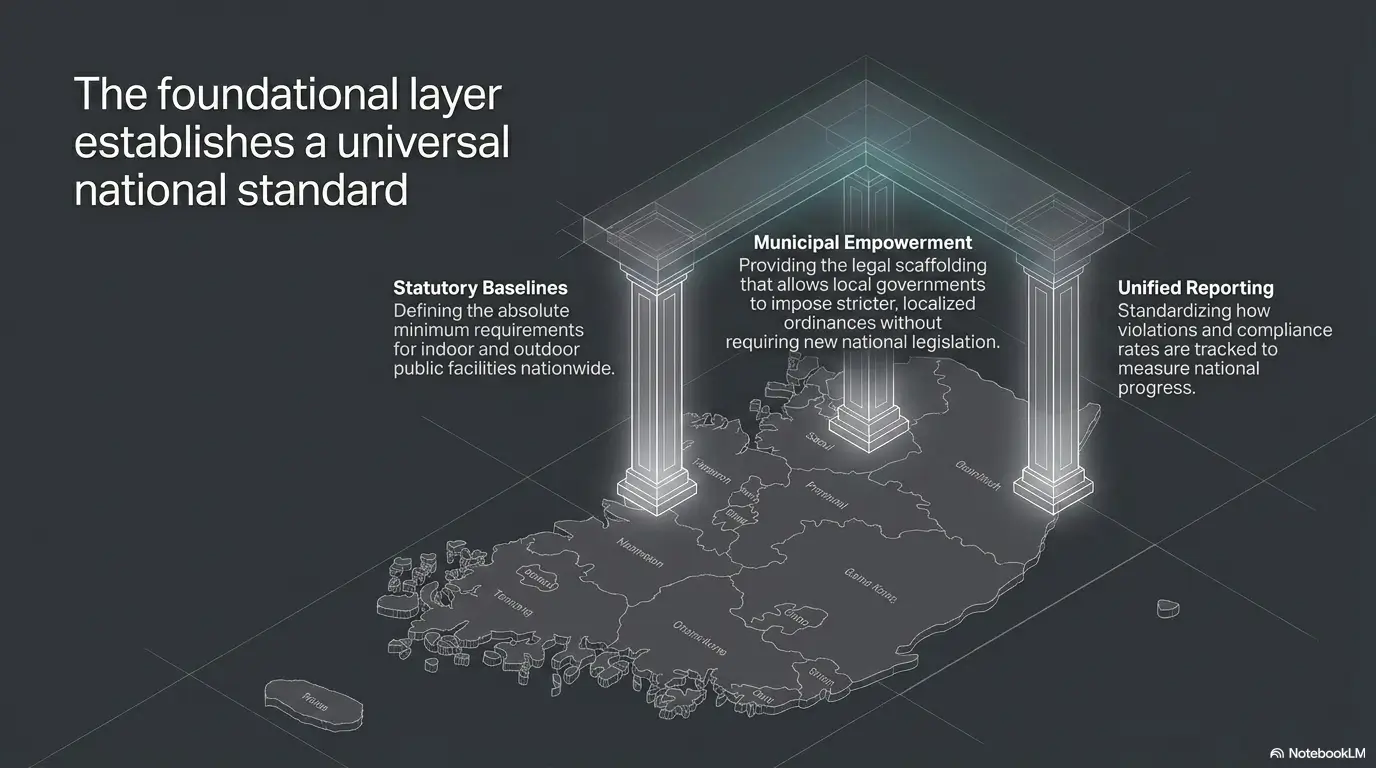
National Law Sets The Floor, Not The Whole Map
Korea has broad smoke-free rules for many indoor public-use facilities. That is the floor. The part that surprises visitors is everything built above that floor: local ordinances, district notices, subway-exit rules, school-zone expansions, public-health campaigns, and business-level policies.
Think of it as a city map printed on transparent paper. One sheet is national law. Another is Seoul, Busan, Jeju, or Incheon. Another is the district. Another is the building owner. The smoker on the sidewalk is standing where those sheets overlap.
This is why one visitor may say, “I saw people smoking outside everywhere,” while another says, “I almost got fined near a station exit.” Both stories can be sincere. Neither story is enough to guide your next cigarette.
The Same Sidewalk Can Feel Different Two Blocks Later
On one block, you may see no obvious sign. Two blocks later, a pavement mark, pole sign, school boundary, subway exit, or park gate changes the practical answer. The sidewalk did not transform into a courtroom. It simply crossed into a designated area.
This is especially important in dense places where streets blur together: Hongdae, Gangnam, Myeongdong, Seomyeon, Haeundae, university neighborhoods, office corridors, and food alleys. The “line” may be a painted icon on the ground, not a dramatic border with trumpets and smoke machines.
- National rules cover many public facilities.
- Local governments can add outdoor smoke-free zones.
- Street signs and pavement markings often matter more than habit.
Apply in 60 seconds: Before lighting up, scan the nearest walls, poles, pavement, entrances, and transit signs.
Here’s What No One Tells You: “Outside” Does Not Always Mean “Okay”
Many visitors arrive with a familiar rule from home: indoors is restricted, outdoors is flexible. Korea often feels different because outdoor life is crowded, compressed, and heavily shared. A cigarette near a bus stop is not just “outside.” It is outside where ten people are waiting in a narrow air pocket.
That is the heart of the confusion. Korea’s public smoking rules are partly legal and partly spatial. A big open riverside path feels different from a narrow cafe entrance. A quiet alley feels different from a school gate. A night-market street feels different from a marked smoking booth.
For travelers trying to understand other Korea-specific social signals, the same pattern appears in Korean politeness norms: the written rule matters, but the shared context often tells you what the rule feels like in public.
Indoor Bans Are The Easy Part: Restaurants, Cafes, Offices, And Public Facilities
Restaurants And Cafes Are Not Negotiable Zones
Indoor restaurants and cafes should be treated as smoke-free by default. Do not assume a staff member can bend the rule because the place is small, quiet, late-night, or unusually tolerant. Korea’s hospitality culture can be gracious, but smoke-free indoor rules are not a charm contest.
This matters in cafes because foreign visitors may see outdoor seating, narrow front patios, or open windows and feel unsure. The safest distinction is this: inside is not the place to ask. Outside still needs a sign check, property check, and crowd check.
Korean cafe culture has its own soft codes, from table time to seasonal menu rituals. If you want the wider etiquette picture, Seoul cafe etiquette for visitors is a useful companion because smoke, seats, noise, and lingering all live in the same tiny room of social judgment.
Government, Medical, School, And Transit Facilities Are High-Risk Places To Guess
Government buildings, clinics, hospitals, schools, universities, libraries, youth facilities, subway stations, transit facilities, and many large public-use buildings are not places to freestyle. If you are near a hospital entrance or school gate, let caution drive the car.
Medical settings deserve special care. Korea’s healthcare system can feel fast, efficient, and surprisingly easy to access for basic needs, but that speed does not mean the surrounding public space is casual. Around clinics and hospitals, secondhand smoke is both a rule issue and a human issue. For a broader look at the medical rhythm, see why Korean clinics are so fast.
Don’t Do This: Following The One Smoker Near The Door
One of the easiest mistakes is copying the nearest smoker. It feels reasonable. It is also unreliable.
Someone smoking near a door may be breaking the rule. They may be standing just outside the marked zone. They may be a regular who knows a property-specific corner. They may simply be taking a chance. None of those possibilities protect you.
Doorways are especially risky because smoke drifts indoors, crowds gather there, and staff often have to manage complaints. If a restaurant entrance has delivery riders, families, and waiting customers, it is not a good place to test your luck. The cigarette may be small. The social radius is not.
Decision Card: Doorway vs. Designated Booth
| Choice | Best when | Risk |
|---|---|---|
| Doorway or building edge | Almost never the best first choice | Smoke drift, complaints, property rules, fines |
| Marked smoking booth | Clearly open and designated for smoking | Usually lower, but still check facility signs |
Neutral action line: Choose the marked smoking booth unless a sign says it is closed, restricted, or facility-specific.
Outdoor Rules Feel Situational Because Cities And Districts Draw Their Own Lines
Subway Exits, Bus Stops, Parks, And Plazas Often Carry Local Rules
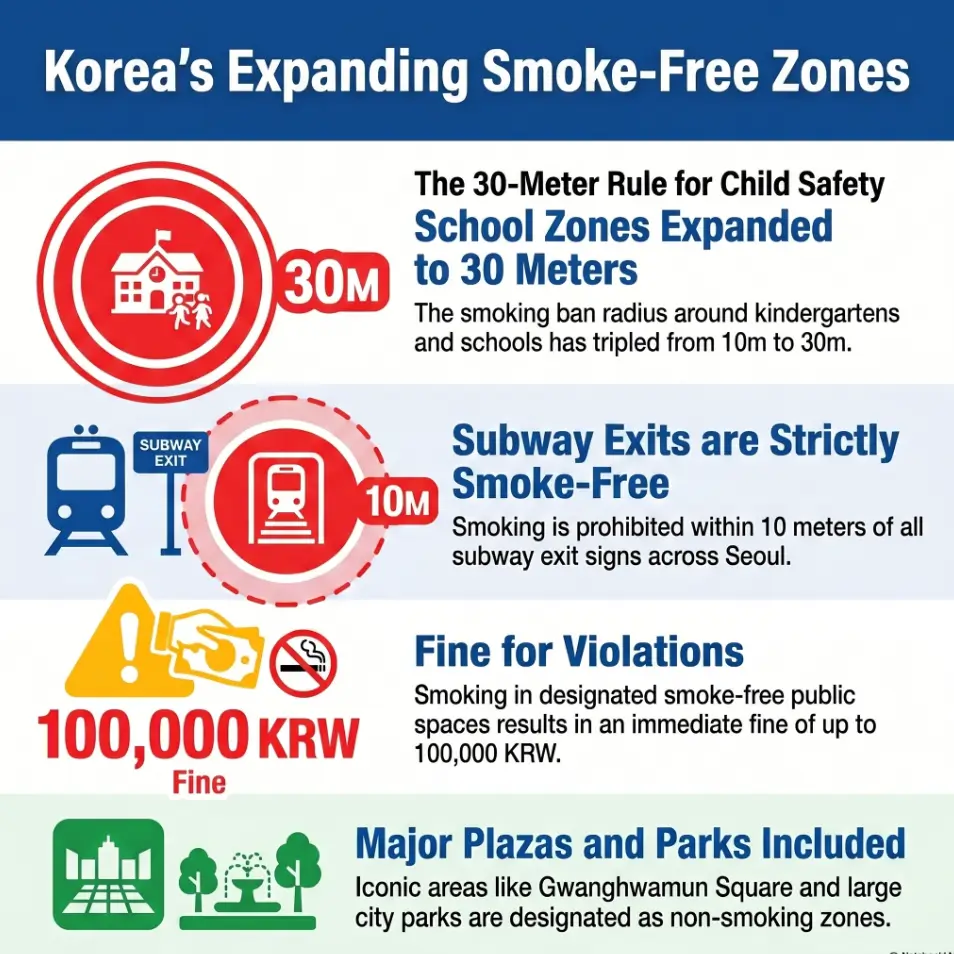
Outdoor smoking in Korea feels situational because local governments can designate additional smoke-free areas. Seoul is the best-known example for many visitors. The city has designated large numbers of indoor and outdoor smoke-free spaces over time, including public campaigns around subway station areas.
Near subway exits, the rule can be easy to miss if you are focused on navigation, luggage, or the urgent spiritual crisis of finding Exit 7 instead of Exit 8. Look down. Many station-area warnings appear on pavement. Look up. Pole signs, banners, and wall signs may also mark the zone.
If you are moving around by rail, the same practical mindset helps with other city problems too. Losing an item on the subway has its own system, and Korea subway lost and found procedures show how public infrastructure in Korea often works best when you know the local channel, not just the national idea.
School-Zone Rules Deserve Extra Caution
School zones are one of the clearest places to be careful. Korea expanded smoke-free areas around daycare centers, kindergartens, and schools to a 30-meter radius beginning August 17, 2024. That includes daycare centers, kindergartens, elementary schools, middle schools, and high schools.
For visitors, the practical rule is simple: if you see children, school uniforms, a school gate, a daycare sign, a kindergarten bus, or a cluster of parents waiting, do not light up. This is not the moment for legal geometry. It is the moment to keep your lighter in your pocket.
Korean school life is surrounded by strong public expectations. That is visible in everything from Korean school cleaning time to school lunch routines and exam rituals. Smoking near those spaces lands in a sensitive civic zone, not just a sidewalk.
The Sign Is The Border
Foreign visitors sometimes look for a physical smoking boundary: a fence, a booth, a painted square. Korea often gives you something subtler. A sign on a pole. A red circle on the pavement. A banner from a district office. A small notice attached to a building entrance.
Read the sign’s boundary description, not just the position of its pole. Look for “금연,” “No Smoking,” “흡연금지,” an area map or distance marking. A restriction may cover a wider designated area, and an absent or unclear sign does not establish that smoking is permitted. If uncertain, pause and ask the responsible venue or district.
1
Scan signsLook for 금연, no-smoking icons, pavement marks, banners, and pole notices.
2
Check locationPause near schools, hospitals, parks, transit exits, queues, entrances, and food areas.
3
Find the boothA marked smoking area is safer than an empty corner or another smoker’s example.
4
Pause if unsureUncertainty is not permission. Walk, ask, or wait until the rule is clear.
The “But I’m Just Walking” Problem: Why Moving While Smoking Feels Rude Or Risky
Walking Smokers Create A Moving Cloud
Smoking while walking is one of the fastest ways to create friction. Even where the legal issue is unclear, the social problem is obvious: the smoke moves with you and spreads behind you. People cannot easily avoid it on narrow sidewalks, especially during commuting hours.
A stationary smoker in a designated spot is one thing. A walking smoker becomes a traveling weather system. Nobody signed up for that tiny gray parade.
Korea’s Crowded Streets Make Distance Harder Than It Looks
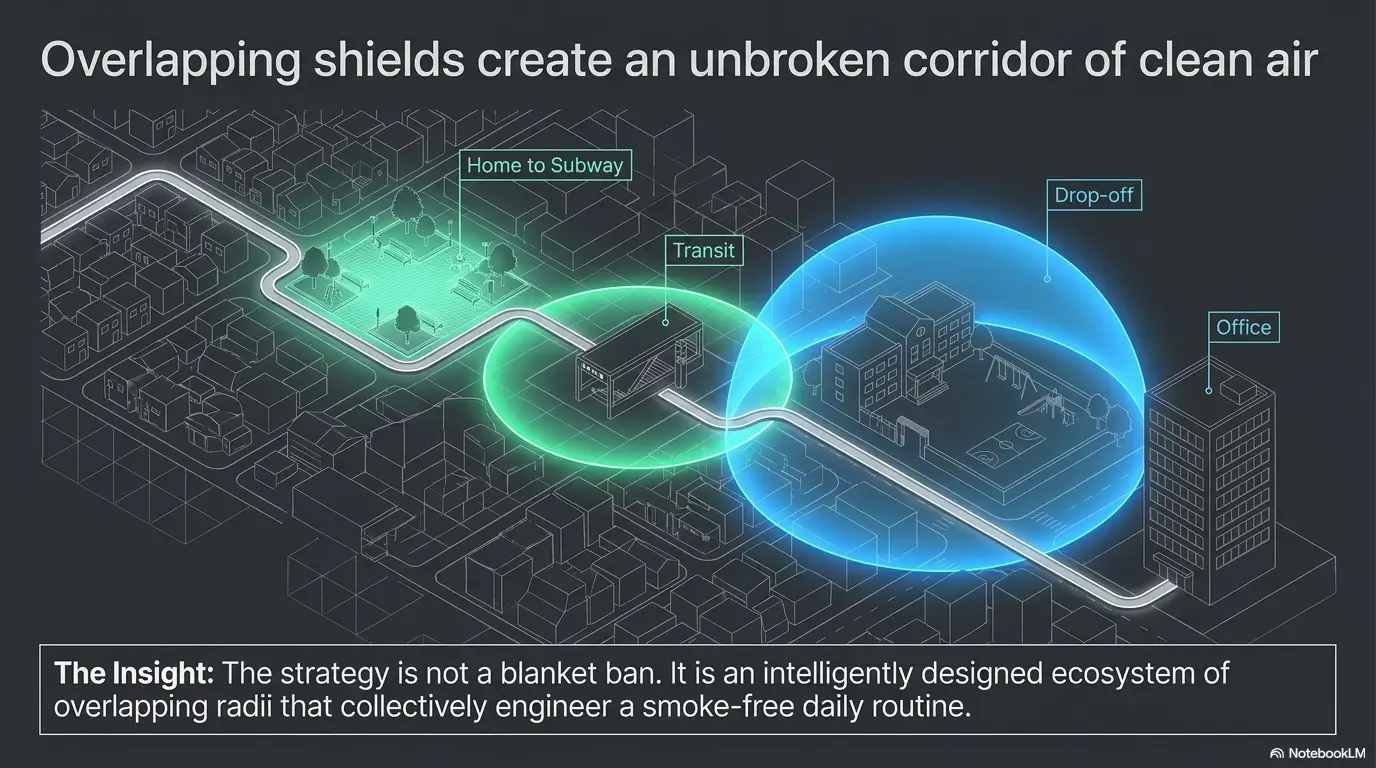
Distance is different in Korea’s busiest neighborhoods. Subway exits funnel people into tight streams. Cafe fronts gather waiting customers. Convenience stores become micro-plazas. Alleys near restaurants fill with delivery riders, couples, students, and office workers who are all trying to pass through the same strip of air.
This is why smoking while walking can feel worse in Korea than in a spacious place with wide sidewalks. The physical city makes personal habits public very quickly.
If you are learning Korea’s social rhythm, this resembles the careful spacing behind Korean seating hierarchy or Korean indirect communication. People may not always confront you directly, but the discomfort can still be very real.
Let’s Be Honest: Tourists Notice The Rule Only After The Stare
Many travelers do not notice a no-smoking zone until someone stares, waves smoke away, or a staff member points to a sign. That moment can feel harsh, but it is often just soft enforcement. Korea does not always begin with a lecture. Sometimes it begins with a look that has the temperature of a closed refrigerator.
Take the cue. Step away. Put it out. Ask for the smoking area. A quick correction is better than a public argument, and much cheaper than a fine.
Eligibility Checklist: Is This A Low-Risk Place To Smoke?
- Yes/No: I can see a marked smoking booth or designated smoking area.
- Yes/No: I do not see a no-smoking sign, pavement mark, or district banner.
- Yes/No: I am not near a school, daycare, hospital, transit exit, bus stop, park, plaza, queue, or entrance.
- Yes/No: Smoke will not drift into a doorway, window, outdoor table, or line of pedestrians.
- Yes/No: I am standing still, not walking with a lit cigarette.
Neutral action line: If you cannot answer “yes” to all five, wait and look for a clearer smoking area.
Who This Is For, And Who Should Read Something Else
Best For Travelers, Exchange Students, Digital Nomads, And New Expats
This guide is for people who are not trying to argue the law. They are trying to avoid an avoidable problem. That includes tourists, exchange students, English teachers, business travelers, digital nomads, visiting relatives, and new residents who want to behave well without carrying a municipal code book in their backpack.
If you are staying longer, your practical needs may expand beyond smoking rules. You may also need basics like Korea resident registration, phone plans, housing routines, recycling rules, and clinic visits. Korea becomes easier when each system gets its own small key.
Useful For Smokers And Non-Smokers
Smokers need to know where they can avoid fines and complaints. Non-smokers need to understand why enforcement appears uneven. A place can be restricted even if someone is smoking there. A place can be permitted but still rude if smoke affects a crowd. Both can be true. Korea loves layered context. It practically serves it as banchan.
Not For Legal Disputes Or Fine Appeals
This article is practical guidance, not legal advice. If you receive a citation, read the notice carefully and contact the relevant district office, public health center, tourist information center, hotel front desk, university office, or a qualified legal professional.
Do not rely on a blog post, a stranger’s comment, or a group-chat rumor for a fine appeal. Korea has many helpful systems, but “someone online said it was fine” is not one of the sturdier ladders.
Common Mistakes: Tiny Assumptions That Can Cost You
Mistake 1: Thinking “No Ashtray” Means “No Rule”
The absence of an ashtray does not prove anything. Some no-smoking zones are marked by signs rather than furniture. Some smoking areas have no obvious ashtray nearby. Some businesses remove ashtrays to avoid encouraging smoking near their entrance.
Street furniture is a clue, not a rulebook. Signs are stronger clues. Marked booths are stronger still.
Mistake 2: Assuming Every District Handles Smoking The Same Way
Seoul, Busan, Incheon, Jeju, and individual districts can feel different in practice. Tourist neighborhoods, office streets, nightlife alleys, beaches, parks, and transportation hubs may each carry different enforcement patterns and public expectations.
This is where Korea’s local character matters. A district’s no-smoking banner may be just as relevant as a national summary. The same traveler who learns Korean city identity will recognize the pattern: local government, neighborhood mood, and public behavior often shape daily experience.
Mistake 3: Treating E-Cigarettes As A Loophole
Do not assume vaping, heated tobacco, or other devices are automatically treated casually. Korea has continued tightening tobacco-related rules, and smoke-free zones may also restrict devices beyond conventional cigarettes depending on the law, venue, and local rule.
The practical traveler’s rule is plain: if cigarettes are banned in the space, do not assume your device is welcome. Ask, check signs, or move to a designated smoking area.
Mistake 4: Smoking Near A Door Because Staff Are Busy
Busy staff are not silent permission. A cafe worker making six drinks and carrying the emotional burden of a Saturday brunch rush may not stop you immediately. That does not make the doorway safe.
Entrances are where smoke slips indoors, customers wait, and complaints begin. It is also where visitors often stand because it feels “outside but nearby.” That nearby feeling is exactly the problem.
- Another smoker is not proof.
- No ashtray is not proof.
- An outdoor location is not proof.
Apply in 60 seconds: Replace “I think it’s fine” with “Can I identify the permitted smoking area?”
The Sign-Reading Method: A 20-Second Check Before Lighting Up
Step 1: Scan For Red Circle Signs, Ground Markings, And District Banners
Start with the obvious signs. Look for a cigarette icon with a red slash, the Korean word “금연,” English “No Smoking,” district office banners, and painted ground notices. Near subway exits, ground markings can be especially easy to miss because your eyes are busy reading exit numbers.
Use your phone camera translation if needed, but do not wait for perfect translation. The icon often tells the story faster than the app can decide what font the pavement is wearing.
Step 2: Look For A Smoking Booth, Not Just An Empty Corner
A quiet corner may look tempting. It may also be a no-smoking zone, a building entrance, a residential edge, or a place where smoke drifts into someone’s shop. A smoking booth or marked smoking area is much safer because it was created for that behavior.
In large buildings, stations, airports, or malls, ask staff where the smoking area is. Use the Korean phrase if helpful: “흡연구역이 어디예요?” Most people will understand the need even if they answer with a point, a hand wave, or a small map drawn in the air.
Step 3: Check The Human Context
Rules aside, check the people around you. Are there children nearby? A queue? A food stall? A hospital entrance? A cafe patio? A subway exit? A bus stop? A narrow alley where people have no room to pass?
If the smoke would force someone else to move, cough, wave, or glare, the location is wrong even before the legal question finishes putting on its shoes.
Step 4: When Unsure, Don’t Light Up Yet
Uncertainty is a reason to wait, not a reason to gamble. That one habit solves most problems. Walk another minute. Look for a booth. Ask a hotel desk. Check the station map. Save the cigarette for a clearer location.
Show me the nerdy details
Korea’s smoke-free experience feels complex because it combines national public-health rules, local ordinance authority, facility management, enforcement resources, and social norms. A visitor usually encounters the rule at the lowest visible layer: a sign, pavement mark, staff reminder, or district banner. That means practical compliance is less about memorizing every statute and more about recognizing local signals before acting. The method above prioritizes visible controls, sensitive spaces, and smoke-drift risk because those are the cues travelers can actually use in real time.
Mini Calculator: Your Korea Smoking Risk Score
Use this quick self-check. It does not store data and is not legal advice.
Score: Not calculated yet.
Neutral action line: A higher score means you should wait, move, or ask for the smoking area.
Why Enforcement Feels Uneven: Law, Signs, Complaints, And Local Capacity
Some Places Are Strict Because Complaints Are Predictable
Enforcement often feels strongest where complaints are predictable: subway exits, bus stops, parks, school zones, plazas, hospitals, and crowded commercial streets. These places concentrate people who did not choose to share smoke.
Quiet backstreets may appear more relaxed, but that does not mean they are always permitted. It may simply mean fewer inspectors, fewer complaints, or less visible signage.
Inspectors And Public Health Centers Matter
Korea’s smoke-free enforcement can involve local public health centers, inspectors, wardens, and complaint-based monitoring. This is one reason the same rule can feel very visible in one district and sleepy in another. Enforcement is a human system, not a magic net floating above every cigarette.
Public-health logic is the engine underneath these rules. The aim is to reduce secondhand-smoke exposure in shared spaces, especially where people cannot easily avoid it.
A Quiet Street Is Not A Permission Slip
One of the most important traveler habits is separating “nobody stopped me” from “this is allowed.” They are not the same sentence.
If you smoke in a designated no-smoking area on a quiet street, the absence of immediate enforcement does not erase the rule. The same is true in many Korea etiquette settings. You may not be corrected every time, but the expectation still exists. For a broader cultural comparison, Korean meeting etiquette shows how silence can be a cue, not approval.
- Busy public nodes get more attention.
- Quiet areas can still be restricted.
- Complaint-driven enforcement can appear suddenly.
Apply in 60 seconds: Judge the location by signs and context, not by whether an inspector is visible.
Etiquette Is The Missing Manual: What Locals Often Expect Before The Law Speaks
Keep Smoke Away From Doorways, Queues, Kids, And Food
Good smoking etiquette in Korea is usually invisible. Nobody has to move. Nobody has to wave smoke away. Nobody has to choose between entering a cafe and inhaling your cigarette first.
Avoid doorways, queues, children, food stalls, outdoor tables, clinic entrances, apartment gates, bus stops, and subway exits. These are not just legal-risk zones. They are shared-air zones.
Korea’s public manners often work through small acts of spatial awareness. You see it in Korean shoe etiquette, tipping in Korea, and even how people speak in elevators or cafes. The polite move often happens before anyone says a word.
Ask With Your Feet, Not Just Your Words
Instead of asking staff whether you can smoke right there, step away first. Then ask where the smoking area is. That small movement communicates respect before language has to work.
This matters because staff may feel uncomfortable saying no directly, especially to a foreign visitor. Asking with your feet lowers the pressure. It says, “I am not asking you to make an exception. I am asking where the proper place is.”
The Polite Move Is Usually Invisible
The best smoking etiquette is almost boring. You find the booth. You smoke there. You dispose of the cigarette properly. Nobody remembers you. This is success.
Travel sometimes teaches us to chase memorable moments. Smoking etiquette is the opposite. Be forgettable. Become a polite little ghost with a pocket lighter.
Illustrative Scenario: The Subway Exit Pause
On a cold evening near Euljiro, I once watched a visitor step out of a subway exit, suitcase in one hand, cigarette in the other. He looked tired in the way long flights make people look slightly folded. A local office worker pointed at the ground, not angrily, just firmly. There it was: a no-smoking mark near the exit, half-hidden by foot traffic and winter grit.
The visitor froze, gave a small embarrassed nod, and walked another block before asking a convenience store clerk, “흡연구역이 어디예요?” The clerk pointed down the side street. No lecture. No drama. Just a tiny civic correction. The lesson was not “Korea is strict.” The lesson was better: pause before the flame. In a dense city, a few seconds of looking can save money, dignity, and the mood of everyone sharing the sidewalk.
Practical Scenarios: Where Foreigners Most Often Guess Wrong
Outside A Cafe In A Trendy Neighborhood
An outdoor table does not automatically mean smoking is allowed. The patio may be part of the business property, near a no-smoking street, close to a doorway, or surrounded by diners. Some cafes may have a separate smoking area, but do not assume.
Ask staff where the smoking area is, not whether you can smoke at the table. The first question invites a practical answer. The second question may create tension, especially when other customers are eating cake with the seriousness of museum conservationists.
Near A Subway Exit At Night
Nightlife streets can look relaxed, but subway exits often remain sensitive. In Seoul, subway station entrances have been a major focus of smoke-free area campaigns, and many exits have visible markings or local enforcement.
Do not use nightlife energy as evidence. People may be drinking, laughing, singing, and eating hot fish cake at midnight. The exit can still be a no-smoking zone.
Beside A Convenience Store
Convenience stores are social magnets in Korea. People gather, snack, wait, charge phones, and sometimes smoke nearby. That does not mean every convenience store edge is permitted.
Check for an actual smoking stand, ash disposal point, or marked area. Also look at what is nearby: school, apartment, bus stop, crosswalk, cafe, or clinic. The convenience store may feel casual, but the sidewalk may be governed by local rules.
If you are new to these little all-purpose neighborhood hubs, a Korean convenience store guide helps explain why they function as more than snack shops. That social role is exactly why smoking beside them can get complicated.
Hotel Entrances And Guesthouse Alleys
Hotels and guesthouses add another layer: property policy. Even if the street does not appear restricted, the hotel may prohibit smoking near entrances, windows, parking areas, rooftop spaces, or alleys where neighbors complain.
Ask the front desk for the designated smoking area. Many hotels can tell you quickly. If they say there is none nearby, believe them. Do not create your own “designated area” beside a planter. The planter has suffered enough.
Coverage Tier Map: Where Smoking Risk Usually Rises
| Tier | Location type | Practical move |
|---|---|---|
| Tier 1 | Marked smoking booth | Usually safest if open and clearly designated |
| Tier 2 | Quiet unmarked outdoor area | Still scan for signs and nearby sensitive spaces |
| Tier 3 | Convenience store edge or alley | Do not rely on other smokers; check markings |
| Tier 4 | Transit, parks, plazas, entrances, queues | Assume higher risk and look for a booth |
| Tier 5 | Schools, daycare centers, hospitals, indoor public facilities | Do not smoke there |
Neutral action line: The higher the tier, the more strongly you should wait for a marked smoking area.
Safety And Disclaimer: Use This As Practical Guidance, Not Legal Advice
Rules Can Change By District And Date
Korea’s smoking rules can change by date, district, facility type, and local ordinance. The August 2024 expansion around daycare centers, kindergartens, and schools is a useful reminder: a rule you learned years ago may not be enough today.
When the stakes matter, check official guidance from the city, district office, airport, hotel, university, venue, or public health center. Tourist information centers and hotel front desks can also help with location-specific questions.
Secondhand Smoke Is The Public-Health Reason Behind The Rules
This article is not here to moralize smokers. It is here to explain how Korea manages shared air in dense public places. Secondhand smoke is the public-health reason behind many smoke-free policies, especially in indoor spaces and crowded outdoor areas where people cannot easily avoid exposure.
That logic matters for travelers because it makes the rule easier to predict. If a space gathers children, patients, commuters, diners, or people waiting in close quarters, treat it as sensitive.
When To Seek Help
If you receive a fine, have a dispute with a business, or need exact legal wording, seek help from the relevant district office, public health center, tourist information center, hotel front desk, university administration, or a qualified legal professional.
If you are a long-term resident, also keep your address, phone number, and local contacts current. Practical Korea life depends on small systems working properly, from health checkups to delivery messages. For broader newcomer routines, Korean phone plans for Americans and recycling in Korea for foreigners explain two other areas where local rules shape daily behavior.
FAQ
Can tourists smoke on the street in Korea?
Sometimes, but not everywhere. Many outdoor areas are locally designated no-smoking zones, especially near subway exits, bus stops, schools, parks, plazas, and busy commercial areas. The safest choice is to use a clearly marked smoking booth or designated smoking area.
Are Korean smoking rules the same in Seoul and Busan?
No. National rules apply broadly to many public facilities, but local governments can designate additional smoke-free areas. Seoul, Busan, Incheon, Jeju, and individual districts may feel different at street level because signage, enforcement, and local ordinances vary.
Can I vape where cigarettes are banned in Korea?
Do not assume so. Smoke-free zones may restrict vaping, heated tobacco, or similar devices depending on the location and applicable rules. If cigarettes are banned, treat vaping as risky unless a sign or staff member clearly says otherwise.
Are smoking booths legal places to smoke?
Usually, yes, if they are clearly designated for smoking, open, and not restricted by a separate facility rule. Still check signs near airports, stations, hotels, campuses, hospitals, and large buildings because some areas have additional instructions.
What happens if I smoke in a no-smoking zone?
You may receive a fine depending on the location, local rule, and enforcement process. Fine amounts and procedures can vary. If cited, read the notice carefully and contact the relevant district office or public health center for official guidance.
Is smoking allowed outside restaurants in Korea?
Not automatically. Sidewalks, patios, entrances, alleys, and outdoor tables may be covered by local smoke-free zones or business property rules. Ask where the smoking area is instead of assuming an outdoor table is acceptable.
Why do I still see people smoking in restricted-looking places?
Enforcement is not constant. Some people ignore rules, misunderstand boundaries, or smoke before being warned. Their behavior is not reliable guidance. Check signs, pavement markings, and local context before deciding.
What is the safest rule for first-time visitors?
Smoke only in clearly marked smoking areas or booths. Avoid smoking while walking, near entrances, transit stops, schools, parks, hospitals, outdoor dining, queues, or crowds. If you are unsure, do not light up yet.
Next Step: Build A “Pause Before Lighting” Habit
The 3-Point Check
The confusion that began at the subway exit has a clean ending. Korea’s public smoking rules feel local because they are local in the places visitors actually stand: beside stations, cafes, schools, parks, hotels, and crowded sidewalks.
Before smoking, ask three questions:
- Is there a no-smoking sign, pavement mark, banner, or facility notice?
- Is this near transit, schools, parks, hospitals, food, entrances, queues, children, or crowds?
- Is there a marked smoking booth or designated smoking area nearby?
If the answer is unclear, pause. That pause is the whole skill. It protects your wallet, your mood, and the shared air around you.
One Concrete Action
Within the next 15 minutes, save this phrase in your phone: 흡연구역이 어디예요? It means, “Where is the smoking area?” Add a note beside it: “Use before lighting up near stations, cafes, hotels, schools, parks, and crowds.”
That tiny sentence can prevent the whole smoky opera from turning into a fine, a glare, or a very awkward bow.
Last reviewed: 2026-05.