
Lost on the Tracks: Navigating Korea’s Subway Lost & Found
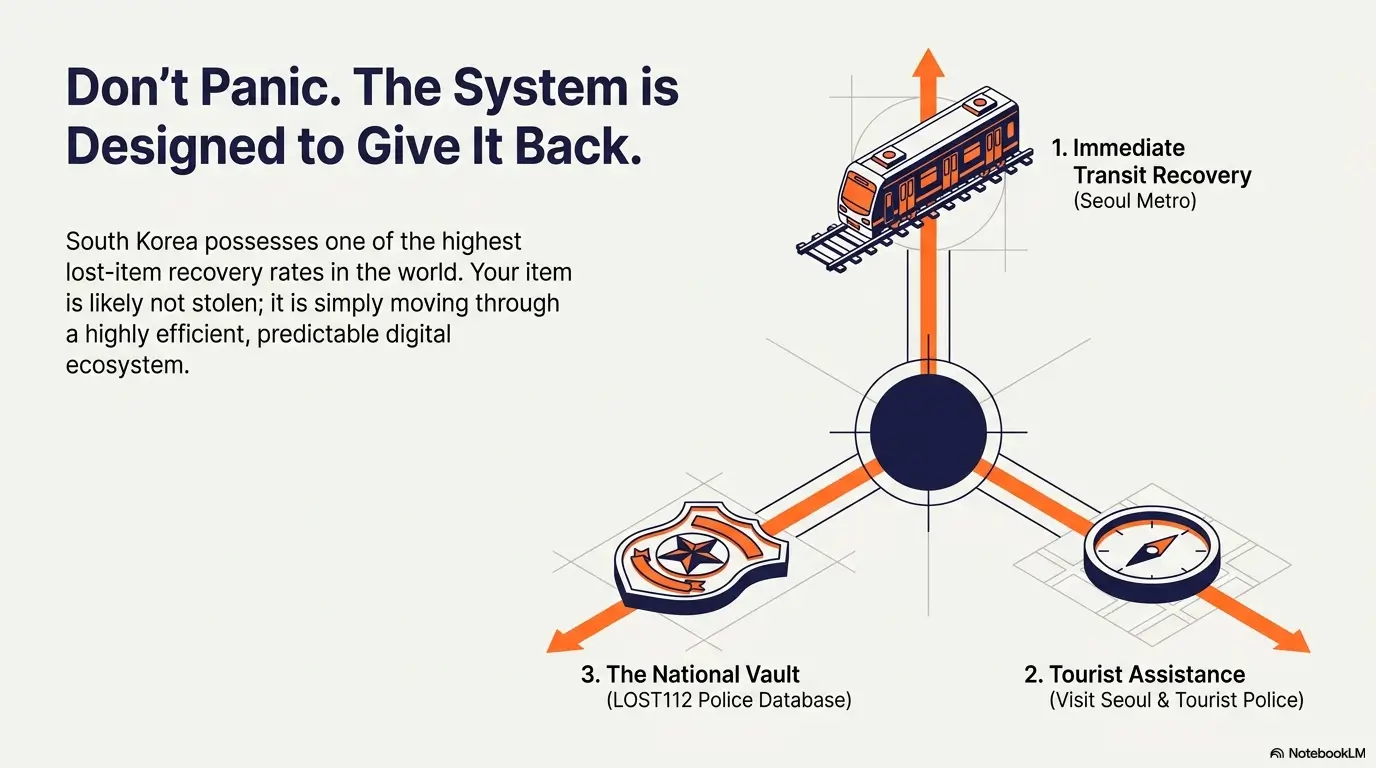
Lose a wallet on the subway in Korea, and your brain may sprint straight to disaster before the train doors finish chiming. Then something stranger happens: the item often comes back. Not by luck alone, but through a surprisingly practical search path.
For foreign residents, expats, and travelers, the real stress isn’t just the loss—it’s the unknown. Should you ask station staff, search LOST112, or contact a dedicated center? Delaying can make recovery harder, but Korea’s system is built for speed and social trust.
This is not “magic honesty.” It is a structured ecosystem of CCTV-backed spaces, digital databases, and daily routines designed to turn a moment of panic into a successful recovery.
From passport pouches to the legendary “umbrella army,” there is a system for everything.
Table of Contents
Fast Answer:
Korea’s subway lost-and-found culture surprises many foreign residents because it combines social trust, dense transit infrastructure, station staff routines, CCTV-backed public spaces, and a centralized reporting system. Lost items are often turned in quickly, searchable through LOST112, or handled by subway lost-and-found centers. The surprise is not magic honesty. It is culture plus procedure, quietly humming under the platform lights.
Why Korea’s Lost-and-Found Feels Almost Unreal at First
The “I Got My Wallet Back?” Moment
The first time a foreign resident gets a lost wallet, phone, or backpack back in Korea, the emotional sequence is oddly cinematic. First comes panic. Then disbelief. Then the sheepish little bow at the station office, when a staff member slides the item across the counter as if this happens every Tuesday because, frankly, it often does.
I once watched a friend discover she had left her pouch on Line 2. Her face went pale enough to qualify as emergency lighting. Two phone calls, one station visit, and roughly 40 minutes later, the pouch was sitting in a staff office with her lip balm, bank card, and tiny museum of receipts still inside.
For many newcomers, that moment does not feel merely convenient. It feels like a cultural door opening.
Why Foreign Residents Often Compare It to Home
Foreign residents often compare Korea’s subway lost-and-found culture with whatever transit system trained their expectations. For some Americans, the baseline is simple: if your wallet falls out in a busy public place, you begin the five stages of grief before checking the last seat cushion.
That comparison can make Korea feel almost unreal. But the better question is not, “Why is Korea perfect?” It is not perfect. Items can be stolen, misplaced, delayed, or never recovered. The better question is: why does recovery feel more probable here?
- Subway stations are staffed and routinized.
- Lost items have a recognized reporting path.
- Passengers often expect found items to be turned in.
- Public transit spaces are watched, cleaned, and managed.
The Quiet Shock: Trust Feels Operational, Not Sentimental
The most surprising part is that trust does not appear as a grand moral speech. It appears as a form, a counter, a staff radio, a posted phone number, and a searchable database. Korea’s subway lost-and-found culture works because trust is not floating in the air like perfume. It has cubbies. It has timestamps. It has procedures.
- Foreign residents often expect permanent loss.
- Korea’s transit routines create recovery paths.
- Trust feels stronger when staff and systems support it.
Apply in 60 seconds: Save the station name, subway line, and train direction in your phone the next time you ride.
The System Behind the Surprise
LOST112: Korea’s Central Lost-and-Found Backbone
LOST112 is Korea’s national lost-and-found information system connected with the Korean National Police Agency. For foreigners, the key idea is simple: lost items are not just sitting in one mysterious station drawer forever. They can enter a wider system where found items are registered and searchable.
The English LOST112 pages explain that users can search for found items, report lost items, and understand the general process flow. That matters because the subway is not the only place where items vanish. Buses, trains, taxis, airports, police stations, and other institutions can all become part of the recovery web.
Think of LOST112 as the civic pantry where misplaced objects may eventually get labeled. Not glamorous. Extremely useful.
Subway Stations as First-Response Points for Lost Items
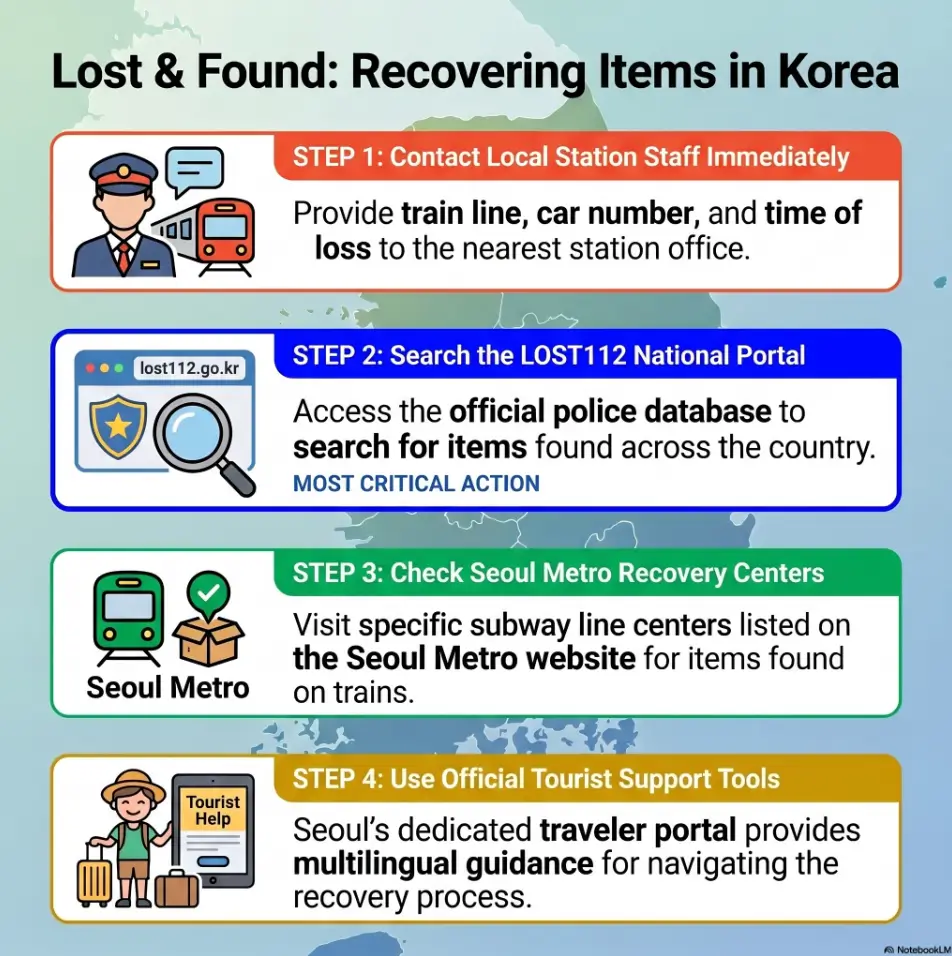
Subway stations often act like first-response points. If your item was found inside a train, on a platform, near a gate, or in a station corridor, staff may receive it before anything reaches a police-linked system.
This is why the first advice is wonderfully unromantic: go to the station office or customer safety center. Give clean details. Resist the urge to narrate the entire tragedy from breakfast onward. The staff needs a search map, not your full emotional weather report, though honestly, they have probably heard both.
Why Line, Station, Time, and Train Direction Matter More Than Panic
In Korea’s subway system, the search becomes much easier when you can provide four details: line, station, approximate time, and direction. Direction matters because “I was on Line 2” is still a rather large haystack wearing green signage.
Infographic: The 4 Details That Shrink the Search
Example: Line 2, Line 4, AREX
Example: toward Hongik Univ., toward Sadang
Example: around 8:20 p.m.
Example: car near door 3-2, platform bench, exit gate
Practical result: These details turn “somewhere underground” into a search path staff can actually use.
Money Block: Quote-Prep Style Lost-Item List
Before you contact a lost-and-found center, gather the same kind of details you would gather before comparing travel insurance or phone repair quotes: enough information for the other person to act quickly.
- Item: wallet, phone, bag, umbrella, passport pouch
- Unique marks: color, brand, sticker, case, initials, keychain
- Transit path: line, boarding station, exit station, transfer station
- Time: closest 10 to 20 minute window you can remember
- Proof: photo, purchase receipt, card name, device serial if relevant
Neutral action: Write these details in one note before calling or visiting the station office.
What Actually Happens After You Lose Something on the Subway
First, the Item May Stay With the Transit Operator
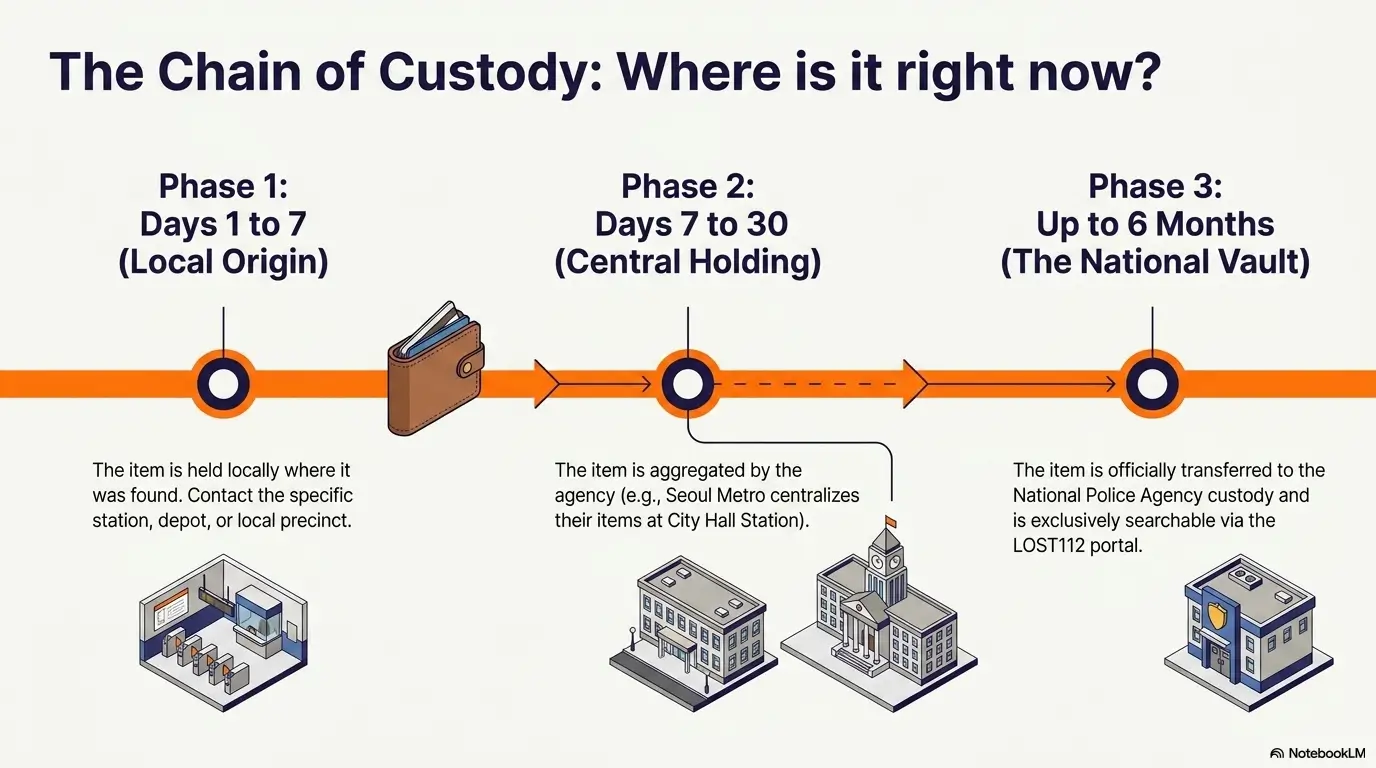
If someone finds an item in or near the subway, it may be handed to station staff or a subway lost-and-found office. This is the period when fast reporting can help most. The item may still be within the transit operator’s own handling process.
That early window can feel strange to foreigners because there is no dramatic detective scene. Sometimes the whole process is a fluorescent-lit counter, a staff member checking a system, and a plastic tray of found umbrellas standing there like little wet soldiers.
If you are still near the station, do not wander away muttering, “I will figure this out later.” Later is where recoverable items go to become paperwork.
Then, Unclaimed Items Can Move Into Police-Linked Systems
If an item remains unclaimed, it may move beyond the station or transit office and into the broader lost-and-found process. LOST112 explains that items may be kept at the relevant institution for 7 days or transferred sooner before becoming part of the National Police Agency lost-and-found process.
That 7-day detail is important. Many newcomers assume the station where they lost something will be the only place to check. But after time passes, the item may no longer be handled only by that immediate station.
The 7-Day Window Many Newcomers Miss
The phrase “7 days” should ring like a small temple bell in your head. It does not mean every item sits neatly in one place for exactly 7 days. It means you should act early, then widen your search if the first station does not have it.
In practice, this creates a two-step rhythm:
- Same day or next day: contact the station or subway lost-and-found center.
- After that: search LOST112 and consider police-linked reporting routes.
Show me the nerdy details
The lost-item path is best understood as a handoff chain. A found item may start with a station office or transit operator, then move into a police-linked lost-and-found system if unclaimed. The exact timing can vary by institution and item type, so the safest behavior is to report early, search repeatedly, and keep your item description consistent.
Why Honesty Alone Doesn’t Explain the Culture
Social Trust Is Real, But It Has Infrastructure Around It
It is tempting to explain every returned wallet with one sentence: “People in Korea are honest.” There is truth in that observation, but it is incomplete. Culture matters. Public norms matter. But systems shape behavior too.
When a passenger finds a phone on a train seat, the environment offers an obvious next step: hand it to staff. The station is not a wilderness. It is staffed, monitored, cleaned, and connected to procedures. That makes doing the right thing easier than inventing a solution.
Virtue, when given a counter and a receipt, becomes less heroic and more ordinary. That may be the quiet genius of the system.
CCTV, Staff Presence, and Public Norms Change Behavior
Korea’s subway spaces often feel watched in the practical sense, not in a dystopian movie-trailer voice. CCTV, staff presence, other passengers, and regular cleaning routines all change the social temperature.
People behave differently in spaces that feel maintained. A platform that is clean, bright, and frequently used sends a message: “This place has expectations.” The message is subtle, but it has teeth.
Here’s What No One Tells You: Systems Make Virtue Easier
Many foreign residents focus on the moral part because it is emotionally striking. But the repeatable part is operational. When people know where to take found items, and when staff know how to route them, honesty does not need to improvise.
The same pattern shows up in other everyday etiquette systems too. Once you understand how Korean politeness works in practical public life, the lost-and-found culture feels less like a miracle and more like one tile in a larger civic mosaic.
- Public norms encourage turning items in.
- Staffed stations reduce uncertainty.
- Searchable systems help lost items travel back toward owners.
Apply in 60 seconds: When you find something, do not keep walking with it. Hand it to station staff or the nearest appropriate office.
Foreign Resident Mistake: Waiting Too Long to Report It
Don’t Assume “Someone Will Message Me Somehow”
One of the most expensive mistakes foreign residents make is waiting. They assume that if the item is found, someone will somehow identify them, contact them, and resolve the problem with the gentle efficiency of a hotel concierge in a drama.
Sometimes that happens, especially if the item contains clear contact information. But you should not build your recovery plan around a miracle with Wi-Fi.
If you lost a wallet, phone, bag, passport pouch, or laptop, act within the same day if possible. Even 15 minutes of clear reporting can beat 2 days of anxious guessing.
Search First, Then Report Clearly
A good sequence is: search your pockets and bag, retrace your last known location, contact the relevant station or subway operator, then check LOST112. If the item has financial cards, IDs, passport-related documents, or work devices, take the obvious protective steps too.
That may mean locking cards, using device-location features, contacting your bank, or checking with your employer if the device contains work data. Lost-and-found optimism is lovely. Risk management still pays the rent.
The Small Details That Save Hours: Line, Car, Door, Time, Direction
The details that feel tiny when you are calm become golden when you are searching. In Seoul subway stations, platform markings often identify where train doors stop. If you remember “near door 5-3” or “second car from the front,” you have just handed staff a flashlight instead of a fog machine.
Money Block: One-Minute Recovery Calculator
Use this quick estimate to decide how urgently to act. It does not store anything.
Neutral action: If ID, payment cards, passport documents, or work data are involved, treat the situation as urgent even when Korea’s lost-and-found culture feels reassuring.
The Station Staff Factor Foreigners Underestimate
Customer Safety Centers Are More Useful Than They Look
Station offices and customer safety centers may not look dramatic from the outside. Sometimes they are tucked near gates, behind glass, or beside a corridor everyone rushes past. But these are often the exact places where your problem becomes searchable.
Foreign residents sometimes hesitate because they worry their Korean is not good enough. That fear is understandable. Still, a simple phrase, translation app, photo, and clear route details can go a long way.
I have seen staff work with half-Korean, half-English, and one very expressive hand-drawn map that looked like a potato wearing subway lines. The potato map helped.
Why Calm, Specific Requests Work Better Than Long Explanations
When you approach staff, lead with the useful facts. Try this structure:
- “I lost a black wallet.”
- “Line 2, toward City Hall.”
- “Around 7:40 p.m.”
- “I got off at Hongdae.”
- “It may have been near the door.”
You can add emotion afterward if needed. Start with the search coordinates. The same rule applies in many social situations: short, respectful, context-rich wording usually works better than a nervous flood of explanation, especially if you are still learning Korean indirect communication.
Let’s Be Honest: “I Lost It Somewhere” Is Not a Search Strategy
Everyone has said some version of “I lost it somewhere.” It is human. It is also not very useful. Subway systems run on routes, times, operators, transfers, and physical spaces. Your job is not to become Sherlock Holmes. Your job is to give staff enough edges to grip.
- Lead with item type and color.
- Give line, direction, time, and station.
- Use photos or translation apps without embarrassment.
Apply in 60 seconds: Save one Korean phrase in your phone: “I lost this item on the subway.”
The Cultural Contrast: Why This Feels So Different From Many US Cities
Public Space Feels Less Disposable
Many US cities have wonderful people, helpful transit workers, and honest strangers. This article is not a civic cage fight. But daily public-space experiences can differ sharply.
In some American transit environments, people expect public space to be under-maintained, loosely supervised, or socially fragmented. When that expectation settles into the bones, losing something feels final faster. The item is not merely lost. It has entered the public void.
In Korea, especially in major subway systems, the environment often feels more managed. Floors are cleaned. Gates are watched. Station staff are visible. Clear routines make public space feel less disposable.
Dense Transit Creates Repeatable Recovery Paths
Density helps. Korea’s subway networks move huge numbers of people through repeatable paths every day. That repetition creates predictable places for lost items to go: train, platform, station office, lost-and-found center, police-linked system.
A dense transit system is not just a way to move bodies. It is a way to create civic muscle memory. When the same problem happens thousands of times, the system learns to make a groove for it.
That civic muscle memory becomes easier to notice once you start reading the city beyond tourist districts. The same sidewalk-level logic appears in Korea’s aging neighborhoods, where clinics, benches, stations, and small shops quietly reveal how public life is organized for daily use.
The Surprise Is Not Perfection, But Probability
The most honest statement is this: Korea’s subway lost-and-found culture raises the probability of recovery. It does not guarantee recovery. Phones disappear. Cash may not come back. Some items never reach a desk. Human nature still has its little trapdoors.
But probability changes how you feel in public. It gives residents a bit more room to breathe.
Money Block: Decision Card
| Situation | Best First Step | Why |
|---|---|---|
| You noticed the loss inside the station | Go to station staff immediately | The item may still be nearby or freshly reported |
| You noticed hours later | Contact the operator and search LOST112 | The item may have moved beyond the station |
| Cards, passport, or work device involved | Report and protect accounts/devices | Recovery is possible, but risk control comes first |
Neutral action: Choose the route based on timing and risk, not on panic level.
Who This Is For / Not For
This Is For Foreign Residents Learning Daily Korea
This guide is for people living in Korea long enough to build routines: exchange students, English teachers, office workers, military families, international spouses, long-stay travelers, and digital nomads who know the smell of subway bread shops better than they expected to.
If you use the subway weekly, lost-and-found knowledge is not trivia. It is daily-life insurance with no monthly premium.
This Is For Travelers Who Use Subway Lines Often
Short-term travelers can benefit too. If you are using Seoul, Busan, Daegu, Daejeon, Gwangju, or airport rail connections, knowing the lost-item path can save your trip from turning into a tragic opera about a missing passport pouch.
The basic rule travels well: identify the operator, contact the station or lost-and-found center, search LOST112, and report with clear details. It belongs beside the other small practical skills travelers learn, from ordering food to navigating Korean convenience stores when your phone battery, umbrella, or emergency snack situation gets dramatic.
This Is Not For Stolen-Property Guarantees or Legal Claims
This article is not a guarantee that stolen property will be recovered. Lost and stolen are different categories, even if they feel identical in your nervous system for the first 10 minutes.
If you suspect theft, if sensitive documents are involved, or if money and identity information are at risk, contact the appropriate authority and protect your accounts. Korea’s lost-and-found culture is impressive. It is not a force field.
Common Mistakes Foreign Residents Make
Mistake 1: Treating Lost and Stolen as the Same First Step
If you simply left an item behind, start with the transit lost-and-found route. If there are signs of theft, treat it differently. For example, a missing phone after you left it on a seat is not the same as a bag opened in a crowd.
When unsure, report clearly without exaggerating. Staff and police can guide you better when the story is precise.
Mistake 2: Forgetting the Exact Subway Direction
Direction is a small detail with enormous value. In circular or busy lines, it can determine which train, platform, and station sequence staff should consider.
When foreign residents say, “I was going to Gangnam,” that helps. When they say, “Line 2 toward Gangnam from Hongdae around 6:10 p.m.,” that helps more.
Mistake 3: Only Checking the Station Where You Noticed the Loss
You may notice the loss at Station B, but the item may have fallen at Station A or stayed on the train until Station C. This is especially common after transfers, rush-hour rides, or sleepy late-night returns when your brain is operating on dumpling steam.
Mistake 4: Giving Up Before Checking LOST112
Some items do not appear immediately. If the first call fails, do not treat that as the end. Search LOST112 later and try different descriptions. A black pouch may be registered as a bag. A card wallet may be registered under wallet. Translation and category choices can matter.
Mistake 5: Assuming English Help Will Be Identical Everywhere
English support can vary by station, operator, time, and staff member. Prepare simple wording and use translation tools. A photo of the item or a screenshot of your route may be more helpful than a perfect sentence.
This is where language and etiquette overlap. If you are nervous about sounding too direct or too casual, a basic grasp of Korean honorifics for foreigners can make station-office conversations feel less intimidating.
- Direction matters more than many foreigners expect.
- The item may move through multiple locations.
- English support can vary, so visual proof helps.
Apply in 60 seconds: Take a screenshot of your subway route when carrying something valuable.
What Korea’s Lost-and-Found Culture Reveals About Everyday Life
Small Public Rituals Build Big Civic Confidence
Lost-and-found culture is not only about objects. It is about what people believe public life can hold. When a stranger turns in your wallet, when staff know where to check, when a database makes the item searchable, the city becomes slightly less hostile.
That feeling accumulates. A returned umbrella is small. A returned phone is not small. A returned passport pouch can feel like the universe briefly put on a neat vest and worked the information desk.
A Returned Umbrella Is Also a Social Signal
Umbrellas are Korea’s unofficial subway confetti. They appear everywhere during rainy season, lean in corners, vanish from memory, and reappear in lost-and-found spaces like a migratory species.
When even low-value items are handled with some order, residents receive a social signal: public things matter. Not always. Not perfectly. But enough to shape behavior.
The Platform Becomes a Mirror: What People Expect From One Another
A subway platform is a mirror. It reflects what people expect strangers to do when nobody knows their name. In Korea, many foreign residents are surprised to find that expectation is often better than the one they brought with them.
This does not mean Korea is morally superior. It means everyday systems and everyday norms have built a particular kind of civic choreography. People step into it, repeat it, and eventually stop thinking of it as special.
That choreography can appear in small linguistic habits too. The social care hidden in everyday phrases, including why Koreans ask if you ate, belongs to the same world of practical concern, routine, and shared expectation.
Short Story: The Blue Wallet at Sindorim
A foreign teacher I knew once lost a blue wallet at Sindorim during the transfer-hour swirl, that strange human river where everyone seems late and nobody technically is. She assumed it was gone. The wallet had her ARC, bank card, apartment keycard, and a coffee stamp card she cared about more than dignity allowed. A station worker asked three questions:
line, direction, time. No speech, no scolding, no theatrical sympathy. Later that evening, the wallet was found and routed through the station office. Nothing inside had moved. She laughed when she picked it up, partly from relief and partly because the coffee stamp card had survived like a tiny laminated hero. What stayed with her was not just the return. It was how ordinary everyone made it feel.
FAQ
Can foreigners use Korea’s subway lost-and-found system?
Yes. Foreigners can ask station staff, contact subway lost-and-found centers, and search LOST112. English support may vary by location, so it helps to prepare simple details, screenshots, photos of the item, and a translation app.
What should I do first if I lose a wallet on the Seoul subway?
If you are still near the station, go to the station office or customer safety center immediately. Give the line, direction, time, boarding station, exit station, and wallet description. Then check the relevant subway lost-and-found center and LOST112 if the item is not found quickly.
Is LOST112 available in English?
LOST112 has English-language guidance pages. The main service may still require patience with translation, categories, and Korean administrative wording. If you struggle, ask a Korean-speaking friend, hotel desk, school office, workplace admin, or local support center to help with the search.
How long are lost items kept before being transferred?
LOST112’s English process guidance explains that lost items may be kept by the relevant institution for 7 days or transferred sooner before moving into the National Police Agency lost-and-found process. Because timing can vary, report early and keep checking.
Should I go to the subway station or police station first?
If you likely lost the item on the subway and it happened recently, start with station staff or the subway lost-and-found center. If the item is not found, if time has passed, or if official reporting is needed, use LOST112 and police-linked routes.
What details help staff find a lost item faster?
The most useful details are the subway line, direction, boarding station, exit station, approximate time, train car or door position, item color, brand, size, and any unique marks. A photo of the item can help more than a long explanation.
Are phones and wallets commonly returned in Korea?
Many foreign residents report positive experiences with phones and wallets being turned in, but recovery is never guaranteed. Treat important items as urgent, protect cards and devices, and use official lost-and-found routes quickly.
What if I lost something outside Seoul?
Use the same logic: contact the relevant transit operator or station first, then search LOST112. LOST112 covers lost-and-found information beyond Seoul, so it can be useful for buses, trains, taxis, airports, and other institutions across Korea.
Next Step: Make a One-Minute Lost-Item Note Before You Need It
Save These Details in Your Phone Now
The best time to prepare for a lost item is before you lose one. That sounds painfully obvious, which is why almost nobody does it. Make a note in your phone called “Korea lost item info” and keep it simple.
- Your name as written on your ID
- Your Korean phone number
- Your emergency contact
- A short Korean phrase saying you lost an item
- Links to LOST112 and the subway lost-and-found page
Write Down the Subway Line, Direction, Station Names, and Time
When you are carrying something valuable, especially a passport pouch, laptop, camera, or wallet, build a tiny habit: notice your line and direction. You do not need to live like a spy. Just give your future panicked self a breadcrumb trail.
Money Block: Eligibility Checklist
Use this yes/no checklist to decide whether to act immediately.
- Did you lose ID, passport, bank cards, or a work device? If yes, act now and protect accounts.
- Do you know the line, direction, and time? If yes, contact staff with those details first.
- Has it been more than a day? If yes, search LOST112 as well as the station route.
- Do you have a photo or unique description? If yes, use it when reporting.
- Are you outside Seoul? If yes, identify the operator and still check LOST112.
Neutral action: Start with the fastest official route you can identify, then widen the search.
Add LOST112 and Seoul Metro Lost-and-Found to Your Travel Safety Routine
Most travel safety routines focus on dramatic risks: scams, theft, emergencies, documents. Fair enough. But daily life is often undone by smaller failures. A phone left on a bench. A wallet slipped beside a train seat. A tote bag forgotten during a transfer because your coffee had not yet entered the bloodstream.
Korea’s subway lost-and-found culture surprises foreign residents because it turns these small failures into solvable problems more often than expected. The lost item does not always return. But the system gives it a fighting chance.
Conclusion: Trust Is Nice, But a Search Path Is Better
The hook of Korea’s subway lost-and-found culture is the returned wallet. That is the story people tell at dinner. “You will not believe this,” they begin, already smiling.
But the deeper story is quieter. Korea surprises foreign residents because public trust is supported by public procedure. Station staff, transit routines, LOST112, CCTV-backed spaces, and shared expectations all reduce the distance between losing something and recovering it.
So make the one-minute note today. Save the links. Learn the four details: line, direction, time, station. Then, the next time the subway doors close and your pocket feels suddenly, horribly light, you will not be helpless. You will have a path.
Last reviewed: 2026-05.