
The Velocity of Care: Decoding the Korean Clinic Experience
Why do Korean clinics move so fast compared with many Western doctor visits? For a lot of Americans, the first shock is not the diagnosis. It is the velocity. You walk into a neighborhood clinic in Seoul, sit down, answer a few clipped questions, and minutes later you are back outside with a prescription, wondering whether the system was brilliantly efficient or just alarmingly brief.
That reaction makes sense. US patients are used to a longer ritual: scheduling delays, insurance friction, waiting room drift, repeated forms, and visits that often feel padded by process before care even begins. So when Korean outpatient care strips away much of that visible drag, the whole experience can feel almost suspiciously smooth.
Get this wrong, and you risk judging speed as either proof of superior care or evidence of careless care, when it can be neither.
This guide helps you read the rhythm correctly. You will see where Korean healthcare speed really comes from, why specialist access and clinic density matter, what Western patients often misread, and where the tradeoffs begin once a case gets complicated. The goal is not to romanticize either system. It is to compare them without confusing tempo for quality.
Because here is the real hinge:
Fast is not always rushed.
Slow is not always thorough.
And that difference changes everything.
Table of Contents
Why This Feels So Different to US Patients
The real shock is not the medicine, it is the tempo
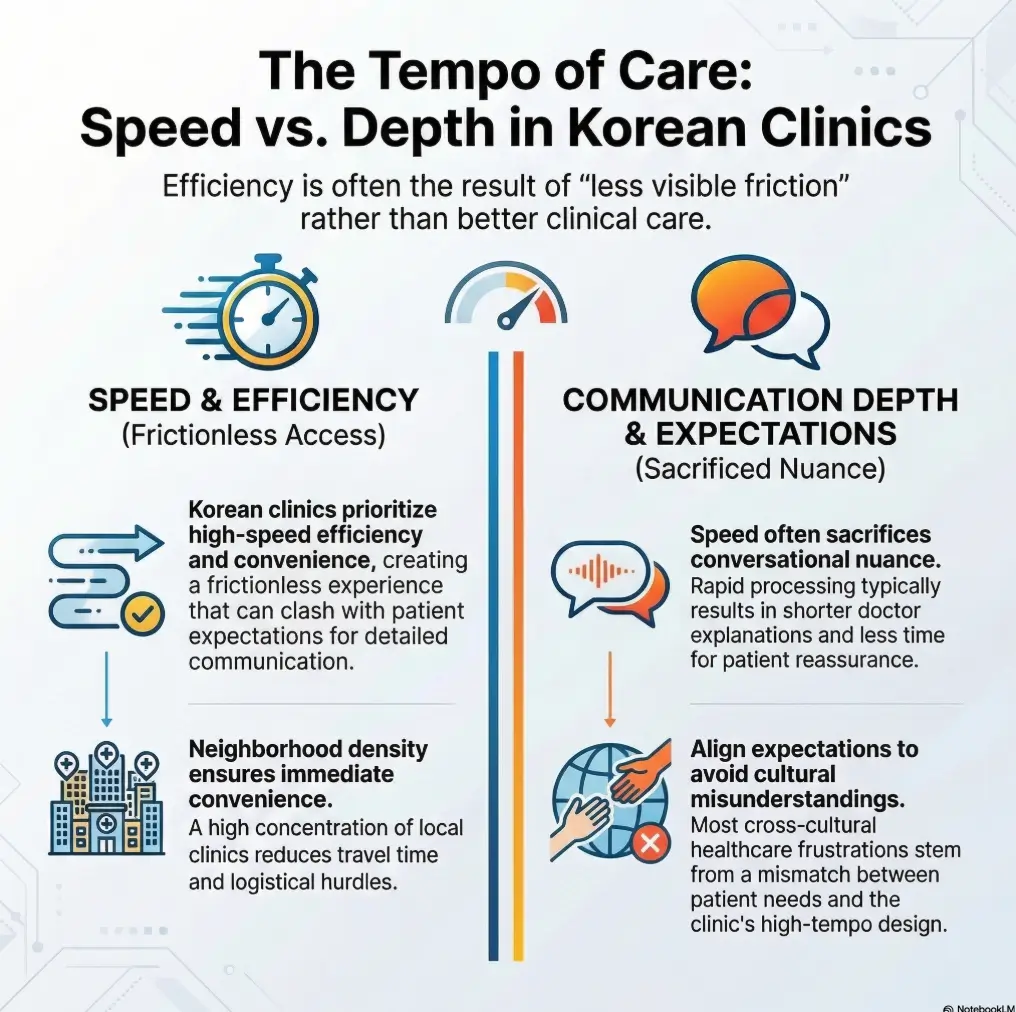
Many Americans are not startled by the equipment, the white coats, or even the cost. They are startled by the rhythm. In the US, getting care often includes a long prelude: scheduling, portal messages, insurance verification, waiting room drift, repeated forms, and the soft hum of bureaucracy warming up in the wings. In Korea, routine outpatient care can feel more like a commuter train. Doors open. People move. Decisions happen. The whole encounter is built for throughput.
I have watched first-time foreign patients come out of a Korean clinic with the same look people wear after an express elevator. They are not always unhappy. They are just slightly gravity-shifted. The question on their face is usually not “Was that bad?” It is “Was that normal?”
Why a 10-minute visit in Seoul can feel more productive than a 30-minute visit in the US
Part of the answer is simple: some of the work is being done outside your sightline. Korean outpatient care is often structured around fast recognition of common patterns, efficient prescription flow, and fewer visible barriers before you reach a clinician. For straightforward problems, that can feel brisk in a good way. The room may contain fewer conversational detours, but it may also contain less dead air.
That does not mean every short visit is excellent. It means a short visit is not automatically evidence of negligence. A five-minute haircut can be a disaster. A five-minute passport check is exactly what you want. Context is the whole orchestra.
What Americans often notice first in the waiting room, not the exam room
What US readers notice first is often not the clinical quality at all. It is the collapse of visible friction. Fewer dramatic pauses. Less ceremonial waiting. Less sense that the system must perform its own complexity before it will touch your problem. The OECD has repeatedly shown that Korea sits far above the OECD average in doctor consultation frequency, and its health-system reviews describe easier first-contact access to many specialist clinics than US patients are used to. That structural difference changes the feeling before anyone says a word.
- US patients tend to notice friction first
- Korean clinics often hide more of the process
- Speed feels dramatic when your baseline is delay
Apply in 60 seconds: When comparing systems, separate wait-time frustration from actual treatment quality.
Who This Is For / Not For
This is for US travelers, expats, students, remote workers, and curious readers comparing healthcare cultures
If you have ever gone to a Korean clinic for a sore throat, skin issue, stomach problem, minor injury, or routine concern and thought, That was unbelievably fast, this article is for you. It is also for the family member back home who hears your story and immediately assumes one of two things: either Korea has solved healthcare, or you have just been medically speed-run. Neither reflex is very useful.
This is not for diagnosing a medical issue or choosing treatment without a licensed clinician
This guide explains systems and patient experience. It does not tell you what your rash is, whether your fracture needs surgery, or whether one country’s treatment plan is right for your body. Complex symptoms, chest pain, worsening infection, breathing trouble, neurological symptoms, or anything high stakes still belong with an appropriately licensed clinician, not a blog post with a decent paragraph rhythm.
Best fit for people asking, “Why was everything so fast?” rather than “Was my care wrong?”
That distinction matters. If your real concern is quality, follow-up, a missed diagnosis, or medication safety, you need case-specific medical advice and sometimes a second opinion. If your real concern is the strange shock of moving from one healthcare culture to another, then what you need is not alarm. You need translation of the system itself.
Eligibility checklist: Is this article the right tool for your question?
- Yes: You want to understand why routine Korean clinic visits feel faster
- Yes: You are comparing patient workflow, not asking for diagnosis
- No: You need urgent medical advice or a treatment recommendation
- No: You are trying to decide whether a specific doctor made an error
Next step: If your question is clinical rather than cultural, write down symptoms, timeline, medications, and seek medical evaluation.
Speed Starts Before the Visit Even Begins
Easier access to clinics and specialists changes the whole rhythm
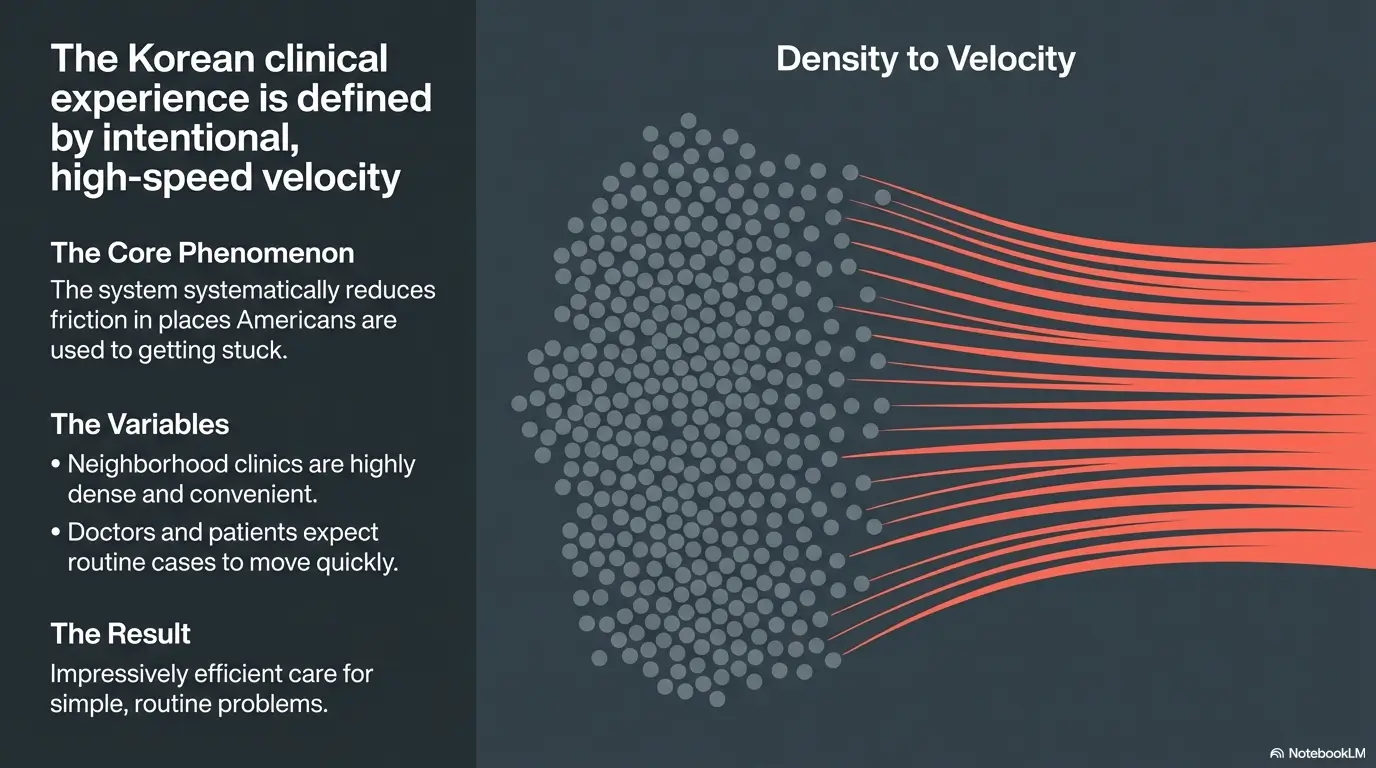
One of the biggest hidden engines of speed is access. In Korea, patients can often go directly to community specialist clinics without the same referral choreography that many Americans expect. OECD reviews of Korea describe this freer first-contact access as one reason consultation rates are high. In plain English: fewer gates change the emotional weather.
In the US, people often spend energy proving that they deserve to reach the next step. In Korea, for many routine outpatient problems, the next step may simply be nearby. That changes not only timing but posture. Patients enter the visit with less bureaucratic fatigue already burning in the background.
Walk-in culture, same-day availability, and fewer scheduling bottlenecks
Korean cities are dense with neighborhood clinics. Geography matters more than people realize. When the clinic is a short walk away, when another clinic is on the next block, and when same-day visits are more culturally normal, the system stops feeling like a formal event and starts feeling like an accessible service. A sinus infection does not need to become a project plan.
I once accompanied someone to a local clinic for what turned out to be a simple upper respiratory issue. In the US, that same problem might have invited a sequence of phone calls, a nurse triage line, an urgent care decision, and an afternoon evaporating into fluorescent suspense. In Seoul, it felt like buying a train ticket and forgetting the station was even controversial.
Why fewer gatekeeping layers can make the system feel lighter to patients
Patients do not experience systems as policy diagrams. They experience them as drag. Every referral, authorization, handoff, or portal loop adds psychological weight. Even when those steps serve legitimate purposes, they still change how care feels. Korea often feels faster because the patient is carrying fewer visible checkpoints at the front end.
Show me the nerdy details
Korea’s outpatient experience is shaped by high clinic density, easier access to many specialist settings, and a health system that historically emphasized hospital and clinic use over a strong gatekeeping primary-care model. That does not make it universally superior. It does help explain why the first-contact experience can feel much lighter.
Decision card: When Korean speed feels great vs when it can feel thin
| Situation A | Simple, common, short-duration problem | Fast flow usually feels efficient |
| Situation B | Complex history, multiple medications, language barrier | The same speed can feel too thin |
Next step: Before going in, decide whether your case is routine or nuance-heavy and behave accordingly.
Less Paper, Less Drag, Less Waiting
Front-desk friction matters more than most people realize
Patients do not always remember the exact wording of a medical explanation, but they remember the corridor. They remember whether the corridor swallowed forty minutes of life before a human being looked up. In many US settings, the front desk is where care begins to feel heavy. Insurance checks, benefit uncertainty, billing anxiety, prior authorization shadows, portal messages, duplicate forms. Every step may have a reason. The accumulation is the problem.
Korean clinics are not paperwork-free utopias. They are simply more likely, for routine encounters, to make the patient feel that administration is not the main character. That matters. A shorter visible runway makes the whole experience feel more competent even before medical quality has been tested.
Insurance flow, payment flow, and why the admin burden often feels smaller at the patient level
US readers often compare the clinical minute and forget the administrative hour around it. In early 2026, KFF polling found that insured adults in the US identified prior authorization as the single biggest burden in navigating healthcare beyond cost, outranking getting appointments, understanding bills, and finding providers who accept their insurance. That finding does not prove Korean medicine is better. It does underline something important: Americans are often arriving in the exam room already bruised by process.
That pre-bruise changes perception. A ten-minute visit after a clean intake can feel respectful. A ten-minute visit after two weeks of insurer ping-pong can feel insulting. Same number on the clock. Entirely different emotional math.
Here’s what no one tells you… the visit often feels faster because fewer steps are visible to you
This is one of the quietest truths in healthcare comparison. Patients often mistake visible simplicity for total simplicity. Some of the machinery still exists. It is just less theatrically staged in front of you. Korea is not magic. It is design. The reduction in visible admin creates a cleaner patient narrative: arrive, see doctor, get answer, move.
- Admin burden shapes trust before treatment begins
- US patients often carry insurance fatigue into the visit
- Front-desk design strongly affects perceived quality
Apply in 60 seconds: Ask yourself whether you are judging the doctor, the system around the doctor, or both.
Short Visits Do Not Always Mean Rushed Care
High-volume medicine versus low-attention medicine
These are not the same thing, though people often talk as if they are twins wearing each other’s coats. High-volume medicine means the system is optimized to move many patients through common problems efficiently. Low-attention medicine means your needs were not meaningfully engaged. Sometimes those overlap. Often they do not.
A clinician who sees the same routine upper-respiratory complaints, seasonal allergies, uncomplicated dermatitis, or minor gastrointestinal issues many times a day may move with a kind of practiced compression. The conversation is shorter because the pattern is familiar. To the patient, that can feel either wonderfully efficient or oddly abrupt. Both reactions are understandable.
Why efficient pattern recognition can make simple cases move quickly
Experienced clinicians build mental shortcuts that are not laziness. They are expertise. The challenge is that good expertise can look, from the outside, suspiciously similar to impatience. It is the old problem of mastery. The concert pianist moves with such economy that the amateur mistakes it for ease. The cost of speed was paid long before you arrived.
This is especially true for low-complexity visits. If your symptoms are classic, your history is short, and the management plan is standard, a brief encounter can be medically adequate. A lot of Western patients are not objecting to the clinical logic. They are objecting to the lack of verbal cushioning around it.
The tradeoff: speed can feel reassuring or abrupt depending on what you needed
If you wanted diagnosis and a workable prescription, fast can feel merciful. If you wanted explanation, education, reassurance, options, shared decision-making, and careful discussion of uncertainty, the same speed may feel like being gently pushed off a moving walkway. Neither response is irrational. They are responses to different needs.
Mini calculator: Was the speed itself the problem?
Score your visit in three areas from 0 to 2:
- Did the doctor understand the core symptom? (0-2)
- Did you leave with a clear next step? (0-2)
- Did you understand when to return or escalate? (0-2)
Output: A score of 5 or 6 suggests the visit may have been brief but still clinically usable. A score of 3 or below suggests the problem may be understanding, safety, or follow-up rather than speed alone.
Next step: If your score is low, write down what was missing and bring it to the follow-up.
The Cultural Script Is Different, Too
In Korea, many patients expect directness, quick turnover, and clear next steps
Healthcare systems do not float above culture. They inherit its manners. In Korea, many routine clinic encounters operate on a script of directness and efficiency. Patients may expect brisk interaction, practical recommendations, and less conversational padding. The visit is often treated less like a relational performance and more like a service exchange with clinical authority at the center.
That is not a moral defect. It is a social script. And scripts matter because they determine what counts as a “good” visit in the patient imagination before the doctor even enters the room.
In the US, many patients expect explanation, discussion, and relationship-building
American patients are often trained by the system, by consumer culture, and by the language of patient-centered care to expect dialogue. Questions are part of the value proposition. Emotional validation is part of the encounter. The explanation is not frosting. It is part of what care feels like. A visit can be clinically fine and still feel thin if it fails the communication test.
I know people who would happily trade ten extra minutes for a doctor who says, “Here is why I’m not worried, here is what would change my mind, and here is what to watch tonight.” Those sentences are sometimes the difference between trust and Googling at 2:13 a.m. with one eye half-open and the other full of dread.
Let’s be honest… sometimes “better bedside manner” and “faster service” are competing goods
Not always. But often enough to matter. Time is finite. When systems optimize for throughput, they tend to reduce narrative space. When systems optimize for dialogue and documentation, they often grow slower and heavier. The art is not pretending one value should always win. The art is matching the encounter to the problem.
Useful comparison: Korean outpatient speed often prioritizes functional clarity. US patients often prioritize explanatory clarity. Those are cousins, not twins.
What Western Patients Often Misread
A brief consultation is not automatically careless
This is the first overcorrection. People assume short equals negligent. Sometimes it does. Sometimes it simply means the clinician recognized a straightforward problem and did not wrap it in ceremony. A quick visit can be competent. A slow visit can be confused. Time is a clue, not a verdict.
A warm, lengthy visit is not automatically more medically effective
This is the second overcorrection. Many of us are so hungry for attention in healthcare that we confuse feeling heard with being well managed. Those can overlap beautifully. They can also come apart. A doctor may be kind, patient, and narratively rich while still missing the essential clinical decision. Another may be brusque but right.
Why “they barely talked to me” and “they handled it fast” can both be true
This is the hardest sentence for some readers to accept because it refuses the easy villain. A Korean clinic visit can be fast, medically appropriate for a routine issue, and still emotionally unsatisfying for someone whose benchmark includes more explanation. Two truths can stand in the same room without throwing chairs.
Short Story: A US expat I knew went to a dermatology clinic in Seoul for a stubborn rash. She expected the visit to unfold like a consultation scene from a prestige drama, with history, nuance, and a small symposium on skin barriers. Instead, the doctor glanced, asked a few pointed questions, prescribed treatment, and moved on. She walked out irritated, convinced she had been dismissed.
Three days later the rash was clearly improving, which only complicated her feelings. What bothered her most was not that the treatment failed. It was that the encounter gave her no emotional runway. She later said, “I think I wanted medicine and a speech.” That sentence stayed with me because it was so honest. Many of us do want both. The system she entered was built to deliver the first one very quickly and the second one only selectively.
- Length is not a reliable proxy for quality
- Communication style affects trust more than people admit
- Routine care and complex care should not be judged by the same tempo
Apply in 60 seconds: Ask whether your disappointment came from the treatment, the communication, or the pace.
Where Korean Clinic Speed Actually Comes From
High patient volume trains systems around throughput
Korea has long stood out for high doctor consultation rates relative to many OECD countries. That matters because systems adapt to what they repeatedly do. If people use clinics often, workflows evolve around frequent, fast outpatient contact. Staff roles, room turnover, patient expectations, and physician habits all start moving to the same metronome.
Dense urban geography makes clinics more accessible and easier to compare
Seoul is not medically typical of the whole world. It is dense, mobile, and packed with choices. When patients can compare clinics with very little travel burden, competition and convenience can compress delay. You do not need to stage a moon landing to see a doctor for a simple problem. You need shoes. The same urban logic shows up in other parts of daily life too, from how neighborhood convenience stores are woven into everyday routines to the way small errands in Korea often happen with startling efficiency.
Specialist-heavy access changes what counts as a “normal” visit
In systems where specialist access is more tightly filtered, reaching specialty care feels like an achievement unlocked through paperwork. In Korea, for many outpatient issues, it can feel more ordinary. That changes the visit’s emotional framing. Ordinary services are expected to be convenient. Once something becomes everyday, the system stops decorating it with the solemnity of a cathedral.
Why routine issues move fastest while complex cases may feel different
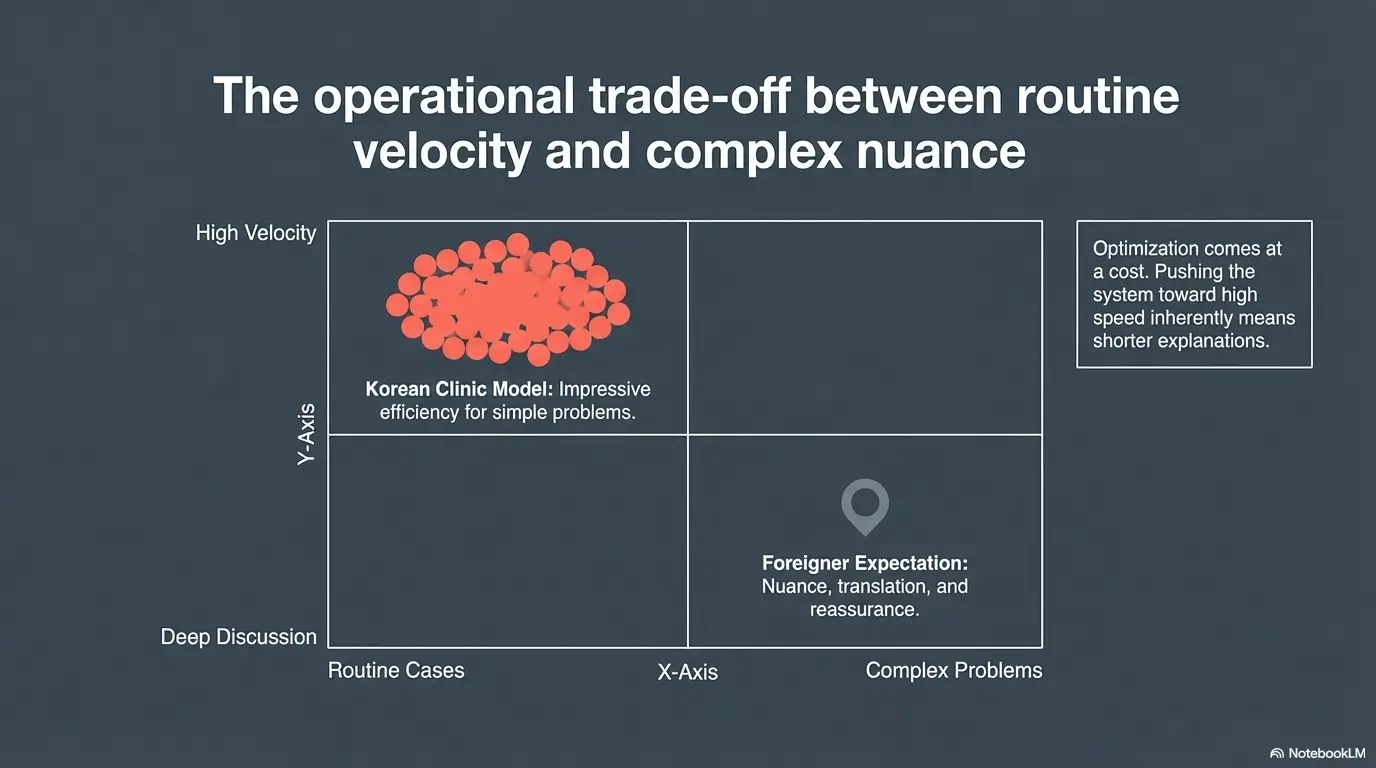
This is crucial. Korea’s speed is most legible in routine outpatient care. Once cases become complex, chronic, multi-specialty, linguistically difficult, or diagnostically murky, the advantages of raw speed can thin out. The system still functions, of course, but the clean sprint of a simple clinic visit does not automatically scale into every kind of care experience.
Coverage tier map: How speed usually changes by problem type
- Tier 1: Simple cold, mild rash, uncomplicated stomach bug. Fastest flow.
- Tier 2: Minor injury, recurring sinus issues, routine dermatology. Usually still brisk.
- Tier 3: Chronic disease follow-up with medication questions. Speed starts to vary.
- Tier 4: Multiple conditions, polypharmacy, translation needs. Communication becomes the bottleneck.
- Tier 5: Complex diagnosis, second opinions, continuity-heavy care. Speed matters less than coordination.
Next step: Judge the system by the tier of problem you actually had, not by the tier you imagined.
Infographic: Why Korean clinics can feel faster
1. Access
Fewer visible gates before you reach a clinician.
2. Density
Clinics are physically close, especially in major cities.
3. Workflow
Routine cases are handled with high-volume efficiency.
4. Expectations
Patients often expect directness more than lengthy explanation.
Don’t Romanticize It Too Quickly
Fast care can be wonderful until you need nuance, translation, or a long discussion
This is the point where many social media comparisons lose their footing. Fast outpatient care is seductive because delay is exhausting. But efficiency has a shadow side. When the problem is unusual, emotionally loaded, multi-factorial, or language-sensitive, speed can stop feeling elegant and start feeling thin. Not cruel. Just too compressed for the shape of the need.
The hidden cost of speed for foreigners: language gaps, assumptions, and missed questions
Foreigners in Korea often discover that the real bottleneck is not appointment availability but communication bandwidth. You can get into the room quickly and still leave with uncertainty because the missing piece was not access. It was translation. Medication instructions, red-flag symptoms, return precautions, duration, side effects, and the reasoning behind the plan all matter more when you are operating in a second language. This is part of a larger adjustment many visitors already notice in Korean phone call culture, KakaoTalk etiquette, and even Korean indirect communication, where brevity and context can carry more weight than many Americans expect.
The National Health Insurance Service also makes clear that eligibility rules for foreigners vary by status and duration of stay. In other words, the system is often accessible, but the experience still depends on practical logistics that locals can take for granted and visitors cannot. For readers still setting up daily life, guides on Korean phone plans for Americans and travel insurance for South Korea often matter more than they seem, because access becomes easier when the rest of your basic infrastructure is less fragile.
Here’s the pattern interrupt: efficient is not the same thing as universally patient-centered
That sentence annoys optimists and cynics equally, which usually means it is doing useful work. Patient-centered care includes understanding, autonomy, communication, safety, and follow-up, not just speed. A system can be efficient and still leave some patients undersupported. A system can be slow and still deliver better interpretive care for a complex situation. The point is not to pick a flag. The point is to match virtues to real human needs.
Show me the nerdy details
Health systems optimize different things. Korea often shines in accessibility and outpatient flow for routine problems. Systems that invest more time in discussion, documentation, and coordination may feel heavier but can serve ambiguity and chronic complexity differently. The right comparison is not national pride. It is problem-fit.
Common Mistakes Americans Make When Comparing Korean and Western Care
Mistake #1: Assuming speed means lower quality
This is the lazy conclusion. Quality depends on the problem, the clinician, the follow-up, and the outcome, not on whether you had enough time to contemplate the wall clock.
Mistake #2: Assuming slower care means incompetence or indifference
Sometimes slowness reflects staffing shortages, documentation requirements, insurance design, or continuity workflows rather than clinical apathy. The corridor may be clogged because the system is overburdened, not because the people inside are careless.
Mistake #3: Comparing urgent care, primary care, and specialty care as if they were the same experience
They are not interchangeable theater sets. A dermatologist visit, a family medicine follow-up, and an urgent care encounter are built around different expectations in every country. Comparing them as if they share one universal script is how people end up drawing giant conclusions from tiny mismatched scenes.
Mistake #4: Forgetting that pricing, staffing, and insurance design shape visit length
Time is financed. Documentation is financed. Gatekeeping is financed. Consumer expectations are financed. If you compare countries without comparing how administrative work is distributed, you are only studying the surface of the water and calling it the ocean floor.
Mistake #5: Judging the whole system from one cold, one dermatologist visit, or one bad translation moment
We all do this because personal experience is sticky. One rushed visit becomes the whole country. One magical clinic becomes proof that every hospital is heaven with fluorescent lights. Resist that urge. Anecdotes are torches, not maps.
- Compare like with like
- Separate workflow from medical quality
- Treat one visit as data, not destiny
Apply in 60 seconds: Rewrite your comparison using this format: “For a routine outpatient problem, System A felt better at X and worse at Y.”
Don’t Do This When Writing Off Either System
Do not confuse convenience with comprehensiveness
A quick visit is satisfying in the way an express checkout line is satisfying. But convenience is not the whole content of care. The right question is whether the visit matched the complexity of the problem. Convenience is a virtue, not a full theology.
Do not assume your preferred communication style is the only safe model
Some patients need detailed explanation to act safely. Others prefer concise direction and clear next steps. The danger begins when we universalize our own temperament and call it the only humane standard. That is true in medicine just as it is in navigating Korean honorifics for foreigners, personal questions in Korean etiquette, or the social logic behind common Korean apology phrases. Social comfort and communicative safety are not always built from the same script in every culture.
Do not ignore follow-up quality, test access, and continuity of care
This is where serious comparison belongs. How easy is it to return? How clearly are warning signs explained? How well are chronic conditions tracked over time? Can the patient navigate referrals, records, and medication issues? These are less glamorous questions than “Was the visit fast?” but they tell you much more about what a system feels like once the first impression wears off.
Quote-prep list: What to gather before you compare systems seriously
- Your actual visit type: urgent, primary, specialist, or follow-up
- How long access took from symptom to appointment
- Whether you understood medication, warnings, and follow-up
- What the total admin burden felt like before and after the visit
Next step: Compare the whole journey, not just the minutes in the room.
Why US Readers Keep Searching This Topic
Some are impressed by Korean efficiency
And understandably so. If you come from a system where getting care can feel like mailing a request into fog, a fast clinic visit in Korea can feel almost futuristic. It satisfies a very modern hunger: not luxury, just less friction.
Some are unsettled by how fast everything moved
That reaction matters too. People want to understand what happened to them. A quick visit can leave a residue of doubt even when the medical management was fine. Humans do not merely want to be processed. They want to know whether the processing made sense.
Some are quietly asking a harder question: what has the US system normalized that patients should not have to accept?
This is the deeper engine of the search. When Americans see a system where routine care can happen with less visible drag, they start noticing how much hassle they have mistaken for inevitability. And that is the true curiosity loop here. The question is not just why Korea feels fast. The question is why so many Western patients have been trained to treat slowness, paperwork, and access barriers as the natural price of seriousness.
Maybe the most useful lesson is not national envy. It is diagnostic humility. When another system feels startlingly efficient, it exposes which burdens at home were structural all along. The music changes and suddenly you notice how much of your old dance was compensating for the floor. For many expats, that same realization spills into broader reflections on Korean culture itself, where efficiency, density, and social rhythm often show up far beyond the clinic door.
FAQ
Why are doctor visits in Korea so fast?
Because routine outpatient care often operates with easier access, high clinic density, fast room turnover, and less visible administrative drag at the patient level. The system is built to move common problems quickly.
Are Korean clinics less thorough than US clinics?
Not automatically. For routine problems, shorter visits can still be medically appropriate. The more important question is whether the clinician understood the issue, gave a clear plan, and explained follow-up or red flags.
Can foreigners trust Korean clinics for routine care?
For many routine issues, yes, especially in urban areas with established clinics. The bigger risk for foreigners is often not access itself but language, insurance eligibility details, and whether instructions were fully understood.
Why do US doctor appointments involve so much waiting and paperwork?
Because the patient experience in the US is shaped heavily by insurance design, scheduling bottlenecks, billing complexity, documentation demands, and authorization requirements. The visit is often surrounded by more visible administrative work.
Is faster healthcare always better for patients?
No. Faster is often better for simple, time-sensitive, routine problems. It is not automatically better for complex diagnoses, chronic disease management, emotionally difficult conversations, or cases where education and shared decision-making matter heavily.
Do Korean patients expect shorter consultations?
Many do, especially for routine clinic visits. Expectations vary, but directness and quick turnover are more normalized than they are in many US patient encounters.
Why can you see specialists more quickly in Korea?
One major reason is that access to many specialist clinics is less tightly gated than US patients may expect. That changes both speed and the overall feel of the system.
What should Americans bring to a Korean clinic visit?
Bring your passport or ID if needed, insurance details if applicable, a list of medications, any known allergies, and a short written summary of your main symptom, timeline, and top three questions. Written notes become extra valuable when the visit is brisk. For some readers, even a compact language aid like a Korean digital nomads phrasebook can help when the appointment moves faster than expected.
Are language barriers a bigger problem than visit length in Korea?
For many foreigners, yes. A fast visit can still be successful if you understand the plan. A longer visit can still fail if key instructions are lost in translation.
What types of health problems need a slower, more detailed consultation?
Complex or recurring symptoms, chronic disease management, mental health concerns, medication interactions, second opinions, unexplained pain, and anything with diagnostic uncertainty usually benefit from more time and clearer communication.
Next Step
Before your next clinic visit abroad, write down your top 3 questions, your medications, and the one symptom detail you do not want to forget
That small act closes the loop we opened at the beginning. The bewildering speed of a Korean clinic is not always a warning sign. Often, it is a system showing you what routine care looks like when friction is stripped away. But once speed is no longer shocking, your real job begins: making sure clarity survives the compression.
In the next 15 minutes, make a one-screen clinic note on your phone with three items only: your main symptom and timeline, current medications, and the single question you most need answered. If the visit moves quickly, that note becomes your anchor. If the visit moves slowly, it still sharpens the conversation. Either way, you stop being a passenger in the tempo.
Last reviewed: 2026-03.